
Our readers keep the lights on and my morning glass full of iced black tea. As an Amazon Associate, I earn from qualifying purchases.
Specs are compiled from manufacturer listings and verified buyer reviews and can change over time — please confirm the key details on the product page before buying.
If your manual says 10W-50 and nothing else, you already know the problem: most shelves are stacked with 10W-40 and 15W-50, and the few true 10W-50 jugs sell out fast. This guide covers the grade that actually holds its thickness when your engine case hits full heat, and it separates the wet-clutch-certified formulas from the ones that just say “motorcycle” on the label.
I’m Min — the founder and writer behind Gadgets Feed. This guide is built by comparing the manufacturers’ published specifications and the patterns across verified customer reviews, so you get each pick’s real strengths and trade-offs instead of marketing spin.
You will see which jugs carry a real wet-clutch rating, which ones stretch the drain interval, and how much oil you actually get per bottle. Every pick below is a genuine SAE 10W-50, so you can shop the 10w50 engine oil tier with confidence.
Our Picks at a Glance
How To Choose The Best 10W-50 Engine Oil
Buying 10W-50 is mostly about matching your owner’s manual, then choosing how hard you want the oil to work between changes. The grade comes in two halves: the “10W” (the winter number, which tells you how thin the oil flows on a cold start) and the “50” (the hot number, which tells you how thick it stays once the engine is at full running temperature). Get the grade right and the rest is base stock, certifications, and how much you get in the jug.
Wet Clutch Certification Is Not Optional
If your bike shares one oil supply between the engine and the clutch, you need a JASO MA or JASO MA2 rating. That certification means the oil has the right amount of friction to let the clutch plates bite instead of sliding. A car oil with friction modifiers can make a wet clutch slip under hard acceleration, which is why the certification line matters more than the brand name on the front of the bottle.
Base Stock: Semi-Synthetic vs Full Synthetic
Semi-synthetic (sometimes called Technosynthese or synthetic blend) mixes mineral and synthetic base stocks, which keeps cost down while resisting heat better than straight mineral oil. Full synthetic goes further: it resists shear (the mechanical thinning that happens as gears chew the oil) and holds its viscosity grade longer between changes. Ester technology is the additive package borrowed from racing formulas, and it helps the oil cling to metal instead of draining away.
How Much Oil You Actually Need
A single-liter bottle covers one small-bore fill; a gallon or 4-liter jug covers one or two full changes on a bigger engine. Sports bikes with an integrated gearbox often take more oil than the same displacement car engine, so check your manual’s capacity before ordering. Two-packs of single liters are handy for topping off, while a 4-liter jug suits riders who want one order to cover a full service.
Quick Comparison
| Model | Best For | Viscosity Grade | Certifications | Volume | Amazon |
|---|---|---|---|---|---|
| Motul 5100 4T 10W-50★ Best Overall | All-round street and touring use | 10W-50 | API SP, JASO MA2 | 4 L | Amazon |
| Motul 7100 10W-50Quietest Top End | Quieting a rattly top end | 10W-50 | API SL/SH/SG, JASO MA | 1 L | Amazon |
| Maxima Pro Plus+ 10W-50 | Track and race engines | 10W-50 | JASO MA, API SL/SJ/SH/SG | 2 L (2-pack) | Amazon |
| Lucas Oil SXS 10W-50 | Side-by-sides and UTVs | 10W-50 | API SM, JASO MA5 | 1 gal | Amazon |
| Yamalube Sport Performance 10W-50 | Yamaha owners keeping it factory | 10W-50 | JASO MA | 1 gal | Amazon |
| Bel-Ray Thumper Racing 10W-50 | Motocross and enduro race bikes | 10W-50 | — | 4 L | Amazon |
| Liqui Moly Motorbike 4T Synth 10W-50 | Long-interval touring | 10W-50 | API SL, JASO MA2 | 4 L | Amazon |
In-Depth Reviews
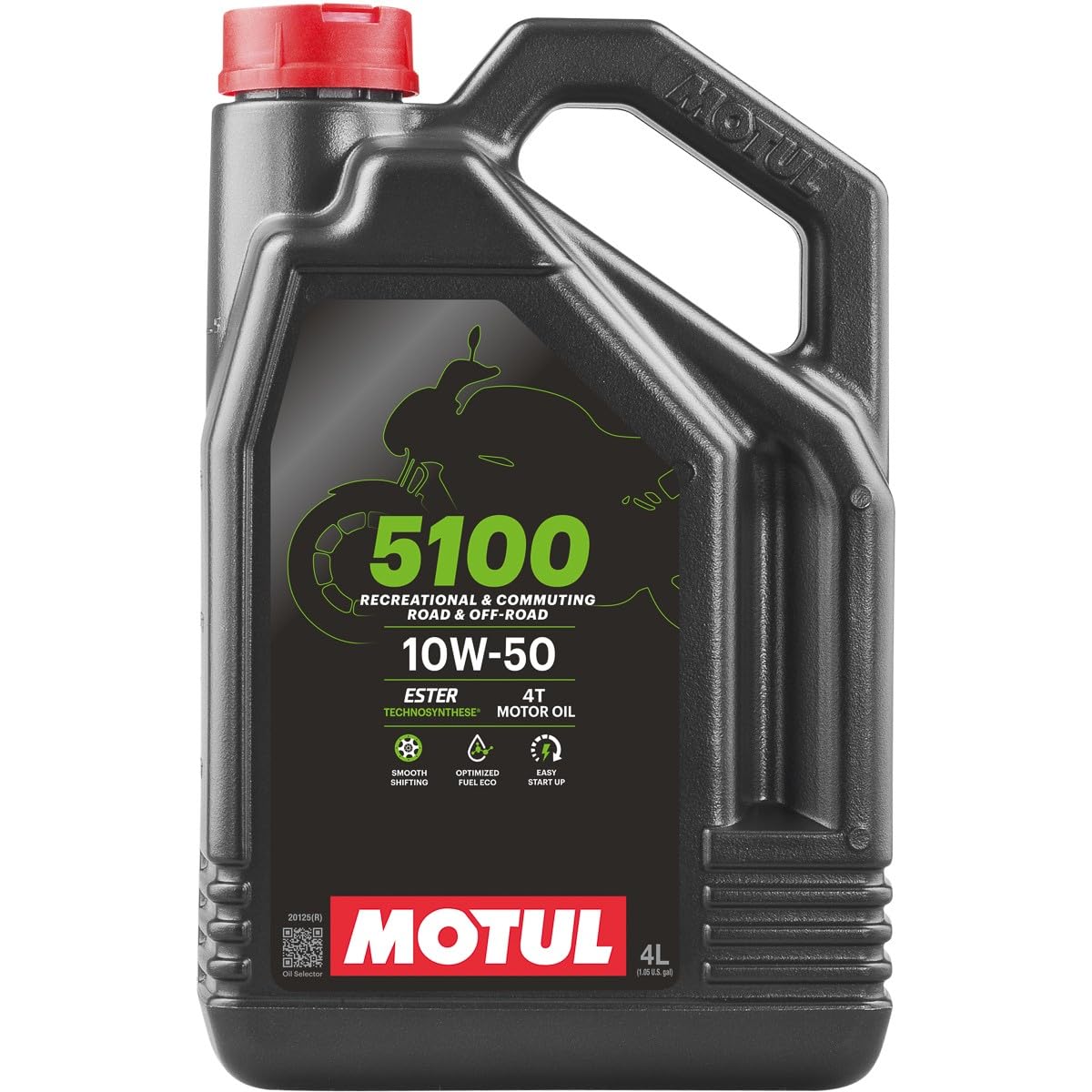
1. Motul 5100 4T 10W-50 Semi-Synthetic, 4 L
Our pick — over 4.5★ from 850+ verified ratings; the strongest balance of quality and price.
A JASO MA2 semi-synthetic blend that keeps a wet clutch biting and the gearbox quiet on the same fill.
Start with the certification, because that is what your clutch feels. This one carries JASO MA2, the friction standard that stops a wet clutch from slipping, and API SP, the rating that covers modern emission-controlled engines. The ester in the blend does real work at temperature: it holds a protective film up to 232 degrees C and flashes at 162 degrees C, with a viscosity index of 163 keeping the grade consistent as the engine heats and cools. In plain terms, it pours readily on a cold morning but stays thick enough to protect a hot gearbox on a long climb.
Pouring this is easier than you might expect for a four-liter jug — the built-in spout helps on awkward filler angles, and the smell of the additive pack is a small giveaway of how much ester is in there. Motul recommends a drain interval up to 16,000 km depending on your manual and riding conditions, so a single jug can cover a full season of street riding. The four-liter size is the practical pick for an adventure or touring bike that takes most of a gallon at once.
What owners settle on is the consistency: the oil quality is the thing people talk about most, and a 40-year rider reported it quieted their engine down, while another owner noted the viscosity held up under hard use and the drain looked new at the usual change point. A 50-year rider puts the 5100 and 7100 at the top of the list for year-round protection, quick starts and smoother shifts. The honest catch is cost: value is the one place buyers split, with plenty calling it fair for what it protects and a few noting it is on the pricey side — if you are tuned to price alone, there are cheaper grades on this list.
What It Nails
- JASO MA2 and API SP certification covers modern wet-clutch bikes and emission-controlled engines
- Ester-reinforced semi-synthetic resists shear and thermal breakdown at improve temperatures
- Drain interval up to 16,000 km depending on manufacturer guidelines
Where It Costs You
- Value is the split point — some riders find it good value, others call it pricey for a semi-synthetic
- Full-synthetic buyers may prefer a different option on this list
Made for you if: you want one jug that covers a full street, sport, adventure or touring change without chasing a smaller bottle mid-service.
Move on if: your budget is the deciding factor, since this is the one place riders openly split on value.
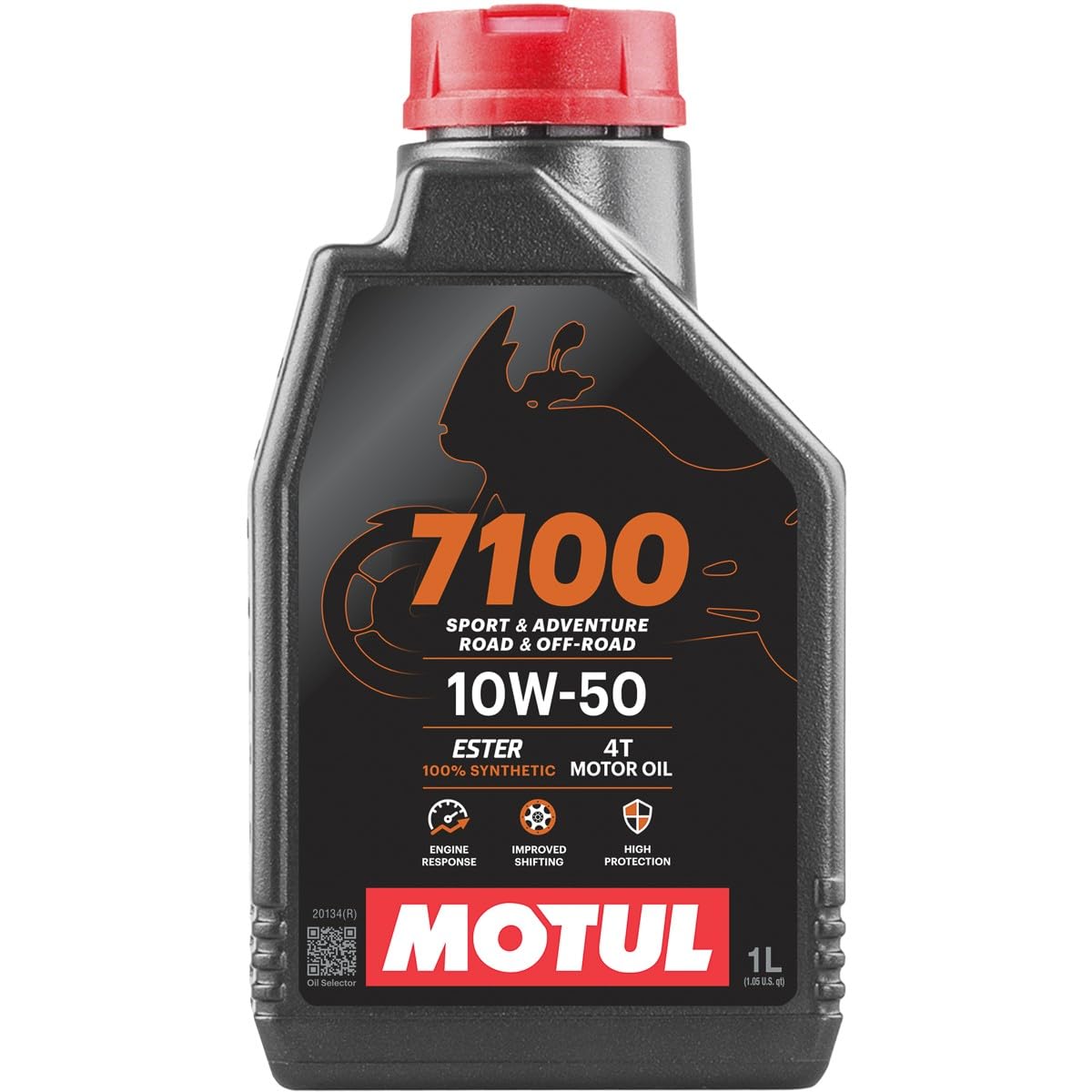
2. Motul 7100 10W-50 100% Synthetic, 1 Liter
A full-synthetic ester 10W-50 aimed at quieting top-end rattle on small-bore bikes.
If you have already heard a top-end rattle at medium-high revs, this is the option that directly targets it. One owner switched a 2023 Honda 300L Rally over at 2,700 miles after the previous oil left it noisy at mid-high RPMs, and reported the engine ran quieter on this 10W-50 synthetic — and they noted it suits a Florida climate. That is the pattern here: the full-synthetic ester base keeps the viscosity grade intact when the engine is hot, so valvetrain noise does not creep back as easily.
It meets API SL/SH/SG and JASO MA, and Motul recommends it for all 4-stroke motorcycles with catalytic converters. The low-sulfur, low-phosphorus formula is built for bikes fitted with a catalytic converter, and the proprietary extreme-pressure additive package is there to protect the gearbox rather than just the engine. Compared to the Motul 5100 above, this is a full-synthetic rather than a semi-synthetic, which is exactly the difference that matters if you want the stronger shear stability over a long interval.
There is a practical catch worth knowing before you order. This listing is for a single liter, and that caught more than one buyer off guard — several expected a multi-bottle case and were surprised by the volume. The bike sense is real though: a Triumph and Royal Enfield owner writes that it “does exactly what it’s supposed to,” a desert-climate rider noticed livelier acceleration on the very first ride, and a KTM 500 owner just wrote “works well” and moved on. Think of this as the top-off and small-bore bottle rather than the family-sized order.
Buy this bottle for: quieting a noisy top end on a small-bore bike that takes around a liter per change.
Know before you order: one liter is one liter — this is a single bottle, not a case, and a few buyers learned that the hard way.
Pick this one if: your engine has gone noisy at mid-range revs and you want a full-synthetic ester formula to settle it down.
Think twice if: your bike takes four liters at a change — you would be ordering four of these to cover one service.
3. Maxima Racing Oils Pro Plus+ 10W-50 Synthetic, 1 L (2-Pack)
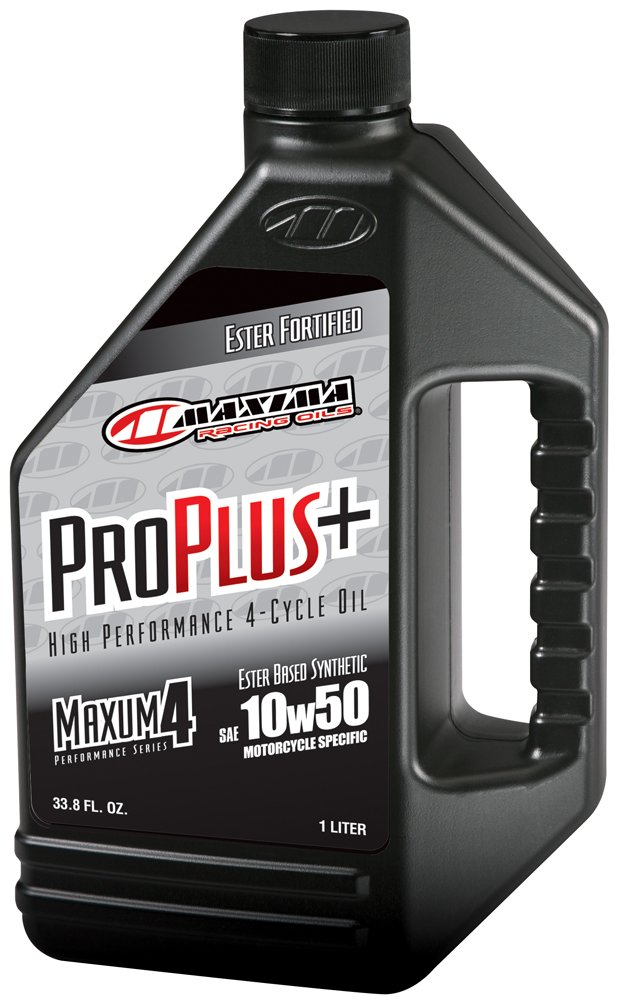
Two one-liter bottles of ester-fortified full synthetic, with riders reporting sharper throttle response.
The headline number here is the two-liter total across the two-pack, against the single liter you get in the Motul 7100 bottle above. Pro Plus+ is an ester-fortified 100% full synthetic 4T oil, built to prolong engine and wet clutch life while smoothing transmission shifts. It is formulated to exceed JASO MA requirements for four-cycle engines with integrated wet clutches, and it meets or exceeds JASO MA along with API SL/SJ/SH/SG. The anti-wear and anti-scuff additive system is balanced to minimize engine deposits while protecting the engine, transmission and clutch together — which is what you want in a shared-sump bike.
The people buying this are not casual commuters. One owner put it plainly: “I trust this in my 350XCF race bike.” Another described a jump in throttle response, power across all gears, and smoother shifting and engagement, keeping the engine cool and running well. A third noted the clutch feel improved, with smoother shifts and better modulation and bite, and someone riding a 2018 Yamaha MT09 reported noticeable improvements after the switch. This is the pick for an engine that gets worked hard and a rider who wants the clutch to stay crisp under that load.
One honest note: a few buyers mention the product image does not always match the bottle in the listing, so read the title before you commit — a rider who normally runs 10W-50 was fine, but it is worth checking the grade line first. Oil quality is the most-discussed strength here, with value a close second, so the two-pack reads as fair rather than cheap. If you want one jug rather than two bottles to pour, look at the four-liter options instead.
Why Race Riders Reach For It
- Ester-fortified 100% full synthetic formula designed to prolong engine and wet clutch life
- Formulated to exceed JASO MA requirements for integrated wet clutches
- Two-liter total across the twin bottles gives you a full change plus top-off room
The Fine Print
- The listing image does not always match the bottle — check the title and grade line
- Two separate bottles to pour rather than one large jug
Right for: track and enduro riders who run their engine hard and want the clutch to keep biting late in a session.
Wrong for: anyone shopping a large-format jug for a touring bike that takes most of a gallon at a service.
4. Lucas Oil Synthetic SAE 10W-50 SXS Engine Oil, 1 Gallon

A full gallon of 10W-50 synthetic formulated for four-stroke side-by-side and UTV engines.
Side-by-side and UTV owners get the full gallon here — 128 fluid ounces in one bottle, which covers a big-engined SXS change without a pit stop for more oil. It meets API SM and JASO MA5, and it is an all-temperature, all-weather synthetic, so it does not care whether you are starting cold or riding in heat. The SXS application is narrow by design: this is formulated for four-stroke off-road side-by-side and UTV engines, and buyers who run those machines are the ones getting the most out of it.
The owner feedback is direct and unromantic, which fits a utility fluid. A Polaris RS1 owner has run it since the machine hit 2,000 miles and added roughly 2,200 more with no oil-related issues, having always had good results from Lucas products. Another buyer summed it up with “it’s oil and it’s Lucas! What more do you want me to say?” A third noted the SXS uses it because the machine was manufacturer-recommended for 10W-50. That is what you want from a fluid: no drama, just the grade your manual specifies.
One owner did use it outside its lane — in a 2008 Ford F250 5.4 Triton with low oil pressure — and reported the oil pressure concern quieted and a 2,000-mile towing trip through Texas heat at 100 degrees F+ produced no oil consumption. That is one owner’s experience in a specific situation, not a recommendation for car use, and the truck warranted a note that the fix was temporary at 286,000 miles. It is worth saying clearly: this is really a UTV and SXS fluid, and treating it as anything else is a choice you make, not one the bottle makes for you.
How it earns its place: a full gallon of 10W-50 synthetic that meets API SM and JASO MA5, priced for utility work.
The trade-off to know: it is aimed at side-by-side and UTV engines, so sport-bike riders should look at the motorcycle-specific options instead.
Choose this if: you own a Polaris, Can-Am or similar side-by-side and want a gallon jug that matches the 10W-50 spec your manual calls out.
Skip this if: you ride a street or dirt motorcycle, where a wet-clutch motorcycle oil is the better fit.
5. Yamaha Yamalube Sport Performance 10W-50 Semi-Synthetic, 1 Gallon

Yamaha’s own semi-synthetic sport blend in a one-gallon jug, JASO MA rated for wet clutches.
If your bike came with Yamalube in it, this is the same fluid without the dealer counter. It is mixed from mineral and synthetic base stocks to handle the stress of competition engines, and it meets or exceeds the JASO MA requirements for wet clutch operation and gear protection — the certification that keeps your clutch engaging cleanly instead of slipping. The blend is designed to cut frictional losses while guarding against ring wear and piston scuffing, and it resists thermal breakdown whether you ride on road or in dirt.
For riders keeping a bike factory-spec, this is a low-risk choice. An owner running the 600-mile break-in on a 2014 Yamaha Super Tenere ES used this exact grade, noting it was the only source they could find for motorcycle-grade 10W-50 at the time, and calling out the easy-pour jug along with good product and price. Another used it for the first 600-mile service on a new MT-10 and plans to keep using it for the life of the bike. The theme from the review pages is simple: it performs like factory-new oil and the value works.
The straightforward caveat is that, as a semi-synthetic, it is not aiming at the shear stability of the full-synthetic options higher up this list. If you are chasing a longer drain interval or sustained hard riding in heat, a full-synthetic is the stronger choice. For a factory-fill-worthy, everyday gallon though, the value and performance points owners make are exactly why it sits here rather than at the bottom of the list.
Why Yamaha Owners Keep Buying It
- Meets or exceeds JASO MA requirements for wet clutch operation and gear protection
- Blended from mineral and synthetic base stocks for competition-level stress
- Resists thermal breakdown for on-road and off-road use
What to Weigh Up
- Semi-synthetic, so full-synthetic buyers get more shear stability from other picks here
- One gallon serves one big bike change, not two
Best fit: Yamaha owners who want the oil the factory put in the bike, from a gallon jug, without a dealer trip.
Look elsewhere if: you are chasing maximum drain interval on a heavily-worked engine and want a full synthetic instead.
6. Bel-Ray Thumper Racing Full Synthetic 10W-50, 4 Liter

A full-synthetic 10W-50 four-liter jug for hard-revving single-cylinder dirt engines.
This is one of the two four-liter jugs on the list, and it is built for the hard-revving single-cylinder engines that dirt riders call thumpers. It is a full synthetic in the 10W-50 grade, sold in a four-liter bottle that covers a big change with room to spare. With no wet-clutch certification line printed on the listing and only a Motor Oil type spelled out, buyers here are choosing it on reputation and results rather than a spec sheet — which is why the buyer feedback carries more weight on this one than the marketing copy.
That feedback is specific. A Husqvarna owner admits the cost is high but says it has always kept their motorcycles running strong, and another rider describes it as handling heat very well. The standout line is from a rider who ran it against two other full-ester oils: “Best 4 stroke oil hands down. Huge difference compared to Maxima Extra 4, and Motorex Cross Power. Shifts smoother and feels slick much longer than the other full esters I’ve used.” That is the exact comparison a motocross rider cares about — how it feels after hours of abuse, not how it pours fresh.
The honest trade-off is price and certification. This is one of the pricier full-synthetic jugs on the list, and there is no JASO rating spelled out on the listing, so it asks for a leap of faith on your own knowledge of the brand. Another owner said they buy it because it is what their Husqvarna 501 is recommended to use. If your frame is wet-clutch certification by the book, the Motul 5100 above gives you the printed standard instead.
The case for it: full-synthetic four-liter volume in a grade made for hard-working single-cylinder dirt engines, with buyers who ride them hard.
The catch: no wet-clutch certification is spelled out on the listing, and the price runs high — this is a trust-the-brand buy.
Own this if: you ride a husky, KTM or YZ four-stroke and want a full-synthetic jug that keeps shifts feeling new deep into the interval.
Pass over it if: you need a printed JASO MA or MA2 certification on the bottle before you buy.
7. Liqui Moly Motorbike 4T Synth 10W-50 Street Race, 4 L

A four-liter full-synthetic jug with a 446 degree F flash point and a pull-out pour neck.
This is the full-synthetic jug for riders who plan to go long between changes. It meets API SL and JASO MA2, so the wet clutch is looked after, and it is tested with catalytic converters for engine cleanliness. Liqui Moly rates it for very high shear and ageing stability — meaning the oil resists thinning as the gears chew it — with a flash point of 446 degrees F, which speaks to how it holds together at heat. Sold in a four-liter jug, that is a full service on a big bike in one order.
The buyers here tend to be deliberate about what they are putting in. A Triumph Tiger 900 owner chose this true full-synthetic over the US Group III options for the higher base-oil quality, and specifically called out the easy pull-out pour neck — a small detail that matters when you are aiming at a filler opening you cannot quite see. Another owner uses this grade across warm Central Texas, where the higher hot-viscosity number is the reason for picking 10W-50 in the first place. A KTM 1290 Super Adventure rider noted it ticks every certification and specification box their bike needs.
One rider described the change in unusually strong terms, saying it was a “scary improvement” over other motorcycle oil with enough of a torque gain to send them back to re-gearing the bike — read that as enthusiasm rather than a promise. The genuine trade-off is that this sits in the premium tier, and the more careful owners on this list treat it as a buy-on-sale fluid and simply change it more often. If cost is your first filter, the Yamalube gallon above carries the value crown instead.
The Long-Interval Argument
- API SL and JASO MA2 approvals cover wet clutch operation and modern engines
- Very high shear and ageing stability with a 446 degree F flash point
- Four-liter jug with an easy pull-out pour neck for awkward filler angles
Steady Rider Trade-offs
- Premium tier pricing, so buyers tend to wait for a sale
- One four-liter jug covers a single big-bike change
For the rider who: runs a big adventure or touring bike and wants one four-liter full-synthetic order to cover the service.
Question it if: premium pricing on a fluid you replace every few thousand miles is not a comfortable trade for you.
Understanding the Specs
The Two Numbers In 10W-50
The “10W” is the winter half: it tells you how readily the oil flows when you press the starter on a cold morning, so the pump pushes it through the engine before wear sets in. The “50” is the hot half: it is the viscosity the oil holds once the engine reaches full running temperature. That is why a 10W-50 suits warm climates and hard-working engines — it stays thick enough at heat while still behaving on a cold start. Match both halves to your manual and you are already most of the way there.
Certifications: JASO MA, MA2 and API
JASO MA and MA2 are the friction certifications that tell you an oil is safe for a wet clutch, where the engine oil also lubricates the clutch plates. MA2 is the newer, tighter version. API ratings like SL, SM and SP describe how the oil performs in engine and emissions terms. If a jug carries a JASO MA or MA2 line, the clutch side is covered; if it only lists an API rating, check your manual before pouring it into a shared-sump bike.
Ester And Base Stock
Ester is an additive and base-stock technology borrowed from racing oils, and it helps the oil cling to metal surfaces instead of draining away when the engine sits. A full-synthetic base stock resists shear and holds its grade longer than a semi-synthetic, which is why full-synthetic jugs tend to carry the longer drain intervals. Semi-synthetics blend mineral and synthetic stocks for a lower cost while still beating straight mineral oil on heat resistance. Neither is wrong — it depends on how hard you ride and how often you change the oil.
Volume And Drain Interval
Oil comes in single-liter bottles, two-packs, gallon jugs and four-liter bottles, and the right one is whichever covers your engine’s fill capacity without leaving you short mid-change. Drain interval is the distance between oil changes, and it is set by your manufacturer first and the oil’s stability second. A longer interval does not mean you can skip checking the level — it means the oil is engineered to keep its grade over that distance. Measure your fill capacity once and you will know exactly which bottle size to reorder every time.
FAQ
Can I use a 10W-50 car oil in my motorcycle?
What is the difference between 10W-40 and 10W-50?
Is semi-synthetic good enough or should I go full synthetic?
How long does 10W-50 engine oil last between changes?
Do I need JASO MA2 specifically or is JASO MA fine?
How much oil do I need for one change?
Can I mix 10W-50 with a different oil brand in an emergency?
Will 10W-50 stop my engine from making top-end noise?
Is 10W-50 suitable for a UTV or side-by-side?
Does a higher flash point actually matter for everyday riding?
Final Thoughts: The Verdict
For most riders, the 10w50 engine oil winner is the Motul 5100 4T 10W-50 because it carries both the JASO MA2 wet-clutch standard and the API SP rating, holds its grade up to a recommended 16,000 km interval, and comes as a four-liter jug that covers a full street, sport or touring change in one pour. If you want to quiet a noisy top end on a small-bore bike, grab the Motul 7100 full synthetic in the single-liter bottle. And for side-by-side and UTV duty, the Lucas Oil SXS gallon is the one to reach for. Whichever you pick, the single best move you can make is to match the grade and the wet-clutch certification to your own manual — and if you are on the fence, the JASO MA2 certification on the top pick is the kind of proof you can check on the bottle rather than take on faith.
How We Picked
We do not accept paid placement. Every pick is matched to a real buyer and a real use-case; we do not hands-on test units.
Sources & Methodology
Specifications: manufacturer listings and product documentation. Review insights: verified customer reviews, as of September 2026. Pricing: not shown on this page (it changes often); check the current price via the retailer link.
As an Amazon Associate, Gadgets Feed earns from qualifying purchases. This does not affect which products we feature.