
Our readers keep the lights on and my morning glass full of iced black tea. As an Amazon Associate, I earn from qualifying purchases.
Specs are compiled from manufacturer listings and verified buyer reviews and can change over time — please confirm the key details on the product page before buying.
The right 10×42 hunting binocular is the difference between a shot at a buck and a long walk with an empty pack. That 10x magnification pulls distant timber edges right to your eyes, and the 42mm objective lens (the big front glass) lets in enough early-morning light to work at dawn and dusk — the exact minutes when deer move. This guide sorts through the field of hunting optics, from rugged workhorses to premium glass, so you can match a pair to your terrain and your budget.
I’m Min — the founder and writer behind Gadgets Feed. This guide is built by comparing the manufacturers’ published specifications and the patterns across verified customer reviews, so you get each pick’s real strengths and trade-offs instead of marketing spin.
Field of view, eye relief, low-light brightness, and waterproofing are the specs that decide whether a pair earns a permanent spot in your hunting pack. With that in mind, here is our breakdown of the best 10×42 binoculars for hunting.
Our Picks at a Glance


How To Choose The Best 10X42 Binoculars For Hunting
Every pair of 10×42 binoculars does the same basic job, but the best ones for hunting share a few non-negotiable traits. You need glass that stays bright in low light, a body that survives rain and bumps, and controls you can work with gloves on. Here is what separates a lifetime hunting tool from a frustrating toy.
Field of view matters in thick cover
Field of view is how wide a scene you see at 1,000 yards. A wider view means you find a moving deer faster and don’t lose it when it runs. Hunting in open country lets you get away with a narrower field, but in brush or timber, a few extra feet of width can be the difference between a clear sight picture and a blur of leaves.
Eye relief for glasses wearers
Eye relief is the distance between your eye and the eyepiece where the full image is visible. If you wear glasses while hunting, you need longer eye relief — usually 15 millimeters or more — so you don’t have to squish your glasses against the rubber cups. Most modern hunting binoculars also have twist-up eyecups that let you adjust that distance quickly.
Low-light performance wins the early morning
Deer move at first light and last light, when the sun is low and the woods are dim. That is why the objective lens is 42mm — bigger front lenses gather more light. But the glass coatings matter just as much. Fully multi-coated lenses transmit more light through the system, keeping images bright and clear when a standard pair goes dark.
Quick Comparison
| Model | Best For | Field of View | Eye Relief | Coating | Amazon |
|---|---|---|---|---|---|
| Vortex Diamondback 10×42★ Best Overall | All-around hunting value | 362 feet | 15 mm | Fully Multi-Coated | Amazon |
| Nikon PROSTAFF P7 10×42Pro Optics | Upgraded Nikon optics | 367 feet | 15.7 mm | Fully multicoated | Amazon |
| ZEISS Terra ED 10×42Premium Pick | Premium low-light clarity | 330 feet | 18 mm | Multi-Coated | Amazon |
| Bushnell Powerview BoneCollector | Budget entry camo | 293 feet | 17.5 mm | Multi-Coated | Amazon |
| Athlon Forerunner 10×42 | Budget optical quality | 6.8 degrees | — | Fully Multicoated | Amazon |
| SVBONY SV202 ED 10×42 | ED glass on a budget | 6.5 degrees | 15.2 mm | Fully Multi-Coated | Amazon |
| Bushnell Engage X 10×42 | Durable clarity | 6.5 degrees | 18 mm | Fully Multi-Coated | Amazon |
| Nikon PROSTAFF P3 10×42 | Trusted brand clarity | 367 feet | 15.7 mm | Multilayer-coated | Amazon |
| Steiner Tactical 10×42 | Rugged tactical duty | 105.24 meters | — | Coated | Amazon |
In‑Depth Reviews
1. Vortex Optics Diamondback Roof Prism Binoculars 10×42
Our pick — over 4.5★ from 900+ verified ratings; the strongest balance of quality and price.
The glass that gets picked up before the rifle, hunt after hunt.
You get a bright, durable view that makes finding game fast, which is why the Vortex Diamondback is the workhorse of the lineup. The fully multi-coated lenses and dielectric prism coatings (special layers that boost light transmission) pull serious light, so you can spot deer at 600 yards in dim woods without eye fatigue, according to owners who call it “clear glass, easy focus.” Its 362-foot field of view is wider than the Bushnell Powerview’s 293 feet, so you scan a visibly larger slice of the treeline between glasses.
The build is where Vortex wins over long days. The short hinge design with rubber armor and thumb indents gives you a secure, non-slip grip, while the multi-position eyecups twist up for adjustable eye relief at 15 millimeters. Argon purging keeps the inside dry and fog-free in extreme weather — a real comfort when you’re parked on a cold ridge before sunrise.
Quality is the single trait owners praise most, and there’s a reason this pair regularly beats glass costing two to three times as much in side-by-side comparisons. The lifetime no-fault warranty backs it all up, meaning Vortex repairs or replaces them no matter what happens in the field. For most hunters, this is the one to buy first and the one that stays in the truck.
Why it wins the ridge
- Wide 362-ft field of view for fast target acquisition
- Dielectric, fully multi-coated lenses for low-light brightness
- Argon purged and rubber armored for rough weather
- Lifetime no-fault warranty
Honest trade-offs
- Soft edges and slight fish-bowl effect when panning
- Best for hand-held scanning, not tripod use
Grab these if: you want one rugged, bright pair that handles everything from deer stands to birding without excuses.
Think twice if: you plan to spend hours glassing from a fixed tripod — the edge softness shows there.
2. Nikon PROSTAFF P7 10×42 Binocular
Flagship Nikon brightness that punches far above its price class.
You get lifelike color and edge-to-edge clarity that owners say rivals much pricier Nikon glass, thanks to the P7’s dielectric high-reflective multilayer prism coating and phase-correction coated roof prisms (coatings that align light waves for sharper images). One owner even noted the view was “almost identical” to their big 50mm set — a serious compliment for a 42mm hunting binocular.
The field of view here is a generous 367 feet, matching the P3 and leading the pack on width. The rubber-armored, fiberglass-reinforced polycarbonate body keeps it lightweight and non-slip, and the locking diopter ring protects your focus setting when you’re crawling through brush — a small detail that prevents a maddening mid-hunt re-adjust. Long eye relief at 15.7 millimeters keeps the full view intact for glasses wearers.
Owners single out lens quality most, and the oil- and water-repellent coatings make cleaning fast after a muddy morning. This is the step-up pick for hunters who want a visible brightness upgrade over budget glass without jumping to premium territory — the P7 is the flagship of the line, and it feels like it in your hands.
Brightness leader: Dielectric prism coatings deliver the maximum light transmission in the PROSTAFF line — the low-light edge hunters want.
Steady by design: The locking diopter keeps your settings locked when the terrain gets rough.
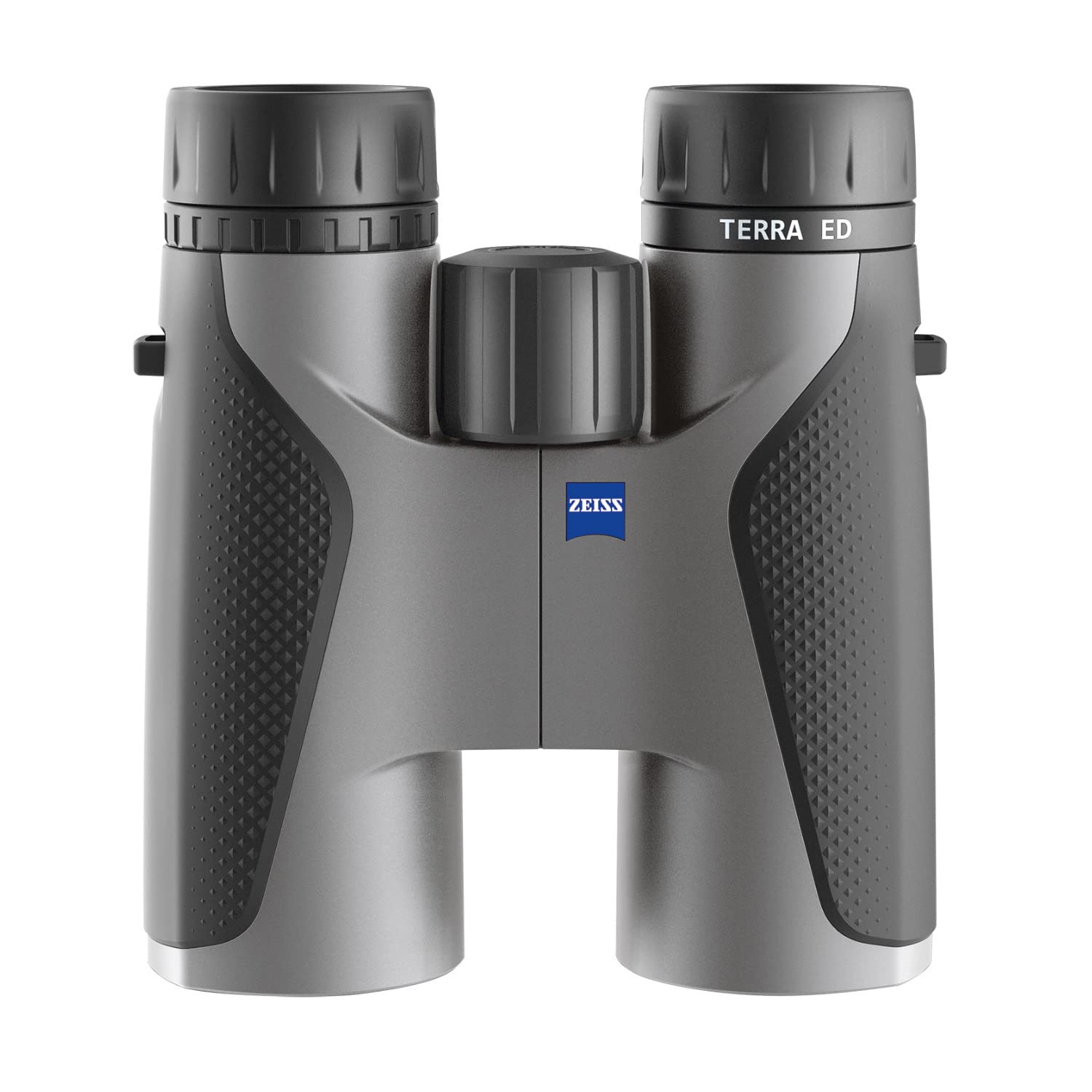
3. ZEISS Terra ED Binoculars 10×42
Zeiss-level depth and clarity that makes distant ridges feel close.
You get a view owners call “crisp” with “outstanding depth of field,” which is why Zeiss is a name hunters trust. The 88% light transmission comes from Schmidt-Pechan ED glass (extra-low dispersion glass that reduces color fringing) with a hydrophobic multi-coating — plain English: the lenses pull in light efficiently, resist water beading, and keep colors accurate even in flat twilight conditions.
The fast focusing is a genuine hunting advantage. The large, easy-to-grip focus wheel sits right under your index finger, so when a buck steps out, you can snap from near to far without hunting for the knob. At 18 millimeters, the eye relief is among the longest in this lineup, making it comfortable for glasses wearers.
The fiberglass-reinforced casing is waterproof and built to shrug off the bumps of a long pack-in. Clarity is the trait owners mention most, and the weight stays light enough for all-day carry. This is the premium pick for hunters who want that last 10% of image depth without stepping into ultra-high-end territory — a pair you’ll hand down, not replace.
Clarity king: The 88% light transmission and ED glass deliver sharp, high-contrast views in adverse light.
Moment-ready: The fingertip focus wheel makes fast target acquisition feel easy.
4. Nikon PROSTAFF P3 10×42 Binocular

crisp Nikon optics that disappear into your pack until needed.
Nikon’s PROSTAFF P3 builds its reputation on clarity that extends edge-to-edge, and owners consistently praise the “very clear, sharp, crisp” view. The large 42mm objective lenses gather abundant light even at dawn or dusk, while the silver-alloy prism coating delivers vivid, lifelike color across the spectrum. At 367 feet, its field of view sits at the top of this list — tied with the P7 and ahead of nearly everything else here.
The weather-ready build uses O-ring seals and nitrogen gas purging to keep fog and water out, so snow or a creek crossing won’t ruin your hunt. The fiberglass-reinforced polycarbonate body with rubber armor stays lightweight and non-slip, and the turn-and-slide eyecups give you 15.7 millimeters of eye relief whether you wear glasses or not.
Quality is the most-praised trait here, and the size makes it a favorite for travel hunters who pack light. Owners even report seeing more stars in the night sky with the P3 — a small sign of just how much light these lenses collect. For a dependable, brand-trusted pair that rides in a backpack all season, this is a hard pick to beat.
What stands out
- 367-ft field of view — the widest in this lineup
- Waterproof, fogproof nitrogen-purged body
- Lightweight, rubber-armored grip for all-day carry
Small gripes
- The included lens covers are flimsy — many replace them
Reach for it if: you want proven Nikon image quality at a mid-range price for hunting and travel.
Look elsewhere if: flimsy lens covers would drive you nuts — budget a few dollars to upgrade them.
5. Bushnell Engage X 10x42mm Binoculars
Bushnell’s exclusive lens coating that shrugs off rain, oil, and fog.
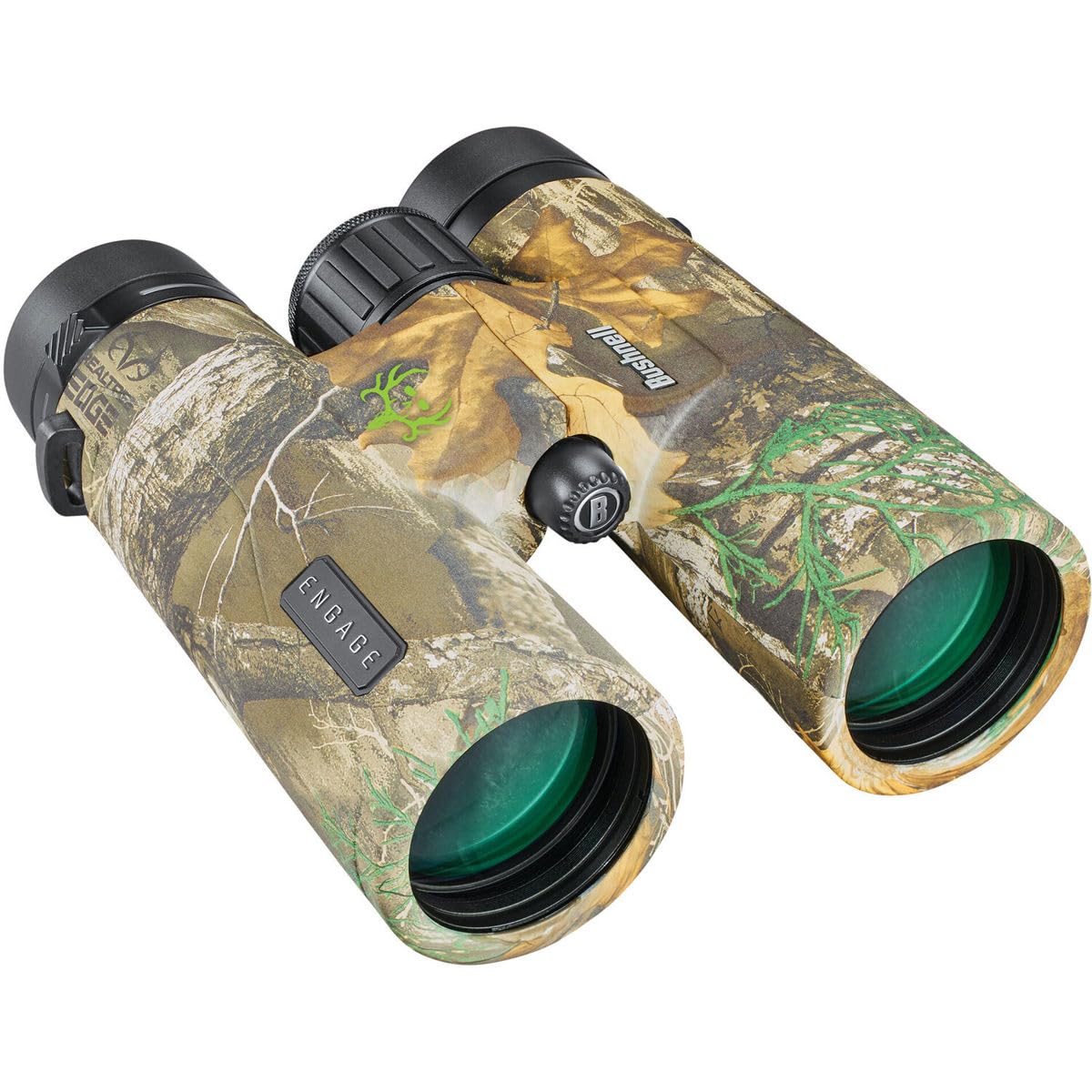
The Engage X leads with Bushnell’s EXO Barrier — a permanent exterior lens coating that repels water, oil, fog, dust, and debris. For a hunter, that means the view stays clear when it starts raining or when brush spray hits the glass. Underneath, all-glass, fully multi-coated lenses deliver brightness and clarity owners call “fantastic value,” with a bird photographer specifically praising how “lightweight” they are for long outdoor days.
At just 2 lbs, this pair is a comfortable all-day companion, and the IPX7 waterproof rating means it won’t fog up in the most crucial moments. Eye relief stretches to 18 millimeters — the longest in this lineup alongside the ZEISS — with twist-up eyecups that make it easy to dial in the view with or without glasses.
Image quality is the trait owners praise most, handily beating the other positives in frequency. The optional Realtree Bone Collector camo finish keeps it low-profile in the woods, and the full lifetime Ironclad Warranty covers it. For hunters who punish their gear, the EXO Barrier and rugged build make the Engage X a trustworthy mid-range workhorse.
Weatherproof glass: The EXO Barrier keeps water, oil, and fog off the lenses — a real edge in wet conditions.
All-day comfort: At 2 lbs with long 18-mm eye relief, it rides easy and views fast.
6. SVBONY Upgraded SV202 10×42 ED Binoculars
Extra-low dispersion glass that rivals names three times the price.
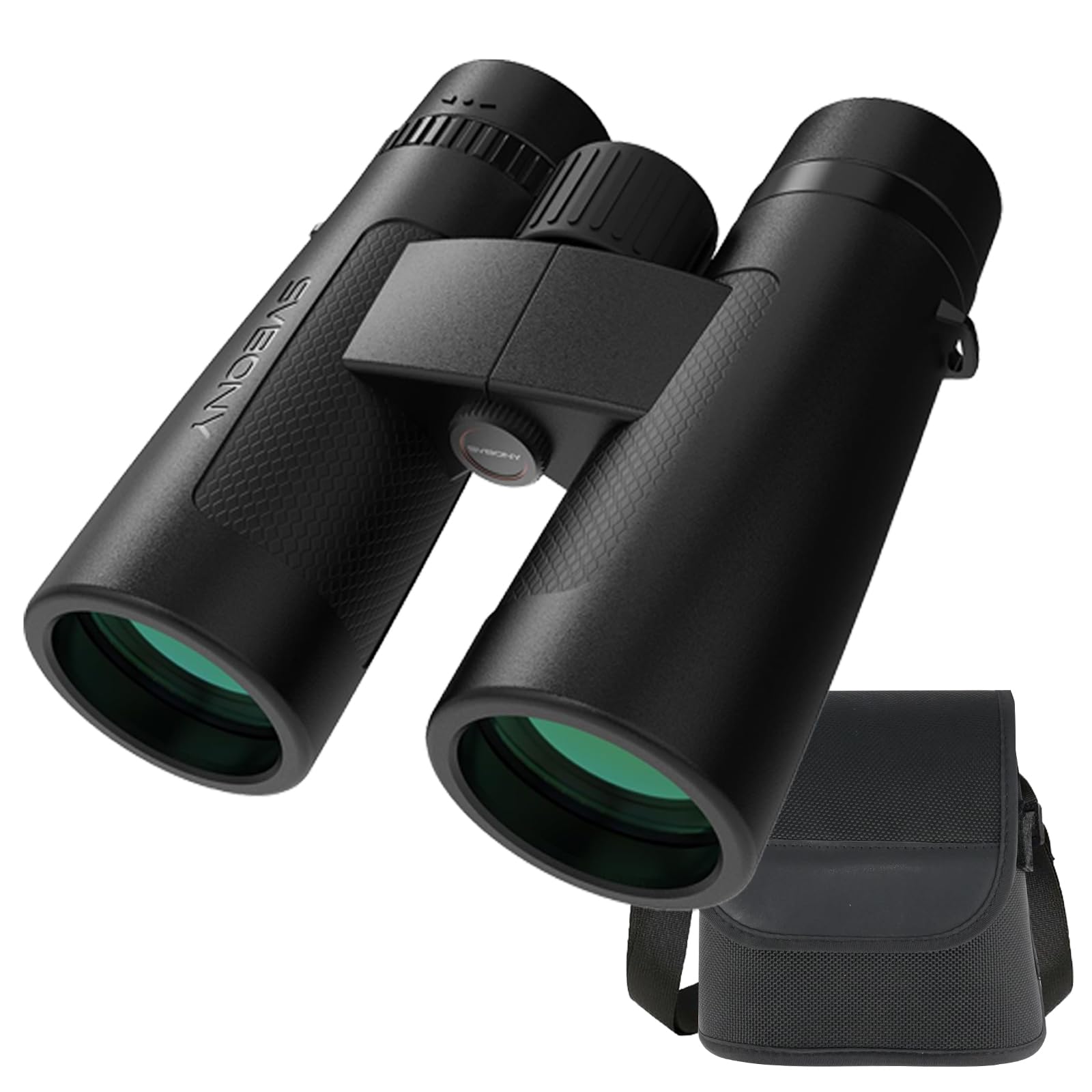
The SVBONY SV202 is the value slingshot of this list. It uses professional-grade extra-low dispersion (ED) glass, which reduces chromatic aberration — the color fringing you see around high-contrast edges — so images stay sharp and vibrant from center to edge. Owners are blunt about the result: one called it “better than Vortex Diamondbacks for half the price,” while another said it “outperforms Pentax models” and rivals -plus big-name glass. That is serious praise for a budget-tier pair.
The IPX7 waterproof rating and non-slip rubber armor make it impact-resistant for harsh field conditions, and the multi-layer coating plus phase correction technology keeps images bright at dawn and dusk — the prime hunting windows. The integrated tripod mount is a thoughtful extra for long glassing sessions, and the rotating eyecups work with or without glasses.
Owners praise optical quality most, then value for money. One catch: the listing’s stated field of view has been reported as slightly off from the actual 6.5-degree spec, so take the listed numbers with a grain of salt and trust the view through the glass. For the money, this ED pair is the smart buy for hunters who want premium-feeling optics without the premium receipt.
The value pitch
- ED glass cuts color fringing for sharp edge-to-edge views
- IPX7 waterproof and impact-resistant rubber armor
- Integrated tripod mount for steady long-range viewing
Know before you buy
- Listing field of view spec may not match actual measurement
- Younger brand without the warranty track record of the big names
Best for: hunters on a budget who want ED-glass image quality without paying premium prices.
Skip if: you want a long-established warranty you can lean on for decades.
7. Athlon Optics Forerunner 10×42 Binoculars
A budget pair with optics that punch like a mid-range model.
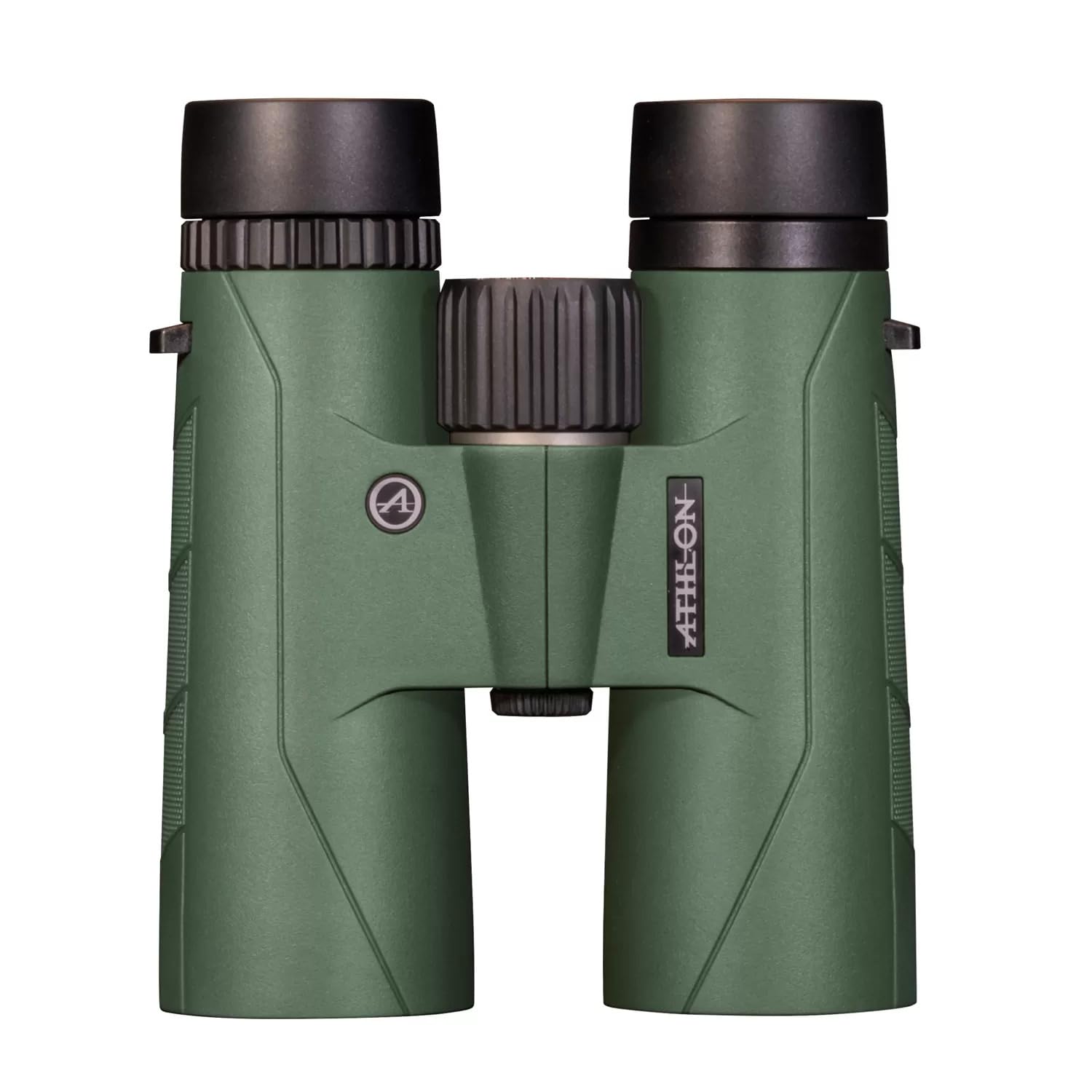
The Athlon Forerunner is one of the best “for the money” stories in budget hunting glass. It’s built with BAK4 prisms and fully multicoated glass, which delivers “exceptional light transmission” and sharp, bright images even in low light. One owner summed up the consensus: “Very good resolution for the money. All the adjustments are very well done,” noting perfect collimation and zero eye strain.
The extended eye relief is the headline feature here — designed for comfortable viewing over long periods without eye fatigue, with a close focus and twist-up eyecups. The aluminum and glass body is built to withstand rugged outdoor use while staying lightweight, and it’s fog-proof against weather. At 6.8 degrees, the field of view is respectably wide for tracking moving game.
Value for money is the single most-praised trait, followed closely by optical quality. The honest catch: at 1.5 pounds it’s on the heavier side, and one owner noted they “can’t wear them long because of their weight.” If you’re a spot-and-stalk hunter who holds them up for minutes at a time, that weight adds up. If you glass from a rest or a stand, the optics-to-dollar ratio is genuinely tough to top.
Optics per dollar: Perfect collimation and zero eye strain at a budget price point is rare.
Weight trade-off: At 1.5 lbs, long handheld sessions will tire your arms.
8. Bushnell Powerview 10×42 BoneCollector Binoculars

A camo-clad entry point with the longest eye relief in this lineup.
The Bushnell Powerview BoneCollector is the classic budget-hunting entry, wrapped in Realtree Edge camo so it disappears against the treeline. At 17.5 millimeters, its eye relief leads this entire list — a standout for hunters who wear glasses and find shorter eye relief frustrating. The diamond-cut easy-grip texture on the sides provides a secure hold even with wet or gloved hands.
The multi-coated optics draw in a solid amount of light for clear, vibrant images in low light — a capability owners put to use spotting a “may doe” during the season. The oversized focus wheel with diamond-cut grips is designed to be dialed in with precision even while wearing gloves, and the quick-adjusting twist-up eyecups allow fast target acquisition.
Quality is the most-praised trait, with value for money close behind, and the field of view comes in at 293 feet — noticeably narrower than the Vortex Diamondback’s 362 feet, so you’ll scan a smaller window. It’s also note that some owners found durability mixed with heavy real-world use. At just 5.5 inches long and 22 oz, this is the budget pick for getting started in hunting glass without a big investment.
Entry-point strengths
- 17.5-mm eye relief — longest here, great for glasses
- Glove-friendly oversized focus wheel
- Lightweight 22 oz, tripod compatible
Budget realities
- Narrower 293-ft field of view than top picks
- Durability under heavy use is mixed
Terrific first pair for: new hunters who wear glasses and want camo optics that won’t break the bank.
Move up if: you glass wide-open country all day — the narrower view will limit you.
9. Steiner Tactical Series Binoculars 10×42
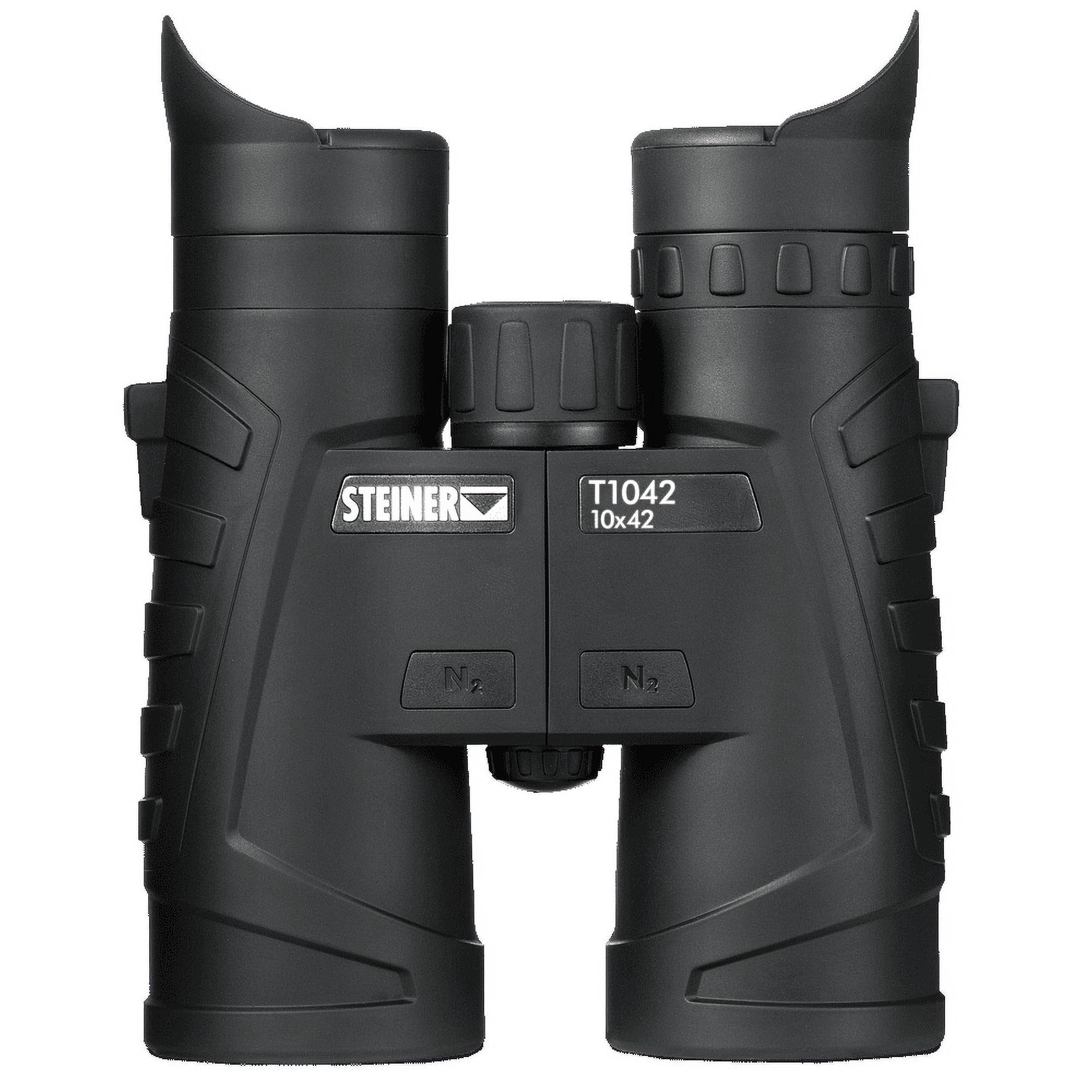
German-engineered ruggedness that never fogs when the temperature drops.
You get optics that survive hard use, which is how Steiner built its name, and the Tactical Series 10×42 delivers exactly that. The roof prism design (a compact internal prism layout) keeps these lightweight, and the high-definition optics are coated for the highest light transmission — buyers report “crisp” views with distant animals appearing “sharp and detailed,” even in the demanding conditions of the Alaskan wilderness.
The fog-proof construction is the standout feature for winter hunters. One owner noted “no fogging in extreme cold,” which is the exact scenario where cheaper glass lets you down. The center focus is smooth and precise, and the compact size fits comfortably in hand — owners say it “works just fine when hand held” at 10-power, which isn’t always easy at that magnification.
Quality is the most-praised trait, with clarity close behind. The field of view measures 105.24 meters — a solid, workable width for tactical and hunting scanning. The main quirk to know: the eyepiece lens covers can snag on the neck strap ring and potentially damage the rubber, so treat them gently. The heritage warranty stands behind the product for life, making this a rugged one-and-done purchase for demanding environments.
Built for extremes: Fog-proof performance in extreme cold is where Steiner earns its reputation.
Watch the covers: Eyepiece caps can snag on the strap ring — handle them with care.
Understanding the Specs
Field of View
Field of view tells you how wide a scene you see at a set distance, usually measured in feet at 1,000 yards or in degrees. A wider field means you find moving game faster and track it more easily through brush. For hunting in open country, a narrower field is fine; for timber and thick cover, every extra foot of width helps you catch movement before the animal disappears.
Eye Relief
Eye relief is the gap between your eye and the eyepiece where you still see the full image. If you wear glasses while hunting, look for 15 millimeters or more so you don’t have to mash your glasses against the rubber cups. Twist-up eyecups let you adjust that distance on the fly, which is why most modern hunting binoculars include them.
FAQ
What does 10×42 mean on hunting binoculars?
Why do hunters need a wide field of view?
Is a 10×42 better than an 8×42 for hunting?
What is ED glass and why does it matter?
How long do hunting binoculars last?
Can I use 10×42 binoculars with glasses?
What is the difference between multi-coated and fully multi-coated lenses?
Do hunting binoculars need to be tripod compatible?
Final Thoughts: The Verdict
For most hunters, the 10×42 binoculars for hunting winner is the Vortex Diamondback because it pairs a bright, durable fully multi-coated view with a lifetime warranty at a price that doesn’t sting — and its 362-foot field of view makes it easy to find game fast. If you want premium low-light depth and edge-to-edge clarity, step up to the Nikon PROSTAFF P7 or the ZEISS Terra ED. And if you’re hunting on a budget, the SVBONY SV202 delivers ED-glass quality that rivals pairs costing far more.
How We Picked
We do not accept paid placement. Every pick is matched to a real buyer and a real use-case; we do not hands-on test units.
Sources & Methodology
Specifications: manufacturer listings and product documentation. Review insights: verified customer reviews, as of August 2026. Pricing: not shown on this page (it changes often); check the current price via the retailer link.
As an Amazon Associate, Gadgets Feed earns from qualifying purchases. This does not affect which products we feature.