
Our readers keep the lights on and my morning glass full of iced black tea. As an Amazon Associate, I earn from qualifying purchases.
Specs are compiled from manufacturer listings and verified buyer reviews and can change over time — please confirm the key details on the product page before buying.
Here is the short answer: buy Neenah Classic Crest 110lb if you want the sheet that takes heavy marker work and die-cutting without flinching, and grab the Weyew cream box pack if you just want fifty sheets of honest 300gsm to test on your printer. Everything else in this list is a specialist — a 5×7 blank, a cherry red ream, a budget ivory stack. One warning before you scroll: this guide uses flexible matching, so every pick is 110 lb cardstock or offers it as a selectable weight, but not every sheet is the exact size, color, or count you pictured. Read each spec line before you commit.
I’m Min — the founder and writer behind Gadgets Feed. This guide is built by comparing the manufacturers’ published specifications and the patterns across verified customer reviews, so you get each pick’s real strengths and trade-offs instead of marketing spin.
The confusion starts with the label itself — “110 lb” means 110-pound cover stock, roughly 300 gsm, a sheet thick enough to hold a fold but not so thick your printer jams. Below, you will find the honest 110 lb cardstock picks, sorted by what each one actually does well.
Our Picks at a Glance


How To Choose The Best 110 Lb Cardstock
The single mistake that ruins most cardstock purchases is buying blind to your own printer. A 110 lb sheet — that is 110-pound cover stock, about 300 gsm — is heavy enough that plenty of home inkjets will balk at it. Check your printer’s supported paper weight before you order anything below.
Cover weight versus index weight — the label trap
Two different sheets can both say “110 lb” and feel nothing alike. Cover stock at 110 lb runs around 300 gsm and is the thick, foldable card material you want for card bases. Index stock at 110 lb is thinner and papery. The picks here are cover stock, or list 110 lb as a selectable option, so you get the foldable version.
Letter size versus 5 x 7 — pick your format first
Most of this list is standard letter size at 8.5 x 11 inches, which you cut down or score yourself. Reskid is the exception: 100 sheets already trimmed to 5 x 7, the size greeting cards come in. That saves you a trim step but limits you to small formats.
Finish, brightness, and how ink behaves
A smooth finish is what lets stamped lines stay crisp and lets markers lay down even color. Brightness is the other number to watch — higher brightness means a whiter sheet and more contrast behind black ink. One pick here lists 98 brightness, another 92, and those small differences show up on printed photos and colored graphics.
Color and sheet count change the math
White and solar white sheets are the workhorses. Cream, ivory, and cherry red are for projects where the paper itself is part of the design. Count matters too — a 50-sheet pack is a trial run, a 250-sheet ream is an office or classroom supply.
Quick Comparison
| Model | Best For | Sheets | Sheet Size | Color | Amazon |
|---|---|---|---|---|---|
| Neenah 4456 Classic Crest★ Best Overall | Ink and die-cutting | 125 | 8.5 x 11 in | Solar White | Amazon |
| Springhill Cherry RedColored Bulk Pick | Colored bulk printing | 250 | 8.5 x 11 in | Cherry Red | Amazon |
| CCS Classic Crest Solar WhiteCard-Maker’s Choice | Card bases | 50 | 8.5 x 11 in | Solar White | Amazon |
| Desktop Publishing Supplies White | Business printing | 50 | 8.5 x 11 in | Bright White | Amazon |
| Goefun Ivory Cream | Folding and scoring | 100 | 8.5 x 11 in | Cream / Ivory | Amazon |
| Reskid 5 x 7 Blank | Pre-trimmed invitations | 100 | 5 x 7 in | White | Amazon |
| Staples Matte White | Office and school | 250 | 8.5 x 11 in | White | Amazon |
| Weyew Cream Box Pack | Testing thickness options | 50 | 8.5 x 11 in | Cream | Amazon |
In‑Depth Reviews
1. Neenah Paper 4456 Neenah 110lb Classic Crest Cardstock 8.5″X11″ 125 per Package
Our pick — 4.5+★ from 550+ verified ratings; the strongest balance of quality and price.
The sheet that swallows marker, survives a die cut, and still folds clean.
Start with the number that governs everything else here: 125 sheets, 110 lb cover weight, 8.5 x 11 inches, in Solar White. That is 125 sheets against the 50-sheet Weyew box pack, and it means you can build a whole batch of cards without rationing. The paper quality — the thing this sheet is known for above all — is what carries it to the top of the list.
What wins people over is how it handles ink. Alcohol markers sit on it without blooming through, and the sheet holds up to die cutting and scoring instead of tearing at the crease. Stampers report crisp impressions with no feathering. For a card maker running a couple of projects a month, that behavior is the entire point of buying cover stock at all.
The catch is cost per sheet and honest weight tolerance. This is one of the pricier picks here, and the thickness earns a split reaction — a few find it heavier than they expected, which can strain a light-duty printer. It is 8.5 x 11 only, so you are trimming and scoring yourself. Card makers rate it 4.5+ stars across 500+ reviews.
What it does best
- 110 lb cover stock that takes alcohol marker and die cutting without tearing
- 125 sheets of 8.5 x 11 in Solar White — enough for a full card batch
- Bright white surface keeps stamped lines and color work crisp
Where it asks more of you
- Premium per-sheet cost compared with the ream-size picks
- Heavier feel than some buyers anticipated — check your printer’s limit
Go here if: you make cards regularly with markers, stamps, or dies and want one sheet that handles all three.
Think twice if: your printer is a lightweight home model with no manual feed — this sheet is thick enough to push it.
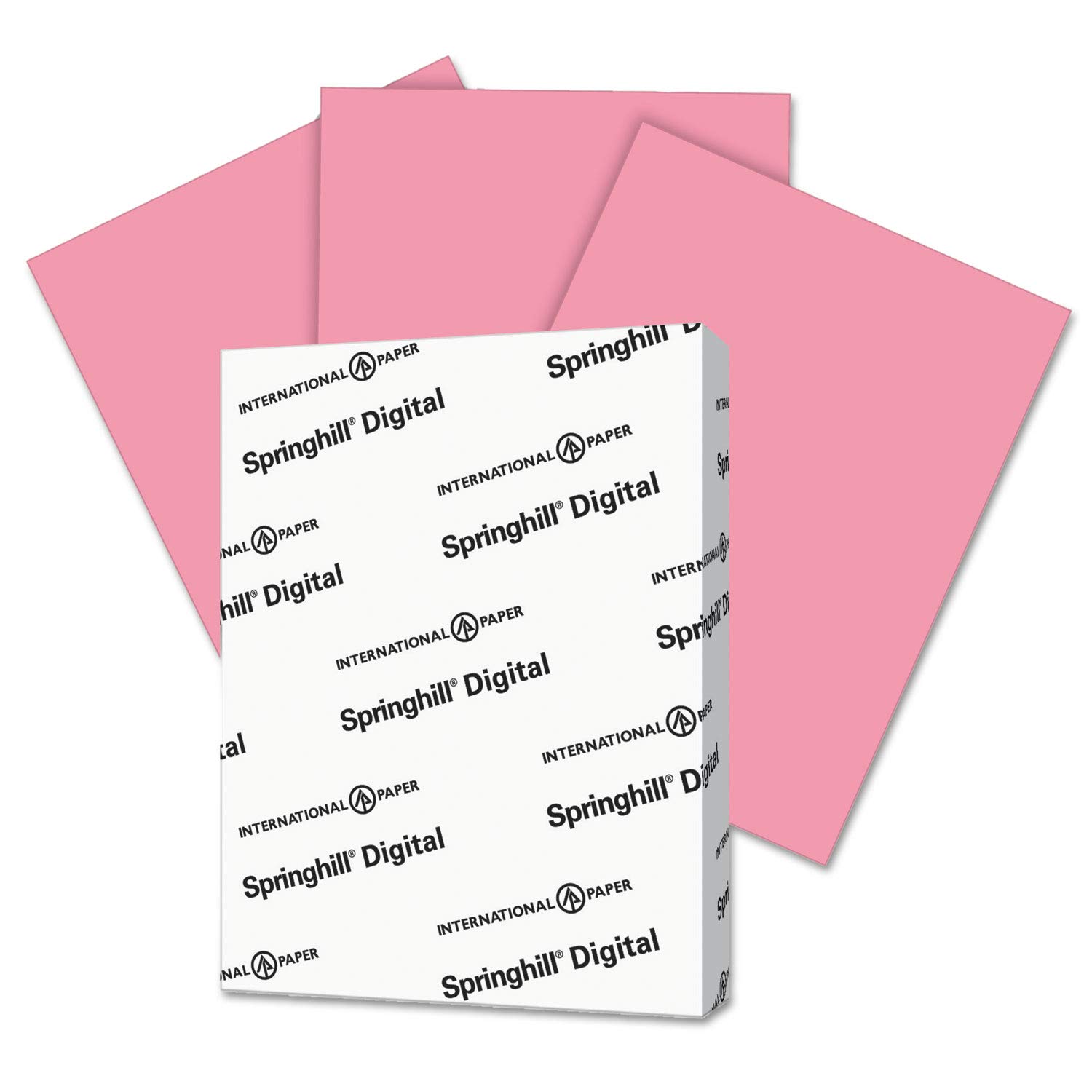
2. Springhill 8.5” x 11” Cherry Red Colored Cardstock Paper, 110lb, 199gsm, 250 Sheets (1 Ream)
A full ream of cherry red — the only colored bulk sheet on this list.
Two hundred and fifty sheets of 8.5 x 11 inch cherry red cardstock in a single ream. Nobody else here gives you that volume in color. If you print flyers, event programs, or scrapbook pages where the paper is the design, this is the pick that stops you from reordering mid-project.
The printing behavior is the real story. The maker lists quick ink-drying for bleed-free double-sided prints, plus acid-free construction so the red does not yellow with age. It also states the 110 lb index meets USPS mailing regulations — worth knowing if these sheets go into an envelope. Smooth surface, minimal show-through, and the sheet takes die cutting, stamping, and folding.
Be honest with yourself about the weight, though. The listing is 110 lb at 199 gsm, and that thinner rating compared with the 300 gsm cover stock picks here shows up in the hand. A handful of buyers also find the red carries a yellow tint rather than a pure cherry. Neither is a deal-breaker for craft and print work; both matter if you are matching an exact brand color.
Editor’s read: the volume and the color are the whole case — 250 sheets of cherry red with quick-dry printing is a genuinely useful supply for anyone running colored projects at scale.
Check the gsm: 199 gsm is lighter than the 300 gsm cover sheets here, so feel a sample before committing to a 250-sheet order.
Built for: classrooms, print shops, and anyone running colored projects by the ream.
Not the one if: you need true 300 gsm cover thickness or a pure un-tinted red.
3. CCS Classic Crest 110# Cover Solar White 8.5×11 – 50 Pack
Fifty sheets of 297 gsm solar white built for one job: the card base.
This is Classic Crest 110# cover at 297 gsm, smooth finish, solar white, 50 sheets. Same paper family as the top pick but in a smaller pack — and with one spec the Neenah 4456 does not list: 30% post-consumer recycled content. If that matters to you, this is where you get it in this lineup.
Card making is what this sheet is for, and it shows. It is thick enough to hold the shape of a folded card without sagging, and it plays nicely with Copic markers — color goes down even and stays put. Sturdiness and a vivid white base are what you are paying for, and the smooth texture means stamped detail stays sharp rather than sinking into grain.
Fifty sheets is the honest limitation. At 297 gsm you are getting a full 300 gsm-class cover sheet, but a card maker churning through holiday batches will run out faster than the 125-sheet Neenah. Total cost for the same volume runs higher too. Printing compatibility is broad — laser, inkjet, offset, copier, and digital — so the printer question is about your machine’s weight limit, not the sheet’s.
Why card makers reach for it
- 297 gsm cover weight holds a folded card’s shape
- Smooth solar white surface keeps Copic and stamp work even
- 30% post-consumer recycled content, listed on the spec sheet
- Works across laser, inkjet, offset, copier, and digital printing
What to plan around
- Only 50 sheets per pack — bulk card makers will reorder
- Higher total outlay once you scale up to match a 125-sheet pack
The right call for: card makers who want a recycled-content cover sheet and do not need a huge pack.
Size up instead if: you fold dozens of bases at a time — the 125-sheet Neenah covers the same job in greater volume.
4. Desktop Publishing Supplies White 110lb Cover (300gsm) Cardstock 8.5×11 – 50 Sheets
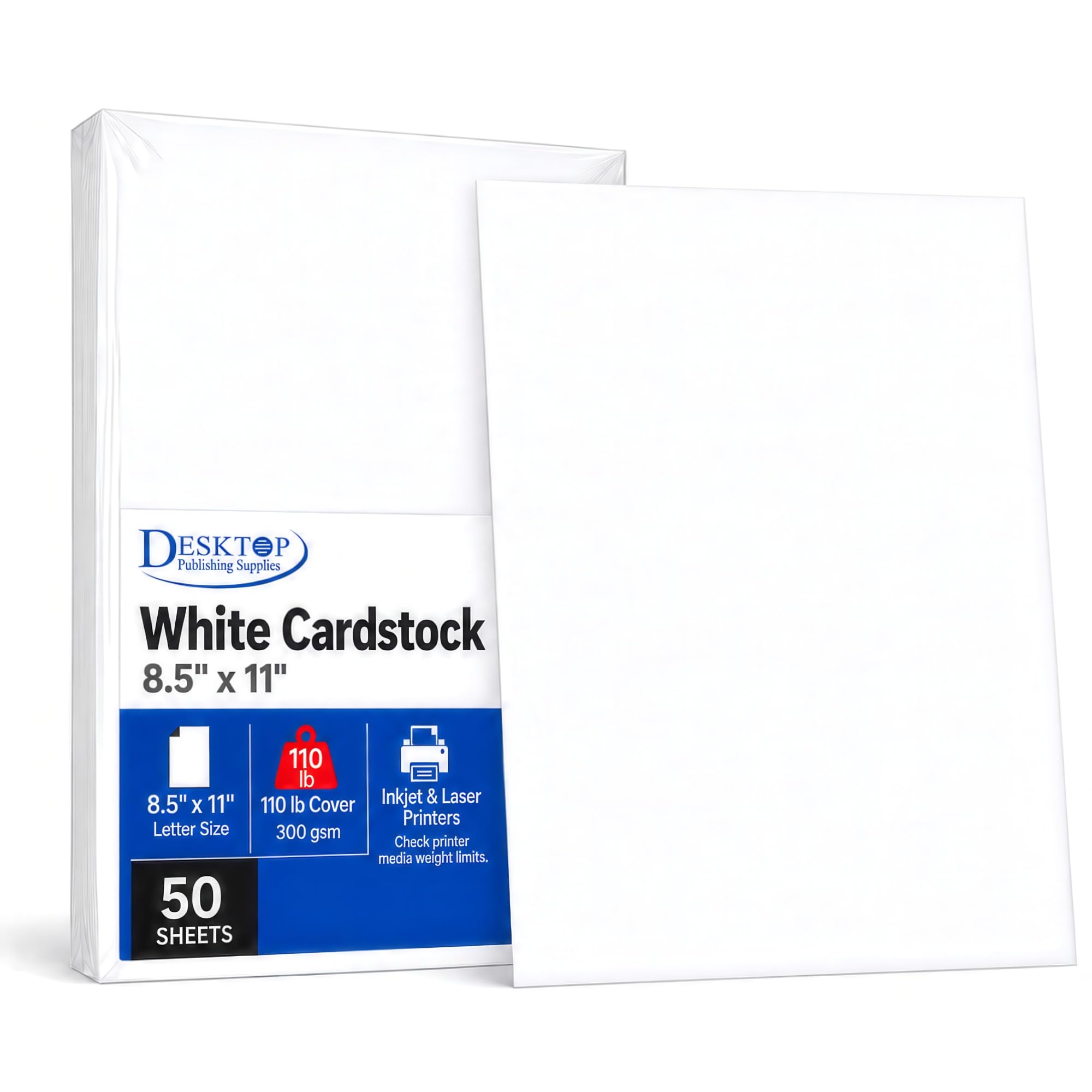
The whitest sheet here at 98 brightness — and the one most likely to jam a basic printer.
Brightness is the number to lead with: 98, the highest on this list. Behind black ink that means maximum contrast, and for color graphics it means colors pop instead of going muddy. Fifty sheets of 110 lb cover at 300 gsm, 8.5 x 11 inches, bright white with a smooth print surface, made in the USA.
The business use case is clear. Business cards, earring cards, presentation covers, menus, brochures — anything where a crisp logo and a stiff hand-feel matter. Stamping and ink blending work on it too, and the surface holds fine detail without texture breaking up the line. This is a heavy 300 gsm sheet, so treat it as a serious press-grade stock rather than casual craft paper.
Here is the warning that belongs with this pick: 110 lb cover is thick, and the maker itself notes some home printers will not feed it. You want a manual feed tray, a straight paper path, or a flat-feed printer. Pair it with a basic inkjet and you may be hand-feeding one sheet at a time or clearing jams.
The 98 brightness edge: if you print photos, color logos, or bold graphics, this sheet gives the cleanest contrast of the group.
The thickness tax: 300 gsm needs a printer that can actually take it — check your manual feed before you buy fifty.
Suits: small-business printing where bright white and a stiff, professional hand-feel sell the product.
Look elsewhere if: you only have a basic home inkjet with no straight-feed option.
5. Goefun 110lb Cream Cardstock 100 Sheets Ivory Cardstock Paper 300 GSM
One hundred ivory sheets at 14 pt — versus 50 in the Weyew box.
Pull the numbers apart and the case builds itself: 100 sheets, 110 lb at 300 gsm, 14 pt — that is 0.35 mm of thickness — in double-sided ivory, sized 8.5 x 11 inches. Compare that to the Weyew cream pack, which gives you 50 sheets in the same weight. Here you get 100 sheets instead of 50 for a modest step up in outlay, which is why this takes the cream-and-ivory slot.
What people praise most is the folding behavior. The sheet holds a sharp crease, scores without a white core showing through, and runs through embossing and a Cricut without complaint. FSC-certified paper backs that up. Fade-resistant color means your ivory stays ivory, and the double-sided finish means the back of a folded card looks as clean as the front.
The recurring gripe is printer compatibility. At 300 gsm, the maker itself tells you to confirm your printer or copier can handle it — a few buyers find print quality depends heavily on the machine. It is also cream, not white, so anyone expecting a bright base should look at the solar white picks instead.
The case for the ivory stack
- 100 sheets at 300 gsm — versus 50 in the Weyew cream pack
- Sharp fold with no white core showing when scored
- FSC-certified, fade-resistant, double-sided ivory
- Runs through embossing and a Cricut machine
The parts to weigh
- 300 gsm thickness demands a printer rated for it
- Cream tone, not a bright white base
Pick this when: you want an ivory sheet in real volume for folded cards, menus, or jewelry cards.
Skip the cream if: your design needs a white base — the solar white picks serve that better.
6. Reskid 100 Pack of White Cardstock – 5 x 7″ Blank Heavy Weight 110lb/14pt Cover Card Stock

Already cut to 5 x 7 — no trimmer, no scrap pile, no measuring.
Every other letter-size pick here makes you cut and score your own card blanks. Reskid does it for you: 100 sheets at 5 x 7 inches, 110 lb at 14 pt cover weight, smooth finish, white. That is the classic greeting-card footprint, ready to print or stamp the moment the box arrives. Put it against the Goefun’s 8.5 x 11 sheets and the trade is obvious — you give up large-format printing for a size that needs no prep.
The material earns its place. It is acid-free and lignin-free, so projects stay true over time rather than yellowing. Markers do not bleed through, gouache paint goes down well, and it runs through a printer without issues. Tim Holtz ink pads work on the smooth surface. For pin backing and other small craft mounts, the 14 pt thickness is enough to hold shape.
What you cannot do is print a full-page poster or a letter-size menu on this. It is 5 x 7 only, so big-format work needs one of the 8.5 x 11 picks. The thickness also drew a mixed note on color consistency — a stray pack here and there reads slightly off-white against a pure white reference.
Time saved, not paper saved: the 5 x 7 pre-cut format is the entire pitch — 100 blanks ready to go the moment you open the pack.
Format limits: 5 x 7 only, so keep a letter-size sheet on hand if a project needs the bigger canvas.
Made for: invitation and announcement batches where a 5 x 7 blank is the exact size you need.
Wrong fit if: your project needs an 8.5 x 11 print area.
7. Staples Cardstock Paper, 8.5×11 Inch, Matte White, 110 lb., 250/Ream

The ream you buy when quantity matters more than prestige branding.
Staples sells this as an office workhorse, and the spec sheet backs it up: 250 sheets of 8.5 x 11 matte white at 110 lb, with 92 brightness. That is the standard letter size most office and school printers and copiers take, and 250 sheets goes a long way through a semester or a quarter of business printing.
Its strengths are sprawl and print quality. Business cards, award certificates, greeting cards, report covers, and restaurant menus all fall inside its lane. Photos come out clear and vibrant on the smooth surface, and the heavy 110 lb stock stands up to repeated handling — the sort of paper that survives being passed around or filed without curling at the corners.
The honest caveat is color. The sheet is matte white but reads warm, and a few buyers report it can lean yellow or cream against a bright white reference — worth knowing if you are matching brand colors or printing alongside a truly white sheet. Weight and thickness also earn a mixed note, so feel a sample before you plan a large print run.
The volume argument: 250 sheets at 92 brightness is the simplest way to stock an office with heavyweight cardstock in one order.
Bring a color reference: this white runs slightly warm, so verify against any brand white you need to match.
Best for: offices, schools, and classrooms that print certificates, cards, and covers by the hundred.
Look past it if: you need a cool, pure white sheet for color-critical print work.
8. Weyew Cream Cardstock 8.5″ x 11″, 110 lb/ 300 gsm, 50 Sheets, Box Packed
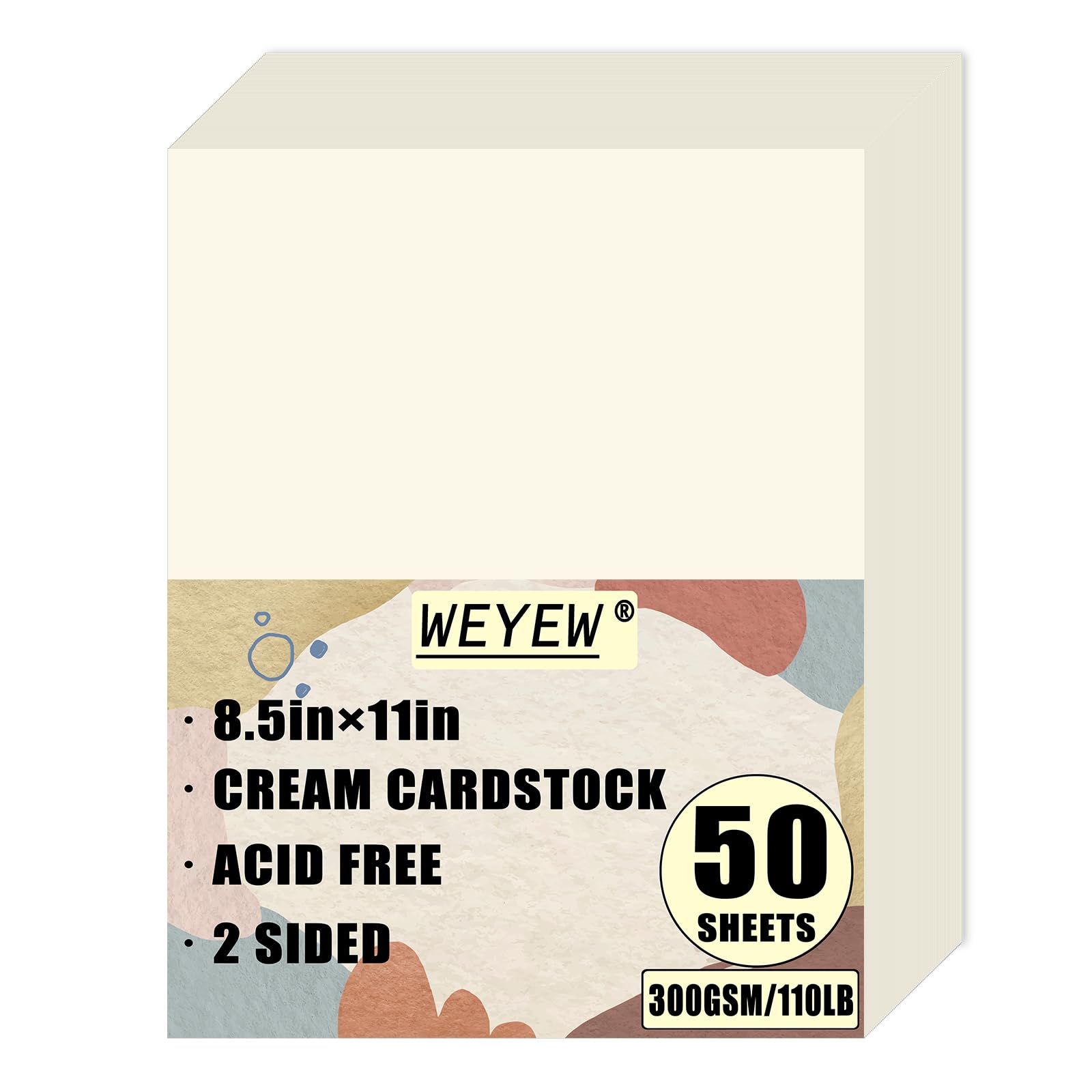
Fifty sheets in a stiff cardboard box — the smallest, safest way to test cream.
Fifty sheets, 8.5 x 11 inches, cream, 110 lb at 300 gsm, arriving in a cardboard box that protects the stack in transit. Against the Goefun’s 100-sheet ivory stack, you are buying 50 sheets to test the color and thickness first.
The color and finish are what you come for. It reads as 14 pt heavyweight off-white with a smooth surface, and it works for report covers, menus, business cards, greeting cards, brochures, calligraphy, embossing, and stamping. Laser and inkjet printing both get along with it, and the opacity hides show-through from the reverse side. The maker also offers this cream in five thickness options from 180 gsm up to 400 gsm, so if 110 lb is not the right feel you can step up or down within the same brand.
The catch is printer compatibility and the small pack. The maker flags it directly — check that your printer can take the thickness before you feed a sheet. Fifty sheets is also a limited run if you fold card bases in volume, so treat this as a sample pack rather than a supply.
What you get in the box
- 50 sheets of 300 gsm cream, 8.5 x 11 in
- Rigid cardboard box keeps corners from bending in transit
- Works on inkjet and laser, with opacity that hides show-through
- Same cream available in 180 to 400 gsm if 110 lb is not your feel
The small print
- Only 50 sheets — a sample, not a supply
- Confirm your printer handles 300 gsm before ordering
Reach for this if: you want to feel cream 300 gsm on your own printer before committing to a bigger order.
Buy the Goefun instead if: you already know you like ivory and need 100 sheets instead of 50.
Understanding the Specs
110 lb versus gsm and pt
“110 lb” is a US cover-weight label, and it translates to roughly 300 gsm — grams per square meter, a metric weight. The pt number is thickness in points, and 14 pt works out to 0.35 mm on the Goefun sheet. A higher pt means a stiffer sheet that folds cleaner but feeds harder through a printer.
Cover weight versus index weight
The same 110 lb label appears on two very different papers. Cover stock is the thick, foldable card material — what you want for card bases and business cards. Index stock at 110 lb is thinner and more papery. Check which one a listing means before you buy, or you may get a sheet that bends where you expected it to hold.
Brightness explained
Brightness is a scale for how white a sheet looks, and higher means more contrast behind ink. One pick here lists 98 brightness, another 92, and those small gaps show on printed photos and colored graphics. A 92-brightness sheet can read slightly warm next to a 98.
Printer weight limits
Your printer has a maximum paper weight it can pull. At 300 gsm, heavyweight cardstock often needs a manual feed tray or straight paper path. Check your printer’s listed supported weight before you order a ream — it is the single most common reason a heavy cardstock purchase goes badly.
FAQ
Is 110 lb cardstock the same as 300 gsm?
Will 110 lb cardstock jam my home printer?
Can I print on 110 lb cardstock with a laser printer?
Does 110 lb cardstock hold up to alcohol markers?
Is 110 lb cardstock too thick to fold for card bases?
What is the difference between 110 lb cover and 110 lb index?
Can I mail a card made from 110 lb cardstock?
Which sheet size should I buy for greeting cards?
Does heavier cardstock cost more per sheet?
Will markers or stamps bleed through 110 lb cardstock?
Final Thoughts: The Verdict
If you only want one pick and you make cards, go with the Neenah Classic Crest 110lb. It is the strongest all-rounder here — 125 sheets of Solar White cover stock that takes marker, stamp, and die cutting without tearing. Want to feel cream 300 gsm on your own printer first? Order the Weyew box pack at 50 sheets — it costs less and the box protects the stack. Running colored projects by the ream? The Springhill Cherry Red is the only 250-sheet colored option here.
How We Picked
We do not accept paid placement. Every pick is matched to a real buyer and a real use-case; we do not hands-on test units.
Sources & Methodology
Specifications: manufacturer listings and product documentation. Review insights: verified customer reviews, as of November 2026. Pricing: not shown on this page (it changes often); check the current price via the retailer link.
As an Amazon Associate, Gadgets Feed earns from qualifying purchases. This does not affect which products we feature.