
Our readers keep the lights on and my morning glass full of iced black tea. As an Amazon Associate, I earn from qualifying purchases.
Specs are compiled from manufacturer listings and verified buyer reviews and can change over time — please confirm the key details on the product page before buying.
A 110-volt plasma cutter lets you slice through steel on the same household outlet that runs your coffee maker — no 240V rewiring, no electrician visit. The catch is that not every machine claiming dual voltage actually performs on 110V, and the honest truth is that most of them cut noticeably thinner metal on a standard garage circuit than they do on 220V. The good news: a handful of dual-voltage machines in this list cut 1/4-inch steel cleanly on 110V and step up beautifully when you do have 220V available. This guide sorts them by what they actually deliver on household current, what air supply they demand, and which ones hold up after the honeymoon.
I’m Min — the founder and writer behind Gadgets Feed. This guide is built by comparing the manufacturers’ published specifications and the patterns across verified customer reviews, so you get each pick’s real strengths and trade-offs instead of marketing spin.
Every machine here runs on standard household current, but they split into two camps: 110V-first designs built for garage beginners, and dual-voltage powerhouses that shine once you feed them 220V. If you want the strongest all-around performer, the PrimeWeld CUT60 leads the pack, and it earns its spot as the best 110 plasma cutter for most buyers.
Our Picks at a Glance


How To Choose The Best 110 Plasma Cutter
Most buyers walk into this category assuming a 110V plasma cutter will cut the same thickness as a 220V unit — just slower. That’s the wrong mental model. On a standard household circuit, a dual-voltage machine typically delivers reduced amperage (the raw cutting power measured in amps) because a 110V outlet can only supply so much current before it trips the breaker. That’s why 110V capability matters most for portability and convenience — you can plug in anywhere — while serious cutting thickness still depends on access to a 220V source or a generator.
Cutting Thickness On 110V Versus 220V
Read the manufacturer’s cutting-thickness specs carefully, because they almost always list separate numbers for each voltage. A machine that claims a maximum cut on 220V will often produce a clean cut several millimeters thinner when running on 110V. If your work stays under 1/4-inch mild steel, a 110V-first machine handles it fine. If you regularly tackle 1/2-inch plate, plan on 220V or accept multiple slower passes on household current.
Air Supply Requirements
Every plasma cutter needs a compressed air supply (the air stream carries the arc and blows molten metal clear). The specs list this as PSI for pressure and CFM for airflow volume. A small pancake compressor may not keep up with a 55-amp machine cutting thick plate — the cutter will starve for air and produce dross (rough slag on the cut edge). Check the machine’s recommended PSI and CFM before you buy, and make sure your compressor can sustain it continuously.
Pilot Arc Versus Scratch Start
Pilot arc technology starts the cutting arc through a high-frequency burst of electricity, so you never have to touch the torch tip to the workpiece to get things going. That matters on painted, rusty, or dirty metal where a scratch start struggles to catch. The trade-off: pilot arc torches cost more and consume slightly more electrode life during the non-cutting arc phase, which is why adjustable pilot-arc timing exists on the better machines.
Quick Comparison
| Model | Best For | Amperage | Voltage | Weight | Amazon |
|---|---|---|---|---|---|
| PRIMEWELD CUT60★ Best Overall | Overall performance and support | 60A | 110V/220V | — | Amazon |
| GNI 55Amp PortableBest for Portability | One-hand portability | 15–55A | 120V/240V | 17.84 lb | Amazon |
| SILATU 55ABudget Champion | Budget-friendly 55A cutting | 55A | 110V/220V | 12.57 lb | Amazon |
| YESWELDER CUT-55DS | Compact garage setup | 20–55A | 110V/220V | 20.9 lb | Amazon |
| Bestarc 50A | Beginners and light DIY | 50A | 110V/220V | 20.9 lb | Amazon |
| ARCCAPTAIN 55A | Portable mid-range power | 20–55A | 120V/240V | — | Amazon |
| ARCCAPTAIN CUT55 Pro | App-connected convenience | 20–55A | 120V/240V | 19.46 lb | Amazon |
| YESWELDER 60A | High-amperage cutting | 60A | 110V/220V | — | Amazon |
| PrimeWeld CUT50D | Rugged shop workhorse | 20–50A | 110V/220V | 19.62 lb | Amazon |
In‑Depth Reviews
1. PRIMEWELD CUT60 60Amp Non-Touch Pilot Arc PT60 Torch Plasma Cutter 110V/220V Dual Voltage 3 Year Warranty
Our pick — over 4.5★ from 450+ verified ratings; the strongest balance of quality and price.
The 60-amp dual-voltage machine that cuts 1/4-inch mild steel on 220V without slowing down.
If you want one machine that handles everything from garage repairs to CNC table work, this 60-amp PRIMEWELD is the strongest overall pick here. The 60% duty cycle at 60 amps gives you six minutes of full-power cutting in every ten, so long jobs don’t stall while the torch cools. That’s a spec that directly translates to fewer forced breaks mid-cut. The continuous pilot arc lets you cut expanded metal, rusted plate, and painted surfaces without swapping tips or grinding the surface first — the arc bridges the gap on its own.
The PT60 blowback torch uses a Euro central connection (a standardized plug that lets you swap torches from other brands), so you’re not locked into proprietary consumables. A CNC port makes it straightforward to tie this into a CNC controller for automated cutting. At 20 x 11 x 19 inches, this machine takes up more bench space than the GNI portable — the GNI packs into 17.56 x 12.64 x 9.8 inches — but that larger frame houses the 60-amp power supply that the smaller units can’t match. On 220V, as buyers report, it cuts 1/8″ carbon steel easily at 60A.
The recurring gripe is the manual — the translated instructions leave a lot to be desired, and several owners wish more spare parts and accessories were listed on the manufacturer’s site. The ground lead and clamp feel thin compared to the torch side. But what wins people over is the functionality and the support: this machine performs on par with brands costing far more, and when the occasional part fails, the company warrants the full assembly rather than just the broken piece. One 4.8-star rating across 400+ owners says the crowd agrees.
What earns the top spot
- 60A output with 60% duty cycle at full amperage
- Continuous pilot arc handles rusted, painted, and expanded metal
- Euro central torch connection accepts standardized consumables
- Dedicated CNC port for automated table setups
Where it asks patience
- Manual translation is rough and hard to follow
- Ground lead and clamp are thinner than the torch side
- Larger 20 x 11 x 19 inch footprint eats bench space
- Air supply needs to stay clean and dry — 100-120 psi supply, 55-75 psi regulated
Built for: fabricators who want one machine that handles thick plate, CNC work, and rusty salvage without swapping gear.
Think twice if: you need something you can carry one-handed between jobs — the GNI at 17.84 lb is the more portable route.
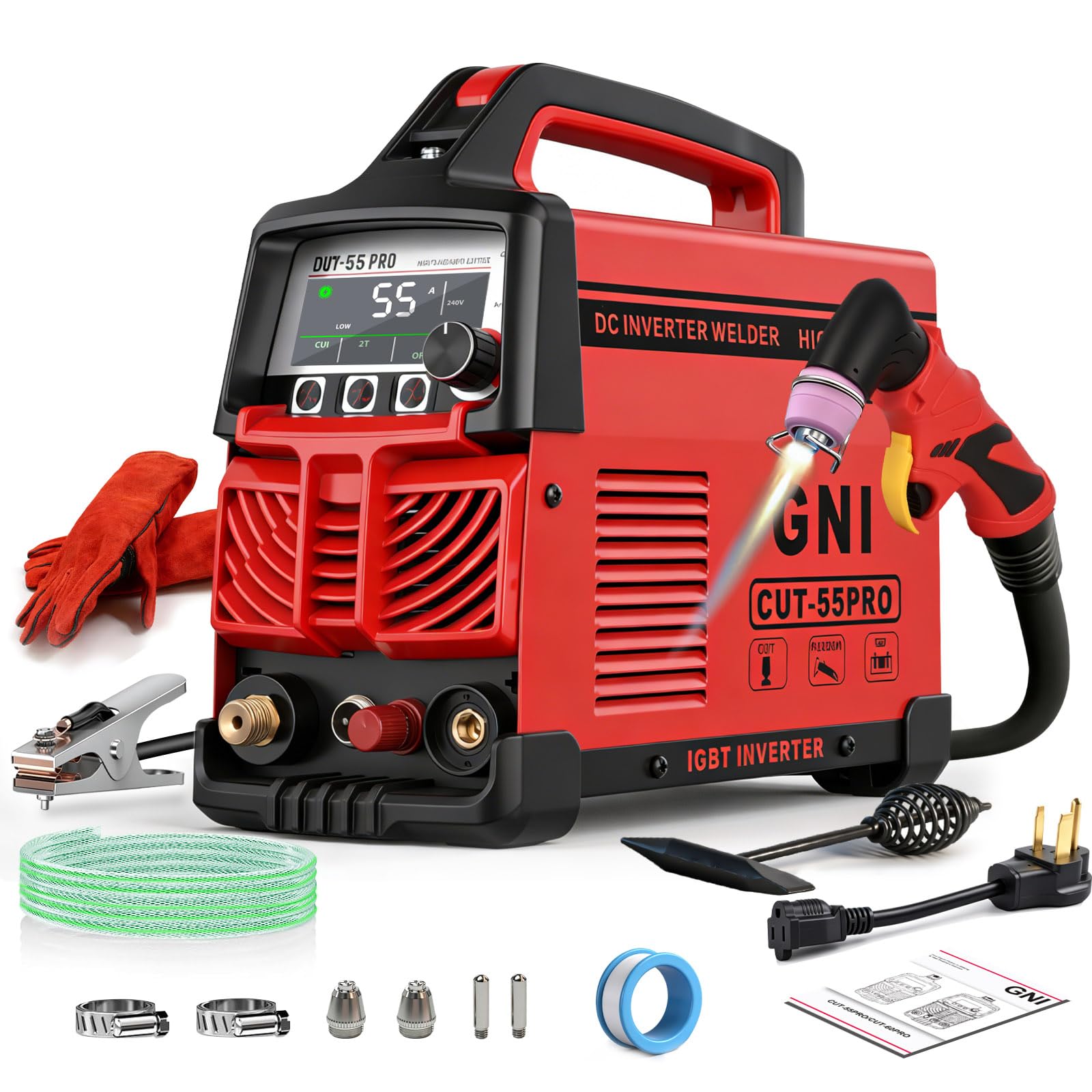
2. GNI 55Amp Portable Plasma Cutter, Non-Touch Pilot Arc Plasma Cutter Machine
The 9.51 lb cutter you can carry one-handed from garage to garden in a single trip.
For anyone who works in more than one spot — driveway one day, friend’s shop the next — this GNI’s 9.51 lb body is the whole pitch. You lift it with one hand and walk. The compact shell fits into car trunks and tight shelf gaps, and the automatic 120V/240V dual-voltage recognition means you plug in wherever you land without flipping a switch or worrying about which outlet you’re standing near. The 15-55A adjustable current lets you dial down for thin sheet and up for plate, and the non-touch pilot arc strikes instantly without touching the plate — which is exactly what makes it friendly to beginners.
Where the GNI stands out on paper is its feature set at this size: the 2T/4T/PA/PT function cluster gives you one-touch switching between rapid cutting and continuous operation, and the PA (pilot arc) timing adjusts from 2-15 seconds so you can stretch it for mesh work or shorten it to save electrodes. The pre-installed air filter and pressure regulator mean you’re cutting within minutes of unboxing, and the LED display shows voltage, current, and air pressure in real time — including fault codes when something’s off. It came with a cutting glove, chip hammer, and two sets of tips and electrodes right in the box.
The trade-off is real-world cutting depth on household current. As owners mention, it achieves 2/5″ (10mm) clean cuts at 120V/35A and 1/2″ (12mm) clean cuts at 240V/55A. That means on a standard 110V garage outlet, you’re looking at roughly 10mm of clean cutting — plenty for sheet metal, exhaust work, and light fabrication, but not a 3/4-inch plate monster. The maximum thicknesses push to 3/5″ (15mm) at 120V and 4/5″ (20mm) at 240V. There’s also a recurring note that it really prefers 220V for serious work. For a compact, feature-dense machine aimed at home and DIY use, that’s a fair and honest limitation.
The portability play: 17.84 lb in the shipping package and 9.51 lb stripped down, with a shell that slides into a trunk — the machine you’ll actually drag out for a five-minute cut.
The honest ceiling: you get full 55A power only on 240V, so plan your household-current projects around the 10mm clean-cut figure.
Reach for this if: you want a feature-loaded 55A machine you can carry in one hand and plug into any outlet without thinking.
Look elsewhere if: your work lives in 1/2-inch plate and up — you need the PRIMEWELD CUT60’s 60 amps on 220V for that.
3. SILATU 55A Plasma Cutter, Non-Touch Pilot Arc, 110V/220V, 2/3″ Max Cut
A lightweight 55-amp cutter that surprises buyers with how cleanly it handles 1/4-inch steel on 220V.
At just 12.57 lb, this SILATU is one of the lightest 55-amp machines here — noticeable when you’re lugging it across a job site. The non-touch pilot arc means you can start a cut on rusty, painted, or uneven metal without grinding first, and the adjustable PA function lets you customize pilot arc duration: longer settings for expanded metal and mesh, shorter settings for standard plate to minimize electrode wear. The built-in air sensor shows real-time air pressure on the digital screen, and the manual regulator lets you fine-tune it — recommended pressure is 70 PSI at a flow rate of 250 liters per minute. Note that you’ll need a compressor; it’s sold separately.
The PT/2T/4T function cluster works the same way as the other machines here: post-time adjusts from 3-15 seconds to cool the torch head and extend consumable life, with 4-8 seconds generally recommended. The 2T mode requires continuous trigger pressure, while 4T mode lets you release the trigger after starting for more comfortable long cuts. The digital display shows air pressure, voltage, and current in real time, and it flashes an error code when something’s wrong so you can troubleshoot fast. The included 10FT AG60P torch and 10FT earth clamp give you decent reach without extension cords.
Most owners find this machine cuts well above its price class. One recurring theme: on 220V at max settings, it cuts 1/4-inch steel so fast you’ll want to slow your hand down. A few note that the instructions are poor — that’s a consistent gripe on budget machines — and one owner points out that the short power cord limits where you can set up. Denser steel demands your full attention; this isn’t a push-and-drag machine on thick plate. But what wins people over is the value proposition: clean 1/4-inch cuts on 220V for a fraction of mainstream pricing, with the pilot arc handling dirty metal that would stall a cheaper scratch-start unit.
What it does with ease: 1/4-inch steel on 220V, rusty and painted surfaces without prep, and mesh metal with a longer PA setting.
The catch: the manual is thin and the power cord is short — budget for an extension and plan to learn by doing.
Ideal for: hobby welders and DIYers who want real 55A cutting performance without paying premium-brand prices.
Skip if: you need a long power cord from day one or documented instructions you can follow step by step.
4. YESWELDER CUT-55DS 55A Pilot Arc Plasma Cutter, 110/220V, Non-Touch Pilot Arc

The small-frame 55-amp cutter with a genuinely wide cutting range — 19/64″ clean on 110V, 25/64″ clean on 220V.
Buyers who need a machine that fits behind a truck seat without dominating the shop will find this YESWELDER’s compact body appealing. The 20-55A current output delivers deep cutting thickness: ideal clean cuts of 19/64″ at 110V and 25/64″ at 220V, with maximum cuts of 9/16″ at 110V and 17/24″ at 220V. That’s a genuinely broad range for a machine this size, and the AG60 torch handles the work efficiently on rough, painted, and rusty surfaces thanks to the non-touch pilot arc — no scratching the tip to get started, which means better cutting quality and longer consumable life.
The PT/2T/4T function cluster gives you the standard kit: post-time cooling from 5-8 seconds recommended to extend consumable life, 2T semi-automatic control for precise cuts, and 4T automatic control for long continuous runs where your hand would otherwise cramp. The digital display puts air pressure, voltage, and current right on the front panel in real time, and the screen flashes an error code when something’s wrong so you can diagnose without disassembly. It includes the PC10-02 air connector, adapter, air compressor filter and gas hose, ground clamp, and the AG60 torch — ready to set up from the start.
The vibe across owner reports is consistent: this machine cuts cleanly at 1/8-inch mild steel, 16-gauge cold-rolled, 1/4-inch hot-rolled, 1/2-inch mild, 1/8-inch aluminum, and 1/4-inch stainless, and long-term users have put it through months of weekly work with zero issues. But there’s a real durability question — reports of a unit blowing out after a short cutting session exist, and Amazon’s own review data flags functionality, quality, and cut performance as mixed. One owner notes that after three years of use, cut quality degraded and the machine struggled above 1/8-inch. The head-scratcher is that a replacement unit reportedly worked fine, which points to a rare quality-control slip rather than a design flaw. Either way, keep your receipts.
What this machine gets right
- Wide 20-55A range with detailed cut-thickness specs for both voltages
- Compact frame that fits behind a truck seat
- AG60 torch handles rough, painted, and rusty surfaces
- Includes air filter, gas hose, ground clamp, and adapter
Where owners hit friction
- Durability reports are mixed — keep your receipt and warranty handy
- Air filter fitting can be glued tight and hard to remove
- Residential plugs may need an adapter not included in the box
- Cut quality can taper after extended use above 1/8-inch
Fits the buyer who: wants a small-footprint machine with a broad cutting range and plans to use it for occasional garage work.
Consider the alternative if: you need proven long-term durability — the PRIMEWELD CUT60’s 3-year warranty backs that concern better.
5. Bestarc 50A Pilot Arc Plasma Cutter, 110/220V, LED Display, Air Sensor
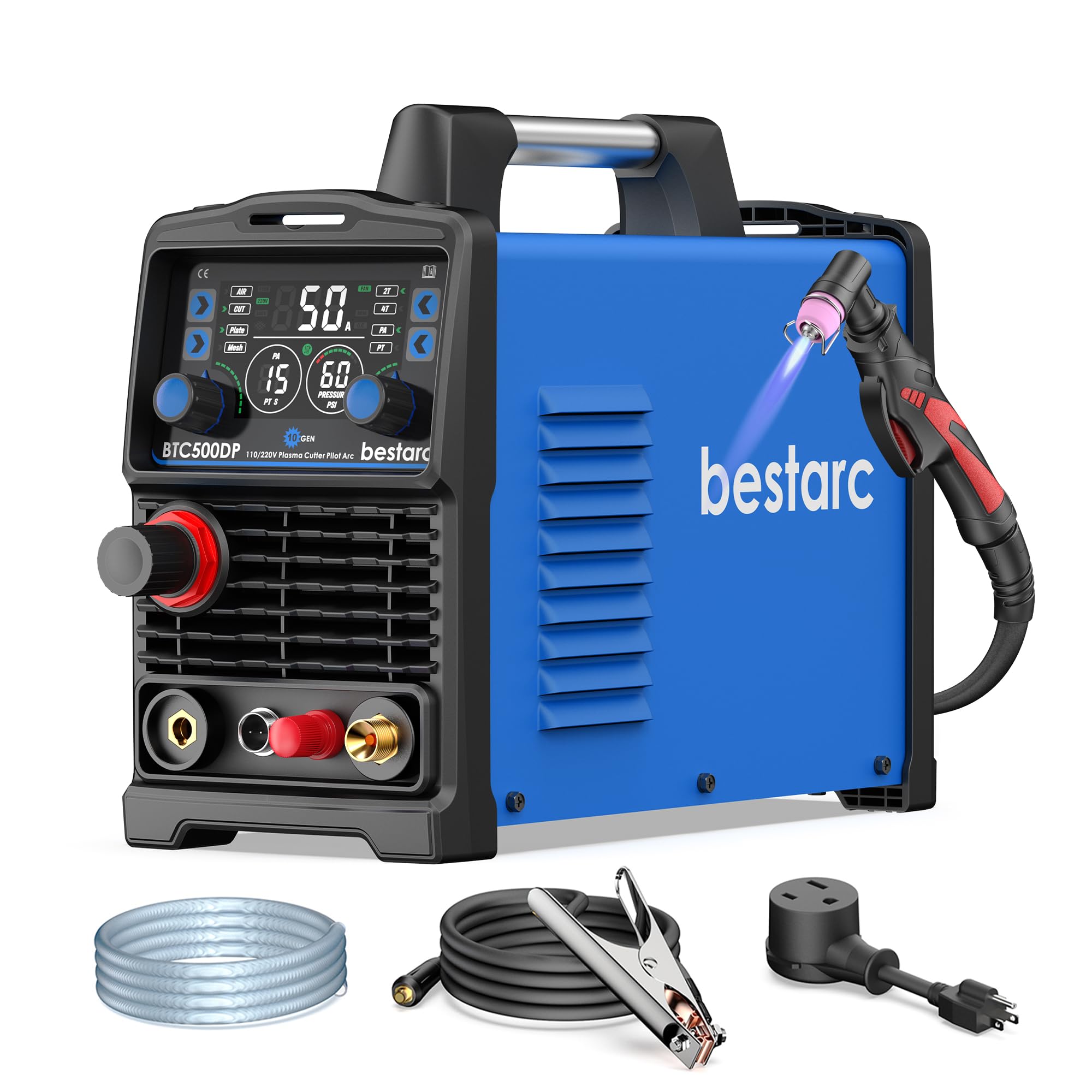
A 50-amp dual-voltage cutter with pilot arc starting that has you cutting within an hour of unboxing.
If you’ve never owned a plasma cutter, the appeal of this Bestarc is that you’re cutting metal the day it arrives. It runs on dual voltage 110/220V, so it’s at home in garages, workshops, and hardware stores alike, and it cuts Iron, Steel, aluminum, and copper with Inverter IGBT technology (a power-regulation design that keeps the arc stable). The cutting-thickness specs lay it out clearly: maximum 1/2″ at 35A on 110V at 50 PSI, or 2/3″ at 50A on 220V at 65 PSI. The air sensor built into the machine displays air pressure on the front panel, and an air filter plus quick-connect 1/4 NPT air connector make setup fast. You’ll need to buy the compressor separately.
The pilot arc is a high-frequency non-touch starting mode, which means the torch head doesn’t need to touch the metal plate — effective on rusted, painted, or dirty surfaces. The adjustable PA function extends pilot arc duration for mesh cutting or shortens it to reduce electrode burn and extend consumable life. The 2T/4T/PA/PT cluster covers the essentials: post-time adjusts from 3-15 seconds to cool the torch head, with 4-8 seconds recommended, and 2T gives you semi-automatic cutting while 4T gives you automatic cutting that releases your finger.
The catch with this one is durability. Multiple owner reports describe the unit blowing out after an hour of use, and one long-term buyer had the machine trip a dedicated 220V/30A breaker on power-up with no response from the manufacturer. That’s a real concern for a machine in this class, and it’s worth sizing: the majority of customers note it cutting well, with the caveat that long-term reliability is unknown. The torch lead sheath also reportedly tears easily — one owner taped it up — and the power cord runs short. For a first plasma cutter used on occasional home jobs, the performance-per-dollar is genuinely there; just manage your expectations on longevity.
The beginner value: pilot arc starting, dual voltage, compact body, and a front-panel air sensor — feature set that usually costs more.
The known risk: durability is a legitimate question mark, so buy from a seller with a clear return policy.
Makes sense for: beginners who want to try plasma cutting without a big outlay and won’t run it for hours on end.
Pass if: your work is daily production — the ARCCAPTAIN CUT55 Pro’s 3-year warranty is the safer bet for regular use.
6. ARCCAPTAIN 55A Plasma Cutter Machine, Non-Touch Pilot Arc, 120V/240V
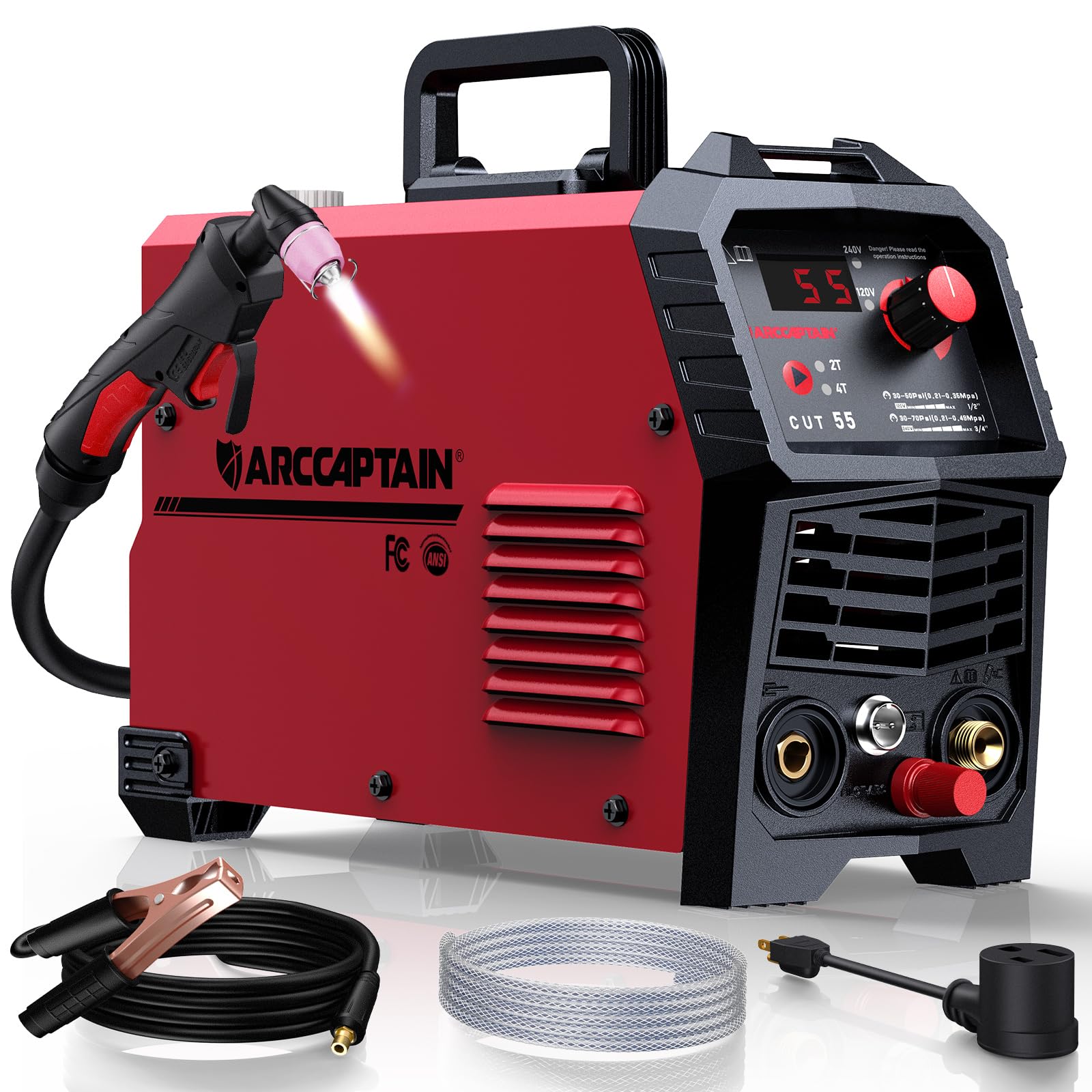
A 55-amp machine with a 60% duty cycle that lets you cut without watching the clock.
The 60% duty cycle lets this ARCCAPTAIN run at 55 amps for six minutes out of every ten, so long cutting sessions don’t stall while it cools. That’s a strong spec at this price point. The maximum cutting thickness reaches 3/4″ at 55A on 240V at 75 PSI, with a clean cut at 1/2″ at 55A on 240V at 60 PSI. The IGBT inverter technology with 50/60Hz high-frequency pilot arc gives you stable arc starting, and the machine weighs in compact with a shoulder strap included — so it travels with you.
Setup is genuinely fast: the air filter mounts at the rear for quick connection, the air pressure sensor works with the regulator, and the recommended compressor pressure is 60 PSI at 5.3 CFM. The machine even comes pre-set with default parameters — air pressure at 60 PSI and post-flow time at 5 seconds — so you only need to choose the voltage and adjust the current knob to start cutting. The 2T/4T automatic cutting function releases your finger, making it friendly for beginners. It’s certified to FCC and ANSI standards, and the current display reads 20-35A at 120V and 20-55A at 240V — an honest disclosure that household current limits your amperage ceiling.
That voltage ceiling is exactly what owners flag. One common note is that this machine works, but not well on 110V — it’s really suited to 1/4-inch material unless you have 220V, in which case it works much better all around. That’s not a defect, it’s the physics of household current: 120V caps you at 35A. The other recurring theme is quality control. A minority report a unit arriving with a bad internal ground connection and difficulty reaching support. Most owners, though, find it a good budget plasma cutter that cuts as described — and what wins them over is the build quality and the value, which lead the feedback overwhelmingly.
Where it delivers: 60% duty cycle at full amperage, 3/4″ maximum cut on 240V, and pre-set parameters that mean you cut minutes after unboxing.
What to plan around: the 35A ceiling on 120V means 1/4-inch material is your realistic balance on household current.
Reach for this if: you want a duty-cycle warrior that keeps cutting through long jobs and moves easily between workspaces.
Look elsewhere if: you need 1/2-inch clean cuts on 110V alone — no machine on this list does that.
7. ARCCAPTAIN iControl CUT55 Pro Plasma Cutter Machine, 55Amp, 120V/240V

The only 55-amp cutter here you can tune from your phone — app control up to 10 meters away.
App control is the headline feature, and it’s genuinely useful: you can adjust parameters, monitor real-time status, and detect faults from up to 10 meters away, which means you’re not running back and forth between the machine and your workpiece every time you want to tweak the current. The MCU technology (a small computer chip that manages cutting parameters) handles current and voltage more precisely, and the brand promises better cutting effects and stability as a result. Cutting thickness specs list a quality cut at 12mm (1/2″) and a maximum cut of 20mm (3/4″). It ships with the AG60 cutting torch, air hose, earth clamp, and a 120/240V power adapter pre-installed — one minute from box to cutting.
The intelligent post-blow system automatically adjusts cooling time based on your current: 5 seconds at 20-34A, 8 seconds at 35-45A, and 10 seconds at 46-55A. No manual adjustment required — the machine figures it out. The high-frequency non-touch pilot arc lets you cut dirty, rusty, or coated steel without affecting cutting performance, and the design avoids torch damage by keeping the tip off the workpiece. The 2T/4T modes cover the standard workflow: 2T for flexible cutting, 4T to alleviate fatigue during prolonged operation.
The durability story is more nuanced than the feature set suggests. Reviewers point out it breaking within three months of use, and Amazon’s own data flags durability as a negative aspect — while build quality splits between those who praise the construction and those who find it flimsy. That said, the smart fan and cooling system are documented as cutting noise by 50%, doubling cooling efficiency, and extending machine life by 50%, and the machine carries a 3-year warranty along with ANSI certification. It’s an impressive performer when it works, particularly with a documented 3/4-inch cutting ceiling on 240V. Just know that the warranty is your safety net if you get a bad unit.
The standout feature: app-based monitoring and parameter adjustment from up to 10 meters away saves real time on setup-heavy jobs.
The reality check: a documented durability complaint exists — the 3-year warranty is the reason that concern is manageable.
Best for: tech-forward fabricators who want smartphone control over their cutting parameters and value a 3-year warranty.
Consider another if: you prioritize proven long-term reliability over app features — the PRIMEWELD CUT60 is the surer bet there.
8. YESWELDER 60A Non-HF Plasma Cutter, Non-Torch Pilot Arc, 110/220V
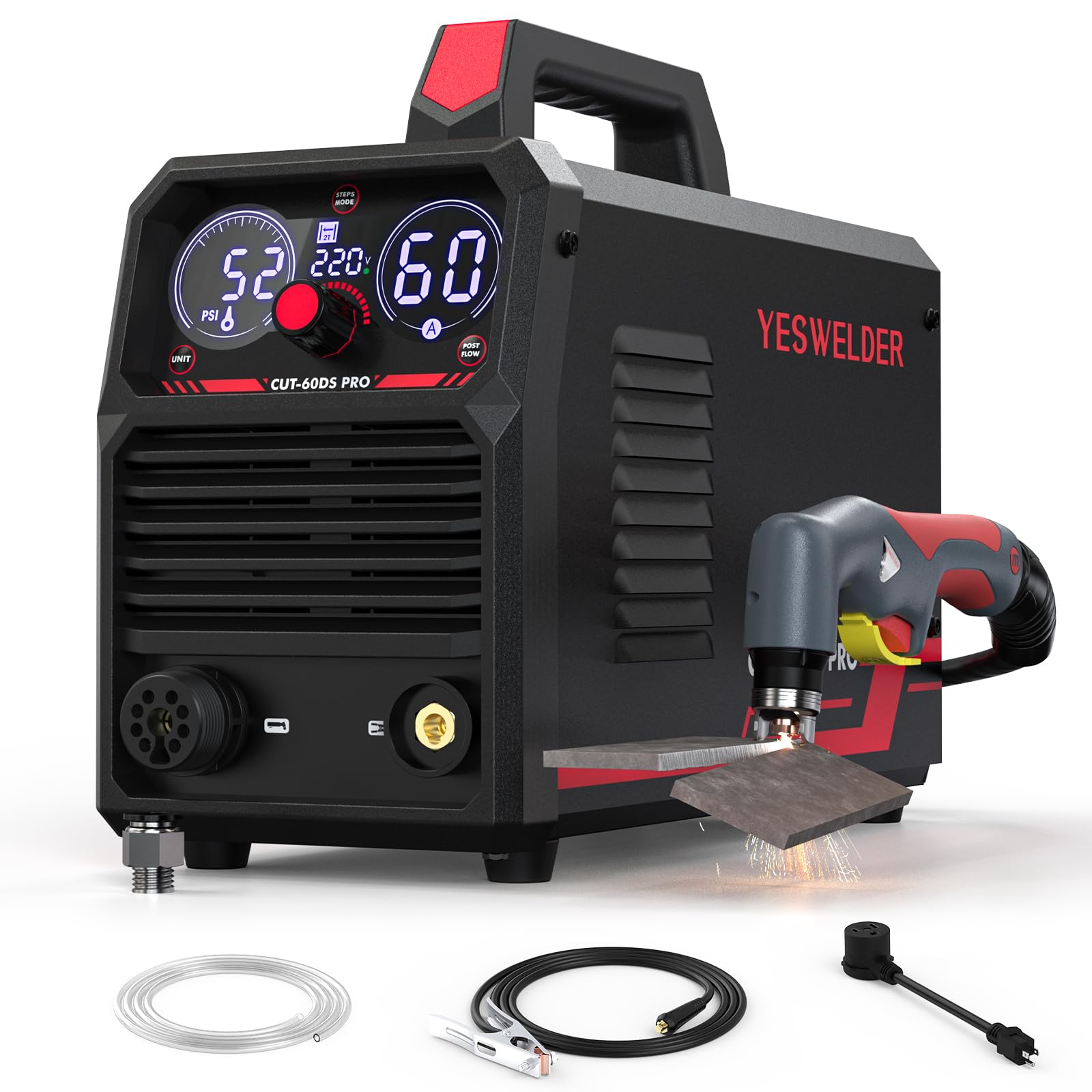
A 60-amp non-HF machine that starts the arc with a blowback — smooth, quiet, and interference-free.
Here’s why the “non-HF” label matters: instead of using high-frequency electricity to start the arc (which can interfere with nearby electronics), this YESWELDER uses a blow-back start system. It initiates the arc by physical movement of the torch parts, which means no high-frequency interference to disturb radios, CNC controllers, or other machinery in your shop. It’s a genuinely different engineering approach, and it accounts for why some buyers specifically choose this machine over cheaper HF units. The 60A high current delivers ideal clean cuts of 5/16″ at 110V and 5/8″ at 220V, with maximum cuts of 1/2″ at 110V and 63/64″ at 220V. That’s the widest clean-cut spec in this list on 220V.
The pilot arc IPT40 torch cuts through rough, painted, and rusty surfaces efficiently, and the non-touch pilot arc keeps the tip off the metal for better quality and longer consumable life. Post time and post flow adjust from 5-20 seconds to control cooling — 5-8 seconds recommended — and the 2T/4T auto cut releases your fingers. The digital display shows air pressure, voltage, and current in real time with error codes when something’s off. It’s IP21 water-rating protected with over-load and over-heating safeguards built in.
Owner experience here is a mixed bag. The machine cuts beautifully — one buyer reports going through 1/2-inch steel with no issues, another describes smooth clean cuts on 3/8-inch steel done right the first time, and several describe the machine as “a cutting beast.” Some praise the customer service, noting that when a first unit failed, the company sent a free upgraded version. But Amazon’s own data shows reliability and build quality trending negative, with reports of a torch retainer overheating and causing fast consumable wear. The takeaway: when this machine works, it works exceptionally; the variance is real, and buyers should keep an eye on consumable wear patterns.
Why the non-HF design matters
- Blow-back start avoids high-frequency interference with shop electronics
- 60A delivers clean 5/8″ cuts on 220V — the widest clean-cut spec here
- IPT40 torch handles rough, painted, rusty surfaces without prep
- IP21 protection with over-load and over-heat safeguards
Where owners hit friction
- Reliability and build quality feedback trends mixed to negative
- Torch retainer can overheat and accelerate consumable wear
- Only one set of consumables in the box
- Smaller form factor than some competing units
Choose this if: you need high-amperage cutting near sensitive electronics and want a machine that handles 5/8″ clean on 220V.
Weigh the alternative if: proven reliability is your priority — the mixed durability reports here make the PrimeWeld CUT50D worth a look.
9. PrimeWeld 50A Air Inverter Plasma Cutter, Portable Plasma Cutting Machine, CUT50D

A 50-amp MOSFET inverter with a lift-start torch and a 4.7-star rating across nearly 670 reviews.
Lift-start is worth understanding: with this PrimeWeld CUT50D, you touch the torch momentarily to the metal to light the arc, then drag the torch across the surface to cut. It’s a natural motion for anyone coming from a cutting torch background, and it’s ideal for drag starts and drag cutting. The machine is a MOSFET inverter design (a power-regulation architecture) that weighs 23 pounds in shipping — light enough to carry between shop, job site, and home. At 50 amps, it cuts up to 1/2-inch thick steel plate with 1/2-inch clean cut performance. Input current range runs 35-45 amps, with output adjustable from 20-50 amps and a 60% efficiency rating.
The feature set covers the essentials: dual 120/240-volt input, overcurrent protection, overheating protection, power spike protection, Dinse connections (standardized quick-connect plugs), a rear panel air pressure gauge, and a digital power display. It ships ready to cut with the AG60 torch, a 13-foot torch hose, air regulator, air supply hose, ground clamp, 10 ft reference cable, reference manual, and a 240-volt to 120-volt adapter pigtail. The high-frequency arc control with a non-pilot touch-and-lift start keeps things simple.
The recurring gripe on this machine is not the cutting — it’s the manual, which is consistently described as terrible or useless, and the air fittings. Several owners have found nearly every internal and external air fitting leaking, requiring them to remove the cover and reseal connections. PrimeWeld did redesign the rear plumbing at some point to be pre-plumbed, which eliminated much of the assembly frustration on newer units. What wins people over is the cutting performance and the support: owners describe it cutting as well as expensive Hypertherm machines, one reporting a 1/2-inch cold-roll cut in about 5 seconds, another noting customer service answers emails within an hour.
The track record: 4.7 stars across nearly 670 ratings — the highest-rated machine on this list.
The honest friction: the manual and air fittings have historically been weak spots, though the rear plumbing redesign addressed the worst of it.
Suits the buyer who: wants proven reliability, US-based support, and lift-start operation that feels like a traditional cutting torch.
Think again if: you refuse to touch up air fittings during setup — the PRIMEWELD CUT60 ships more pre-assembled.
Understanding the Specs
Amperage and Its Practical Ceiling
Amperage measures raw cutting power. A 60-amp machine cuts thicker steel than a 50-amp one, but only if you feed it enough electricity and air. On 110V household current, most machines here cap between 20 and 35 amps — the outlet limits how much power you can draw. That’s why 220V access matters so much for thick-plate work. The amperage dial on your machine lets you back off for thin sheet (less warping) and push up for plate (deeper cuts).
Duty Cycle Explained
Duty cycle is the percentage of a ten-minute window you can cut at full power before the machine needs to cool. A 60% duty cycle at 60 amps means six minutes cutting, four minutes cooling. This matters most on production jobs where you’re cutting continuously. For hobby use with breaks between cuts, even a lower duty cycle rarely comes into play. Look for a duty cycle spec that matches your actual work pace — occasional users can ignore it, full-day fabricators can’t.
FAQ
Will a 110V plasma cutter trip my household breaker?
What size air compressor do I need for a 55A plasma cutter?
Can I run a 110 plasma cutter on a generator?
What is the difference between pilot arc and scratch start?
How thick can a 110V plasma cutter cut?
Do I need a special outlet for a dual-voltage plasma cutter?
How long do plasma cutter consumables last?
Is a plasma cutter better than an angle grinder for cutting steel?
What does the PA and PT setting do on a plasma cutter?
Can I use a plasma cutter for CNC table work?
How much air pressure should I run through my plasma cutter?
Final Thoughts: The Verdict
If you want the machine that does the most right and asks the least of you, the 110 plasma cutter to buy is the PRIMEWELD CUT60 — 60 amps, a 60% duty cycle, a continuous pilot arc for rusty metal, and a CNC port for table work. Note that the CUT50D carries the higher star rating across a similarly sized crowd, but the CUT60’s extra amperage and Euro-connection torch flexibility give it the edge for serious work. If you just want one machine you can plug into any outlet and carry in one hand, grab the GNI 55Amp Portable, which packs a full feature cluster into a 9.51 lb body. And if you need 60 amps of non-HF cutting near sensitive electronics, the YESWELDER 60A is the machine that fits that niche.
How We Picked
We do not accept paid placement. Every pick is matched to a real buyer and a real use-case; we do not hands-on test units.
Sources & Methodology
Specifications: manufacturer listings and product documentation. Review insights: verified customer reviews, as of September 2026. Pricing: not shown on this page (it changes often); check the current price via the retailer link.
As an Amazon Associate, Gadgets Feed earns from qualifying purchases. This does not affect which products we feature.