
Our readers keep the lights on and my morning glass full of iced black tea. As an Amazon Associate, I earn from qualifying purchases.
Specs are compiled from manufacturer listings and verified buyer reviews and can change over time — please confirm the key details on the product page before buying.
If your generator has a big round 30-amp socket and everything you own has a normal household plug, you need one small piece of gear: a dogbone adapter that turns that single 30-amp outlet into regular 110-volt receptacles. That is the whole job. Get the right one and your fridge, coffee maker, and phone chargers all run at once. Get the wrong one and you are back to daisy-chaining orange extension cords across a campsite.
I’m Min — the founder and writer behind Gadgets Feed. This guide is built by comparing the manufacturers’ published specifications and the patterns across verified customer reviews, so you get each pick’s real strengths and trade-offs instead of marketing spin.
A quick note before the picks: this list uses flexible, human-like matching. Not every adapter here is the exact plug number you typed into the search bar — the nearest same-type 30-amp-to-110-volt converter serves the same purpose, so read the plug type on each pick before you buy. Below you will find the 110 to 30 amp adapter generator picks that fit campers, job sites, and storm-season backup power.
Our Picks at a Glance


How To Choose The Best 110 To 30 Amp Adapter Generator
Two things decide whether an adapter works for you: the shape of the plug on your generator and how much juice the adapter can pass without getting warm. Everything else is convenience. Here is what to check before you add one to your cart.
Match the plug, or nothing else matters
Look at the outlet on your generator or campsite pedestal. A TT-30P plug is the straight three-prong RV-style plug with two flat blades and a rounded one. An L5-30P plug is the twist-lock type — you push it in and rotate it a quarter turn so it cannot vibrate loose. They are not interchangeable, and an adapter with the wrong male end will not seat no matter how hard you push. The picks below split between both, so confirm yours first.
Check the wire gauge for heavy loads
A 10 AWG cord (American wire gauge, where 10 is a chunky strand that carries current with little resistance) is what you want for tools, space heaters, or an air conditioner. Thinner wire gets warm under sustained draw. Every adapter here runs 10-gauge copper, which is why they stay relaxed even when several devices pull at once.
Add up your watts before you split the power
Most of these adapters feed three household outlets from one 30-amp source, and several are rated to 125 volts and 3750 watts. That ceiling is shared across all three sockets, not per socket. If you plug in a space heater and a microwave together, you can reach the limit quickly. Plan the combination, not just the count.
Quick Comparison
| Model | Best For | Plug Type | Amps / Volts | Length | Amazon |
|---|---|---|---|---|---|
| CircleCord 30 Amp to 110V RV Generator Distribution Adapter Cord★ Best Overall | All-round campsite and storm backup pick | TT-30P male | 30 A / 125 V | 12 in | Amazon |
| GOMEN 12 Inch 30 Amp to 110 AdapterSecure Connector Pick | Twist-lock generators that rattle and vibrate | L5-30P male | 30 A / 125 V | 12 in | Amazon |
| LAZMUMI 30 Amp to 20 Amp 110V RV Distribution Adapter CordGrip Design | RV owners who also work off a job-site generator | TT-30P male | 30 A / — | 1.5 ft | Amazon |
| ELEGRP 30 Amp to 110 RV Adapter Plug | Travel trailers where outlets crowd together | TT-30P male | 30 A / 110 V | 12 in | Amazon |
| ADCAUDX 1FT 30-Amp to 15-Amp Marine Shore Power Adapter | Dock and marina shore power hookups | L5-30P male | 30 A / 125 V | 12 in | Amazon |
| Nilight 30 Amp to 110V RV Adapter Cord | Wet, muddy job sites and wet weather | TT-30P male | 30 A / 125 V | 12 in | Amazon |
| MECMO 30 Amp to 20 Amp 110V RV Distribution Adapter | Shop, barn, and garage power tools | TT-30P male | 30 A / 125 V | 1 ft | Amazon |
| KANGIKX 30 Amp to 20Amp 110V Adapter | Tight pedestals and mobile detailing rigs | TT-30P male | 30 A / 125 V | 1.5 ft | Amazon |
| Rophor 30 Amp to 110 Adapter Generator Power Cord | Home backup running several devices at once | L5-30P male | 30 A / 125 V | 1.5 ft | Amazon |
In‑Depth Reviews
1. CircleCord 30 Amp to 110V RV Generator Distribution Adapter Cord
Our pick — over 4.5★ from 900+ verified ratings; the strongest balance of quality and price.
One 30-amp socket in, three household outlets out — and it shrugs off the rain doing it.
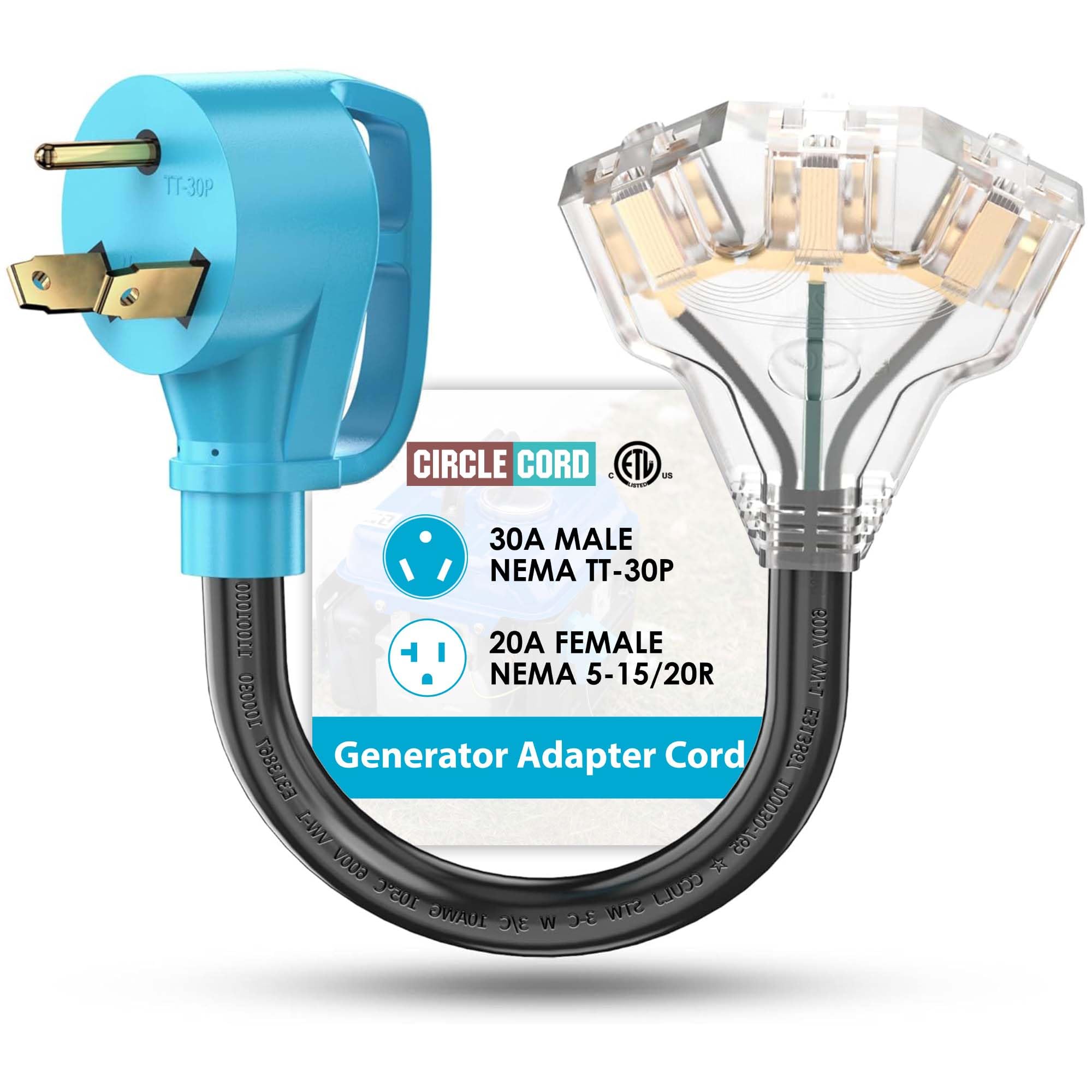
The plug that takes this one home is the blue jacket. It runs a NEMA TT-30P male end — the straight three-prong RV and generator plug — into three NEMA 5-15R/5-20R T-blade household connectors, and the whole thing is 10-gauge wire packed into a 12-inch molded body.
What wins people over is the sheer number of jobs it covers. Campers use it to farm three outlets off a campground pedestal. It also shows up on construction sites where someone needs to run a circular saw and a work light off one generator. On cold nights it lets owners run two space heaters so the propane furnace stays off. One buyer summed up the campsite case neatly: “I purchased this for camp, because my site has the camper connection, but no plugs, and I didn’t want to risk running extensions for my golf cart and stuff through the camper.”
The honest catch is the prong length. Buyers repeatedly note the blades sit shorter than they expected, so on a loose or worn pedestal socket the fit can feel less than rock-solid. It is not a defect — it is a nudge to check the fit in your own socket before you drive off with a trailer behind you. The build itself is flame-retardant, UV-resistant, and sheathed in STW PVC rated for indoor and outdoor use, with an LED that lights when power is flowing so you know the connection is live before you walk away. It carries a 4.8-star average across 900+ ratings.
Where it holds up
- 10-gauge copper stays relaxed under a space heater or tool load
- Blue jacket makes it easy to find in a crowded cord tote
- LED indicator confirms live power at a glance
- Flame-retardant, UV-resistant, water-resistant STW jacket rated for indoor and outdoor use
What to watch
- Shorter prongs can feel loose in a worn pedestal socket
- 12-inch body leaves little slack if your pedestal sits high
Money well spent: the safest single buy for RV campers, tailgaters, and storm-season backup power off a TT-30 outlet.
Reconsider if: your generator uses a twist-lock L5-30 outlet instead of the straight TT-30 plug — this male end will not seat in it.
2. GOMEN 12 Inch 30 Amp to 110 Adapter
A quarter-turn twist lock so your cord cannot shake loose on a vibrating generator deck.
If your generator has an L5-30P socket — the round twist-lock port that most inverter generators use — the CircleCord above will not fit it, and this GOMEN will. You push the male end in and rotate to lock it down. That single motion is the difference between a connection that survives a running engine and one that works its way loose by hour three. Rated to 125 volts and a maximum of 3750 watts, with 10-gauge STW copper, an ETL listing, and power indicator lights on the receptacles.
The everyday read on this one is simple: it fits, it stays put, and it does not feel cheap in the hand. Buyers describe the fit onto their generator as easy and the cable as sturdy, with the small LED on the end getting called out repeatedly as a nice touch for confirming the connection is live. The build quality gets compared favorably to pricier alternatives, which is buyers rate its build quality above pricier twist-lock adapters.
Worth knowing: this is the newest and least-reviewed pick in the bunch, so long-term owner history is thinner than the veteran picks — which is not a knock on the build, just an honest read on how much track record you can weigh.
Best fit: anyone with a twist-lock generator that experiences engine vibration — the lock mechanism is the whole point of buying this over a straight-blade cord.
Wrong tool if: your generator has a plain TT-30 outlet, because the L5-30P male end simply will not go in.
3. LAZMUMI 30 Amp to 20 Amp 110V RV Distribution Adapter Cord
Built for hands that have to yank it out of a stiff pedestal in freezing weather.
The feature that stands out here is not electrical — it is the molded grip on the plug end. Pulling a tight adapter out of a campground pedestal with cold, wet fingers is exactly the exact problem this grip solves, so you get a real handle to grab instead of a smooth plastic shell. Underneath, it is a standard TT-30P male plug feeding three NEMA 5-15R/5-20R household outlets, in a flame-retardant, UV-resistant, water-resistant STW jacket with an ETL listing and a 24-month maintenance window from the brand.
Owners describe a stout, heavy-duty pigtail with three solid plugs on the end. One buyer on a generator run reported the adapter powering three warmers on a hotdog stand, which is a nice mental picture of what this class of cord is for: real equipment, running hard, at a point of sale. Another noted it plugs straight into a Honda companion’s 30-amp outlet and yields three working receptacles with no fuss.
Where it fits: anyone who wants a durable three-way splitter with a handle and a brand that will answer the phone if something goes wrong. Where it does not: this cord has no locking ring or twist mechanism, so a high-vibration setup is better served by the GOMEN above.
Why owners keep it
- Grip handle makes plug-in and pull-out easier in cold or wet conditions
- Three household outlets from one 30-amp RV or generator socket
- LED indicator confirms a live connection
- Flame-retardant, UV-resistant, water-resistant jacket rated indoor and outdoor
skip it if
- Your generator uses a twist-lock L5-30 outlet — this uses a straight TT-30P male end
- The 1.5-foot length may be tight against a pedestal that sits high off the ground
Pick it for: comfortable handling — the grip is a real quality-of-life upgrade for anyone who wrestles with stiff pedestal plugs.
Not for you if: the cord needs to travel a long distance; the 1.5-foot pigtail lives at the socket, not across the site.
4. ELEGRP 30 Amp to 110 RV Adapter Plug

A fan-out shape that stops bulky power bricks from fighting each other for space.
Most pigtail adapters put three outlets in a line, which is fine until you plug in a laptop charger with a chunky brick or a refrigerator cord with a right-angle head. The ELEGRP fans the three NEMA 5-15R/5-20R household sockets outward instead, so each plug gets its own breathing room. That matters inside a tight travel-trailer cabinet or a crowded pedestal box where you cannot physically bend a cable around a neighbor’s plug. It is a NEMA TT-30P male end running 10-gauge copper with a rugged STW jacket, and it is tested to UL specifications.
The most common hiccup reported is ordering the wrong plug size for a particular generator — a fit mistake, not a fault with the cord, and the sort of thing that is worth double-checking against your machine’s outlet before checkout. Otherwise, buyers describe it as well made, high quality, and suited to the job it claims.
On load capacity, the manufacturer is explicit: this is not a fuse, and total draw must stay under 30 amps. If you plug three things in and the source trips, the source is doing its job — the adapter is not meant to protect individual devices from a shared overload. Keep that in mind when stacking appliances.
The trade-off to weigh: the fan-out shape is genuinely more convenient for bulky plugs, but it also means the adapter occupies a wider footprint in the socket. On a pedestal with a hinged cover, check that the cover still closes before you commit.
Made for: travel trailers and campers where outlet crowding is a daily annoyance — the wide fan-out is the fix.
Think twice if: you run high-draw tools and need the source itself to limit each branch — this has no per-outlet protection.
5. ADCAUDX 1FT 30-Amp to 15-Amp Marine Shore Power Adapter
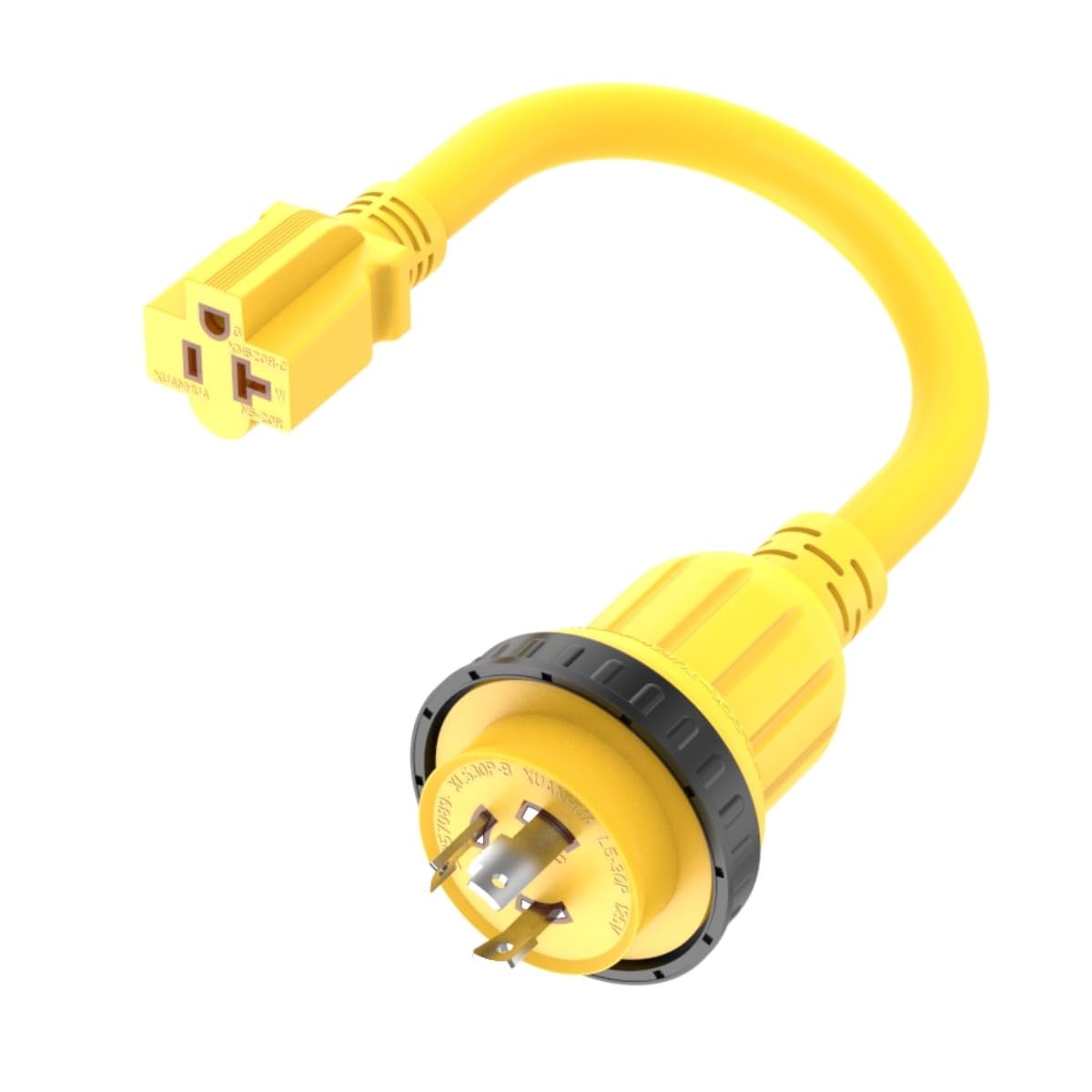
A single-outlet dogbone for docks, boats, and generators that only need one clean tap.
This one does not fan out three ways. It takes one NEMA L5-30P twist-lock male end — the ringed plug you rotate into place — and feeds a single NEMA 5-20R receptacle rated at 20 amps and 125 volts, or 2500 watts, with 100% copper wires inside a one-foot STW 10-gauge jacket. The brand spells out a hard limit that matters: this works with 125-volt T-blade 20R sockets, not the 250-volt NEMA 6-20R variant, so make sure your device’s cord matches the socket type before you buy.
The scenario this serves best is a dock. A boat plugs into shore power, and this adapter lets a heavy-duty extension cord run off that connection to a tool or charger on the pier. Owners who use it confirm it works fine for that purpose. The one place owners extend it beyond the label is off-grid welding — one account describes running a small arc welder off a Honda EU3000is, and the combination of 10-gauge conductors and the short one-foot run keeping voltage drop minimal. If that is your use case, it is a compelling example of a small adapter doing serious work.
What it is not: a splitter. If you need three outlets at once, this is not the one — it gives you a single receptacle. That is the whole point of the design, but it is worth being explicit if you are comparing it to the multi-outlet picks above.
Why it earns a spot
- L5-30P twist-lock male end secures against vibration on a running generator
- Rated at 125 volts, 20 amps, 2500 watts for the single outlet
- 10-gauge, 100% copper conductors in a one-foot STW jacket
- ETL listed for safety
Don’t overlook
- Only one outlet — no three-way splitting
- Compatible with 125-volt sockets only, not 250-volt NEMA 6-20R
Built for: boaters and dock users, or any twist-lock generator job that only needs a single clean household outlet at the end.
Look elsewhere if: you want to run three appliances at once — this one deliberately gives you one receptacle.
6. Nilight 30 Amp to 110V RV Adapter Cord ETL Listed

Built for the cord that lives outside — in rain, mud, snow, and everything between.
If your adapter is going to sit on wet ground at a muddy job site or a campsite in November, the jacket matters as much as the wiring. The Nilight comes sheathed in a heavy-duty, flame-retardant, heat-resilient PVC shell that the manufacturer says protects against wind, rain, snow, soil, and rocks. Under that is 100% pure copper in full 10-gauge stranded wire, feeding three NEMA 5-15R/5-20R household connectors from a NEMA TT-30P male end, all rated to 125 volts and 3750 watts. An LED lights up when the connection is live.
The pattern across buyer feedback is a cord that shows up working exactly as described. It is the pick that gets used on Predator and inverter generators, and the recurring theme is that it replaces multiple separate cords with one clean distribution point. There is one open risk flagged by buyers that is worth understanding: because the adapter itself is not fused, a 30-amp source feeding three 20-amp cords can let a smaller cord overload before the source trips. That is not the adapter failing — it is the way unfused distribution works, and it is a good reason to match your powered devices’ total draw carefully.
What to know about the fuse question: the manufacturer lists all-weather protection and LED indication but does not claim any built-in breaker. Treat this as a distribution cord — not a protective device — and plan your loads accordingly.
Best for: outdoor-only use — the cord was built to stay outside in weather that would sideline a flimsier adapter.
Rethink if: you expect the adapter to protect individual devices; it splits power, it does not limit each branch.
7. MECMO 30 Amp to 20 Amp 110V RV Distribution Adapter

The adapter that keeps inline GFCI outlets from tripping when you fire up a shop tool.
For someone running power tools in a garage, barn, or shop building, the appeal here is stability. This TT-30P to 3X 5-15R/5-20R adapter is described by owners as handling high-current tools without drama, and specifically avoiding the kind of nuisance tripping that plagues some inline GFCI setups on 20-amp circuits in outbuildings. It runs 3C/10 AWG STW wire in a flame-retardant, UV-resistant jacket with molded plugs, a built-in LED on the three female ends, and a rating of 30 amps at 125 volts, with each of the three outlets individually supporting 15 or 20 amps.
RV campers get the same benefit — three household outlets from a campground hookup for a mini-fridge, a microwave, and a phone charger at the same time. It is the most widely used adapter in this class, with 40+ buyers citing quality and 39 citing function.
The one detail to know: on stability, feedback runs mixed. A few owners note that it does not feel quite as planted as a locking connector when handling a heavy cable pull — a reasonable caveat if your setup has lots of cord weight hanging off the adapter. For most RV and light-tool use, though, it sits in the socket just fine.
Where it shines
- Buyers report fewer nuisance GFCI trips in shop and barn setups
- Three individually rated 15A/20A household outlets
- 10 AWG STW construction with UV-resistant jacket
- LED indicator lights built into all three female ends
Worth flagging
- Does not lock in place like a twist-lock connector
- One-foot body means very little reach
Top choice if: you power tools from a garage or barn and have fought with inline GFCI outlets that trip randomly — this smooths that out.
Consider a different pick if: your connection sees heavy vibration or sideways cord pull, where a locking connector is safer.
8. KANGIKX 30 Amp to 20Amp 110V Adapter

Slim enough for a retro-fitted RV outlet cover to close clean over it.
This is a NEMA TT-30P male end to three 5-15/20R household outlets in a 1.5-foot molded body, running 100% copper 10-gauge wire inside a PVC jacket and ETL listed for safety. The brightly colored yellow shell is a small but real design choice — in low light or a cluttered toolbox, you can spot it without squinting. Rated to 125 volts and 3750 watts, plug-and-play with no assembly, it does what the label says on paper.
Two specific scenarios stand out from owner experience. First: an RV that came with a standard 20-amp circuit where an RV outlet used to be, and the KANGIKX is slim enough that the outlet cover closes completely over it. Second: mobile detailing, where the adapter lets one 5000-watt generator feed three standard plugs at once. In both cases the fit is the validation, not the specs — the plug sits snugly where a bulkier adapter would not.
The KANGIKX also goes on Harbor Freight-class generators that some other brands struggle to seat properly against, which is a smaller point but a real one if you have experienced that specific frustration. What it will not do: survive a lock-dependent connection, since it uses a straight push-in male end rather than a twist-lock ring.
Best use: retrofit situations where the socket is fixed and you have limited depth — the slim body is what makes this a fit where others are not.
Expectation check: the yellow plastic looks bright and handy, and it is, but heat from continuous heavy draw will eventually discolor it over years of use. The cord works; it just tells on you cosmetically.
Reach for this if: you have a tight pedestal, an RV with a retro-fitted household outlet, or a generator whose socket leaves little room — the slim profile is the point.
pass on it if: your setup demands a locking male end; this is a straight push-in TT-30P only.
9. Rophor 30 Amp to 110 Adapter Generator Power Cord

Twist-lock on the intake, three household outlets on the out — all in a single 1.5-foot body.
The Rophor is the twist-lock answer for anyone who wants three outlets rather than one. It takes a NEMA L5-30P twist-lock male end — that ringed locking plug you rotate into place — and feeds three NEMA 5-20R grounded sockets, rated to 30 amps, 125 volts, and 3750 watts, with 10-gauge all-copper wire inside a 600-volt thermoplastic STW jacket that resists abrasion, oil, and moisture and stays flexible in cold. The lit end confirms power is on, and the brand backs it with a 5-year maintenance window.
Owner feedback on this pick is consistent: quality and durability are the reasons it gets recommended. The jacket stays manageable — owners who tested in 60°F weather note it flexed well, which matters when you are working with a stiff 10-gauge cord on a cold morning. The twist-lock end holds solid, and the short length means less slack to trip over at the connection point.
Two honest caveats echo through the reviews. First, the cord itself is stiff at rest — that is 10-gauge copper behaving like 10-gauge copper, not a design flaw, but pack it expecting no soft coiling. Second, the included plastic tie strap for storing the cord when coiled does not stay latched; a bungee or a hook does the same job with less fuss.
Where it earns its keep: the twist-lock plus three outlets plus a 5-year maintenance window is a lot of coverage in one 1.5-foot cord, and owners consistently report it holds up under real-world use.
One grain of salt: a handful of owners wished the cord were longer; if you need reach, this 1.5-foot pigtail is not the tool for a distant load.
Winner for twist-lock generators: three household outlets, locked in, from a single L5-30P socket — with the longest maintenance window of any pick here.
Choose the MECMO or CircleCord instead if: your generator has a straight TT-30 outlet rather than a twist-lock L5-30 socket.
Understanding the Specs
TT-30P vs. L5-30P — the plug that decides everything
TT-30P is the straight RV-style plug: two flat blades and a pin, pushed straight in. L5-30P is the twist-lock version: same general amperage, but you rotate it a quarter turn to lock. Most campground pedestals use TT-30, while inverter generators often use L5-30. If the male end of your adapter does not physically match your socket, nothing else about the product matters. Check the socket before you buy — the picks above are split between both, so the right one depends on your machine.
What 30 amps, 125 volts, and 3750 watts actually mean for you
Thirty amps at 125 volts is the maximum the source can deliver, and the watt figure is the running ceiling. Every outlet the adapter adds shares that same pool. If one outlet is running a 1,500-watt space heater, the other two outlets together have to fit inside the remaining budget. The 30-amp rating is a maximum, not a promise that you can run three heavy appliances at once. Match your total load to the watt ceiling before you plan what to plug in.
Why 10 AWG matters more than length
AWG stands for American wire gauge, and lower numbers mean thicker wire. A 10-gauge cord carries the current the adapter is rated for with less heat build-up than a thinner strand. This is why you see 10 AWG repeated across all these picks — it is the specification that keeps the cord cool when you are running a sustained load like a heater or an air conditioner. Thinner wire will get warm, and under extended draw, warm wire is a problem.
Fused, unfused, and what to expect
None of the adapters in this roundup are fused. They are distribution cords: they pass current from one 30-amp source to three household outlets without individual protection. If the source trips, it is doing its job — but a 20-amp device on a 20-amp cord can still overload before the 30-amp source cuts out. That is normal for the category, but it means planning your loads is on you, not on the adapter. If you want a fused protection stage, that has to live elsewhere in the circuit.
FAQ
Will a 30-amp to 110 adapter work with any generator?
What is the difference between a 30-amp to 15-amp and a 30-amp to 20-amp adapter?
Can I run three space heaters off one 30-amp adapter?
Does the adapter work in rain or snow?
How long do these adapters last?
Why do I sometimes see an LED light on the adapter?
Should I worry about the prongs being too short?
Can I use these adapters with a marine or boat shore power setup?
Is it safe to daisy-chain adapters?
What is the difference between 10 AWG and a thinner gauge cord?
Do I need a fused or breaker-equipped adapter?
Final Thoughts: The Verdict
For most buyers, the 110 to 30 amp adapter generator pick is the CircleCord 30 Amp to 110V RV Generator Distribution Adapter Cord, because it pairs the strongest owner track record in this class with the practical bits that matter most: a 12-inch molded body, 10-gauge copper, a flame-retardant, UV-resistant jacket, and a blue shell you can spot in a tote full of cords. If your generator uses a twist-lock L5-30 outlet instead of the straight TT-30, skip it and grab the Rophor 30 Amp to 110 Adapter Generator Power Cord, which locks in place and lands three household outlets off a single L5-30P socket. And if you power tools in a garage or barn and have fought with jumpy GFCI outlets, the MECMO 30 Amp to 20 Amp 110V RV Distribution Adapter is the one to reach for.
Before you order, one quick check saves a return: look at the outlet on your generator and compare it to the plug type on the pick you are considering. The rest of the specification sheet — watts, amps, wire gauge — falls into place once the plug matches.
How We Picked
We do not accept paid placement. Every pick is matched to a real buyer and a real use-case; we do not hands-on test units.
Sources & Methodology
Specifications: manufacturer listings and product documentation. Review insights: verified customer reviews, as of September 2026. Pricing: not shown on this page (it changes often); check the current price via the retailer link.
As an Amazon Associate, Gadgets Feed earns from qualifying purchases. This does not affect which products we feature.