
You plug a 110-volt air compressor into the same wall outlet as your shop vac. But not all of them actually keep up with a nail gun or a paint sprayer. The ones that frustrate you are loud, slow to refill, or both. The ones you will love deliver enough cubic feet per minute (CFM — the volume of air the pump moves each minute) at a noise level you can live with, and a tank that lets you work longer before the motor kicks on. This guide covers five models that make that choice clear.
I’m Min — the co-founder and writer behind Gadgets Feed. This guide is built by comparing the manufacturers’ published specifications and the patterns across verified customer reviews, so you get each pick’s real strengths and trade-offs instead of marketing spin.
If you need to run a brad nailer on a weekend project or keep a busy shop supplied with air, you will find a match here — these picks cover the full range of what a 110 volt air compressor can actually deliver on a standard outlet.
How To Choose The Best 110 Volt Air Compressor
Three numbers on the spec sheet tell you everything you need to know: CFM (cubic feet per minute — the volume of air the pump pushes each minute) at the pressure you use, the maximum PSI (pounds per square inch — the pressure inside the tank) of the tank, and the decibel (dB — a measure of sound level) rating. Ignore the horsepower figure — it is often peak (not running) power and it gets exaggerated. Focus on CFM because that is what decides whether your tool stalls or runs smoothly.
Match CFM to your most demanding tool
A brad nailer might need only 0.3 CFM, but a 1/2-inch impact wrench can demand 5 CFM or more. If the compressor’s delivered CFM at 90 PSI is lower than what your tool requires, the compressor will run constantly and never catch up — you will be stuck waiting for pressure to build while your tool rests. Check the tool’s manual for its CFM requirement at operating pressure, then make sure the compressor’s CFM at that same PSI is at least equal or preferably a bit higher.
Understand why tank size matters less than you think
A bigger tank gives you a longer buffer before the motor kicks on, which is helpful for short-burst tools like a nail gun. But for continuous-use tools like a grinder or a sandblaster, tank size just delays the inevitable — what you really need is higher CFM from the pump. That said, a 20-gallon tank at 175 PSI stores much more usable air than a 2.4-gallon tank at 115 PSI, so if you frequently use high-air-volume tools, the larger tank keeps you working longer between cycles.
Do not ignore the decibel number
Every 10-decibel increase sounds roughly twice as loud to your ears. A 60-decibel compressor is quiet enough for a conversation next to it — about the level of a normal household refrigerator. A 70-decibel unit is noticeably louder but still does not require hearing protection for short sessions. Anything above 80 decibels will have you reaching for earplugs, especially in an enclosed garage. If you work indoors or near living spaces, a 60-decibel rating is worth paying extra for.
Quick Comparison
On smaller screens, swipe sideways to see the full table.
| Model | Category | Best For | Key Spec | Amazon |
|---|---|---|---|---|
| VELPAX VX1100-09 | Mid-Range | Home garage & indoor nailing | 60 dB noise level | Amazon |
| MZB 6.4 Gallon | Mid-Range | Paint spray & high-CFM tools | 7.41 CFM @ 115 PSI | Amazon |
| Klutch 20-Gallon | Premium | Daily automotive & shop use | 175 PSI / 20 gallon | Amazon |
| California Air Tools CAT-4610AC | Premium | Noise-sensitive workshops | 60 dB / 44 lbs | Amazon |
| Craftsman CMXECXA0331042 | Premium | Professional nailing crew | 4.0 CFM @ 90 PSI | Amazon |
In-Depth Reviews
1. VELPAX VX1100-09 Ultra Quiet Air Compressor
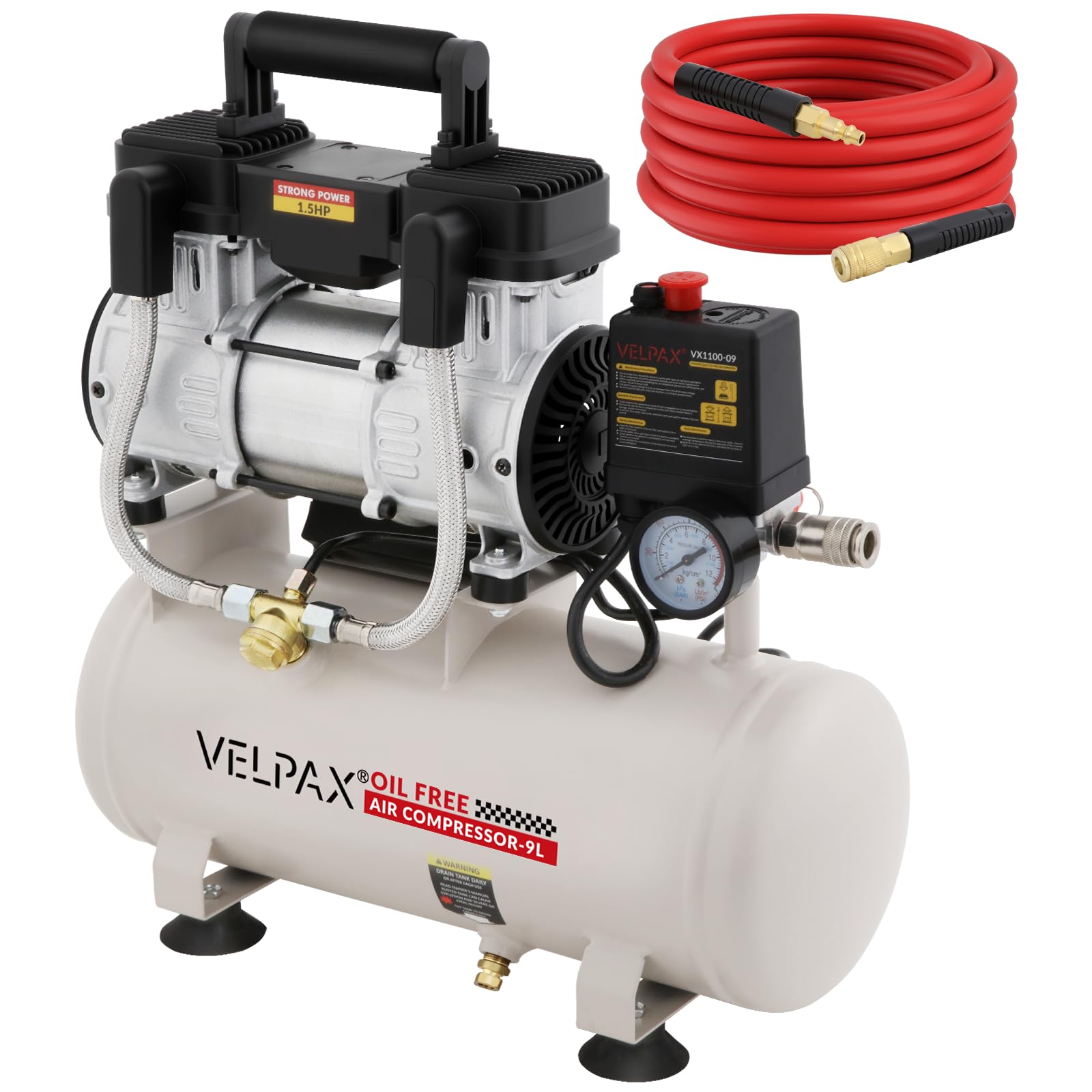
The VELPAX VX1100-09 earns the top spot because it runs at just 60 dB (decibels — loud enough for a conversation, no earplugs needed) and buyers report it “fills to 116 psi in 26 sec.” That speed means you inflate a tire or fire a few brad nails without standing around waiting. For anyone with an attached garage or a low tolerance for noise, this is the one that stays pleasant all day.
Its 1.5-horsepower motor delivers 6.71 CFM (cubic feet per minute) at maximum pressure, enough to run a brad nailer or a stapler without the pump cycling constantly. The oil-free design means you never check or change compressor oil — just plug it in and use it. Reviewers consistently mention it is “much quieter than my old single cylinder compressor” and that the included hose with pre-attached fittings makes setup instant.
The catch is the 2.4-gallon tank is small. A continuous-use tool like a die grinder will trigger the motor frequently. But for intermittent work — nailing, inflating tires, cleaning with a blow gun — this compressor combines silence and speed better than anything in its class. For most home garages, this is the one to buy.
Why it’s great
- Exceptionally quiet at 60 dB, comfortable for indoor use without hearing protection
- Fills the tank to 116 PSI in just 26 seconds, minimizing downtime
- Oil-free pump means zero maintenance beyond draining the tank
Good to know
- 2.4-gallon tank limits runtime for continuous-use tools
- Some owners mention the pressure switch burst is louder than the compressor itself
2. MZB 6.4 Gallon Ultra Quiet Air Compressor

The MZB beats the VELPAX on air volume by a clear margin — 7.41 CFM at 115 PSI versus 6.71 CFM — and its 6.4-gallon steel tank holds 2.7 times more air. That difference matters when you use an HVLP (high-volume, low-pressure) paint sprayer or a roofing nailer that fires rapidly. The downside is noise: the MZB runs at 70 dB, which is about twice as loud perceptually as the VELPAX’s 60 dB, but customers note they “don’t need ear plugs.”
Where this compressor shines is real-world efficiency. Reviewers point out it is “fast to reach 100 PSI” and that it keeps up well with intermittent tools. The integrated wheels and handle make it easy to roll around a shop, and the oil-free pump eliminates oil-change maintenance. One reviewer noted a startup current issue on a 15-amp circuit — the seller replaced the unit with one that runs on a 15-amp breaker, so be aware your garage wiring needs to support the inrush.
Choose the MZB over the VELPAX if your work involves any continuous-air tool like a paint sprayer or an air drill, or if you want a larger air reserve that keeps the motor from cycling as often. The trade-off of 10 extra decibels for nearly three times the tank capacity and higher CFM is a fair one for a busy shop. Pick this over the top pick if you need higher air volume for tools that breathe heavy.
Where it shines
- 7.41 CFM at 115 PSI is the highest air delivery on this list, great for spray painting and air tools
- 6.4-gallon steel tank stores enough air to run multiple nailers without the pump kicking in constantly
- Wheels and handle make it easy to move around a workshop
Worth noting
- At 70 dB it is noticeably louder than the 60 dB VELPAX
- May trip a 15-amp breaker on startup; a 20-amp circuit is recommended
3. Klutch 20-Gallon Air Compressor

If your daily work involves impact wrenches, air ratchets, and tire changes, the Klutch is built for that rhythm. It holds 20 gallons of air at 175 PSI, storing 8.3 times more air than the VELPAX. That stored energy means you can zip off lug nuts from all four wheels before the motor even thinks about kicking on.
The 2-horsepower motor is paired with a splash-lubricated cast-iron twin-cylinder pump, a step up in durability from the oil-free pumps on the smaller units. Buyers describe it as “reliable daily shop use” and note it “builds pressure quickly, holds air well.” At 90 pounds, it is the heaviest compressor here — it is not portable for job sites — but the vertical tank design saves floor space and the front drain valve makes maintenance easier than reaching under a horizontal tank.
The standout spec is the 175 PSI maximum pressure, which is 60 PSI higher than the 115 PSI of the smaller MZB. That extra stored pressure translates directly into more usable tool runtime before the pressure drops below your tool’s minimum operating threshold. This is the choice for the dedicated home mechanic who wants one compressor that handles everything without complaint.
What stands out
- 20-gallon tank at 175 PSI stores a massive air reserve for continuous tool use
- Cast-iron twin-cylinder pump is built for longevity and daily professional use
- Vertical design saves floor space and the front drain valve simplifies maintenance
The trade-offs
- At 90 pounds it is heavy and not easily portable between job sites
- Some units ship with a slightly bent foot from the factory, causing a wobble
4. California Air Tools CAT-4610AC

The single number that matters most in this category is 60 decibels — the same noise level as the VELPAX, but here it comes from a 1.0-horsepower motor spinning at only 1680 RPM. Slower RPM means less wear, less noise, and a longer lifespan — the maker claims over 3,000 hours of pump life. At 45.5 pounds, it is also half the weight of the Klutch, making it genuinely portable.
One limitation for whisper-quiet operation is lower air output: 2.2 CFM at 90 PSI. That is one-third the air volume of the MZB (which delivers 7.41 CFM), so this compressor is not suited for continuous-use tools like sanders or die grinders. It is perfect for brad nailers, finish nailers, inflating tires, and light airbrushing. Reviewers call it “remarkably quiet” and note it is “much quieter than larger Dewalt compressor.”
What you are paying for here is build quality and silence. The aluminum twin tank will never rust from the inside (a common failure point on steel tanks), and the 8.5-amp draw means it runs happily on any standard 15-amp household outlet. If noise bothers your family, neighbors, or your own sanity, this is the compressor that disappears into the background. It costs more per CFM than any other pick, but that is the price of true peace and quiet.
The upsides
- Exceptionally quiet 60 dB operation makes it suitable for noise-sensitive environments like home garages
- Aluminum tanks never rust, eliminating a common failure point on traditional steel compressors
- At 45.5 pounds it is the lightest premium option, easy to carry or mount on a rolling dolly
Keep in mind
- Only 2.2 CFM at 90 PSI limits tool compatibility — not suitable for high-air-volume continuous tools
- On/off switch feels flimsy compared to the rest of the build quality, per some buyer reports
5. Craftsman CMXECXA0331042 10-Gallon Air Compressor

The Craftsman gives you a 10-gallon tank and 4.0 CFM at 90 PSI with dual quick-couplers, so you can run two framing nailers or a framing nailer plus two finish nailers simultaneously without losing pressure. The oil-free pump reduces maintenance, and the 150 PSI maximum pressure sits 25 PSI below the Klutch but 35 PSI above the MZB, balancing stored energy with pump longevity.
Shoppers say it “used for painting and tire inflation for one month without issues” and after two years it “performs well for impacts, nail guns, and inflating” without running out of air. The fold-down handle and integrated wheels make it easy to load into a truck bed or roll across a job site. The honest trade-off is noise — buyers describe it as “a little louder than I expected” and one reviewer says it is “loud but easy to use.”
If quiet operation is your priority, the VELPAX or California Air Tools are better choices. But if you need a compressor that keeps a framing crew supplied with air all day on a 120-volt circuit, the Craftsman delivers where smaller, quieter units would stall. For the price, it is the best value for anyone running professional-grade nailing tools on a standard outlet.
Why we’d pick it
- 4.0 CFM at 90 PSI handles multiple simultaneous nailers without pressure drop
- Dual quick-couplers let two people work from the same compressor at the same time
- 10-gallon tank and 150 PSI max pressure provide a generous air reserve for professional nailing
A few caveats
- Noise level is higher than the ultra-quiet options — expect moderate to loud operation
- Some units arrive with shipping damage; the included customer service may not resolve quickly
Understanding the Specs
Cubic Feet per Minute (CFM)
This is the most important number on the spec sheet. CFM measures how much air the pump pushes out each minute. All compressors list CFM at two pressures — for example, “4.0 CFM @ 90 PSI” means the pump delivers 4 cubic feet of air per minute when the tank pressure is at 90 PSI. Match this number to your tool’s requirement: a brad nailer needs about 0.3 CFM, while a 1/2-inch impact wrench can need 5 CFM or more. If the compressor’s CFM at your tool’s operating pressure is lower than what the tool draws, the compressor will run continuously and never fill the tank.
Decibels (dB) and noise perception
Decibels measure sound pressure, and the scale is logarithmic, not linear. A 70-decibel compressor is not 17% louder than a 60-decibel compressor — it is roughly twice as loud to human ears. A 60 dB unit is about as loud as a normal refrigerator or a quiet library. A 70 dB unit is comparable to a vacuum cleaner. An 80 dB compressor (common on traditional pancake models) is as loud as heavy traffic. If you work in an attached garage or near living spaces, a 60 dB model is a significant quality-of-life improvement.
PSI — Pounds per Square Inch
PSI measures the pressure inside the tank, not the air volume. A compressor with 175 PSI maximum stores more usable air than one with 115 PSI, even if the tank size is the same, because the higher pressure allows more air molecules to be packed into the tank. However, your tools regulate down to their operating pressure (typically 70-90 PSI for most nailers and impact wrenches), so the higher tank pressure just means you get more cycles before the pump kicks on. It does not make the tools themselves more powerful.
Oil-Free vs Oil-Lubricated pumps
Oil-free pumps use permanent lubrication in the cylinder walls and require no maintenance — you never check or change oil. They are cleaner (no oil mist in the air output) and lighter, but they tend to be louder and have shorter lifespans (typically 500-1,500 hours). Oil-lubricated pumps, like the cast-iron twin-cylinder on the Klutch, use a splash system to coat internal parts. They are quieter, last longer (often exceeding 3,000 hours), and handle continuous use better, but they require regular oil checks and the air output can carry a slight oil mist unless filtered.
FAQ
Can a 110-volt air compressor run a paint sprayer?
Do I need a 20-amp outlet for a 110-volt air compressor?
What size air compressor do I need for impact wrenches and automotive work?
Final Thoughts: The Verdict
For most people, the 110 volt air compressor winner is the VELPAX VX1100-09 because it strikes the best balance of quiet operation, quick tank fill-up, and maintenance-free ownership for everyday garage tasks. If you need higher air volume for paint sprayers or continuous-use tools, grab the MZB 6.4 Gallon. And for a professional-grade shop compressor that handles daily automotive work without compromise, the Klutch 20-Gallon is the one that will outlast everything else on the list.