
The first time you drag a 50-amp welder into a garage built on a 15-amp circuit, you learn a hard lesson about household power limits. A 110-volt MIG welder solves that specific problem — it delivers real weld penetration on structural steel, auto body panels, and farm equipment without requiring a dedicated 220V sub-panel or a generator the size of a cooler. These compact inverter machines use IGBT technology to pull clean, stable arcs from a standard wall outlet.
I’m Min — the co-founder and writer behind Gadgets Feed. I’ve spent hundreds of hours analyzing technical specifications, reading through customer build logs, and cross-referencing duty cycles against real-world garage conditions to separate the machines that burn clean from those that just make a mess.
After comparing arc stability, wire feed consistency, and multi-process capability across nine contenders, I’ve narrowed the field to the models that actually earn their spot as a legit, permanent tool in your shop. This guide covers the best 110 volt mig welder for sheet metal work, thick plate jobs, and everything in between.
How To Choose The Best 110 Volt MIG Welder
A 110V MIG welder lives or dies by three things: how cleanly the inverter regulates the arc, how consistently the wire feeder pushes wire through the liner, and how long you can weld before the thermal overload kicks in. Beginners often chase the highest peak amperage number, but a 140-amp machine with proper synergic control and a quality torch will out-weld a 180-amp unit with a janky feeder every time. Focus on duty cycle at your target amp setting and the quality of the wire feed assembly — those specs tell you what the machine actually does on a hot Saturday afternoon.
Understanding Duty Cycle on 110V
Every inverter welder has a thermal limit. The duty cycle is expressed as a percentage — for example, 25% at 180 amps means you can weld for 1.5 minutes out of every 6-minute window before the machine needs to cool down. On 110V input, most compact units run a 20–25% duty cycle at their max rated output. That’s fine for quick repairs and hobby work, but if you’re planning to weld continuously for half an hour, you need a unit with a longer duty cycle or a built-in thermal shutdown that recovers fast. The HITBOX 140A and the Everlast Cyclone 200ES both handle this well because of their oversized aluminum heatsinks and efficient fans.
Synergic Control vs. Manual Tuning
Synergic control simplifies one of the trickiest parts of MIG welding: matching wire feed speed to voltage. With a synergic machine, you set the wire diameter and material thickness, and the onboard computer automatically selects the optimal feed speed. This is a game-changer for beginners and a time-saver for pros switching between materials. Manual tuning gives you more granular control if you’re running exotic wire or unconventional joint geometry. The YESWELDER 160A and the ARCCAPTAIN 200A both offer hybrid systems — auto-synergic presets plus full manual override — giving you the best of both approaches.
Multi-Process Capability: What Actually Works
Multi-process welders pack MIG, flux-core, stick, and lift TIG into one chassis. The catch is that some modes are clearly afterthoughts — lift TIG without a gas solenoid or stick mode that arcs inconsistently. On 110V machines, flux-core MIG and standard gas MIG are the workhorses. Stick welding on 110V is limited to thin electrodes (1/16″ to 3/32″) but works for rusty or dirty metal where you can’t get a clean ground. Lift TIG is useful for thin stainless and sheet metal, but if you plan to TIG seriously, you’ll want a dedicated machine. The LOTOS MIG225SP and Weldpro 200A both implement lift TIG with real arc control, while the Lincoln 90i FC sticks exclusively to flux-core — and that focus makes it excellent at its one job.
Quick Comparison
On smaller screens, swipe sideways to see the full table.
| Model | Category | Best For | Key Spec | Amazon |
|---|---|---|---|---|
| Ehomful 145A 4-in-1 | Mid-Range | Beginners & complete kits | 145A / 110-220V dual | Amazon |
| HITBOX 140A | Mid-Range | Outdoor flux-core work | 140A / 0.8–6mm steel | Amazon |
| YESWELDER 160A | Mid-Range | Smart synergic for hobbyists | 160A / 2LB & 10LB spools | Amazon |
| Lincoln 90i FC | Premium | Brand reliability & thin metal | 90A / 15 lbs | Amazon |
| ARCCAPTAIN 200A | Premium | 6-in-1 versatility | 200A / 2T & 4T modes | Amazon |
| LOTOS MIG180SP | Premium | Aluminum welding out of box | 180A / 1/4″ steel | Amazon |
| LOTOS MIG225SP | Premium | Heavy amateur/pro builds | 225A / 2/5″ steel | Amazon |
| Everlast Cyclone 200ES | Premium | Shop backup / pro-grade | 180A / 25% duty | Amazon |
| Weldpro 200A | Premium | Full featured 5-in-1 | 200A / 13.7 lbs | Amazon |
In‑Depth Reviews
1. YESWELDER 160A MIG Welder
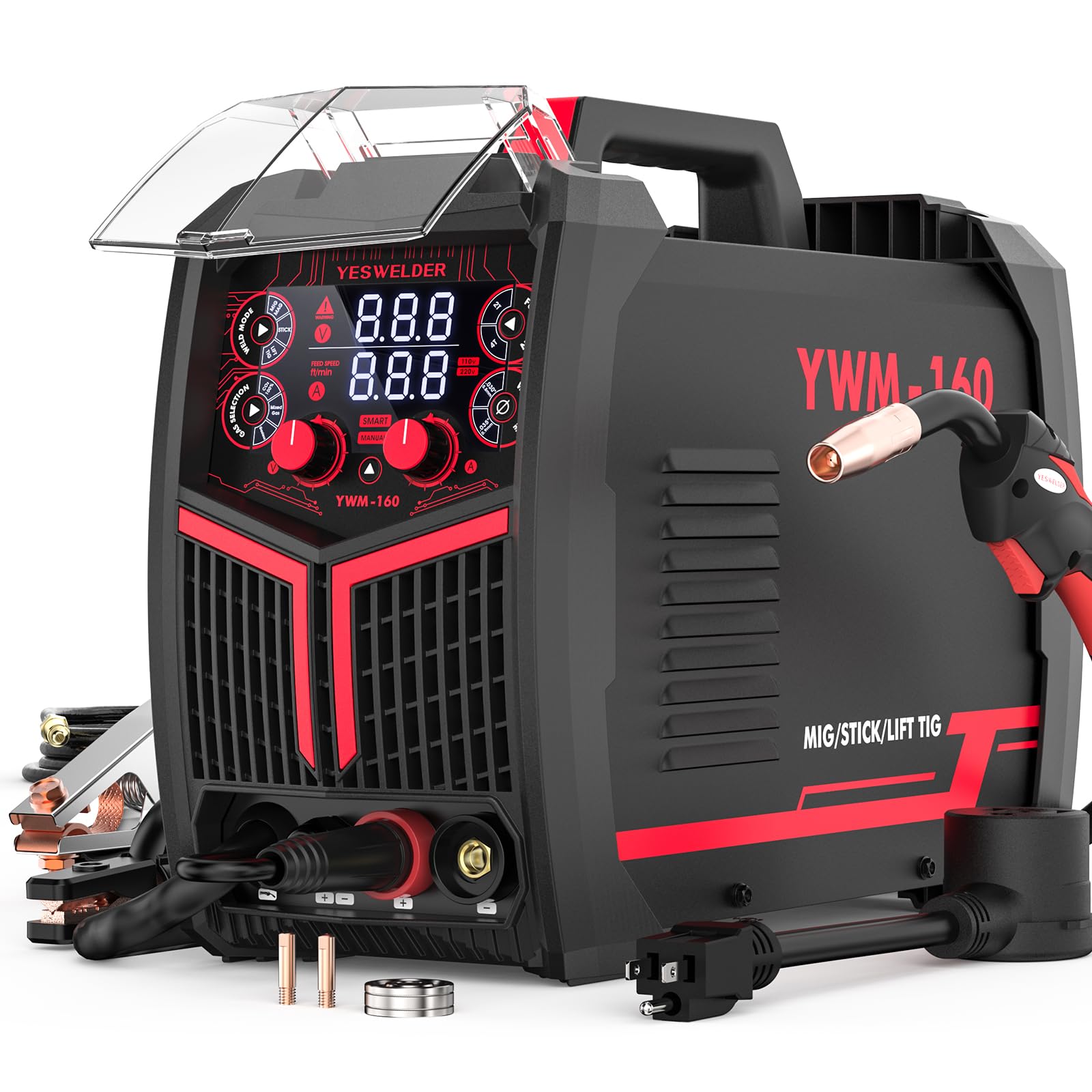
The YESWELDER 160A hits a rare sweet spot: enough power on 110V to weld 1/4-inch mild steel with multiple passes, plus a synergic control system that removes the guesswork for beginners. On 220V, it bumps to the full 160-amp output, giving you overhead for thicker plate without needing to upgrade the machine later. The large LED display shows voltage and wire speed clearly even under bright shop lights — a small detail that saves significant frustration when you’re leaning over a workbench in glare.
Manual adjustment is fully available alongside the smart modes, so experienced welders can override the synergic presets when running 6010 rods or thin-gauge stainless. The unit accepts both 2LB and 10LB wire spools, which is unusual at this price tier — most entry-level machines cap out at 4LB spools. The 0.030-inch flux-core wire included in the kit is serviceable for practice, but you’ll want to swap to a quality solid wire for real structural work.
Customer reviews consistently mention that it outperforms expectations compared to big-box store units at similar price points. Experienced users with Miller and Lincoln shop machines report being impressed by the bead consistency on 220V. The stick mode takes some practice to start cleanly, but once the arc establishes, it runs 6013 rods with steady penetration. For the hobbyist who wants one machine that grows with their skills, this is the anchor choice.
Why it’s great
- Synergic control auto-matches voltage and wire speed for quick setup
- Dual-voltage (110V/220V) with automatic sensing — no switch to flip
- Accepts 2LB and 10LB spools, rare at this price
Good to know
- Stick mode arc start can be finicky on the first strike
- TIG torch not included; must be purchased separately
2. Ehomful 145A 4-in-1 MIG Welder

The Ehomful 145A bundles a 4-in-1 welder with an auto-darkening helmet, gloves, both flux-core and solid wire, a gas hose, and a carrying strap — everything you need to make your first weld within minutes of opening the box. The 145-amp output on 110V handles 3mm (roughly 1/8-inch) steel in a single pass, which covers the majority of home garage projects: trailer repairs, gate hinges, automotive brackets, and light fab work.
The synergic system automatically sets optimal voltage and wire feed speed when you select the wire diameter and material thickness. Manual fine-tuning remains available for when you want to tweak the arc characteristics. The HD digital screen is genuinely legible without removing your helmet — a feature that sounds minor until you’re in a dark corner of a truck bed trying to read tiny numbers. Safety protections include over-current, over-voltage, and overheat auto-shutdown, which gives confidence when running the machine near its duty cycle limit.
Customer feedback highlights that the included accessories are a mixed bag — the auto-darkening helmet can be glitchy in bright sunlight, and the welding gloves are thin gardening-quality. Experienced buyers recommend buying separate gloves and a better helmet. However, the welder itself draws consistent 5-star ratings for its smooth arc, easy setup, and ability to run both gas and gasless wire right out of the box. For budget-conscious first-time buyers, this is the smartest entry point.
Why it’s great
- Complete starter kit with helmet, gloves, and both wire types
- Synergic control makes first-time setup foolproof
- Dual voltage 110/220V with automatic detection
Good to know
- Included auto-darkening helmet can flicker in bright outdoor light
- Included gloves are thin — plan to upgrade immediately
3. HITBOX 140A 3-in-1 MIG Welder
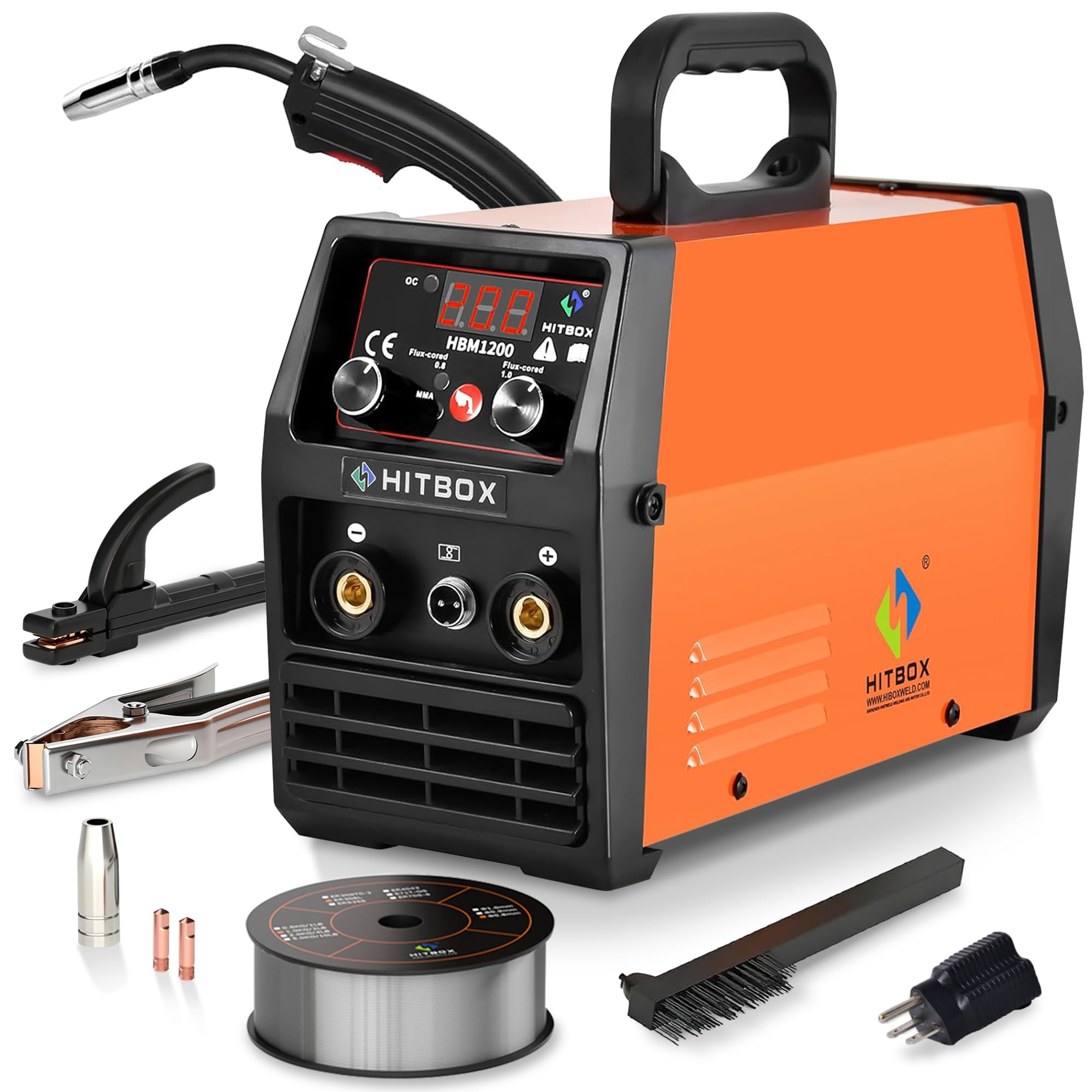
The HITBOX 140A is built for the corner of the shop where wind blows through open doors and gas-shielded MIG becomes a spatter nightmare. It is primarily a flux-core machine on 110V, meaning it requires no shielding gas tank — the flux core wire creates its own gas shield during combustion. That makes it ideal for outdoor repairs on farm equipment, trailers, and fence gates where a breeze would compromise gas MIG quality. The 140-amp output welds carbon steel and stainless from 0.8mm sheet up to 6mm (1/4-inch) plate.
The synergic control auto-matches wire feed speed as you adjust the amperage dial — a single-knob workflow that simplifies the learning curve dramatically. Pros can switch to manual voltage control for fine-tuning. The machine uses IGBT inverter technology with copper windings and a dual 7-fin aluminum heatsink that pulls 46 CFM of air through the chassis. The cooling system is genuinely overbuilt for a 140-amp unit, which means the HITBOX runs a longer effective duty cycle than its spec sheet suggests.
Users consistently report that this welder outperforms comparable Harbor Freight flux-core machines, with smoother arc starts and less spatter. The main criticisms are that the included 220V adapter uses a non-standard outlet that doesn’t match common stove/dryer plugs, and the MIG wire spool capacity is limited to smaller sizes. The ground clamp uses soft metal that can warp under repeated clamping. For dedicated outdoor flux-core work at its price point, this is the most reliable option on the market.
Why it’s great
- Flux-core operation handles windy outdoor conditions without gas
- Overbuilt heatsink and fan system for extended duty cycle
- Synergic one-knob control simplifies setup for beginners
Good to know
- 220V adapter uses an uncommon outlet pattern
- Ground clamp has soft metal that can deform
4. Lincoln Electric 90i FC Weld-Pak

The Lincoln 90i FC is a purpose-built flux-core only machine that weighs 15 pounds and fits inside a shoebox-sized metal case. It is the most portable unit in this roundup — throw it over your shoulder with the included strap and walk up a ladder or into a crawl space. The 90-amp output is intentionally limited; this machine is designed for thin gauge work (14 to 18-gauge sheet metal) where a higher-amperage machine would burn through the material instantly. For classic car restoration, HVAC duct repair, and light hobby steel, it is near perfect.
Unlike the multi-process units, the 90i FC has a simple two-knob interface: one for wire speed, one for infinite voltage adjustment (a smooth 1-to-10 scale rather than a two-position rocker). That infinite voltage range gives you granular control over the arc characteristics on thin metal. The inverter power source produces a noticeably smoother arc than traditional transformer-based flux-core welders, with significantly less spatter. The included metal case protects the machine from jobsite dust and impacts when tossed in a truck bed.
Reviews from restoration shops and mobile welders consistently highlight how clean the welds are on thin automotive sheet metal — one user called it “cheating compared to non-inverter flux core machines.” The trade-offs are real: it only takes 1LB spools, it lacks a handle (only a shoulder strap), and it has no MIG gas capability whatsoever. But for its intended niche — portable, thin-gauge flux-core welding on 110V — nothing else in this price range matches the build quality and arc performance.
Why it’s great
- Extremely portable at 15 pounds with carry strap
- Infinite voltage adjustment (1-10) for precise thin-metal tuning
- Inverter arc is smoother with less spatter than transformer units
Good to know
- Only accepts 1LB wire spools — requires frequent changes
- Flux-core only; no MIG gas capability
5. ARCCAPTAIN 200A 6-in-1 MIG Welder
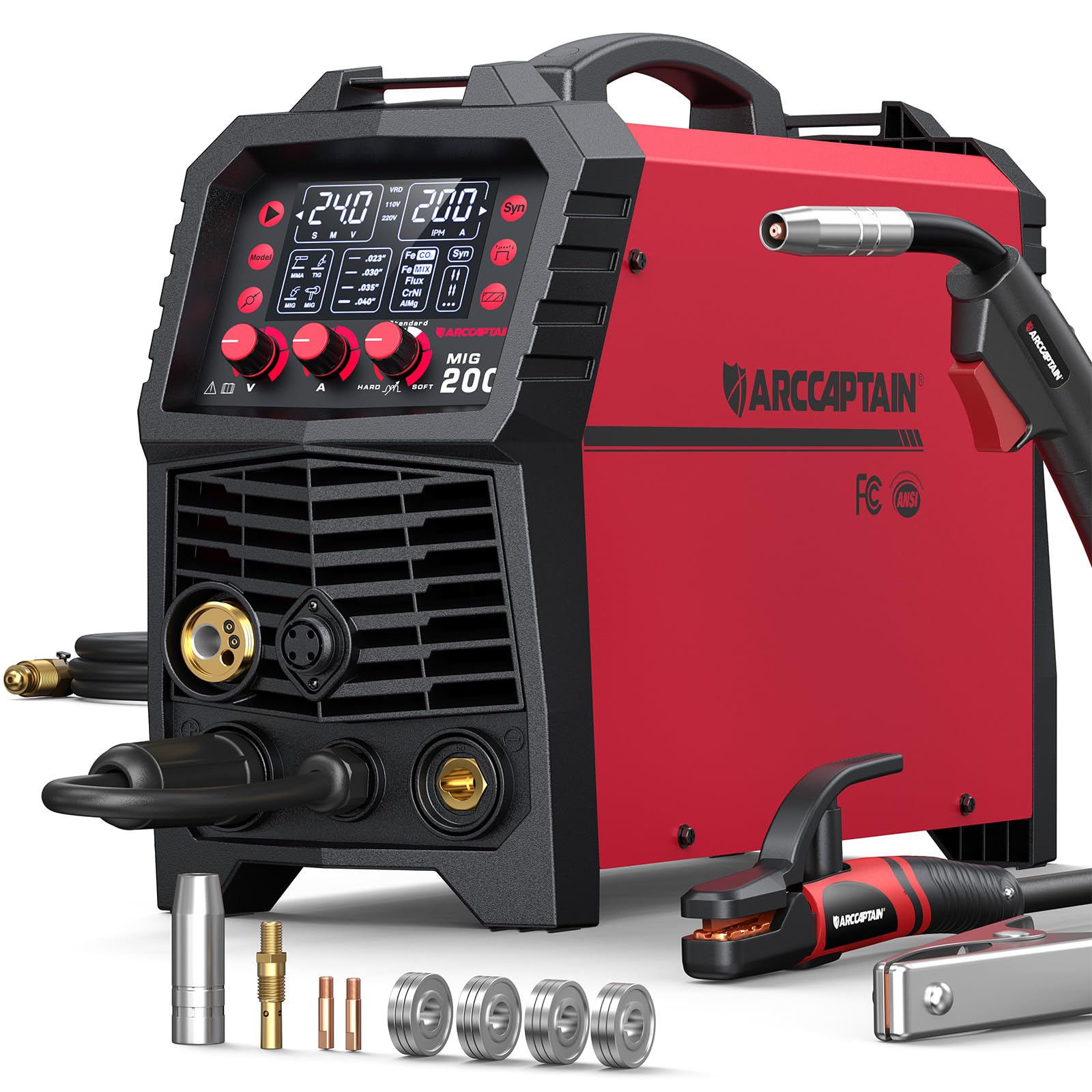
The ARCCAPTAIN 200A is the most feature-dense 110V-compatible welder in this lineup, packing six welding modes into a single chassis: gas MIG, flux-core MIG, stick, lift TIG, spot welding, and spool gun connector (for aluminum). The 200-amp peak output on 220V handles 1/4-inch steel comfortably, while on 110V it still delivers enough heat for most hobby jobs. The synergic digital control automatically selects voltage and wire speed when you input wire diameter and gas type, then lets you fine-tune from there.
What sets the ARCCAPTAIN apart is its software sophistication. It includes adaptive crater fill (which fills the end of the weld bead to prevent cracks), adjustable burn-back time, and pre-flow/post-flow gas settings for MIG mode. The 2T/4T trigger modes give you hands-free welding for long beads. You can store up to 10 groups of parameter presets — a huge time-saver when you switch repeatedly between wire diameters or base metals. The large LED interface is the clearest in this category, with a human-computer interaction layout that displays every parameter at a glance.
Customer feedback from experienced welders is overwhelmingly positive, with many comparing the bead quality to shop machines costing three times as much. The main complaint is that the supplied power cable gauge is thin — it runs warm on 110V at high amperage, and some users worry about it on 220V. The 110/220V pigtail adapter design is also less robust than a dedicated plug solution. For the DIY enthusiast who wants to experiment with TIG and stick without buying separate machines, the ARCCAPTAIN delivers exceptional versatility.
Why it’s great
- Six welding processes in one unit including spot and spool gun
- Adaptive crater fill and burn-back adjustment reduce weld defects
- 10 preset memory slots for quick process switching
Good to know
- Power cable gauge is thin — runs warm at high settings
- TIG torch and spool gun not included
6. LOTOS MIG180SP 180A MIG Welder
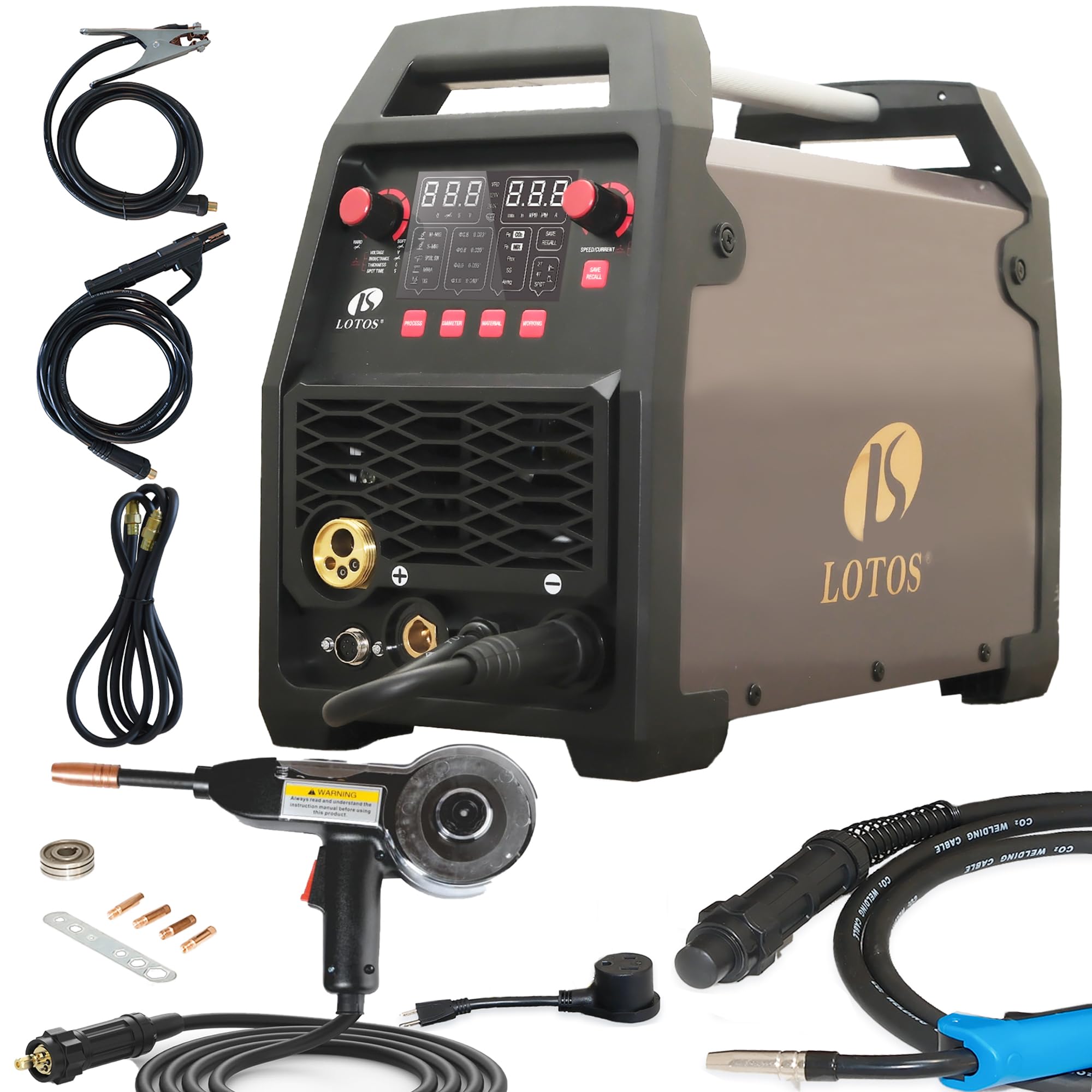
The LOTOS MIG180SP is the first unit in this roundup that ships with a dedicated spool gun for aluminum welding — a 10-foot spool gun that dramatically reduces bird-nesting and feed tangles that plague standard MIG torches with soft aluminum wire. On 110V, it runs strong enough to weld aluminum up to 1/5-inch thick, and on 240V it handles 1/4-inch mild steel with ease. The auto-synergic system sets voltage to match wire feed speed, but the manual voltage trim lets you fine-tune the puddle for cleaner beads on aluminum.
The 6-in-1 capability includes gas MIG, flux-core MIG, stick, lift TIG, spot welding, and the spool gun mode. The included kit covers the essentials: MIG torch, stick holder, ground clamp, gas hose, and a set of drive rollers covering 0.023-inch to 0.040-inch wire. The 240V-to-120V pigtail adapter is included, which saves you the cost of buying one separately. The build quality is robust — the chassis feels denser and more rigid than the entry-level units, with a beefy aluminum wire feeder that provides zero-slip traction on both steel and aluminum wire.
Users upgrading from basic flux-core kits report a night-and-day difference in aluminum weld quality, particularly on thin panels and brackets. The spool gun runs smoothly at low feed speeds where standard torches would bird-nest. The main drawback is weight — at 29 pounds, it’s heavy for a “portable” unit, and the ground cable is on the shorter side at 6 feet. For the home fabricator who needs aluminum capability without buying a separate spool gun, this is the most cost-efficient route into that territory.
Why it’s great
- Dedicated 10ft spool gun included for clean aluminum welding
- Auto-synergic with manual voltage trim for precise puddle control
- 240V-to-120V adapter included out of the box
Good to know
- Heavier than competitors at 29 pounds
- Ground cable is only 6 feet — may need an extension
7. LOTOS MIG225SP 225A MIG Welder

The LOTOS MIG225SP takes the same core platform as the MIG180SP but pushes output to 225 amps, giving you the overhead to weld 2/5-inch structural steel on multi-pass joints and aluminum up to 1/4-inch with the included spool gun. On 110V input, it still delivers enough current for 1/8-inch to 3/16-inch steel with good penetration — but the machine truly shines when connected to 220V, where the additional headroom prevents the duty cycle from cutting out mid-bead. The 10-foot spool gun is identical to the MIG180SP’s unit, and it handles aluminum wire up to 0.040-inch without bird-nesting.
Auto-synergic parameter calibration remains the headline feature: set wire diameter, gas type, and material thickness, and the machine calculates the optimal MIG parameters. The large LED screen displays the adjustments in real time, and the voltage trim knob lets you tweak the arc characteristics without diving into sub-menus. The thermal overload protection is aggressive yet recovers quickly thanks to the heavy IGBT inverter and the aluminum heatsink setup. LOTOS also includes a full set of contact tips from 0.023-inch to 0.040-inch and pre-installed drive rollers for both steel and aluminum.
Early adopters report that the MIG225SP feels like a significant step up from the YESWELDER and ARCCAPTAIN units in terms of build density and arc stability. The spool gun works flawlessly for aluminum out of the box, which is rare — most multi-process welders treat the spool gun as an optional add-on. The main downside is that lift TIG mode lacks a built-in gas solenoid, meaning you need an external argon regulator and manual gas valve. For a serious home fabricator who wants to weld aluminum and thick steel without upgrading for years, the MIG225SP is the best long-term investment in this list.
Why it’s great
- 225A output handles 2/5-inch steel and 1/4-inch aluminum
- Spool gun included for reliable aluminum feed
- Full set of tips and pre-installed dual-purpose rollers
Good to know
- Lift TIG mode requires external gas valve — no built-in solenoid
- Heavy unit at 30 pounds; less portable than compact models
8. Everlast Cyclone 200ES MIG Welder

The Everlast Cyclone 200ES is the unit that shop pros buy as a portable backup or a second station. It uses digital IGBT inverter technology with a 25% duty cycle at 180 amps — a respectable rating for its class. The PowerSet mode simplifies setup by automatically adjusting parameters based on the material thickness you dial in. On 110V, it runs flux-core and small-diameter solid wire competently, but its real strength emerges on 240V, where the 200-amp peak output and the low-spatter arc produce beads that rival Miller and Lincoln machines.
The build quality is visibly higher than the budget-tier units: the LCD display is crisp, the wire feed mechanism has a solid mechanical feel, and the torch connector uses a durable European-style Euro connector rather than a proprietary fitting. The machine supports 0.030- to 0.045-inch flux-core wire and up to 0.035-inch solid wire with the correct drive rolls (not included). It is also spool-gun compatible, making it a viable option for aluminum work with an additional purchase.
Customer reviews from career welders — one with 10 years of experience — specifically praise the Cyclone 200ES for matching the weld quality of their Miller and Lincoln shop machines at roughly a quarter of the cost. The main complaints center on the annoyingly short 4-foot ground cable and the absence of a flux-core drive roller in the box. Everlast customer service is consistently rated highly, with one user reporting a same-day callback and a replacement board shipped within a week. For the welder who prioritizes arc quality and build durability above all else, this is the top pick.
Why it’s great
- Arc quality matches Miller/Lincoln at a fraction of the price
- PowerSet mode simplifies setup for beginners
- Excellent customer support with rapid parts replacement
Good to know
- Ground cable is only 4 feet — plan to replace with 8-foot cable
- Flux-core drive rollers not included; must purchase separately
9. Weldpro 200A 5-in-1 MIG Welder

The Weldpro 200A packs 200 amps of output into a chassis that weighs only 13.7 pounds — making it the lightest high-amp unit in this comparison. It supports five welding modes: gas MIG, flux-core MIG, spool gun (SB8 sold separately), lift TIG, and stick. The dual-voltage capability (110V/220V) with auto-sensing means you can plug into a standard wall outlet for sheet metal work and then switch to a 220V circuit for 1/4-inch plate without any manual switch or adapter fumbling. The large LED display clearly shows all welding parameters at eye level.
What makes the Weldpro stand out is its integration of IGBT inverter technology with an integrated wire feeder that automatically matches voltage and wire speed based on your settings. The spot welding timer is a unique addition — you can set a precise weld time for tacking sheet metal panels, which eliminates burn-through on thin gauge material. The machine is also aluminum-capable via the Weldpro SB8 spool gun, though that is sold separately. The included kit is leaner than the Ehomful bundle but contains all the essential torch, clamp, and gas connections.
Customers who have owned this unit for two-plus years report zero functional issues, with one user noting that the price has dropped significantly since their initial purchase. The fan auto-shuts off when not welding, which dramatically reduces noise in the shop between beads. The TIG mode works for simple DC TIG on steel and stainless, but experienced users note that the included torch is not TIG-compatible and the argon regulator included with some kits is unreliable. For the welder who wants a lightweight, powerful, multi-process machine that can do steel, stainless, and aluminum (with the spool gun), the Weldpro 200A is a compelling top-tier choice.
Why it’s great
- Only 13.7 pounds while delivering 200-amp output
- Spot welding timer prevents burn-through on thin sheet metal
- Quiet auto-stop fan reduces shop noise
Good to know
- Spool gun for aluminum sold separately
- Kit argon regulator reported as unreliable by some users
FAQ
Can a 110V MIG welder weld 1/4-inch steel in a single pass?
What size wire should I use with a 110V MIG welder?
Do I need shielding gas for a 110V MIG welder?
Will a 110V MIG welder trip a standard 15-amp breaker?
Final Thoughts: The Verdict
For most users, the best 110 volt mig welder winner is the YESWELDER 160A because it balances synergic control, reliable arc quality, and dual-voltage flexibility at a price that doesn’t force you to compromise on spool capacity or build quality. If you primarily weld outdoors and need gasless flux-core portability, grab the HITBOX 140A for its overbuilt cooling system and wind-resistant arc. And for the ambitious fabricator who wants thick-plate structural capacity and aluminum welding with a dedicated spool gun, nothing beats the LOTOS MIG225SP for its power ceiling and professional-grade arc stability.