
Our readers keep the lights on and my morning glass full of iced black tea. As an Amazon Associate, I earn from qualifying purchases.
Specs are compiled from manufacturer listings and verified buyer reviews and can change over time — please confirm the key details on the product page before buying.
If your home only has a standard wall outlet and no dryer vent, you can still do laundry without a trip to the laundromat. The catch is drying speed: ventless machines run on 110 volts, and that lower power means a full wash-and-dry load often takes hours rather than one. That trade-off is the single most important thing to understand before you buy one of these machines.
I’m Min — the founder and writer behind Gadgets Feed. This guide is built by comparing the manufacturers’ published specifications and the patterns across verified customer reviews, so you get each pick’s real strengths and trade-offs instead of marketing spin.
This guide breaks down drum capacity, spin speed, and real drying times so you can match a machine to your space. Because every unit here plugs into a standard outlet with no venting, the picks below show how to choose the best 110 Volt Washer And Dryer for apartment, RV, or small-home laundry.
Our Picks at a Glance

How To Choose The Best 110 Volt Washer And Dryer
The defining constraint here is electricity. These machines run on 110 volts (or 120 volts — the same standard household outlet), and they dry without a vent by condensing moisture out of the air. No rewiring, no ductwork, no contractor visit. The trade-off is that ventless drying is slower, so the spec sheet matters more than it does with a traditional 220-volt set. Here is what to weigh before you commit.
Match capacity to how much laundry you actually generate
Drum capacity is measured in cubic feet (cu. ft.) or pounds of dry laundry. A 1.62 cu. ft. drum suits one person or a couple in a tight space. A 2.7 cu. ft. drum is the common middle ground — it fits roughly a half to three-quarter load of everyday clothes. A 5.0 cu. ft. drum holds enough for a family, but the unit itself is a full-size appliance that needs the floor space to match. Underloading is a real habit with combos, so buy slightly more capacity than you think you need.
Understand what spin speed does for you
Spin speed, measured in RPM (revolutions per minute), is how fast the drum turns during the final spin to fling water out of the fabric. Higher spins leave clothes drier going into the dry cycle, which shortens drying time. A 1400 RPM spin pulls more water out than a 1300 RPM spin. This is the closest thing you get to a lever on drying speed without changing the electrical supply.
Check the door and the vent before the machine arrives
Ventless means you can place a unit in a closet or cabinet, but the door still needs room to swing. Depth with the door open is the number that decides whether a built-in spot works. Some machines are designed to sit flush against a wall or inside cabinetry with zero clearance, and others need a much larger clearance behind and around them. Measure the open-door depth, not just the closed unit.
Decide if you want one unit or two
An all-in-one combo washes and dries in the same drum — you load once and walk away. A stackable or side-by-side pair lets you wash a second load while the first dries, which cuts total laundry time. Combos lean on the convenience of never transferring wet clothes; pairs win on throughput. For an RV or a tiny apartment, the single unit usually wins on space.
Quick Comparison
| Model | Best For | Capacity | Spin Speed | Power Source | Amazon |
|---|---|---|---|---|---|
| Equator Premium Stackable 15 Lbs Washer + Digi Dryer★ Best Overall | RV and camper owners who want separate wash and dry | 1.62 cu. ft. (13 lb dry) | — | 110V, vented | Amazon |
| Midea All-in-One Ventless ComboBest Value | Tight spaces where a single machine is the only option | 2.7 cu. ft. | 1400 RPM | 120V, ventless | Amazon |
| BLACK+DECKER BCW27MW Combo | Renters replacing a dishwasher-sized gap | 2.7 cu. ft. (26.5 lb wash / 13.2 lb dry) | — | 120V, ventless | Amazon |
| Equator Built-In 0-Clearance Combo | Built-in cabinetry with zero clearance | 1.62 cu. ft. (15 lb) | 1400 RPM | 110V, ventless | Amazon |
| SMETA 2-in-1 Ventless Combo | Apartments and RVers who value quiet operation | 2.7 cu. ft. | — | 120V, ventless | Amazon |
| KoolMore FLC-3CWH Combo | Full-time campers and dorm rooms | 2.7 cu. ft. | 1300 RPM | 120V, ventless | Amazon |
| LG Mega Capacity Smart Combo | Families who want smart features and a big drum | 5.0 cu. ft. | — | 120V, ventless | Amazon |
In‑Depth Reviews
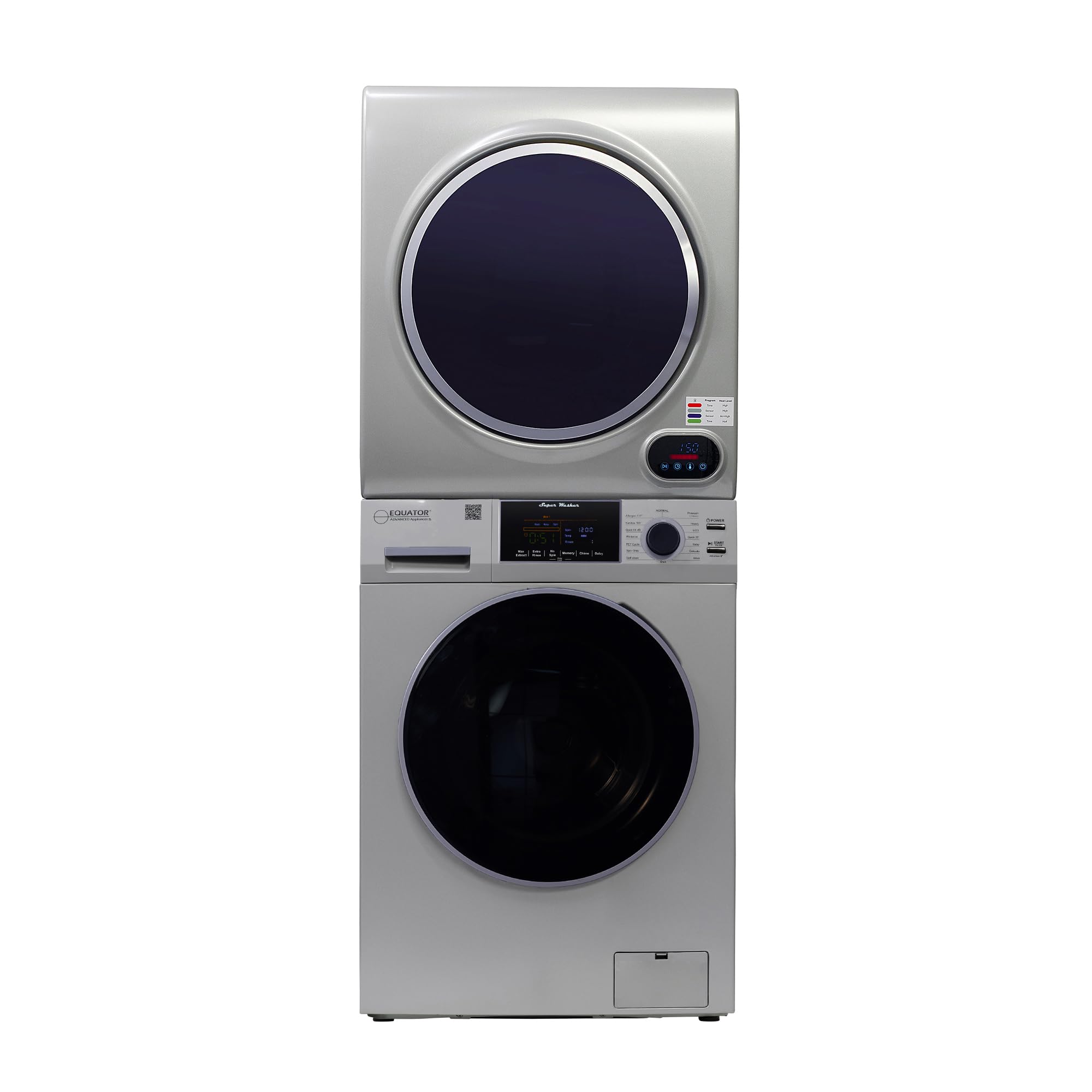
1. Equator Premium Stackable 15 Lbs Washer 1.62cf 110V + Vented Digi Dryer 3.5cf 110V (Silver)
Our pick — over 4★ from 30+ verified ratings; the strongest balance of quality and price.
The only stackable pair here that runs a wash and a dry cycle at the same time.
You can wash one load while the other dries, so laundry day moves twice as fast. That is why the Equator EW 826 washer and ED 852 dryer earn the top spot here. They are a stackable pair, not an all-in-one combo, and they come with a stacking kit (the hardware to bolt one on top of the other). In an RV or a tight utility closet, that means you run both machines at once instead of waiting for the wash to finish before you start drying.
The washer runs 12 wash cycles covering ECO, Baby, Delicate, Quiet, and a dedicated PET Cycle built to pull out pet fur. The dryer uses Sensor Dry, which reads the moisture level and stops when the load is dry instead of running on a fixed timer. Touch buttons control both, and there is a child lock for safety during operation. The pair fits into a footprint that suits a camper or small home, and the finish is stainless steel.
What wins owners over is running both machines at once — reviews single out the fast wash and dry times. The trade-off worth knowing: this pair is a separate washer and dryer, not a single combo you load once. You still move wet clothes from washer to dryer. Buyers also note it cannot fit heavy quilts, so it is best for standard clothing loads. As buyers put it: “First washer was not working properly after we moved it into our 5th wheel. Contacted them and 2 weeks later we have a new one that’s working great.” The recurring gripe is the dryer’s lint trap — it is hard to reach and hard to clean, so plan to work at it.
What earns its top spot
- Wash and dry two loads at once — washer and dryer run simultaneously
- 12 wash cycles including ECO, Baby, Delicate, and a PET Cycle for fur removal
- Sensor Dry stops the dryer when the load is actually dry, saving energy
- Stacking kit included, so the pair fits a small footprint
- Touch controls with a child lock for safety
What to weigh first
- It is two machines, so you still transfer wet clothes between them
- The lint trap is awkward to reach and clean
- Too small for heavy quilts — best for everyday clothing loads
Top of the list for: RV and camper owners who want washer and dryer running side by side and will trade a little manual handling for speed.
Reconsider if: you want to load once and walk away, or you regularly wash bulky bedding — a single-drum combo or a larger unit suits you better.
2. Midea Washer Dryer Combo 2.7 Cu.ft 24″ All-in-One Front Load 1400 RPM White
One drum, 1400 RPM spin, and a footprint built for the tightest laundry closet.
If space is your hard limit, the Midea’s 23.4″D x 25.2″W x 33.5″H frame earns its place. It measures 23.4″D x 25.2″W x 33.5″H, so it tucks into apartment closets and RV bays that a full-size set would never fit. Spin speed is 1400 RPM, which flings more water out of the fabric before the dry cycle begins. The BLDC inverter quattro motor carries a 10-year warranty, and the unit runs on a standard 120V outlet with no venting required.
This is where the physics catch up. Depth with the door open runs to 42.4 inches — compare that to the Equator pair at 21.85 inches, and you can see the Midea needs far more clearance in front of it. On energy, it uses 90 kilowatt hours per year, a little under the Equator pair’s 96. The control panel offers 16 programs plus 6 extra features, including steam care, overnight wash and dry, quick wash, and air fluff.
Owner consensus is blunt and consistent: setup is easy, the compact footprint fits RVs and small apartments, and it runs quiet. Noise appears as a mixed topic in feedback — decent in wash, less predictable in a fast spin. What buyers keep coming back to is how long the dry takes. One owner logged it plainly: “Full wash+dry cycle takes 6hr 28min; wash-only 1hr 28min.” The default dryer program runs 4 hours, and the wash-and-dry program runs 6. Midea also warns you must remove the transport bolts before first use — skip that and the unit will shake hard on spin.
Where it wins: the smallest full-load footprint with a high 1400 RPM spin, ideal for a closet or RV bay where a stacked set will not go.
Plan your day around it: a complete wash-and-dry cycle can run 6 hours or more, so start a load overnight or before you leave the house rather than waiting on it.
Built for: apartment dwellers and RV owners who need the most capable wash in the least floor space and can let a load run for hours unattended.
Look elsewhere if: you expect a load finished in an afternoon — a vented separate dryer is the only way to move that fast.
3. BLACK+DECKER Washer and Dryer Combo, 2.7 Cu. Ft. Capacity, BCW27MW, White

Dishwasher-sized at 2.7 cu. ft., it slides into a kitchen gap you already have.
The BCW27MW is the machine for renters and urban dwellers who are squeezing laundry into a space that was never built for it. The dimensions — 23.1″D x 23.4″W x 33.5″H — are close enough to a dishwasher that you can install it where one would sit. Drum capacity is 2.7 cu. ft., rated to wash up to 26.5 lbs. and dry up to 13.2 lbs. per load. It runs on a standard 120V socket with no exhaust required, so no contractor and no new wiring.
There are 16 cycles to choose from: My Cycle, Quick Wash, Delicates, Wool, Baby Wear, Sanitary, Cold Wash, Tub Clean, Normal/Cotton, Permanent Press, Heavy Duty, Bulky/Large, Sports Wear, Spin Only, Drain Only, and Rinse & Spin. Drying runs on Auto Dry or Timed Dry, and the transparent front lid lets you watch the wash and dry progress without guessing. The interior tub is stainless steel, and annual energy use is 90 kWh.
The dishwasher-sized 23.1″D x 23.4″W x 33.5″H frame is the headline. Reviews range widely, so read the caveats as fit notes rather than deal-breakers: it is genuinely built for one or two people, and families of three or more will find loads too small and cycles too slow. The wash side draws mixed feedback for running longer than advertised. A handful of buyers report vibration that is severe if the four shipping bolts are not removed first. The frequency of complaints about the manual is unusually high — the print is tiny, so find the online copy. Drying time runs long, as expected for ventless. If your household is one or two people and your space is the tightest of all, this is the compact answer.
Best fit: a single person or couple installing laundry into a kitchen or hall gap the size of a dishwasher.
Not your machine if: you have a family generating several loads a week — the load size and cycle time will frustrate you.
4. Equator All-in-one Washer Dryer Ventless FULLY BUILTIN 0-CLEARANCE 1.62cf/15lbs 110V 1400RPM
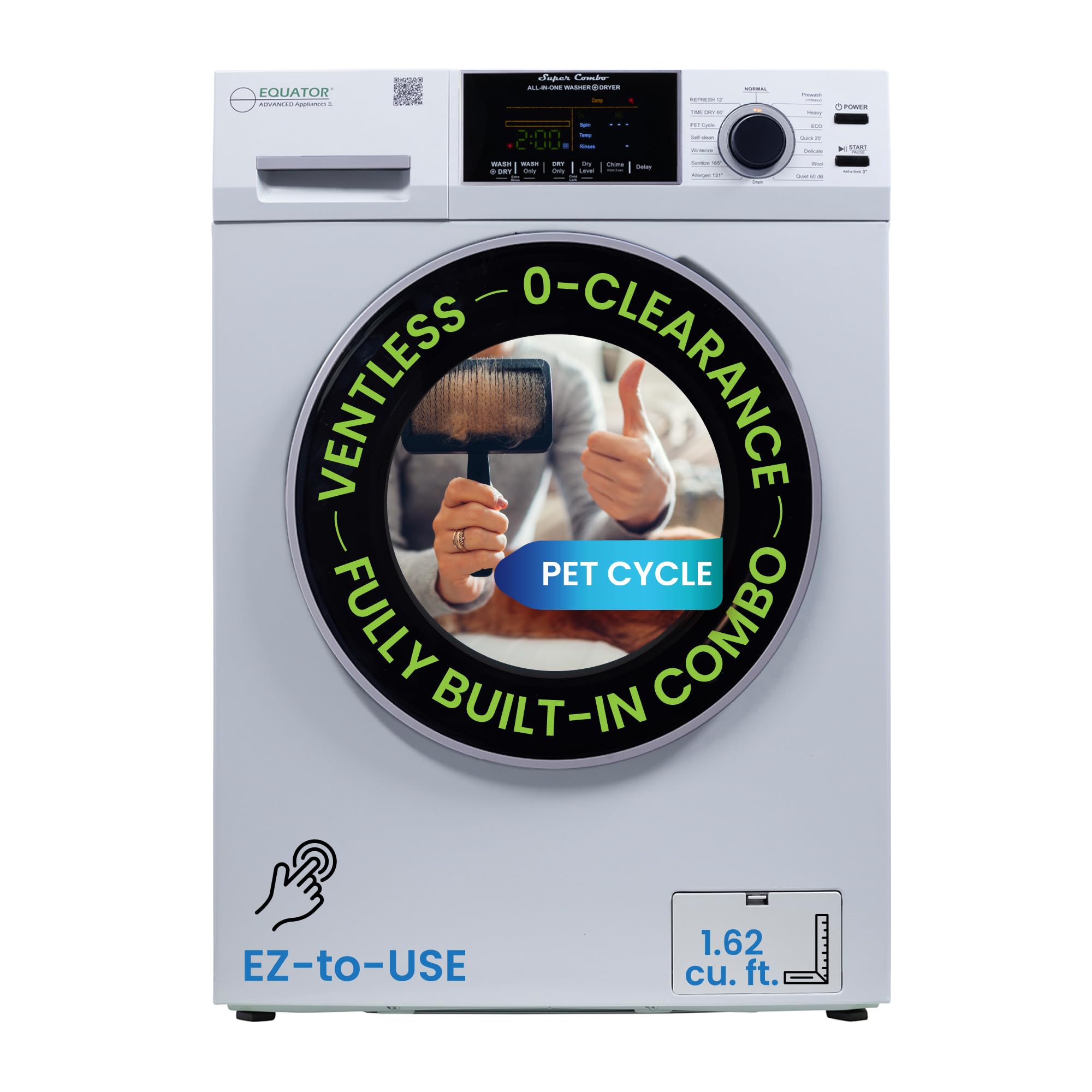
Zero clearance lets the door swing fully open even flush inside cabinetry.
For anyone finishing a kitchen or utility closet with built-in appliances, this is the unit that solves the geometry problem. “Zero clearance” means the machine can sit flush against a wall or inside a cabinet and the door still swings all the way open — no gap reserved behind it. It spins at 1400 RPM, runs on 110V with no venting, and fits a compact 1.62 cu. ft. drum rated for 15 lbs. of laundry in a 24-inch-wide frame.
There are 15 wash and dry programs, including a Quiet mode rated at 60 dB, a Time Dry, a 12-minute Refresh, and a Salt Wash, plus a dedicated PET Cycle for hair removal. The drum is stainless steel, and an angled 45-degree door handle is shaped to cut down on bending during loading. Touch controls and an LED display handle the interface. Dimensions sit at 21.8″D x 23.6″W x 33.5″H.
Here is the honest trade-off. This is the lowest-capacity machine in the lineup at 1.62 cu. ft., so keep loads small. Owner feedback on quality and reliability splits down the middle — some machines run well for years, others report a dryer failure early on. Drying time is a recurring theme in both directions: fast loads delight, slower ones disappoint. Small overstuffed loads come out wrinkled, so run less per cycle than you would expect. Built-in looks are the reason to pick this one, not raw capacity.
The install story: zero clearance plus a front door that opens all the way means you can tuck this into a cabinet run without leaving clearance behind or beside it — a rare fit for true built-in spaces.
Keep loads light: at 1.62 cu. ft. rated for 15 lbs., overloading is the fastest route to wrinkled, semi-damp results. Smaller, more frequent loads work best.
Made for: a finished kitchen or utility closet where the machine has to disappear into cabinetry and match a built-in look.
Think twice if: you need to wash anything bulky or large — the small drum is a hard ceiling, not a guideline.
5. SMETA Washer and Dryer Combo, 120V All In One Ventless Compact 2.7 Cu.ft

A 2.7 cu. ft. drum that runs quietly enough for second-floor apartment living.
For apartment dwellers sharing a wall or floor with neighbors, the SMETA’s selling point is quiet operation. Owners consistently describe it as running softly, with the spin barely noticeable. The drum is 2.7 cu. ft. in stainless steel, sized for families of two to three people, and the unit runs on a standard 120V outlet with no venting. Drying temperature is held below 120 degrees Fahrenheit through temperature-sensing technology to protect fabric, and the unit is UL Energy Verified.
There are 16 washing and drying programs covering cotton, silk, baby wear, underwear, bulky/large, and wool, controlled by a simple knob. A child lock keeps little hands out during operation. It fits into tight spots: apartments, small homes, dorms, and RVs. Note that you must remove the transport bolts before first use — SMETA spells out the three-step process, and skipping it causes the violent shaking some owners mention.
What wins buyers over is quiet, capable function at a fair price — washing performance is the most-praised quality in owner reviews, and it cleans well without much noise. The review consensus lands on drying as the mixed point: some report reasonable times if you do not overload, others find it slow. When an owner got a faulty first machine, SMETA replaced it immediately. One reported the first unit arrived mislabeled as “Smod” rather than Smeta, so check the label on delivery. If quiet is your top priority in a shared building, the SMETA is your pick.
Where it shines
- Quiet enough for second-floor apartments — owners barely notice the spin
- 16 programs covering cotton, silk, baby wear, bulky, and wool
- Temperature sensing holds drying below 120 degrees Fahrenheit to protect fabric
- UL Energy Verified for lower utility use
- Child lock for safety during operation
Know before you buy
- Drying time is mixed — generous if you keep loads moderate, slow if you overload
- Transport bolts must be removed before use or it shakes hard on spin
- Check the label on arrival — one unit shipped mislabeled
Ideal for: apartment and RV owners who share walls and want the quietest wash-and-dry in this lineup, plus a brand that swaps faulty units fast.
Skip if: you run heavy, frequent family loads and cannot tolerate a slow dry cycle.
6. KoolMore 2-in-1 Front Load Washer and Dryer Combo, 2.7 Cu. Ft., FLC-3CWH

A ventless combo built to survive rough roads in a bus or camper conversion.
The KoolMore FLC-3CWH is a 2.7 cu. ft. front loader that was designed with mobile living in mind. It offers 16 washing cycles and 4 drying cycles — more drying choices than most combos here — plus a fast 20-minute wash. Spin speed tops out at 1300 RPM on a stainless steel drum, and it runs ventless on 120V. The unit is UL listed and UL energy verified, and carries a 1-year parts and labor warranty.
Reviews keep praising the 2.7 cu. ft. drum, the easy setup, and a footprint that fits snug into RV bathrooms and dorm corners. It fits small loads well, which is exactly the point for a camper or single-person setup. One full-time camper chose it over GE and LG models specifically because it had a smaller footprint but a larger 2.7 cu. ft. drum than a 2.4 cu. ft. competitor, and it reportedly handled rough roads well strapped down on anti-vibration pads.
Two honest notes. Drying performance draws mixed feedback — it does dry, but slowly, and the 4-hour pants cycle is a common reference point. Some customers note strong vibration on the spin, though others say it is quieter and steadier than expected, which points to leveling and shipping-bolt removal as the deciding factors. The manual is unclear on the wash-and-dry combined cycle, so plan on some trial and error. For full-time campers and dorm rooms, the mobile-friendly build and dual cycle counts make it a strong pick.
Great for: full-time campers and dorm residents who want more drying-cycle flexibility and a towing-tough build in a small footprint.
Not the pick if: you hate fiddling with settings — the manual leaves the combined wash-and-dry cycle unclear.
7. LG 5.0 cu. ft. Mega Capacity Smart Front Load Electric All-in-One Washer Dryer Combo with TurboWash360 WiFi in Black Steel

A 5.0 cu. ft. drum — the biggest here — with app control and TurboWash360.
If you want a full-size laundry experience on a standard outlet, the LG leads on sheer capacity. At 5.0 cu. ft., it holds far more than any other combo in this lineup, which matters for families who wash towels and bedding in volume. It runs on a standard 120-volt household outlet, dries ventless, and is an ENERGY STAR certified washer. The LG ThinQ app lets you monitor cycles remotely, get notifications, and download extra wash programs. Annual energy consumption is listed at 479 kilowatt hours per year.
The smart features are the draw here — auto detergent dispensing with an over-suds detector, drain filter alerts, tub clean tracking, and app notifications that tell you when a load is done. TurboWash360 and a Speed Wash cycle trim time on smaller loads. One owner upgrading from an older LG combo noted the drum size roughly doubled, and reported better drying and a faster turbo wash than the machine it replaced.
Be clear-eyed about the trade-offs. Performance is the quality owners praise most, with the wash itself doing its job well and cycles running economically. The mixed point is drying and cycle time: a full wash-and-dry can stretch to several hours, and one owner reports cycles repeating up to seven hours with no error code. It is a one-load-at-a-time machine, so for a family of four it is slow. Large or mixed loads dry unevenly — towels and small pieces perform best. The lint trap on top needs careful cleaning to avoid jams. For a person or couple who wants the biggest drum and app control, it is the premium choice.
The capacity win: a 5.0 cu. ft. drum, larger than any other combo here, so bedding and towel loads fit that smaller units turn away.
The smart stuff: ThinQ app control, remote monitoring, downloadable programs, and an auto detergent dispenser with an over-suds detector keep the machine low-effort once it is set up.
Best for: a person or couple who wants the largest drum, ENERGY STAR certification, and app-connected convenience, and who does not mind a slow full cycle.
Not ideal if: you are a busy family of four — one load at a time with multi-hour cycles will not keep up with your pile.
Understanding the Specs
Capacity: Cubic Feet and Pounds
Capacity is listed either as drum volume in cubic feet (cu. ft.) or as a weight in pounds of dry laundry. A 1.62 cu. ft. drum suits one person; a 2.7 cu. ft. drum covers a small household; a 5.0 cu. ft. drum handles family-sized loads. On combos, the wash and dry ratings often differ — the same machine might wash up to 26.5 lbs. but dry only 13.2 lbs., because drying the full wash load in one pass is not realistic. Always match your real weekly load size to the smaller of the two numbers.
Spin Speed: RPM
Spin speed (RPM, revolutions per minute) is how fast the drum spins to squeeze water out before drying. Higher spin speeds extract more water, which shortens the drying phase that follows. The combos here range up to 1400 RPM. If drying time tops your worry list, a higher-RPM machine gets clothes drier going in, so the ventless dry cycle has less work to do.
Ventless vs. Vented Drying
A vented dryer pushes hot, damp air outdoors through a duct, which is faster but needs a duct and a wall to run it through. A ventless dryer condenses the moisture and drains it away, so it needs no ductwork and can sit anywhere with a standard outlet. The price is speed: ventless drying is slower by design. That is the single fact that explains why the setups here dry in hours, not in one.
Clearance and Door Swing
The number that decides if a unit fits your spot is depth with the door open, not closed. Some machines need a large clearance in front to open the door and load the drum; others, like a zero-clearance built-in, open fully even flush against a wall. Measure the open-door depth against your space before you buy, and check whether a machine is stackable if you plan to place a dryer above it.
FAQ
Can a 110 volt washer and dryer run on a normal household outlet?
Why do ventless combos take so long to dry clothes?
Is a stacked washer and dryer better than an all-in-one combo for an RV?
What drum size do I need for one person?
Do I need to remove transport bolts before using a combo washer dryer?
Can a 110V washer dryer be installed in an apartment building?
What spin speed should I look for in a compact combo?
Do ventless washer dryer combos need a lint trap I have to clean?
How much laundry can a 2.7 cu. ft. combo handle at once?
Is a vented or ventless dryer better for a small home?
Final Thoughts: The Verdict
For most RV and small-space buyers, the 110 volt washer and dryer winner is the Equator Premium Stackable Washer + Digi Dryer because it is the only pick that lets you wash and dry at the same time — the fastest laundry turnaround without rewiring or a new vent. If you want one machine that runs on a plain outlet and fits the tightest closet, grab the Midea All-in-One Ventless Combo. And for the largest drum plus app control, the LG Mega Capacity Smart Combo is the one to reach for.
How We Picked
We do not accept paid placement. Every pick is matched to a real buyer and a real use-case; we do not hands-on test units.
Sources & Methodology
Specifications: manufacturer listings and product documentation. Review insights: verified customer reviews, as of September 2026. Pricing: not shown on this page (it changes often); check the current price via the retailer link.
As an Amazon Associate, Gadgets Feed earns from qualifying purchases. This does not affect which products we feature.