
Our readers keep the lights on and my morning glass full of iced black tea. As an Amazon Associate, I earn from qualifying purchases.
Specs are compiled from manufacturer listings and verified buyer reviews and can change over time — please confirm the key details on the product page before buying.
When the grid goes down, a 11000 watt generator is the difference between a minor inconvenience and a full-blown crisis. These machines can power your entire home—fridge, well pump, lights, and even your central AC—all at once. The challenge is choosing the right one from a sea of specs, fuel types, and price tags that all promise the same thing: backup power you can count on.
I’m Min — the founder and writer behind Gadgets Feed. This guide is built by comparing the manufacturers’ published specifications and the patterns across verified customer reviews, so you get each pick’s real strengths and trade-offs instead of marketing spin.
if you need a reliable dual-fuel workhorse or a whisper-quiet inverter for sensitive electronics, these reviews break down why each model earns its spot as a top 11000 watt generator for your home, job site, or RV.
Our Picks at a Glance


How To Choose The Best 11000 Watt Generator
An 11,000-watt generator is a serious investment, and the wrong choice means either buying more machine than you need or getting stuck without enough power when it counts. Here are the three specs you should focus on first.
Surge vs. Running Watts: The Real Number
The “peak” or “surge” wattage is the jolt of power needed to start a motor—like a well pump or air conditioner kicking on. The “running” or “rated” wattage is what the generator can sustain. A generator that advertises 11,000 surge watts might only deliver 8,000 running watts. Always compare the running wattage to your home’s actual steady load, not the peak number.
Fuel Type: Dual Fuel vs. Tri-Fuel vs. Gasoline Only
Dual fuel generators let you switch between gasoline and propane (LPG). Tri-fuel adds natural gas, which gives you a connection to your home’s gas line for near-endless runtime during a long outage. Gasoline-only models are simpler and cheaper but require you to store fuel and deal with carburetor gumming if left unused for months.
Noise Level and Inverter Technology
Conventional generators are loud—often above 70 decibels. Inverter generators use advanced electronics to produce clean power (under 3% total harmonic distortion, or THD) and automatically adjust engine speed to match the load, which cuts noise and fuel consumption dramatically. If you plan to run computers, TVs, or modern refrigerator boards, an inverter is the safer choice.
Quick Comparison
| Model | Best For | Surge Watts | Fuel Type | Run Time (50% Load) | Amazon |
|---|---|---|---|---|---|
| WEN DF1100T★ Best Overall | Best Value Dual Fuel | 11,000W | Dual Fuel | 8.5 hrs | Amazon |
| Westinghouse iGen12000TFcPremium Inverter | Quiet Inverter Power | 12,000W | Tri-Fuel | 19 hrs | Amazon |
| Champion 201407Quiet Powerhouse | Inverter Power for Sensitive Electronics | 11,000W | Gasoline | 15 hrs | Amazon |
| Gidrox GNV | Longest Runtime | 11,000W | Tri-Fuel | 21 hrs | Amazon |
| Westinghouse WGen12500DF | Remote Start Convenience | 12,500W | Dual Fuel | 12 hrs | Amazon |
| WEN DF1100X | Dual Fuel with CO Shutdown | 11,000W | Dual Fuel | 8.5 hrs | Amazon |
| DuroStar DS13000MX | High Power with CO Alert | 13,000W | Dual Fuel | — | Amazon |
| Pulsar G12KBN-SG | Long Run Time on Gasoline | 12,000W | Dual Fuel | 12 hrs | Amazon |
| Generac GP9500 Tri-Fuel | Tri-Fuel Flexibility | 12,500W | Tri-Fuel | 9.5 hrs | Amazon |
| GENMAX GM10500iETC | Tri-Fuel Inverter with ATS | 10,500W | Tri-Fuel | — | Amazon |
In‑Depth Reviews
1. WEN DF1100T
Our pick — over 4.5★ from 1,500+ verified ratings; the strongest balance of quality and price.
The most-reviewed 11kW dual fuel generator, proven through thousands of outages.
This generator has 1,873 ratings and a 4.6-star average, making it the most customer-verified pick on the list. It produces 11,000 surge watts (8,300 running) on gasoline and 9,500 surge watts (7,500 running) on propane. The 457cc 4-stroke OHV engine starts with a key turn, and the 6.6-gallon tank delivers up to 8.5 hours of runtime at half load. One customer observed using it for 36 hours straight during Hurricane Zeta, powering two fridges, two HVAC units, lights, and electronics without issue.
The control panel has four 120V GFCI outlets, a 120V 30A twist-lock outlet (L5-30R), a 120V/240V 50A outlet (NEMA 14-50R), and a 12V DC cigarette-lighter plug. It includes a 47-inch LPG hose and a two-year warranty. Buyers praise its value, dual-fuel efficiency, and the built-in meters, though some note it lacks an amp/watt meter and that the manual start is hard if the battery dies.
One owner who ran it for 2+ years in Texas through multiple multi-day outages called it perfect, noting that WEN replaced a defective battery free of charge. The fuel tank can develop a vacuum issue that some resolve with a pressure relief valve.
Why It’s a Top Seller
- Proven reliability with thousands of positive reviews
- Dual fuel gives you gasoline and propane flexibility
- 50A outlet is transfer switch ready for home backup
- Great value for the power output
Common Complaints
- No amp/watt meter to track load in real time
- Loud operation compared to inverter models
- Dirty waveform can cause UPS battery chargers to not work
Best for budget-minded buyers: If you want proven, affordable 11kW power in a dual-fuel package and don’t mind noise, this WEN is the safe bet.
skip it if: You need clean, inverter-grade power for sensitive electronics or require a CO shutdown sensor for safety.
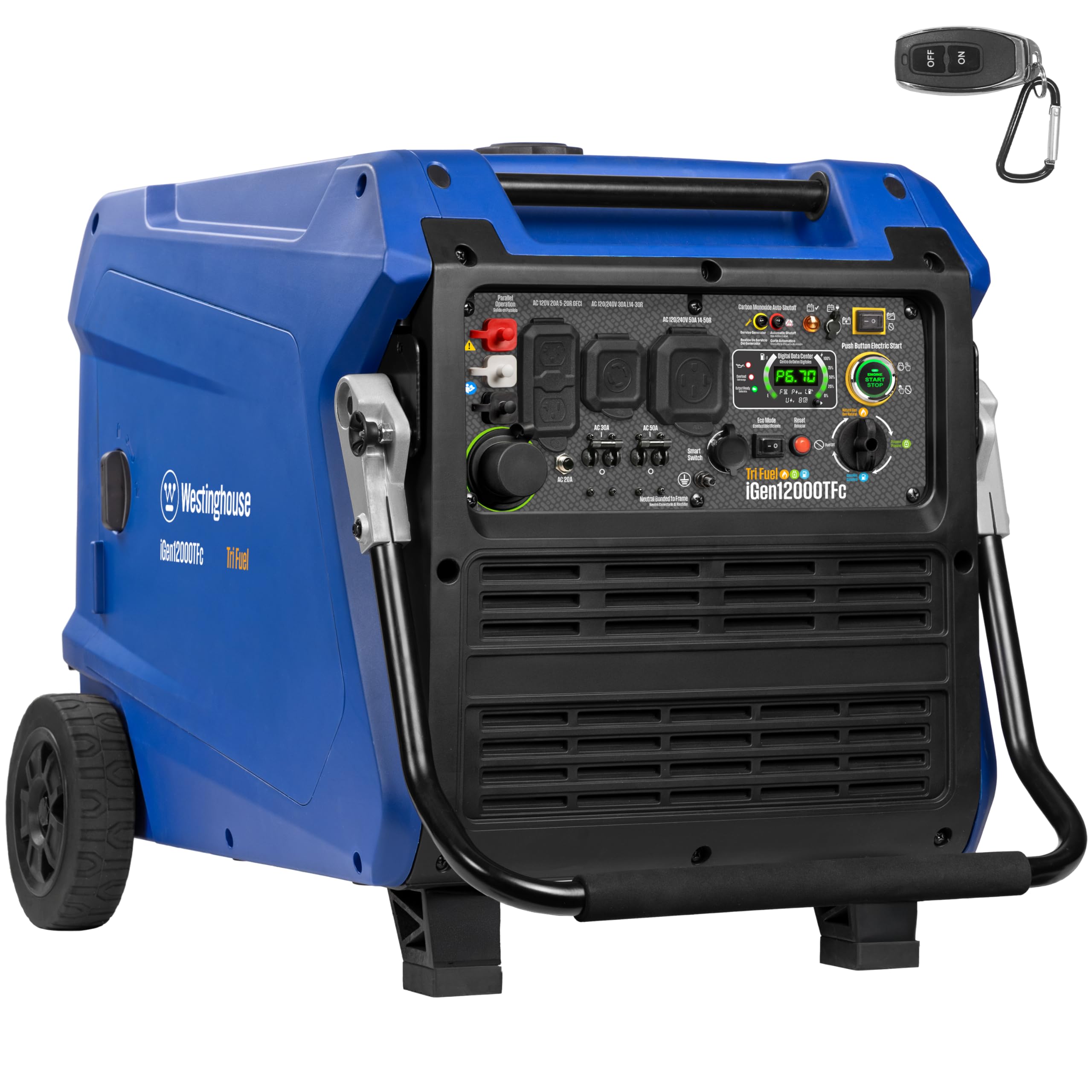
2. Westinghouse iGen12000TFc
This inverter delivers whole-home backup power with whisper-quiet operation.
This tri-fuel inverter generator runs on gasoline, propane, or natural gas, so you have three ways to keep the lights on. It delivers 12,000 peak watts (9,000 running on gas) and its clean sine wave output (under 3% THD) is safe for laptops, TVs, and modern refrigerator boards. The 7.9-gallon fuel tank provides up to 19 hours of runtime at 25% load—that’s a full day and night without refueling.
Buyers report it starts immediately with the push button, remote key fob, or manual pull-start, and its eco mode cuts fuel use because the engine only runs as fast as needed. At 64 dBA, it’s quiet enough that one reviewer noted his wife could start it with the remote control easily. The LED data center shows fuel level, power output, remaining runtime, and lifetime hours, making maintenance tracking simple.
It’s parallel capable if you ever need to double your output, and it comes with a 50A (14-50R) outlet that is transfer switch ready for whole-home backup.
Why It Shines
- Tri-fuel flexibility—gas, propane, or natural gas gives you options during a crisis
- 19-hour runtime at 25% load means fewer middle-of-the-night refuels
- Inverter tech (under 3% THD) protects sensitive electronics
- Remote start works from inside the house
The Trade-offs
- At 191 pounds, it’s heavy and bulky to move
- Assembly requires some muscle to attach wheels and feet
Best for the whole-home crowd: If you want near-silent operation, tri-fuel capability, and safe power for your electronics, this is the premium pick.
Consider otherwise if: You need a generator today and don’t want to spend on the inverter premium—a conventional dual-fuel will cost less and still run your appliances.
3. Champion Power Equipment 201407
The quietest way to keep your whole house running during a grid failure.
This 11,000-watt inverter generator uses a 459cc Champion engine and produces just 64 dBA of noise from 23 feet—roughly the sound of a normal conversation. That makes it a standout for neighborhoods with strict noise rules or for homeowners who don’t want to shout over the generator. It delivers 11,000 starting watts and 9,000 running watts on gasoline, with up to 15 hours of runtime on a full tank.
The inverter technology (under 3% THD) is gentle on sensitive devices, and reviewers confirm it runs mini-splits and well pumps without issues—something non-inverter generators often struggle with. Owners mention it easily powered a 2,600-square-foot home including a 3-ton AC during a 4-day outage, running at less than 30% load.
You get a wireless remote key fob for start and stop from up to 80 feet away, plus a built-in CO Shield carbon monoxide auto-shutoff system. The control panel includes two 120V 20A GFCI outlets, a 120/240V 30A locking outlet, a 120/240V 37.5A outlet, and a 12V automotive-style plug.
What Makes It Stand Out
- Extremely quiet (64 dBA) for an 11kW generator—good for neighborhoods
- Inverter technology provides clean power for electronics and variable-speed engines
- Remote key fob works up to 80 feet away
- Up to 15 hours of runtime on a full tank
Where It Falls Short
- Gasoline-only—no dual-fuel or tri-fuel option
- Fuel gauge is hard to read, according to buyers
- No included cables for hooking up to your house
The quiet-home champion: If noise is your primary concern and you want clean power for electronics, this Champion inverter is the pick.
Look elsewhere if: You need the flexibility of running on propane or natural gas—this unit is gas-only.
4. Gidrox GNV 11000W Tri-Fuel Inverter Generator

This tri-fuel inverter runs for over a full day on a single tank.
With an 8.7-gallon fuel tank, this generator delivers up to 21 hours of runtime at 25% load—the longest of any unit on this list. That means you can sleep through the night without worrying about refueling. It produces 11,000 peak watts and runs on gasoline, propane, or natural gas with a simple turn of the dial. The inverter technology keeps total harmonic distortion under 3%, making it safe for computers and phones.
The control panel includes an ATS (automatic transfer switch) port for smooth whole-home backup when connected to a transfer switch. It has a 50A (14-50R) outlet, a 30A (L14-30R) outlet, and two 20A GFCI-protected 120V outlets—all with waterproof rubber covers. A built-in CO sensor automatically shuts the unit down if dangerous levels are detected. One buyer mentioned the thoughtful design includes an oil drain tube and carburetor bowl drain, making routine maintenance easier.
Customers note easy setup and quiet operation, with one owner saying it’s “worth every penny” and another praising the build quality. A third reviewer offered a measured take: steady under 5,000W but fuel consumption rises sharply above that.
Strengths You’ll Appreciate
- 21-hour runtime at 25% load—best in class for long outages
- Tri-fuel capability with included NG and LPG hoses
- ATS-ready port for automatic backup
- Clean inverter power (under 3% THD) protects electronics
Watch Out For
- Heavy at roughly 200 pounds—plan your delivery spot
- One owner reported fuel consumption spikes above 5,000 watts
- Long-term reliability is unproven with limited reviews
Reach for this if: You need the longest possible runtime between refuels and tri-fuel flexibility, especially if you have natural gas at home.
Look elsewhere if: You want a proven track record from thousands of reviews—this model is newer with only 21 ratings at launch.
5. Westinghouse WGen12500DF

The dual-fuel workhorse that combines remote start, high power, and a trusted brand.
This generator delivers 12,500 peak watts (9,500 running) on gasoline and 11,200 peak watts (8,500 running) on propane. The 457cc Westinghouse engine with a cast iron sleeve is built for longevity, and the 6.6-gallon fuel tank provides up to 12 hours of runtime at half load. It starts via remote key fob, push-button electric, or recoil, giving you three ways to get power when you need it.
The control panel has two GFCI 120V 20A household outlets, a transfer-switch-ready L14-30R 30A outlet, and an RV-ready 14-50R 50A outlet with rubber covers. A built-in CO sensor and automatic low-oil shutdown add safety layers. Reviewers point out assembly is straightforward (one reviewer did it in under 5 minutes for wheels and feet), and the unit includes a 12V battery charger, oil, funnel, and tool kit. One owner emphasized reading the documentation carefully, noting the oil dipstick is hard to read.
Westinghouse backs it with a 3-year limited service, labor, and parts warranty and a nationwide customer service network. At 212 pounds, it rolls easily on its included wheel kit once assembled.
Best Features
- Remote start key fob makes operation convenient
- Dual fuel gives you fuel-choice flexibility
- 3-year warranty is among the best in this category
- Cast iron sleeve engine for added durability
Be Aware
- Heavy (212 pounds) and assembly requires some effort
- Manual mentions a non-existent Eco switch, according to reviewers
- Loses efficiency above 2,000 feet elevation without optional high-altitude kit
The balanced pick: With remote start, dual fuel, strong reviews (4.8/5 from 999 ratings), and a three-year warranty, this Westinghouse is the most reliable all-around choice for home backup.
Think twice if: You need inverter-clean power for sensitive electronics—this is a conventional generator with higher THD.
6. WEN DF1100X

The same proven WEN platform, now with a carbon monoxide watchdog for family safety.
This is essentially the DF1100T with a critical upgrade: a CO Watchdog shutdown sensor that automatically turns the generator off if carbon monoxide builds to dangerous levels. It produces 11,000 surge watts (8,300 running) on gasoline and 9,500 surge watts (7,500 running) on propane. The 457cc engine and 6.6-gallon tank give you the same 8.5 hours of half-load runtime as its sibling.
Shoppers say it’s a great generator for the price, with one owner running his elderly father’s entire house during hurricane season. Another noted that initial propane start issues were resolved by switching the fuel lever to “run” position. The delivery experience can be rough—one user highlighted a 26-day wait with the generator left unannounced at the garage door. Assembly requires about 20 minutes, and reviewers stress removing red engine mounts per the manual before adding oil.
The control panel mirrors the DF1100T: four 120V GFCI outlets, a 120V L5-30R twist lock, a 120V/240V L14-50R 50A outlet, and a 12V DC plug. It also includes a wheel and handle kit, a 47-inch LPG hose, and a 2-year warranty.
What Makes It Safer
- CO Watchdog sensor adds a life-saving safety layer
- Same reliable dual-fuel platform as the top-rated DF1100T
- Electric start and 50A outlet for home backup
- Strong performance on propane, according to buyers
Potential Headaches
- Poor delivery experience reported by multiple buyers
- No included instructions—YouTube assembly often needed
- Carburetor may need cleaning before first use if stored
Choose this for safety: If you want the proven WEN engine with automatic CO shutoff, this is the version to buy.
Stick with the DF1100T if: CO safety isn’t a concern and you want the same performance at a lower cost.
7. DuroStar DS13000MX

The most powerful surge rating on this list, with a 500cc engine to back it up.
That extra displacement gives it the muscle to handle simultaneous heavy loads. One shopper added running two AC units, a fridge, stove, microwave, TVs, and a water heater all at once with no issues. Another noted it can power a vintage 1HP air compressor and a 250A welder or 160A plasma unit simultaneously.
It runs on both gasoline and propane with a front-facing fuel selector. A built-in CO Alert automatically shuts the generator down if dangerous carbon monoxide levels are detected. The push-button electric start makes operation simple, and an included remote control adds convenience. The control panel has a 50A heavy-duty outlet that is transfer switch ready for whole-home backup.
The all-metal construction and reinforced power panel are built to withstand harsh weather and heavy use. At 29.75 inches long by 27.5 inches wide by 25.75 inches tall, it’s bigger than the WEN DF1100X (27.3″ x 20.6″ x 21.9″)—something to consider for storage space. One reviewer called it “extremely powerful but loud,” noting noise could be a concern if you value quiet operation.
Performance Highlights
- 500cc engine gives top-tier surge capacity (13,000W)
- Remote electric start with included key fob
- CO Alert sensor for safety
- Dual fuel (gasoline and propane) for fuel flexibility
Things to Consider
- Very loud during operation, per multiple reviews
- Heavier than most (220 pounds) and larger footprint
- Bonded neutral requires removing a ground wire for whole-house use with a transfer switch
The power player: If you need maximum surge capacity and have room for a larger frame, this DuroStar delivers the most raw power.
Think twice if: Noise is a concern—this is one of the loudest models here.
8. Pulsar G12KBN-SG

The 8-gallon fuel tank gives you 12 hours of run time, compared to the WEN DF1100T’s 8.5 hours.
With its 8-gallon fuel tank, this Pulsar runs for 12 hours at half load on gasoline, making it a top choice for long outages. That’s longer than the WEN DF1100T’s 8.5 hours from its 6.6-gallon tank. It delivers 12,000 peak watts (9,500 running) on gasoline and 10,800 peak watts (8,550 running) on LPG.
The 457cc, single-cylinder, 4-stroke OHV engine with electric start is protected by a durable powder-coated frame. One buyer who researched for three months before buying said it powers his entire 2,600-square-foot house and air conditioner. The electrician who installed his 50-amp box was impressed by the price. Another reviewer noted that setup is straightforward, with a supplied funnel and hose making oil filling easy.
The control panel has four 120V 20A AC outlets, one 120V/240V 30A twist-lock outlet, one 120V/240V 50A outlet, and one 12V DC output. It’s CARB compliant, so it can be sold in all 50 states. The unit comes with a battery, mobility kit, propane hose, and basic tools.
Why It Excels
- 8-gallon tank delivers 12-hour run time—best among dual-fuel conventional models
- Proven to power a whole house including central AC
- CARB compliant for use in all states
- Good value for the run time and power output
Watch Out For
- Customer service and warranty experience can be frustrating, per some reviews
- Heavy (214 pounds) and requires assembly
- One buyer needed to start it weekly to keep it running right
Go long with this one: If you need the longest half-load run time on gasoline, the Pulsar’s 8-gallon tank is the winner.
pass on it if: You prefer a brand with more responsive customer support and a stronger warranty track record.
9. Generac GP9500 Tri-Fuel
The big-name standby brand now makes a portable tri-fuel for your home.
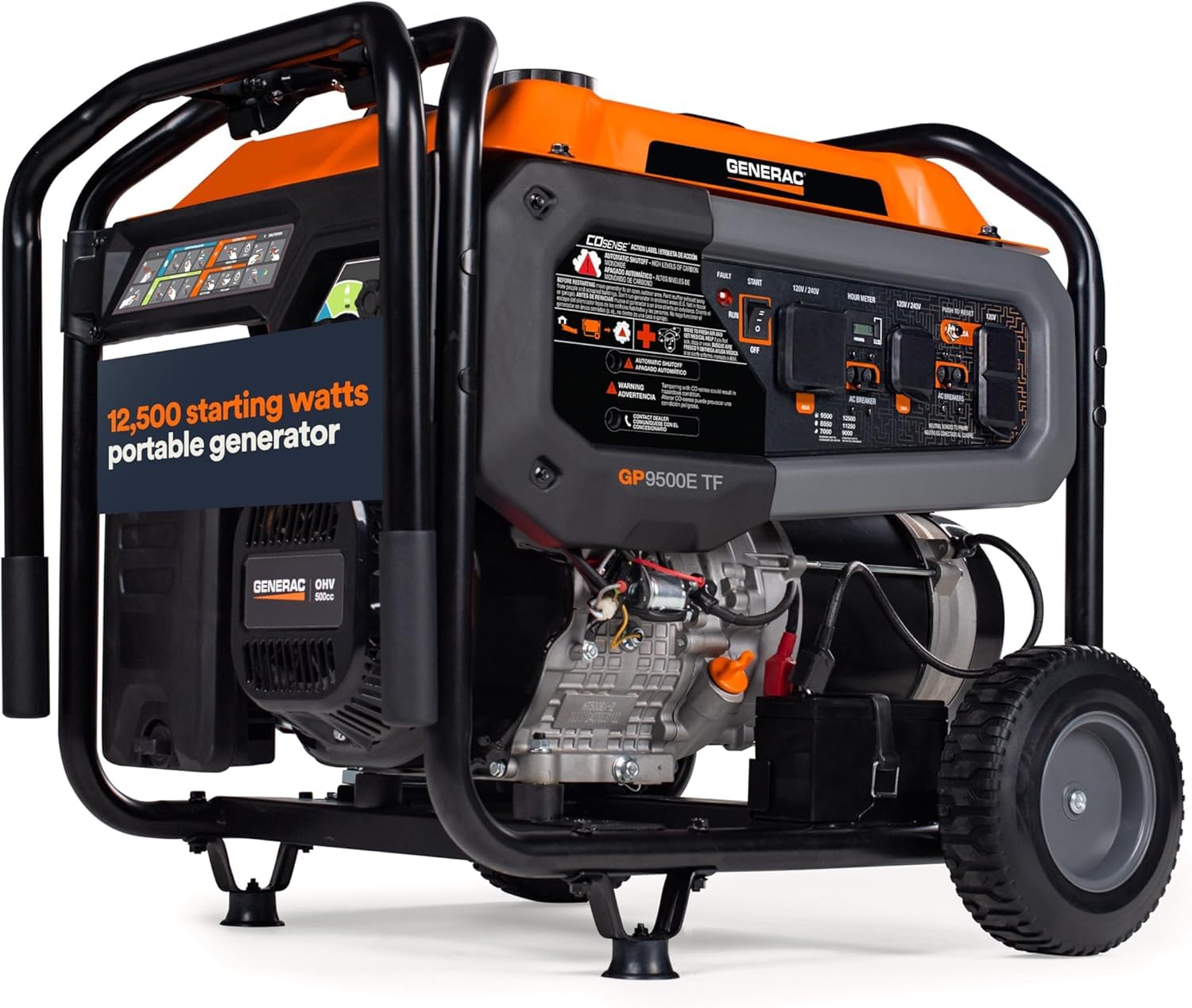
Generac’s GP9500 Tri-Fuel runs on gasoline, liquid propane, or natural gas with a simple dial turn. It delivers 12,500 starting watts and 9,500 running watts on gasoline, with a 500cc OHV engine. The 7.5-gallon fuel tank gives you up to 9.5 hours at 50% load on gasoline, 14 hours at 25% load on gasoline, or unlimited runtime when hooked to a natural gas line.
The onboard COsense technology automatically detects rising carbon monoxide levels and shuts the generator down before they reach dangerous thresholds. Push-button electric start with an included 12V battery eliminates pull-cord effort. The control panel has two 120V 20A GFCI duplex outlets, a 120/240V 30A twist-lock (L14-30R), and a 120/240V 50A (14-50R) outlet with covered protection. A digital hour meter helps track maintenance intervals.
Buyer reviews are mixed: one owner said it powered his whole house easily, but others report serious reliability problems—one unit blew a hole in the motor after 15.9 hours, and another refused to stay running after one month. The natural gas hookup requires a certified plumber and additional parts that are not included, despite the “tri-fuel” marketing. Generac includes a 3-year residential/2-year commercial limited warranty.
The Good
- Tri-fuel flexibility with natural gas connectivity
- 12,500W starting surge versus 9,500W running output
- COsense safety sensor
- Backed by the most recognized name in standby generators
The Bad
- Multiple buyers report engine failure or fuel system issues within hours
- Natural gas kit is not included—requires a certified plumber and extra parts
- Low average rating (4.2/5) compared to top picks
Consider if: You want the Generac brand and plan to use natural gas with a professional installation.
Look elsewhere if: You need reliable, out-of-the-box performance—this unit has concerning failure reports and missing components.
10. GENMAX GM10500iETC

The feature-rich tri-fuel inverter that comes with a rain cover, ATS cable, and bonding plug.
This is the most complete package on the list. The GM10500iETC is a tri-fuel inverter generator that runs on gasoline, propane, or natural gas, producing 10,500 starting watts (8,500 running) on gasoline, 9,500 starting watts (8,000 running) on LPG, and 8,400 starting watts (6,800 running) on natural gas. The inverter technology keeps THD under 3%, making it safe for sensitive electronics.
The control panel has a 50A (14-50R) outlet, a 30A (L14-30R) outlet, four 120V AC 20A outlets, and a 12V DC cigarette lighter port. It’s ATS-ready for automatic whole-home backup and comes with an ATS cable, rain cover, NG hose, LPG hose, bonding plug, and a magnetic oil dipstick. The neutral floating design can be switched to bonded using the included plug for portable use. One buyer ran it for 6+ hours on propane during a storm and praised its quiet operation.
The 458cc single-cylinder engine includes an oil filter, forced lubrication, and multiple built-in protections: overload, thermal, overvoltage, undervoltage, overcurrent, short circuit, and overspeed. At 30.9 inches long by 22.6 inches wide by 29.3 inches tall, it’s relatively compact for its output. Owners mention it runs central AC and a well pump simultaneously, though you can’t run all heavy appliances at once.
What Comes With It
- Tri-fuel inverter with under 3% THD for electronics
- Includes ATS cable, rain cover, NG/LPG hoses, and bonding plug
- Oil filter and forced lubrication extend engine life
- Quiet operation on natural gas, per buyers
Potential Issues
- No manual included—digital copy emailed on request
- One reviewer noted a defective unit that bogged and surged under fridge load
- Heavy and difficult to transport despite wheels
Buy this if: You want a single-box solution with every accessory—rain cover, hoses, ATS cable, bonding plug—already included.
Proceed with caution if: You prefer a brand with a proven track record; GENMAX is newer and quality control varies per unit.
Understanding the Specs
Surge vs. Running Watts
Surge watts (also called peak or starting watts) is the jolt of extra power needed to start motors—like a well pump, air conditioner, or refrigerator compressor kicking on. Running watts (rated watts) is the power the generator can sustain continuously. Always size your generator by the running watts, not the surge. A generator with 12,500 surge watts might only deliver 9,500 running watts, which is the number that matters for steady, whole-home power.
Dual Fuel vs. Tri-Fuel vs. Inverter
Dual fuel generators run on gasoline and propane. Tri-fuel adds natural gas, which connects to your home’s gas line for essentially unlimited runtime. Inverter generators produce cleaner power (under 3% THD) that’s safe for sensitive electronics, and they automatically adjust engine speed to match the load—cutting noise and fuel consumption by up to 50% versus conventional models. If you plan to power computers, TVs, or modern appliances, an inverter is the safer choice.
FAQ
What size generator do I need to power my whole house?
Can I run a 11000 watt generator on natural gas?
How long does an 11000 watt generator run on a full tank?
What is the difference between an inverter generator and a conventional generator?
Is an 11000 watt generator loud?
How do I connect an 11000 watt generator to my house?
Can I run a 3-ton AC with an 11000 watt generator?
How often should I change the oil in my 11000 watt generator?
What is bonded neutral vs floating neutral on a generator?
Final Thoughts: The Verdict
If you want one dependable pick, the 11000 watt generator winner is the Westinghouse WGen12500DF because it combines dual fuel, remote start, a strong 3-year warranty, and nearly 1,000 customer reviews averaging 4.8 stars into one reliable package. If you want quiet inverter power for sensitive electronics and natural gas capability, grab the Westinghouse iGen12000TFc. And for longest runtime between refuels, the standout is the tri-fuel Gidrox GNV with its 21-hour tank.
How We Picked
We do not accept paid placement. Every pick is matched to a real buyer and a real use-case; we do not hands-on test units.
Sources & Methodology
Specifications: manufacturer listings and product documentation. Review insights: verified customer reviews, as of July 2026. Pricing: not shown on this page (it changes often); check the current price via the retailer link.
As an Amazon Associate, Gadgets Feed earns from qualifying purchases. This does not affect which products we feature.