
Our readers keep the lights on and my morning glass full of iced black tea. As an Amazon Associate, I earn from qualifying purchases.
Specs are compiled from manufacturer listings and verified buyer reviews and can change over time — please confirm the key details on the product page before buying.
Moving diesel, kerosene, or heating oil from a barrel to a tank is a messy, slow chore when you rely on gravity or a hand crank. A 110V fuel transfer pump plugs into a standard wall outlet and does the work for you — in some cases emptying a 55-gallon drum in under ten minutes.
I’m Min — the founder and writer behind Gadgets Feed. This guide is built by comparing the manufacturers’ published specifications and the patterns across verified customer reviews, so you get each pick’s real strengths and trade-offs instead of marketing spin.
You’ll find the 110v fuel transfer pump that matches your work — if you need high flow for a farm, a compact unit for boat gas, or a budget diesel-only model for the shop.
Quick Picks
- VEVOR Oil Transfer Pump 110V, 16 GPM — Workhorse
- TRUPOW 110V AC Self-priming Gasoline Fuel Oil — Versatile
- TOPWAY 110V AC Gasoline Fuel Pump 3.7GPM — Easy Carry
- caqeg 110V AC 550W Self Priming Electric — Budget Speed
- BLACKHORSE-RACING Self Priming 110V AC 16GPM — Solid Performer
- TIGEROAR Oil Transfer Pump 110V Electric Fuel — High Lift
- YOHOME Diesel Transfer Pump 110V 20GPM — Max Flow
How To Choose The Best 110V Fuel Transfer Pump
Selecting the right pump depends on three things: what fuel you are moving, how fast you need it moved, and how high the pump has to push it. Here is what to look at.
Fuel Compatibility Is Non-Negotiable
Some pumps are built exclusively for diesel, kerosene, and biodiesel. Others are rated for gasoline blends up to E15. Using a diesel-only pump on gasoline is a fire hazard — the pump internals may not be spark-proof. Check the “Gas Type” spec before you buy.
Flow Rate and Lift Height
Flow rate is measured in gallons per minute (GPM). A 3.7 GPM pump fills a 5-gallon can in about 80 seconds, while a 16-20 GPM pump empties a 55-gallon drum in a few minutes. Lift height tells you how far the pump can pull fuel up from a barrel below it — look for at least 6 feet of suction lift if you are working from ground level.
Durability and Safety Features
A cast iron pump head resists corrosion and handles pressure better than plastic. Overheat protection (thermal shutoff) prevents the motor from burning out during long runs. A reversible switch lets you use the same pump for both filling and draining — a handy feature for maintenance work.
Quick Comparison
| Model | Best For | Max Flow Rate | Suction Lift | Max Lift | Amazon |
|---|---|---|---|---|---|
| VEVOR 16 GPM | Heavy diesel/oil transfer | 16 GPM | 8 ft | 45 ft | Amazon |
| TRUPOW 3.7 GPM | Gasoline & diesel portability | 3.7 GPM | 4.9 ft | 19 ft | Amazon |
| TOPWAY 3.7 GPM | Versatile fuel pump with handle | 3.7 GPM | 4.9 ft | — | Amazon |
| caqeg 550W 60L/min | Budget diesel-only fast transfer | 16 GPM | — | — | Amazon |
| BLACKHORSE-RACING | Diesel/kerosene small shop | 15.75 GPM | — | — | Amazon |
| TIGEROAR 18 GPM | High-lift farm/construction | 18 GPM | — | 49 ft | Amazon |
| YOHOME 20 GPM | Highest flow for big tanks | 20 GPM | 6.6 ft | 60 ft | Amazon |
In‑Depth Reviews
1. VEVOR Oil Transfer Pump 110V, 16 GPM
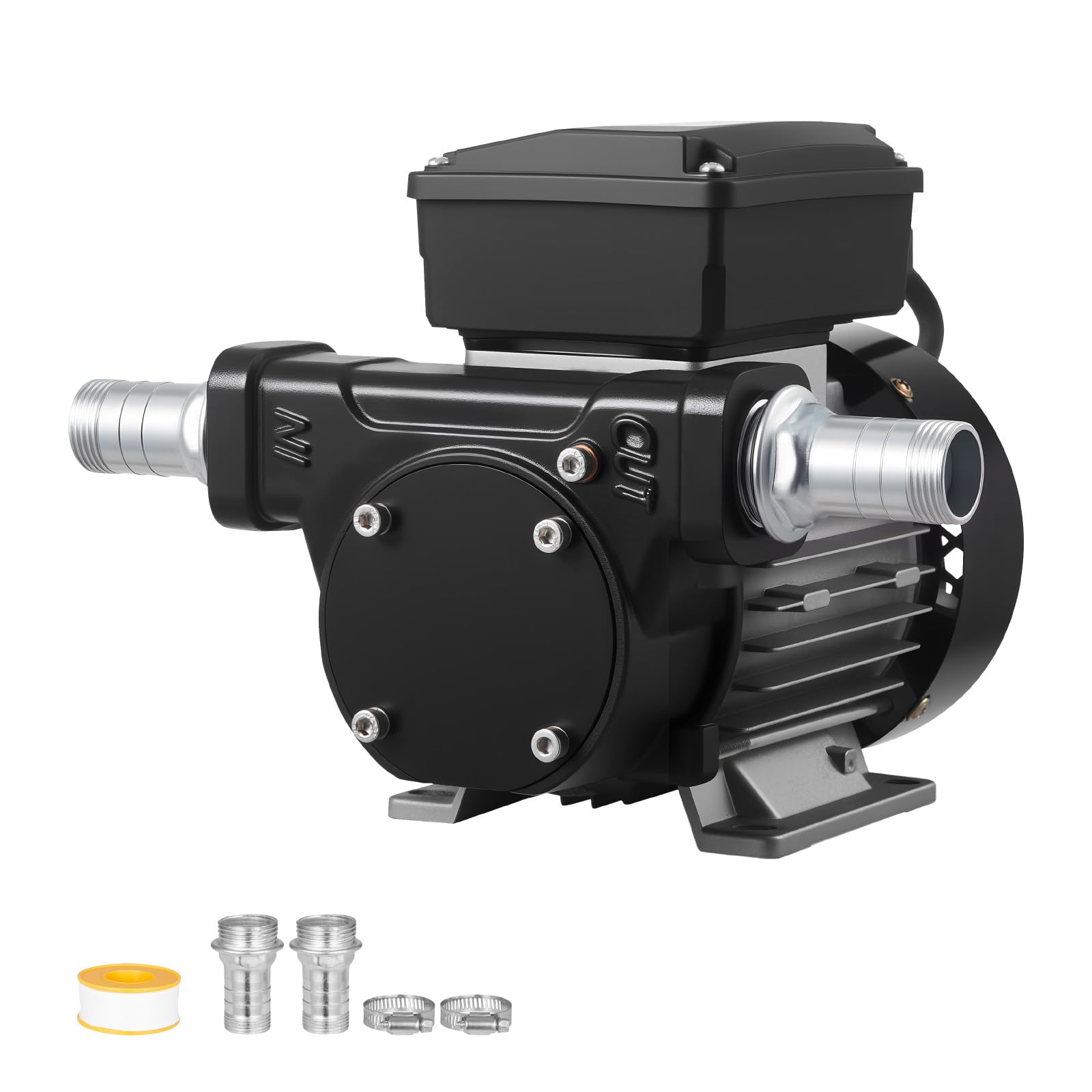
This 15.1-pound pump gnaws through a 55-gallon drum of hydraulic oil in about ten minutes — faster than your morning commute.
You get speed without sacrifice. The VEVOR pushes fuel at 16 GPM (gallons per minute), which means fewer trips back and forth. It can pull fuel from 8 feet below your work surface and push it 45 feet up — enough to fill a tractor or feed a second-story tank. The cast iron housing resists corrosion and handles pressure, and the waterproof power switch keeps working when you are outdoors in damp weather.
Buyers report one owner emptied a 55-gallon drum of hydraulic oil in under ten minutes; another swapped out a 12V pump on his drain pan and got twice the speed. The trade-off is weight: at 15.1 pounds, it is about three times heavier than the compact TOPWAY — so you will not want to carry this one around a farm all day.
This pump is designed for diesel, kerosene, and biodiesel only — the manufacturer states it is not for use with gasoline. The 1-inch inlet and outlet are standard, but you need to buy hoses separately.
What Moves Fast
- 16 GPM flow rate empties large drums quickly
- Cast iron build withstands wear and damp conditions
- Automatic overheat protection prevents motor burnout
- 1-inch standard ports for broad hose compatibility
What Holds It Back
- Not for use with gasoline at all
- Heavy at 15.1 pounds — not very portable
- No reversible pumping switch for draining
Reach for this if: you need to move large volumes of diesel or hydraulic oil fast on a farm or construction site — no gasoline, no problem.
Look elsewhere if: you need gasoline compatibility or a lightweight unit you can carry between jobs.
2. TRUPOW 110V AC Self-priming Gasoline Fuel Oil Transfer Pump
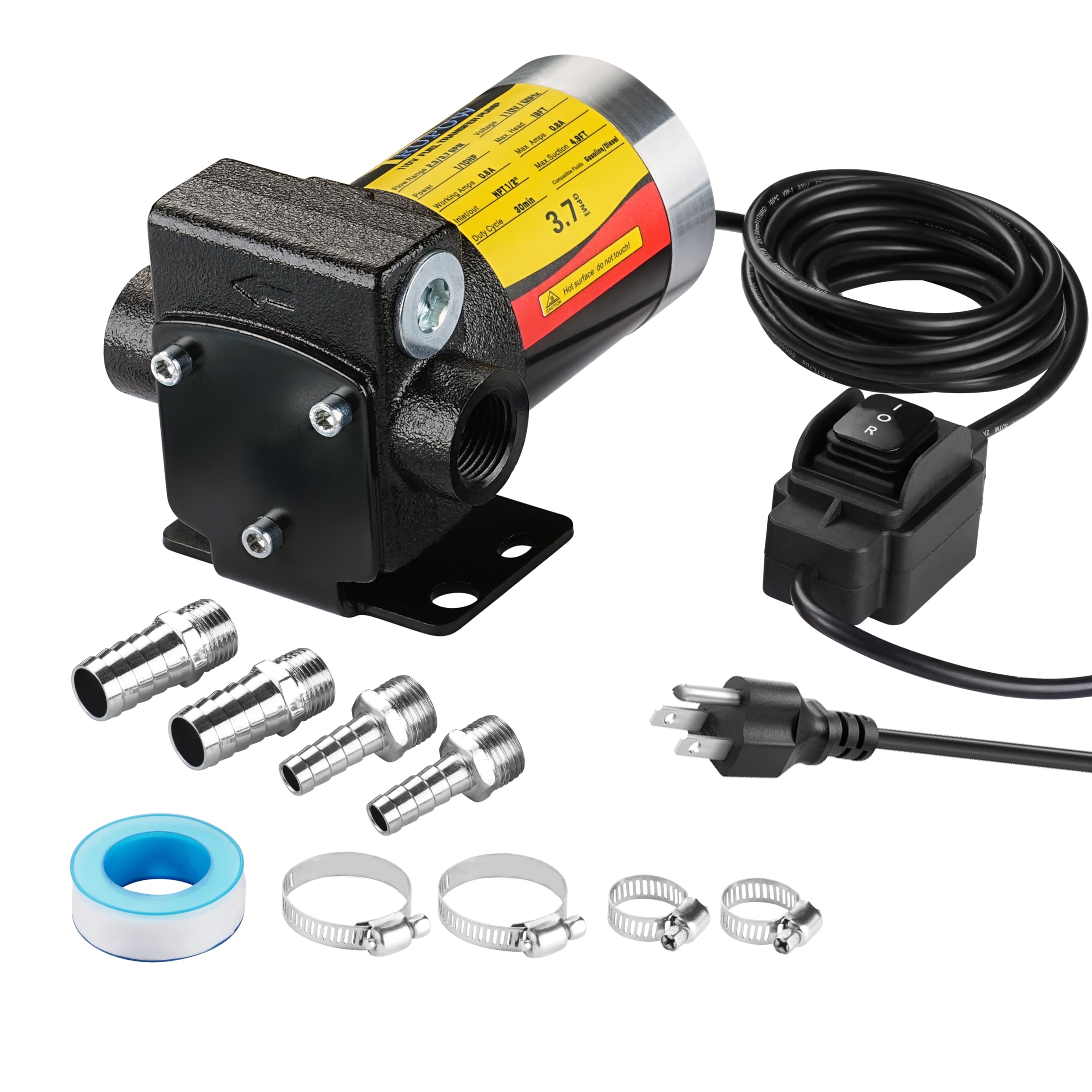
This 3.7 GPM pump empties a 5-gallon gas can in under two minutes — and it runs in reverse without moving a hose.
Unlike the diesel-only VEVOR, the TRUPOW works on gasoline blends up to E15 (15% ethanol), diesel up to B20 (20% biodiesel), and kerosene. That makes it the true one-pump solution for boaters, small-engine owners, and anyone handling multiple fuel types. The explosion-proof components (parts designed not to spark) add safety when pumping gasoline.
The reversible switch is the standout feature. Flick it to change direction without touching hoses. One owner reports using it to flush transmission cooler lines with ATF (automatic transmission fluid) — the pump handles that viscosity. Buyers also say it empties a 5-gallon gas can in less than two minutes.
The catch: some units arrive defective. One reviewer noted the pump tripped the circuit breaker immediately on plug-in, and the 30-day return window had passed. Test it on arrival. The running cycle is rated at 30 minutes continuous use before a cooldown.
Why It Stands Out
- Rated for gasoline (E15), diesel (B20), and kerosene
- Reversible switch for filling or draining
- Explosion-proof cast iron chamber improves safety
- Lightweight and includes hose fittings and clamps
Heads-Up
- Some buyers received units that tripped breakers on first use
- Lower flow (3.7 GPM) compared to heavy-duty models
- Only 4.9 ft suction lift limits depth from underground tanks
Grab it for: gasoline transfer from cans to boats, jet skis, or cars where multi-fuel flexibility matters.
skip it if: you need to move large volumes of diesel fast — the 3.7 GPM rate will feel slow.
3. TOPWAY 110V AC Gasoline Fuel Pump 3.7GPM
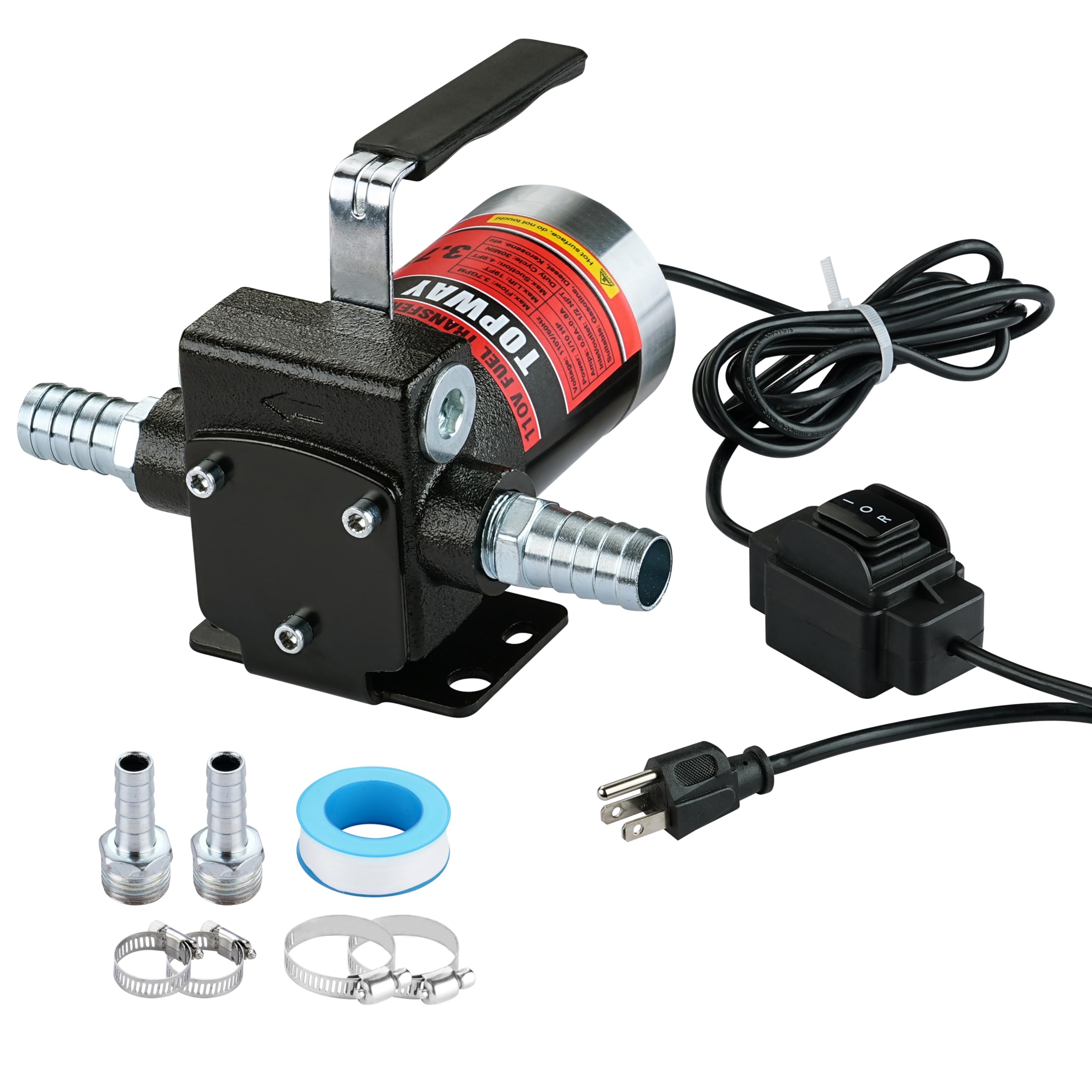
At just 5 pounds with a built-in handle, this is the pump you will actually carry from job to job — the VEVOR is three times heavier.
The TOPWAY shares the same 3.7 GPM flow rate and reversible switch as the TRUPOW, but it is noticeably lighter — 5 pounds compared to the VEVOR’s 15.1 pounds. The portable handle is built into the cast iron body, so you do not need a separate carry strap.
Owners mention one reviewer uses it as an external solvent pump for a Harbor Freight solvent tank and calls it “perfect.” Another says it pumps “a little over 3 gallons a minute.” For filling older cars from a gas can or draining stale fuel, the long power cord and easy-reach reverse switch make the job simple.
The honest trade-off: build quality complaints exist. One owner reported the pump overheated and started smoking during its first use pumping water (water is not a supported fluid). Stick to gasoline, diesel, and kerosene within the viscosity spec, and test it on arrival.
What Works
- Lightweight at 5 pounds with a built-in carry handle
- Dual-direction switch for fill or drain without moving hoses
- Pure copper motor runs quietly compared to some competition
- Comes with 4 hose adaptors and clamps
Watch Out For
- Not rated for thick fluids like used motor oil
- Some buyers reported overheating on first use
- No published max lift height for vertical push
Ideal for: the mechanic or hobbyist who needs a portable, reversible pump for gasoline and light diesel work — easy to grab and go.
Not for: high-volume farm or construction duty where 3.7 GPM feels too slow.
4. caqeg 110V AC 550W Self Priming Electric Transfer Pump

This 16 GPM diesel pump matches the VEVOR’s speed for noticeably less money — but has no reversible switch and weighs 20.3 pounds.
If your only requirement is moving diesel or kerosene fast and you do not need gasoline compatibility or a reversible switch, this caqeg pump delivers the same 16 GPM (60 L/min) as the premium VEVOR at a lower price. The 550W all-copper motor is self-priming and the waterproof power switch includes a transparent cover for safety in damp conditions.
Customers note it picks up prime quickly and works well for used oil and diesel transfer — one called it “powerful but noisy,” a common theme among high-flow pumps. Another owner adapted the hose barb to garden hose connections.
The trade-off: there is very little documentation included, and the 20.3 pounds make it the heaviest pump on this list. Plan on mounting it in a fixed location rather than carrying it around.
The Upside
- 16 GPM flow rate matches far more expensive pumps
- All-copper motor is durable and self-priming
- Waterproof switch cover for outdoor use
- Budget-friendly entry point for high-speed diesel transfer
The Downside
- Very heavy at 20.3 pounds — not portable
- Diesel and kerosene only — no gasoline
- No included fittings beyond basic hose barb
- No reversible pumping function
Best for: the shop or farm owner who wants 16 GPM diesel transfer on a budget and does not need portability.
Pass on it if: you need gasoline capability, a lightweight unit, or a reversible drain function.
5. BLACKHORSE-RACING Self Priming 110V AC 16GPM Oil Transfer Pump

This cast-iron pump does 15.75 GPM for diesel and kerosene — and has an anti-drainback valve (a small valve that keeps fuel in the line after you stop) to maintain prime.
This pump runs on a 550W, 110V AC motor at 2800 r/m and delivers a variable flow rate of 20-60 L/min (5.25-15.75 GPM). It handles diesel, kerosene, and biodiesel. The manufacturer also lists gasoline compatibility, but several owners say gasoline is low-flammability fuel and the pump is not ideal for it. The 1-inch inlet uses BSP threading (a British standard, not the common NPT), so verify your hose fittings before buying.
Reviewers point out it “moves waste oil faster than twin diaphragm pumps” and includes a steel mesh filter and anti-drainback valve. One owner pumped over 1,000 gallons through it before the noise got worse; another left it outside in the sun for nearly a year without issues.
The main durability risk: a few shoppers say the pump burned up after a handful of uses. Others note it gets very noisy with a smaller-diameter hose; switching to a 1-inch hose reduces the racket significantly.
Strong Points
- Up to 15.75 GPM for quick oil and diesel transfer
- Anti-drainback valve keeps the pump primed
- Steel mesh inlet filter catches debris
- Heavy cast iron build handles outdoor exposure
Weak Points
- 1″ BSP threading is not compatible with standard NPT fittings
- Some units failed after a few uses
- Loud with smaller hoses
- Not recommended for gasoline despite label
Reach for it if: you need a strong self-priming diesel/kerosene pump for a stationary setup and can work with BSP hose threads.
Avoid it if: you want NPT-compatible fittings or a gasoline-rated pump — check the thread standard first.
6. TIGEROAR Oil Transfer Pump 110V Electric Fuel Transfer Pump, 18 GPM
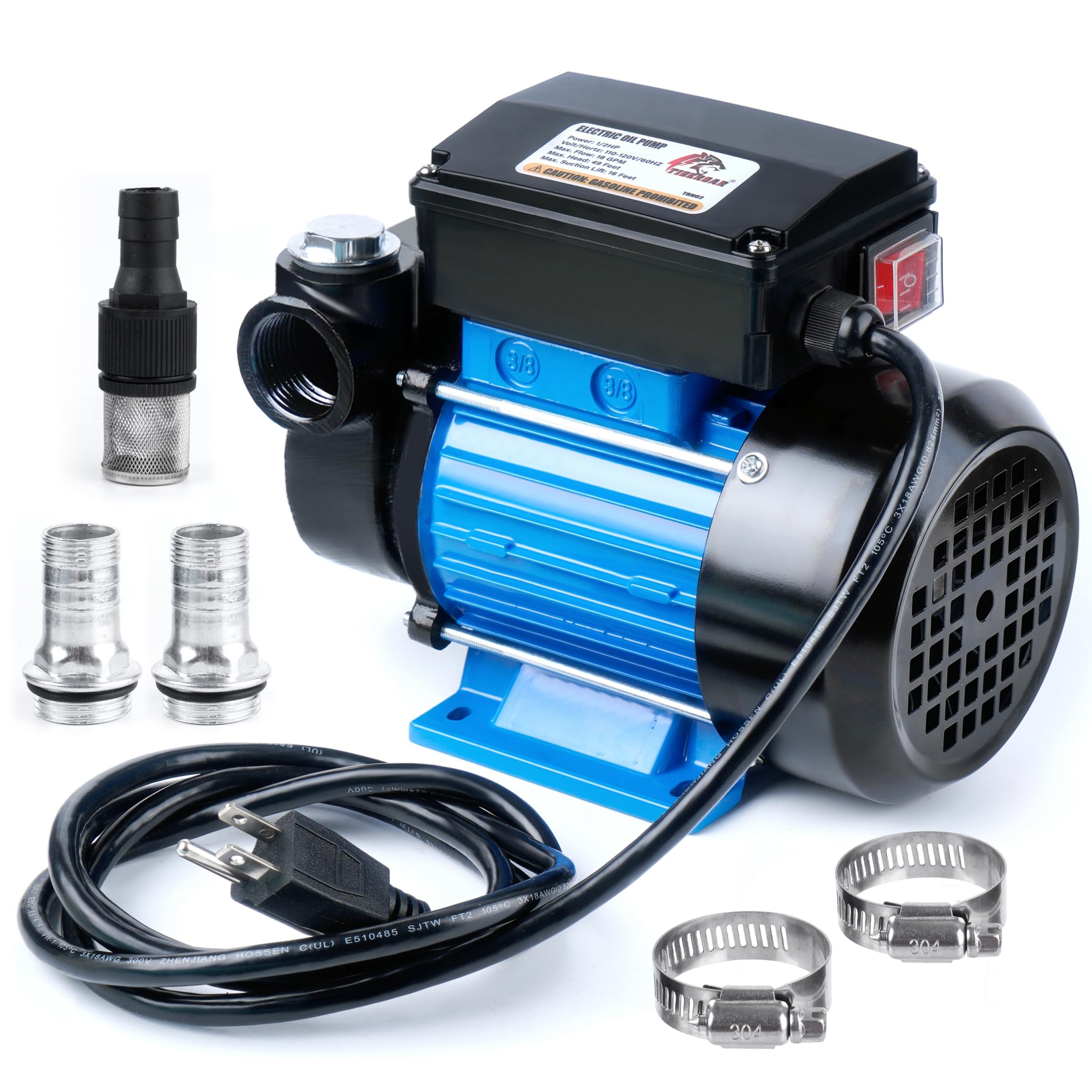
This 18 GPM pump pushes diesel 49 feet up — enough to fill an improve tank that the VEVOR’s 45-foot lift cannot reach.
When you are moving fuel to a raised platform or second-story storage, lift height matters as much as speed. The TIGEROAR delivers on both: 18 GPM (quicker than the VEVOR’s 16 GPM) and a max lift of 49 feet. It runs on a 1/2 HP motor with an all-copper winding, and the cooling fan keeps heat down during extended use in hot weather.
The mixed cast aluminum casing and cast iron pump head give it corrosion resistance without the full weight of an iron-only body.
The flip side: some buyers experienced failures within minutes of first use — one said “it quit working after about 2 minutes of running” and another called it noisy. The included hose adapters are G3/4 (roughly 25 mm) at the G1 (32 mm) inlet/outlet, so you may need to source your own step-down fittings.
What Impresses
- 18 GPM flow and 49 ft lift handle heavy vertical transfers
- All-copper motor with cooling fan for heat dissipation
- Cast aluminum and iron build resists corrosion
- 1-year limited warranty with lifetime tech support
What Concerns
- Inconsistent quality — some units failed right away
- Adapter sizes (G3/4) may not match standard hoses
- Not rated for gasoline use
- Loud operation reported by multiple owners
Best for: diesel transfer to overhead tanks or uphill storage where 49 feet of lift solves a real problem.
Think twice if: you need a quiet pump or gasoline compatibility — and test the unit as soon as it arrives.
7. YOHOME Diesel Transfer Pump 110V 20GPM
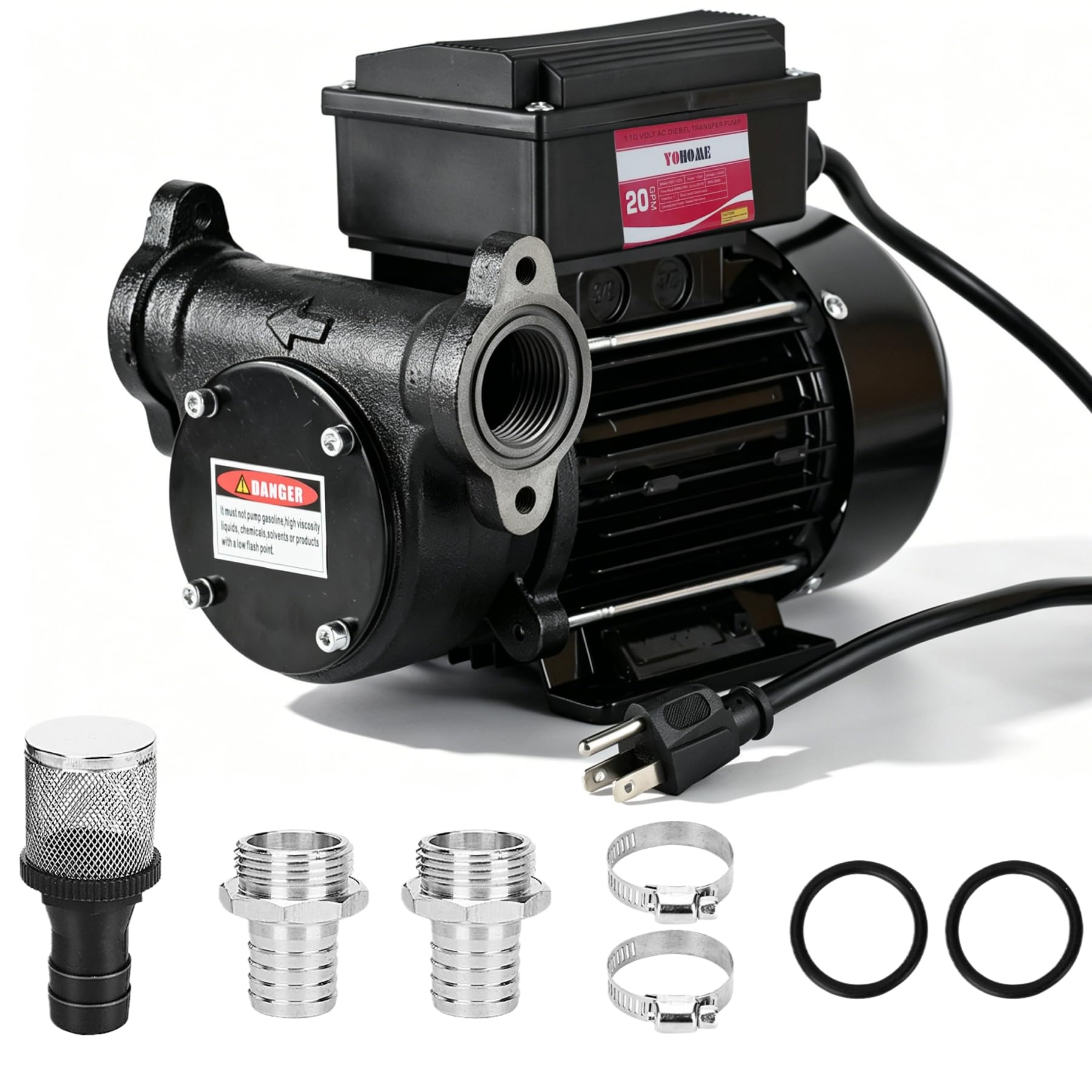
At 20 GPM with a 60-foot vertical lift, this pump empties a 55-gallon drum in under three minutes — faster than any other pick here.
If speed is the priority, the YOHOME leads every other pick: 20 GPM (75 L/min) and a max lift of 60 feet, driven by a 1/3 HP motor. That means it can empty a 55-gallon drum in under three minutes and push the fuel up to a tall overhead tank without losing pressure. The 1-inch inlet and outlet are standard, and the metal mesh inlet filter keeps debris out of the line.
One buyer moved over 100 gallons of oil in less than 40 minutes. Another used it to drain a 40-gallon diesel tank for relocation — “no time at all” was the verdict. The built-in bypass and overheat protection give you a 3-minute internal relief cycle, and the manufacturer recommends 30-minute running intervals to keep the motor cool.
The catch: the pump is designed only for low-viscosity fuels (diesel, kerosene, biodiesel, light fuel oil) and specifically warns against gasoline and water. It does not come with hoses — just two barbs, two clamps, and two o-rings. Some buyers report finding a 1-inch barb fitting hard to match with common garden hose sizes, so plan your hose purchase ahead.
Speed Highlights
- 20 GPM flow is the highest on this list
- 60 ft max lift handles any realistic vertical run
- Cast iron body with thermal protection for safety
- 1-inch standard inlet for easy hose fitting
Speed Trade-offs
- No hoses included — you must buy 1″ hose separately
- Gasoline and water are not supported
- Some units failed after short use — test immediately
- Loud operation (72 dB reported by one buyer)
Reach for it if: you need the fastest possible diesel transfer for large tanks or commercial fuel storage — nothing here beats 20 GPM.
pass on it if: you need gasoline compatibility, want hoses included, or only move small amounts where a slower pump works fine.
Understanding the Specs
Flow Rate (GPM)
Gallons per minute tells you how fast the pump moves fuel. A 3.7 GPM pump fills a standard 5-gallon gas can in about 80 seconds. A 16-20 GPM pump empties a 55-gallon drum in three to four minutes. Higher GPM usually means a heavier, noisier motor and a larger hose size — 1-inch is typical for high-flow pumps.
Suction Lift vs Max Lift
Suction lift is how far the pump can pull fuel vertically from below it — important if your barrel sits on the ground and the pump is above it. Max lift is how high the pump can push fuel after it has drawn it in — critical for filling overhead tanks. Most pumps here manage 4-8 feet of suction and 19-60 feet of max lift.
Self-Priming
A self-priming pump can clear air from the hose and start moving fuel on its own, without you having to manually fill the line first. Every pump on this list is self-priming, but the lift height limits still apply — if you exceed the suction lift spec, the pump will not prime.
Reversible Switch
A reversible pumping switch lets you change the direction of the flow by pressing a button, without moving any hoses. This is useful for draining tanks as well as filling them — you only need one pump and one hose setup instead of two separate tools.
FAQ
Can a 110V fuel transfer pump handle gasoline?
What size hose do I need for a 1-inch pump?
How long can I run a fuel transfer pump continuously?
Can I use a diesel transfer pump for used motor oil?
What does “self-priming” mean on a fuel pump?
Do these pumps come with hoses and fittings?
Is a reversible pump worth the extra cost?
Why does my pump keep tripping the circuit breaker?
What is the difference between suction lift and max lift?
Can I use a 110V pump outdoors in the rain?
Final Thoughts: The Verdict
For most people, the 110v fuel transfer pump winner is the VEVOR 16 GPM because it combines high flow rate, cast iron durability, and overheat protection at a price that makes it a no-brainer for diesel or hydraulic oil jobs. If you need gasoline compatibility and portability, grab the TRUPOW with its reversible switch and explosion-proof chamber. And for the fastest diesel transfer you can plug into a standard wall outlet, the standout is the YOHOME 20 GPM with its 60-foot lift capacity.
How We Picked
We do not accept paid placement. Every pick is matched to a real buyer and a real use-case; we do not hands-on test units.
Sources & Methodology
Specifications: manufacturer listings and product documentation. Review insights: verified customer reviews, as of July 2026. Pricing: not shown on this page (it changes often); check the current price via the retailer link.
As an Amazon Associate, Gadgets Feed earns from qualifying purchases. This does not affect which products we feature.