
Our readers keep the lights on and my morning glass full of iced black tea. As an Amazon Associate, I earn from qualifying purchases.
Specs are compiled from manufacturer listings and verified buyer reviews and can change over time — please confirm the key details on the product page before buying.
A 110V MIG welder that stutters, birdnests, or won’t penetrate is just an expensive paperweight in your garage. You need a machine that feeds wire smoothly on a standard household outlet, lays clean beads on thin steel, and doesn’t trip your breaker halfway through a repair. This guide cuts through the marketing to find the welders that actually deliver stable arcs on 110V power.
I’m Min — the founder and writer behind Gadgets Feed. This guide is built by comparing the manufacturers’ published specifications and the patterns across verified customer reviews, so you get each pick’s real strengths and trade-offs instead of marketing spin.
Whether you are patching a trailer, building a lawn cart, or learning to weld on your farm, the right 110v mig welder makes the difference between a clean bead and a frustrated afternoon spent unclogging the liner.
Quick Picks
- FEMEROL 250A MIG Welder — Best Overall
- PrimeWeld MIG180 Mig Welder — Pro-Level
- GZ GUOZHI MIG Welder 210A with Pulse — Aluminum Ace
- ARCCAPTAIN MIG Welder 200A — Feature-Rich
- Bestarc 165A MIG Welder — Best Value
- YESWELDER 160A MIG Welder — Smart Simplicity
- AZZUNO 200A MIG Welder — Battle-Budget
- Forney 271 Easy Weld 140 MP — Trusted Brand
How To Choose The Best 110V Mig Welder
Choosing a MIG welder for a standard household outlet differs from buying a shop-grade unit. Three specs separate a useful garage tool from a frustrating one.
Duty Cycle — How Long You Can Actually Weld
A 110V outlet limits how much current the machine can draw, so duty cycle (the number of minutes you can weld in a 10-minute period before the machine needs to cool) is the real limiter. A welder rated at 20% at 90A means you weld for 2 minutes, then wait 8. Look for at least 30% at your working amperage so you can run multiple beads without the thermal shutdown kicking in.
Wire Feed Smoothness — The Heart of a Clean Bead
Stuttering wire feed causes burn-back, birdnesting (wire tangling inside the drive roller), and inconsistent arc. Machines with all-metal drive systems and a smooth tension arm handle.030-inch flux-core wire without skipping. A poorly designed tension system is the #1 complaint across budget welders, regardless of the max amperage on the sticker.
Synergic vs Manual Control
Synergic control means you set the wire thickness and the machine automatically picks the voltage and wire-feed speed. This is a massive time-saver for beginners. Manual control lets seasoned welders fine-tune the arc for specific joints. Some machines offer both — start in synergic mode and switch to manual as your skill grows.
Quick Comparison
On smaller screens, swipe sideways to see the full table.
| Model | Best For | Max Current | Processes | Dual Voltage | Amazon |
|---|---|---|---|---|---|
| FEMEROL 250A | Multiprocess versatility | 250A | 6-in-1 | Yes (110/220V) | $170.98$189.99Limited time dealAmazon |
| PrimeWeld MIG180 | Premium build & support | 180A | 3-in-1 | Yes (120/240V) | $549.00Amazon |
| GZ GUOZHI 210A | Pulse MIG for aluminum | 210A | 8-in-1 | Yes (110/220V) | $242.89$284.99Amazon |
| ARCCAPTAIN 200A | Feature-packed mid-range | 200A | 6-in-1 | Yes (110/220V) | $369.99$499.99PrimeAmazon |
| Bestarc 165A | Entry-level value | 165A | 4-in-1 | Yes (110/220V) | $158.08$166.41PrimeAmazon |
| YESWELDER 160A | Smart-mode simplicity | 160A | 4-in-1 | Yes (110/220V) | $175.98$225.99Amazon |
| AZZUNO 200A | Budget durability | 200A | 4-in-1 | Yes (110/220V) | from $99.99Amazon |
| Forney 271 | Trusted brand simplicity | 140A | 3-in-1 | No (110V only) | Amazon |
In‑Depth Reviews
1. FEMEROL 250A MIG Welder

The multiprocess champ that welds aluminum without a second mortgage.
You get six welding processes — Gas MIG, flux core, stick, Lift TIG, spot welding, and spool-gun compatibility for aluminum — all in a 32.6-pound package. That is about 9.5 pounds heavier than the Bestarc 165A (23.1 pounds), but the extra weight brings a true 60% duty cycle at 250A (the machine can weld for 6 minutes out of every 10-minute block before thermal protection kicks in). Buyers report the actual output measures around 245A, and the synergic control (which automatically matches current and wire-feed speed when you select the wire diameter) helps beginners get clean beads on steel and aluminum without guesswork.
Owners mention the intuitive UI, long cables, and excellent spot-weld function are standouts. The trade-offs are a loud fan that runs constantly (not just when needed), an undersized 120V plug that feels flimsy for the current draw, and a barbed gas fitting instead of a standard 5/8-18 thread. The machine weighs 32.6 pounds with package dimensions of 21.6 x 16.5 x 12.7 inches — noticeably larger than the YESWELDER 160A at 20.16 x 16.1 x 12.83 inches. But for a 6-in-1 unit at this price, it is remarkably tough to top.
Why it stands out
- 60% duty cycle at 250A out-works every other pick in this list
- Weld aluminum with a spool gun or Teflon liner (not included)
- Spot-weld function saves time on sheet-metal projects
- Experienced customers note actual output near 245A — no spec inflation
Know before you buy
- Loud fan runs continuously, not thermostatically controlled
- 110V power cord feels undersized for the draw
- Gas inlet uses a barb, not the standard connector
The ideal pick if: you need a single machine for steel, stainless, and aluminum across multiple processes and aren’t bothered by a constantly-spinning fan.
Pass on it if: near-silent operation matters for a home garage or you prefer a factory-standard gas fitting.
2. PrimeWeld MIG180 Mig Welder

The 55-pound shop staple that comes with a spool gun included.
Most welders under this price make you buy the spool gun for aluminum separately. PrimeWeld includes it in the box, along with a gas regulator and hose. The MIG180 runs on 120V or 240V dual voltage and uses standard Tweco consumables — meaning you can grab new tips and liners at any local welding supply instead of waiting for odd-sized replacements in the mail. It handles 3/8-inch steel and aluminum, and professional welders have compared its mild-steel performance favorably against a Miller 215.
The catch is size. At 55 pounds, this is the heaviest unit in the lineup — more than double the Bestarc 165A’s 23.1 pounds. It is not a machine you throw in the truck bed for quick roadside repairs. The duty cycle is generous, and reviewers report excellent customer service based out of the USA. The unit includes a helpful settings chart and guide on the inside panel, so you are not hunting online for recommended voltages.
What you get
- Spool gun, gas regulator, and hose all included — ready for aluminum from the start
- Standard Tweco consumables, easy to find locally
- US-based customer service and parts
- Professional welders rate it near Miller 215 on mild steel
What holds it back
- 55-pound weight makes it a shop fixture, not a portable unit
- No synergic control — all parameters set manually
- Premium pricing; you pay for the included accessories and support
Reach for this when: you want a semi-pro machine with full accessories and US-based support for home-shop fabrication.
skip it if: portability and automatic settings are must-haves for your workspace.
3. GZ GUOZHI MIG Welder 210A with Pulse
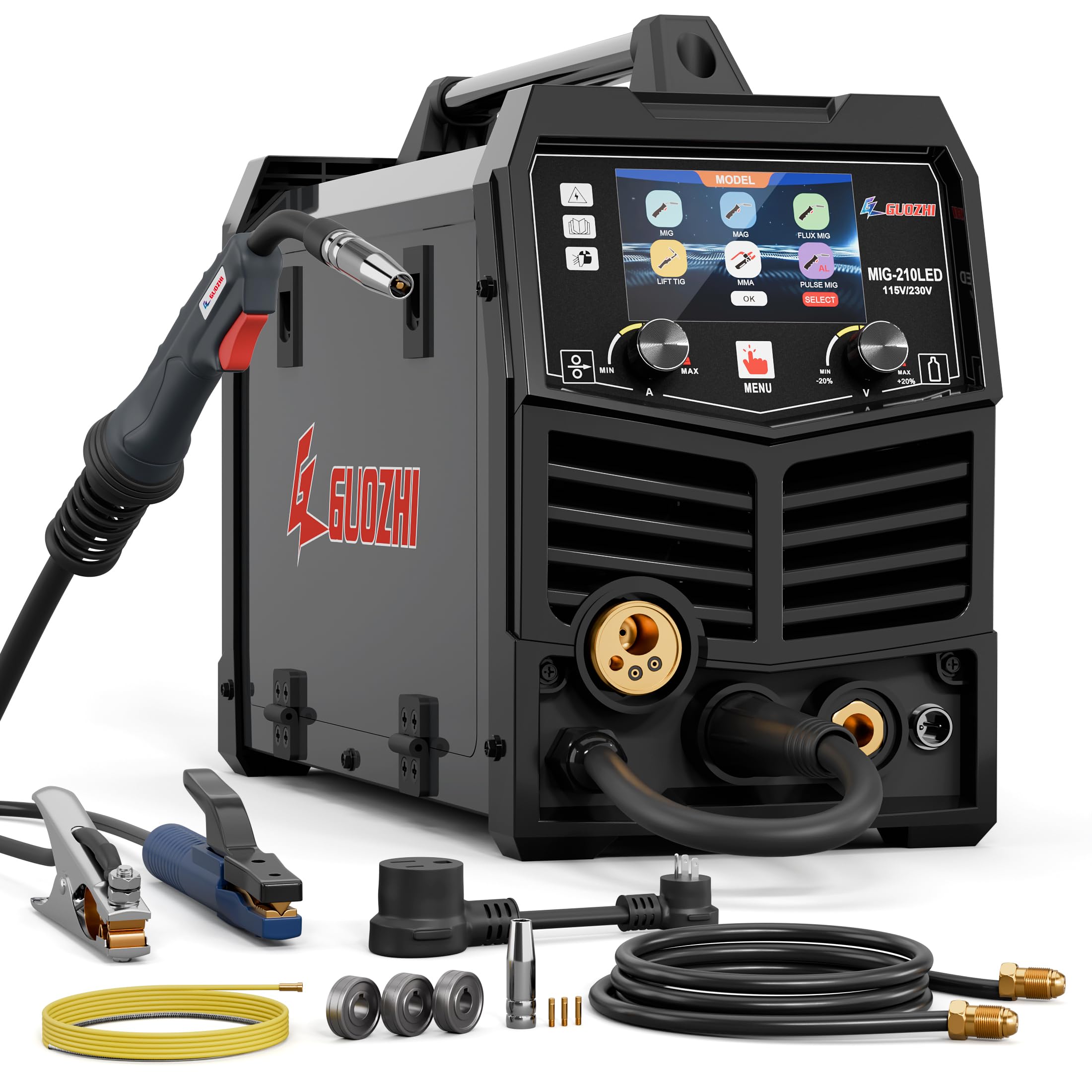
Eight welding modes plus pulse MIG for easier aluminum beads.
Pulse MIG reduces spatter and heat input, which makes welding aluminum noticeably easier than with a standard MIG machine. This unit offers pulse mode alongside Gas MIG, MAG, flux core, stick, Lift TIG, spot welding, and spool-gun compatibility — eight processes in a 33.7-pound body. It also stores up to 40 groups of parameter data (10 per mode), so you can save the settings for common jobs and recall them instantly instead of dialing in each time.
Reviewers point out flux-core on.035-inch wire penetrates 3/32-inch steel with a clean bead, and the large LCD screen shows all parameters clearly. The lack of a printed instruction manual for wire loading and settings is a common complaint — expect to look up setup details online. At 20.7 x 15.2 x 12.6 inches package size, it takes up similar bench space as the FEMEROL (21.6 x 16.5 x 12.7 inches).
Strengths
- Pulse MIG mode makes aluminum welding more accessible
- 40 memory slots for saving favorite settings
- Auto voltage and wire-feed with manual fine-tune
Weaknesses
- No printed manual for setup — rely on online resources
- Durability is unproven over multiple years
- Instructions for wire loading could be clearer
Best fit: intermediate users who want to experiment with aluminum welding and save custom settings for repeat jobs.
Not for you if: you prefer a comprehensive manual and proven long-term track record.
4. ARCCAPTAIN MIG Welder 200A
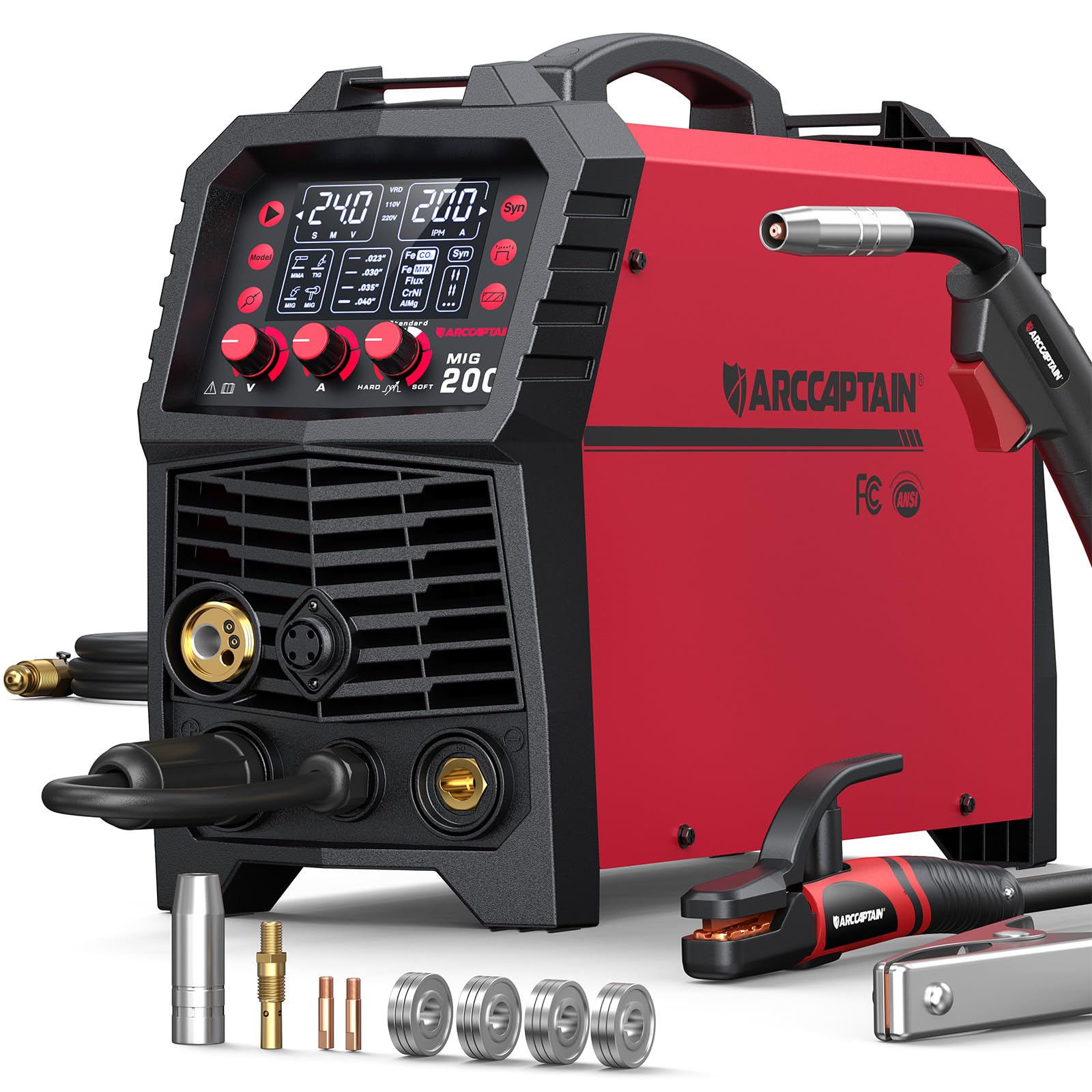
A 6-in-1 that lets you crater-fill and burn-back adjust on the fly.
Adaptive crater fill and burn-back adjustment are features normally found on welders twice this price. The ARCCAPTAIN 200A adds spot welding and spool-gun compatibility to Gas MIG, flux core, stick, and Lift TIG, making it a genuine 6-in-1 machine. It stores 10 preset groups per welding mode, and the fan runs only when the machine gets hot — keeping noise down compared to the constant-fan FEMEROL. The large LED display is readable without lifting your helmet.
Shoppers say the power cable gets hot on 110V, which raises a concern for extended use on a 15-amp circuit. The 110V adapter cable design for 220V use feels like an afterthought. On the positive side, the synergistic mode works well — set amps per.001-inch of material thickness and the machine handles the rest. The unit comes with a shoulder strap for carrying, measuring 20.9 x 8.5 x 16.1 inches and weighing a manageable amount.
Unique features
- Adaptive crater fill and burn-back adjustment fine-tune the end of each weld
- Thermostatic fan runs only when needed — quieter than constant-fan models
- 10 memory groups per mode for saved settings
Concerns
- 110V power cable runs hot under heavy use
- 220V adapter cable is a poor design; best used with a proper plug
- No setup chart printed on the machine
Who it works for: intermediate DIYers who want advanced MIG controls (crater fill, burn-back) without stepping up to a commercial price.
Pass if: you plan to weld near maximum duty cycle on 110V regularly — the hot cable is a real concern.
5. Bestarc 165A MIG Welder
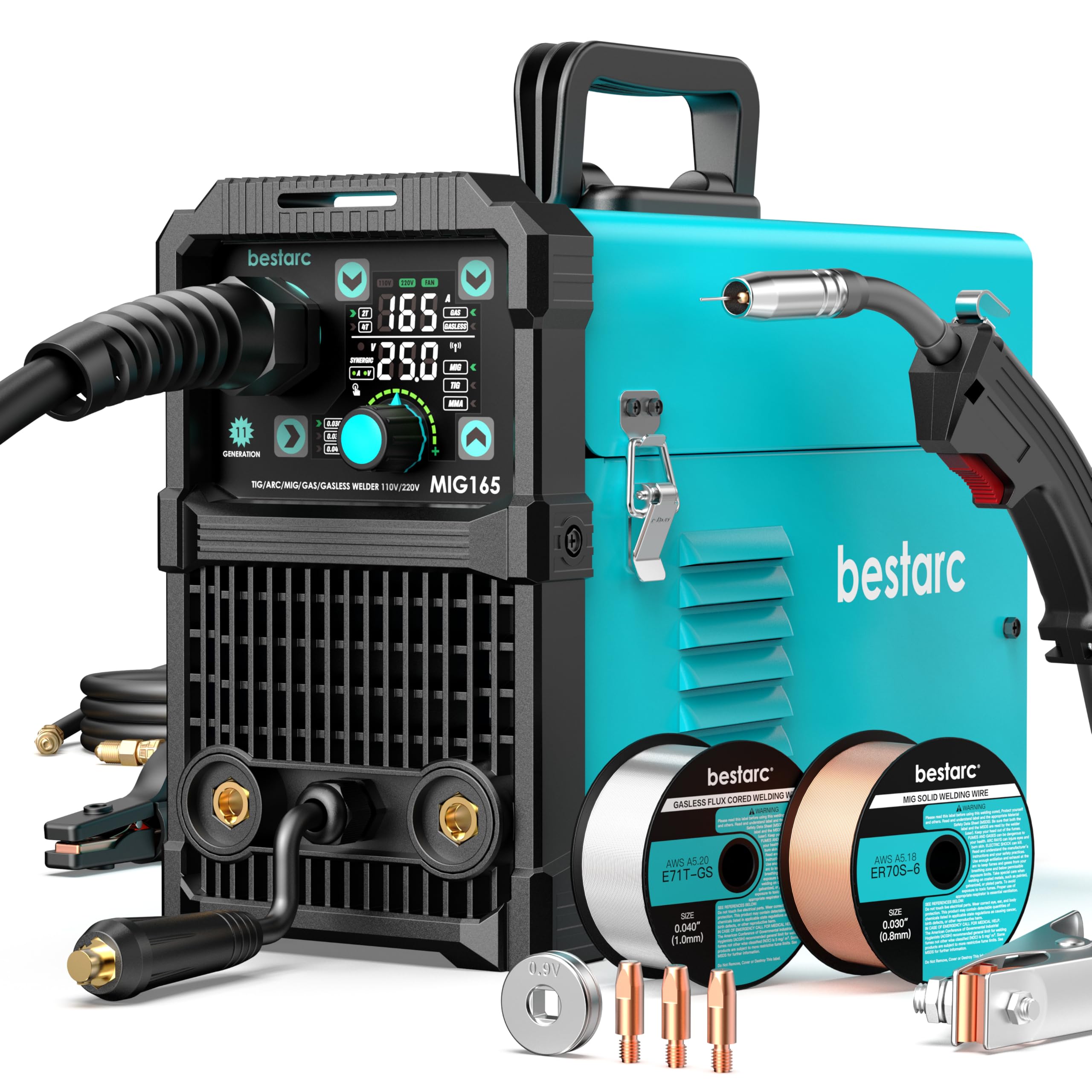
Synergic settings that make a beginner look like a pro.
Synergic control automatically matches the voltage and wire-feed speed when you select the wire diameter, then lets you fine-tune the voltage by -3V to +3V. The Bestarc 165A runs on 110V or 220V (auto-detected with a front-panel indicator) and offers four processes: gas MIG, flux core, Lift TIG, and stick. Weighing just 23.1 pounds, it is 9.5 pounds lighter than the FEMEROL 250A, making it genuinely portable for taking to a job site or up a ladder.
Buyers report that the early “145” version had a short 5.5-foot gun lead and no knurled drive roll. The current MIG165 fixes those issues with a longer lead, knurled rolls, and better presets. Some users say the stick mode maxes out at 130A, which limits thicker electrodes, and the power cord on the 110V side is a light 14/2 AWG that may struggle on high settings. It is still one of the lightest dual-voltage options here and delivers solid welds for the money.
Why it is a value leader
- Synergic control with fine-tune voltage makes setup fast for beginners
- 23.1 pounds is the lightest dual-voltage machine in this lineup
- Updated version fixes earlier complaints about short lead and missing knurled rolls
- Large LED display readable through a welding helmet
Hard truths
- 110V cord is 14/2 AWG — may limit performance compared to a 12/2 upgrade
- Stick welding is capped at 130A, limiting electrode options
Grab this if: you want the lightest dual-voltage MIG with autoset features for garage and mobile work.
Look elsewhere if: you need full-power stick welding or plan to push the machine at max amperage on 110V.
6. YESWELDER 160A MIG Welder
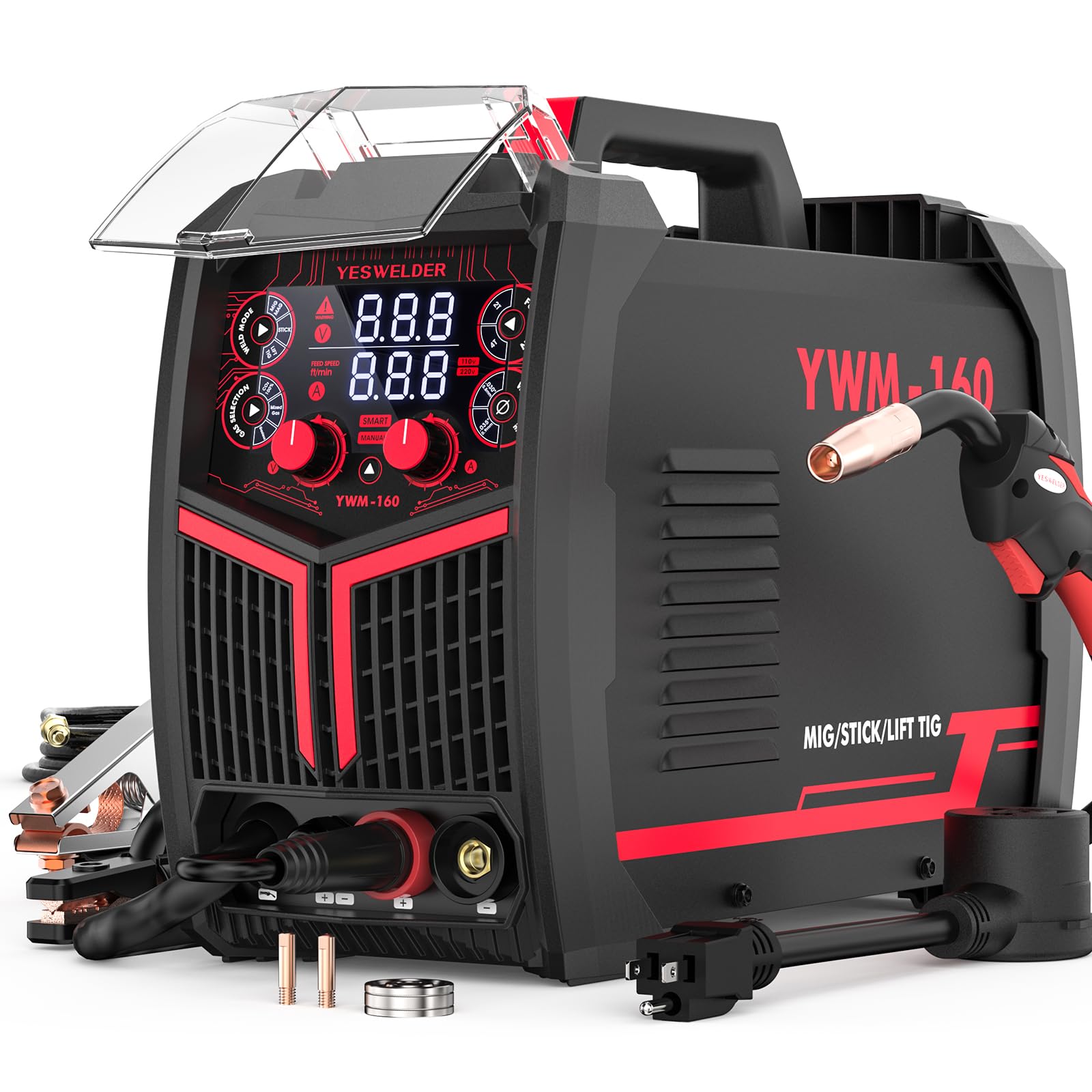
Smart mode that dials in settings while you focus on the bead.
Smart control (synergic) means you select the metal thickness and the YESWELDER 160A automatically sets the voltage and wire-feed speed. If you prefer manual tuning, you can override both parameters. It is a 4-in-1 machine (flux core, gas MIG, stick, Lift TIG with an extra torch) and weighs 27.8 pounds. The package dimensions are 20.16 x 16.1 x 12.83 inches — close to the FEMEROL’s 21.6 x 16.5 x 12.7 inches, but lighter by about 5 pounds.
One amateur buyer ran this on 220V in smart mode and reported it worked flawlessly on 1/4-inch steel. Stick welding has a steeper learning curve — the arc can be hard to start — but once established, it runs well even for users accustomed to Miller and Lincoln machines. The included 220V-to-110V adapter lets you run it off a standard outlet, though the real power shows on 220V. The manual is basic, and the stick mode width of the variable-speed control takes some getting used to.
What it does well
- Smart mode automates voltage and feed speed for beginners
- Manual override gives experienced users full control
- Reviewers report excellent results on 220V with 1/4-inch steel
What to watch for
- Stick arc is hard to initiate compared to dedicated stick welders
- Manual lacks depth for the stick setting recommendations
Choose it for: a dual-mode MIG that adapts to your skill level — smart for novices, manual for pros.
Skip if: you primarily need stick welding and want a smooth arc start every time.
7. AZZUNO 200A MIG Welder

200 advertised amps and a track record of 2-year daily use.
Rated at 200A, the AZZUNO 4-in-1 welds mild steel up to 8.0 mm thick and supports flux-core, gas MIG, stick, and Lift TIG (torch not included). Synergic control automatically sets voltage and feed speed when you dial in the amperage. It weighs 23.8 pounds and works with 2lb and 10lb spools in.030 to.040-inch wire sizes. The machine has been used daily for 2 years by one reviewer with no feeding or overheating issues, giving it a better long-term track record than many cheaper models.
The biggest complaint is the non-standard threading on replacement tips — you cannot buy them at the local hardware store; you must order online. The included ground clamp and electrode holder feel weak, and the controls take a bit of practice to memorize. Despite those gripes, the welder performs well on both 110V and 220V, with better stick performance on 220V. The gray finish and compact size look more substantial than the budget price suggests.
Pros
- 200A peak with auto-synergic makes setup fast
- Proven 2-year daily-use reliability from verified reviewers
- Responsive customer support that quickly replaced a damaged unit
Cons
- Non-standard tip threading means no local replacements
- Stock ground clamp and electrode holder feel cheap
- Control layout takes time to learn
Best for: the budget-conscious buyer who values proven long-term durability and strong customer support over fancy features.
Not for: anyone who wants to buy consumables at a local welding store without planning ahead.
8. Forney 271 Easy Weld 140 MP
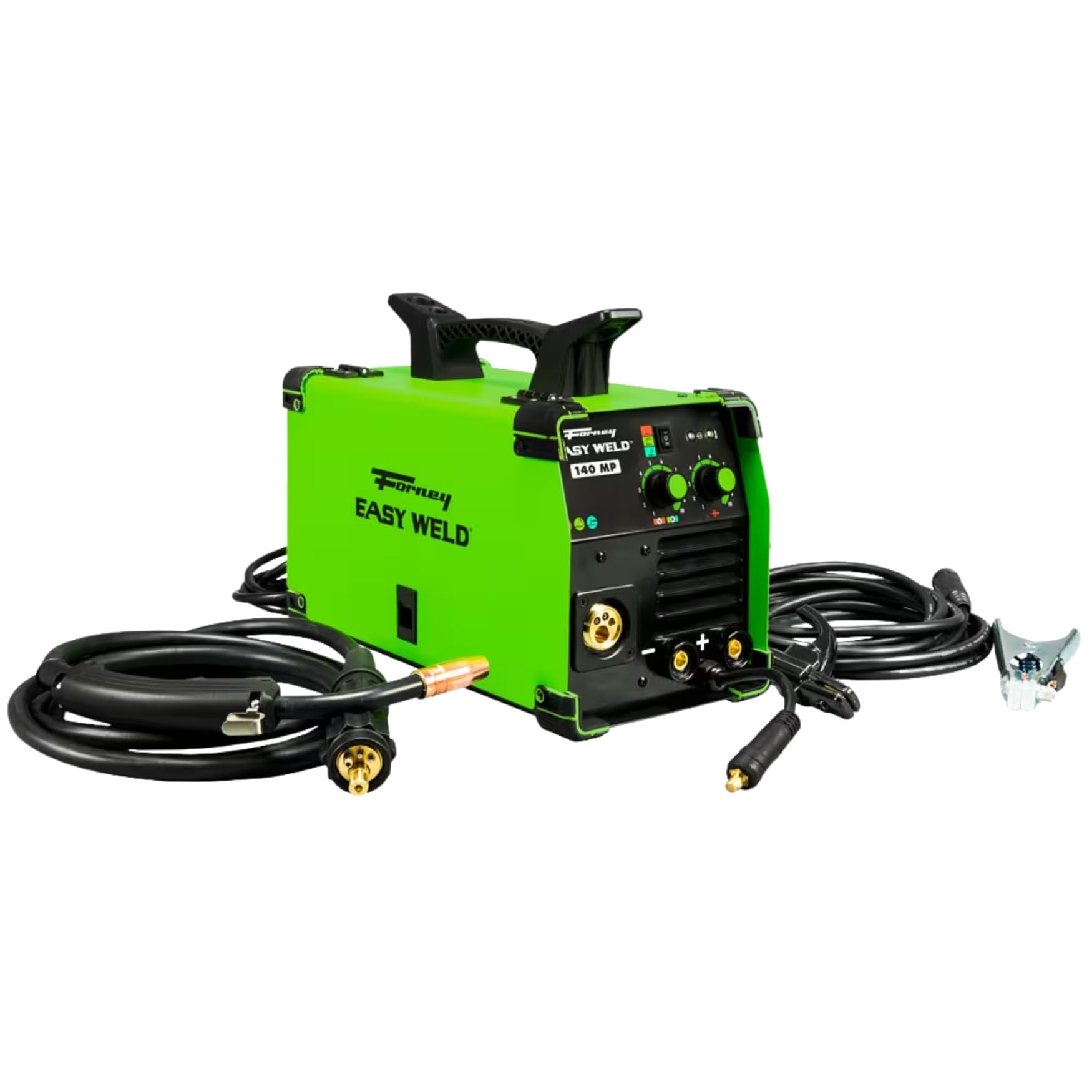
A 110V-only workhorse that Forney has been making for years.
Forney is an established USA brand, and this 140-amp 3-in-1 (MIG, DC TIG, stick) is built around a single voltage — 110V — with no dual-voltage option. It has an all-metal case and includes a 10-foot MIG gun, 8-foot electrode holder, 8-foot ground clamp, and a 20-amp to 15-amp adapter. The 3-position switch lets you change processes quickly, and infinite voltage and wire-feed dials let you fine-tune the arc. It runs well on a dedicated 20-amp 110V circuit and even better on a 30A outlet.
Owners mention it is a “favorite among 3 welders” for its quality components, clean fit and finish, and smooth arc with low spatter when using Argon/CO2 mix. It will struggle a bit with Lincoln 1/8-inch 6011 rods on a 20A circuit, but runs 6013 perfectly. The 25.8-pound weight makes it manageable for moving around the garage. Forney backs it with a 12-month warranty. It is the only machine on this list that does not accept 220V, so if you ever upgrade your shop outlet, you would outgrow this unit.
Reasons to buy
- All-metal case with a reputation for better fit and finish than generic imports
- Inverter is generator-friendly, manageable weight at 25.8 pounds
- Smooth, low-spatter arc with 75/25 argon/CO2 mix
Limitations
- 110V-only — no upgrade path to 220V
- Needs a dedicated 25-30A circuit for consistent performance
- Stick welding with 6011 rods is anemic on a 20A outlet
Perfect for: the hobbyist who wants reliable 110V-only MIG from a known brand and does not plan on upgrading their shop wiring.
pass on it if: you might someday want 220V power or need a multi-voltage machine for job-site flexibility.
Understanding the Specs
Duty Cycle — The Real Work Timer
Duty cycle is the number of minutes you can weld out of a 10-minute period at a given amperage. A 60% duty cycle at 200A means you weld for 6 minutes and cool for 4. This matters more than the peak amperage number because a welder that thermal-shuts down every 90 seconds is useless for longer projects. Inverter-based 110V welders typically have lower duty cycles than 220V machines because they draw less power, so look for at least 30% at your typical working current.
Synergic Control — The Beginner’s Cheat Code
Synergic (or “smart”) control means you tell the machine the wire diameter and material thickness, and it sets the voltage and wire-feed speed automatically. You can usually fine-tune from there. This removes the biggest frustration for new welders — figuring out which knob settings produce a stable arc. Some machines offer both synergic and full manual modes so you can learn the settings by feel and gradually switch to manual control as your experience grows.
FAQ
Can a 110V MIG welder weld 1/4-inch steel in a single pass?
What is the difference between flux-core wire and gas MIG?
Will a 110V welder trip a 15-amp breaker?
Can I weld aluminum with a 110V MIG welder?
Which welding process should I start with as a beginner?
How long does a MIG welder typically last?
Is dual voltage worth paying extra for?
What wire sizes should I use for a 110V MIG welder?
What does a “duty cycle” of 60% mean in real terms?
Can I use a standard household extension cord with a 110V welder?
Final Thoughts: The Verdict
If you want one dependable pick, the 110v mig welder winner is the FEMEROL 250A because it gives you six processes, a true 60% duty cycle, and the ability to weld aluminum — all at a price that undercuts units with fewer features. If you want a premium shop machine with a spool gun included and US-based support, grab the PrimeWeld MIG180. And for the best balance of portability and synergic ease, the Bestarc 165A is the lightest dual-voltage option that still delivers clean beads without a heavy price tag.
How We Picked
We do not accept paid placement, and we did not hands-on test every unit. Instead, we match each pick to a real buyer and use-case by comparing the manufacturers’ published specifications against the patterns in verified customer reviews — so you get each pick’s real strengths and trade-offs instead of marketing copy.
Sources & Methodology
Specifications: manufacturer listings and product documentation. Review insights: verified customer reviews, as of July 2026. Pricing: not shown on this page (it changes often); check the current price via the retailer link.
As an Amazon Associate, Gadgets Feed earns from qualifying purchases. This does not affect which products we feature.
Product prices and availability are accurate as of the date/time indicated and are subject to change. Any price and availability information displayed on Amazon at the time of purchase will apply to the purchase of this product. As an Amazon Associate I earn from qualifying purchases.
CERTAIN CONTENT THAT APPEARS ON THIS SITE COMES FROM AMAZON. THIS CONTENT IS PROVIDED "AS IS" AND IS SUBJECT TO CHANGE OR REMOVAL AT ANY TIME.
Amazon and the Amazon logo are trademarks of Amazon.com, Inc. or its affiliates.