
Our readers keep the lights on and my morning glass full of iced black tea. As an Amazon Associate, I earn from qualifying purchases.
Specs are compiled from manufacturer listings and verified buyer reviews and can change over time — please confirm the key details on the product page before buying.
Buying 12/2 MC cable is really a three-question purchase: how many feet do you actually need, is the armor aluminum or steel, and are the conductors solid bare copper the whole way through. Get those three right and the run pulls clean on the first try. Get them wrong and you are splicing a run that should have been one piece, or wrestling armor that will not take the corner. This guide sorts five real options by workload so you can match the roll to the job.
I’m Min — the founder and writer behind Gadgets Feed. This guide is built by comparing the manufacturers’ published specifications and the patterns across verified customer reviews, so you get each pick’s real strengths and trade-offs instead of marketing spin.
Two current-carrying wires plus a ground, wrapped in metal armor, is the whole idea. The variables are length, conductor count, and how stiff the armor feels in your hands. Below is a straight comparison of the 12/2 MC Cable options that hold up on real jobs.
Our Picks at a Glance
How To Choose The Best 12/2 MC Cable
The number in the name does all the heavy lifting. “12/2” means two 12-gauge conductors, and the “MC” means metal clad — the conductors sit inside a flexible metal armor instead of a plastic sheath. Everything else is a decision about length, armor material, and whether the listing matches the job.
Match the roll length to the run
Measure your run before you order, then add slack for the bends and the box terminations. A short run to a disconnect box is fine on a 75-foot roll, while a long branch circuit across a shop usually needs the full 100 feet. Going up to a 250-foot coil means fewer splices on big commercial runs — and every splice is a place that can fail inspection. If your measured run lands close to the roll length, buy the next size up rather than trying to stretch the last few feet.
Aluminum armor versus steel armor
Most value-priced 12/2 MC cable uses aluminum alloy armor, which resists corrosion and stays flexible enough to bend by hand. Steel interlocked armor is the heavier, tougher tradition and shrugs off more physical abuse. Weight matters more than buyers expect on a long pull overhead or through a tray, so if you are running 100 feet or more above your head, lighter armor saves your shoulders. Both types protect the copper inside from moisture and nicks.
Check the copper and the listing
Solid bare copper conductors carry current with less resistance than stranded or alloyed wire. Confirm the listing too: UL 83 covers the insulated conductor, UL 1569 covers the metal-clad assembly, and UL 2556 covers the testing method. A 600-volt rating covers the branch, feeder, and service work most buyers are doing, and a temperature rating of 90°C dry and 75°C wet is the common benchmark for this cable type.
Quick Comparison
| Model | Best For | Length | Conductor | Voltage Rating | Amazon |
|---|---|---|---|---|---|
| 75FT 12/2 Metal Clad (MC) Cable with Ground★ Best Overall | Short outdoor runs and EV charger hookups | 75 ft | Solid bare copper, 3 wires | 600 volts | Amazon |
| HUANCHAIN 12/2 MC Cable 100FTBest Value | Mini split and HVAC installs | 100 ft | Solid bare copper, 3 wires | 600V | Amazon |
| YYOGEE 12/2 100FT MC Cable with Ground | Shop wiring on a budget | 100 ft | 99.99% solid bare copper | 600V | Amazon |
| MOOKEERF 12/2 MC Cable with Ground | Exposed commercial runs and conduit-grade work | 100 ft | 99.99% oxygen free copper, 12AWG | 600V | Amazon |
| Stock Wire-6124 12/2 MC Cable 250 Feet | Long feeder runs and cable trays | 250 ft | Copper, 20 A max | — | Amazon |
In‑Depth Reviews
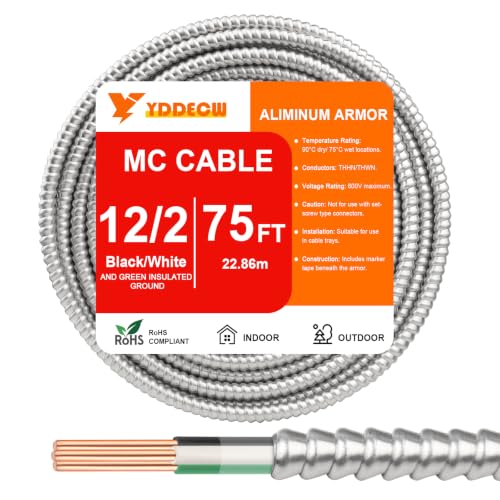
1. 75FT 12/2 Metal Clad Cable with Ground (YDDECW)
Our pick — over 4.5★ from 400+ verified ratings; the strongest balance of quality and price.
The 75-foot roll that bends where it counts and still handles a garage charger.
What separates this one is the armor. The jacket is aluminum alloy rather than steel, so it resists corrosion, handles heat and humidity, and stays flexible enough to route by hand — which is exactly why it keeps showing up in Level 2 EV charger installs. If you are running from an outside breaker to a disconnect box, that flexibility matters more than raw toughness, and the 75-foot length covers most of those runs without a splice.
The copper inside is solid bare, drawn at a 2.05mm diameter, with three conductors total: two current-carrying wires and one ground. That ground is the practical difference from a gimmick roll — a metal-clad run without a ground wire simply cannot be used for most modern branch circuits. Rated 600 volts and built to UL 83, UL 1569, and UL 2556, it covers industrial, commercial, and outdoor work in one coil.
The honest catch is the copper itself. The material quality draws mixed feedback, with several owners noting it is not solid copper wire throughout — so if your spec calls for a verified all-copper run, check the listing language against your inspector’s requirements before you pull it. For standard 20-amp branch circuits, the flexible 600-volt 75-foot roll covers the run.
Where it wins
- Aluminum alloy armor bends by hand and shrugs off heat, humidity, and corrosion — the flexibility is the point
- Three conductors with a dedicated ground wire, so the run is usable for modern branch circuits
- 75-foot length suits a breaker-to-disconnect run without an extra splice point
- 600V rated against UL 83, UL 1569, and UL 2556
Where it gives ground
- Several owners flag the conductor material as not solid copper, so spec-critical jobs should verify first
- At 75 feet it is 25 feet shorter than the 100-foot rolls below — long shop runs will fall short
Take this one if: you need a flexible 600V run for an EV charger, a mini split, or an outdoor disconnect and 75 feet is enough.
Think again if: your job calls for verified all-solid-copper conductors — the material note here is the one thing to double-check before ordering.
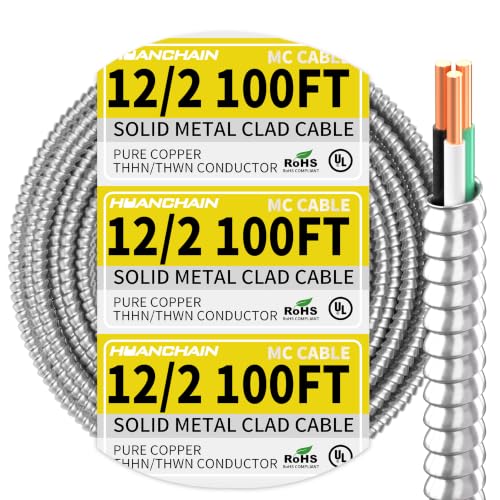
2. HUANCHAIN 12/2 MC Cable 100FT Solid Copper Wire
A full 100 feet with a real ground wire, priced like a roll you would settle for.
Where this beats the YDDECW roll above is raw length: 100 feet versus 75 feet, which is the difference between one clean pull and a splice you did not plan for. It also carries the same three-conductor layout — two current-carrying wires plus a ground — so nothing about the install changes, you just have more slack to work with on an HVAC or branch-circuit run.
The copper is 12-gauge solid bare, which gives you higher current capacity and better heat dissipation than a non-copper alternative, and the temperature ceiling is 90°C dry and 75°C wet. The aluminum alloy armor handles the same weather as the armor on the 75-foot pick, and it bends easily, which is what keeps an outdoor run from turning into a wrestling match.
What sells this one is the arithmetic. It is priced near the 75-foot roll despite giving you 25 more feet, and it is a 600V UL-listed coil — that is why it is such a strong pick for a mini split AC run from an outside breaker to a disconnect box. The one thing owners run into is stiffness at the tight bends; it does not love a sharp corner, but it works around the issue.
The real edge: 100 feet at a value-tier price is the reason to start here — you get a full-branch-circuit length without paying for the premium coil.
Set your expectations: the armor resists tight bends, so plan your corners with a little more slack than you think you need.
Reach for this if: you want a 100-foot, UL-listed 12/2 run for HVAC or shop branch circuits without stretching your budget.
Look elsewhere if: your run is under 75 feet and you would rather not carry the extra coiled weight — the shorter roll does the same job for less.
3. YYOGEE 12/2 100FT MC Cable with Ground
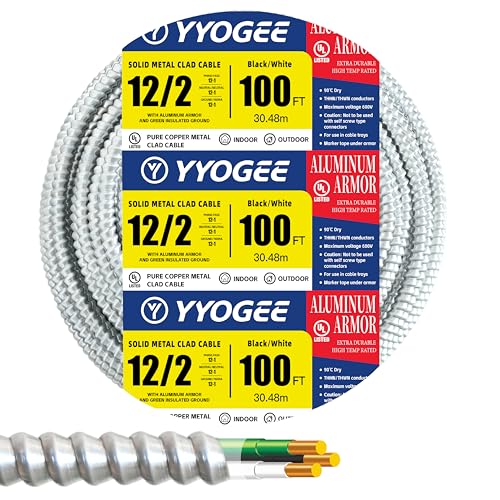
A 100-footer built for garages and workshops, with conductor specs that punch above its price.
Start with the copper, because it is the reason this one earns its place. The conductors are 99.99% solid bare copper inside THHN/THWN-2 insulation, rated for 600V and for 90°C dry / 75°C wet conditions. That combination — high-purity copper plus a dual-rated insulation — is what separates a genuine branch-circuit coil from a cheap grab, and it is why serious buyers look at conductor count before anything else.
The armor here is worth noting. YYOGEE calls it an upgraded aluminum alloy jacket built to resist crushing, bending, and impact, and to protect the conductors from moisture and chemicals. For a garage or shop where the run sits exposed on a wall, that crush resistance is the spec that matters — a run that survives a broom handle or a dropped wrench is worth more than one that does not. It is fully UL listed and flexible enough to route through a working space.
Owners confirm the easy-use reputation: the review pages describe it as flexible and easy to work with whether you are a licensed electrician or a first-timer, and the value holds up against the big-box alternative. The catch is packaging — no bushings come in the box and the coil ships in a plain brown carton, so budget for connectors and bushings separately. It is also a touch stiffer than standard armored cable.
What earns the pick
- 99.99% solid bare copper in THHN/THWN-2 insulation — the conductor quality is the standout spec here
- UL listed for 600V, 90°C dry / 75°C wet, so it covers exposed and concealed runs
- Upgraded aluminum alloy armor resists crushing, bending, and impact — good for a working shop wall
- Easy to handle for electricians and newcomers alike
What to budget for
- No bushings included and plain brown-box packaging
- Stiffer than standard armored cable at the corners
Pick this for: garage, shop, and commercial branch runs where crush-resistant armor and pure copper conductors matter more than cosmetics.
Only skip it if: you want connectors and bushings in the box — factor those into your cart before you start pulling.
4. MOOKEERF 12/2 MC Cable with Ground — 100FT Pure Copper
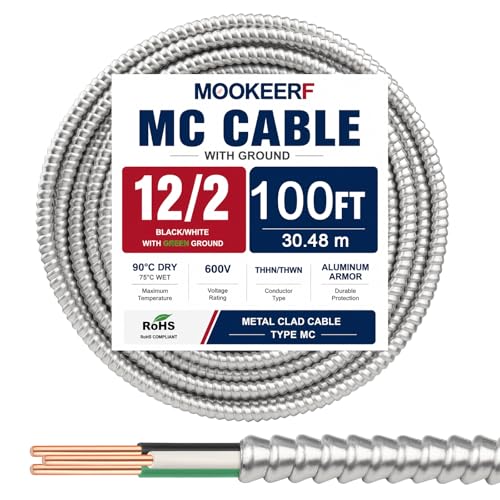
Industrial-grade armor and a nylon-wrapped insulator for jobs where the run stays exposed.
The specification sheet is where this one makes its case. You get 12AWG conductors in black and white with a 12AWG ground, THHN/THWN insulation, a 600V rating, and a 90°C dry / 75°C wet temperature ceiling — the same core numbers as the value picks, but built for commercial and industrial conditions. Checked against NEC Article 330, it is rated for exposed and concealed use in both dry and wet locations, which is what lets it run through a factory or a commercial building without a fight at inspection.
The materials stack up the same way. The copper is 99.99% oxygen free, the inner insulator is premium PVC with a nylon sheath over the surface for wear resistance and stable performance under high voltage. The steel interlocked armor is the trade-off against the aluminum-armored rolls above — heavier on the hands, but tougher against physical damage, corrosion, and moisture in a high-risk area.
Weight is a genuine consideration here. This is the heaviest of the 100-foot options, and running it overhead or through a long pull takes more effort than an aluminum-armored roll. Owners describe it as performing exactly as rated, with stiffness at tight bends as the one recurring complaint. If your run is on a wall or in a tray at working height, that trade is worth taking.
The engineering read: oxygen-free copper plus a nylon-sheathed inner insulator plus steel interlocked armor is the most protective stack in this lineup.
The cost of that: steel armor is heavier than aluminum and this coil has the stiffness to match, so plan your pulls accordingly.
Buy it for: exposed commercial and industrial runs where NEC Article 330 compliance and physical armor protection are non-negotiable.
Move on if: you are doing a short indoor run at working height and the heavier steel armor would just slow you down — the aluminum rolls above are easier on the arms.
5. Stock Wire-6124 12/2 MC Cable, 250 Feet

A 250-foot coil for whole-floor runs where a splice is not an option.
Length is the entire point of this roll. At 250 feet it carries more than double the 100-foot coils above — and versus the MOOKEERF 100FT at the same gauge, that is 150 extra feet in one continuous pull, which is the difference between finishing a commercial feeder run in one piece and stopping at a junction box. For branch, feeder, and service distribution across industrial, institutional, and multi-residential buildings, that uninterrupted length saves both time and inspection risk.
The electrical headroom is real too. It carries a 20-amp maximum current rating at 12-gauge copper, which matches the standard breaker for a 12/2 branch circuit. The armor is aluminum interlocking, built to run in cable trays and approved raceways, and to be installed concealed or exposed or fished and embedded in plaster — so the same coil covers a surface run on a warehouse wall and a hidden run inside a finished space.
Two things to size up before ordering: the coil’s weight and the space it needs. And if you are only wiring a garage or a single outdoor circuit, 250 feet is far more than you need — the shorter rolls do the same job with less waste. Owners wiring commercial and multi-residential buildings to spec, though, tend to come back for this one.
The right coil for: commercial, institutional, or multi-residential jobs where a 250-foot uninterrupted run through a tray or raceway is the requirement.
Not the pick if: you are wiring one garage circuit — a 75- or 100-foot roll covers that without the extra coiled weight.
Understanding the Specs
12/2 — What the Numbers Mean
The “12” is the wire gauge — 12 AWG copper, the standard size for a 20-amp branch circuit. The “2” is the conductor count: two current-carrying wires. Add the separate bare ground wire and you get the three conductors that make the run code-ready for modern installations. A metal-clad build wraps all three inside flexible metal armor instead of a plastic sheath, which is what lets the cable run exposed in a commercial or industrial space.
Aluminum Armor vs Steel Armor
Most value-tier 12/2 MC cable uses aluminum alloy armor. It resists corrosion, handles heat and humidity, and stays flexible enough to bend by hand around corners. Steel interlocked armor is the heavier option — it costs more weight in the hands but shrugs off more physical abuse and resists crushing. On a long overhead run, the lighter aluminum armor saves your shoulders; on a wall in a busy shop, the tougher steel armor takes more punishment.
Voltage and Temperature Ratings
600V is the voltage rating that covers the branch, feeder, and service work most buyers are doing with 12/2 MC cable. The temperature ratings come in pairs — 90°C dry and 75°C wet is the common ceiling for this cable type. Match the rating to your installation environment: a run that will see moisture needs the wet rating, while an indoor branch circuit is fine under the dry ceiling.
UL Standards and Listing
UL 83 covers the insulated conductor, UL 1569 covers the metal-clad assembly, and UL 2556 covers the testing method. Seeing these on the label is your assurance the roll was built to a recognized safety standard, not just stamped with a brand name. Always confirm the marking on the coil itself before you order for a job that will be inspected.
FAQ
Can 12/2 MC cable feed a mini split AC unit?
Is 12/2 MC cable safe for an EV charger installation?
What does the “12/2” label actually mean on the cable?
How many feet of 12/2 MC cable should I order?
Does MC cable have to be grounded?
Is aluminum armor as strong as steel armor on MC cable?
What does UL listing actually cover on 12/2 MC cable?
Can I use 12/2 MC cable outdoors or underground?
Why is some 12/2 MC cable stiffer than others?
Does 12/2 MC cable work for shop and garage wiring?
Final Thoughts: The Verdict
For most jobs, the 12/2 mc cable winner is the 75FT YDDECW roll — flexible aluminum armor, three conductors with a real ground, 600V rated, and enough length for a typical breaker-to-disconnect run. If you want the extra 25 feet for a shop or HVAC run, reach for the HUANCHAIN 100FT; it is the shortest jump from the winner and it brings the same three-conductor layout. For exposed commercial work where the armor has to take a hit, the MOOKEERF with its steel interlocked armor is the tougher call. And if a 250-foot pull to the panel is the job, the Stock Wire-6124 finishes it in one piece. Match the roll length to the measured run and you skip the splice — the one decision that saves real time on install day.
How We Picked
We do not accept paid placement. Every pick is matched to a real buyer and a real use-case; we do not hands-on test units.
Sources & Methodology
Specifications: manufacturer listings and product documentation. Review insights: verified customer reviews, as of September 2026. Pricing: not shown on this page (it changes often); check the current price via the retailer link.
As an Amazon Associate, Gadgets Feed earns from qualifying purchases. This does not affect which products we feature.