
Our readers keep the lights on and my morning glass full of iced black tea. As an Amazon Associate, I earn from qualifying purchases.
Specs are compiled from manufacturer listings and verified buyer reviews and can change over time — please confirm the key details on the product page before buying.
A 12-inch auger bit drills deep, clean holes through thick lumber, fence posts, and framing. But the wrong one jams up, overheats, and leaves you fighting to pull it back out. The difference depends on the flute design (the spiral grooves that pull chips out) and how sharp the screw point stays after a few holes. This guide covers three verified 12-inch bits across different prices so you can pick the one that actually gets the job done on your next project.
I’m Min — the founder and writer behind Gadgets Feed. This guide is built by comparing the manufacturers’ published specifications and the patterns across verified customer reviews, so you get each pick’s real strengths and trade-offs instead of marketing spin.
Running cable through studs or boring holes in a tree stump? The right 12 auger bit saves you from burned-out batteries and half-finished holes — here is exactly what to look for.
Our Picks at a Glance

How To Choose The Best 12 Auger Bit
A 12-inch auger bit needs to do three things well: start on its own without skating across the wood, clear wood chips so you do not have to reverse the drill every few seconds, and leave a reasonably clean hole for cable or bolt passage. These three specs tell you whether a bit will do all that or leave you frustrated mid-project.
Flute Count & Design
The number of flutes, or spiral grooves running up the shaft, controls how fast sawdust exits the hole. A single-flute bit has one open channel. It clears chips reasonably well. A tri-flute bit has three hollow-ground channels, so it moves more material out per revolution — meaning less binding in deep holes. The trade-off is that a tri-flute can leave slightly rougher hole walls because the extra cutting edges scrape wood all the way around. For deep holes through thick lumber where binding is your main enemy, more flutes usually win.
Self-Feeding Screw Point
This is the sharp threaded tip at the front. It pulls the bit forward as you drill, so you do not have to push hard — the bit does the work. A good screw point also prevents the bit from wandering off-center when you start. On a 12-inch bit, this matters a lot because a wandering start means an off-angle hole that gets worse the deeper you go.
Shank Type & Steel Quality
Nearly all 12-inch auger bits use a hex shank (commonly 3/8-inch or 2/5-inch) that locks into a drill chuck without slipping under high torque. The steel itself is usually high-carbon steel or carbon steel. High-carbon steel (like 1045 grade) holds an edge longer across hardwood and repeated use. A softer bit dulls faster in dense lumber like oak or treated timber, so check the material if you know you will be drilling hardwoods regularly.
Quick Comparison
| Model | Best For | Cutting Diameter | Number of Flutes | Material | Amazon |
|---|---|---|---|---|---|
| NICAVKIT 3/4″ x 12″ Auger Bit★ Best Overall | Budget-friendly all-purpose drilling | 0.75 Inches | 1 | 1045 High-Carbon Steel | Amazon |
| TOOLMAYS 1″ x 12″ Auger Bit | Clean deep holes in soft & hard wood | 1 Inch | 1 | High-Quality Carbon Steel | Amazon |
| WOBLLMX 1″ x 12″ Tri-Flute Auger Bit | Fast chip clearance in deep holes | 1 Inch (25.4 mm) | 3 | 1045 High-Carbon Steel | Amazon |
In‑Depth Reviews
1. NICAVKIT 3/4″ x 12″ Auger Bit
Our pick — 4.5★ from 500+ verified ratings; the strongest balance of quality and price.
An affordable 3/4-inch workhorse that buyers report stays sharp and drills clean holes from day one.
At 0.75 inches of cutting diameter, this is the narrowest bit in the group — a deliberate choice if you drill for smaller bolts or single cables rather than bundles. Where it surprises is the build quality for the price: 1045 high-carbon steel with a single-tooth cutting edge and an extra-large chip flute that buyers consistently call “very sharp” and able to drill holes easily. One reviewer running fence gate hinges said it made quick work of old posts. Another noted it produced clean chip-free holes for cabinet pulls without the tear-out you expect from a twist bit.
The number of flutes is 1 — the same single-flute layout as the TOOLMAYS bit — but the 3/4-inch diameter means chips have less distance to travel out of the hole, so clogging is less of an issue at this size. The self-positioning screw point grabs wood immediately, which is a big help when starting on a curved fence post face. The catch is the smaller bore: at 0.75 inches versus the 1-inch competitors, you give up 33% more cutting diameter (a full quarter-inch of hole) compared to the WOBLLMX and TOOLMAYS bits above. If you routinely need to pass 2-3 ethernet cables or Romex, that 1-inch opening is the difference between a snug pull and a forced squeeze.
What Buyers Love
- Arrives genuinely sharp — owners mention it cuts clean holes without forcing the bit.
- Self-positioning screw point starts exactly where you place it, no skating on rounded post surfaces.
- High-carbon steel holds up well across dozens of holes in treated lumber per owner reports.
Where It Pulls Back
- Narrower 3/4-inch bore means you cannot pass thick cable bundles; max 1-2 network cables snugly.
- Single-flute design still requires the occasional pull-back to clear chips on full 12-inch-deep holes.
- Uncoated finish may be more prone to light surface rust than coated bits if stored in humid conditions.
Who should grab this: the DIYer or weekend woodworker who needs a single-size auger for gate hardware, cabinet pulls, or shallow bolt holes and does not want to overpay for unused capacity.
Who should skip it: electricians or low-voltage installers pulling multiple cables — the 1-inch TOOLMAYS or WOBLLMX bits give you the pass-through room you need.
2. TOOLMAYS 1″ x 12″ Auger Drill Bit
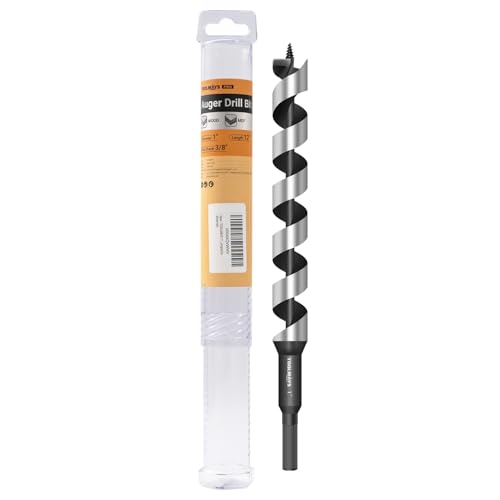
A full 1-inch bore that punches clean holes through tight knots without bending your wrist sideways.
This is the bit you reach for when the hole needs to be precise and the wood is not going to cooperate. It cuts a full 1-inch diameter all the way to 10 inches deep — so you can run thick bundles of wire or conduit through a single pass. The solid center core adds rigidity so the shaft does not flex under load. That matters when you are drilling through a knot in framing lumber. One reviewer noted the TOOLMAYS “sharp 3/4″ bit cuts framing easily; fits 2-3 ethernet cables or Romex” — the cutting edges arrive sharp out of the PVC tube.
Where it falls short against the WOBLLMX tri-flute bit below is chip evacuation. With a single-flute design, you may need to pull the bit out more often to clear sawdust in very deep holes. The screw point pulls you forward smoothly, but the chips sit in that single channel longer. It also weighs 16 ounces, so you feel the heft on an extended drilling session.
Clean Cutter: Leaves a smoother hole wall than a tri-flute bit because only one cutting edge touches the wood at a time, reducing tear-out around the rim.
The Real Catch: For holes deeper than about 8 inches in softwood, the single flute plugs up and you have to back the bit out to clear chips — a pause that breaks your rhythm.
Reach for this if: you need a true 1-inch bore for running cables or making passthrough holes in framing and you prefer a cleaner hole edge over blistering chip speed.
Look elsewhere if: you drill repetitive deep holes in pine or cedar where chip clogging costs you time — the tri-flute WOBLLMX below would suit you better.
3. WOBLLMX 1″ x 12″ Tri-Flute Auger Bit
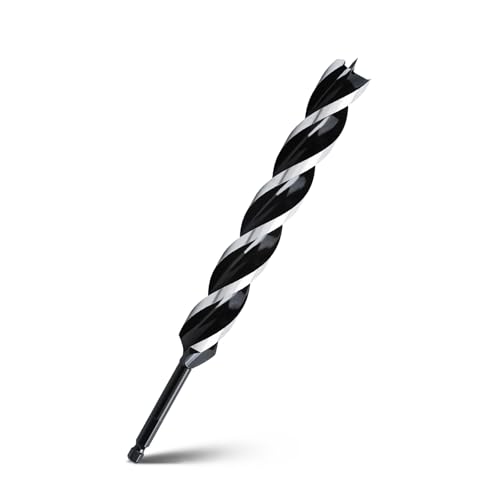
Three flutes pushing sawdust out so fast you barely slow down between fence posts.
This bit uses a tri-flute design — three precision-milled spiral channels with hollow centers — that clears wood chips more aggressively than any single-flute bit on this list. For deep holes through 6×6 lumber or tree stumps, that means less time wrestling the bit out of a clogged hole. One buyer using it in pine for 10-inch-deep holes noted it did “a decent job clearing chips” but still needed to completely remove the bit from the hole about twice per pass — even tri-flute bits need a breather on full-depth bores.
The 1045 high-carbon steel construction gives this bit an edge-holding advantage over standard carbon steel, especially if you hit a hidden nail or screw in old lumber. A 3/8-inch hex shank fits most standard drill chucks without slipping. The trade-off versus the TOOLMAYS bit above is that the tri-flute design can leave a slightly rougher finish on the inside of the hole because three cutting edges scrape around the circumference. For cable runs, that roughness does not matter. For furniture-grade work, the single-flute TOOLMAYS leaves a nicer finish.
Speed Auger: The extra two flutes mean hollow-ground chip channels clear debris faster than a single-flute bit — a real advantage when you drill ten holes in a row through pressure-treated lumber.
Hole Finish Trade: More cutting edges equal more surface contact, so the hole walls come out a bit textured rather than smooth — irrelevant for construction, noticeable for cabinet work.
Best suited for: anyone boring deep holes in rough lumber, fence posts, or stumps where chip clearance speed matters more than polished hole walls.
Not ideal for: visible woodworking like exposed beam drilling or furniture assembly — the rougher finish from three flutes may need sanding.
Understanding the Specs
Cutting Diameter
This is the width of the hole the bit leaves behind, measured in inches. A 1-inch bit is the most versatile for trade work because it passes Romex (a type of electrical cable), multiple ethernet cables, or conduit in one hole. A 3/4-inch bit gives up some of that pass-through room but stays tighter on centering and produces less waste in thin material.
Flute Count
Flutes are the spiral channels that carry sawdust out of the hole as you drill. A single-flute bit has one channel, which is simpler and leaves smoother hole walls. A tri-flute (three-flute) bit has three channels that clear chips much faster in deep holes but can leave a slightly textured finish. More flutes generally mean less binding, not a cleaner hole.
Self-Feeding Screw Point
A sharp threaded tip at the nose of the bit. Instead of you pushing the bit into the wood, the screw thread pulls the bit forward automatically as it rotates. This means you start exactly where you want and the bit does not wander off-center — especially helpful on angled entry or rounded surfaces like fence posts.
Hex Shank Dimensions
The hex shank is the flat-sided section at the back that the drill chuck grips. Most 12-inch auger bits use a 3/8-inch or 2/5-inch hex. The hexagonal shape prevents the bit from spinning inside the chuck under the high torque of deep drilling. Always check that your drill’s chuck can accept the shank diameter before buying.
FAQ
Will a 12-inch auger bit fit any standard drill?
Can a 12-inch auger bit drill through metal?
How deep can a 12-inch auger bit actually drill?
What is the difference between a ship auger bit and a standard auger bit?
Why does my auger bit keep getting stuck in the wood?
How do I clean and store a 12-inch auger bit?
Is a single-flute or tri-flute auger bit better for cable running?
Will a 3/4-inch auger bit fit multiple ethernet cables?
Can I use a 12-inch auger bit in an impact driver?
How often should I sharpen a 12-inch auger bit?
Final Thoughts: The Verdict
For most buyers, the 12 auger bit winner is the TOOLMAYS 1″ x 12″ Auger Bit because it combines a full one-inch bore with a rigid solid-center design that drills clean, precise holes through both soft and hard wood. If you prioritize non-stop chip clearance for repetitive deep boring in construction lumber or stumps, grab the WOBLLMX 1″ x 12″ Tri-Flute Auger Bit. And for a no-regret entry price that still uses proper 1045 high-carbon steel, the NICAVKIT 3/4″ x 12″ Auger Bit is your smart buy for smaller gate and cabinet work.
How We Picked
We do not accept paid placement. Every pick is matched to a real buyer and a real use-case; we do not hands-on test units.
Sources & Methodology
Specifications: manufacturer listings and product documentation. Review insights: verified customer reviews, as of July 2026. Pricing: not shown on this page (it changes often); check the current price via the retailer link.
As an Amazon Associate, Gadgets Feed earns from qualifying purchases. This does not affect which products we feature.