
A 12-channel audio mixer is the central nervous system of any serious live-sound rig, studio corner, or multi-performer podcast. Getting the mix right means managing gain staging across a dozen inputs while keeping noise floor low and headroom high — a razor’s edge between clean transients and feedback chaos. Choosing poorly forces you to fight the board instead of the performance.
I’m Min — the co-founder and writer behind Gadgets Feed. I’ve spent hundreds of hours cross-referencing preamp specs, effects processors, routing flexibility, and build quality across the exact 12-channel mixers serious buyers actually consider, cutting through marketing noise to isolate what really matters for live and studio work.
Whether you need phantom power for condenser mics, multitrack recording to SD card, or enough headroom for a full band on stage, finding the right 12 channel audio mixer demands understanding which features are non-negotiable for your specific signal chain.
How To Choose The Best 12 Channel Audio Mixer
A 12-channel mixer sounds like a straightforward buy until you realize the term “channel” can mean mono XLR inputs, stereo line pairs, or USB returns. Real durability comes from understanding preamp character, bus architecture, and whether you need built-in multitrack recording. The wrong choice wastes money on features you never touch or misses critical routing for your setup.
Preamp Quality and Gain Architecture
The preamps are the lungs of your mixer. A published EIN figure of -128 dBu or lower with at least 60 dB of gain range tells you the board can handle ribbon mics without adding hiss. Look for inverted Darlington circuits or discrete op-amp designs — these deliver the headroom needed for percussive transients and vocal peaks without distortion. Cheap preamps introduce noise that no amount of post-processing can clean.
Effects Processing and Bus Flexibility
Not all effects are created equal. A mixer with 99 DSP effects is only useful if those effects are assignable per channel and include usable reverbs and delays. Equally important is whether the mixer offers dedicated aux sends for monitor mixes, pre/post fader switching for foldback, and inserts for external compressors. A board with only one aux send severely limits your live stage flexibility.
Recording and Connectivity Options
Modern 12-channel mixers fall into three connectivity camps: USB audio interfaces for DAW recording, SD card recorders for standalone multitrack capture, and Bluetooth for wireless playback. A mixer that records individual tracks to SD card is a game-changer for rehearsal capture and live archiving. USB class-compliance matters if you plan to use an iPad — some mixers require drivers that iOS cannot install.
Quick Comparison
On smaller screens, swipe sideways to see the full table.
| Model | Category | Best For | Key Spec | Amazon |
|---|---|---|---|---|
| Zoom LiveTrak L-12 | Digital | Multitrack Recording | 5 headphone outs, 24-bit/96kHz SD recording | Amazon |
| Allen & Heath CQ-12T | Digital | Touchscreen Control | 7″ capacitive touchscreen, 16×16 USB/SD | Amazon |
| Yamaha MG12 | Analog | Clean Preamps | D-PRE inverted Darlington circuit | Amazon |
| Mackie 1202VLZ4 | Analog | Broadcast Clarity | Onyx preamps, 60dB gain range | Amazon |
| Mackie Mix12FX | Analog | Ultra-Compact | 3.7 pounds, 75Hz low-cut filter | Amazon |
| Pyle PMXU128BT | Analog | Live PA | 7-band master EQ, 16 DSP effects | Amazon |
| Behringer Xenyx 1202SFX | Analog | Synth Rigs | USB interface, 99 effects voices | Amazon |
| FULODE MIX-12 | Analog | DSP Variety | 99 DSP effects, 7-band master EQ | Amazon |
| K-mxerpro 12 Channel | Analog | Budget Entry | Bluetooth playback, USB direct recording | Amazon |
In‑Depth Reviews
1. Zoom LiveTrak L-12 Mixer/Multitrack Recorder

The Zoom LiveTrak L-12 redefines what a 12-channel mixer can do by combining a full analog mixer with a 14-track digital recorder that writes directly to SD card at 24-bit/96kHz. Its five independently assignable headphone outputs let each band member craft a personal monitor mix without extra outboard gear — a feature that costs hundreds more in separate systems. The preamps offer -128 dBu EIN with up to +60 dB of gain, enough to drive passive ribbon mics cleanly.
Recording is where the L-12 truly dominates: each input records to its own track on the SD card, giving you full multitrack separation for post-production. The USB audio interface mode streams all channels to your DAW while class-compliance allows direct connection to iPads. The built-in metronome and scene recall make it a complete rehearsal tool that replaces a mixer, recorder, and headphone amp in one 5.7-pound chassis.
The plastic housing feels light but durable for transport, though the effects processor applies to the entire mix globally — you cannot route reverb to one channel and delay to another independently. File organization on the SD card requires a computer rename workflow for track bouncing, but these are minor tradeoffs for the most versatile mixer-recorder under studio-tier pricing.
Why it’s great
- Five separate monitor mixes with dedicated headphone amps — a live band’s dream
- 14-track simultaneous SD recording at studio-grade bit depth and sample rate
- Class-compliant USB interface works with iPad without drivers
Good to know
- Only one global effects engine — cannot assign different effects per channel
- No virtual tracks or track bouncing on the unit itself
- SD card file naming can be cumbersome for large sessions
2. Allen & Heath CQ-12T Digital Mixer

The Allen & Heath CQ-12T brings a 7-inch capacitive touchscreen to the 12-channel mixer market, replacing dozens of physical knobs with an intuitive visual interface that makes complex routing feel simple. Its ten mic/line inputs (five combo) plus stereo line give you true 12-channel flexibility, while the 16×16 USB interface and SD card recorder handle multitrack capture without a computer. The Auto Gain feature automatically sets levels per channel, a lifesaver for quick soundchecks at small venues.
The DSP effects engine includes reverbs, delays, and modulation effects that sound genuinely musical — not the tinny presets common at this price tier. Six outputs (main L/R plus four aux) support in-ear monitor systems with individual mixes. The built-in Bluetooth input lets a phone feed music between sets, assignable to a dedicated stereo channel. At 8.85 pounds, it is backpack-portable enough for a solo engineer carrying gear to multiple events.
The digital architecture means mute groups and DCAs affect every output simultaneously — you cannot mute a channel on only the monitor mix while keeping it live on the main bus. This limits complexity for advanced monitor-world applications. Tablet control via the CQ app adds wireless adjustment during performances, making it the most forward-thinking analog-digital hybrid in its class.
Why it’s great
- Responsive 7-inch touchscreen with visual EQ and routing
- Auto Gain intelligently sets input levels for quick setup
- 16×16 multitrack recording to SD and USB simultaneously
Good to know
- Mute groups and DCAs are not output-specific — affects all buses
- Learning curve for users accustomed to fully analog layouts
3. Yamaha MG12 12-Input 4-Bus Mixer
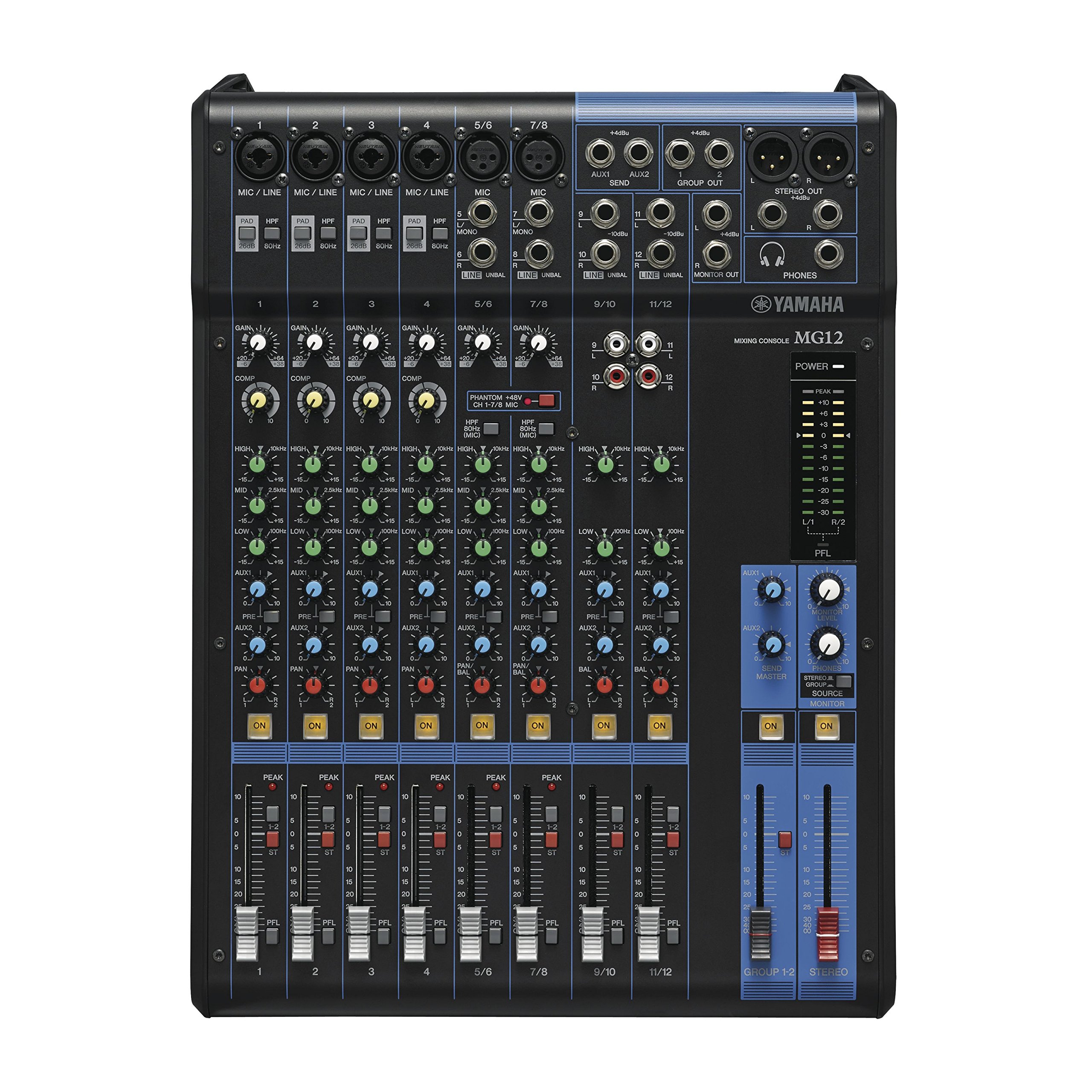
The Yamaha MG12 is the reference standard for clean analog sound at a mid-range price, built around the D-PRE preamp with an inverted Darlington circuit that delivers exceptional transient response and low noise. Each mono channel includes a one-knob compressor that simplifies dynamic control for vocals and acoustic instruments — you get usable compression without navigating attack and release parameters. The metal chassis and internal universal power supply make it stage-reliable across different voltage regions.
The four-bus architecture gives you subgroup routing for managing drums, vocals, or backing tracks before they hit the main mix, a feature typically reserved for more expensive consoles. The 192 kHz D/A converters ensure the stereo output retains clarity, and the XLR balanced outputs keep signal integrity over long cable runs. Monitors on channels 1-2 handle high-SPL sources without preamp overload, an advantage for electronic musicians running synths directly into the board.
The MG12 lacks built-in effects, so reverb and delay require external processors or pedal units. Some users report noise floor hiss when pairing with multiple synthesizers, particularly at high gain settings. Lighted on/off switches and a rugged feel confirm why Yamaha mixers remain industry staples for small to mid-sized venues.
Why it’s great
- D-PRE preamps with inverted Darlington circuit for ultra-low noise
- One-knob compressors on each mono channel simplify dynamics
- Four-bus routing for subgroup management of large input counts
Good to know
- No built-in effects — external processors needed for reverb/delay
- Some noise floor hiss reported with multiple synth inputs
- Lacks insert jacks on every channel
4. Mackie 1202VLZ4 12-Channel Mixer

The Mackie 1202VLZ4 represents the gold standard for analog mixer construction, with an all-metal chassis that absorbs vibration and resists the abuse of weekly load-ins at clubs and houses of worship. Its four Onyx mic preamps deliver an ultra-wide 60 dB gain range with -129 dBu EIN, making them some of the quietest preamps available outside of broadcast consoles. The improved RF rejection circuitry eliminates radio interference that plagues digital-equipped mixers in urban venues.
The 12-channel count is achieved through four mono channels with boutique-quality preamps plus eight high-headroom line inputs, giving you enough flexibility for multi-instrument setups. The 3-band EQ with swept midrange on the mono channels allows surgical frequency correction, while the ALT 3-4 bus expands your submix capabilities. The external power supply keeps the chassis thin, but color-coded knobs and logical signal flow make live adjustments intuitive even in low light.
There are no built-in effects — this is a pure analog signal path with zero digital coloration. The headphone output is not independent from the main mix, which limits solo monitoring for some engineers. The knob-based volume controls (no sliders) divide opinion: they are more resistant to dust but less visual at a glance during performances.
Why it’s great
- All-metal construction built to survive touring and regular transport
- Onyx preamps with 60 dB gain range and industry-best noise floor
- Swept midrange EQ on mono channels for precise frequency shaping
Good to know
- No built-in effects require external reverb or delay units
- Knob volume controls instead of faders may feel less intuitive
- Headphone output mirrors main mix — no separate cue mix
5. Mackie Mix12FX Compact Mixer

The Mackie Mix12FX squeezes 12 channels and 12 integrated effects into a chassis that weighs only 3.7 pounds — light enough to fit in a laptop bag alongside cables and microphones. Its four mic/line inputs deliver the same high-headroom, low-noise performance Mackie is known for, while the 3-band EQ and 75 Hz low-cut filter clean up stage rumble and handling noise. The dedicated stereo RCA inputs and outputs make connecting media players or recording interfaces seamless.
The built-in effects processor includes 16 reverbs, choruses, and delays that range from usable to genuinely good for a compact mixer. The 3-band EQ on each channel provides clean tone shaping without coloration, and the phantom power switch handles condenser mics across all four XLR inputs. The 2.1-inch height profile means it slides into tight rack spaces or under desks for permanent installations without sacrificing audio quality.
The plastic chassis saves weight but lacks the road-worthy durability of Mackie’s VLZ series — it is best suited for semi-permanent setups or careful transport. There is no power switch; the unit operates as long as it is plugged in, which is a minor inconvenience but low-power draw keeps it safe to leave connected. The effects are acceptable for vocals and acoustic instruments but lack the depth needed for complex electronic productions.
Why it’s great
- Ultra-light 3.7-pound design fits in a laptop bag for mobile engineers
- 12 integrated effects including reverb, chorus, and delay
- Dedicated RCA inputs/outputs for easy media device connection
Good to know
- Plastic chassis is less durable for frequent touring
- No power switch — always active when plugged in
- Effects processor lacks the depth of higher-end digital units
6. Pyle PMXU128BT 12-Channel Mixer

The Pyle PMXU128BT brings a full-size console layout to the 12-channel mixer category with 8 XLR combo inputs, 2 mono line inputs, and a stereo line input giving you 12 usable channels for complex live PA setups. The 7-band master graphic EQ lets you shape the overall room response, compensating for problematic venue acoustics without requiring external equalizers. The 16 built-in DSP effects include reverbs, delays, and modulation that can be assigned to individual channels for targeted processing.
Bluetooth wireless streaming works as an independent input channel, letting a DJ or presenter mix music from a phone alongside microphones. The 12-segment LED output meter shows levels clearly across -30 dB to +0 dB and into the CLIP zone, helping you avoid distortion without guessing. The USB soundcard interface records a stereo mix to your computer, which is fine for podcast archiving but not multitrack separation. Users report excellent headroom when paired with FetHead inline preamps, producing clean signals even on dynamic mics at distance.
The 10.6-pound weight makes it one of the heavier options, and the USB connection occasionally requires re-plugging to re-establish the link with the computer. The potentiometers can bend under heavy pressure, so careful handling during transport is recommended. Despite these quirks, the combination of graphic EQ, Bluetooth, and sufficient channel count makes it a compelling choice for budget-conscious venues and churches.
Why it’s great
- 7-band master graphic EQ shapes room response without external gear
- Bluetooth wireless input for mixing phone or tablet audio
- Excellent headroom with clean preamps for demanding live scenarios
Good to know
- Heavier build at 10.6 pounds — less portable for solo engineers
- USB connection occasionally drops and requires reinsertion
- Potentiometers are more delicate than pro-level alternatives
7. Behringer Xenyx 1202SFX 12-Channel Mixer

The Behringer Xenyx 1202SFX packs 12 channels, a USB audio interface, and 99 built-in effects voices into a chassis smaller than a laptop and lighter than most textbooks. Its four Xenyx mic preamps deliver sufficient gain for dynamic microphones, while the 3-band EQ on each mono channel provides essential tone shaping for vocals and instruments. The 12 line inputs make it an ideal hub for synthesizer setups where TRS connections dominate over XLR.
The 99 effects voices include reverbs, delays, choruses, and multi-effects that are fun to experiment with and can add character to otherwise dry mixes. The USB connectivity records to your DAW directly, simplifying recording for bedroom producers. The compact size surprises users who expect a larger footprint — it slides into small desk corners or fits on cramped stage tables without taking over the space. The effects can be routed per channel, giving you flexibility that simpler mixers lack.
The “SFX” designation means effects are built-in but their quality is described as “fun” rather than “studio-grade” — subtle reverb tails can sound metallic compared to dedicated units. Some users report the headphone output volume is lower than expected, requiring sensitive headphones for monitoring. The lack of RCA tape in and out limits connection options for legacy media players.
Why it’s great
- Ultra-compact footprint perfect for synth rigs and small desks
- 99 effects voices with per-channel assignability for creative processing
- USB audio interface for direct DAW recording without extra converter
Good to know
- Effects quality is more “fun” than transparent studio-grade
- Headphone output volume may be insufficient for low-impedance headphones
- No RCA tape inputs or outputs for vintage gear connection
8. FULODE MIX-12 Bluetooth Studio Mixer

The FULODE MIX-12 packs 12 input channels, 99 DSP effects, and a 7-band master equalizer into a price range that competes with entry-level 8-channel mixers. Its three-band EQ on each mono channel plus the master graphic EQ gives you fine control over the room sound. The built-in Bluetooth supports wireless music streaming from mobile devices, assignable to a dedicated channel or blended into the main mix. Individual phantom power switches per channel eliminate the need to power up all mics simultaneously — a thoughtful touch for mixed condenser/dynamic setups.
The 99 DSP effects cover everything from small rooms to large halls, reverbs, delays, and modulation effects that are listed directly on the unit for easy reference. The mute buttons on every channel and smooth faders make live operation efficient. The digital display on the USB player shows track information for flash drive playback, adding convenience for DJs and presenters who need queue management. The 6.46 kg weight indicates substantial build quality for the price.
The effects processor quality is acceptable for live reinforcement but lacks the nuance of higher-end digital desks — engineers looking for studio-grade reverb tails should budget for an external effects unit. The headphone output is notably quiet, struggling to drive standard monitoring headphones to adequate levels. The absence of PFL/AFL functionality limits solo monitoring in live band environments, making gain staging more guesswork than precision.
Why it’s great
- 99 DSP effects with on-unit printed list for quick reference
- Individual phantom power switches per channel avoid powering all mics at once
- 7-band master EQ plus 3-band per-channel EQ for comprehensive tone shaping
Good to know
- No PFL/AFL functionality for channel soloing during live shows
- Headphone output is very low in volume — requires sensitive headphones
- Effects quality is usable but not as detailed as dedicated processors
9. K-mxerpro 12 Channel Professional Mixer
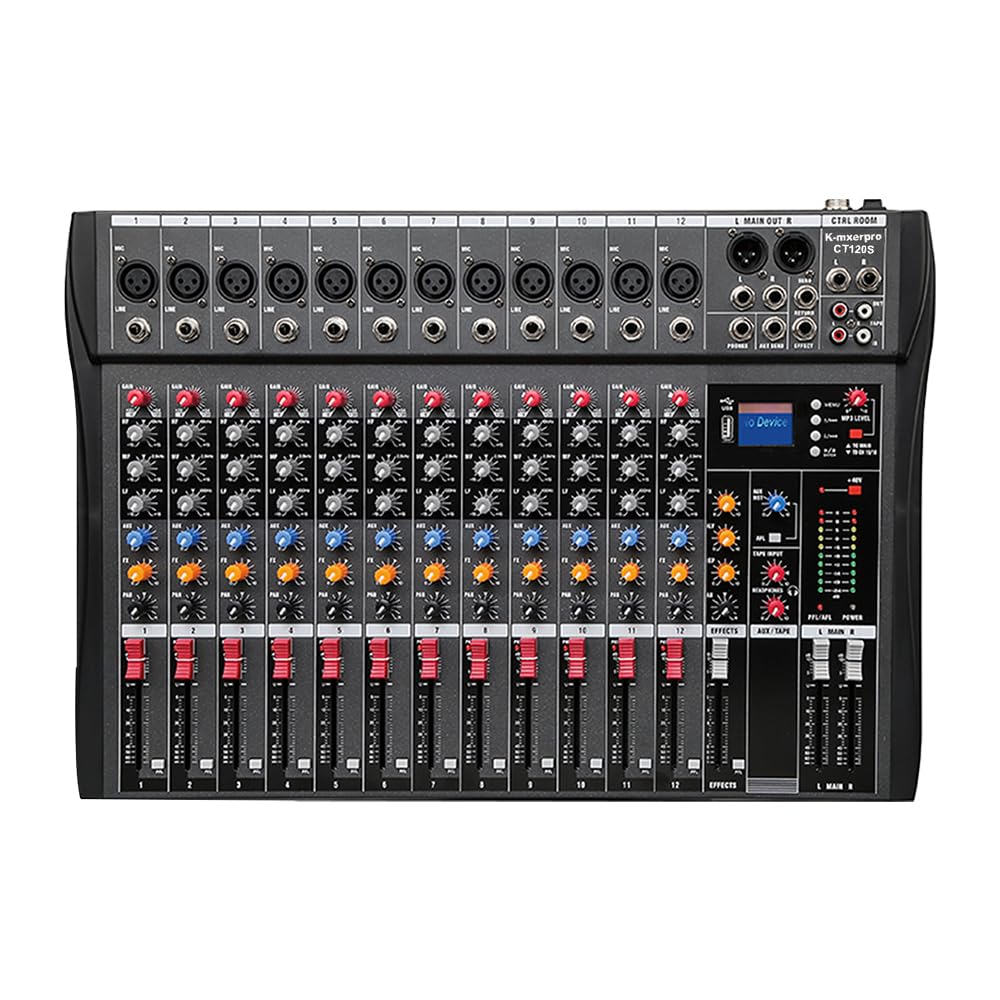
The K-mxerpro 12 Channel Mixer proves that 12 input channels don’t require premium-tier budgets, delivering XLR and unbalanced 1/4-inch inputs on all channels plus Bluetooth streaming and USB playback at an entry-level price point. Its ultra-thin chassis (approximately 2 inches high) resists dust with sealed rotary controls, making it suitable for semi-permanent installations where rack depth is limited. The 3-band EQ and gain controls on each channel provide essential sound shaping, while the reverb and delay effects add polish to vocals and instruments.
The Bluetooth connection streams music from phones and tablets, assignable to channel faders or independent volume control for background music. The USB reader plays MP3 files directly from flash drives and can record the stereo mix to USB — a rare feature at this price level. The PFL/AFL monitoring lets you solo individual channels through headphones for precise level setting. The REC and TAPE input/output jacks expand connectivity for external recorders.
The unit includes a transformer for 220V operation which may require a step-down converter in 110V regions — a critical check before purchasing internationally. Build quality is adequate for careful home or studio use but the plastic chassis and compact design may not withstand heavy touring. Some users report the effects processor is sufficient for rehearsal but thin for professional performance.
Why it’s great
- Full 12-channel XLR/1/4-inch input count at entry-level pricing
- Bluetooth playback and USB direct recording to flash drive
- Ultra-thin 2-inch chassis with dust-resistant sealed knobs
Good to know
- Comes with 220V transformer — may need step-down in 110V regions
- Plastic build limits durability for regular touring
- Effects quality is reasonable for rehearsal, not professional shows
FAQ
Can a 12-channel mixer handle a full band with multiple vocal mics and instruments?
Do I need a mixer with a USB audio interface or is a standalone mixer fine?
Final Thoughts: The Verdict
For most users, the right 12 channel audio mixer is the Zoom LiveTrak L-12 because its five independent monitor mixes and 14-track SD recording replace a mixer, recorder, and headphone amp in one package. If you want touchscreen control and Auto Gain for fast soundchecks, grab the Allen & Heath CQ-12T. And for pure analog preamp quality with legendary build durability, nothing beats the Mackie 1202VLZ4.