
Our readers keep the lights on and my morning glass full of iced black tea. As an Amazon Associate, I earn from qualifying purchases.
Specs are compiled from manufacturer listings and verified buyer reviews and can change over time — please confirm the key details on the product page before buying.
If you are reaching for a 12-inch saw, you are done fighting thin 7-1/4-inch blades on thick lumber. This size class is about raw cutting depth and capacity — ripping through 4x6s, slicing crown molding, and making wide crosscuts that smaller saws simply cannot handle. The catch is that “12 circular saw” spans two very different tools: a portable circular saw blade and a heavy miter saw that lives on a stand. This guide sorts out which style fits your workshop, then digs into the specs that actually matter for each.
I’m Min — the founder and writer behind Gadgets Feed. This guide is built by comparing the manufacturers’ published specifications and the patterns across verified customer reviews, so you get each pick’s real strengths and trade-offs instead of marketing spin.
From sliding compound miter saws to a compact 12-inch circular table saw setup, here is the practical shortlist for choosing your next 12 circular saw.
Our Picks at a Glance

How To Choose The Best 12 Circular Saw
Before you compare motor amps or bevel ranges, decide which physical tool you need. A 12-inch miter saw is a stationary powerhouse for angled cuts on trim and framing. A 12-inch circular saw is a handheld beast for deep cuts in thick beams — and it can even be flipped upside down to act as a makeshift table saw. These are different machines that happen to share a blade size.
Miter Saw or Circular Saw?
If you are cutting crown molding, baseboards, or framing lumber at precise angles all day, you want a miter saw with a sliding head. If you need to carry a saw to the lumber and make deep, straight cuts through beams or posts, the portable circular saw is the one. One clue: a 12-inch circular blade cuts deep because it is nearly twice the diameter of a standard 7-1/4-inch blade, which is why it is the tool of choice for thick timber.
Sliding vs. Non-Sliding Heads
A sliding miter saw pulls the blade forward on rails, which lets you cut wider boards without lifting and repositioning. Non-sliding models are lighter and often more accurate from the start, but they are limited by their fixed cut width. If you regularly crosscut 12-inch or wider stock, a sliding rail system is worth the extra weight and cost.
Dual-Bevel: What It Means in Practice
Bevel is the tilt of the blade from vertical, used for angled edges on trim. A single-bevel saw only tilts one direction, which means you must flip the board for the opposite angle. A dual-bevel saw tilts both left and right without turning the workpiece — a huge time saver when you are cutting crown molding or picture frames in batches.
Quick Comparison
| Model | Best For | Type | Cutting Angle | Weight | Amazon |
|---|---|---|---|---|---|
| DEWALT DWS716★ Best Overall | Accuracy-first finish work | Miter Saw | 50° | 48.3 lbs | Amazon |
| Makita LS1219L | Premium dual-bevel sliding capacity | Sliding Miter Saw | 90° | 81.6 lbs | Amazon |
| DOVAMAN DMS03G | Budget sliding miter with laser | Sliding Miter Saw | 45° | 53.9 lbs | Amazon |
| Hoteche PG800611A | Portable deep cuts on beams | Circular Saw | 45° | 21.2 lbs | Amazon |
In-Depth Reviews
1. DEWALT Miter Saw, Double-Bevel, Compound, 12-Inch, 15-Amp (DWS716)
Our pick — over 4.5★ from 450+ verified ratings; the strongest balance of quality and price.
The finish carpenter’s choice for dead-on repeatable angles without the bulk of sliding rails.
You buy this DEWALT for one reason: it cuts square and true right from the start. The stainless steel miter detent plate with 14 positive stops snaps into place and holds your angle with repeatable accuracy, so when you set 45 degrees, you get 45 degrees every single time. Buyers report it is “accurate out of box, very easy to use comes with a super sharp blade.”
Unlike the Makita’s sliding rails, this is a non-sliding compound saw, and that simplicity pays off in stability. The double-bevel head tilts 0 to 48 degrees left and right with positive stops at 0, 22.5, 33.9, and 45 degrees, so you can flip bevels without turning the workpiece. It tilts up to 50 degrees of miter capacity, which is a touch more headroom than the Hoteche’s fixed 45-degree cutting angle.
The tall sliding fences are the real workhorse feature — they support crown molding up to 6-5/8-inch nested and base molding up to 6-1/2-inch vertically against the fence. At 48.3 pounds, it is heavy enough to stay put but manageable. The cam lock miter handle with detent override lets you fine-tune an angle quickly when you do not want to fight the detents.
Built for Precision
- 14 positive stops lock common angles instantly
- Dual-bevel tilts left and right up to 48°
- Tall fences support 6-1/2-inch base molding vertically
The Trade-Off
- Non-sliding head limits wide crosscut capacity
- Angle adjustment draws mixed feedback on feel
The verdict: If you do precision trim, picture frames, or any work where angle accuracy is non-negotiable, this is the saw that delivers with zero fuss.
Think twice if: You regularly crosscut wide boards — a non-sliding head means larger stock needs extra setup.
2. Makita LS1219L 12″ Dual-Bevel Sliding Compound Miter Saw with Laser

A sliding-head giant that crosscuts wide stock and nests crown molding without leaving the wall.
This is the saw you graduate to when capacity and smoothness matter more than portability. The unique 2-steel rail sliding system uses a single slide-glide operation, and the reduced footprint lets you run it flush against a wall — a feature the fixed-head DEWALT cannot match. That sliding head opens up a 15-inch crosscut at 90 degrees, which is a full step beyond what a non-sliding saw can handle.
For trim carpenters, the headline number is the 8-inch crown molding capacity (vertically nested) and 6-3/4-inch baseboard support. The dual dust collection ports do an excellent job of keeping the workspace clear, and the in-front bevel lock makes angle changes convenient without reaching around the back. The innovative direct drive motor and guard system is engineered to boost vertical cutting capacity to 6-3/4 inches.
At 81.6 pounds, this is a stationary shop tool, not a job-site traveler. The hard truth buyers hit: the rails occasionally arrive not perfectly parallel, and calibration is essential — a veteran carpenter reported spending 6 hours diagnosing a curved kerf. The laser guide is a reliable spot-on helper once you tune it, and it adjusts to either side of the blade.
Capacity King
- 15-inch crosscuts at 90° on sliding rails
- Handles 8-inch crown molding nested
- Dual dust ports keep the air clear
Setup Required
- Rails may need alignment for dead-straight cuts
- Heavy enough that a dedicated table is a must
Reach for this if: You cut wide crown or baseboard all day and want a smooth sliding action with laser accuracy baked in.
Look elsewhere if: You need to haul a saw between sites — this one stays parked in the shop.
3. DOVAMAN 12-Inch Dual-Bevel Sliding Compound Miter Saw, 15-Amp | 3800 RPM (DMS03G)

Sliding-rail capacity and a laser guide at a price that undercuts the big brands.
This DOVAMAN brings serious sliding-saw features to a mid-range budget. The 15-amp pure copper motor spins up to 3800 rpm, and the sliding rail system delivers a maximum cut capacity of 4.2 x 13 inches. Owners mention it “rips through a 4 X 6 PT with ease” — pressure-treated lumber that stalls lesser saws. The laser guide is a genuine working feature, not a gimmick, helping you line up cuts with consistency.
Dual-bevel tilt goes 45 degrees left and right, with nine common angle presets on the base including 0, 15, 22.5, 30, and 45 degrees on both sides. That makes repeated angle work fast, though the cutting angle tops out at 45 degrees compared to the Makita’s 90. The transparent blade guard keeps the cut visible, and the upgraded switch has a safety lock for operation from either hand.
You get solid value here, but you trade some refinement for the savings. At 53.9 pounds, it is heavier than the DEWALT’s 48.3 pounds yet far lighter than the Makita’s 81.6-pound frame, so it is a middle-ground carry. Owners call it a “grab it for the money” saw, and one buyer who built a 20×20 deck with it reported a plastic handle broke under stress. Durability gets mixed feedback, so handle the plastic parts gently.
Value verdict: You get sliding rails, dual bevel, and a working laser for a fraction of the premium price — as long as you accept slightly rougher build quality.
Who it fits: DIY deck builders and weekend woodworkers who want big capacity without the premium sticker.
Grab it if: You want sliding-rail capacity and a laser for less, and you are ready to do a quick alignment check after shipping.
Hard pass if: You need a professional-grade daily driver that will shrug off abuse for years.
4. Hoteche 12-Inch Circular Saw 4-HP Compact Portable Table Saw with Saw Blade
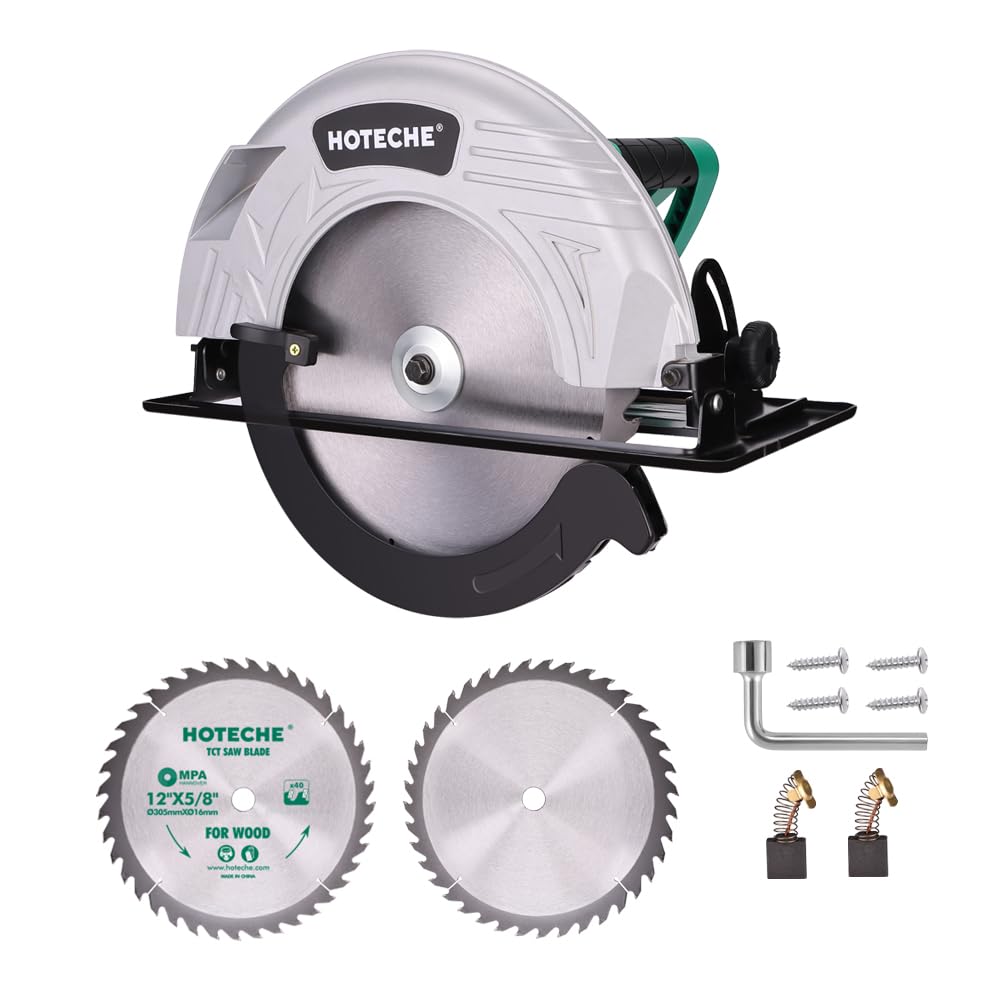
The deep-cut handheld that doubles as a table saw for thick beams and post work.
For thick lumber, this is the 12-inch blade you actually carry to the workpiece. The 4-HP motor spins at a no-load speed of 3300 rpm, and customers note it “cuts 5 inches deep with a 12 inch blade, like most circular saws.” At 21.2 pounds, it is a feather next to the DOVAMAN’s 53.9 pounds — a huge weight advantage when you haul it up a ladder or across a job site.
The clever a neat extra: flip it upside down on a tabletop and it functions as a makeshift table saw, which is why the maker pitches it for desktop use. It is not just a handheld tool. The included 40T saw blade, hex wrench, and pair of carbon brushes cover the basics, and the rubberized grips help you hold on during heavy cuts. The 2-meter cable with a UL plug gives decent reach without an extension cord.
There is a real trade-off here. Owners praise the power and value, but stability draws mixed feedback, and the blade guard is described as flimsy — “blade hits guard when set down” is a recurring note. This is an occasional-use tool for beam work, not a daily production saw. If you are cutting 2-inch lumber all day, a 7-1/4-inch saw is the better fit; reach for this one when you need the extra depth of a 12-inch blade.
The skinny: Unbeatable deep-cut depth-to-weight ratio for the money, but the guard and stability demand respect.
Best used for: Framing beams, posts, and thick stock where a 7-1/4-inch blade simply cannot reach.
Pick this when: You need 5-inch-deep cuts in thick lumber and want a tool that rides in the truck, not a stationary miter station.
skip it if: Your work is finish trim and precise angles — that is a miter saw’s territory, not this beast’s.
Understanding the Specs
Cutting Angle vs. Bevel Range
The cutting angle number tells you how far the head can swing for angled cuts. A 45-degree miter is the standard for most trim work, while a 50-degree or 90-degree figure gives you extra headroom for tighter corner cuts. For bevels, a dual-bevel saw tilts both left and right, which is the feature that saves you from flipping every board when cutting crown molding.
Sliding Rails and Cut Capacity
A sliding head pulls the blade forward on rails, which increases the width of board you can cut in one pass. Look for the max cut capacity in inches — a number like 4.2 x 13 inches tells you the depth and width of stock it can handle. Non-sliding saws are lighter and often more rigid, but they cap out at narrower crosscuts.
Motor Power: Amps and RPM
Most 12-inch saws run on a 15-amp motor, which is the standard for household 120-volt circuits. RPM (revolutions per minute) tells you how fast the blade spins — higher numbers like 3800 rpm mean faster, smoother cuts through dense wood. For a circular saw, horsepower (like 4-HP) is the number owners watch for raw cutting force.
Weight and Portability
Weight is the spec that decides whether a saw lives on a stand or rides in your truck. A 48-pound miter saw is manageable for occasional moves. A 53.9-pound sliding saw starts to feel heavy. An 81.6-pound saw is a permanent shop resident. Portable circular saws like the Hoteche come in around 21 pounds, which is the whole point of that style.
FAQ
What can a 12-inch circular saw cut that a 7-1/4-inch cannot?
Is a sliding miter saw better than a non-sliding one?
What does dual-bevel mean and do I need it?
Can I use a 12-inch circular saw upside down as a table saw?
How important is a laser guide on a miter saw?
Why is my miter saw cutting at an angle when it should be square?
How much does a 12-inch miter saw weigh?
Is a 12-inch saw overkill for a DIYer?
Final Thoughts: The Verdict
Across the board, the 12 circular saw winner is the DEWALT DWS716 because it delivers dead-on accuracy with 14 positive stops and zero setup fuss. If you want sliding-rail capacity for wide crown and baseboard, grab the Makita LS1219L. And for hauling deep cuts to thick beams on a budget, the Hoteche is the one to reach for.
How We Picked
We do not accept paid placement. Every pick is matched to a real buyer and a real use-case; we do not hands-on test units.
Sources & Methodology
Specifications: manufacturer listings and product documentation. Review insights: verified customer reviews, as of August 2026. Pricing: not shown on this page (it changes often); check the current price via the retailer link.
As an Amazon Associate, Gadgets Feed earns from qualifying purchases. This does not affect which products we feature.