
Our readers keep the lights on and my morning glass full of iced black tea. As an Amazon Associate, I earn from qualifying purchases.
Specs are compiled from manufacturer listings and verified buyer reviews and can change over time — please confirm the key details on the product page before buying.
You need crosscuts that fit tight on the first try, bevels that do not drift, and a saw that handles 4x4s (the standard 3.5-inch thick lumber) without bogging down. A 12-inch compound sliding miter saw is the one tool that does all three—it slides across wide boards up to 15 inches, tilts for angled cuts left or right, and spins fast enough to chew through hardwoods. But the wrong one leaves you fighting blade wobble, dust clouds, and fences that refuse to stay square.
I’m Min — the founder and writer behind Gadgets Feed. This guide is built by comparing the manufacturers’ published specifications and the patterns across verified customer reviews, so you get each pick’s real strengths and trade-offs instead of marketing spin.
We break down five top contenders on the market right now, comparing precision, power, and dust control so you can confidently pick the best 12 inch sliding compound miter saw for your workshop and budget.
Quick Picks
- DEWALT DWS780 — Premium Pick
- Makita LS1219L — Shop Champion
- WEN MM1214T — Space Saver
- VEVOR 12-Inch Sliding Compound Miter Saw — Best Value
- DOVAMAN DMS03G — Budget Champion
How To Choose The Best 12 Inch Sliding Miter Saw
A 12-inch blade gives you the depth to cut thick lumber like 4x4s and 6x6s (actual 5.5-inch thick lumber), but the saw’s real value comes from the sliding mechanism and the bevel system. Here are the three specs that separate a daily workhorse from a frustrating paperweight.
Dual Bevel vs. Single Bevel
A single bevel tilts the blade left only. A dual bevel tilts left and right. If you cut crown molding or compound angles frequently, dual bevel saves you from flipping the workpiece and recalculating your setup—you just tilt the blade the other way and keep cutting.
Sliding Rail Design: Front vs. Rear
Traditional rails extend out the back of the saw, which means the whole unit needs deep clearance behind it. Front-slide or compact rail designs let you place the saw flush against a wall, saving up to a foot of bench space. For small shops, that difference matters more than any other spec.
Cutting Capacity (Crosscut and Vertical)
Crosscut capacity tells you the widest board you can cut at 90 degrees (a straight up-and-down cut)—look for at least 13 inches to handle 2×12 lumber (actual 11.5-inch wide lumber). Vertical capacity matters for baseboard cutting: 6-3/4 inches (about 17 centimeters) is the standard for cutting tall baseboard standing up against the fence. Check both numbers before you buy.
Quick Comparison
| Model | Best For | Motor (Amps) | Weight (Lbs) | Crosscut Capacity | Amazon |
|---|---|---|---|---|---|
| DEWALT DWS780 | Pro-grade precision & dust control | 15 | 54.7 | 2×14 lumber | $499.00$635.00Limited time dealAmazon |
| Makita LS1219L | Shop-grade accuracy & compact rails | 15 | 81.6 | 15-inch crosscuts | $989.00Amazon |
| WEN MM1214T | Space-saving front slide | 15 | 56 | 13-3/8 inch wide | $389.12Amazon |
| VEVOR 12-Inch | Lightweight LED precision | 15 | 46.4 | — | $309.99Amazon |
| DOVAMAN DMS03G | Budget-friendly dual bevel | 15 | 53.9 | 4.2 x 13 inch | $269.97$299.97PrimeAmazon |
In‑Depth Reviews
1. DEWALT DWS780
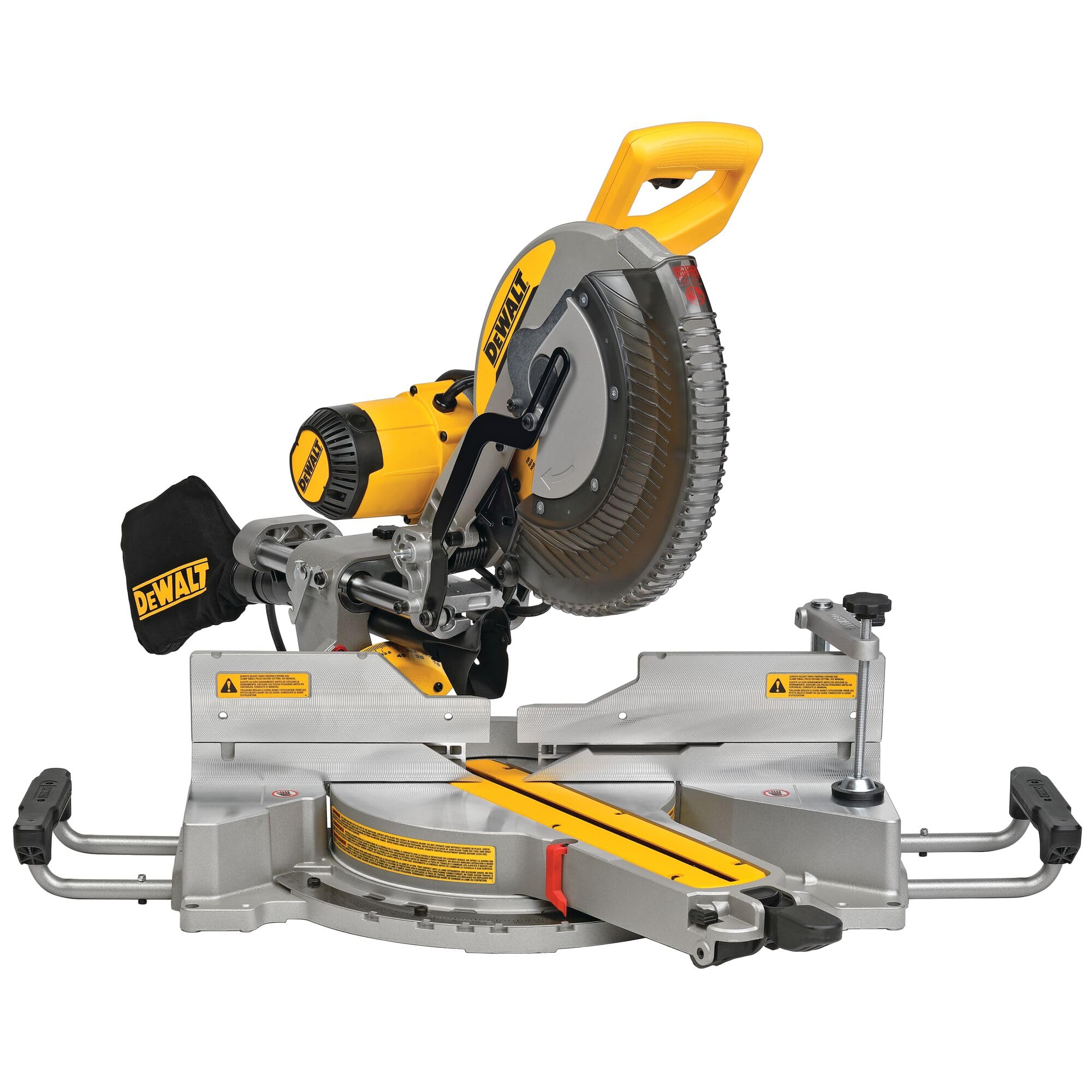
It cuts 2×14 lumber in one pass and captures over 75% of its dust, so you breathe less and measure less.
The DEWALT DWS780 is the benchmark for a reason. Its XPS LED shadow light system (a built-in light that casts a precise blade-shaped shadow) projects a blade-shaped shadow directly onto the cutting line, so you see exactly where the blade will land without adjusting a laser. Buyers report the system is “simple to use, no calibration needed” and that the saw arrived with a 90-degree cut (a straight up-and-down cut) that was spot-on from the start. The tall sliding fences handle crown molding (decorative trim at the ceiling) up to 7-1/2 inches nested and base molding up to 6-3/4 inches vertical, while sliding out of the way for bevel cuts so you do not lose capacity.
The super-efficient dust collection system captures over 75% of the dust generated, which is noticeably better than most competitors. At 54.7 pounds (about 24.8 kilograms), versus the WEN MM1214T at 56 pounds, it is far more portable than you’d expect for a 12-inch saw. The cam lock miter handle (a lever that locks the saw at your chosen angle) with detent override (a feature to disengage the preset click-stops) lets you disengage the clicks for micro-adjustments, and the adjustable stainless-steel detent plate (the metal ring with preset angle stops) has 10 positive stops for quick common angles. Some users note the stock blade is fine for rough work but recommend swapping to a 60-tooth blade (a blade with 60 cutting tips, better for smooth cuts) for trim work, and the dust bag has limited capacity—you will want a shop vac (a portable vacuum cleaner for sawdust) for long sessions.
Why It Leads
- XPS light is adjustment-free and incredibly precise (users verify within 0.005″, or about the thickness of a credit card)
- Dust collection captures over 75% of debris
- Fence design allows 2×14 dimensional lumber at 90 degrees
- Lightweight and portable for a 12-inch model
The Trade-offs
- Stock blade is better suited for framing than fine trim
- Dust bag fills quickly—invest in a shop vac
- Bearings can be stiff initially and require a break-in period
Reach for this if: you need pro-grade accuracy, minimal dust, and a saw that handles dimensional lumber without bogging down.
Look elsewhere if: you want a soft-start motor or a saw that fits flush against a wall—the rear rails need deep clearance.
2. Makita LS1219L

The engineer’s saw—dead accurate, dead quiet, and slides flush against the wall, so you reclaim up to 15 inches of bench depth compared to a rear-rail saw like the DEWALT.
The Makita LS1219L uses a unique 2-steel rail sliding system that glides forward without needing clearance behind the saw, so you can mount it flush against a wall. That is a standout for small shops where every inch of bench space counts. The direct drive motor (the motor connects directly to the blade, without a belt) includes a soft start (a feature that ramps up motor speed gently) that ramps up smoothly instead of jerking, and it runs quieter than most 12-inch saws. With 15-inch crosscuts (the widest board it can cut at 90 degrees) at 90 degrees, it handles wide panels that many competitors cannot reach.
Buyers with decades of carpentry experience note the saw is “dead accurate” and arrives “perfectly square up to 15 inches,” though they caution that the aluminum detent plate can wear over time from the steel lock pin—you must engage the pin gently. The dual dust collection ports provide excellent extraction performance, but the included dust bag fills quickly. At 81.6 pounds (about 37 kilograms), this is the heaviest saw on our list, while the DEWALT weighs 54.7 pounds, so it is better suited for a stationary shop than daily jobsite hauling.
Precision Over Portability: The Makita is the most accurate saw in this lineup, with zero play in the slide bars and smooth, consistent cuts. Builders confirm it is “the best miter saw ever” for fine woodworking. But the weight and the fragile angle indicator are real concerns—handle the detent with care and plan to leave this saw on a dedicated stand.
Ideal for: the serious woodworker who prioritizes accuracy and shelf space over portability.
Not for: daily job site transport—at 81.6 pounds, it is a beast to move, and the aluminum angle ring needs careful handling.
3. WEN MM1214T

The front-slide design cuts through 4x4s without needing 12 inches of clearance behind the bench like the DEWALT does.
The WEN MM1214T uses an innovative front-slide rail system so the saw does not extend rearward, letting you place it flush against a wall. At 56 pounds (about 25.4 kilograms) and 37.5 inches long, while the DEWALT is 32.6 inches, the lack of rear overhang makes it more space-efficient in practice. The 15-amp motor (a measure of electrical power draw) is powerful enough for deck building, with buyers reporting “cutting 2x10s and 6x6s” without struggle. It includes a 12-inch 60-tooth carbide-tipped blade (a blade with 60 cutting tips hardened with tungsten carbide), two retractable table extensions with work stops, and a clamp assembly.
The onboard class II laser guide (a safety-rated laser that projects a red line) combines with an LED work light for maximum clarity, and buyers confirm the “shadow line is accurate within 1/16 inch.” However, some users report that the saw is “not for fine woodworking” due to slight deflection over long cuts and an inconsistent 90-degree stop. The dust bag is poor, but the dust collection improves dramatically when connected to a shop vac. Be aware that the arbor bolt (the bolt that holds the blade on) is reverse-threaded (clockwise to loosen, opposite of standard) and the bevel indicator decals may peel over time.
What Stands Out
- Front-slide rail design eliminates rear clearance issues
- Powerful 15-amp motor handles 6×6 posts and deck boards
- Shadow line accurate within 1/16 inch according to users
Where It Struggles
- Some users report inconsistent 90-degree cuts and blade deflection over 8 inches
- Bevel indicator decals can peel after months of use
- Dust bag is nearly useless without a shop vac
Best for: the DIYer or general contractor building decks and framing—the front slide saves bench space and the power is there when you need it.
skip it if: you need furniture-grade precision from the factory; plan on fine-tuning the fences and checking square before each project.
4. VEVOR 12-Inch Sliding Compound Miter Saw
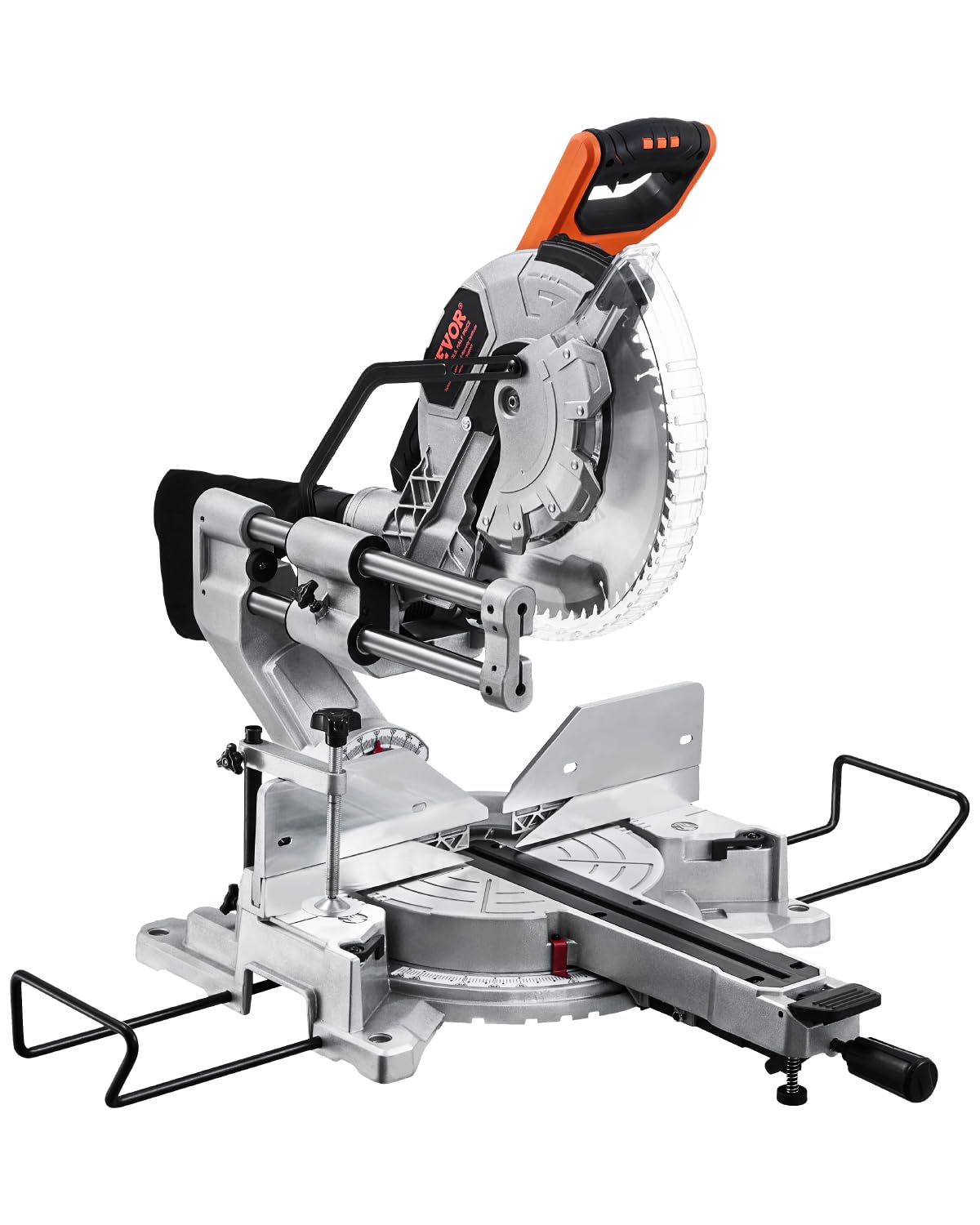
Weighs only 46.4 pounds—the lightest saw here, so you can carry it up stairs easily, but reviewers warn the dust collector is “terrible.”
The VEVOR’s biggest advantage is weight: at 46.4 pounds (about 21 kilograms), the WEN is 56 pounds and the DEWALT is 54.7 pounds, making it the easiest saw on this list to carry between jobs. The upgraded aluminum base replaces traditional cast iron, saving weight while maintaining heat dissipation (the ability to shed heat during long cuts) for continuous high-demand cuts. The axial sliding system lets the saw glide forward and backward smoothly, and the LED guide system (a built-in light that projects a cut line) projects a clear cutting line that owners mention is “superior to laser” for accuracy. The 60-tooth blade comes pre-installed and is ready for fine cuts from the start.
Customers note the saw “cuts great” and is “ideal for occasional large-dimension cuts like composite deck boards,” but the dust collection system is a weak point—one reviewer plainly says “the dust collector is terrible.” The sawdust discharge also clogs with soft woods and the included 32-tooth blade (depending on variant). The LED light is vulnerable—one reviewer noted knocking it out after a board kicked back. At this price point, it is a solid light-duty option for DIYers, but professional contractors who cut all day should budget for a more sturdy machine.
Grab this for: weekend projects, occasional composite decking cuts, and jobs where you need to carry the saw up and down stairs.
Look elsewhere if: you cut all day in a production shop—the dust management and LED durability won’t keep up with daily abuse.
5. DOVAMAN DMS03G

A dual-bevel saw (tilts left AND right) at a budget price that one buyer says “cuts 4x4s like butter,” but the plastic handle feels less sturdy than the Makita’s all-metal build.
The DOVAMAN DMS03G brings dual-bevel capability at a price that undercuts most competitors by a wide margin. It offers both left and right 45-degree bevel cuts, a 3800 RPM motor (rotations per minute of the blade), and a laser guide for alignment. The base includes nine common angle presets—0, 15, 22.5, 30, and 45 degrees on both sides—so you can lock into the most frequent miters without fussing with a protractor. The upgraded switch design includes a safety lock and works from either hand, which is handy for ambidextrous operation.
Reviewers point out the saw “works just as good as my old Dewalt” and that it handled a full 20×20 deck build without bogging down. One buyer mentioned the plastic handle broke, likely from user force, and that the build is “a little more unrefined than others.” The 40-tooth blade is adequate for framing but you will want a finer blade for trim work. The laser works perfectly according to most users, but as the manufacturer notes, you should check and adjust the miter angle before first use since shipping can knock it out of alignment.
Why It Wins for the Price
- Dual bevel capability on a budget—tilt left and right without flipping the workpiece
- 3800 RPM motor cuts 4x4s without bogging down
- 9 positive stops for fast common miters
Where You Compromise
- Plastic handle feels less durable than metal alternatives
- Build quality is “more unrefined” than premium brands
- 40-tooth stock blade is better for framing than finish work
Ideal for the budget-conscious DIYer: you get dual-bevel flexibility and enough power for framing projects without spending premium dollars.
Not for you if: you need industrial-grade components or furniture-level fit-and-finish right from the start.
Understanding the Specs
Laser vs. LED Shadow Line
A laser guide projects a red dot or line onto your workpiece so you see where the blade hits. It works well indoors but can be hard to see in bright sunlight or on glossy surfaces. An LED shadow line (like DEWALT’s XPS system) projects a blade-shaped shadow directly onto the cut line using ambient light—it never needs calibration and stays visible across all lighting conditions. The trade-off: laser systems can get knocked out of alignment, while shadow systems are fixed and maintenance-free.
Cutting Capacity: Crosscut and Vertical
Crosscut capacity is the widest board the saw can cut when the blade is at 90 degrees (a straight vertical cut)—look for at least 13 inches to handle 2×12 lumber (actual 11.5-inch wide lumber). Vertical capacity measures the tallest baseboard you can cut standing up against the fence; 6-3/4 inches (about 17 centimeters) is the standard for modern trim work. Some saws also specify nested crown molding capacity (usually 7-1/2 inches), which tells you the largest crown you can cut in its installed position. Always match these numbers to the materials you actually cut.
FAQ
What is the difference between a sliding and non-sliding miter saw?
Can a 12-inch sliding miter saw cut a 4×4 in one pass?
What does dual bevel mean and do I need it?
How much bench space does a sliding miter saw need behind it?
Is a laser guide better than an LED shadow line for accuracy?
What size dust hose fits a 12-inch sliding miter saw?
How heavy is a typical 12-inch sliding miter saw?
Can I use a 10-inch blade on a 12-inch miter saw?
Final Thoughts: The Verdict
For most buyers, the best 12 inch sliding compound miter saw winner is the DEWALT DWS780 because it combines pro-grade accuracy with the best dust collection in its class and the XPS shadow light that never needs calibration. If you want a saw that saves bench space and delivers furniture-level precision, grab the Makita LS1219L. And for a budget-friendly entry point that still offers dual bevel and solid power, choose the DOVAMAN DMS03G.
How We Picked
We do not accept paid placement. Every pick is matched to a real buyer and a real use-case; we do not hands-on test units.
Sources & Methodology
Specifications: manufacturer listings and product documentation. Review insights: verified customer reviews, as of July 2026. Pricing: not shown on this page (it changes often); check the current price via the retailer link.
As an Amazon Associate, Gadgets Feed earns from qualifying purchases. This does not affect which products we feature.
Related Guides
Product prices and availability are accurate as of the date/time indicated and are subject to change. Any price and availability information displayed on Amazon at the time of purchase will apply to the purchase of this product. As an Amazon Associate I earn from qualifying purchases.
CERTAIN CONTENT THAT APPEARS ON THIS SITE COMES FROM AMAZON. THIS CONTENT IS PROVIDED "AS IS" AND IS SUBJECT TO CHANGE OR REMOVAL AT ANY TIME.
Amazon and the Amazon logo are trademarks of Amazon.com, Inc. or its affiliates.