
Our readers keep the lights on and my morning glass full of iced black tea. As an Amazon Associate, I earn from qualifying purchases.
Specs are compiled from manufacturer listings and verified buyer reviews and can change over time — please confirm the key details on the product page before buying.
Buying 12 gauge wire is really two decisions, not one: are you running it inside a wall for a house circuit, or are you running it behind a car stereo or a set of speakers? Get that split right and the rest falls into place fast. Pick the wrong build for the job and you end up fighting a jacket that will not strip or a conductor that will not bend around a corner. Below you get seven gauge-correct options sorted by what they are actually built to do.
I’m Min — the founder and writer behind Gadgets Feed. This guide is built by comparing the manufacturers’ published specifications and the patterns across verified customer reviews, so you get each pick’s real strengths and trade-offs instead of marketing spin.
Some wire is solid copper built to sit behind drywall for decades, and some is stranded copper-clad aluminum built to flex through a tight amp install. Knowing which is which before you cut is the whole game, so here is how each option in this 12 gauge wire lineup actually earns its place.
Our Picks at a Glance

How To Choose The Best 12 Gauge Wire
Start with where the wire lives. Inside a wall cavity means you want solid copper NM-B cable that holds its shape and takes a screw terminal cleanly. Inside a car door, a speaker cabinet, or a moving machine means you want stranded conductors that shrug off vibration. Answer that one question and half the list drops away.
Solid versus stranded is the first fork
Solid copper is a single stiff conductor per wire. It pushes through a drilled stud hole without fraying and clamps down hard under outlet screws, which is why house branch circuits use it. Stranded wire bundles many thin copper threads into one conductor instead. It bends around tight radii without cracking, but it also needs a proper connector or ferrule so the strands do not splay.
Read the voltage and amperage ratings together
A 600 volt rating tells you what insulation class the wire carries — it is the ceiling for how much electrical pressure the jacket is built to withstand. A 20 amp rating on 12 AWG copper tells you it is sized for a standard household branch circuit. Both numbers matter, and a listing missing either one is a listing you should question before you buy.
Match the jacket to the environment
NM-B cable comes sheathed for running through dry indoor wall cavities and attics. THHN wire comes as a single insulated conductor with a nylon topcoat that resists oil, gas, moisture and heat, so it suits conduit and panel work. A low-voltage red and black CCA wire is the third path — light, flexible, and budget-friendly for 12V and 24V DC runs.
Quick Comparison
| Model | Best For | Conductor Build | Voltage Rating | Length | Amazon |
|---|---|---|---|---|---|
| Solid Indoor 12/2 W/G NMB Cable 50ft★ Best Overall | Home branch circuits | Solid copper, 2 conductor + ground | 600 volts | 50 feet | Amazon |
| 12 AWG THHN Stranded Bare Copper 100FTBest for Grounding | Grounding and panel work | Stranded copper, 19 strands | 600 volts | 100 feet | Amazon |
| 12/2 NM-B Wire with Ground, 100 ft Coil | Whole-room rewiring | Solid copper, 2 conductor + ground | 600 volts | 100 feet | Amazon |
| 15 Ft 12/2 NM-B Electrical Wire | Small DIY repairs | Solid copper, 2 conductor + ground | 600 volts | 15 feet | Amazon |
| DS18 SW-12GA-100RB Speaker Wire | Car and home audio runs | Stranded CCA, 10 strands | — | 100 feet | Amazon |
| NAOEVO 12 Gauge Wire 2 Conductors | 12V and 24V DC projects | Stranded CCA, red and black | 12 volts | 100 feet | Amazon |
| 12AWG THHN Wire 25FT | Short conduit pulls | Solid copper, 1 conductor | 600V rated | 25 feet | Amazon |
In‑Depth Reviews
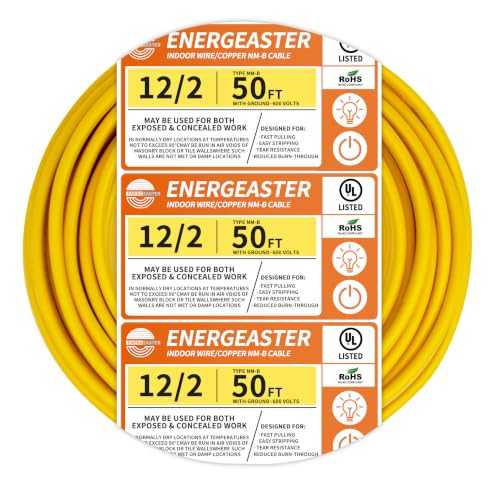
1. Solid Indoor 12/2 W/G NMB Cable 50ft, Electrical Wire, Yellow
Our pick — 4.5+★ from 800+ verified ratings; the strongest balance of quality and price.
Fifty feet of solid copper that pulls clean through a stud hole and takes a screw terminal without a fight.
This is a 50 foot coil of Type NM-B non-metallic sheathed cable carrying two 12 gauge solid copper conductors plus a bare ground. Its voltage rating runs to 600 volts, well beyond the 120 volt circuits most of us are actually wiring. The jacket is the trade-standard yellow, so it reads as 12 gauge at a glance in a panel stuffed with white 14 and orange 10.
What wins people over is the fire-retardant paper wrap around the bare ground. The two insulated conductors run parallel, and the ground sits between them wrapped in fire-retardant paper — a detail that matters when you are stuffing a box and want the bare copper protected. Insulation is rated for 90° C conductor temperature, which means the cable keeps its rating in a hot attic run.
The honest snag: the outer jacket is stubborn to open. Slicing it cleanly takes a sharp knife and a shallow scoring pass, and it is the one thing a chunk of the feedback pushes back on. It is a technique problem rather than a defect, but give yourself room on the first cut instead of cutting down to the conductors. The maker also notes it belongs in dry locations — so not outdoors and not buried in wet ground.
Reasons This Sits First
- Two 12 gauge solid copper conductors plus a full 12 gauge solid ground, all at 600 volts
- Fire-retardant paper wrap keeps the bare ground shielded between the insulated pair
- Yellow sheath identifies 12 gauge instantly in panels and junction boxes
- Coil format feeds smoothly for rough-in work behind walls and ceilings
The Part You Should Know
- The outer jacket is stiff to score open — a sharp blade and light passes beat brute force
- Rated for dry indoor cavities, so it is not the cable for wet or buried runs
Straight Answer: This is the one to buy if your job runs through wall cavities and attic spaces feeding outlets, switches or lighting.
Wrong Tool If: You need a cable that survives damp ground or a direct-burial trench — Type NM-B is not built for either.
2. 12 AWG THHN Stranded Bare Copper Wire 100FT Green Grounding Wire
Nineteen copper strands in a green jacket — a whole spool of grounding wire that snakes through a crowded panel.
Where a speaker cable stops at ten strands, this one carries 19 strands, and that is exactly why it bends into curves a stiffer conductor will not take. It is a single 12 AWG stranded copper conductor in 100 feet, jacketed in green so anyone opening a panel knows instantly it is the ground. The rating is 600 volts, which covers residential, commercial and industrial grounding work alike.
The jacket is the THHN type: thermoplastic, high-heat resistant, and nylon-coated. In plain terms, that nylon skin is what shrugs off oil, gas, moisture and heat so the conductor inside stays protected indoors and out. For panel wiring, grounding, lighting circuits and control systems, that combination is the point. Copper purity is the most-praised quality in the feedback on this spool.
Flexibility, though, splits down the middle. Stranded wire theoretically bends easily, but several folks find this spool stiff enough to resist tight bends — so if your route has a hard 90-degree turn in a cramped box, plan a little extra slack. Treat the stiffness as a stripped-back conductor reality, not a flaw.
The Copper Argument: A bare copper conductor in 19 strands and a 600 volt nylon-jacketed build is the honest recipe for a ground run that stays reliable in wet, hot, and oily environments — and it holds up as the most-praised quality of this spool.
What to Plan Around: Give it room at sharp corners. The wire is stiff enough that a tight radius will make you fight it, and long sweeping bends install far quicker than short ones.
Pick It For: Panel grounding and conduit runs where one continuous green conductor over 100 feet saves you splice points.
Look Elsewhere If: You need a two-conductor sheathed cable for a branch circuit — this has one conductor only.
3. DS18 SW-12GA-100RB 12-GA Ultra Flex Speaker Wire Red and Black 100FT

Soft-jacketed speaker wire that wraps a door hinge and a subwoofer box without kinking.
Strand count is the number that decides this one. The DS18 carries 10 strands per conductor where the single-conductor THHN above carries 1 — and that difference is the whole reason it feels pliable in your hand. It is a 100 foot red and black pair of 12 gauge copper-clad aluminum, built specifically as speaker cable for audio runs rather than building wire.
On the construction, the outside is a soft rubber-esque coating that lets the wire bend around tight corners behind a door panel or under carpet without fighting back. Buyers call it heavy duty, and the soft jacket’s flexibility ranks alongside quality as the reason they keep buying it. Hooking it into both a receiver and a pair of speakers is described as straightforward, and for a 100 foot spool that reliability matters.
Here is the honest trade-off worth reading before you buy: this is copper-clad aluminum, not solid copper. The maker says it plainly — CCA is the economical conductor, and systems that pull serious power should step up to OFC wiring instead. For a modest car stereo or an everyday home setup, CCA does the job for far less than pure copper. For a high-current subwoofer build, plan on upgrading.
Why Audio Guys Keep Buying This
- 10 strands per conductor for the flexibility that tight routes demand
- Red and black color coding keeps polarity straight without a label
- 100 feet gives you slack for full-vehicle or multi-room runs
- Soft, pliable jacket bends around corners instead of kinking
The Straight Honest Limit
- Copper-clad aluminum rather than solid copper — budget-friendly, not high-current
- Best for everyday audio; more demanding systems want OFC copper instead
Go With This If: You are running speaker wire in a car or home setup and want the flexibility and color-coding to make the job quick.
Think Twice If: Your system is a high-draw build — the maker itself points high-power rigs toward OFC copper.
4. 12/2 NM-B Electrical Wire with Ground, 100 ft Coil, Yellow
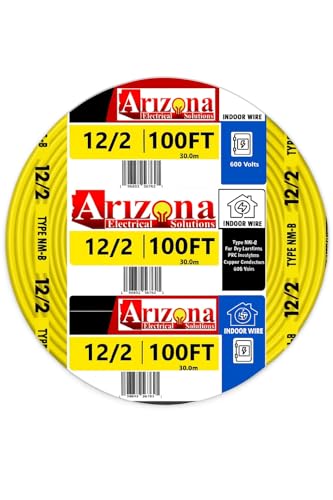
A hundred feet on one coil, which is the length you actually want when a room needs rewiring end to end.
This Arizona Electrical Solutions cable pairs two insulated 12 AWG conductors with a grounding conductor in 100 feet of yellow NM-B sheath. Both the 600 volt rating and the 20 amp rating are printed on the spec sheet, so you know it is sized for the standard household branch circuit. It is solid bare copper inside, which is the right conductor for a permanent run.
The pitch is essentially length: 100 feet covers a whole room’s outlets and lights on one coil. A whole room or two of outlets and light fixtures fits into a single coil, so you spend less time splicing between rolls and more time pulling. The yellow jacket is professionally coiled and packaged to protect it in storage, then slips easily into a panel or box because that color identifies it as 12 gauge at a glance. What earns it the nod across the feedback is the value-per-foot math on a whole-room job.
The catch is that NM-B is a dry-location cable. It belongs in permitted exposed or concealed installation inside dry indoor spaces — no exterior, no buried trench, no damp basement wall. Plan the route so the sheath stays inside the building envelope, and this is a cable that will outlast the room it is in.
Where It Wins: One hundred feet of solid copper NM-B at a 20 amp rating means you finish a room’s outlets and lights without a splice — the best per-foot buy for the volume of work on a whole-room remodel.
The Wet-Location Caveat: Keep it indoors and dry. NM-B will not survive a damp location or a buried run, so if your project heads outside, pick a different cable.
Right Job for It: Whole-room or whole-floor rewiring where a single 100 foot coil keeps you from splicing short runs together.
Not for You If: You are wiring an outdoor circuit or anything buried — the dry-location limit is hard.
5. NAOEVO 12 Gauge Wire 2 Conductors, CCA Red Black Electrical Wire, 100FT
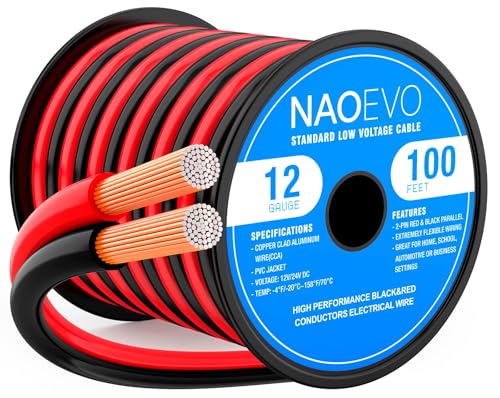
The cheap, flexible spool for LED strips, solar, and marine 12V runs.
Two conductors is the difference between this and a single-conductor THHN — here you get a red and a black run together on one 100 foot spool, each 100 feet on its own. The voltage rating is 12 volts, so this is squarely a low-voltage DC wire, not building cable. Automotive, marine, LED, solar, and battery runs are exactly its territory.
The jacket carries a -20°C to 70°C operating range and a PVC build with anti-aging, moisture-proof and anti-corrosion properties, which is why it holds up in a cabin or under an LED strip where condensation lives. Polarity is handled for you: the two colors differentiate clearly and are numbered to cut out mix-ups. Peeling and cutting to length is easy, so 100 feet turns into a dozen short runs without waste.
The one honest gripe that pops up: the conductor is copper-clad aluminum, and some buyers report the wire corrodes more readily than solid copper over time. On a wiring job that sees weather or salt, seal your connections and keep the cuts clean, and that risk shrinks. On a dry indoor LED run, it barely matters at all. Only a handful of buyers out of many hundreds report it, so keep it in perspective.
The Practical Read: A red/black pair on one 100 foot spool with numbered jackets is the fastest way to wire a multi-leg LED or marine project — the naming alone saves you a splice mistake.
Sealing Note: Because it is CCA, damp or salty installations want sealed terminations. It is not a wire to run bare and forgotten in a wet environment.
Reach For It When: Your project runs on 12V or 24V DC — LED, solar, marine, or battery — and you want both colors on one spool.
Look Elsewhere If: You are wiring a 120 volt household circuit — the 12 volt rating rules it out entirely.
6. 15 Ft 12/2 NM-B Electrical Wire, Copper 12 AWG 2 Conductor with Ground
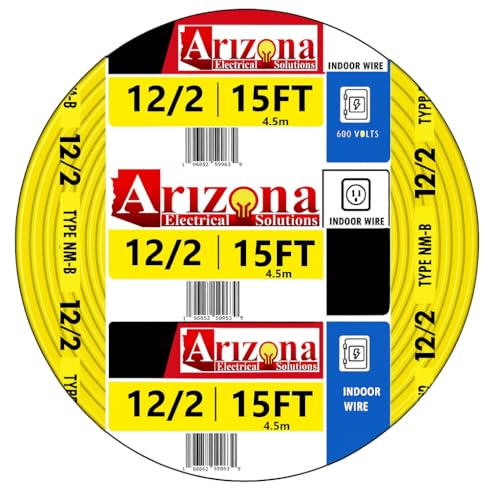
A 15 foot roll for the single outlet, switch, or GFI swap you keep putting off.
Look at the length against the NAOEVO’s 100 feet — a 15 foot roll versus a 100 foot coil above. But that is the point. This is a two-conductor 12 AWG NM-B cable with a bare copper ground and yellow sheath, coiled short for small jobs. When you are replacing one GFI outlet or fishing a short run to a switch box, a 100 foot coil is waste and a 15 foot roll is right-sized. It carries the 600 volt rating and a 90° C conductor rating for dry interior use, and it’s rated for the standard 20 amp branch circuit.
The yellow sheath is the same industry-standard color on all 12 gauge cable, so you can still identify it in a panel or a junction box. Copper quality and value-for-money are the two things the feedback lands on hardest — for a single GFI or switch swap, a 15-foot roll beats a full spool.
The trade-off is obvious once you measure: 15 feet goes fast if a route turns out longer than planned. Buy it for the job you have measured, not the job you might have later.
Why Small Jobs Want This
- Two 12 AWG copper conductors plus ground in a short 15 foot roll
- 600 volt, 90° C rating for interior dry locations
- Rated for a 20 amp branch circuit — standard household sizing
- Yellow sheath identifies gauge instantly in a box
Measure Before You Buy
- 15 feet is short for anything beyond a single-point repair
- Dry-location only, like all NM-B cable
Exactly Right For: A single outlet, switch, light, or GFI swap where a short run is all you need.
Better Off Elsewhere If: The route runs more than a room’s length — this roll runs out long before a whole-circuit pull finishes.
7. 12AWG THHN Wire 25FT, Single Bare Copper Conductor

One solid conductor, 25 feet, built to push down a short conduit run.
The NAOEVO gives you two conductors in a pair; this gives you one, and that single-stranded solid copper build is why it moves differently. It is a 12 AWG solid bare copper conductor in 25 feet with a two-layer jacket: PVC insulation underneath and a PA6 nylon topcoat on the outside. The 600 volt rating covers household, construction, and industrial wiring, and it is RoHS compliant.
The dual jacket is the standout. The nylon layer resists abrasion, chemicals, and impact in a way a plain PVC wire will not, so a conductor pulled through a metal conduit or run past an oily workshop bench keeps its insulation intact. A solid core also holds a clean, straight run once it is set, which is the sort of thing you want in short conduit pulls and panel work. It handles household wiring and construction projects without complaint.
Two things to weigh before ordering. Twenty-five feet is a short pull, so measure the conduit run first. And the listing touts THHN, but the specs show a solid 1-strand conductor where the name-brand THHN spools above run 19 strands — so if you want flex, this is not the spool for you. For a rigid, short run, it is exactly right.
The Jacket Is the Story: A PA6 nylon topcoat over PVC insulation gives this conductor a tough outer skin against abrasion and oil — the sort of wear a short industrial or conduit run throws at a wire.
Fits Best For: A short conduit pull or a panel connection where a single solid conductor over 25 feet is all the job needs.
Skip It When: You need flexible multi-strand copper for a bend-heavy route — one thick strand will fight every corner.
Understanding the Specs
Solid Copper Versus CCA
A solid copper conductor is one high-purity copper core, which gives the strongest conductivity and the most reliable long-term performance — the right metal for a permanent wall circuit. Copper-clad aluminum (CCA) wraps a thin copper skin over an aluminum core. It costs less and weighs less, so it flexes more easily, which makes it the budget and audio-wire pick. It does not carry current as well as solid copper, so high-draw systems often want OFC instead.
Voltage and Amperage Ratings
A voltage rating is the ceiling for the electrical pressure the insulation is built to handle — 600 volts covers standard household branch circuits with headroom. An amperage rating in amps tells you how much current the gauge is sized for; 12 AWG solid copper at 20 amps is standard for home outlets and lights. Match both to your circuit and never exceed the lower of the two.
NM-B Versus THHN
NM-B is non-metallic sheathed cable: multiple insulated conductors plus a ground wrapped in an outer jacket, intended for dry indoor wall cavities and attics. THHN is a single insulated conductor with a nylon topcoat, built for conduit, panels, and industrial runs where it faces oil, heat, and moisture. Same gauge, entirely different jobs — buy the one your route calls for.
Strand Count and Flexibility
A solid conductor carries a single thick strand and holds its shape, which suits rigid, short runs. A stranded conductor bundles many thin copper threads — 10 or 19 in the picks above — so it bends around corners and handles vibration without cracking. For speaker runs and tight spaces, more strands means easier routing; for a short conduit pull, a solid core is quicker to push through.
FAQ
Is 12 gauge wire the right size for a standard household outlet circuit?
What is the difference between NM-B cable and THHN wire?
Can I use 12 gauge speaker wire for household wiring?
Will 12 gauge wire carry a 20 amp circuit?
Why does stranded wire cost less than solid copper?
Is it safe to run NM-B cable outdoors or underground?
How much wire do I need for a basic outlet or switch replacement?
Does the outer jacket on NM-B cable come off easily?
How many strands should a flexible 12 gauge wire have?
Can I strip 12 gauge wire down and reuse the individual conductors?
Final Thoughts: The Verdict
For most home-wiring jobs, the 12 gauge wire that just works is the Solid Indoor 12/2 NMB Cable 50ft — a 600 volt, 50 foot roll with a full 12 gauge ground and a fire-retardant ground wrap for dry interior runs. If you would rather buy once for a whole room, the 100-Foot 12/2 NM-B Coil gives you the same solid copper over 100 feet instead of 50. And for anything running on 12V or 24V DC — LED, solar, marine — reach for the NAOEVO 12 Gauge Pair and skip the building-cable question entirely. For a plain branch-circuit job, the 50-foot NM-B coil is the easiest buy on this page to get right the first time.
How We Picked
We do not accept paid placement. Every pick is matched to a real buyer and a real use-case; we do not hands-on test units.
Sources & Methodology
Specifications: manufacturer listings and product documentation. Review insights: verified customer reviews, as of November 2026. Pricing: not shown on this page (it changes often); check the current price via the retailer link.
As an Amazon Associate, Gadgets Feed earns from qualifying purchases. This does not affect which products we feature.