
Our readers keep the lights on and my morning glass full of iced black tea. As an Amazon Associate, I earn from qualifying purchases.
Specs are compiled from manufacturer listings and verified buyer reviews and can change over time — please confirm the key details on the product page before buying.
If you are shopping for a 12-inch compound miter saw, the real question is not just power — it is whether the angles you set are the angles you get. This guide breaks down nine of the most capable models on the market, comparing real cutting capacities, motor strength, and the features that actually save you time on trim, framing, and crown molding. You will see exactly which saw handles a thick 4×4, which one slides flush against a wall, and which ones arrive calibrated closely enough to trust right out of the crate.
I’m Min — the founder and writer behind Gadgets Feed. This guide is built by comparing the manufacturers’ published specifications and the patterns across verified customer reviews, so you get each pick’s real strengths and trade-offs instead of marketing spin.
From single-bevel workhorses to dual-bevel sliding systems with laser guides, these picks cover every serious shop need for a 12-inch compound miter saw that you can trust.
Our Picks at a Glance

How To Choose The Best 12-Inch Compound Miter Saw
Buying a 12-inch miter saw is a long-term decision, so the details matter more than the brand sticker. You want a saw that holds its settings, cuts cleanly through the wood you actually use, and does not fight you on every adjustment.
Single-Bevel vs. Dual-Bevel
The bevel is the tilt of the blade, side to side. A single-bevel saw tilts only one way (usually left), which means cutting a compound angle on the other side requires flipping the workpiece. A dual-bevel saw tilts both ways, so you can cut crown molding nested flat without flipping — a huge time-saver on big trim jobs.
Sliding vs. Non-Sliding Rails
Sliding rails pull the blade forward through the cut, which multiplies the width of wood you can handle. A non-sliding saw is lighter and more portable but caps your crosscut capacity. Look at how the rails move too — rear rails need clearance behind the saw, while front-slide designs sit flush against a wall and free up shop space.
Cutting Capacity Is King
Every spec sheet lists the maximum board it can crosscut at 90 degrees and at 45 degrees. These numbers tell you whether the saw handles a 2×8 flat or a 4×4 in one pass. Match the capacity to your daily lumber, not your dream project.
Accuracy Features That Earn Their Keep
Positive stops click into the common angles — 0, 15, 22.5, 30, and 45 degrees — so you get repeatable settings without eyeballing a scale. A laser or shadow line projects your cut path onto the wood, which helps line up marks instantly. Neither replaces a square, but both speed up production work.
Quick Comparison
| Model | Best For | Type | Max Crosscut | Motor | Amazon |
|---|---|---|---|---|---|
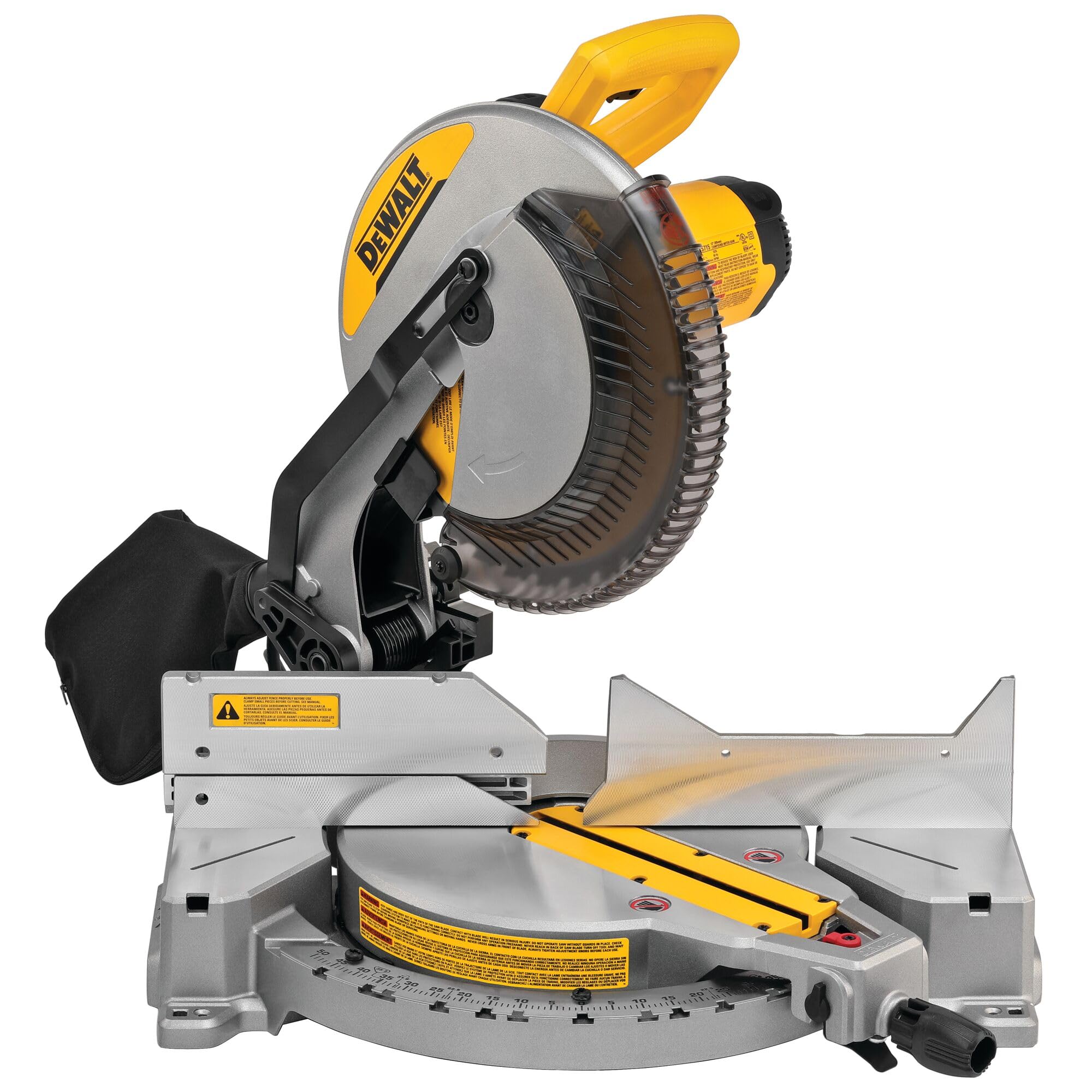
| DEWALT DWS715★ Best Overall | All-around home & DIY | Single Bevel | 2″ x 8″ at 90° | 15-Amp | Amazon |
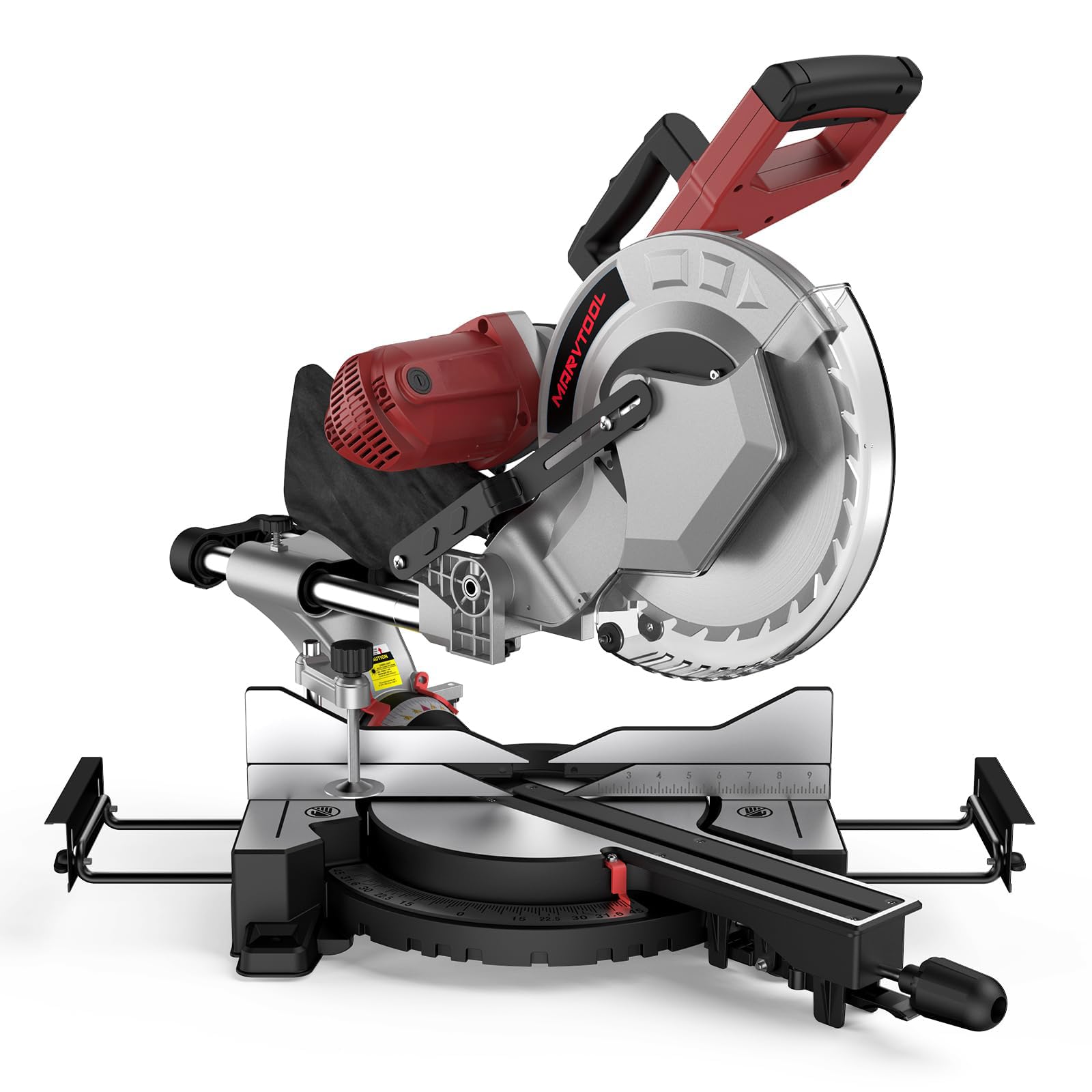
| MarvTool JS-1013C4Best Value | Budget DIY & portability | Dual Bevel Sliding | — | 15-Amp | Amazon |
| DOVAMAN DMS03GTop Performer | Value dual-bevel with laser | Dual Bevel Sliding | 4.2″ x 13″ | 15-Amp | Amazon |
| VEVOR J1G-ZP11-K305 | Hardwood and composite decks | Dual Bevel Sliding | — | 15-Amp | Amazon |
| WEN MM1215 | Compact shops & tight spaces | Dual Bevel Sliding | 13.25″ W x 4.5″ T | 15-Amp | Amazon |
| DEWALT DWS716 | Crown molding & trim work | Dual Bevel | — | 15-Amp | Amazon |
| Metabo HPT C12RSH3 | Small shops needing big cuts | Dual Bevel Sliding | — | 15-Amp | Amazon |
| Makita LS1219L | Pro precision & wide crown | Dual Bevel Sliding | 15″ at 90° | 15-Amp | Amazon |
| Truper SINCO-12X | Heavy-duty workshop cuts | Dual Bevel Sliding | — | 2 3/4 HP | Amazon |
In-Depth Reviews
1. DEWALT 12-Inch Miter Saw, 15-Amp, Single Bevel, Compound (DWS715)
Our pick — over 4.5★ from 6,500+ verified ratings; the strongest balance of quality and price.
The best overall pick for homeowners, offering reliable cuts and the highest owner satisfaction in this lineup.
The defining spec here is the stainless-steel miter detent plate, which locks in 14 positive stops for repeatable angle accuracy that holds up on the job site. It means you click to 22.5 degrees for an octagon frame, and it lands the same each time — no dial-watching. The tall sliding fence supports a 5-1/2-inch base vertically, so you can stand baseboard molding up on edge and cut it accurately without shimming.
Bevel range runs 0 to 48 degrees on the left and 0 to 3 degrees on the right. For most DIY work, that single left tilt is plenty, since you flip the board for mirrored cuts. Crosscut capacity hits 2-inch x 8-inch dimensional lumber at 90 degrees and 2-inch x 6-inch at 45 degrees, which covers baseboards, casings, and most framing repairs.
Buyers report the saw is ready to use right from the start, cuts cleanly through vinyl plank flooring and 4x4s with ease, and earns praise for its smooth operation and safety switch. The crowd favorite — 4.8 stars across 6,900+ owners — is the highest-rated pick in this list. The recurring gripe is the included clamp, with owners noting it is not all that good, but as buyers put it: “the saw itself is sweet!”
What Wins People Over
- Quality and build are the top praise points, with over 370 owners citing the sturdy construction
- Value for money lands second, with 178 owners calling it fairly priced for the capability
- Cutting performance and ease of use round out the strong consensus
Honest Trade-Offs
- Single bevel means mirrored compound cuts require flipping the workpiece
- The included vertical clamp draws frequent criticism
- Short power cord means you will likely need an extension
Your best bet if: you want a proven, accurate 12-inch saw for home projects and trim without paying for a sliding mechanism you may rarely use.
Think twice if: your work involves lots of crown molding, where a dual-bevel design saves real time.
2. 12-Inch Dual-Bevel Sliding Compound Miter Saw, 3800RPM, 15 Amp (MarvTool JS-1013C4)
The lightest dual-bevel slider here at 39.6 pounds, delivering solid performance at a budget-friendly price.
The standout number is the weight: 39.6 pounds makes this the lightest sliding saw in the lineup, and a full 14.3 pounds lighter than the DOVAMAN above it. That difference is what you feel when you carry it from a truck to a basement workshop or lift it onto a saw stand. The head locks into the base for storage, so it takes up less room between projects.
Versatility is the real story. The saw supports left and right bevel angles from 0 to 45 degrees, and the base adjusts on both sides for compound angle cuts. Owners mention it cuts smoothly through wood and handles 6-inch boards effectively, with one owner noting it “cuts accurately / square” even on heavy 4x4s. It ships with a 36-tooth carbide-tipped blade, two extension tables, and an Allen key.
You get a solid 12-inch sliding miter saw without overspending, and buyers back that up: 33 owners praise the build quality, and 24 call it a great deal for the price. A few reviewers disagree on long-term durability, and some units arrive with a small plastic piece broken from shipping. If you need a laser guide or plan to resell later, choose a higher-priced model on this list instead. But for weekend projects where you want a dependable 12-inch slider that won’t drain your wallet, this saw fits the bill.
Why it wins: the rare dual-bevel slider that is genuinely light enough to move easily, backed by a 2-year warranty and 24/7 customer support.
Reach for this if: you are a DIYer who wants dual-bevel flexibility and easy portability without a premium price.
Look elsewhere if: you need a laser guide, which owners note this model lacks.
3. DOVAMAN 12-Inch Dual-Bevel Sliding Compound Miter Saw, 15-Amp (DMS03G)
A 15-amp slider with a laser guide and a maximum cut capacity of 4.2 inches by 13 inches.
DOVAMAN packs serious cutting capacity into this dark grey machine. A 15-amp pure copper motor spins up to 3800 rpm, and the sliding rail system pushes maximum cutting capacity to 4.2 inches thick by 13 inches wide. Customers note it rips through a 4×6 pressure-treated post with ease and cuts 1×12 boards cleanly, which makes it a strong option for decks and larger framing.
The laser guide projects your cut line onto the work, and the base carries nine common angle presets, including 0, 15, 22.5, 30, and 45 degrees on both left and right sides. That means fewer trips to the angle gauge and more consistent miters on repetitive trim work. The package includes a pre-installed 40-tooth TCT blade, a dust bag, a support clamp, and two spare carbon brushes for the motor.
Quality wins the consensus with 58 owners praising it, and precision earns 14 mentions for accurate cuts. Owners also note this saw runs quieter than previous saws they have owned. The honest caveats: a few reviewers point out the blade lock cannot be fully locked in place, and the adjustability is mixed. One owner found the LED light is off by 1/16 inch, though it still cuts easy. Expect to verify the miter angles after shipping, as the manual advises.
Strong and smooth: owners describe it as very powerful and quieter than prior saws, cutting hardwoods and treated lumber without bogging.
Grab it if: you need dual-bevel sliding capacity with a laser for accuracy, at a mid-range price.
skip it if: precision out of the crate matters most — plan to spend a few minutes verifying angles and squaring the blade.
4. VEVOR Sliding Compound Miter Saw, 12-Inch Blade, 15 Amp Motor
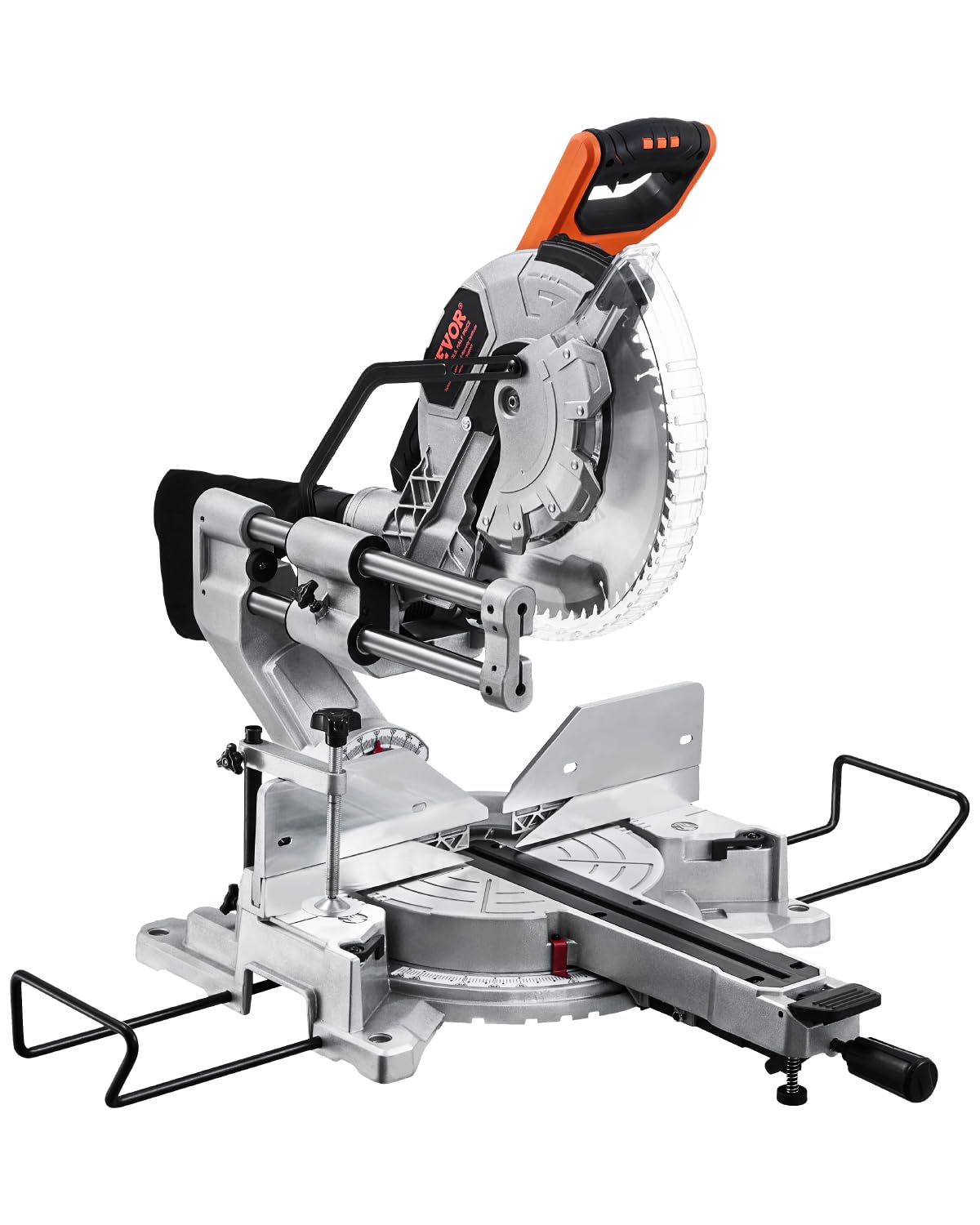
An axial rail system lets this slider sit flush against a wall, saving rear shop space.
VEVOR’s axial sliding system moves the blade forward and backward, so you can sit this saw flush against a wall and still make wide crosscuts. Owners praise the space-saving design for workshop tables, noting you can cover the backside to catch sawdust since there is no rear slide. The upgraded aluminum base is lighter than traditional cast iron, keeping the whole unit at 46.4 pounds while offering enhanced strength and heat dissipation for continuous running.
Dual-bevel capability reaches 0 to 45 degrees in both directions, and an LED guide system projects a clear cut line for alignment. The motor delivers 2500W straight-cutting power and 3000W bevel-cutting power at 5000 rpm, which owners say handles hardwood, composite decking, and laminates with precision. Test cuts come out perfectly straight at 90 degrees, and the blade brake stops in minimum time.
Quality leads the consensus with 42 owners praising it, and value for money adds 26 more mentions. It comes with a 60-tooth blade and an extendable design for cutting longer pieces. The main trade-offs: the sliding lock mechanism draws mixed feedback, plastic knobs may wear, and the included dust bag is small. Buyers generally recommend it for hobbyists and DIYers who need a 2-in-1 value.
The Big Wins
- Axial slide design fits tight workshops against a wall
- Dual-bevel 0-45° both directions for compound cutting
- Owners call it solid and a great 2-for-1 value
What to Watch
- Sliding lock mechanism gets mixed reviews
- Plastic knobs may wear over time
- Not pro-grade, better for hobbyist use
Best for: hobbyists and DIYers in tight spaces who want dual-bevel sliding capability and solid accuracy.
Not for: daily professional production, where the plastic knobs and smaller dust bag would frustrate.
5. WEN MM1215 15-Amp 12-Inch Dual Bevel Sliding Compound Miter Saw with LED Cutline

Its front-slide design eliminates rear overhang, making it ideal for compact workshops.
WEN’s unique dual-rail slide system moves the saw head on front rails, which means no rear overhang and operation flush against the wall. This minimizes the saw’s footprint dramatically compared to rear-slide designs. A powerful 15-amp motor crosscuts boards up to 13.25 inches wide and 4.5 inches thick, giving it capacity that rivals bigger-name sliders for general building work.
The saw bevels or miters up to 45 degrees in either direction with nine miter stops for quick indexing. An onboard LED cutline guide illuminates your cut path, and shoppers say the shadow line stays accurate within 1/16 inch. It ships with an 80-tooth carbide-tipped blade with a 1-inch arbor, plus two quick-lock table extension support arms, two adjustable support fences, a quick-clamp assembly, a dust port, a dust bag, and a carrying handle.
Blade quality leads the praise with 18 owners citing it as suitable for the general building trades, and cutting performance adds 15 mentions. Owners have built entire decks with 2x10s and 6x6s using this saw. The honest trade-offs: value for money is mixed, long cuts can deflect beyond 8 inches, and the right fence may arrive slightly out of square. Owners recommend it for general trades, not fine woodworking or instrument building.
Power matches the big names: buyers report the cutting power equals a DeWalt sliding saw on heavy lumber, with great dust port design and a fast blade stop.
Choose this if: wall space is tight and you want a powerful slider that does not need rear clearance.
Reconsider if: your work demands fine-woodworking precision, where deflection and fence squareness become issues.
6. DEWALT Miter Saw, Double-Bevel, Compound, 12-Inch, 15-Amp (DWS716)

A dual-bevel workhorse for trim carpenters, featuring stainless steel detents for repeatable accuracy.
This is the dual-bevel sibling to the DWS715, and it is built for one thing above all: crown molding. The tall sliding fences support crown molding up to 6-5/8 inches nested and base molding up to 6-1/2 inches vertically against the fence, which is the clearance you need for tall trim. The double-bevel design tilts 0 to 48 degrees left and right, with positive stops at 0, 22.5, 33.9, and 45 degrees for repeatable compound cuts without flipping the board.
Miter capacity runs 0 to 50 degrees left and right, and the cam lock miter handle with detent override delivers quick, accurate angle changes. The stainless-steel miter detent plate carries 14 positive stops for repeatable accuracy and worksite durability. Owners describe it as a very accurate saw at 90 and 45 degrees, with simple miter angle changes and an effective safety blade guard.
Consensus highlights quality with 21 owners praising it, and cut quality adds 8 more mentions. Owners mention cutting a whole room of baseboards without difficulty and note it performs as well as more expensive models. Compared to the DWS715, owners say the DWS716 uses better metal parts with a nicer finish and more angle stops. The honest caveat: expect to spend about an hour on initial alignment, and dust collection leaks some despite improvements.
Why It Leads on Trim
- Handles crown up to 6-5/8″ nested without flipping
- Cam lock miter handle speeds up angle changes
- Owners call it accurate from the start
Small Frustrations
- Needs about an hour of setup and alignment time
- Dust collection leaks some on heavy cuts
- Heavier than the single-bevel sibling at nearly 48.3 lbs
Pick this if: crown molding and tall baseboards are your main gig and you hate flipping workpieces.
Pass if: you only cut occasional trim and want the lighter, lower-cost single-bevel DWS715 instead.
7. Metabo HPT 12-Inch Dual Bevel Sliding Miter Saw (C12RSH3)
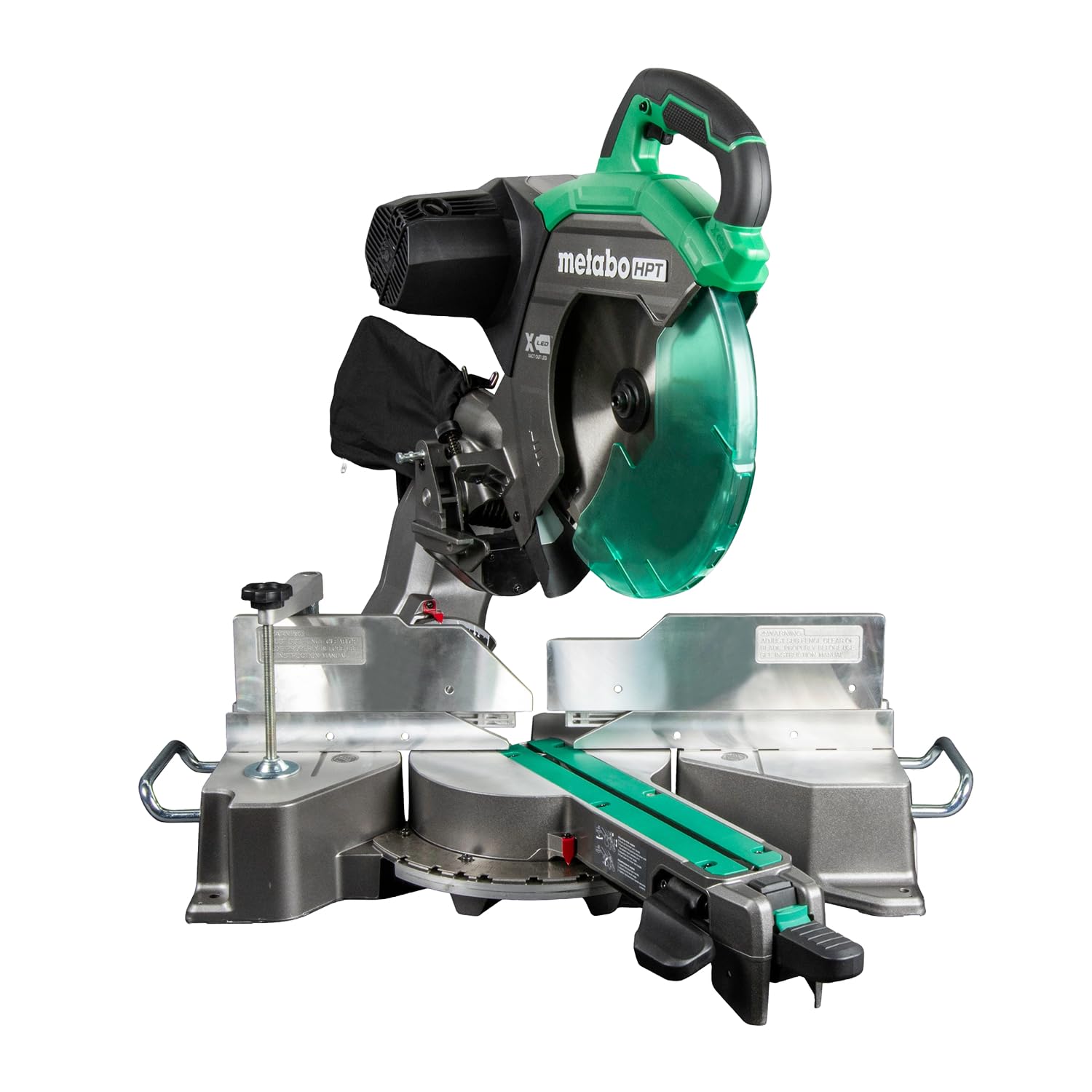
Japanese-engineered precision with front rails that fit narrow benches.
Metabo HPT brings a no-load speed of up to 4,000 RPM and a dual-bevel range of 45 degrees left and right, wrapped in a design that fits easily on narrow benches. The miter angle range extends 0 to 45 degrees left and 0 to 57 degrees right, an unusual asymmetry that gives extra right-side reach. The Xact Cut Shadow Line clearly marks your cut path for visibility in any lighting, and 9 miter detent stops make quick adjustments repeatable.
The one-touch bevel and miter locks allow fast, precise changes, and an adjustable miter scale keeps you honest. The forward-rail design is ideal for small shops, and the compact footprint pairs with a solid build that owners say matches saws costing three times as much. It comes with a dust bag, vise assembly, and wrench, backed by Metabo HPT’s 5-year warranty.
Performance leads the consensus with 38 owners praising it, and value for money adds 14 mentions. Customers note it cuts perfectly square from the start, with solid detents on popular angles and a soft start that prevents kickback. The recurring complaint is the sliding mechanism — several owners note it is not always smooth and needs regular clearing of debris. Dust port design also draws a few grumbles.
Precision at a fair price: a bright always-on LED stays visible in daylight and the forward rails make this a sensible choice for small professional shops.
Ideal for: professionals who need accuracy and a compact footprint without stepping up to premium-tier pricing.
Note before buying: the slide can resist occasionally, so keep the rails clean and check the manual on best practices.
8. Makita LS1219L 12″ Dual-Bevel Sliding Compound Miter Saw with Laser

A favorite among veteran carpenters, offering a double rail slide and a precise laser guide.
Makita’s unique 2-steel rail sliding system delivers a single slide-glide operation and a reduced footprint that lets the saw run flush against a wall. Cutting capacity is the big story here: up to 8-inch crown molding vertically nested, 6-3/4-inch baseboard vertical, and 15-inch crosscuts at 90 degrees. The in-front bevel lock keeps controls within reach, and dual dust collection ports provide excellent extraction. A direct-drive motor and guard system push vertical cutting capacity to 6-3/4 inches.
The 12-inch x 1-inch 60-tooth micro-polished blade ships in the box, and the laser projects a precise cut line that owners call dead-on accurate and adjustable to the side of the line. Zero head play and little slop in the sliding mechanism make this the choice of pros who measure twice. At 81.6 pounds, this is a heavy beast built for the shop, not the daily job site.
Quality wins the consensus with 88 owners praising it, and accuracy adds 28 more mentions. A 40-year carpenter called it the best miter saw ever, and a 20-year builder praised the compact footprint, thumb detent override, and front bevel knob. The honest trade-offs: value for money is mixed, dust collection has mixed reviews, and the aluminum angle plate wears if you do not ease the steel pin gently. Owners note an occasional defective unit arrives with a curved kerf, though replacements cut true after adjustment.
Pro-Level Strengths
- 8″ crown and 15″ crosscut capacity leads the class
- Dual dust ports keep the workspace cleaner
- Laser is precise and adjustable to the cut line
Pro-Level Trade-Offs
- Heavy at 81.6 lbs — a shop saw, not a job-site tool
- Aluminum angle ring wears if handled roughly
- Mixed reviews on dust collection and value
Worth it for: serious woodworkers and pros who need maximum crown capacity and accuracy that holds all day.
Not for: budget buyers or anyone who carries a saw between sites daily — this one stays home.
9. TRUPER SINCO-12X 12″ Double Bevel Sliding Compound Miter Saw with Laser Line, 2 3/4 HP

A 2 3/4 HP heavy-duty slider with a telescopic arm for wider cuts.
Truper steps in with raw power: a 2 3/4 HP motor that owners say has good power and delivers clean cuts on 12-inch stock. The telescopic arm increases cutting capacity, and an ergonomic handle pairs with a transparent retractable protective guard for visibility. Vertical and horizontal presses firmly hold the workpiece during cutting, and table extensions with rails support wider workpieces for better control.
Left and right positive stops handle the common angles — 0, 15, 22.5, 30, and 45 degrees on both sides — so compound miter work is quick to set. The laser line brightens the cut path for alignment. Owners praise the clear instruction manual, clean packaging, and quality that they say competes with foreign brands. One Spanish-language review praises the cutting reach of 35 mm wide and the included 12-inch blade.
The catch is consistency from the start: one owner returned the saw because the packaging listed two blades but only one arrived. Buyers generally report excellent quality and fine, precise cuts. This is a niche pick — heavier and less review-proven than the leaders, but a solid heavy-duty option for owners who want a 2 3/4 HP motor and laser guidance.
Built for power: the 2 3/4 HP motor gives this saw a distinct edge for continuous heavy cuts where 15-amp models might strain.
Best for: buyers who want high horsepower and laser precision at a heavy-duty price point.
Check carefully: verify the package contents on arrival, as the blade count has occasionally been wrong in shipping.
Understanding the Specs
Bevel vs. Miter
These two axes control every angle cut you make. The miter pivots the blade left and right on the flat table for angled cuts across a board’s width, like a picture frame corner. The bevel tilts the blade head side to side for angled cuts through a board’s thickness, like the slope on a baseboard corner. Compound cuts combine both — which is exactly what crown molding demands. Single-bevel saws tilt only one way; dual-bevel saws tilt both ways so you never flip the workpiece.
Cutting Capacity Numbers
Every spec sheet lists its maximum crosscut at 90 degrees and at 45 degrees. These two numbers tell you the biggest board that fits through the blade in one pass. A 2-inch x 8-inch capacity at 90 degrees means a flat 2×8 cuts in a single pass; at 45 degrees the same measure drops to a 2×6. Sliding saws stretch this capacity far wider since the blade pulls through the wood. Match capacity to the lumber you cut daily, not the occasional big project.
Positive Stops and Detents
Positive stops are preset click-points that lock the saw at common angles — 0, 15, 22.5, 30, and 45 degrees. They eliminate the guesswork of aligning a scale by eye and give repeatable results job after job. The count matters: more stops mean more common angles covered, like the 33.9-degree stop for 8-inch crown molding. A detent override lets you bypass the stops to fine-tune a custom angle and lock it in place.
Laser vs. Shadow Line
Every alignment guide projects your cut path onto the wood, but they work differently. A laser shines a red line that marks one edge of the kerf. A shadow line casts a dark shadow exactly where the blade will cut, using the blade itself. Owners often find shadow lines easier to see in bright daylight, while lasers can wash out. Both speed up alignment, but neither replaces a square — you still verify the blade is perpendicular to the fence.
FAQ
What is the real difference between single-bevel and dual-bevel miter saws?
Do I need a sliding miter saw?
Can a 12-inch miter saw cut a 4×4 in one pass?
What does a laser guide actually do for me?
How much setup does a new miter saw need from the start?
Is the included blade worth using or should I upgrade immediately?
What is a miter detent stop and why does the count matter?
How heavy is too heavy for a 12-inch compound miter saw?
Can I cut crown molding flat on a compound miter saw?
What safety features should I look for on a miter saw?
Final Thoughts: The Verdict
For most buyers, the 12-inch compound miter saw winner is the DEWALT DWS715 because it pairs proven accuracy with the strongest owner consensus in the group — nearly 7,000 buyers have pushed it to a 4.8-star rating. If you want dual-bevel flexibility and crown molding capability, grab the DEWALT DWS716. And for compact shops needing sliding capacity, the WEN MM1215 front-slide design is the one to reach for — it delivers big crosscuts without demanding rear wall clearance.
How We Picked
We do not accept paid placement. Every pick is matched to a real buyer and a real use-case; we do not hands-on test units.
Sources & Methodology
Specifications: manufacturer listings and product documentation. Review insights: verified customer reviews, as of September 2026. Pricing: not shown on this page (it changes often); check the current price via the retailer link.
As an Amazon Associate, Gadgets Feed earns from qualifying purchases. This does not affect which products we feature.