
Our readers keep the lights on and my morning glass full of iced black tea. As an Amazon Associate, I earn from qualifying purchases.
Most people think a subwoofer box is just a wooden box, but the box actually decides if your bass hits like a punch to the chest or sounds like a muddy rumble. A ported (vented) box uses a tuned opening to push air harder, so you get louder, deeper bass than a sealed box. The catch is that a badly tuned ported box makes bass sound hollow or boomy. You want a box that matches your subwoofer’s specifications and fits your vehicle’s space. Here are five real 12-inch ported subwoofer box options with their actual specs and what verified buyers experienced, so you pick the one that fits your car and your ears without wasting money on the wrong design.
I’m Min — the co-founder and writer behind Gadgets Feed. This guide is built by comparing the manufacturers’ published specifications and the patterns across verified customer reviews, so you get each pick’s real strengths and trade-offs instead of marketing spin.
Whether you need a compact box for a single cab truck or a larger enclosure for deep bass, these picks cover the critical differences in airspace (the internal volume the sub pushes against, measured in cubic feet), tuning frequency (the pitch where the port boosts sound the most, measured in Hertz), and build quality that actually change how your system sounds.
How To Choose The Best 12-Inch Ported Subwoofer Box
Choosing a ported box is different from picking speakers — the box dimensions, internal airspace, and port tuning dramatically shape the sound. You want a box that matches your subwoofer’s specifications and fits your vehicle’s available space. Here are the three critical specs to check before buying.
Airspace Volume: How Much Room Your Sub Needs
Every subwoofer manufacturer specifies an ideal airspace range (in cubic feet, or cu. ft.) for a ported enclosure. If the box is too small, the sub sounds strained and punchy; too big, and the bass gets loose and uncontrolled. The airspace in these boxes ranges from 1.4 cu. ft. to 2.2 cu. ft. — check your sub’s manual to find the right match.
Tuning Frequency: Where the Bass Peaks
The tuning frequency (measured in Hertz, or Hz) is the frequency at which the port resonates most efficiently. A lower tuning (around 30-35 Hz) produces deeper, more musical bass for rock and hip-hop. A higher tuning (around 50-55 Hz) emphasizes punchier, louder bass at the cost of sub-bass depth. Many buyers find that 43 Hz offers a solid middle ground for both punch and depth.
Build Quality: MDF Thickness and Sealing
A 3/4-inch MDF (medium-density fiberboard) box is stiffer and less prone to flexing than a 5/8-inch box, especially with higher-powered subwoofers. Thicker MDF also reduces panel vibration that can cause buzzes. Many ported boxes also benefit from internal sealing — some buyers report that adding caulk along internal joints eliminates air leaks that hurt bass clarity.
Quick Comparison
On smaller screens, swipe sideways to see the full table.
| Model | Category | Best For | Key Spec | Amazon |
|---|---|---|---|---|
| Atrend Bbox 12SVSC | Mid-Range | Compact vehicles & convertibles | 40 Hz tuning / 5/8″ MDF | $82.89$86.95Amazon |
| QPower QBOMB (Side-Ported) | Mid-Range | Kicker L7 subwoofer compatibility | 43 Hz tuning / 3/4″ MDF | $95.99Amazon |
| QPower Triangle Ported | Value | Single cab trucks (triangle fit) | 54 Hz tuning / 2.2 cu. ft. airspace | $97.99Amazon |
| Q Power QBomb (Truck Style) | Premium | Behind-seat truck fitment | 20 Hz frequency response | $109.08Amazon |
| Q Power QBomb (1.4 cu. ft.) | Premium | High-power subwoofer setups | 3/4″ MDF / 1.4 cu. ft. airspace | $124.99Amazon |
In‑Depth Reviews
1. Atrend Bbox 12SVSC Single Vented 12 Inch Subwoofer Box

At just 16 inches wide, this box cures the trunk-space headache — it slides into a 99-04 Mustang convertible without eating your whole cargo area, and its 40 Hz tuning frequency delivers deep bass you feel and punch you hear across rock and hip-hop. Owners mention pairing it with an Infinity 1250W sub and a Jensen 1000W amp (bridged at 4-ohm, 500W) for earth-shaking bass that transformed their audio. The Aliphatic wood glue and recessed side panels create an airtight chamber, so you get rattle-free sound at a price that leaves budget for a good sub.
The 5/8-inch MDF (medium-density fiberboard) is thinner than the 3/4-inch board on the QPower QBOMB, so it may flex slightly with very high-power subs. One reviewer noted the original port tuning around 45-50 Hz cancels low notes, but they fixed it by blocking the port with a pool noodle to drop tuning to about 31 Hz. If you need a compact box that fits tight trunks, the Atrend is your pick. skip it if you plan to push over 1,000 watts RMS and want maximum panel rigidity — that buyer should step up to the QPower QBOMB.
For anyone needing a space-saving 12-inch ported box that still delivers punchy, rattle-free bass, the Atrend Bbox 12SVSC is the compact champion.
Why it’s great
- Compact 16-inch width fits tight trunks and convertibles
- Airtight recessed side panels prevent rattles
- Aliphatic resin wood glue for durable sealed joints
Good to know
- Part 5/8″ and part 1/2″ MDF — thinner than premium boxes
- Port tuning may need modification for deeper sub-bass
- Terminal cup wiring gauge is small for high-power setups
2. QPower QBOMB Single 12-Inch Speaker Box – Side-Ported

Where the Atrend Bbox fits tight spots, this QPower QBOMB wins on build stiffness with its 3/4-inch MDF — that is 67% thicker than the Atrend’s 5/8-inch board, so you get fewer panel buzzes when you crank the volume. But at 22 inches wide, it is 38% wider than the Atrend, so measure your trunk first. Its 43 Hz tuning works beautifully with a Kicker L7 subwoofer, delivering strong performance across all frequencies with no dead spots, according to buyers. One reviewer wished it were tuned closer to 28-32 Hz for deeper sub-bass but still called it a solid box.
Pick the QPower QBOMB over the Atrend if you want a stiffer, more resonance-free build and plan to pair it with a Kicker L7. The black bed liner finish resists scratches and moisture better than the Atrend’s charcoal finish, making it ideal for trucks and hatchbacks where the box is visible. But if your space is tighter than 22 inches wide, the Atrend’s 16-inch width is your only fit.
Where it shines
- 3/4-inch MDF is denser and more rigid than budget boxes
- Durable black bed liner finish resists scratches and moisture
- Side-ported design compatible with Kicker L7 subwoofers
Worth noting
- At 22 inches wide, it needs more trunk space
- Some customers note a slight echo that requires poly fill padding
- Spring-loaded terminals are basic quality
3. QPower Single Triangle Car Audio Ported Subwoofer Box

If you drive a single cab truck with limited floor space, this triangle shape is your ticket — it wedges into tight corners where a rectangular box like the Atrend Bbox will not fit. One buyer paired it with a Tarantula T5-122 sub and a Taramps HD2000-1ohm amp, reporting that it “quakes in single cab Chevy” and at max volume the bass became so intense it was hard to breathe. Its 54 Hz tuning frequency is tuned for maximum punch and SPL (sound pressure level, meaning loudness), but it trades away the deepest sub-bass that the Atrend’s 40 Hz can deliver.
This box has the largest internal volume in this lineup at 2.2 cu. ft., so it suits high-excursion subwoofers that need lots of breathing room. Multiple buyers recommend sealing the internal joints yourself with caulk before installation — the factory seal can leak air and create rattles. Triangle fit owners who want deep, musical sub-bass should look at the Atrend or QPower QBOMB instead; this one is for SPL punch.
At 2.2 cubic feet and 54 Hz, this box delivers the biggest airspace and the highest tuning in the guide.
What stands out
- Triangle shape fits single cab trucks and tight spaces
- 2.2 cu. ft. airspace — largest volume in this comparison
- Bed liner coating resists moisture and looks rugged
The trade-offs
- 54 Hz tuning emphasizes punch over deep sub-bass
- Requires additional sealing (caulk) for best performance
- Heavy unit may need brackets for secure mounting
4. Q Power QBomb Single 12 Inch Vented Subwoofer Box (Truck Style)

The single number that matters most in a truck box is fitment, and this one slides behind the rear seat of extended cab trucks — one buyer confirmed it fits a 2012 Toyota Tundra CrewMax with only about two clicks of seat movement lost. Its 20 Hz frequency response (the lowest pitch it can produce) is the deepest in this comparison, so it can reproduce those chest-thumping sub-bass notes that lower-tuned boxes like the Atrend’s 40 Hz also handle, but this one is built specifically for truck clearance.
The downside is that this box is designed for moderate power levels around 500-800 watts. One buyer mentioned it needs mods like risers and a longer port to handle high-power subs without distortion. A buyer paired it with a Skar VD D2 on a Skar 800.1 amp and reported it hits hard in a 2016 F-150 single cab. The hard bed liner finish has no visible logo, giving it a clean, stealth look behind your seat. Pick this over the triangle QPower if you need behind-seat clearance; pass on it if you plan to run over 800 watts RMS — the QPower QBOMB (1.4 cu. ft.) handles higher power better.
For its price point, this box delivers the deepest frequency extension in the guide and a proven fit for popular truck models, making it a strong value if your power needs stay under 800 watts RMS.
The upsides
- Behind-seat design fits extended cab trucks with minimal seat loss
- Hard bed liner finish is durable and easy to clean
- 20 Hz frequency response supports deep bass reproduction
Keep in mind
- May need modifications (longer port) for high-power subs
- Does not match the advertised cosmetic look for some buyers
- Packaging can arrive damaged according to some reviews
5. Q Power QBomb Single 12-Inch Vented Subwoofer Box, 1.4 cu. ft.
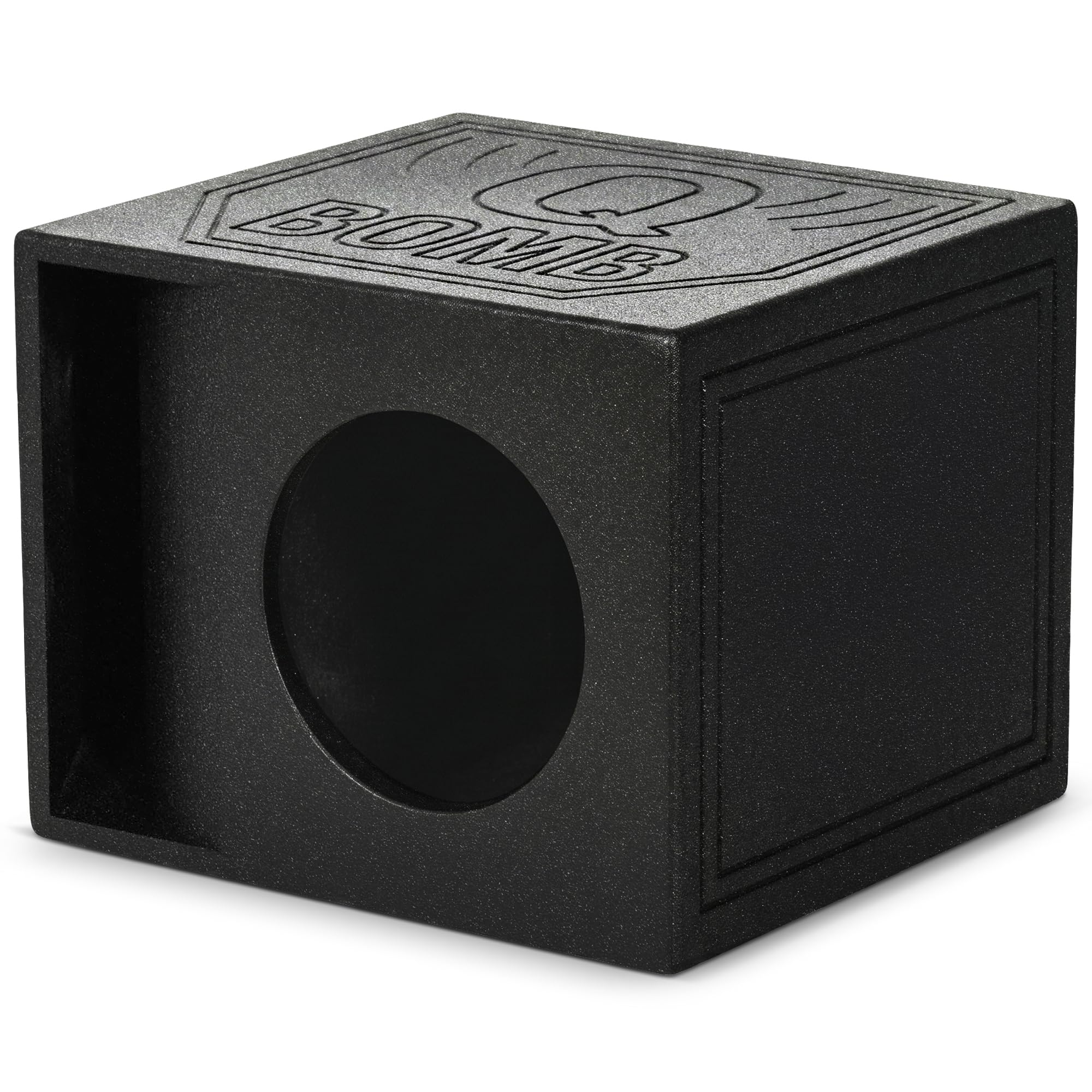
At this lower price you get a 1.4 cu. ft. vented enclosure built from 3/4-inch MDF throughout — the same rigidity as the QPower QBOMB side-ported box, but in a more compact format that fits tighter trunks than the side-ported design’s 22-inch width. One buyer bought three of these for their kids’ cars — a Honda Civic, Acura RSX, and Chevy Malibu — and reported that with Prodigy Audio NB2-12 subs and a Recoil Red1800.5 amp, the setup produced deep, chest-thumping bass that filled each cabin. Reviewers call it the best 12-inch sub box for its tuning and design, with clean bass extension down to 30 Hz.
The 1.4 cu. ft. airspace is smaller than the triangle box’s 2.2 cu. ft., but it is precisely matched to the QBomb’s port tuning for controlled, musical bass rather than loose boom. One buyer ran a 2,000-watt RMS sub through it and reported twice the sound output with no box flex. Packaging damage during shipping is a known issue, so inspect immediately upon arrival. Choose this over the Atrend Bbox if you run over 500 watts RMS and want no panel flex; it’s not for you if you need the largest internal volume — the triangle QPower gives you more airspace.
This box is perfect for the budget buyer who wants a rigid, no-flex enclosure for a high-power sub (over 500 watts RMS) in a compact trunk, and who is willing to inspect packaging upon delivery to avoid damage issues.
Why we’d pick it
- 3/4-inch MDF throughout provides maximum rigidity
- Precision-cut vent design enhances airflow for louder bass
- Handles high-power subwoofers up to 2,000W RMS without flex
A few caveats
- Packaging can arrive damaged in transit
- 1.4 cu. ft. airspace is smaller than some alternatives
- Third-party seller refunds can be difficult if damaged
Understanding the Specs
Tuning Frequency (Hz)
The tuning frequency tells you where the port resonates most efficiently — it is the frequency at which the bass gets a natural boost. A box tuned to 40 Hz will emphasize notes around that pitch, while a 54 Hz box pushes harder in the mid-bass range. For deep, rumbling sub-bass that you feel in your chest, lower numbers (30-40 Hz) are better. For punchy, aggressive SPL-style bass, higher numbers (45-55 Hz) work well.
Airspace Volume (cu. ft.)
Internal airspace is the volume of air inside the box that your subwoofer pushes against. More airspace (like 2.2 cu. ft.) lets the subwoofer cone move more freely, producing louder and deeper bass — but only if your sub is designed for a large enclosure. Less airspace (like 1.4 cu. ft.) creates a tighter, more controlled sound that works well with subs designed for smaller boxes. Always check your subwoofer’s recommended enclosure volume before buying.
MDF Thickness
Medium-density fiberboard (MDF) is the standard material for subwoofer boxes because it is dense and deadens vibration well. Thicker MDF (3/4-inch) resists panel flex better than thinner MDF (5/8-inch), especially with high-power subs that create more internal pressure. Flexing panels cause audible distortion and buzzes, so thicker material matters if you plan to run more than 500 watts RMS.
Frequency Response Range
This spec shows the range of bass frequencies the box can reproduce. A box with a 20 Hz frequency response can play very low notes that create that deep sub-bass sensation, while a box starting at 40 Hz will miss the lowest octave of bass. However, the actual bass you hear also depends on your subwoofer and your car’s acoustics — a box’s frequency response is a capability, not a guarantee.
FAQ
What is the difference between a ported and sealed subwoofer box?
How do I know what tuning frequency my subwoofer needs?
Can I modify a ported box’s tuning frequency after buying it?
Does the box finish affect sound quality or just looks?
Final Thoughts: The Verdict
Across the board, the 12-inch ported subwoofer box winner is the Atrend Bbox 12SVSC because its compact 16-inch width and 40 Hz tuning strike the best balance for tight trunks and versatile bass. If you want maximum build rigidity and a Kicker L7-friendly design, grab the QPower QBOMB Side-Ported Box — its 3/4-inch MDF is stiffer than the Atrend’s. And for single cab truck owners who need a triangle box that fits where nothing else will, the QPower Triangle Ported Enclosure with its massive 2.2 cu. ft. airspace is your only real option for maximum volume.
Product prices and availability are accurate as of the date/time indicated and are subject to change. Any price and availability information displayed on Amazon at the time of purchase will apply to the purchase of this product. As an Amazon Associate I earn from qualifying purchases.
CERTAIN CONTENT THAT APPEARS ON THIS SITE COMES FROM AMAZON. THIS CONTENT IS PROVIDED "AS IS" AND IS SUBJECT TO CHANGE OR REMOVAL AT ANY TIME.
Amazon and the Amazon logo are trademarks of Amazon.com, Inc. or its affiliates.