
Our readers keep the lights on and my morning glass full of iced black tea. As an Amazon Associate, I earn from qualifying purchases.
If you are sizing up crown molding, ripping through a pile of 2x12s, or building a deck that needs flawless compound angles, the machine you pick sits at the center of every cut. The wrong choice means fighting with calibration, wobbly rails, or a dust port that clogs on the first pass — the right one turns a day of framing into a quiet rhythm of clean, repeatable cuts.
I’m Min — the co-founder and writer behind Gadgets Feed. This guide is built by comparing the manufacturers’ published specifications and the patterns across verified customer reviews, so you get each pick’s real strengths and trade-offs instead of marketing spin.
Whether you’re a weekend trim carpenter or running a busy jobsite, this breakdown of the 12 inch sliding miter saw landscape helps you pinpoint the tool whose motor, slide system, and dust handling actually match your work — not just its sticker price.
How To Choose The Best 12 Inch Sliding Miter Saw
Before you click “buy,” the three decisions that separate a long-term keeper from a frustrating paperweight are the slide rail system, the blade alignment guide, and how the saw handles dust and bevel adjustments. Nail these three, and every other spec falls into place.
Slide Rail Design: Axial Glide vs. Dual-Bar Rails
The sliding mechanism determines how far back the saw needs to sit. Traditional dual-bar rails (found on most mid-range saws like the DOVAMAN and MarvTool) need clearance behind the saw — roughly 12 inches of dead space. Axial-glide systems (used on the Bosch GCM12SD) collapse the rails into the body, letting you place the saw flush against a wall. If your shop space is tight, axial-glide is a standout. If you have room to spare, conventional dual rails are simpler and cost less to repair.
Blade Alignment: Shadow/LED vs. Laser Guide
A laser guide projects a red line onto the material — a direct visual cue that works well in dim light but can wash out under bright job-site sun. An LED shadow system (like DeWalt’s XPS or VEVOR’s LED) casts a sharp shadow of the blade’s exact path onto the wood, meaning zero calibration drift over time. For trim work requiring 1/32-inch precision, an LED shadow guide is generally more reliable. For rough framing or budget builds, a laser is perfectly adequate if you calibrate it on setup.
Dust Collection and Bevel Repeatability
A 12-inch slider kicks up a lot of sawdust. Look for a saw with a properly shaped dust port that connects to a shop vacuum — the bag that ships in the box will fill in minutes. On the bevel side, check whether the saw has positive stops at common angles (0°, 15°, 22.5°, 30°, 45°) and whether the detent plate is steel (resists wear) vs. aluminum (lighter but can deform over time). Repeatable bevel locks save you from having to re-square the blade every few cuts.
Quick Comparison
On smaller screens, swipe sideways to see the full table.
| Model | Category | Best For | Key Spec | Amazon |
|---|---|---|---|---|
| DEWALT DWS780 | Premium | Pro job-site accuracy & shadow guide | XPS Shadow Light, 3800 RPM, 58 lbs | $499.00$635.00Limited time dealAmazon |
| BOSCH GCM12SD | Premium | Space-saving axial glide & smooth cuts | Axial-Glide, 60T blade, 88.2 lbs | $562.99$642.99Amazon |
| Makita LS1219L | Premium | Fine woodworking precision & dual slide | 2-Steel Rail Slide, 15A, 81.6 lbs | $989.00Amazon |
| WEN MM1214T | Mid-Range | Front-slide compact design & value | Front-Slide Rails, 60T blade, 56 lbs | $389.12Amazon |
| DOVAMAN 12-Inch | Mid-Range | Heavy cuts & dual-bevel on a budget | 3800 RPM, 53.9 lbs, 40T blade | $269.97$299.97PrimeAmazon |
| VEVOR Sliding Compound | Mid-Range | High-speed cutting with LED guide | 5000 RPM, 46.4 lbs, 60T blade | $309.99Amazon |
| MarvTool 12-Inch | Mid-Range | Lightweight portability & easy setup | 3800 RPM, 39.6 lbs, 36T blade | $269.99Amazon |
| GENERAL INTERNATIONAL | Mid-Range | Laser alignment & extended crosscuts | 4200 RPM, 46 lbs, 1mW Laser | $301.56Amazon |
| TRUPER SINCO-12X | Premium | Industrial-grade construction & telescopic arm | 60T blade, 2 3/4 HP, telescopic arm | $999.37Amazon |
In‑Depth Reviews
1. DEWALT DWS780
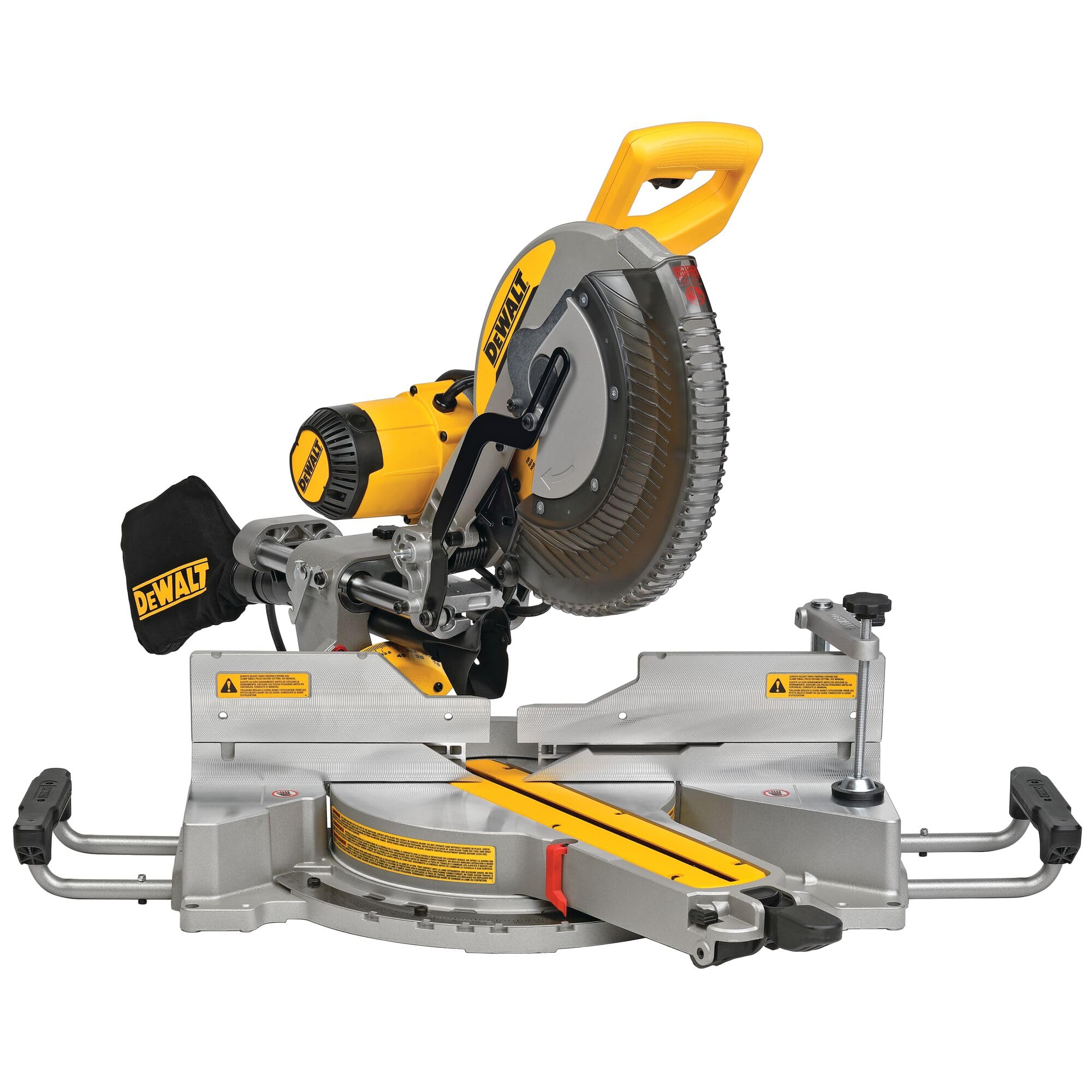
3800 RPM and a 58-pound weight make the DEWALT DWS780 the top pick for the pro who needs a lighter, dead-accurate sliding miter saw on the job site. Its XPS shadow light casts the blade’s exact outline onto the wood for a perfect alignment line without any calibration drift over time, so your first cut lands accurate without ever adjusting a laser. At 58 pounds, it is noticeably lighter than the Bosch GCM12SD at 88.2 pounds — a difference you feel when carrying it up stairs.
Buyers report that the XPS light is “foolproof, no calibration needed,” and the motor glides through a 2×12 pressure-treated plank without bogging. The super-efficient dust collection system captures over 75% of dust, though the included bag fills quickly — most owners hook it to a shop vac immediately. The fence design handles crown molding up to 7-1/2 inches nested and base molding up to 6-3/4 inches, which covers typical trim work without a second pass.
One honest limit: some owners mention the preset angle stops arrived slightly off and needed tweaking, and the rear split fence can interfere with wide bevel cuts. For the pro who values accuracy and speed on the job site, this is the one to beat.
Why it’s great
- XPS shadow light is drift-free and always accurate
- Motor torque is strong; cuts 2×14 dimensional lumber at 90°
- Compact 58-lb design with dual horizontal steel rails
Good to know
- Preset stops may need initial adjustment
- Dust bag is small; a shop vacuum is recommended
2. BOSCH GCM12SD

The Bosch GCM12SD counters with its patented axial-glide system — instead of sliding rails that need 12 inches of clearance behind the saw, the Bosch folds its rails into the body, saving valuable shop space while delivering unmatched smoothness. Where the DEWALT relies on conventional steel rails, the Bosch’s glide feels like cutting on ball bearings with zero side-play. It runs at 3800 RPM and includes a quality 60-tooth blade from the factory.
Buyers describe it as “smooth, quiet, wow,” and the 90% dust collection rating (optimized for 2x material with a vacuum) is best-in-category for this price tier. The square lock quick-release fences lock at 90 degrees without adjustment — a time-saver when switching between rip cuts and bevel cuts. It handles 14 inches of horizontal capacity and 6-1/2 inches of vertical capacity against the fence, which is ideal for baseboard and crown work.
Choose the Bosch over the DEWALT if your shop is tight and you prize the axial-glide’s compact footprint. The catch: at 88.2 pounds, it is the heaviest 12-inch slider here — more of a permanent shop fixture than a job-site traveler.
Where it shines
- Axial-glide saves 12 inches of rear clearance
- 90% dust collection with a shop vacuum is class-leading
- Square-lock fences require no adjustment at 90°
Worth noting
- 88.2 lbs is heavy; best for a dedicated stand or bench
- Some users find the handle trigger placement awkward
3. Makita LS1219L

If you’re building furniture-grade joinery where a 1/64-inch error means a rejected dovetail, the Makita LS1219L is the precision standard. Its unique 2-steel rail sliding system offers single slide-glide operation with zero play, and the reduced saw footprint lets you work flush against a wall — something the MarvTool and DOVAMAN cannot do without rear clearance. A seasoned buyer with 40 years of carpentry calls it the “best miter saw ever.” It cuts up to 8 inches of nested crown molding and 6-3/4 inches of baseboard vertically, with a laser guide that customers note “matches the cut line perfectly.”
One real detail from the data: the laser can be swapped to either side of the blade, so it stays visible when making left or right bevel cuts. The dual dust collection ports provide excellent extraction, but reviewers point out the bag fills fast — plan to use a shop vac. At 81.6 pounds, it is comparable to the Bosch in weight, so this is a shop saw, not a daily toss-in-the-truck tool.
The in-front bevel lock is the most ergonomically satisfying in this lineup — you adjust the bevel angle without reaching around the back of the saw.
What stands out
- Zero-play 2-rail slide system is engineered for dead accuracy
- Swappable laser side stays visible on bevel cuts
- 8-inch crown nested capacity beats most competitors
The trade-offs
- 81.6 lbs; better suited for a shop than mobile use
- Aluminum detent plate can wear over time with the steel lock pin
4. WEN MM1214T

The single number that matters most in this category is rear clearance, and the WEN MM1214T scores a perfect zero inches needed behind the saw thanks to its front-slide rail design — unlike the DEWALT and DOVAMAN that have rails protruding behind the saw, the WEN’s rails extend forward, eliminating the need for 12 inches of rear clearance entirely. This gives it one of the smallest footprints in this category while still delivering a full 13-3/8 inch crosscut capacity and a 15-amp motor. It includes a 60-tooth carbide-tipped blade from the factory (sharper than the 36-tooth blade on the MarvTool by a wide margin).
The downside you accept: reviewers report that the right fence can arrive slightly off-square and the bevel indicator alignment stickers may peel. The rear upper fence may need a thin shim to achieve true 90 degrees for fine woodworking. For general building trades and deck framing, however, shoppers say it has “plenty of power, comparable to DeWalt sliding saw.” The compact rail design is also wall-friendly, letting you store it flush against a wall without losing the sliding function.
At a price that slots between the entry-level models and the premium trio, the WEN delivers genuine innovation in the rail system — you get space-saving geometry that usually costs hundreds more, making this a strong price-to-value read.
The upsides
- Front-slide rails eliminate rear overhang for tight shops
- 60T carbide blade cuts cleanly right out of the box
- Onboard laser + LED work light for dual alignment
Keep in mind
- Fence may need squaring adjustment after shipping
- Dust bag is poor; a shop vacuum is essential
5. DOVAMAN 12-Inch Dual-Bevel

What you actually get at this lower price is a 15-amp pure copper motor spinning at 3800 RPM, a laser guide, and dual-bevel capability (0° to 45° left and right) — all while undercutting the DEWALT by hundreds but keeping the same core features. The 53.9-pound weight is 4.1 pounds lighter than the DEWALT and 34.3 pounds lighter than the Bosch, making it noticeably easier to haul from garage to driveway. Buyers report it cuts “4×4s like butter” without bogging, a direct quote from a user who swapped from an older Dewalt and found the performance equal.
What you give up: the laser guide, while functional, is less reliable than an LED shadow system in bright sunlight, and the included dust bag is small — most users hook a shop vac to keep the work area clean. The sliding rail system is conventional dual-bar, meaning you need about 12 inches of rear clearance behind the saw. The included 40-tooth TCT blade is serviceable for framing but may leave a rougher edge on trim compared to a 60-tooth blade.
For the DIYer or semi-pro who needs the full capability of a 12-inch dual-bevel slider without spending pro-tier money, the DOVAMAN is the exact budget buyer it is perfect for.
Why we’d pick it
- Strong 15-amp motor cuts hardwood and 4x4s effortlessly
- Dual-bevel 0-45° left and right for compound angles
- 53.9 lbs is manageable for one-person setup
A few caveats
- Laser can be hard to see in bright conditions
- Dust collection bag fills quickly; a shop vacuum is better
6. VEVOR Sliding Compound Miter Saw
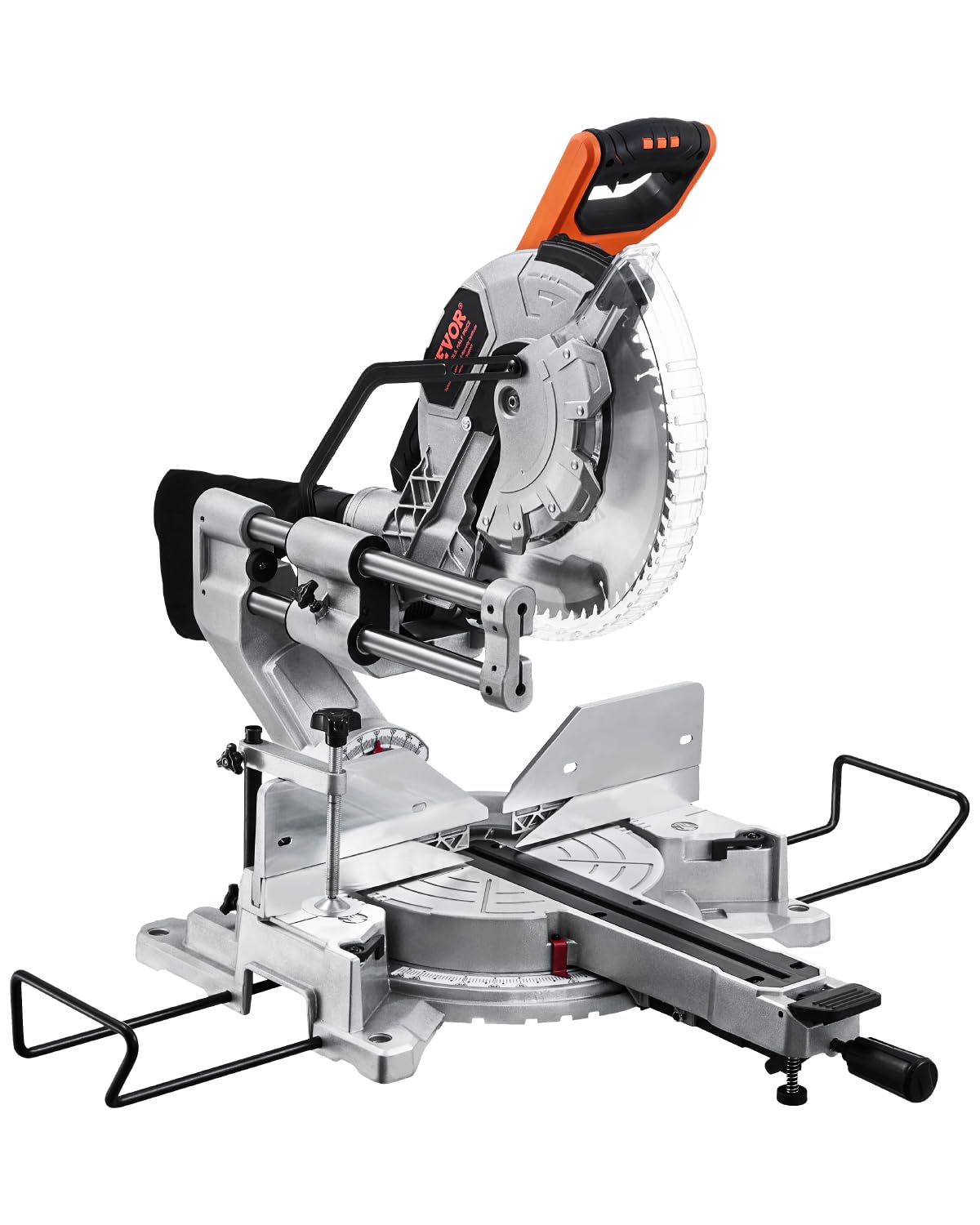
The VEVOR is the speed champion of this roundup, perfect for production work where you need to zip through repetitive crosscuts on composite decking or laminates. It spins at 5000 RPM — that is 32% faster than the DOVAMAN and MarvTool which both run at 3800 RPM — and packs a 60-tooth blade, which is 67% more teeth than the 36-tooth blade on the MarvTool, meaning finer, cleaner cuts on the first pass. Owners mention the “shadow guide superior to laser; accurate blade path display” — the LED system projects a clear shadow line similar to the DEWALT’s XPS but at a fraction of the price.
The axial sliding system is smooth and lets you push the saw flush against a wall, saving about 12 inches of rear workspace compared to dual-rail designs. It also boasts an upgraded aluminum base — lighter than the cast iron bases on the DEWALT and Makita — at 46.4 pounds, making it the lightest mid-range option here. For a job-site that values speed and portability, this is a compelling dark horse.
However, reviewers flag that the sawdust exhaust clogs when cutting soft woods with the stock 32-tooth blade (the included blade is 60-tooth, so this is a minor risk with aftermarket blades), and one buyer had an LED unit fail and resolved it via direct email rather than the website ticketing system — so be aware that customer service may require a bit more persistence than the big brands.
Strong points
- 5000 RPM is the fastest spin speed in this lineup
- 60-tooth blade delivers fine cuts on laminates and hardwood
- Aluminum base at 46.4 lbs is very portable
Before you buy
- Dust discharge clogs with soft woods and fine dust
- LED unit may need direct customer service if it fails
7. MarvTool 12-Inch Dual-Bevel
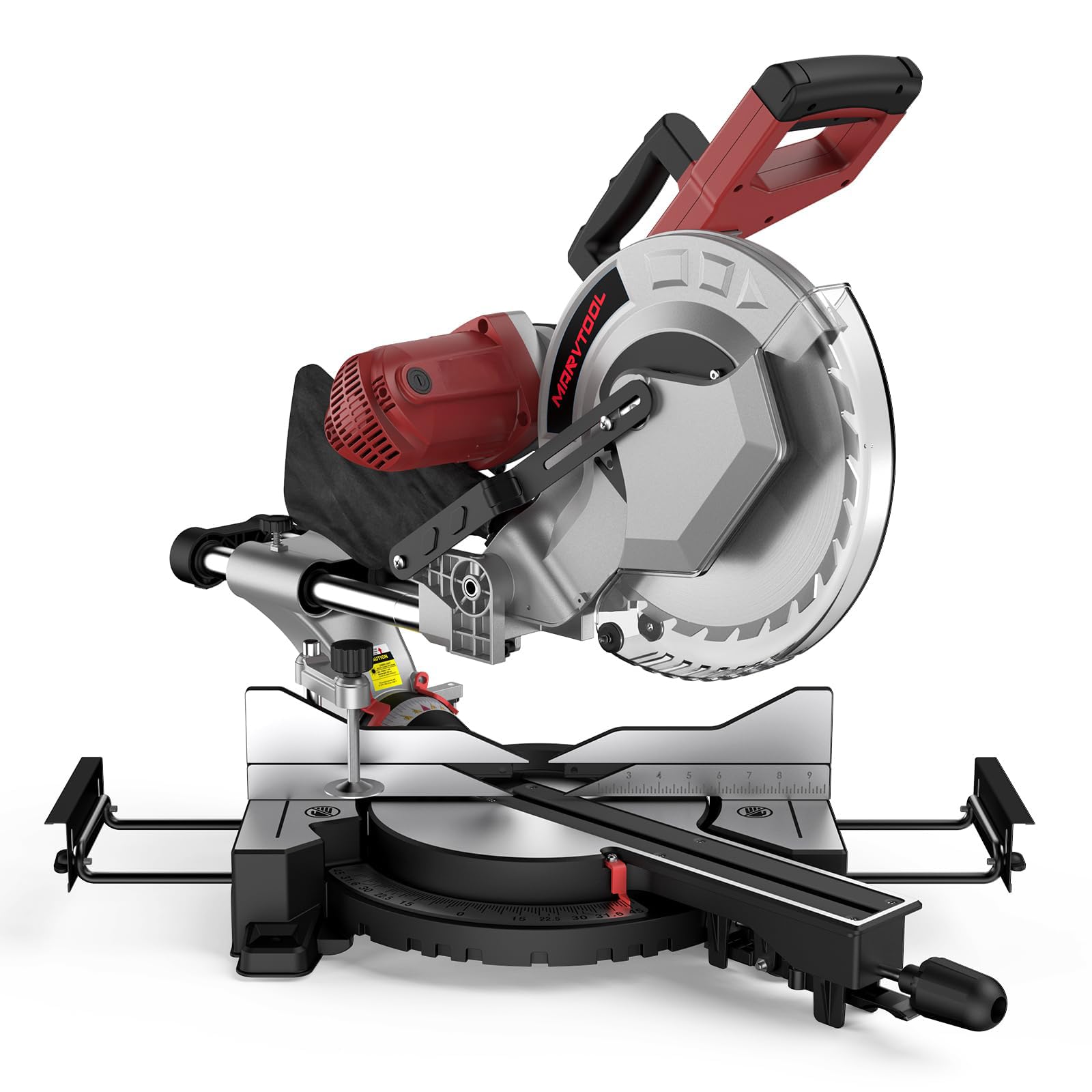
At 39.6 pounds, the MarvTool is the lightest 12-inch slider in this guide — 33% lighter than the 53.9-pound DOVAMAN and 60% lighter than the 88.2-pound Bosch — making it the clear value pick for portability. It runs a 15-amp motor at 3800 RPM with dual-bevel capability (0° to 45° left and right), matching the DOVAMAN’s bevel range, and includes two extension tables and a 36-tooth blade. Customers note it is “affordable, lightweight, easy setup” and “perfect for the DIY that don’t need to break the bank.”
What you give up: there is no laser guide or LED shadow system — you align cuts by eye or mark the wood. The 36-tooth blade is adequate for rough framing but will leave a coarser edge on trim compared to the 60-tooth blades on the VEVOR or DEWALT. Some reviewers point out the dust collection bag is basic and the material supports (extension tables) could be longer for wide panels. The fences are adequate but feel less robust than on the premium models.
The one clear reason to choose the MarvTool is that it is the exact saw for the weekend warrior who needs a 12-inch sliding saw for occasional deck repairs, fence building, or DIY projects — and does not want to invest pro-level money for tools that sit idle for months.
What we like
- 39.6 lbs is the lightest full-size 12-inch slider here
- Dual-bevel 0-45° capability at an entry-level price
- Setup is quick; blade is pre-installed and basic calibration is simple
The downsides
- No laser or shadow guide; cuts are aligned by eye
- 36T blade is rougher on trim than higher-tooth alternatives
8. GENERAL INTERNATIONAL MS3008

The 15-amp motor spinning at 4200 RPM makes this the fastest-spinning saw in the roundup, and it is for the budget-conscious woodworker who prioritizes speed and a laser guide over long-term reliability. At 46 pounds, it is 16.6 pounds lighter than the DOVAMAN, and the dual slide rails extend cutting capacity while an oversized knob for blade tilt simplifies bevel adjustments.
The honest truth from the data: this saw has the most negative review pattern in the entire roundup. Multiple 1-star reports state it breaks within 4 months, with one buyer saying a bearing fragment went into the operator’s hand during use. Reviewers describe the weight distribution as “weak” — it feels like it will tip over during cuts and needs to be clamped down, and the measurements printed on the back fence shown in product images may not match the actual saw you receive.
While the 4200 RPM speed and class II 1mW laser are attractive on paper, the real-world reliability data does not support choosing this over the DOVAMAN or VEVOR in the same price tier. Only consider this if you find it at a significant discount and are comfortable performing your own alignment and potentially dealing with early failure.
Why it’s great
- 4200 RPM is faster than most competitors
- 1mW laser is bright and visible in most shop lighting
- 46 lbs is light for a 12-inch slider
Good to know
- Multiple reports of motor and bearing failure within months
- Weight distribution feels unstable; may require clamping down
9. TRUPER SINCO-12X

The Truper SINCO-12X enters the premium tier with a telescopic arm design — unlike the conventional rail systems on the DOVAMAN and MarvTool, the telescopic arm extends forward without rear rails, giving you increased cutting capacity while keeping the saw flush against a wall. It runs a 2 3/4 HP motor and includes a 60-tooth blade from the factory, matching the tooth count of the VEVOR (60 teeth) but with a telescopic mechanism that feels more robust than the VEVOR’s axial slide. Shoppers say its quality is “comparable to foreign brands at a much lower price.”
What that money actually gets you: an ergonomic handle with a transparent retractable protective guard, vertical and horizontal presses that firmly hold workpieces, and table extensions with rails for wider material support. The positive stops at 0°, 15°, 22.5°, 30°, and 45° left and right make repetitive angle changes fast. At 35.91 inches by 20.94 inches, the footprint is slightly larger than the Makita but the telescopic arm means no rail mechanism protrudes behind the saw.
The one reason to choose it over the Makita or Bosch: if you are in a heavy-industrial setting where a steel telescopic arm feels more durable than the aluminum detent plates on the Makita, and you want a laser line for alignment rather than a shadow system. The trade-off is weight — it is a heavy unit that stays on a dedicated stand.
Where it shines
- Telescopic arm eliminates rear rail protrusion
- 60-tooth blade cuts cleanly out of box; positive stops at common angles
- Build quality noted as “excelente” by buyers for industrial use
Worth noting
- Heavy; intended for a permanent work station
- Laser alignment is not as wide as shadow/dual-LED systems
Understanding the Specs
Motor Power (Amps & RPM)
The motor rating, measured in amps (typically 15-amp for this category), tells you how much electrical current the motor can draw — more amps generally means more sustained torque through thick hardwoods. The speed, measured in RPM (revolutions per minute), tells you how fast the blade spins. A 5000 RPM saw like the VEVOR cuts faster per second than a 3800 RPM saw like the DOVAMAN, but higher RPM does not always mean cleaner cuts — blade quality and material matter more. For framing lumber, either speed works; for delicate trim, the blade’s tooth count is the bigger factor.
Slide Rail Systems
There are three main slide mechanisms you see in the data. Conventional dual-bar rails (on the DOVAMAN and MarvTool) have two exposed bars that slide back and forth — simple, reliable, but need about 12 inches of rear clearance. Axial-glide (Bosch) uses a single articulated arm that collapses into the body, saving rear space. Front-slide rails (WEN) extend forward instead of backward, also saving rear space. The difference matters if your saw sits against a wall; otherwise, any system works.
Blade Tooth Count and Material
The number of teeth on the blade directly affects cut quality. A 60-tooth blade (like on the DEWALT, VEVOR, and Truper) makes fine, splinter-free cuts on trim and plywood but cuts slower through thick framing. A 36-tooth blade (MarvTool) rips through framing faster but leaves a rougher edge — you may need sanding. The blade material: carbide-tipped (TCT) lasts much longer than high-speed steel. The DOVAMAN’s TCT blade is a step above the MarvTool’s HSS blade for durability.
Weight and Portability
A 12-inch sliding miter saw is a heavy tool — weights range from 39.6 pounds (MarvTool) to 88.2 pounds (Bosch). The difference of nearly 49 pounds determines whether you can carry the saw up stairs, mount it on a jobsite stand, or leave it on a dedicated bench. The DEWALT at 58 pounds and the DOVAMAN at 53.9 pounds strike a good balance for occasional transport. The Bosch at 88.2 pounds is best for a permanent shop station.
FAQ
Is a laser guide better than an LED shadow system on a 12-inch sliding miter saw?
How much rear clearance do I need for a sliding miter saw?
What does dual-bevel mean and do I need it?
Final Thoughts: The Verdict
For the majority of shoppers, the 12 inch sliding miter saw winner is the DEWALT DWS780 because the XPS shadow light gives you drift-free accuracy on every cut, the 15-amp motor handles dimensional lumber without stalling, and the 58-pound weight is light enough for a job-site but still a solid shop tool. If you want the smoothest slide mechanism and have a permanent bench, grab the BOSCH GCM12SD with its axial-glide. And for the budget-conscious DIYer who needs a lightweight, full-featured slider for occasional projects, the standout is the DOVAMAN 12-Inch Dual-Bevel.
Product prices and availability are accurate as of the date/time indicated and are subject to change. Any price and availability information displayed on Amazon at the time of purchase will apply to the purchase of this product. As an Amazon Associate I earn from qualifying purchases.
CERTAIN CONTENT THAT APPEARS ON THIS SITE COMES FROM AMAZON. THIS CONTENT IS PROVIDED "AS IS" AND IS SUBJECT TO CHANGE OR REMOVAL AT ANY TIME.
Amazon and the Amazon logo are trademarks of Amazon.com, Inc. or its affiliates.