
Our readers keep the lights on and my morning glass full of iced black tea. As an Amazon Associate, I earn from qualifying purchases.
Specs are compiled from manufacturer listings and verified buyer reviews and can change over time — please confirm the key details on the product page before buying.
When the utility goes dark, a 12 kW generator is the difference between camp-chair suffering and keeping your fridge cold, your well pump running, and your lights on. The real question is not if you need one—it is which fuel type, which engine, and which control panel matches the way your house actually pulls power. This guide walks you through a dozen models that genuinely handle 12,000 watts or above, focused on real-world assembly, run times, and the noise you will actually hear through your walls.
I’m Min — the founder and writer behind Gadgets Feed. This guide is built by comparing the manufacturers’ published specifications and the patterns across verified customer reviews, so you get each pick’s real strengths and trade-offs instead of marketing spin.
If sorting through watt ratings, fuel-switching knobs, and CO sensors feels like decoding a second manual, this lineup of the best 12 kw generator options cuts the noise by showing you exactly which frame fits your breaker panel and your budget.
Our Picks at a Glance


How To Choose The Best 12 kW Generator
Picking the right generator at this wattage class means matching your home’s start-up surge to the engine’s actual running watts—not just the peak number on the box. Here are the three specs that separate a satisfying backup from a frustrating paperweight.
Fuel Type: Dual-Fuel vs. Tri-Fuel
A dual-fuel generator runs on gasoline and propane. A tri-fuel adds natural gas, which plugs straight into your home’s gas line for indefinite runtime. If you have natural gas piped to your house, tri-fuel saves you from storing and rotating liquid fuel. If you value portability and propane’s stable shelf life, dual-fuel keeps the setup simple and the weight lower.
Running Watts vs. Starting Watts
A 12,000-watt peak (starting) generator might only deliver 9,500 running watts. The difference is the surge needed to start a motor—like your AC compressor or well pump—before settling into a steady load. Add up the running watts of every appliance you plan to power simultaneously, then confirm the generator’s running watt rating is at least 20% higher than that total.
Noise and Enclosure Type
Open-frame generators produce the most power per dollar but run loud (70-80 dBA). Inverter generators use a fully enclosed design that cuts noise by 10-20 decibels and produce clean power (≤3% THD) safe for sensitive electronics. If the generator sits near a bedroom window or a neighbor’s property line, the extra money for an inverter model buys you peace—and sleep.
Quick Comparison
| Model | Best For | Running Watts | Engine CC | Weight | Amazon |
|---|---|---|---|---|---|
| DuroMax XP13000EH★ Best Overall | Whole-Home Dual Fuel | 13,000 | 500 | 234 lb | Amazon |
| DuroStar DS13000MXTop Value | Remote-Start Value | 13,000 | 500 | 220 lb | Amazon |
| Westinghouse 12500Consumer-Report Rated | Consumer Reports Pick | 9,500 | 457 | 212.1 lb | Amazon |
| Generac GP9500 Tri-Fuel | 3-Fuel Flexibility | 9,500 | 500 | 219 lb | Amazon |
| Pulsar PG12000B | Budget Dual-Fuel | 9,500 | 457 | 209 lb | Amazon |
| DuroMax XP12000E | Gas-Only Simplicity | 9,500 | 457 | 217 lb | Amazon |
| Generac 12.5kW Tri-Fuel | Natural Gas Ready | 9,500 | — | 227 lb | Amazon |
| DuroMax XP12000HX | Dual-Fuel Workhorse | 12,000 | 457 | 222 lb | Amazon |
| Westinghouse iGen12000TFc | Quiet Inverter Power | 9,000 | 457 | 191 lb | Amazon |
| Champion 201161 | Heavy-Duty Tri-Fuel | 12,000 | 717 | 331 lb | Amazon |
In‑Depth Reviews
1. DuroMax XP13000EH 13,000-Watt Dual Fuel Portable Generator
Our pick — 4.5★ from 3,500+ verified ratings; the strongest balance of quality and price.
A 13,000-watt dual-fuel beast that actually delivers on the “whole home” promise for under thirteen hundred.
This is the generator that buyers report ran for 8 hours on a full gas tank during a 9-hour outage while feeding two 3-ton HVAC units. The 500cc engine (versus the Westinghouse 12500’s 457cc) gives it the grunt to start hard-drawing appliances without dropping a notch. The front-facing fuel selector lets you swap from gasoline to propane in seconds, and the push-button electric start means you are not wrestling a recoil cord in a storm.
The all-metal frame—no plastic parts—and 100% copper windings mean this unit is built to last through years of weather and wear. At 234 pounds (versus the Westinghouse 12500 at 212.1 pounds), it is a heavy lifter, but the fold-down handle and no-flat tires make rolling it off your driveway manageable. Noise is loud for a closed-frame unit, but one owner noted it handled two 3-ton HVAC units (~6000W load) plus the rest of the house without strain, which is the real test at this wattage.
Buyers consistently mention that the CO sensor, low-oil shutoff, and idle-control features give them confidence to run it overnight. The biggest trade-off is the muffler noise—expect to position it away from bedrooms—but for raw power and fuel flexibility at this price point, the trade-offs are minor.
What Owners Appreciate
- 100% copper windings extend engine life by managing heat
- Dual fuel with simple knob—runs 7-8 hours on a 20 lb propane tank
- Push-button electric start with recoil back-up
Where It Falls Short
- Heavy at 234 pounds—hard to single-person load into a truck bed
- Not an inverter—total harmonic distortion may affect very sensitive electronics
Your best bet if: you need a whole-home dual-fuel generator that can start two central AC units simultaneously and you have someone strong to help unbox it.
Proceed with caution if: you must have whisper-quiet operation or plan to power sensitive home-theater gear without a separate line conditioner.
2. DuroStar DS13000MX 13,000-Watt 500cc Dual Fuel Portable Generator
A full 13,000-watt dual-fuel generator with a remote fob at a price that undercuts almost everything in this class.
While the DuroMax XP13000EH is the sales leader, the DuroStar DS13000MX is its slightly lighter (220 pounds vs. 234 pounds) sibling that adds a remote-start key fob. The 500cc engine produces 13 kilowatts of peak power, and owners mention it powers an entire home—AC, fridge, stove—without strain. One owner specifically noted: “Powers entire home with AC, fridge, stove, etc. without strain.” The CO alert auto-shutdown adds a layer of safety that is easy to take for granted until a window blows shut.
The control panel includes a transfer-switch-ready 50-amp outlet, a front-facing fuel selector, and push-button electric start with recoil backup. The engine displacement is 500cc, same as the DuroMax, giving it a 43cc advantage over the 457cc engines in many competitors. Reviewers mention that the sturdy fold-out handles make wheeling it across the yard easier than the weight suggests.
One honest caveat from a buyer: “Extremely powerful, can run a 1HP air compressor and welder/plasma simultaneously. Very noisy.” This is not a quiet inverter unit—expect the typical open-frame roar. But if you value a remote start that saves you from walking out in the rain, and you want the lowest-priced high-wattage generator with a 500cc engine, this is a serious contender.
Reasons to Buy
- Remote start fob included—start from inside the house
- Dual fuel with simple switch; propane hose and regulator included
- All-metal construction with reinforced power panel
Reasons to Think Twice
- Bonded neutral—needs ground wire removal for whole-house transfer switch use
- Very noisy; no inverter technology for clean power to sensitive gear
Reach for this if: you want 13,000 watts of dual-fuel power plus remote-start convenience without spending over a thousand dollars up front.
Look elsewhere if: your generator sits close to your bedroom window or you need bonded-neutral for jobsite-only use without modifying the unit.
3. Westinghouse 12500 Peak Watt Dual Fuel Home Backup Portable Generator
A Consumer Reports and Popular Mechanics favorite that sacrifices a bit of peak wattage for unusually high reliability scores.
The Westinghouse 12500 has the highest review count in this lineup (999 ratings at 4.8 stars—the best average in the class). It delivers 9,500 running watts on gasoline (12,500 peak) and 8,500 running on propane, with up to 12 hours of run time on a 6.6-gallon fuel tank. The 457cc engine features a cast-iron sleeve, automatic low-oil and CO shutdown, and a digital hour meter to track maintenance.
Assembly takes under 5 minutes, according to multiple buyers; the unit ships with oil, a funnel, tools, and a remote start key fob. One reviewer noted: “Rated best by Consumer Reports and Popular Mechanics.” At 212.1 pounds (versus the DuroMax XP13000EH’s 234 pounds) and measuring 27.2 x 26.1 x 26.5 inches, it is the most maneuverable unit in the class. The rubber outlet covers for all outlets add a thoughtful touch, keeping mud and snow out of the plugs.
A real-world limitation: customers note it loses efficiency above 2,000 feet elevation, though a high-altitude kit is available with a straightforward YouTube installation guide. Also, the manual mentions a non-existent Eco switch, and the printed pages may fall out—minor annoyances for a generator that fires up on the third cycle of the electric starter.
Trusted and Tested: With a 4.8-star average across nearly 1,000 reviews and backup from a 3-year warranty, this is the safest pick for a buyer who wants a community-tested generator that works from the start.
Your move: Grab this if you prioritize proven reliability and the highest buyer-satisfaction score in the category over raw peak wattage. skip it if your home pulls more than 9,500 running watts simultaneously, or if you live above 2,000 feet elevation and prefer not to buy an altitude jet kit.
4. Generac 12,500 Starting Watt Tri-Fuel Portable Generator
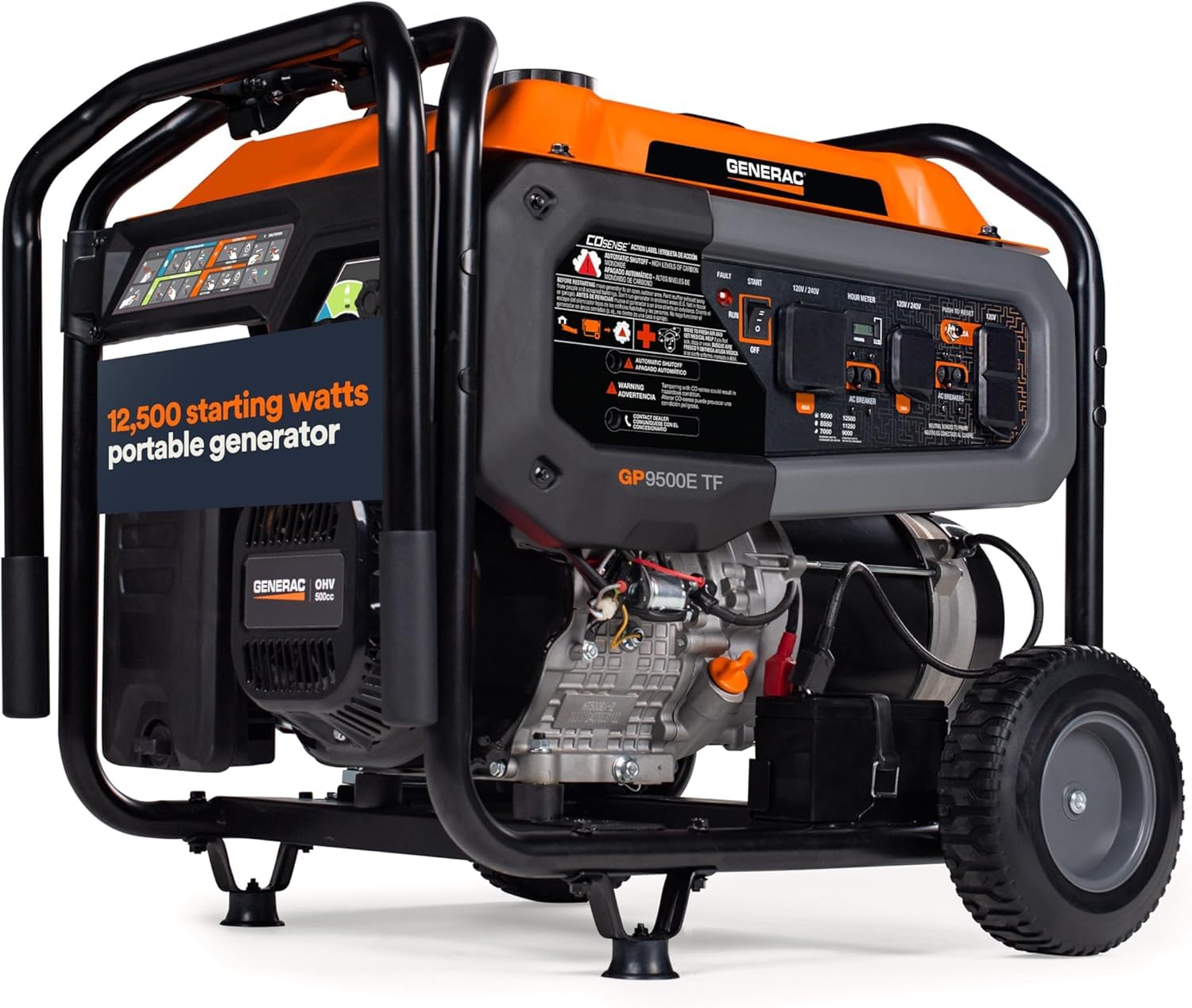
The first budget-friendly tri-fuel in this class—gasoline, propane, or natural gas—with a 7.5-gallon tank for extended runtimes.
While the premium DuroMax XP13000HXT offers tri-fuel for a higher price, the Generac GP9500 tri-fuel lands at a sub- entry point with a 500cc engine delivering 12,500 starting watts on gasoline and 9,500 running watts. The automatic voltage regulation (AVR) keeps power output steady, protecting sensitive electronics from voltage fluctuations that are common with open-frame generators. On a 7.5-gallon tank you get up to 14 hours of run time at 25% load on gasoline.
The COsense technology automatically detects rising carbon monoxide levels and shuts the generator down before thresholds are reached. The push-button electric start comes with a 12V battery included, and the steel-tube frame with 9.5-inch never-flat wheels and a folding handle makes the 219-pound unit manageable to roll into place. Transfer-switch compatibility means you can back-feed your home safely through a Generac HomeLink switch.
Honest mixed feedback: one buyer mentioned that after 15.9 hours the motor “blew a hole in the motor you could almost put your fist in,” while another called it “reliable hopefully” but had not used it yet. Also, a reviewer stated: “You don’t get anything to hook it for natural gas… you need to get a certified plumber.” This means the natural-gas conversion kit and plumber are on you, adding to total cost.
Solid entry-level tri-fuel: You get the flexibility of three fuels at a price that undercuts virtually every other tri-fuel. The trade-off is mixed initial quality reports and the hidden cost of professional natural-gas hookup.
Reach for this if: you want tri-fuel capability at the lowest possible price and can stomach the natural-gas installation expense. Look elsewhere if you need a track record of zero early failures.
5. Pulsar 12,000W Dual Fuel Portable Generator with Electric Start PG12000B

A CARB-legal, 209-pound dual-fuel generator that fits in tighter spaces than the bulkier 13kW units while still powering a whole house.
The Pulsar PG12000B delivers 12,000 peak watts (9,500 running) on gasoline and 10,800 peak (8,550 running) on propane. The 457cc OHV engine and Switch & Go technology let you switch fuel types without shutting the generator down—a feature usually found on more expensive units. The control panel includes four 120V outlets, a 120/240V twist-lock, a 50-amp RV outlet, and a 12V DC output.
Reviewers point out it runs an entire house—furnace, well pump, sump pumps, freezers, fridges, water heater, dishwasher, and internet—on 240V. One owner noted: “Excellent off-grid backup for solar battery bank. Runs all needs including A/C. smoothly switches between propane and gasoline without shutdown.” The 10-inch never-flat wheels and drop-down handle make the 209-pound unit easier to position than the 234-pound DuroMax, and CARB approval means it is legal in all 50 states.
A buyer truth: “Loud but typical for class. Heavy, non-inverter.” On propane, 20-pound tanks can freeze up in cold weather, so owners recommend 40-pound or larger tanks for extended use. The 3-in-1 digital meter tracks voltage, frequency, and run time, which is a handy maintenance aid for a generator at this price point.
What Works
- Switch & Go technology—hot-switch fuel without powering down
- CARB-approved for sale in California and other strict-emissions states
- Lightest dual-fuel in this class at 209 pounds
What Doesn’t
- Non-inverter design means higher THD than inverter generators
- 20 lb propane tanks can freeze during cold-weather runs
Best for: budget-conscious buyers who need CARB compliance and want a fuel-switching generator that is easier to move around the yard than the 230+ pound competition.
Not for you if: you need inverter-clean power for electronics or plan to run on small propane tanks below freezing.
6. DuroMax XP12000E 12,000-Watt Gas Powered Portable Generator

A gasoline-only generator that uses MX2 technology to deliver full 120-volt power through both duplex outlets simultaneously.
The DuroMax XP12000E is a simpler, gas-only sibling to the dual-fuel models above. It produces 12,000 starting watts and 9,500 running watts from a 457cc DuroMax OHV engine. The stand-out feature is MX2 technology, which lets you either run the generator at both 120V and 240V simultaneously, or at 120V only with full power from both 120-volt receptacles—useful if you only need to power 120-volt loads like lights, fridges, and sump pumps.
The low-oil shutoff protects the engine, and idle control lowers RPMs when no load is present—saving fuel and reducing noise on job sites where power is used intermittently. At 217 pounds and with the same all-metal frame as the rest of the DuroMax line, it is durable but not lightweight. Shoppers say: “Easily outputs 10kW, runs 3-ton HVAC.” An honest review caveat: “Tires develop flat spots from sitting; mildly inconvenient.”
This unit is a strong pick if you have no propane storage plans and want to keep your budget under control. It lacks a CO sensor, so you must operate it outside and away from windows—a non-issue for experienced generator owners but note for safety-conscious first-time buyers.
Best for gas-only users: If you are comfortable storing and rotating ethanol-free gasoline, this gas-only model saves you money while still providing enough surge to start a 3-ton AC unit. The flat-spot-prone wheels are the main recurring complaint—plan to roll it occasionally to prevent them.
Reach for this if: you want a proven, gas-only whole-home generator at a budget-friendly price and only need 120-volt loads sometimes.
pass on it if: you need dual-fuel flexibility or a built-in CO sensor for extra safety around your family.
7. Generac 12,500 Starting Watt Tri-Fuel Portable Generator (V2)
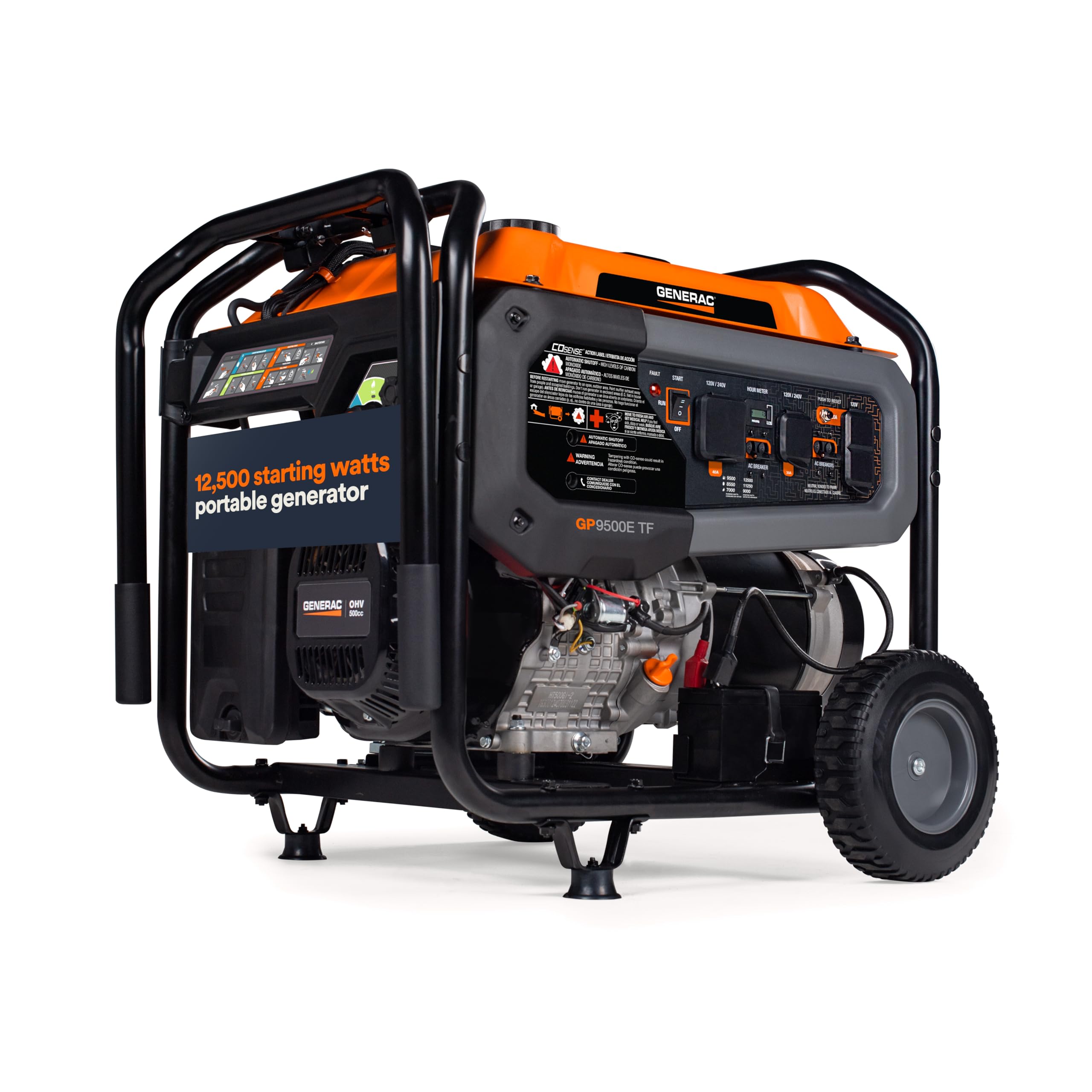
The second-generation Generac tri-fuel adds a rocker-switch electric start, a 9Ah battery in the box, and up to 14 hours of runtime.
This updated version of the Generac tri-fuel shares the same 12,500 starting watts and 9,500 running watts (gas) as the previous model, but upgrades the starting system to a rocker switch with a 12V 9Ah battery included and a recoil backup. The fuel selector dial lets you switch between gasoline, propane (8,550 running watts), and natural gas (7,000 running watts) without shutting the unit down. The 7.5-gallon tank delivers up to 14 hours at 25% load or 10.5 hours at 50% load on gasoline.
The COsense technology continuously monitors carbon monoxide levels, triggering an alert and an auto shutdown before dangerous concentrations build. The three-outlet panel includes one GFCI duplex outlet, one L14-30R twist-lock, and one NEMA 14-50R 50-amp outlet—enough to connect a transfer switch for whole-home backup. At 227 pounds with a steel-tube cradle and 9.5-inch never-flat wheels, it is one of the heavier portable options but rolls easily once assembled.
One mixed buyer experience: “Engine failed to start despite oil, gas, and propane. Generac confirmed engine defect; requires 2-hour warranty trip and 2+ week repair delay.” This is a reminder that even a well-known brand can produce a lemon, and warranty service can be slow. However, multiple other buyers praised it, with one noting it kept their home powered for 36 hours during an outage.
An updated package with a service asterisk: The rocker-switch start and included battery are genuine upgrades. But the occasional engine defect and the 2+ week repair timeline mean you should buy from a retailer with a solid return policy.
Best for: buyers who want a tri-fuel generator with the largest fuel tank in the class and a modern control panel, and who have a local service center close by.
Beware if: you cannot afford any downtime in a multi-week outage scenario, or you lack a nearby Generac warranty service dealer.
8. DuroMax XP12000HX 12,000-Watt Dual Fuel Portable Generator

A 12,000-watt dual-fuel generator with all-copper windings and CO Alert—built to the same standard as the larger 13kW units.
The DuroMax XP12000HX sits in a balance: 12,000 starting watts and 9,500 running watts on gasoline, with the same dual-fuel flexibility and CO Alert safety system found on the more expensive 13kW models. The 457cc OHV engine powers a full panel of outlets: four 120V GFCI household outlets, one 120V 30-amp outlet, one 120/240V 30-amp twist-lock, and a heavy-duty 120/240V 50-amp outlet for transfer switch connection.
Owners mention it runs an entire house—lights, 2 fridges, hot tub, electronics—for 8 hours without issue. One owner noted: “Beast of a generator. Started after 3 years with new battery. Runs fridge, freezer, sump pump, lights, furnace/air for 2+ days. Fuel efficient.” The all-copper windings and metal frame are the same build quality as the company’s premium models, just with a smaller engine displacement.
At 222 pounds, it is 12 pounds lighter than the XP13000EH and easier to maneuver. The propane regulator and hose are included, and the front-facing fuel selector makes switching quick. A real-world limitation: one owner reported the frame arrived slightly bent from shipping damage, but the unit still functioned perfectly.
The practical middle ground: You get 12,000 watts with dual-fuel flexibility, CO Alert safety, and a proven 457cc engine, all at a weight most people can manage alone. If you do not need the full 13,000 watts, this saves you money and back strain.
Your pick if: you want a reliable dual-fuel generator from a trusted brand, with enough power for a typical 2,000-2,500 sq ft home, at a weight you can personally handle.
Not for you if: you need tri-fuel natural gas capability or the maximum 13,000 watts to start multiple large AC units simultaneously.
9. Westinghouse iGen12000TFc 12,000 Peak Watt Tri-Fuel Portable Inverter Generator
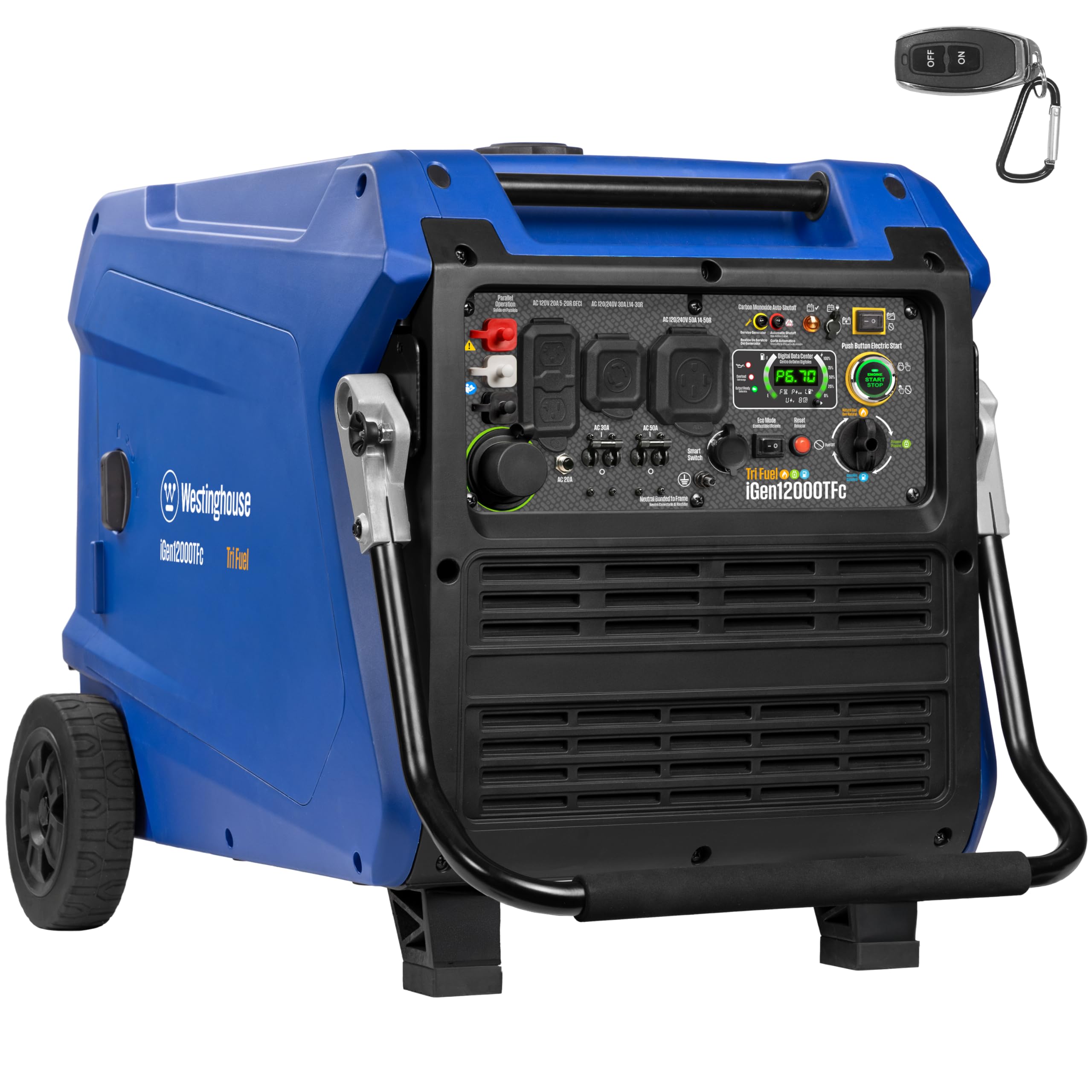
A tri-fuel inverter generator that is quiet enough for suburban neighborhoods and clean enough for your TV and laptop.
The Westinghouse iGen12000TFc is the only tri-fuel inverter in this lineup. It delivers 12,000 peak watts (9,000 running) on gasoline, 11,000 peak (8,100 running) on propane, and 9,800 peak (7,200 running) on natural gas. The total harmonic distortion (THD) is ≤3%, meaning the power is clean enough for sensitive electronics like a home theater, computer workstation, or CPAP machine. The enclosed design and insulation keep noise as low as 64 dBA—roughly the sound of a riding lawnmower at idle, not the roar of an open-frame generator.
The inverter technology matches engine speed to the actual power demand, saving fuel—the maker claims up to 50% less fuel consumption compared to traditional generators. The 7.9-gallon tank delivers up to 19 hours of run time at 25% load. The LED data center shows fuel level, power output, remaining run time, voltage output, and lifetime hours. At only 191 pounds, it is the lightest unit in this class, making it feasible for one person to roll into position.
Buyers praise the quiet operation: “Much quieter than I expected and I love the idea of using propane over gas since propane can be stored indefinitely.” One reviewer tested it on propane and was able to charge a 2022 Tesla Model Y at 32 amps/220 volts. The major trade-off is the premium price—this is the most expensive portable generator here—but if you need clean power and low noise, the extra cost buys you compatibility with electronics and neighbors.
Why It Stands Out
- Inverter output with ≤3% THD—safe for all sensitive electronics
- Quiet 64 dBA operation—neighborhood-friendly
- Lightest tri-fuel inverter at 191 pounds
The Trade-offs
- Highest price in the category (tri-fuel inverter premium)
- Lower running watts (9,000) than open-frame 13kW units
Best for: homeowners who need whole-home backup but must keep the noise down for neighbors and need clean power for modern electronics. Accept that 9,000 running watts may mean managing which high-draw appliances run simultaneously.
10. Champion Power Equipment 15,000-Watt Electric Start Tri Fuel Home Backup Portable Generator

A 717cc V-Twin tri-fuel monster that can run your whole house on natural gas for a full week after a hurricane.
The Champion 201161 is the most physically powerful generator in this class, with a 717cc Milwaukee Series V-Twin engine delivering 15,000 starting watts and 12,000 running watts. It operates on gasoline, propane, or natural gas, and both the natural gas and propane hoses are included—no extra purchases needed for tri-fuel operation. The 7.7-gallon fuel tank provides up to 9 hours of run time on gasoline.
The CO Shield carbon monoxide auto-shutoff system provides essential safety, and the Intelligauge tracks voltage, hertz, and run-time hours. The battery-included electric start features a reliable toggle switch rather than a push-button, which some buyers prefer for durability. At 331 pounds, this is the heaviest unit by far, but the built-in wheel kit and folding handle make rolling it across a yard feasible. One customer observed: “Powers entire house on natural gas after Hurricane Beryl, including AC with soft start. Requires 5-hour break-in and oil change.”
A critical real-world note from another buyer: “CO2 shutoff is extremely sensitive, shutting down outdoors after 1.5-2 hours.” This may be a safety feature working as designed, but it can be frustrating if the generator shuts off during the night. Champion offers a 3-year limited warranty and free lifetime technical support, which is the best warranty in this class.
Massive Power, Pro-Level Build
- 717cc V-Twin engine—most displacement and likely longest service life
- Tri-fuel with all hoses included; runs on natural gas indefinitely
- 3-year warranty with free lifetime tech support
Real-World Limits
- 331 pounds—needs two people or a ramp for truck loading
- Sensitive CO sensor may cause unexpected shutdowns outdoors
Reach for this if: you need the absolute most rugged, longest-lasting tri-fuel generator available in the portable class, with the warranty to back it up. Expect to handle the 331-pound weight with a friend or a hand truck.
Consider alternatives if: you need a lighter unit or cannot tolerate the possibility of a sensitive CO sensor shutting you down during a storm.
Understanding the Specs
Running Watts vs. Starting Watts
The most misunderstood number on a generator. Starting (peak) watts is the surge needed to kick on a motor—like an AC compressor or well pump—that lasts a few seconds. Running (continuous) watts is the steady power the generator can deliver for hours. A 12,000-peak generator might only run at 9,500 watts, so always add up the running watts of your simultaneous loads and leave a 20% buffer.
CO Sensor / CO Shield / COsense
These are different brand names for the same essential safety feature: a carbon monoxide detector built into the generator that automatically shuts down the unit if CO levels become dangerous. Since generators produce deadly exhaust, this feature is critical if the unit runs near any open window, door, or garage. All modern generators in this class should include one—if a model lacks it, budget for extra exhaust precautions.
FAQ
Can a 12 kW generator run my whole house?
What is the difference between running watts and starting watts on a 12 kW generator?
Should I choose dual-fuel or tri-fuel for my 12 kW generator?
How much propane does a 12 kW generator use per hour?
Will a 12 kW generator damage my sensitive electronics?
How quiet is a 12 kW generator?
Do I need a transfer switch for a 12 kW generator?
How long does a 12 kW generator last before needing maintenance?
Final Thoughts: The Verdict
For most homeowners, the best 12 kw generator is the DuroMax XP13000EH because it delivers a true 13,000 watts from a 500cc engine with dual-fuel flexibility, a proven track record across thousands of buyers, and a price that undercuts most competitors. If you want the same power with remote-start convenience and a slightly lower weight, the DuroStar DS13000MX is a close second. For buyers who need inverter-clean power and quiet operation in a suburban setting, the Westinghouse iGen12000TFc is the premium pick, though its 9,000 running watts require careful load planning. And if you have natural gas at home and want the maximum durability with a 3-year warranty, the Champion 201161 is the heavy-duty tri-fuel workhorse that can run your home for a week straight.
How We Picked
We do not accept paid placement. Every pick is matched to a real buyer and a real use-case; we do not hands-on test units.
Sources & Methodology
Specifications: manufacturer listings and product documentation. Review insights: verified customer reviews, as of July 2026. Pricing: not shown on this page (it changes often); check the current price via the retailer link.
As an Amazon Associate, Gadgets Feed earns from qualifying purchases. This does not affect which products we feature.