
Our readers keep the lights on and my morning glass full of iced black tea. As an Amazon Associate, I earn from qualifying purchases.
Specs are compiled from manufacturer listings and verified buyer reviews and can change over time — please confirm the key details on the product page before buying.
If you are shopping for backup power that can actually run a house, the “12 kWh battery” you find online usually falls into one of two very different camps: a fixed server-rack unit for solar installs, or a wheeled portable power station you roll out during outages. This guide sorts those options so you can match the right one to your setup.
I’m Min — the founder and writer behind Gadgets Feed. This guide is built by comparing the manufacturers’ published specifications and the patterns across verified customer reviews, so you get each pick’s real strengths and trade-offs instead of marketing spin.
Here is the honest starting point: the picks below land at or very near the 12 kWh mark, with one hitting 10.24 kWh total, and the reader note is that this list uses flexible matching so the nearest same-type size serves the same purpose. Finding the right 12 kwh battery means deciding between fixed solar storage and an all-in-one portable generator first.
Our Picks at a Glance
How To Choose The Best 12 kWh Battery
Before you compare brands, you need to settle one big question: are you building a permanent solar storage system, or do you want a portable unit you can move around and use during outages? That single choice drives everything else.
Fixed rack battery vs. portable power station
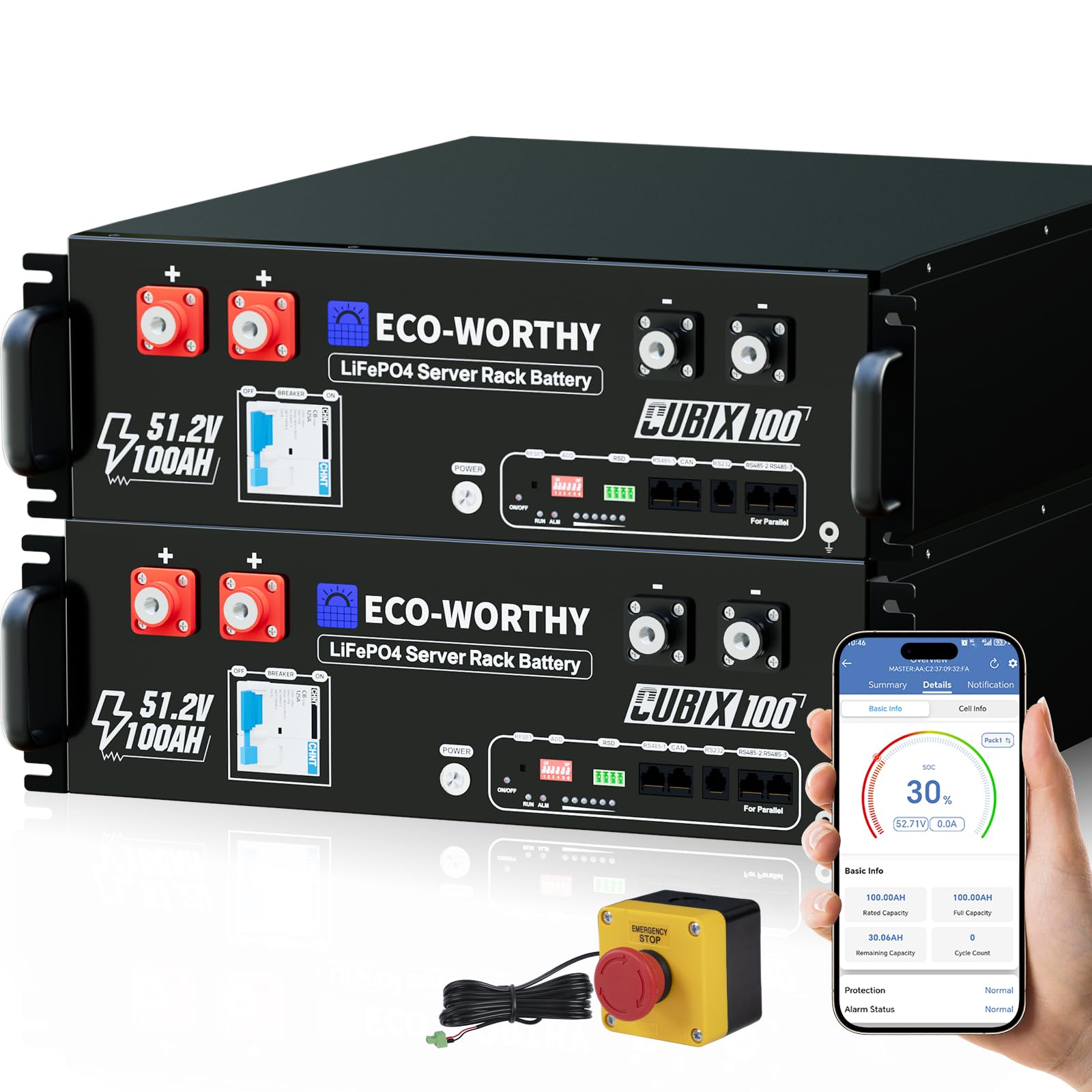
A server rack battery (like the ECO-WORTHY Cubix100) is a bare battery that connects to your existing solar inverter. It is designed to sit in one place, mount in a rack, and scale up. A portable power station (like the EcoFlow Delta Pro models) is a complete unit with an inverter, outlets, and wheels built in — you plug appliances straight into it.
Inverter output: the number that decides what runs
The battery stores the energy, but the inverter converts it into power your appliances can use. A 4000W inverter handles essentials like a fridge, TV, and router. A 7200W inverter can also start a 3-ton central air conditioner. You need to match the inverter’s wattage to the heaviest appliance you plan to run.
Quick Comparison
| Model | Best For | Type | AC Output | Weight | Amazon |
|---|---|---|---|---|---|
| ECO-WORTHY Cubix100 48V 200Ah★ Best Overall | Fixed solar storage expansion | Server Rack Battery | — | 200 pounds | Amazon |
| EF ECOFLOW Delta Pro 3 with 2 Extra Batteries | Portable whole-home backup | Power Station | 4000W | 260 pounds | Amazon |
| EF ECOFLOW Delta Pro Ultra with Extra Battery | High-output home generator | Power Station | 7200W | 293.6 pounds | Amazon |
In‑Depth Reviews
1. ECO-WORTHY Cubix100 48V 200Ah LiFePO4 Lithium Battery (2 Pack)
Our pick — over 4.5★ from 300+ verified ratings; the strongest balance of quality and price.
A rack-mounted battery that expands your solar storage into serious backup capacity.
This is the pick for anyone who already owns a solar inverter and wants to add real storage without paying for a second inverter. The Cubix100 is a 51.2V 100Ah server rack battery sold as a 2-pack, giving you 10.24kWh of total capacity (accepting the flexible 12 kWh match) in a form designed to bolt into a standard rack and leave there for a decade.
It uses Grade A LiFePO₄ cells and carries UL9540, UL1973, and CEC safety certifications, verified by Intertek for electrical safety and thermal runaway management.
Buyers report the rack itself is the standout: “High-quality rack, pre-drilled/tapped, all hardware included, easy assembly, wheels.” One owner had theirs running in 5-10 minutes and powering an entire 2000-square-foot house. The Bluetooth and WiFi app lets you monitor status remotely, though a couple of owners note the app is basic and lacks time-left predictions.
What wins people over
- Certified safety (UL9540, UL1973, CEC) on a battery this affordable
- Scales up to 32 parallel units (up to 163.8kWh total)
- Plug-and-play kit includes cables, screws, and manual
Who should think twice
- No on-unit screen — status lives in the app only
- 10.24kWh, not a full 12kWh on the nose
- Requires your own inverter; this is a bare battery
Reach for this if: you have a solar inverter and want cheap, certified, expandable storage.
Look elsewhere if: you need a ready-to-plug-in unit with its own inverter and outlets.
2. EF ECOFLOW 12kWh Portable Power Station: DELTA Pro 3 with 2 Extra Batteries

An all-in-one portable station that powers your TV, router, and fridge during outages.
If you want one box that does everything — battery, inverter, outlets, and wheels — this is your unit. The DELTA Pro 3 delivers 4000W of AC output on 120/240V (boosting to 6000W with X-Boost and scaling up to 12000W), which comfortably covers the essentials like a fridge, TV, and router, and even a 1 HP water pump.
Owners mention the killer feature is the 10 ms UPS switch-over: “Yes, I now have 12 kWh available to me 24/7 inside my house,” with the TV and router running off the system so an outage causes zero interruption. The unit operates as low as 30 dB with X-Quiet technology, so it can sit beside a bed without disturbing sleep. It uses automotive-grade LFP cells, an IP65-rated pack, and a 5-year warranty.
It is a hefty 260 pounds, so this is “portable” in the sense that it rolls, not that it travels easily. It is 260 pounds versus the ECO-WORTHY’s 200 pounds, a 30% heavier footprint for the convenience of a self-contained system. The main recurring complaint is customer service quality, with a few owners noting support feels outsourced.
What owners love: the instant UPS-style backup means the TV stays on even when the grid drops — no resetting clocks or waiting for a generator to spin up.
The honest trade-off: at 260 pounds and a 4000W ceiling, it suits essential appliances better than whole-house AC.
The verdict: the best pick if you want plug-and-play backup without any installation.
Just know: customer service is the weak spot some owners hit, and 4000W won’t start a central AC.
3. EF ECOFLOW 12kWh Power Station: Delta Pro Ultra with Extra Battery

A heavyweight unit delivering 7200W to keep a 3-ton central AC running during grid failures.
This is the serious home-generator option. The DELTA Pro Ultra pushes an exceptional 7200W of AC output on 120/240V — that is 80% more output than the Delta Pro 3’s 4000W — which is the difference between “essentials only” and “run the whole house.” It powers heavy appliances like a 3-ton central air conditioner, and you can triple the inverters for 21.6kW.
The capacity story is big too: it starts at 6144Wh per battery and scales to 15 batteries for a gigantic 90kWh — over 30 days of essential power for a standard North American household. A single battery recharges in 2 hours and provides 0-ms UPS transfer for sensitive electronics. The inverter and battery arrive in separate packages.
Owners who want a gas-generator replacement are thrilled — it “powers my entire house” and has “come in very handy during our power outages.” The honest fit note: power output gets mixed feedback in reviews. Some report EV charging maxes out around 6100W rather than the full 7200W, and a few note a 5-10% daily standby drain. One long-term owner called it a “great alternative to my gas generator.”
Why it earns the premium spot
- 7200W output runs central AC, not just essentials
- Expands from 6144Wh up to 90kWh for whole-home backup
- 0-ms UPS transfer protects sensitive electronics
The fit note, honestly
- Mixed feedback on real-world output vs. the 7200W claim
- 293.6 pounds — the heaviest pick here
- Some customers note standby power drain
Choose it for: whole-house backup where 7200W (not 4000W) is the non-negotiable requirement.
Pause if: you only need to keep a fridge and router alive — the Delta Pro 3 covers that for less.
Understanding the Specs
Capacity (kWh)
Kilowatt-hours measure total stored energy — think of it as the size of the fuel tank. A 12 kWh battery can deliver 1 kW of power for 12 hours, or 2 kW for 6 hours. More kWh means more hours of backup, but also more weight and cost. The ECO-WORTHY here is a 10.24kWh 2-pack, which is in the same working range for a home solar setup.
AC Output (Watts)
Watts measure how much power the inverter can push out at once — the “flow rate” of the tank. A 4000W output runs a fridge, TV, and router. A 7200W output can also start a 3-ton central AC. Match this number to your heaviest appliance, not your total storage, because the inverter is the gatekeeper for what actually turns on.
FAQ
What is the difference between a 12 kWh rack battery and a portable power station?
Will a 4000W portable station run my whole house?
Can I expand these 12 kWh batteries later?
What does LiFePO₄ mean and why does it matter?
How heavy are these 12 kWh systems?
Can these batteries power a house during an outage automatically?
How long does a 12 kWh battery last on a charge?
What safety certifications should a home battery have?
Final Thoughts: The Verdict
If you want one dependable pick, the 12 kwh battery winner depends on your setup: the ECO-WORTHY Cubix100 is the certified, budget-friendly rack battery for solar owners, while the Delta Pro 3 is the plug-and-play portable for essential appliance backup. If you need whole-house output, the Delta Pro Ultra with its 7200W output is the one to reach for.
How We Picked
We do not accept paid placement. Every pick is matched to a real buyer and a real use-case; we do not hands-on test units.
Sources & Methodology
Specifications: manufacturer listings and product documentation. Review insights: verified customer reviews, as of August 2026. Pricing: not shown on this page (it changes often); check the current price via the retailer link.
As an Amazon Associate, Gadgets Feed earns from qualifying purchases. This does not affect which products we feature.