
Our readers keep the lights on and my morning glass full of iced black tea. As an Amazon Associate, I earn from qualifying purchases.
Specs are compiled from manufacturer listings and verified buyer reviews and can change over time — please confirm the key details on the product page before buying.
Dropping a 60-pound brick into your boat or RV just to keep the lights on feels like a step backward — and honestly, it is. The shift from heavy lead-acid to a lightweight lithium battery is one of the biggest quality-of-life upgrades you can make, and the clearest sign of that is a simple number: 100 amp hours (the amount of energy it can deliver over time). That spec is the balance for trolling motors, solar storage, camper fridges, and backup power systems.
I’m Min — the founder and writer behind Gadgets Feed. This guide is built by comparing the manufacturers’ published specifications and the patterns across verified customer reviews, so you get each pick’s real strengths and trade-offs instead of marketing spin.
You want a battery that holds a charge, cuts dead weight, and doesn’t leave you stranded mid-trip — here is the research to find the right 12 volt 100ah battery without trial and error.
Our Picks at a Glance

How To Choose The Best 12 Volt 100Ah Battery
The first fork in the road is chemistry: Lithium (LiFePO4) versus lead-acid (AGM or Gel). Lithium batteries are lighter — often 20-25 lbs versus lead-acid at 60-65 lbs — and let you use nearly all of their 100Ah capacity safely. Lead-acid batteries typically only give you about 50 amp-hours of usable power to avoid permanent damage, so that 100Ah label is misleading without knowing the chemistry.
BMS — The Invisible Guardian
The Battery Management System (BMS) is the onboard computer that protects the cells from overcharging, extreme discharge, and short circuits. A 100A BMS rating means it can deliver up to 100 amps of continuous current — enough for most 30-70 lb thrust trolling motors. If you plan to run a high-power inverter (over 1,000W), look for a higher BMS rating or confirm the peak surge limit.
Group Size & Physical Fit
Group 24 (about 10 x 6.6 x 8.2 inches), Group 27, and Group 31 (about 13 x 6.8 x 8.4 inches) are the most common sizes. A Group 31 holds the same 100Ah capacity as a Group 24 in a longer case, which matters if your battery tray is tight on width. Measure your tray before buying — a lithium battery that is “25% smaller than Group 31” is a huge deal if you are squeezing it into a kayak or small camper.
Quick Comparison
| Model | Best For | Chemistry | Weight | BMS | Amazon |
|---|---|---|---|---|---|
| Litime 12V 100Ah★ Best Overall | All-around marine/RV champ | LiFePO4 | 22.1 lbs | 100A | Amazon |
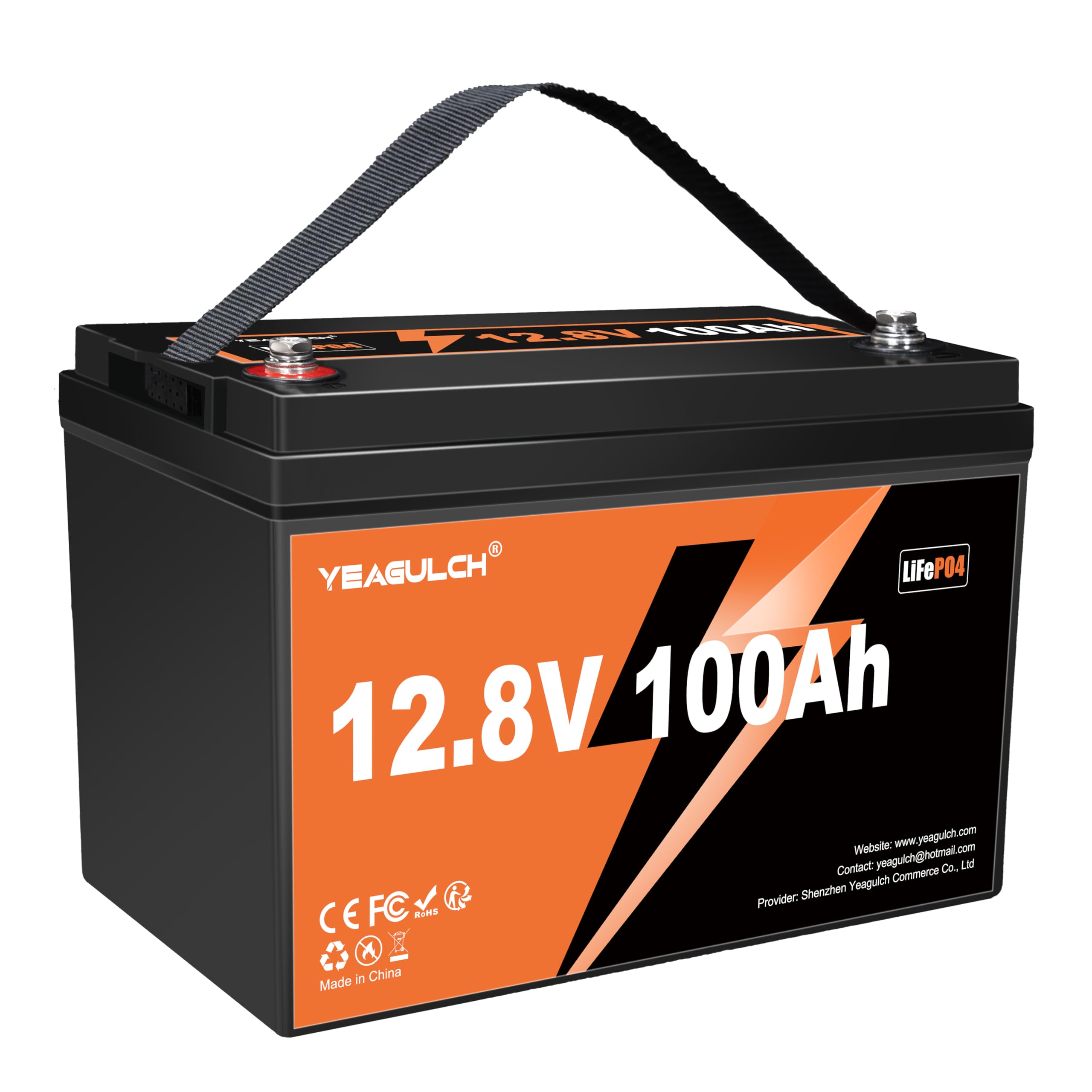
| Yeagulch 12V 100AhBudget Champion | Budget trolling motor power | LiFePO4 | 21.6 lbs | 100A | Amazon |
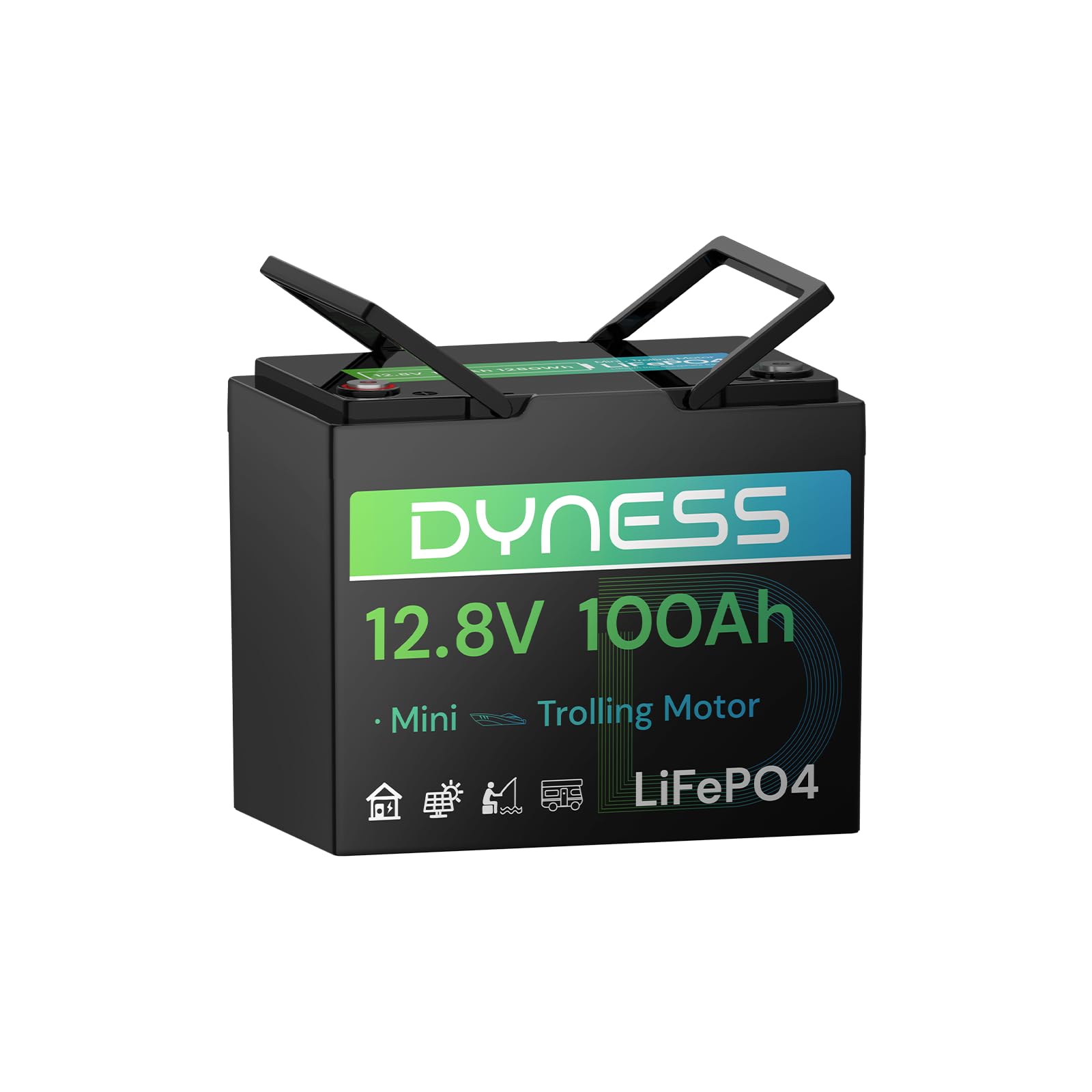
| Dyness 12V 100Ah Mini TMUltra-Compact | Ultra-compact kayak/fishing rigs | LiFePO4 | 20.9 lbs | 100A | Amazon |
| WEIZE 12V 100Ah AGM | Budget-minded stationary backup | AGM | 60+ lbs | N/A | Amazon |
| HumsiENK 12V 100Ah | Tech-friendly Bluetooth monitoring | LiFePO4 | 19.7 lbs | 100A | Amazon |
| Wattcycle 12V 100Ah | Reliable value for solar/RV | LiFePO4 | 23.2 lbs | 100A | Amazon |
| ExpertPower EXP-100 GEL | Sealed lead-acid traditionalist | Gel Lead Acid | 59.5 lbs | N/A | Amazon |
| Power Queen 12V 100Ah | Established brand, proven reliability | LiFePO4 | 24 lbs | 100A | Amazon |
| Redodo 12V 100Ah | High-cycle, long warranty choice | LiFePO4 | 22.0 lbs | 100A | Amazon |
| Power Queen 12V 100Ah BT | Bluetooth monitoring in Group 31 | LiFePO4 | 22.2 lbs | 100A | Amazon |
| Renogy 12V 100Ah Mini | Tiny spaces (teardrop / kayak) | LiFePO4 | 22.7 lbs | 100A | Amazon |
In‑Depth Reviews
1. Litime 12V 100Ah LiFePO4 Battery
Our pick — over 4.5★ from 550+ verified ratings; the strongest balance of quality and price.
The 22-pound marine marvel that made lead-acid batteries obsolete overnight.
At just 22.1 lbs and dressed in a standard Group 31 case, the Litime is at 22.1 lbs versus a comparable 100Ah lead-acid battery at 60-65 lbs, which means you feel the difference the moment you pick it up — and your boat’s hole shot feels it too. It packs a built-in TVS (a surge protector for electronics) that shields 12V-36V trolling motors from voltage spikes, so rough water does not fry your expensive gear.
The battery quality is the most-discussed strength here — and for good reason. Buyers report running a 12V refrigerator for days on end, and one owner noted “used it 4 hours straight pushing my 16′ jonboat with 3 – 200+ pound men into a 8mph headwind most of the time and hardly discharged the battery at all.” The smart low-temperature protection stops charging below 32°F (0°C) and stops discharging below -4°F (-20°C), a critical safeguard for anyone storing a battery in a cold garage or northern camper.
Why Owners Keep Coming Back
- Built-in TVS protects against voltage spikes — essential for marine electronics
- 64% lighter than lead-acid at 22.1 lbs; transforms boat handling
- Expandable to 4P4S (51.2V 400Ah, 20.48kWh) for large solar banks
- 4000+ full-depth cycles at 100% DOD — 10-year design life
A Couple of Installation Caveats
- BMS may lack active balancing; some owners use periodic disconnects
- Battery can ship “asleep” with no wake-up instructions — a quick force-charge on a compatible charger solves it
Reach for this if: you want a proven, lightweight, high-cycle marine battery that handles everything from trolling motors to RV refrigeration with zero fuss.
Think twice if: you need a drop-in for a system that requires active cell balancing, or you are not comfortable waking a sleeping BMS on delivery.
2. Yeagulch 12V 100Ah LiFePO4 Battery
The entry-level lithium that punches above its price tag for weekend anglers.
At 21.6 lbs with a 1.28kWh energy capacity, the Yeagulch is at 21.6 lbs versus lead-acid at 60-65 lbs and delivers up to 95% usable capacity — meaning you actually get almost all of that 100Ah, unlike lead-acid where you lose half to damage protection. The flat discharge curve holds 12.8V steady until deep discharge, so your trolling motor runs at full speed right up to the end.
Reliability is the top praise, with owners noting it works great for 70 lb thrust trolling motors on multi-day trips. One buyer summed it up: “Works great for trolling motor 70lb thrust. Did a 3 day trip where we trolled most the days and we didnt have to charge them yet!” Another owner powers an 80lb trolling motor on a 10-foot pontoon and reports a 10% speed boost from the extra voltage. The only catch is the 700W power limit on trolling motors — do not pair this with a high-thrust motor above that draw.
Best for budget-first buyers: If you want lithium performance at the lowest entry cost and you are running a moderate trolling motor (under 700W), this is your pick. The wiring aspect draws mixed feedback, so double-check your connector setup.
Grab this if: you are on a tight budget and need a 21.6 lb lithium that delivers 1.28kWh for weekend fishing trips.
Pass if: your trolling motor pulls more than 700W or you want premium features like Bluetooth monitoring.
3. Dyness 12V 100Ah Mini TM Battery
The 20.9-lb powerhouse that slips into a Group 24 tray like it was made for it.
The Dyness Mini TM is a Category 6 winner for a tight squeeze: at 10.2 x 6.6 x 8.2 inches, it is at 10.2 x 6.6 x 8.2 inches versus a standard Group 31 battery at 13 x 6.8 x 8.4 inches, yet it still packs 100Ah and 12.8 volts. That 0.32 cubic foot footprint frees up precious deck space on a kayak or small skiff. The IP65 waterproof and dustproof casing shrugs off splashes and rain, so you are not worrying about spray killing your power mid-fishing trip.
Designed specifically for 30-68 lb thrust trolling motors, the built-in 100A BMS provides low-temperature charging protection (cuts off below 32°F) and full overcharge/over-discharge safeguards. A kayak owner reports it powers a trolling motor for about 6 hours at 50% thrust. The battery uses A+ grade LiFePO4 cells rated for 6000+ deep cycles and comes with a 5-year warranty from Dyness.
The trade-off for the tiny footprint: At 20.9 lbs and Group 24 dimensions, this is the smallest true 100Ah lithium here. It is ideal for kayaks and small boats, but the compact case means fewer post positions than a Group 31 — plan your wiring accordingly.
Choose this if: your battery compartment barely fits a shoebox and you need the smallest 20.9 lb lithium that still delivers the full 100Ah.
skip it if: you need a Group 31 case for an existing battery tray or prefer the extra post-adjustment options of a larger format.
4. WEIZE 12V 100Ah Deep Cycle AGM Battery

The heavy-lifting lead-acid alternative that still holds its own at a lower price.
At 63 lbs, the WEIZE AGM is no featherweight — it is 2-3x heavier than the lithium options above — but this sealed lead-acid battery is maintenance-free and spill-proof. It delivers a hearty 1150A max discharge current (the burst of power for starting or inverters) and a very low 3% self-discharge rate, meaning it holds its charge for months in storage. The Group 31 dimensions (12.99 x 6.73 x 8.34 inches) fit standard trays.
Performance is the top-rated aspect, and owners often use four in parallel to build a 4.8 kWh home backup system running a 2000W inverter. One owner notes they have been using two in an off-grid RV with 300W solar for two years. The mixed feedback on battery life is typical for AGM — they last 200-500 cycles versus lithium’s 4000+, so weigh the upfront savings against the shorter service life.
Who it fits: This is for the fixed-installation buyer who does not move the battery often — a cabin, a home backup rig, or a stationary solar bank — where the 63 lb weight is a non-issue and the price is the priority.
Best for: stationary solar or backup power where 63 lbs sits still and 1150A burst current is needed.
Look elsewhere if: you carry the battery regularly, want 4000+ cycles, or need to move it between boat and garage.
5. HumsiENK 12V 100Ah LiFePO4 Battery

At 19.7 lbs with a BT app, this Group 24 is the data geek’s dream battery.
The HumsiENK weighs just 19.73 lbs — the lightest 100Ah on this list — and packs it into a BCI Group 24 box (8.4 x 6.6 x 10.2 inches). The standout feature is the built-in Bluetooth that connects to a smartphone app, letting you check voltage, state of charge (SOC), current draw, and temperature in real time. That is a major upgrade from blindly trusting a battery gauge.
It uses A+ grade LiFePO4 cells certified SDS/UN38.3/FCC/CE/ROHS, with an IP67 rating (fully dust-tight and protected against temporary submersion — a step above IP65). Owners use it with 55 lb trolling motors on 12-foot jon boats, reporting 8-hour trips consuming only 50% of the battery. The BMS discharges at 100A continuous and disconnects if the current spikes past 300±50A. The nylon carrying handle makes it easy to lug around.
What the Bluetooth adds: You can stop discharging via the app for safety, view data updating several times per second, and even adjust the 12V output voltage — all from your phone.
Choose this if: you love monitoring battery health via an app, want the lightest (19.7 lbs) 100Ah lithium, or need IP67 water protection.
Skip if: you do not need smartphone features and prefer a simpler, slightly cheaper, non-BT battery.
6. Wattcycle 12V 100Ah LiFePO4 Battery
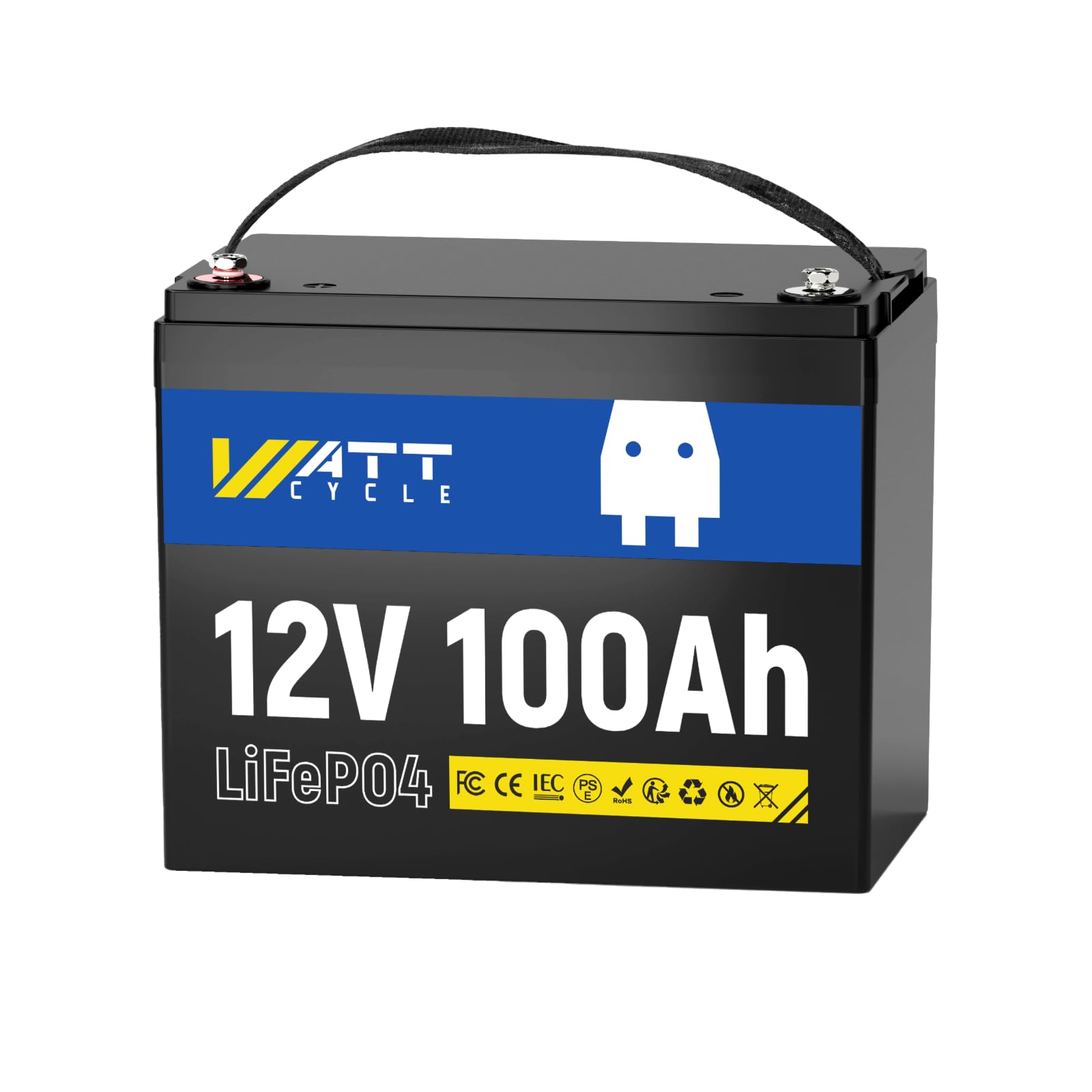
The Group 24 value king that delivers steady 12.8V performance without the premium price.
Measuring 10.2 x 6.6 x 8.2 inches and weighing 23.2 lbs, the Wattcycle fits standard Group 24 battery boxes and delivers 12.8V nominal voltage. The A+ grade cells are rated for up to 15000 cycles, backed by SDS/UN38.3/FCC/CE/ROHS certifications. The built-in 100A BMS disconnects the battery if the discharge current exceeds 300±50A, providing sturdy protection for both the battery and your connected devices.
Quality and performance are the top-cited strengths, and owners commonly use this in pairs for trolling motors — one reports two in series for a 42A max draw motor, with voltage never dropping below 25V (12.5V each) even at 75% depth of discharge. A few owners note the included bolts are short (M8 x 16mm needed if paralleling), but that is an easy fix. There is no Bluetooth, so you need a third-party monitor if you want data.
The real-world take: The Wattcycle is a solid, no-frills lithium that delivers on the basics — light weight, strong cycle life, and a 100A BMS — without charging extra for smartphone extras.
Best for: RV and solar owners who want a reliable Group 24 lithium at a mid-range price without needing Bluetooth.
Pass if: you require smartphone monitoring or prefer bolt options longer than the stock M8 screws.
7. ExpertPower EXP-100 GEL Deep Cycle Battery

The sealed gel battery that still serves the traditionalist who trusts lead-acid chemistry.
At 59.5 lbs with 12V and 100Ah of deep-cycle gel power, the ExpertPower is a sealed, maintenance-free, and spill-proof design — no watering, no acid leaks, no fuss. Gel batteries use a thickened electrolyte that handles deep discharges better than flooded batteries and resists vibration, making them a decent fit for travel trailers and ham radio setups. The M8 terminal posts are standard and easy to connect.
Battery life holds the top positive feedback, with owners reporting consistent power for long periods. One owner uses it in a 1966 Aloha travel trailer to run a water pump and says it “holds a long charge.” However, quality gets mixed marks — a small number of units arrive with defects, and the return process was described as difficult by one owner. The large physical size (13.11 x 6.81 x 8.74 inches) may not fit all trays. Value for money receives negative feedback, so this is only worth it if you specifically need gel chemistry.
Who it serves: The buyer who wants a familiar lead-acid format with zero maintenance, does not mind the 59.5 lb weight, and needs gel chemistry for specific charge profiles or temperature ranges.
Reach for this if: you need a sealed, spill-proof gel battery for a travel trailer or ham radio box and are comfortable with lead-acid cycle life.
pass on it if: you want lithium’s lighter weight, longer lifespan, or better value per cycle — most owners find the price-to-cycle ratio disappointing.
8. Power Queen 12V 100Ah LiFePO4 Battery
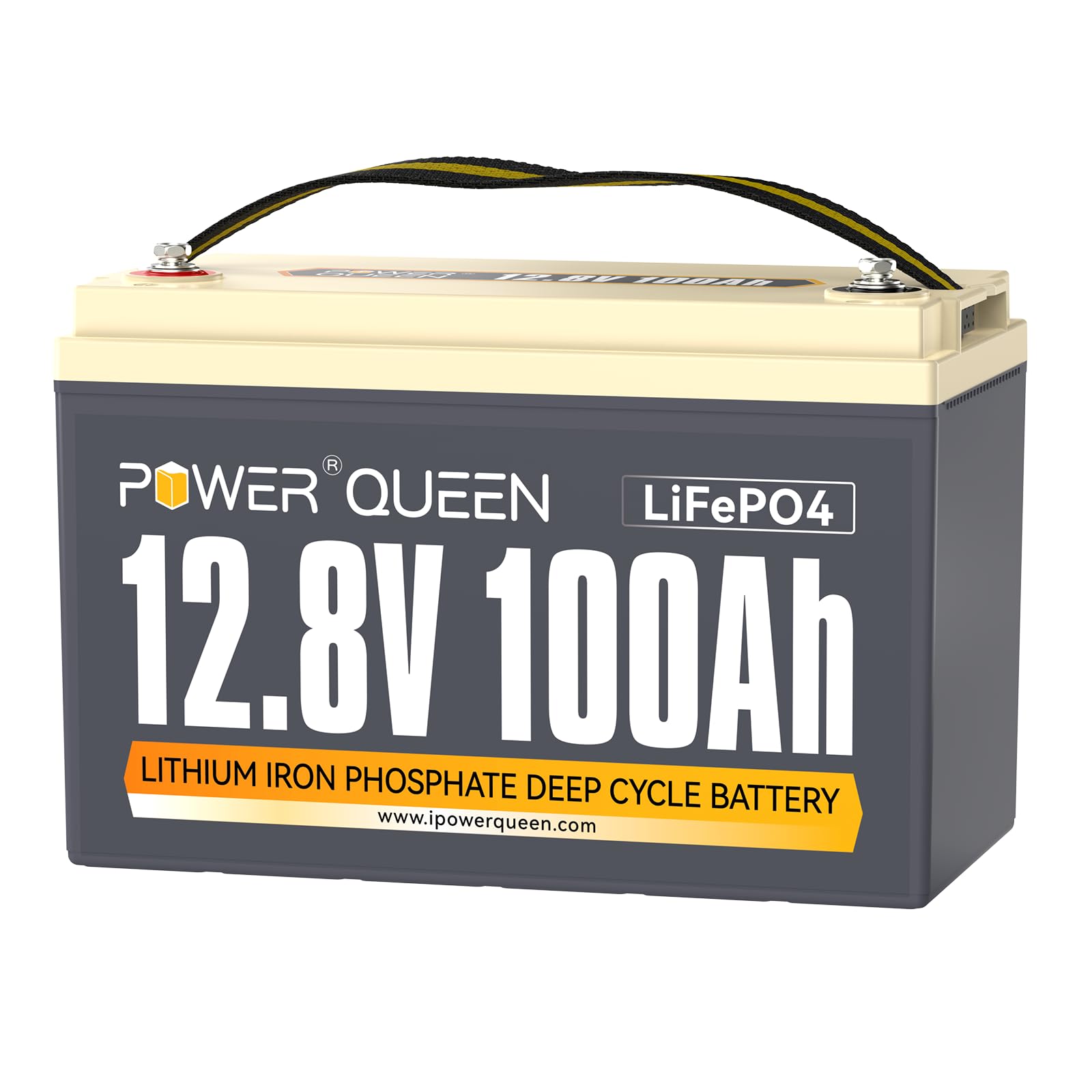
The 24-lb Group 31 built for serious anglers who demand all-day run time.
At 24 lbs in a standard Group 31 case (13 x 6.82 x 8.84 inches), the Power Queen is at 24 lbs versus a comparable lead-acid battery at 60-65 lbs. It packs 1280Wh of energy and uses Grade-A LiFePO4 cells for stable voltage output. The 100A BMS provides protection against overcharge, over-discharge, short circuits, and overheating — with low-temperature protection that stops charging below freezing.
Battery life is the most-praised feature — it is the #1 aspect by a wide margin. Owners who use it for 24V trolling motors report running from 6 AM to 6 PM (70% speed) with voltage only dropping from 13.2V to 13.0-13.1V, lasting three full days. Another owner powers a trolling motor for 6 miles across three trips with capacity to spare. The battery supports up to 4S4P connections for a total 51.2V 400Ah (20.48kWh) system. The only recurring grumble is the 6mm terminal bolt feels easy to cross-thread.
Why it stands out: That 111-count battery life aspect is not just a number — it is backed by real data from owners running multi-day fishing trips without a recharge. The build quality is solid, with one owner testing it at 102 Ah from full charge.
Best for: full-day anglers and RV owners who need a 24-lb, proven 100Ah battery that genuinely lasts 3+ days on a single charge.
Watch out for: the 6mm terminal bolts — tighten gently and consider an aftermarket adapter kit if you are heavy-handed.
9. Redodo 12V 100Ah LiFePO4 Battery
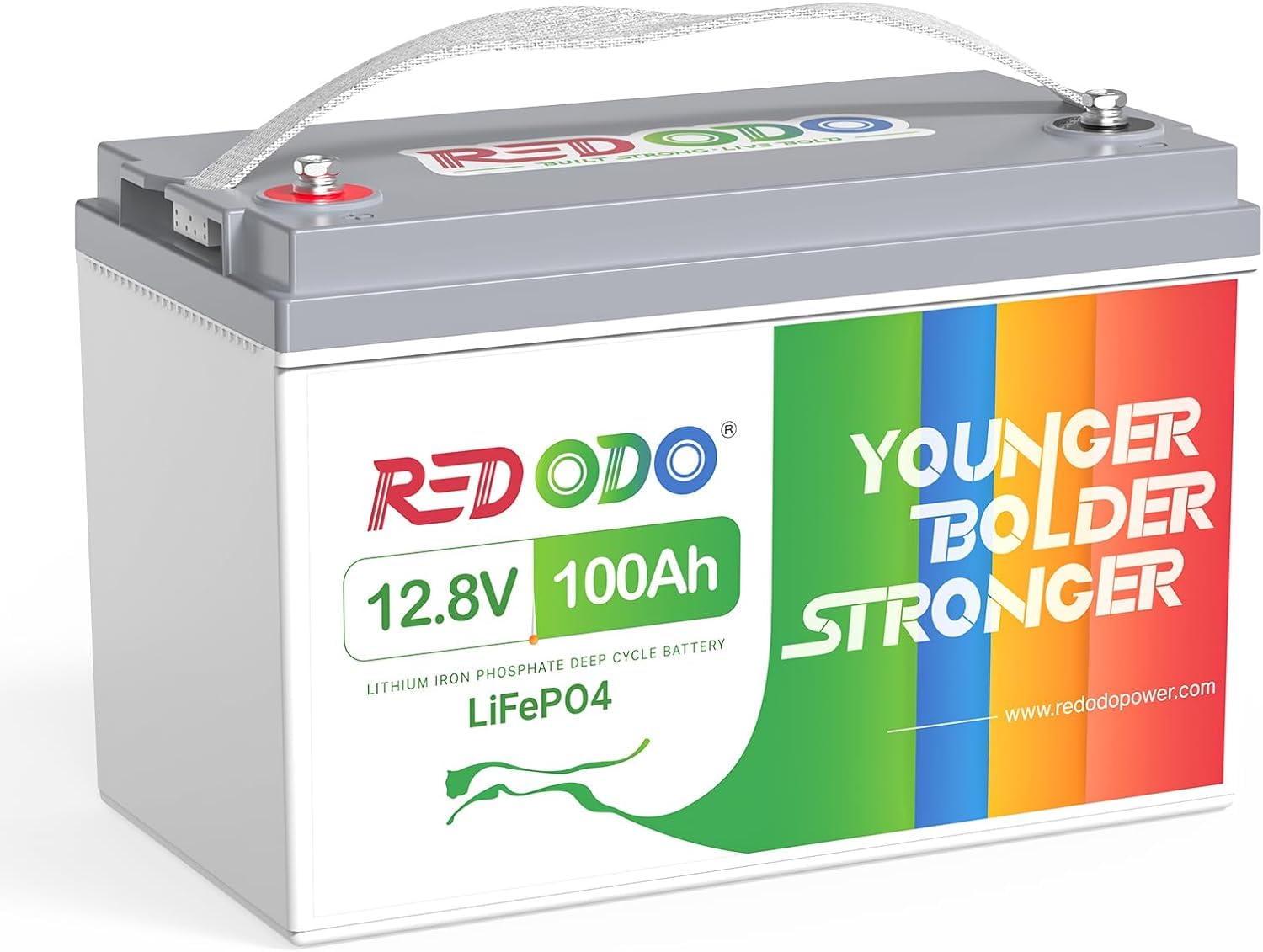
The near-1000-review veteran that proves consistent quality at a fair price.
With strong ratings across nearly 1,000 owners, the Redodo 100Ah is a community-tested workhorse. At 22.0 lbs and Group 31 dimensions (13 x 6.77 x 8.43 inches), it is at 22.0 lbs versus lead-acid at 60-65 lbs, and at 13 x 6.77 x 8.43 inches versus typical lead-acid dimensions, giving you noticeable weight savings without needing to change your battery box. Automotive grade LiFePO4 cells deliver 4000 cycles at 100% DOD (depth of discharge — using the full battery), extending to 15,000 cycles at 60% DOD.
Quality and reliability are the top two aspects, with owners reporting years of trouble-free service. One pool cleaning company replaced lead-acid batteries that failed every 3-4 months with Redodo units and found they lasted all day with no voltage drop. Another owner has used the same battery for 3 years, then bought two more. The 100A BMS handles overcharge, over-discharge, and high-temperature protection. The suggested pairing is 30-70 lb thrust trolling motors — it is not recommended for high-power trolling motors above that range.
The longevity proof: One owner reported 4 years of kayak trolling motor use before the battery stopped charging — then the company replaced it under warranty after simple tests. That combination of lifespan and support is rare in any battery.
Grab this if: you want a high-review-count, proven 22-lb lithium from a company with responsive warranty support.
Pass if: you need a Bluetooth monitor or are running a trolling motor over 70 lb thrust.
10. Power Queen 12V 100Ah Bluetooth Battery
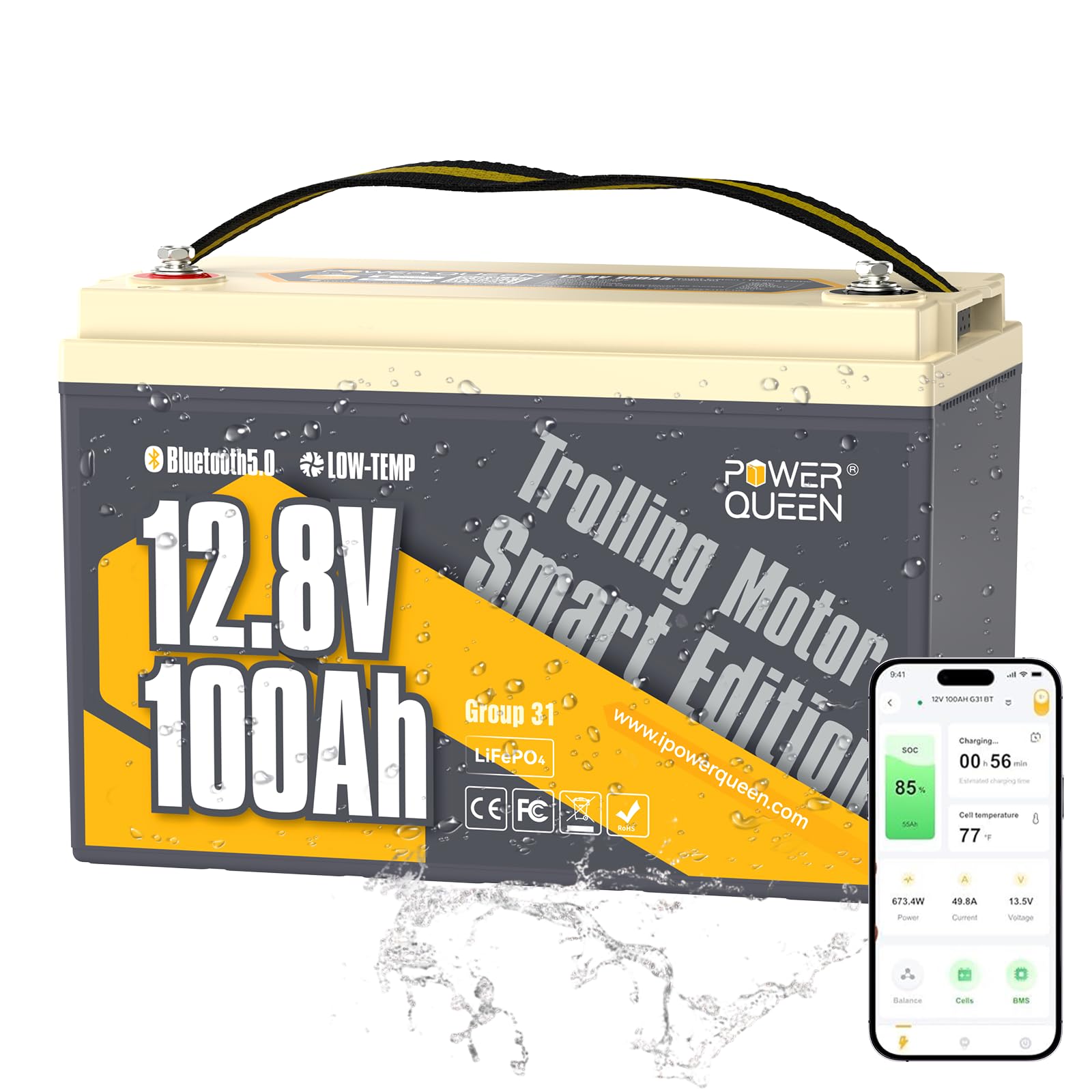
The Group 31 lithium that lets you check battery levels from your phone — at 22.2 lbs.
This Power Queen variant takes the standard Group 31 format (6.7 x 13 x 8.4 inches, 22.2 lbs) and adds smart Bluetooth monitoring — instant pairing that shows SOC (state of charge), voltage, temperature, and system diagnostics via a phone app. You can also control discharge and run diagnostics from the app, which is a huge edge over blind battery management. The 100A BMS provides 20+ safety protections including low-temperature cut-off (stops charging below 32°F).
Owners mention the Bluetooth is a standout for checking charge levels without crawling into tight compartments. One owner switched from lead-acid and noted: “a fraction of the weight and a lot less worry. The Bluetooth feature is also great.” Another bass boat owner loves that her husband can “check the battery charge levels on an app on his phone.” The only caveat is the Bluetooth connection can be a little finicky to pair initially — once connected, it works reliably.
The premium angle: At 1280Wh (about 2x the runtime of many lead-acid options) with 4000+ deep cycles at 100% DOD, this is a long-haul investment with instant data feedback.
Best for: boaters who want phone-level monitoring, can tolerate a one-time pairing hassle, and want the proven Power Queen reliability in a 22.2 lb package.
Skip if: you do not want to fiddle with Bluetooth pairing or prefer a simpler, lower-cost non-BT battery.
11. Renogy 12V 100Ah Mini Size LiFePO4 Battery
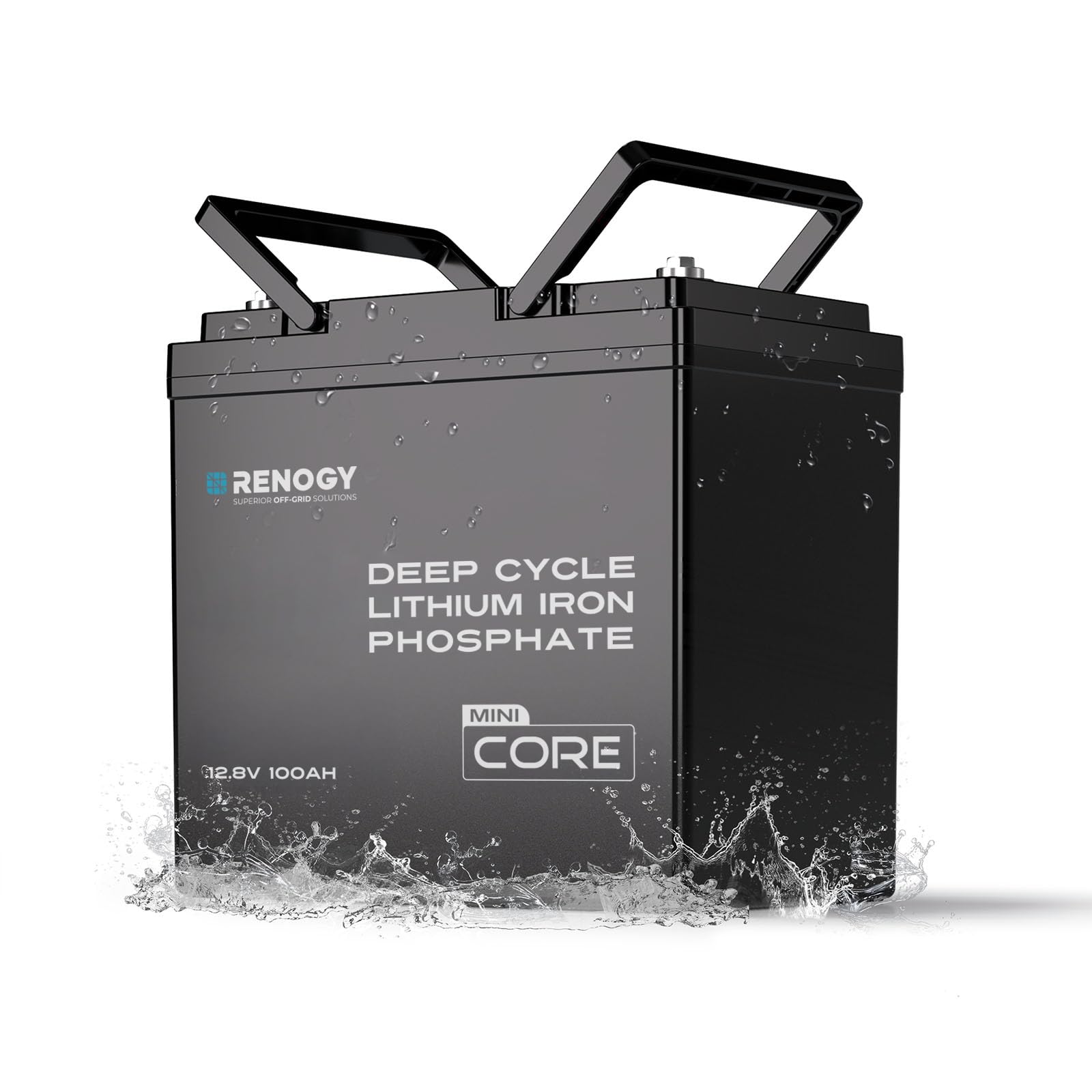
The 22.7-lb Renogy that shrinks a full 100Ah into a tiny group 22NF box.
The Renogy Core Mini is at 9.02 x 5.43 x 8.39 inches versus a Group 31 battery at 13 x 6.8 x 8.4 inches, and compact compared to other 100Ah mini batteries, fitting a Group 22NF form factor (9.02 x 5.43 x 8.39 inches). That tiny footprint — combined with a 22.7 lb weight — makes it the best choice for teardrop trailers, kayaks, and any space that cannot accommodate a standard battery tray. The IP65-rated casing resists splashes, water, and dust.
It uses UL-listed, EV-grade prismatic cells with metallic cell spacers that keep cells in position during rough roads or choppy waves. The 100A BMS provides low-temperature (charging) protection, high-temperature, overvoltage, undervoltage, overcurrent, and short-circuit protection. You can mount it in any orientation (just not upside down). Customers note it is “10x better than my old AGM battery” and handles 200W solar arrays flawlessly. The optional Renogy 300A Battery Shunt adds real-time monitoring via the DC Home app if you want it.
The design detail that matters: Integrated metallic cell spacers prevent the internal cells from shifting or shorting when you bounce down a dirt road — a small engineering touch that big-name brands often skip.
Perfect for: tight installs — teardrop campers, kayaks, and motorcycle trailers — where every inch counts and you trust the Renogy ecosystem.
Not for: standard Group 31 trays — the 22NF case is smaller, so you may need adapter brackets if your tray expects a larger battery.
Understanding the Specs
LiFePO4 vs AGM vs Gel
LiFePO4 (Lithium Iron Phosphate) batteries are the modern standard: they weigh roughly 20-25 lbs versus lead-acid at 60-65 lbs, last 4000-15000 full cycles, and deliver near-100% usable capacity. AGM (Absorbent Glass Mat) is a sealed lead-acid type that is maintenance-free but heavy — expect 200-500 cycles and only 50% usable capacity before damage. Gel batteries use a thickened electrolyte that handles deep discharges better than standard lead-acid but still weighs 2-3x more than lithium for the same capacity.
BMS — The Battery Management System
The BMS is a small circuit board inside every lithium battery that acts as a guardian. It prevents overcharging (stops charge once full), over-discharging (shuts down before the cells are damaged), short-circuit protection, and temperature extremes. A 100A BMS rating means the battery can safely deliver up to 100 amps of continuous current — enough for most 30-70 lb thrust trolling motors. If you draw more amps than the BMS rating for extended periods, it will trip and shut down the battery to protect it.
FAQ
Can I use a 12V 100Ah LiFePO4 battery to start my car engine?
What does 100Ah (amp hours) actually mean in real-world use?
How many cycles does a LiFePO4 100Ah battery last?
Can I connect two 12V 100Ah batteries in series or parallel?
Why does my LiFePO4 battery show 13V even when 75% discharged?
Is it safe to charge a 12V 100Ah lithium battery with a regular car alternator?
What is the difference between IP65 and IP67 waterproof ratings?
How heavy is a 12V 100Ah lead-acid vs lithium battery?
Final Thoughts: The Verdict
For the majority of shoppers, the best 12 volt 100Ah battery is the Litime 12V 100Ah because it combines a weight of 22.1 lbs versus lead-acid at 60-65 lbs, a built-in TVS for voltage spike protection, and a 10-year design life backed by 4,000+ cycles — all at a competitive price that undercuts many premium brands while delivering top-tier ratings. If you want the absolute lightest option with Bluetooth monitoring, the HumsiENK 12V 100Ah at 19.7 lbs gives you real-time phone data. And for the tightest installation space, the Renogy 12V 100Ah Mini shrinks a full 100Ah into a Group 22NF case that is 50% smaller than a Group 31 — ideal for teardrop trailers and kayaks where every inch counts.
How We Picked
We do not accept paid placement. Every pick is matched to a real buyer and a real use-case; we do not hands-on test units.
Sources & Methodology
Specifications: manufacturer listings and product documentation. Review insights: verified customer reviews, as of July 2026. Pricing: not shown on this page (it changes often); check the current price via the retailer link.
As an Amazon Associate, Gadgets Feed earns from qualifying purchases. This does not affect which products we feature.