
Shutting off the engine on a hot summer night should bring peace, not a sweaty, restless cabin. A traditional rooftop RV AC that needs 15 amps of shore power or a screaming generator defeats the entire purpose of boondocking or dry camping. The search for a 12-volt system that can actually keep a camper livable without draining the battery bank by midnight is a real struggle for van lifers, truck campers, and travel trailer owners alike.
I’m Min — the co-founder and writer behind Gadgets Feed. I’ve spent hundreds of hours combing through manufacturer spec sheets, cross-referencing BTU ratings against real-world amp draws, and analyzing customer feedback for the most popular 12-volt mini-splits and rooftop units to separate the true performers from the power-hungry disappointments.
After comparing 11000 BTU and 10000 BTU models across split-system and rooftop form factors, quiet inverter compressors, and integrated heat pumps, here is my analysis of the best 12 volt air conditioner for camper units available right now.
How To Choose The Best 12 Volt Air Conditioner For Camper
Selecting a 12-volt AC for your camper comes down to three core decisions: form factor, cooling capacity relative to battery bank size, and whether you need a built-in heat pump. Unlike household mini-splits, these units are designed to sip power from a deep-cycle lithium battery, but the differences in efficiency between a budget scroll compressor and a premium inverter compressor are night and day.
Rooftop vs. Split System Form Factor
A rooftop unit (often called a “low-profile” unit) replaces your existing roof vent and mounts entirely on the roof, with only a ceiling panel visible inside. These are simpler to install if you already have a 14-by-14-inch opening. A split system places the heavy compressor and condenser outside (typically on the roof) and the evaporator inside, which allows the rooftop profile to be thinner and reduces interior noise from the compressor. Split systems also offer more flexibility for vans with arched roofs or unusual mounting surfaces.
Inverter Compressor and Amp Draw
The compressor type determines how much current the unit pulls from your battery bank. A non-inverter scroll compressor cycles on and off at full power, often drawing 50 to 60 amps at start-up and around 40 to 45 amps during steady running. An inverter compressor ramps up and down smoothly, drawing as little as 20 amps in eco mode and even less once the cabin reaches the set temperature. This variable-speed operation makes inverter-based units the clear choice for anyone relying on solar panels or a modest 200–400 Ah lithium battery bank.
Cooling Capacity (BTU) vs. Camper Size
A 10,000 BTU unit is generally adequate for campers up to about 150 square feet, including most Class B vans, small travel trailers, and truck campers. A 13,500 BTU or 16,000 BTU unit is better suited for larger fifth wheels or Class C motorhomes above 20 feet. Oversizing can cause short cycling, poor humidity removal, and wasted battery power. Look for a unit with multiple operating modes (turbo, eco, sleep) to adjust output to real-time conditions.
Quick Comparison
On smaller screens, swipe sideways to see the full table.
| Model | Category | Best For | Key Spec | Amazon |
|---|---|---|---|---|
| Outequip 10000 BTU (w/ heater) | Premium Rooftop | All-night off-grid use | 45 lbs, 40 dB, 10,000 BTU | Amazon |
| Treeligo 11000 BTU | Mid-Range Rooftop | Fast cooling with heat pump | 45 dB, 11,000 BTU, inverter | Amazon |
| Countrymod 10000 BTU | Mid-Range Rooftop | Efficiency and quiet sleep mode | 44 dB sleep, 300-900W inverter | Amazon |
| Gidrox 10000 BTU | Premium Rooftop | Smart app control + heat pump | 40 dB, 10,000 BTU, 52 lbs | Amazon |
| TURBRO 13.5K BTU | Premium Rooftop | High BTU with WiFi & LED light | 13,500 BTU, 10″ low profile | Amazon |
| TOSOT 16000 BTU | Premium Rooftop | Large campers and extreme heat | 43 dB, 12,500 BTU heat pump | Amazon |
| Furrion Chill Cube 18K | Premium Rooftop | Highest BTU in a rooftop form | 18,000 BTU, variable speed | Amazon |
| CNCEST 11000 BTU Split | Budget Split | Semi-trucks and budget builds | 11,000 BTU, 400-600W | Amazon |
| FOGATTI InstaCool 13.5K | Mid-Range Rooftop | Dual compressor and quiet run | 13,500 BTU, 59 dB | Amazon |
| Outequip 10000 BTU (w/o heater) | Premium Rooftop | Ultra-lightweight van install | 45 lbs, Bluetooth app, 10K BTU | Amazon |
| ROVSUN 4-Zone 38000 BTU | Premium Mini-Split | Multi-room camper or large RV | 38,000 BTU, 20 SEER2 | Amazon |
In‑Depth Reviews
1. Outequip 10000 BTU RV Air Conditioner with Heater
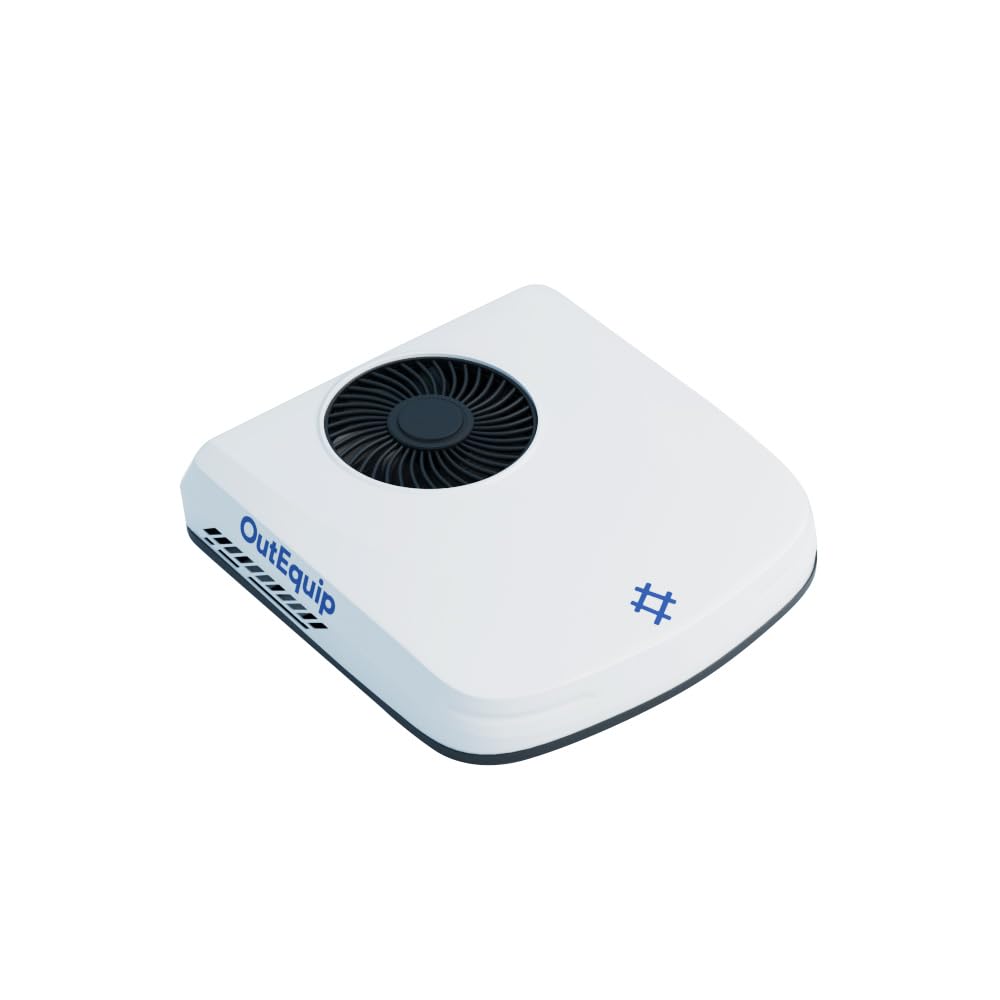
This 10,000 BTU rooftop unit strikes an exceptional balance between cooling power and battery efficiency. The inverter compressor draws a measured 16 amps in eco mode, which means a 300 Ah LiFePO4 battery can comfortably power it through a full night without needing a generator top-up. Users installing it in Class B vans and small travel trailers consistently report that the unit holds temperature steady, dropping from 89°F to 79°F in about 25 minutes on turbo mode.
The built-in 4,500 BTU PTC heater takes the chill off spring and fall mornings, though it is not a replacement for a furnace in sub-freezing weather. At 43 pounds, it is roughly half the weight of a standard Coleman Mach rooftop AC, making solo installation on a 14-by-14-inch roof opening entirely manageable. The variable-speed compressor also eliminates the hard start current spike, so no additional soft starter is required.
Build quality stands out with UV-stabilized ABS plastic and a zinc-coated condenser coil. The 40 dB sleep mode is genuinely library-quiet, and the remote control supports turbo, eco, and dry modes. Users with 24-volt battery banks appreciated the responsive customer support team that quickly swapped units after an ordering error. The combination of low weight, low amp draw, and supplementary heat makes this the most versatile single-unit solution for off-grid campers.
Why it’s great
- Draws only 16 amps in eco mode, ideal for 300 Ah battery banks
- Weighs 43 lbs — light enough for solo rooftop installation
- Includes PTC heater for mild-weather warmth without extra propane
Good to know
- PTC heater is not powerful enough for below-freezing temperatures as a primary heat source
- Installation instructions for foam gasket alignment could be clearer
2. Countrymod 10000 BTU RV Air Conditioner
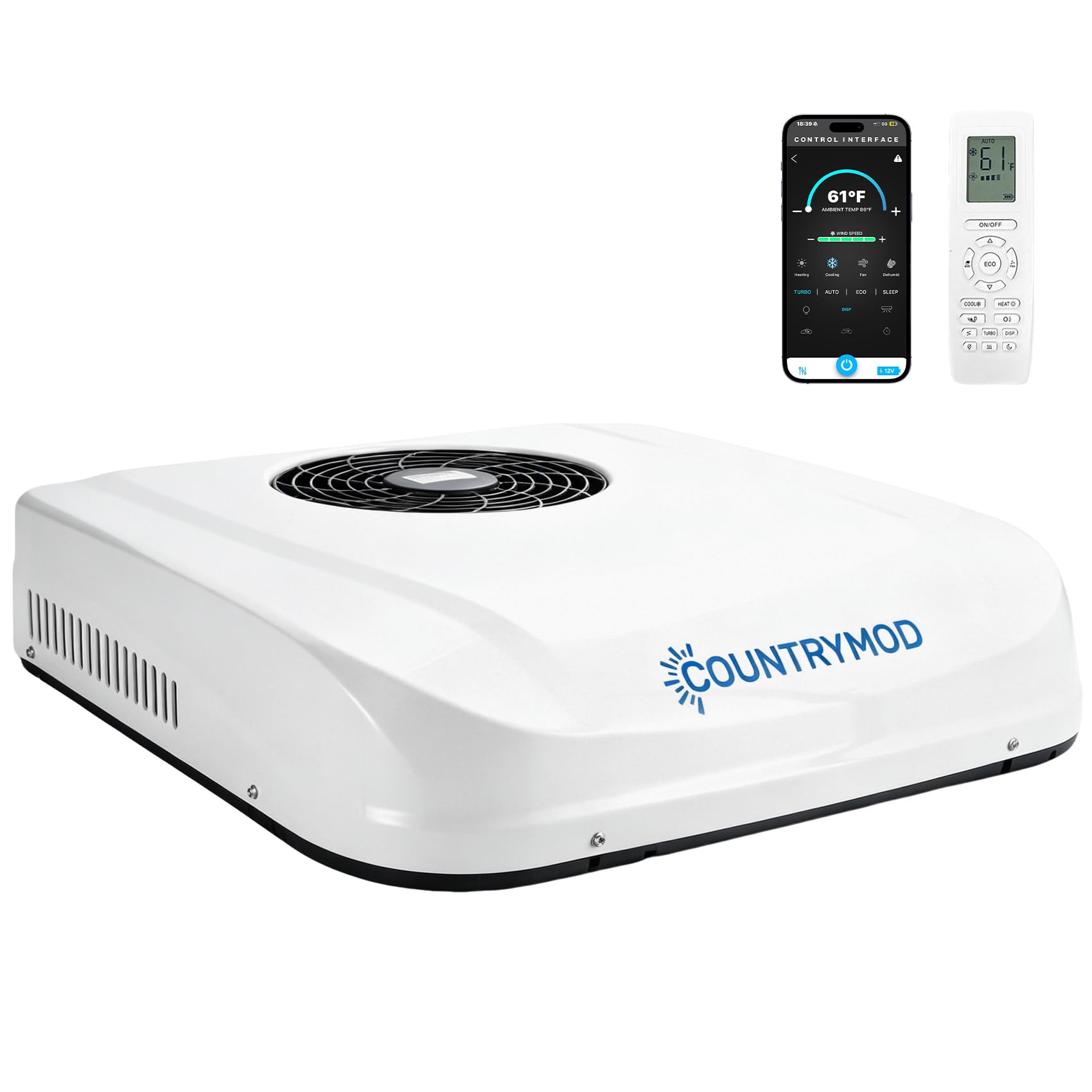
The Countrymod 10,000 BTU unit uses a horizontal inverter compressor that reduces vibration and keeps the center of gravity low on the roof. This design choice minimizes road shock and extends the unit’s service life. Users report power consumption as low as 260 watts in eco mode, allowing a 480 Ah battery to easily run the AC all night in desert conditions where daytime temperatures hit 113°F.
At just 44 dB in sleep mode, the fan noise is softer than a ceiling fan on low, and the articulating vents distribute cold air evenly rather than blasting one spot. The unit fits a standard 14-by-14-inch roof opening and includes all mounting hardware. A few buyers noted that the installation instructions are minimal, but the steel mounting frame is robust enough to secure all four corners without any flex under highway wind loads.
Customer support from the brand’s representative appears responsive — a missing remote was replaced within three days. The only recurring frustration is that arched or thick roofs (above 3 inches) require longer M8 all-thread to bolt the unit down securely. For anyone prioritizing runtime over raw BTUs, this unit’s 260-watt eco draw is nearly unmatched in its price tier.
Why it’s great
- 260W eco mode draws less power than a household microwave
- Horizontal compressor reduces vibration and center of gravity
- 44 dB sleep mode is genuinely unobtrusive
Good to know
- Thicker roofs need replacement M8 all-thread (not included)
- Instruction manual is sparse — YouTube installation videos help
3. Treeligo 11000 BTU Rooftop RV Air Conditioner
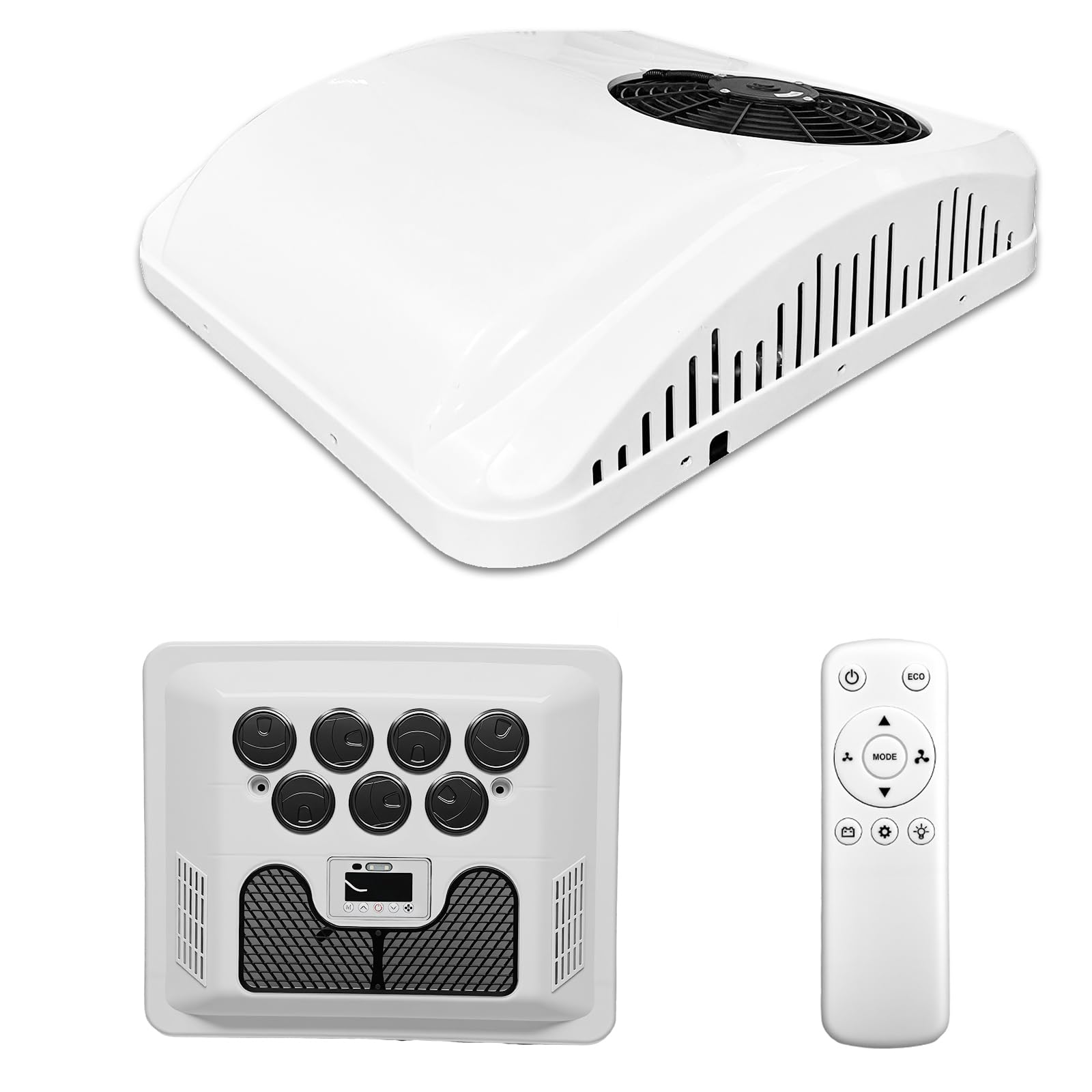
Treeligo’s 11,000 BTU rooftop unit delivers both cooling and heating from a single rooftop footprint, making it a compelling all-season option for van dwellers. The inverter compressor operates below 45 dB and reaches target temperature within about five minutes according to field reports. A user with a 300 Ah battery and 300 watts of solar reported the unit ran comfortably through Arizona summer nights without ever depleting the bank.
The installation requires a minimum roof opening of 12.6 by 10.24 inches, which is smaller than the standard 14-by-14 cutout, so it fits a wider range of older campers and vans with non-standard vent sizes. The total weight is a manageable 350 cubic centimeters displacement compressor — the unit itself feels solid without being impossible to lift up a ladder alone. FCC and UL certifications add peace of mind regarding electrical safety and radio interference.
Some users reported that the 6-gauge cable provided was insufficient for a 200 Ah battery, requiring an upgrade to 4-gauge wire for optimal current delivery. In high-humidity environments, the unit struggled slightly compared to dedicated dehumidifying units, though it still reduced humidity noticeably. The remote and digital display work reliably, and few buyers experienced compressor failures after the first season.
Why it’s great
- 11,000 BTU cools larger vans (up to 20 ft) effectively
- Integrated heat pump extends camping season into cool months
- FCC and UL certified for electrical safety and RF interference
Good to know
- May require upgrading to 4-gauge wiring for longer battery runs
- Struggles to maintain set temperature in sustained high humidity
4. Gidrox 10000 BTU RV Air Conditioner with Heater
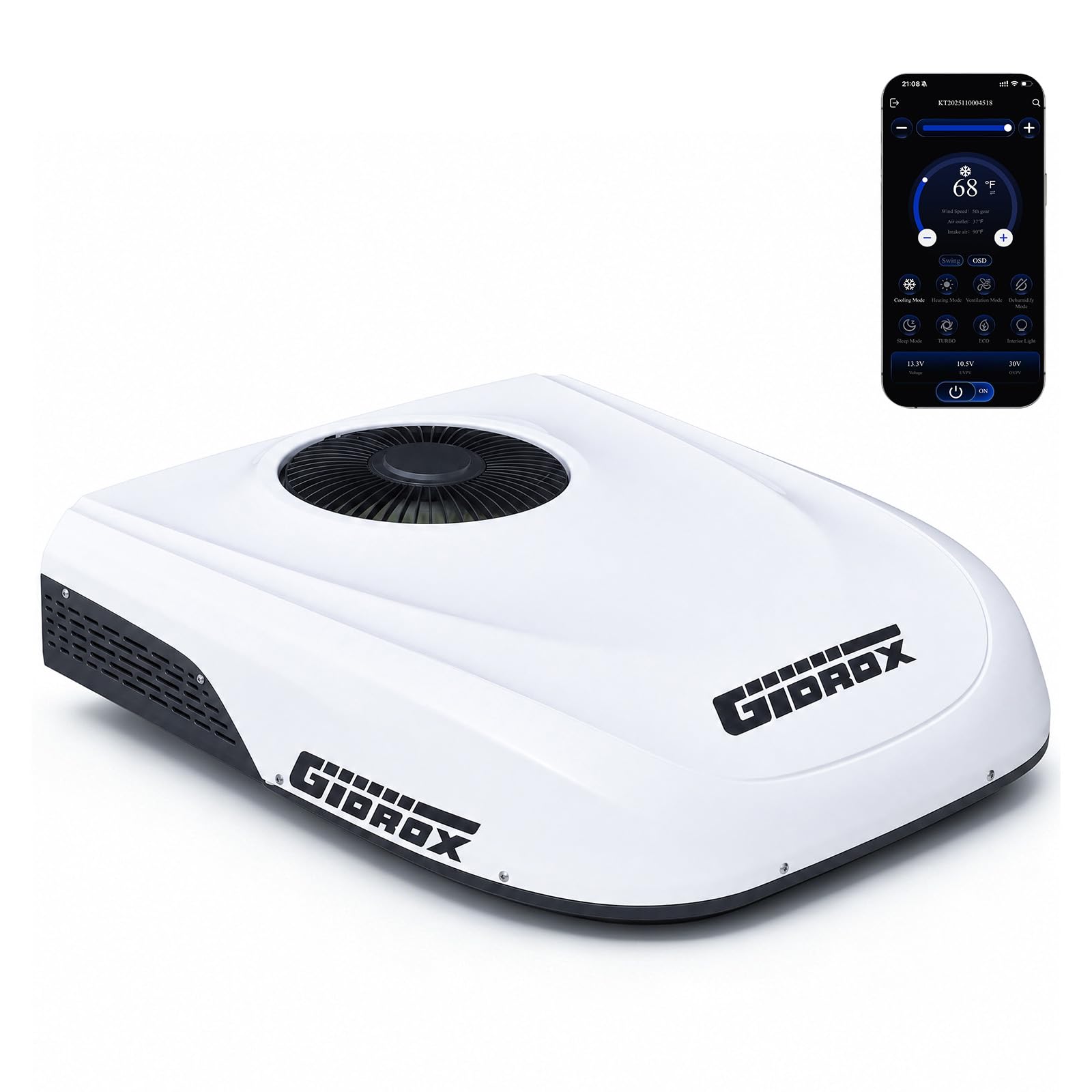
The Gidrox 10,000 BTU unit integrates Bluetooth app control alongside a physical panel and IR remote, giving you three ways to change temperature without getting out of bed. The 52-pound weight makes it one of the lighter inverter rooftop units on the market, and the 7-inch profile sits low enough to avoid shading solar panels mounted further forward. The PTC heater delivers instant warmth, which owners use to take the morning chill off without firing up a propane furnace.
Average power consumption measured around 350 watts during nighttime operation in 86°F ambient conditions. That translates to roughly 30 amps per hour from a 12-volt battery, meaning a 400 Ah bank can run it all night with ample reserve. The included 19.7-foot power cable makes it easy to route wiring to a battery compartment even in larger fifth wheels. The HEPA filter is a nice bonus for reducing dust and pollen inside the camper.
Customer feedback highlights the quick-responding support team, which sent replacement circuit boards and sensors free of charge after a buyer damaged theirs during installation. The only notable issue: the 8mm threaded rods included with the unit are too short for camper roofs thicker than 3.5 inches. Owners of RVs with thicker roofs can buy standard 8mm all-thread from a hardware store and cut it to length.
Why it’s great
- Bluetooth app control for temperature changes from bed
- 350W nighttime draw is battery-friendly for 400 Ah banks
- Low 7-inch profile minimizes roof drag and solar panel shading
Good to know
- Threaded rods too short for roofs thicker than 3.5 inches
- IR remote range is shorter than some competing models
5. TURBRO 13.5K BTU Inverter RV Air Conditioner
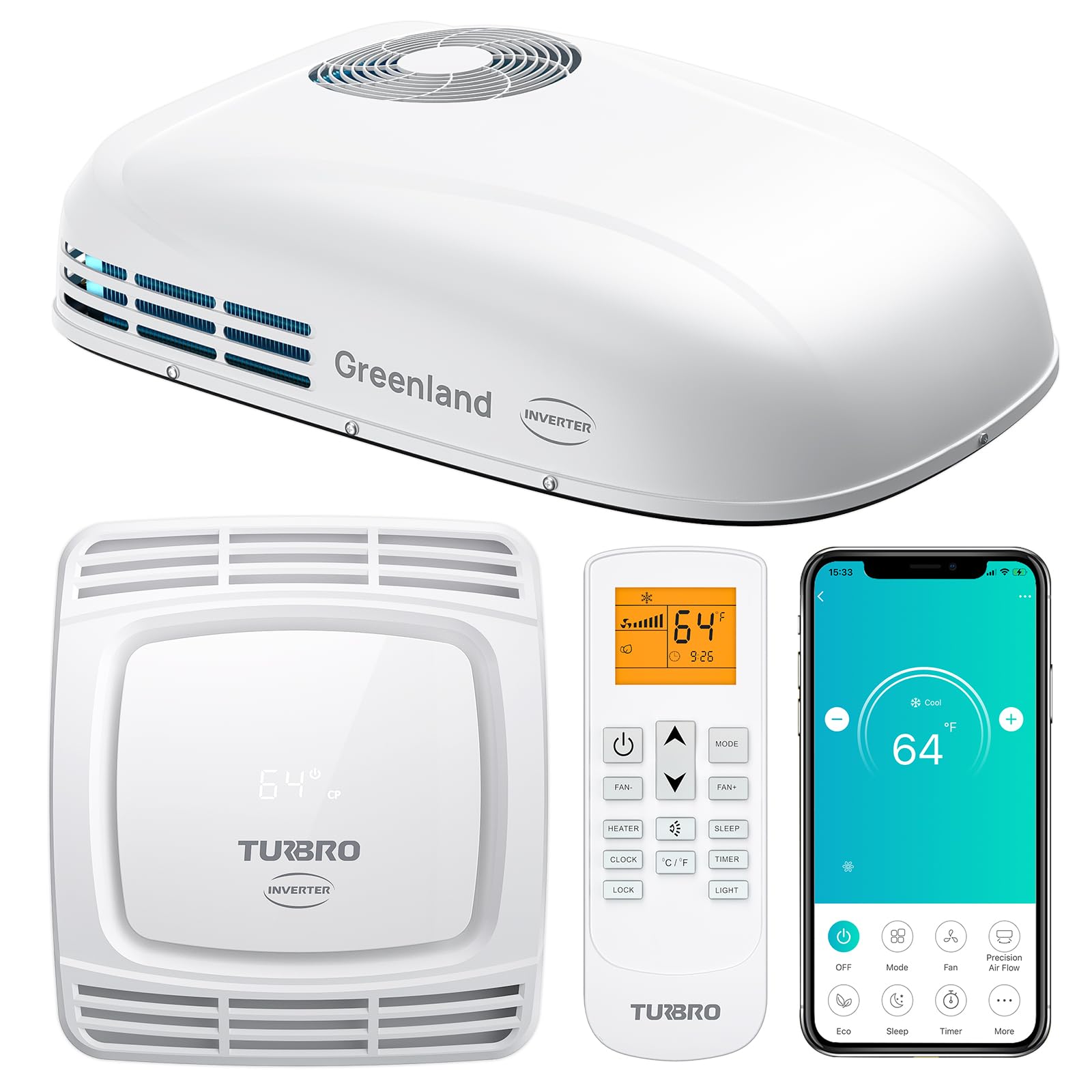
The TURBRO 13.5K BTU unit replaces a bulky Coleman Mach or Dometic rooftop unit with a 10-inch-tall profile that is up to 35 percent thinner than traditional RV ACs. The inverter compressor provides a soft start that draws only 1.6 amps at startup, eliminating the need for any external soft starter. Owners report that the unit runs continuously rather than cycling on and off, which eliminates the hot and cold temperature swings that plague non-inverter ACs.
The integrated heat pump delivers warmth down to 19.4°F ambient, making it a genuine four-season solution. WiFi control via the smart app works reliably for temperature adjustments and mode switching. The included LED atmosphere light adds a color accent (blue, yellow, or white) that can be controlled separately. At around 9 amps running current in cooling mode, the power draw is impressively low for a 13,500 BTU unit.
The most persistent criticism involves the thermostat sensor location near the cold air outlet, causing it to read up to 12°F lower than the actual room temperature and cycling the compressor longer than necessary. Some users have worked around this with Tuya automations using external sensors. The unit also produces slightly more fan noise than the quietest 10,000 BTU competitors. For large fifth wheels where 13,500 BTU is necessary, the TURBRO’s inverter efficiency and heat pump capability still make it a strong contender.
Why it’s great
- 13,500 BTU is enough for fifth wheels and larger Class C motorhomes
- Soft start at 1.6 amps means no extra soft starter required
- Heat pump works down to 19.4°F for cold-weather camping
Good to know
- Built-in thermostat can read 10–12°F low near the outlet
- Fan noise is louder than smaller 10,000 BTU inverter units
6. TOSOT 16000 BTU GO Cool RV Air Conditioner

For campers exceeding 24 feet, the TOSOT 16,000 BTU unit provides the most raw cooling capacity of any 12-volt rooftop AC in this roundup. The heat pump delivers 12,500 BTUs of heating, sufficient to keep a 23-foot travel trailer comfortable even when outdoor temperatures dip to 23°F. The unit is rated to operate in ambient conditions from 23°F up to 115°F, making it suitable for desert summers and shoulder-season snowbird trips.
The Gree+ WiFi app gives you full remote control from anywhere within Bluetooth range, and the 43 dB noise rating makes it quieter than a normal conversation. Users replacing failed 13,500 BTU Dometic units have reported noticeably better airflow and more consistent temperature maintenance. The non-ducted design fits directly into a standard 14.25-by-14.25-inch rooftop opening with no ceiling ductwork required.
Reliability after the first year is the main question mark. A recurring complaint involves seal leaks around the rooftop gasket causing water ingress into the interior unit, and the manufacturer’s customer service has been difficult to reach for warranty claims. The 2-year warranty is only as good as the support behind it. For buyers comfortable handling their own gasket maintenance and sealing, the raw performance ceiling is unmatched at this price.
Why it’s great
- 16,000 BTU cooling handles large fifth wheels and Class A motorhomes
- 12,500 BTU heat pump eliminates the need for a separate furnace in mild weather
- 43 dB operation is noticeably quieter than standard rooftop ACs
Good to know
- Long-term reliability and manufacturer support are inconsistent
- Requires careful rooftop seal maintenance to prevent water leaks
7. Furrion Chill Cube 18K BTU Variable Speed RV Air Conditioner

Furrion’s Chill Cube pushes the rooftop AC format to its logical extreme: 18,000 BTUs from a single, 72.4-pound variable-speed unit. It covers roughly one and a half tons of cooling capacity, enough to keep a 37-foot fifth wheel comfortable with a single rooftop unit. The variable-speed compressor eliminates the abrupt start-stop cycles that drain batteries, and the aerodynamic shroud reduces wind resistance when driving.
The dry mode is particularly effective for humid Gulf Coast summers, pulling moisture out of the air while maintaining a moderate cool temperature. The wireless thermostat can be placed at a separate location in the RV, giving a more accurate reading at the remote control spot rather than right next to the cold air plenum. This design choice helps prevent the temperature misreading that plagues some other units.
The biggest drawback is installation: the Chill Cube requires a compatible Air Distribution Box (ADB), which is sold separately. The compressor vibration has also been reported to transfer through the roof structure in some fifth wheels, creating a low-frequency hum that some owners found intrusive. At highway speeds, the aerodynamic profile does reduce drag compared to a boxy traditional AC, but the added weight on the roof should be considered for smaller trailers.
Why it’s great
- 18,000 BTU is the highest cooling capacity in a rooftop form factor
- Separate wireless thermostat provides more accurate temperature reading
- Dry mode effectively reduces interior humidity
Good to know
- Requires a separately purchased Air Distribution Box (ADB)
- Compressor vibration can transmit through the roof in some installations
8. CNCEST 11000 BTU 12V DC Split Air Conditioner
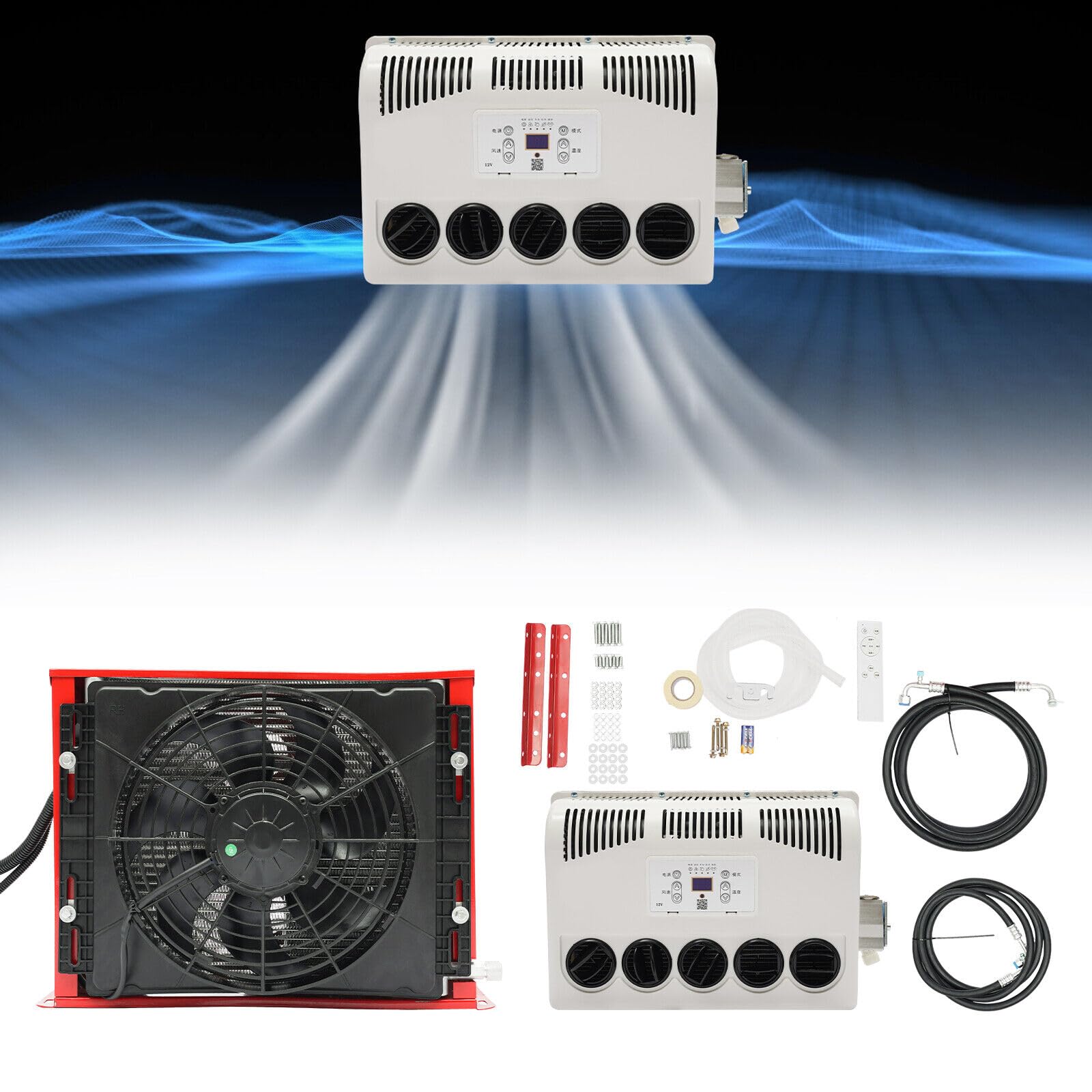
At the entry-level price point, the CNCEST 11,000 BTU split system offers a surprising amount of raw cooling for budget-conscious truck camper and semi-truck owners. The iron outer case and pure copper motor provide durability that exceeds what the price would suggest. The built-in under-voltage protection cuts power below 11 volts to prevent draining a starting battery, which is a critical safety feature for anyone wiring this directly to a vehicle’s chassis battery.
The 5-speed fan and multi-directional vents give decent control over air distribution, and the remote control works well from the driver’s seat. Multiple owners verified that the unit “freezes you out” even in Georgia or Texas summer heat. The split form factor allows the heavy compressor to be mounted outside or on the roof, keeping the interior space cleaner and less crowded.
The downsides are significant. The instruction manual is not available in English, and the control panel labels are in Chinese characters, which makes initial setup confusing. More critically, several users reported condenser leaks developing after about two months of use, with inconsistent customer service responses — some received replacement units, others were told to buy a new one. This unit is best suited for buyers comfortable with some DIY troubleshooting who want maximum BTUs for minimum investment.
Why it’s great
- 11,000 BTU output at a budget-friendly sticker price
- Under-voltage protection prevents battery damage
- Split form factor keeps interior noise lower than rooftop units
Good to know
- Manual and control panel in Chinese only
- Condenser reliability is inconsistent after a few months of use
9. FOGATTI InstaCool 13.5K BTU RV Air Conditioner
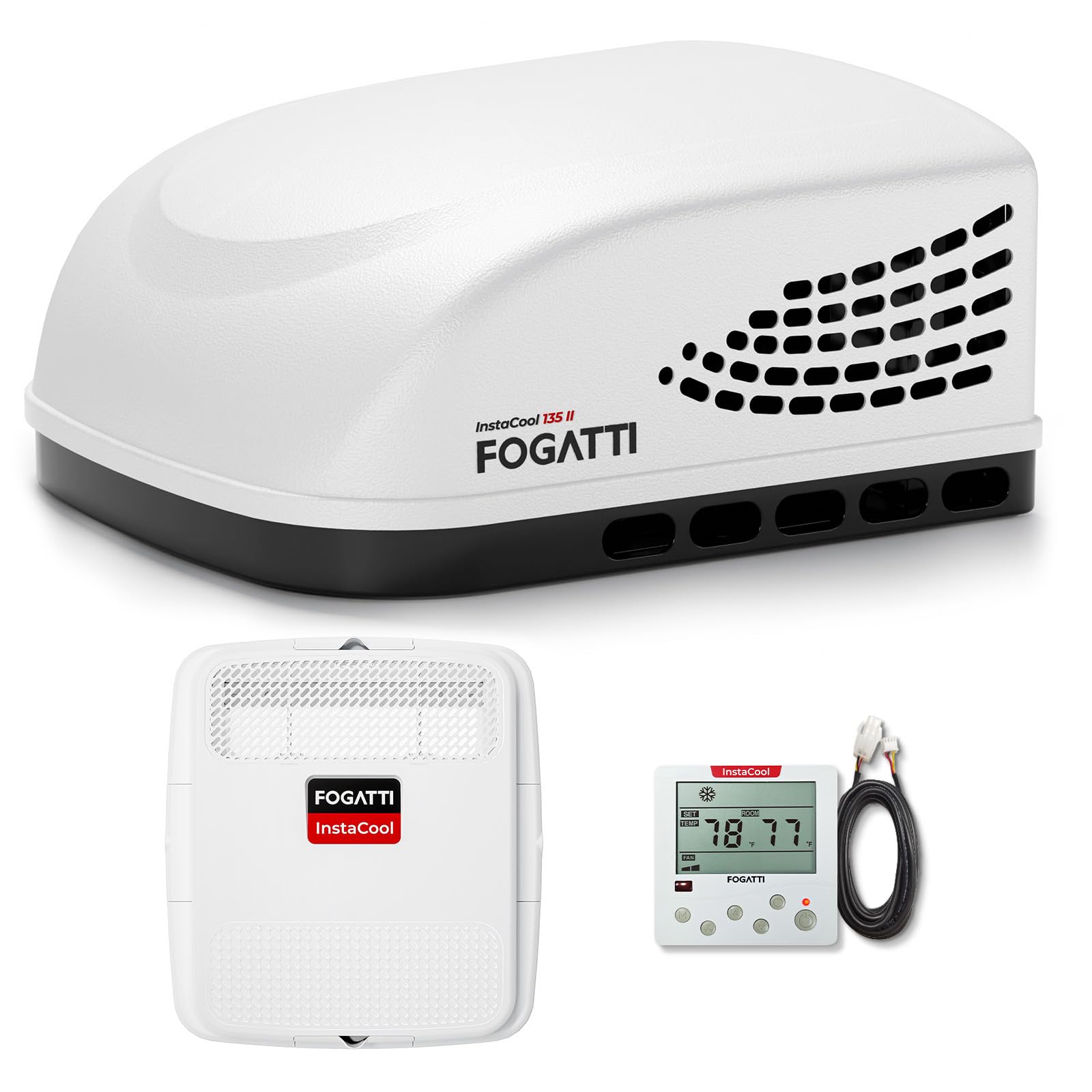
FOGATTI’s InstaCool uses dual high-efficiency compressors to deliver 13,500 BTUs of cooling power in a non-ducted rooftop format. The unit is designed to fit the standard 14.25-by-14.25-inch roof vent opening, and the installation instructions include a detailed video guide. The HIPS shell is UV-resistant and built to handle prolonged sun exposure without cracking or yellowing.
Performance-wise, the 59 dB noise level is louder than inverter-based competitors, but still quieter than many traditional Coleman or Dometic units from the 2010s. The R32 refrigerant is more environmentally friendly than R410A and provides slightly better thermodynamic efficiency. Several owners in Texas and other hot climates confirmed the unit cycles like a central air system, maintaining a steady temperature without the jarring on-off cycling of older RV ACs.
The main drawback is that the InstaCool requires both 115V AC and 12V DC power to operate, meaning it is not a pure 12-volt solution for full off-grid use. It must be connected to shore power or a generator for the AC compressor, while the 12V line runs the control board and fan. A certified technician reported a blower motor failure within the first month, which suggests that quality control on the fan assembly could be tighter. This unit works best for buyers with regular access to 115V campsite power who want a straightforward roof swap.
Why it’s great
- Dual compressors deliver strong 13,500 BTU cooling
- Fits standard roof openings with minimal modifications
- UV-resistant HIPS shell stands up to sun exposure
Good to know
- Requires both 115V AC and 12V DC — not a pure off-grid solution
- Blower motor reliability has room for improvement
10. Outequip 10000 BTU RV Air Conditioner (Without Heater)
This version of the Outequip 10,000 BTU unit drops the PTC heater to save weight and cost, landing at just 45 pounds. It is the same core hardware as the top pick but optimized for buyers who only need cooling. The Bluetooth app control works on both iOS and Android, giving you smartphone control over temperature, fan speed, and mode without needing the IR remote.
In a VW Westfalia bus conversion, the unit drew surprisingly low power on eco mode and kept the small interior frosty even under direct sun. The 54 dB noise level on high is moderate, but eco mode drops the fan speed significantly, reducing noise to a whisper. For Class B vans and pop-up campers with limited roof-load capacity, the 45-pound weight is a massive advantage compared to a 77-pound Dometic unit.
The installation instructions for the foam gasket and bolt torque are not the clearest, and a few owners recommended watching the VWJawbreaker installation video on YouTube. The condenser area also needs careful sealing to prevent water ingress from rain or car washes. For minimalists who want pure cooling without heating complexity, this is the lightest and simplest inverter rooftop unit on the market.
Why it’s great
- Weighs only 45 lbs — lightest inverter rooftop unit in this roundup
- Bluetooth app control from your phone for easy adjustments
- Low-power eco mode ideal for pop-up campers and van conversions
Good to know
- No heating function — cooling only
- Foam gasket sealing instructions could be more detailed
11. ROVSUN 4 Zone 38000 BTU Mini Split AC/Heating System

For large RVs, bus conversions, or multi-room campers that need separate temperature zones, the ROVSUN 4-zone mini split delivers 38,000 BTUs of total cooling capacity across four indoor air handlers (12,000 BTU each). Each room gets its own remote control, allowing independent temperature settings. The 20 SEER2 efficiency rating is substantially higher than any rooftop unit, translating to lower overall energy consumption for the same cooling output.
The system includes pre-charged 25-foot line sets, communication wires, and installation kits for all four zones. The inverter technology ramps compressor speed to match total demand, running quietly at 28–45 dB depending on fan speed. The heat pump function with a -4°F to 122°F ambient operating range makes it suitable for year-round use in virtually any climate.
The trade-off is complexity and voltage. This system runs on 208–230V AC, requiring a proper inverter or generator setup to convert from 12V battery power. Professional installation is strongly recommended. A few units have arrived with component issues (non-functioning indoor unit or condensation dripping), and the lack of phone support — only email with 24–48 hour turnaround — can be frustrating when troubleshooting wiring problems. For multi-room setups where 12V rooftop units cannot provide enough coverage, the ROVSUN mini split is the only viable option.
Why it’s great
- Four independent zones allow room-by-room temperature control
- 20 SEER2 rating is the most efficient system in this lineup
- Heat pump operates down to -4°F ambient
Good to know
- Requires 208–230V AC supply — not a direct 12V installation
- Customer support is email-only with slow response times
FAQ
How many amp-hours does a 12V camper AC use per hour?
Can I install a 12V rooftop AC on a camper with a 14×14 inch vent?
Do I need a soft starter for a 12V inverter AC?
How does a PTC heater compare to a heat pump in a camper AC?
Final Thoughts: The Verdict
For most users, the 12 volt air conditioner for camper winner is the Outequip 10000 BTU with heater because it combines a 40 dB quiet inverter compressor, a low 45-pound weight, and a PTC heater in a standard rooftop form factor that works with any 300 Ah lithium battery bank. If you want maximum battery runtime and don’t need heating, grab the Countrymod 10000 BTU unit for its 260-watt eco mode draw. And for a large fifth wheel or multi-room camper, nothing beats the TOSOT 16000 BTU rooftop unit for raw cooling power.