
A van without air conditioning isn’t a home — it’s an oven on wheels. The moment you park under the summer sun, the interior temperature climbs past unbearable, and every minute waiting for the generator to kick in feels like an hour. A dedicated 12-volt DC air conditioner changes everything, letting you run cool, dry air off your house battery bank without the noise, fumes, or fuel cost of a generator. The choice is no longer about comfort alone; it’s about reclaiming your ability to sleep, cook, and relax anywhere, quietly.
I’m Min — the co-founder and writer behind Gadgets Feed. I’ve spent hundreds of hours analyzing the technical specifications, inverter efficiency curves, power draw data, and real-world customer feedback on the latest 12-volt DC rooftop air conditioners to identify the units that actually deliver on their BTU ratings and battery life claims.
If you are converting a van or upgrading an RV, your air conditioner is the single largest power consumer you will spec. That’s why this guide cuts through the marketing to help you find the best 12 volt air conditioner for van that matches your power system, roof space, and real-world climate demands.
How To Choose The Best 12 Volt Air Conditioner For Van
Selecting the right rooftop AC for your van is a balancing act between cooling capacity, available battery power, roof space, and noise tolerance. A mismatch in any one area can turn a costly purchase into a paperweight.
Power Draw and Battery Compatibility
Every 12V air conditioner lists a power range — typically 300W to 1000W depending on mode and ambient temperature. In real terms, a unit drawing 50 amps at 12V will drain a 100Ah battery in roughly two hours at full load. For overnight use without a generator, you should plan for at least 200Ah of usable LiFePO4 capacity per unit, and ideally 400Ah if you also plan to run a heater or other appliances. Units with variable-speed inverter compressors offer the best efficiency, dropping to 200-300W in ECO mode, which can extend runtime to six to ten hours on the same battery bank.
BTU Rating vs. Real-World Performance
A 10,000 BTU unit is sufficient for most short-wheelbase vans (50-100 square feet of floor space), while 11,000-13,000 BTU units suit larger RVs and campervans with less insulation. However, BTU numbers are measured under lab conditions at 95°F ambient. In 110°F desert heat, a 10,000 BTU unit may struggle to reach 80°F inside if the van lacks proper insulation. Real buyers consistently report that units rated 10,000 BTU from brands like Treeligo and Gidrox cool effectively in moderate climates, but the same BTU rating from different brands yields noticeably different results due to compressor type and airflow design.
Roof Cutout Size and Installation Complexity
The overwhelming majority of 12V rooftop ACs are designed to fit the standard 14-inch by 14-inch RV roof vent opening. This includes the Gidrox, Contrymod, and Outequip units reviewed below. The Treeligo unit requires a slightly smaller opening of 12.6 x 10.24 inches. Always measure your existing roof opening or reserved roof space before ordering. Also note that thicker roofs (over two inches) may require longer M8 allthread or metric bolts, and some units require sealing the inner duct gap to prevent air loss. Installation is typically a one-person, two-hour job for a competent DIY builder.
Quick Comparison
On smaller screens, swipe sideways to see the full table.
| Model | Category | Best For | Key Spec | Amazon |
|---|---|---|---|---|
| Treeligo 11000 BTU | Best Overall | All-around van & RV cooling with heat | 11000 BTU, 330-1000W draw, 45 dB noise | Amazon |
| Gidrox 10000 BTU | Premium Pick | Full smart control & low noise | 10000 BTU, ~350W ECO, 40 dB sleep mode | Amazon |
| Contrymod 10000 BTU | Best Value | Budget-conscious van builds | 10000 BTU, 300-900W, 45-55 dB, 0.3 kWh/hr | Amazon |
| Outequip 10000 BTU (with heater) | Compact & Light | Low-profile, lightweight builds | 10000 BTU, 43 lbs, 40 dB, 6″ profile | Amazon |
| Outequip 10000 BTU (no heater) | Eco Focus | Class B vans, strict battery budgets | 10000 BTU, 45 lbs, 20A ECO, 54 dB high | Amazon |
In‑Depth Reviews
1. Treeligo 11000 BTU 12V DC Rooftop RV Air Conditioner
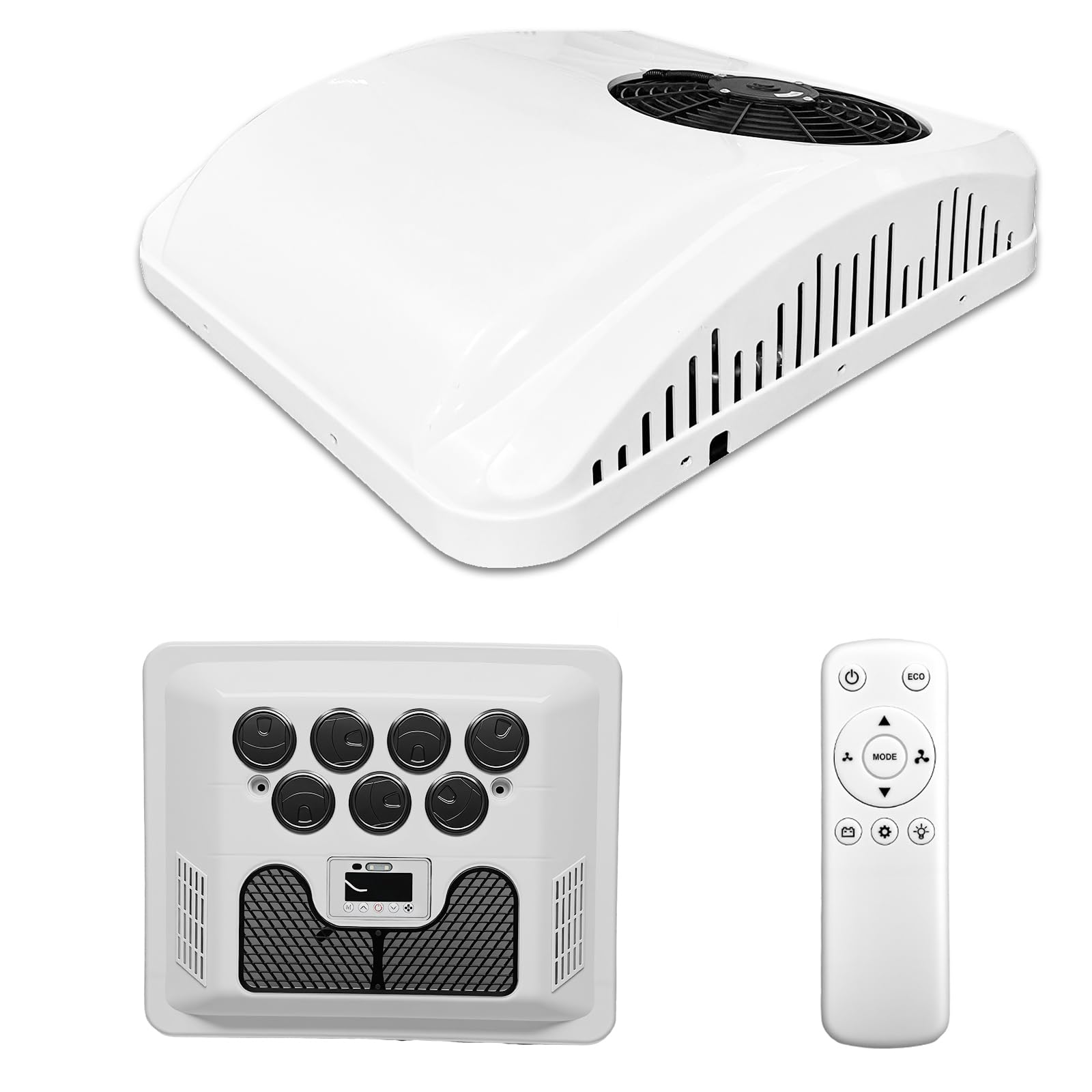
The Treeligo delivers the highest BTU rating in this roundup at 11,000 BTUs, making it best suited for larger vans, campervans, or 5th wheel trailers where cooling capacity is paramount. Its inverter compressor operates between 330W and 1000W depending on the mode, meaning on milder days it runs at the low end of the power band and conserves battery. The heating function adds genuine year-round utility, especially for shoulder-season camping when nights dip below 50°F. Real-world buyers report that it can cool a 5th wheel bedroom quickly in 100°F weather when paired with 200Ah of LiFePO4 and adequate solar.
The unit is FCC and UL certified, which matters for van insurance and safety inspections. At 45 dB maximum noise, it is slightly louder than some competitors in sleep mode, but still quiet enough for undisturbed rest. The packaging includes a digital display and remote control for temperature adjustment. The roof cutout required is 12.6 by 10.24 inches — smaller than the standard 14-by-14 inch opening — so verify your van’s roof dimensions before purchasing. Some users found that the fan would not turn off automatically when running solely on solar power, but support resolved the issue quickly.
Battery efficiency is a strong point: customers using 300Ah battery banks report running the unit overnight without dropping below 50% state of charge in moderate heat. The power draw on ECO mode hovers around 330-400W, which translates to roughly 27 to 33 amps at 12V. Combined with its heat pump, this unit offers the most complete feature set for a van owner who needs both summer cooling and a supplementary heat source without adding a separate propane furnace.
Why it’s great
- Highest 11,000 BTU capacity handles larger vans and intense sun.
- Integrated heat pump provides 5,000+ BTU of warmth for cool nights.
- FCC/UL certified — important for insurance and safety.
Good to know
- Roof cutout is non-standard (12.6 x 10.24 inches), not a drop-in for typical 14×14 openings.
- Customer support responsiveness is inconsistent — some users report quick help, others get no reply.
- High humidity environments cause it to struggle more than lower-humidity climates.
2. Gidrox 10000 BTU 12V DC RV Air Conditioner with Heater
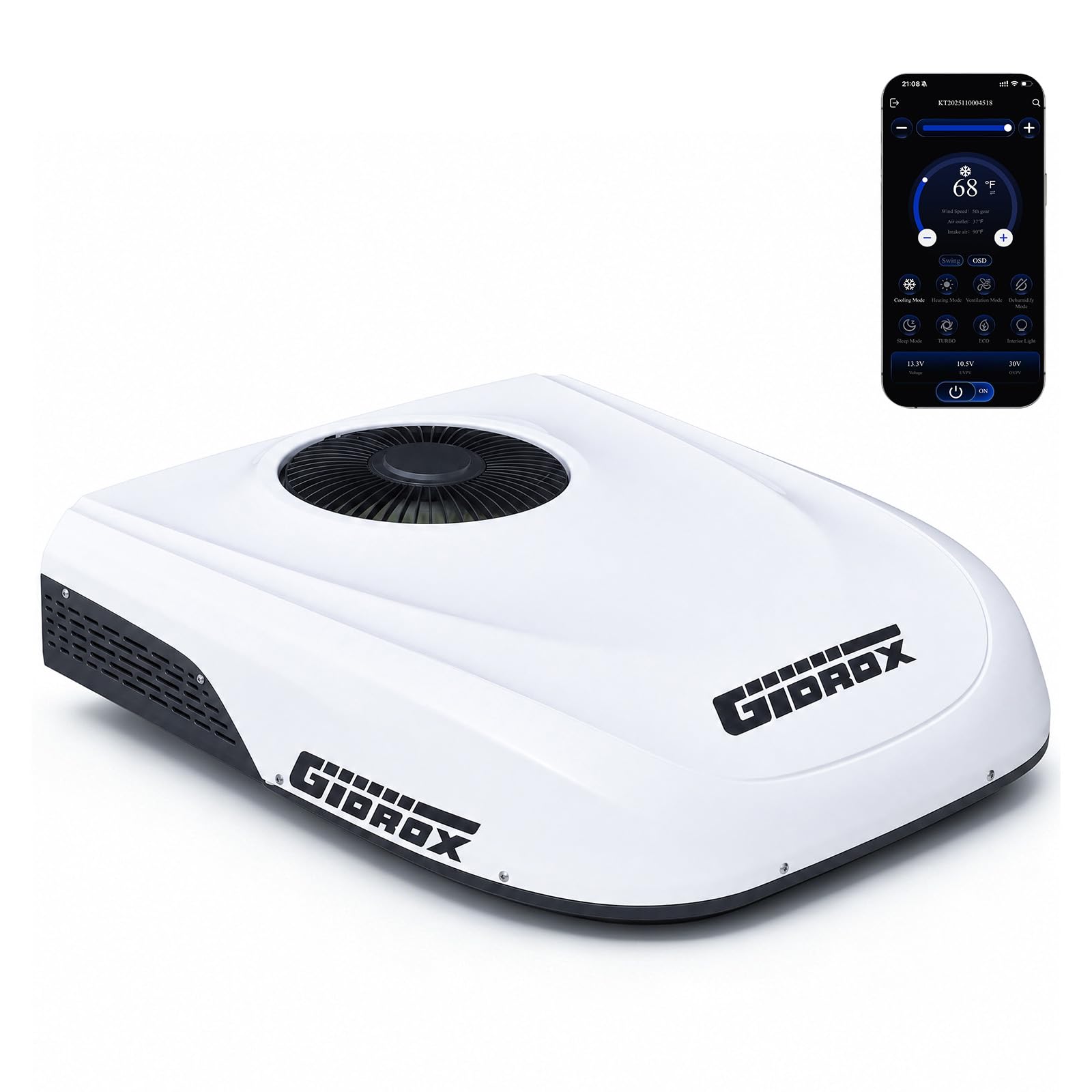
The Gidrox unit distinguishes itself through an advanced control system and exceptionally low noise. Its DC inverter compressor allows three distinct operational modes: Turbo for rapid cooling, ECO for energy-conscious overnight use, and Sleep mode which drops noise to a library-quiet 40 dB. This makes it the best option for van dwellers who prioritize undisturbed sleep. The unit also features a PTC heater that delivers instant heat on below-freezing mornings without a warm-up cycle — ideal for mountain camping. Real-world testing shows it can maintain a comfortable temperature in a 5th wheel or van with standard insulation while consuming about 350W in ECO mode at 30°C ambient.
Installation is straightforward for standard 14-by-14 inch roof openings, and it ships with a 19.7-foot power cable and all mounting hardware. The kit includes a built-in fuse, which simplifies wiring to your house battery. However, the supplied 8mm threaded rods may be too short for roofs thicker than three inches, so budget for longer M8 allthread if your build has thick insulation or a raised roof. Customer reviews praise the company’s responsiveness when issues arise: one buyer who broke the circuit board during installation received a free replacement with return shipping covered.
The 52-pound total weight is manageable for a single person to hoist onto a roof, though a helper is recommended. The unit works with 12V, 24V, and 48V systems, giving it flexibility for larger electrical architectures. At the mid-range price point, it offers the best balance between premium features (Bluetooth app, touch control, HEPA-style filter) and real-world install friendliness. The only notable drawback is that the included faceplate screws are reported as slightly small, and the unit is on the pricey side compared to other 10,000 BTU competitors.
Why it’s great
- 40 dB sleep mode is the quietest in this comparison — ideal for night-time van life.
- Three smart control methods (app, remote, physical panel) offer genuine flexibility.
- PTC heater delivers instant heat without a generator or furnace.
Good to know
- Faceplate mounting screws are undersized — plan to use wire support or larger hardware.
- 8mm threaded rods may be too short for roofs over 3 inches thick.
- Remote control has sporadic functionality for some users; the app is more reliable.
3. Countrymod 10000 BTU 12V DC RV Air Conditioner
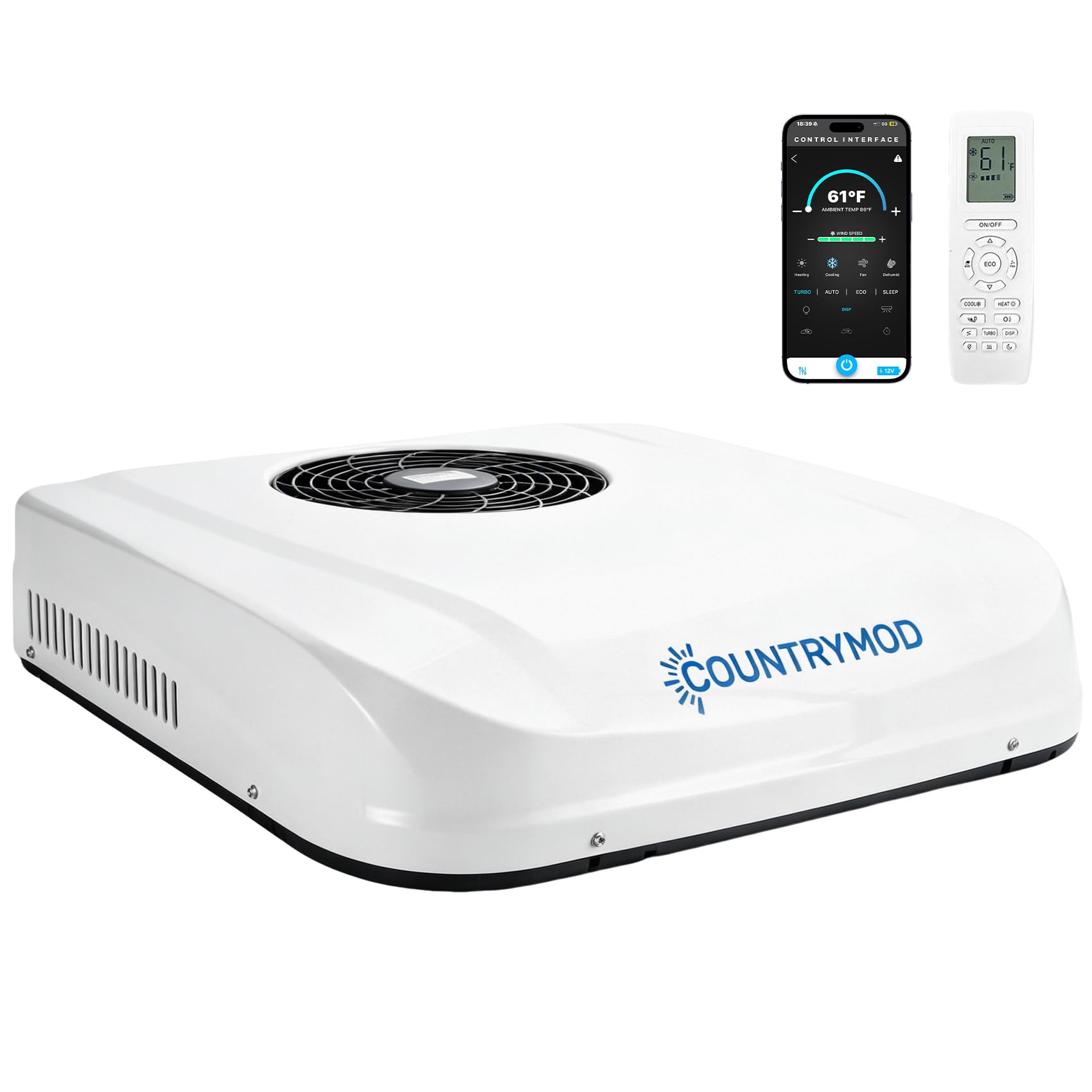
The Countrymod unit delivers the lowest power consumption in the lineup, claiming just 0.3 kWh per hour in efficient operation. That equates to roughly 25 amps at 12V, which is exceptional for a 10,000 BTU rooftop AC. Real-user reports confirm that a 480Ah LiFePO4 battery can run this unit all night without needing a campsite power hookup. At 45-55 dB, it is slightly louder than the Gidrox in sleep mode but still far quieter than traditional rooftop units like Dometic 13K BTU models, which often run at 60+ dB. The horizontal compressor design reduces vibration and lowers the center of gravity, which improves stability during travel.
Installation is designed for the standard 14-by-14 inch roof vent opening, and the unit is ductless, so it doesn’t require modifications to existing ductwork. That said, buyers with arched roofs or thicker roofs (over 2 inches) report needing longer M8 allthread bolts in the 160mm range and gap-sealing tape to prevent air leaks at the inner flange. The instructions are sparse, so watching a YouTube installation video is strongly recommended. Customer service is notably good: one reviewer cited “Tony Allen” promptly replacing a faulty remote within three days, and another reported help resolving a compressor cycling issue.
The unit draws 260W on ECO mode and up to 590W on Turbo, making it one of the most energy-efficient options for van builders on a budget. At the entry-level price point, you lose some fit-and-finish polish — the remote control is basic, there is no app connectivity, and the overall build uses simpler materials. But for a DIY van converter who wants maximum battery runtime per dollar spent, the Countrymod is hard to beat. Just be prepared to source your own longer bolts and insulation tape if your roof deviates from standard flat construction.
Why it’s great
- 0.3 kWh/hr consumption is class-leading — extends battery runtime significantly.
- Fits standard 14×14 inch roof vent with no ductwork modifications needed.
- Horizontal compressor reduces vibration and lowers the unit’s center of gravity.
Good to know
- Instructions are minimal; installation requires YouTube guidance for best results.
- Arched or thick roofs need longer M8 bolts and inner duct sealing tape (not included).
- No smart control — relies on basic remote and manual touch buttons only.
4. Outequip 10000 BTU 12V RV Air Conditioner (with heater)
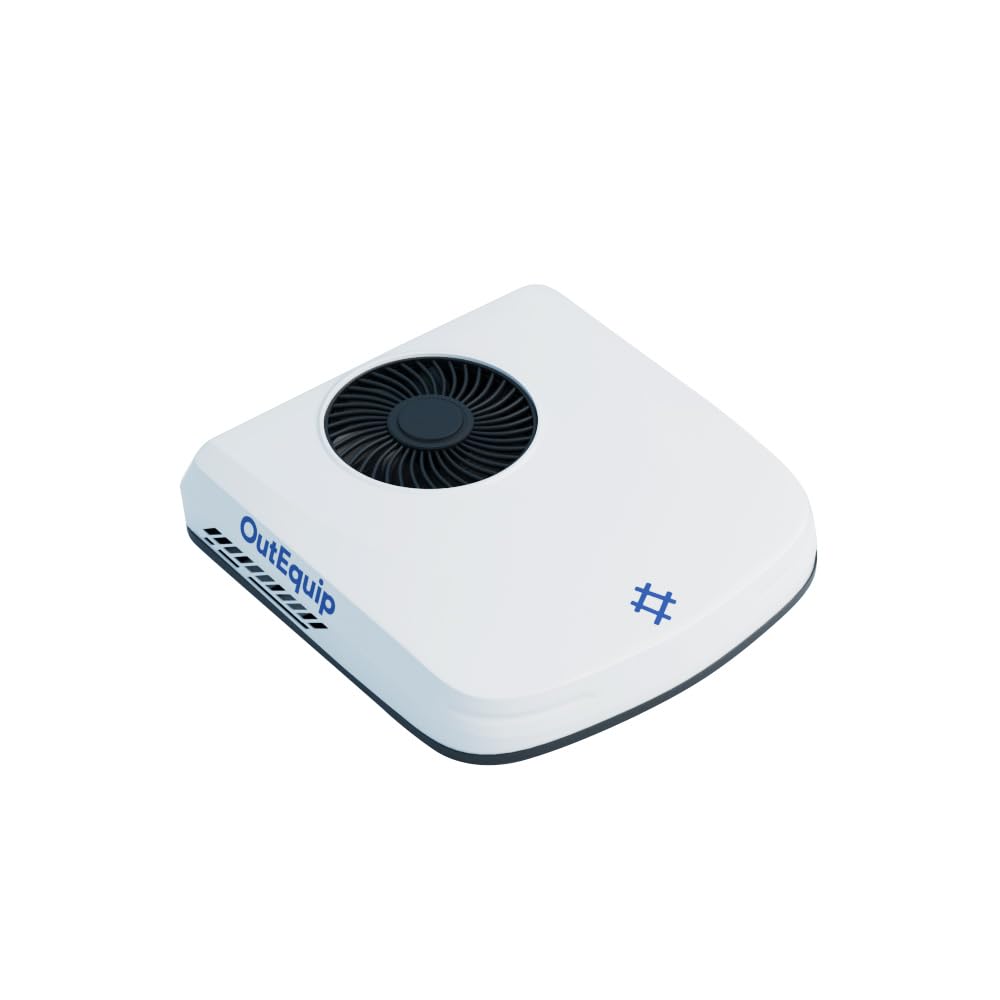
The Outequip unit with heater is the lightweight champion of this comparison at just 43 pounds, and its 6-inch rooftop profile makes it ideal for Class B vans with limited overhead clearance. It delivers 10,000 BTU of cooling and 4,500 BTU of PTC heat — enough to take the chill off a cool morning but not a primary heat source for arctic conditions. The brushless copper motor fans, combined with spring-supported mounts and a directional duct, keep operating noise down to 40 dB in sleep mode, rivaling the Gidrox for quietness. Buyers who installed this in high-roof Sprinters and Promasters report it cools the interior from 90°F to 75°F in about 15 to 20 minutes on Turbo mode.
Installation is easier than most because the unit ships with multiple mounting options and doesn’t require drilling through the roof for power wiring — the cable routes through the return air duct. It is available in 12V, 24V, and 48V configurations, so you can match it to your existing battery voltage. The UV-stabilized ABS housing, EPDM foam gasket, and zinc-coated condenser are built to withstand years of road vibration and weather exposure. However, some users report that the lid screws are difficult to remove without stripping, and the internal connectors can be fragile — keeping spare connectors on hand is wise.
On a 200Ah battery bank, the unit draws approximately 200-300W on ECO mode while idling, translating to roughly 16-25 amps at 12V. That makes it compatible with modest solar setups (800W+) for off-grid boondocking. The heating function is supplementary only — don’t expect it to keep you warm in sub-freezing temperatures without a backup heat source. Overall, this is the best choice for van builders who prioritize a low-profile aesthetic and weight savings over raw cooling power, especially if they have a 24V or 48V electrical system.
Why it’s great
- 43-pound weight and 6-inch profile are the lightest and lowest in this roundup.
- 40 dB sleep mode is exceptionally quiet for undisturbed rest.
- Available in 12V, 24V, and 48V for flexible electrical system integration.
Good to know
- Lid screws and internal connectors are reported as fragile — handle with care.
- 4,500 BTU heater is insufficient for extreme cold; it is a supplementary heat source only.
- Higher cost per BTU compared to the entry-level Countrymod unit.
5. Outequip OutEquipPro 10000 BTU 12V RV Air Conditioner (no heater)
The OutEquipPro is the heater-free version of the Outequip unit above, optimized purely for cooling efficiency and battery conservation. It weighs 45 pounds and shares the same 6-inch low-profile form factor, making it another excellent choice for Class B vans and VW bus conversions. Real-world testing by van lifers shows it draws just 20 amps on ECO mode (roughly 240W at 12V), and a 600Ah LiFePO4 battery can power it for 10+ hours without recharging. The unit includes a Bluetooth app for remote temperature monitoring, along with a standard infrared remote. Multiple customers verified that it fits the standard 14-inch by 14-inch roof opening without issue.
In terms of cooling performance, this unit can hold 80°F inside a van during 105°F Phoenix summer heat while drawing only 21A (ECO) and 51A (Turbo). That’s a remarkably low draw for a 10,000 BTU unit, attributable to its brushless DC fan and variable-speed inverter compressor. The included spring-mounted supports and directional duct keep the interior air moving evenly without irritating drafts. For VW Westfalia owners who retrofit these units, the low power consumption means they can run off a modest 200Ah battery bank with 400W solar and still have enough reserve for lights and a fridge overnight.
Installation is largely the same as the heater-equipped version, with the same caveats: the lid screws can strip, the gasket fit requires attention, and torque instructions should be followed carefully to avoid cracking the chassis. The omission of a heater makes the unit 2 pounds lighter and slightly cheaper, but you lose the ability to take the chill off on cool mornings. If your van build already includes a diesel heater or propane furnace, this cooling-only version is the smart choice. If you want a single appliance that handles both seasons, the heater-equipped Outequip is the better bet.
Why it’s great
- 20A ECO mode power draw is excellent for off-grid battery conservation.
- Low-profile 6-inch height fits under standard van roof racks and fans.
- Bluetooth app and remote control give convenient multi-device operation.
Good to know
- No heating function — relies on separate heat source for cold weather.
- Lid screws and mounting hardware can strip if over-torqued.
- Proper roof sealing is critical to prevent water ingress — use butyl tape and Dicor.
FAQ
Can I install a 12V rooftop AC in a van with a standard 14×14 inch vent?
How many amp-hours does a 12V van AC draw in real-world use?
Is a 12V DC rooftop AC more efficient than running a 110V window unit through an inverter?
Do I need a generator if I have a 12V van AC with solar panels?
Final Thoughts: The Verdict
For most users, the best 12 volt air conditioner for van is the Treeligo 11,000 BTU unit because it combines the highest cooling capacity with a built-in heat pump, UL certification, and competitive power draw for its class. If you want quieter operation and the most flexible control options, grab the Gidrox 10,000 BTU unit. And for tight-budget van builds or extended off-grid use where every amp-hour counts, nothing beats the Countrymod 10,000 BTU unit for its exceptional 0.3 kWh draw and straightforward fit.