
Our readers keep the lights on and my morning glass full of iced black tea. As an Amazon Associate, I earn from qualifying purchases.
Specs are compiled from manufacturer listings and verified buyer reviews and can change over time — please confirm the key details on the product page before buying.
Parking a rig or camper in summer heat turns the cabin into an oven, and idling the engine all night just to run the cab AC wastes fuel and wears out your equipment. A dedicated 12-volt air conditioner runs straight off your battery bank, so A 12V AC delivers cabin cooling without the noise, fumes, or fuel cost of idling the engine.. This guide sorts through the battery-powered split systems, rooftop units, and under-dash kits to find the ones that actually deliver cold air where it counts.
I’m Min — the founder and writer behind Gadgets Feed. This guide is built by comparing the manufacturers’ published specifications and the patterns across verified customer reviews, so you get each pick’s real strengths and trade-offs instead of marketing spin.
To find the right 12 volt air conditioner, match the BTU output and amp draw to your battery capacity and install style.
Our Picks at a Glance
How To Choose The Best 12 Volt Air Conditioner
Buying a 12V AC is a balance between cooling power (BTU), the electrical load on your batteries, and how much space you have for installation. The ideal unit for a sleeper cab differs from one for a rooftop camper vent., Start by measuring your available space and calculating your battery capacity..
Match BTU to your space
BTU (British thermal units) measures raw cooling power. A 10,000 BTU unit handles a small bedroom or a van; a 12,000 BTU unit gives faster pull-down in a larger cab or a fifth-wheel bedroom. Higher BTU cools faster but draws more amps, so your battery bank size limits what you can run..
Battery capacity decides your run time
Every 12V unit draws a serious number of amps — typically 20 to 60 amps on high, dropping in ECO mode. To estimate run time, divide your battery capacity in amp-hours (Ah) by the unit’s amp draw. A 300Ah bank with a 30-amp draw gives roughly 10 hours, so plan your battery setup before you pick the unit.
Installation style matters
Rooftop units drop into a standard 14″ x 14″ vent hole and are the easiest RV upgrade. Mini-splits have an exterior condenser and an interior evaporator, which means more work but better placement flexibility for trucks. Under-dash kits pack everything into one box that mounts inside the cab — simplest for classic cars and tractors.
Quick Comparison
| Model | Best For | Cooling Power | Noise Level | Install Style | Amazon |
|---|---|---|---|---|---|
| Outequip 10K BTU★ Best Overall | Rooftop RV vent drop-in | 10,000 BTU | Quiet (brushless fans) | Rooftop | Amazon |
| CNCEST 11K BTUBudget Champion | Budget mini-split for trucks | 11,000 BTU | 5-speed fan | Split System | Amazon |
| Treeligo 12K Mini SplitFast Cooler | Fast cooling in cabs | 10,000 BTU (3000W) | 45dB low noise | Mini-Split | Amazon |
| Treeligo 11K Rooftop | Cooling and heating year-round | 11,000 BTU | Below 45dB | Rooftop | Amazon |
| Aspligo 10K Mini Split | Universal truck fit | 10,000 BTU | — | Split System | Amazon |
| Aspligo 10K Split | Quiet overnight parking | 10,000 BTU | 50dB internal | Split System | Amazon |
| Bailigo 12K Underdash | Classic cars & tractors | 12,000 BTU | Below 50dB | Under Dash | Amazon |
| Gidrox 10K Rooftop | All-night battery use | 10,000 BTU | 40dB in Sleep mode | Rooftop | Amazon |
| Countrymod 10K Rooftop | Efficiency and long battery life | 10,000 BTU | 45-55dB | Rooftop | Amazon |
| Outequip 10K w/ Heater | Year-round camper comfort | 10,000 BTU cool / 4,500 BTU heat | Quiet (brushless fans) | Rooftop | Amazon |
| Gidrox 12K Heat Pump | Maximum cooling with heating | 12,000 BTU cool / 9,000 BTU heat | 40dB in Sleep mode | Rooftop | Amazon |
In‑Depth Reviews
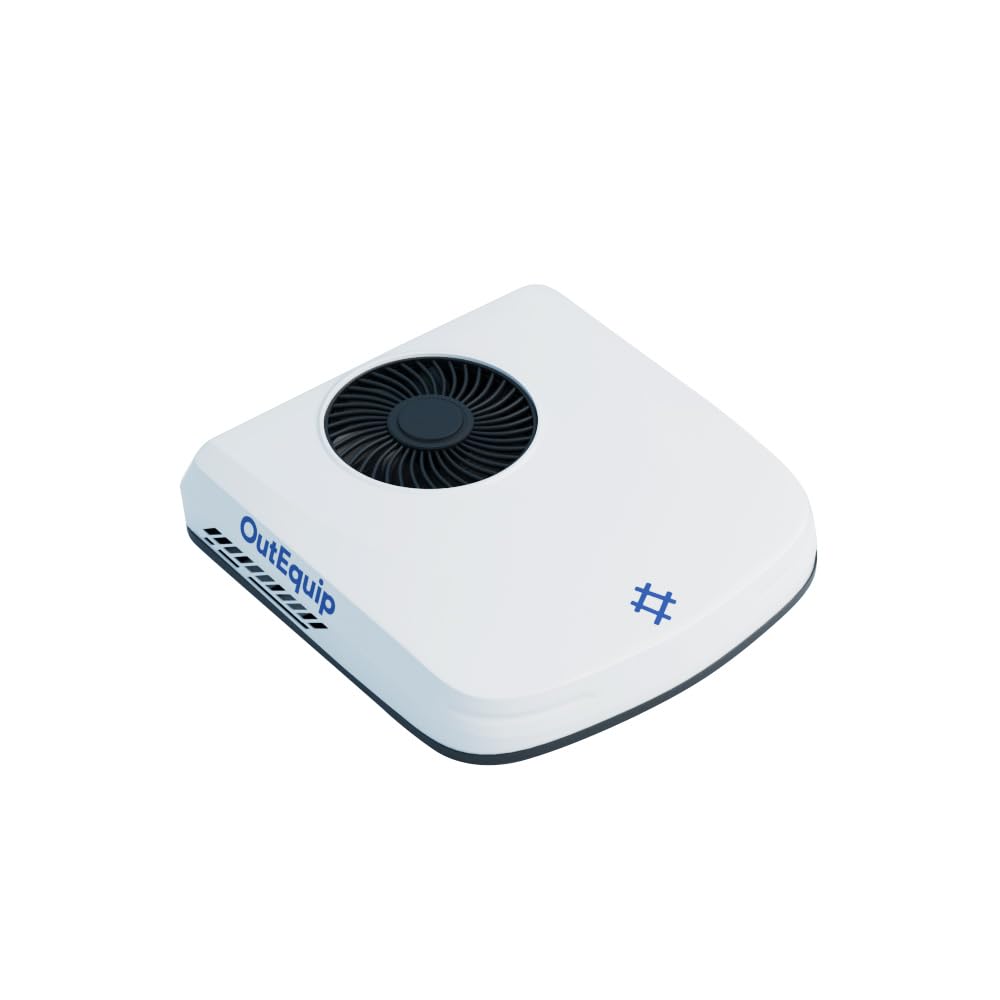
1. Outequip RV Air Conditioner 10K BTU
Our pick — over 4.5★ from 90+ verified ratings; the strongest balance of quality and price.
The roof-drop unit that wins owners over with serious cold air and a quiet hum.
You get a 10,000 BTU unit that owners say cools an insulated 7×14 trailer even in 100°F+ sun. The key spec is the amp draw: buyers report roughly 55 amps on high and a much friendlier 20 amps on ECO mode, so your battery lasts when you need it to.
Installation is where this one shines — it fits standard roof vent holes, and solo owners mention a manageable two-day install with no roof modifications. The build (UV-stabilized ABS, EPDM foam gasket, zinc-coated condenser) is designed to shrug off harsh weather, and brushless copper motor fans keep the noise down to a level owners call surprisingly quiet.
You get a remote, temperature monitoring, and eco, sleep, and turbo modes, so you can adjust cooling without leaving your seat. Customers note the unit is “well-made, and the cool air is more than adequate for the size of the unit.” One caution: a few reviewers point out to seal the condenser carefully during install, or you may lose cooling efficiency.
Real-world consensus: Performance is the thing people rave about most, followed closely by cooling speed and how easy the install turns out to be. The low wattage and quiet exterior are recurring compliments.
Reach for this if: you want a proven rooftop unit that cools fast, sips power on ECO, and doesn’t demand pro-level install skills.
Think twice if: you need heating too — this version is cooling only, so pair it with a separate heat source for winter.
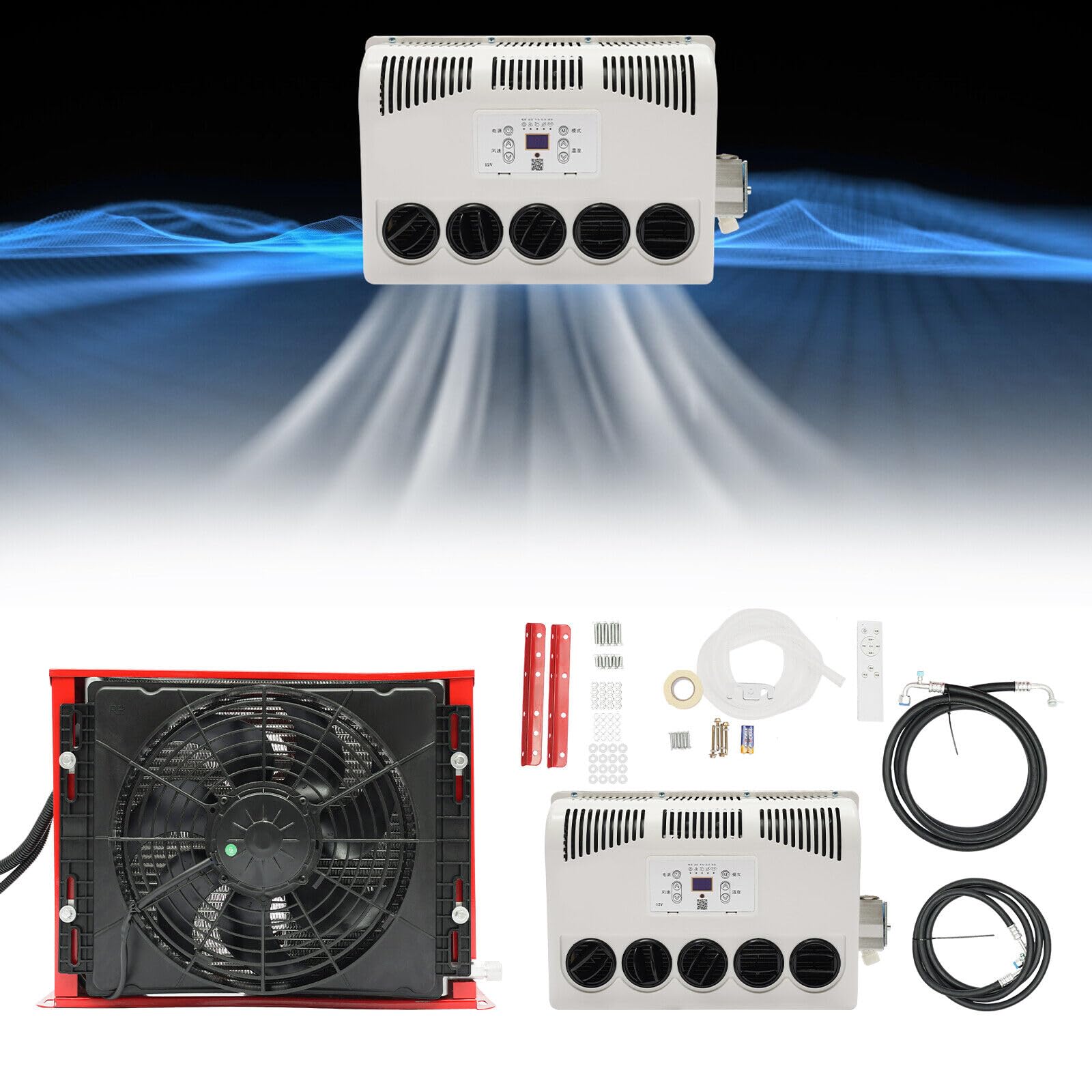
2. CNCEST 12V DC Split Air Conditioner 11K BTU
A high-BTU split for trucks that delivers big cold at a lean price.
This unit packs 11,000 BTU — 10% more cooling than the Outequip’s 10,000 BTU — into a mini-split format that fits semi-trucks, trailers, RVs, and even excavators. The energy story is strong: it runs on just 400-600W with a high-efficiency aluminum condenser, and the built-in under-voltage protection cuts off below 11V to guard your battery.
Owners are split on long-term durability. Some report a condenser leak after a couple of months, while others got a replacement condenser arranged through customer service and an “extremely simple to install” experience. One truck owner sums up the high end: “it keeps nice and cool in 90+ heat.”
You get 5-speed fan control, adjustable temperature, multi-directional vents, and a digital display, all controllable by remote or panel. With a 100Ah battery, the maker says it runs continuously for 1-3 hours after parking — enough for a quick rest break.
The strong points
- Highest raw BTU in the budget tier at 11,000 BTU
- Low 400-600W draw is easy on batteries
- Under-voltage cut-off below 11V protects your bank
The watch-outs
- Some owners hit condenser leaks within months
- No printed instructions, and panel labels are in Chinese/Japanese
Best if: you want maximum BTU per dollar and a split-system layout that fits a truck cab.
Look elsewhere if: you need guarantee of multi-year reliability — the leak complaints mean this favors handy owners.
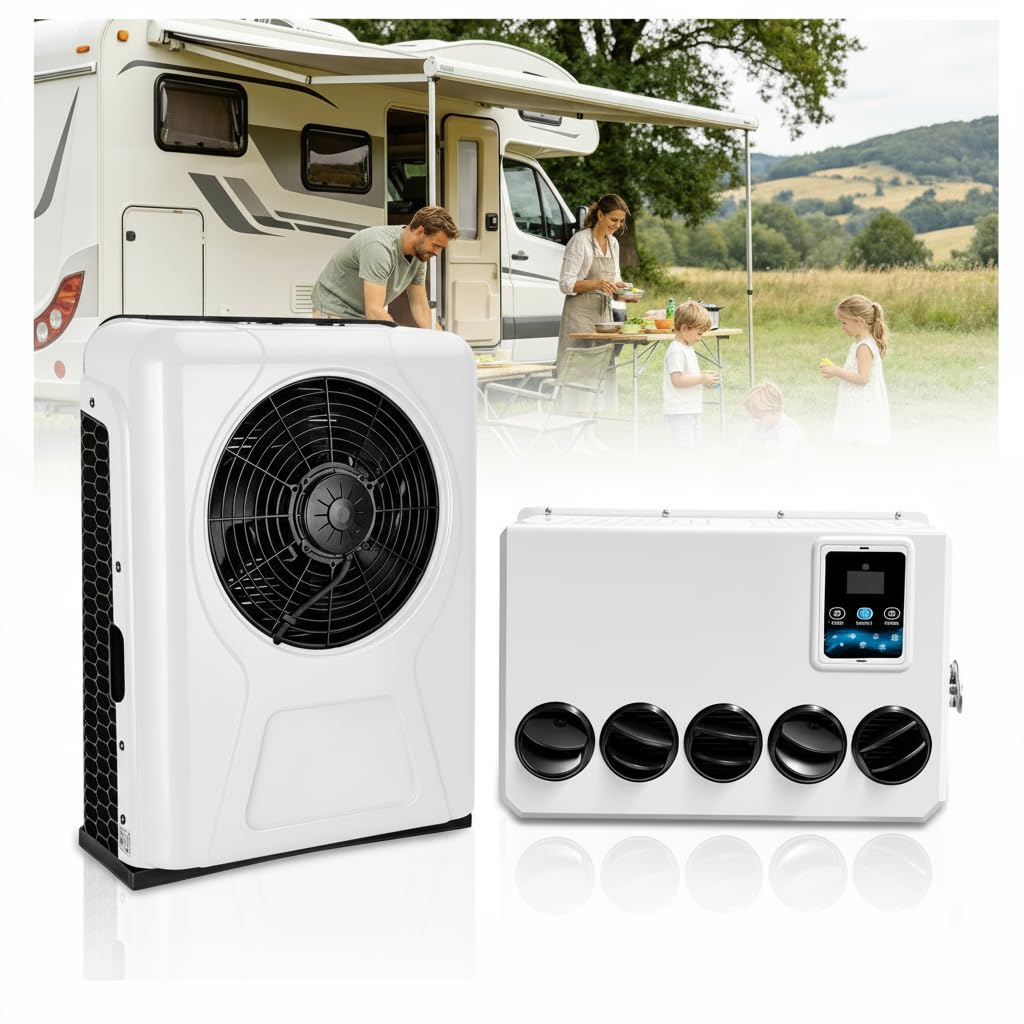
3. Treeligo 12V Truck Cab Air Conditioner 12K BTU
A 20CC scroll compressor mini-split built for fast pull-down in truck cabs.
The headline here is the 20CC variable-frequency scroll compressor, which the maker says pushes cooling up to 3000W (about 10,000 BTU) — stronger than most 8800BTU units on the market. Rated current is 60-80A, so this is a serious draw that needs a beefy battery bank behind it.
Run time is the trade-off to plan around: with a 480Ah battery, the maker claims 8 hours parked and 3-4 hours while driving. The quiet spec is 45dB, and the three modes (fast cooling, sleep, energy saving) give you control over the balance between cold and battery life.
The reliability picture is genuinely mixed. The thing buyers complain about most is durability, with reports of the compressor dying after about four months. One owner found the compressor shipped with only 25ml of oil and had to add 100ml of POE 68 (spec is 90-125ml) to get it running well. Installation earns praise — one happy owner calls it “easy install” and “efficient.”
Honest read: Installation is the strong suit, but reliability gets mixed feedback and durability is the recurring concern. If you buy, check the compressor oil level before first run.
Choose this for: quick, powerful cooling in a cab with a strong battery bank and DIY confidence.
skip it if: you want set-and-forget reliability — the compressor durability reports argue for checking oil and warranty terms.
4. Treeligo 11K BTU Rooftop RV Air Conditioner with Heating
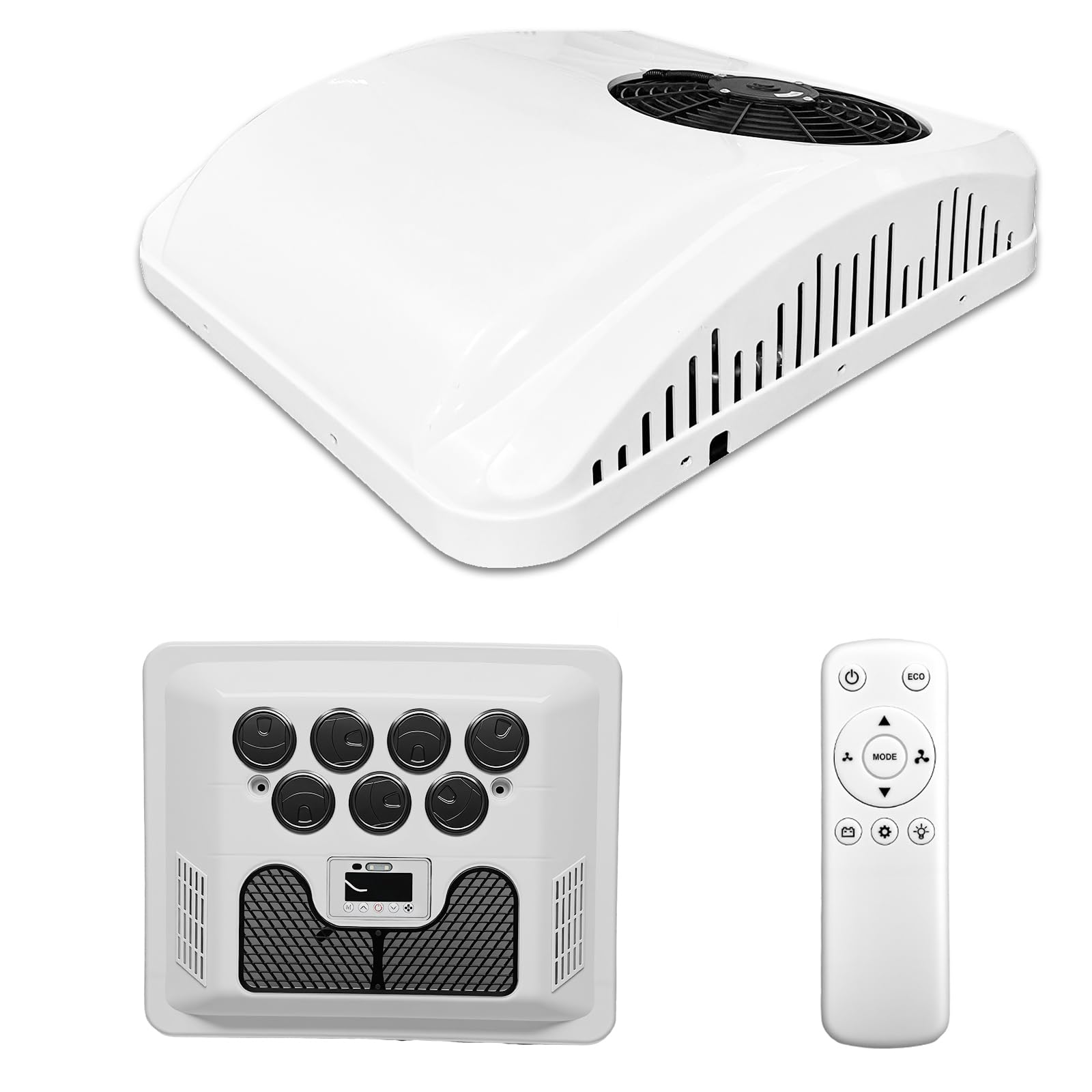
A rooftop two-in-one that cools and heats from a single 50-pound unit.
You get 11,000 BTU of cooling and heating that the maker says adjusts indoor temperature within 5 minutes. Operating power ranges from 330W to 1000W depending on mode, and it’s FCC and UL certified with multi-layer circuit protection against surges and vibration.
The unit runs on a 12V system, with tested owners reporting solid results: one runs it on a 12V 300Ah battery at 50A and got a strong fan that heats and cools. Another cooled a 5th-wheel bedroom fast in 100°F using 3x100W solar and 2x100Ah batteries, calling it “quiet, easy install, powerful, low profile.”
The catch is support and setup. A few owners hit a fan that wouldn’t turn off or a unit that stopped working with error codes 2P-4P, and support was slow to respond. One also noted 6-gauge cables were too small and swapped to 4-gauge for better performance.
What stands out: heating plus cooling in one roof unit, with owners praising its quiet operation and low profile. The complaints center on intermittent support and the need for proper cable sizing.
Grab it if: you want a single rooftop unit that handles both summer cooling and mild winter warmth off your battery bank.
Hold off if: you’re not comfortable sizing your own cables — a few owners had to upgrade to 4-gauge wiring.
5. Aspligo 12V Mini Split Air Conditioner 10K BTU

A universal mini-split with a 15% cooling boost claim and extra-thick copper wiring.
This 10,000 BTU split system targets trucks, RVs, campers, and boats, and the maker claims 15% more cooling capacity than comparable units. The wiring is a standout: a 12mm² pure copper core with thick PVC insulation that handles higher current loads and keeps things stable in voltage fluctuations.
The remote control works from the driver’s seat, which is the whole point for truck use — you can adjust the temperature without climbing into the bunk. It runs off battery power with low-voltage protection to prevent over-draining your bank.
Quality control is the honest worry here. Several shoppers say serious issues: one got only the compressor and hoses, missing the fan and controller entirely; another says it only worked when outdoor temps were 70°F or lower. On the flip side, a van owner who did the install in about 3 hours reports it “runs great, quiet, cools van fast” with low power draw.
The real story: When it works, it’s a quiet, fast-cooling split with good wiring. But shipping and QC issues are notable, so inspect the box contents before you start cutting holes.
Best for: a buyer who wants strong wired performance and accepts some QC roulette — check everything on arrival.
Not for: anyone who can’t handle a possible missing-parts return or a unit that needs swapping.
6. Aspligo 12V 10K BTU Split Parking AC
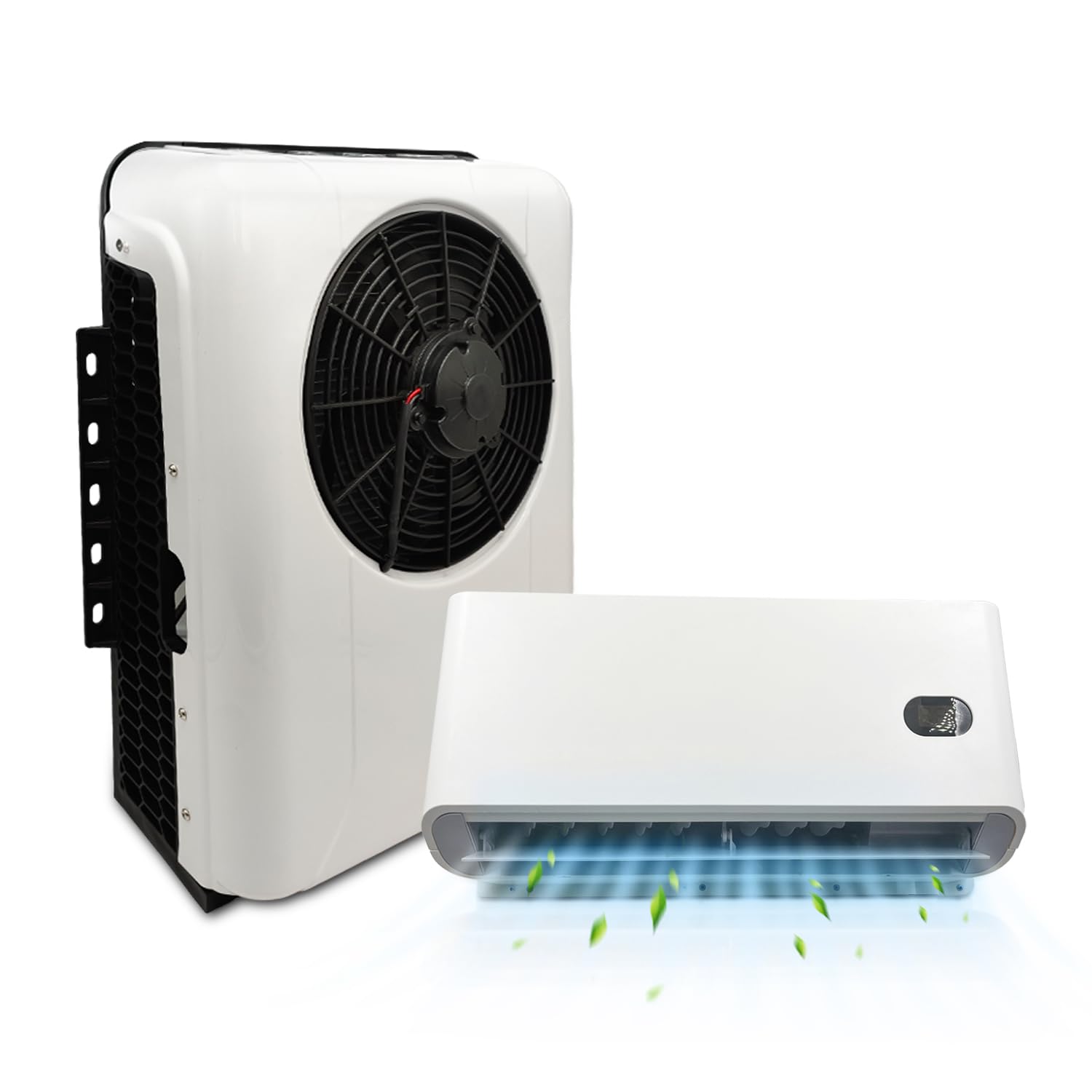
The overnight parking pick, with owners reporting a surprisingly gentle battery drain.
This 10,000 BTU split is aimed at overnight rest, and the noise spec backs that up: the internal unit runs at 50dB with a silent brushless evaporator. One owner using two 300Ah LiFePO4 batteries reported only 45% battery use across a hot summer day and night, calling it the “quietest ac compressor” they’d tried.
The low-voltage protection is a thoughtful safety net that prevents over-draining your bank and lets the unit start smoothly. It’s built to fit a wide range of vehicles — trucks, RVs, agricultural machines, excavators, even corn harvesters.
There’s a real caveat baked into the listing: refrigerant (500-550g of R134a) is not included, and the maker is upfront that you need over 350Ah of battery for 3 hours of daytime cooling or 6 hours at night. A trucker who runs two 300Ah LiFePO4 batteries plus a 60A charger reports 88% battery use across 34 hours in 100°F heat — strong real-world endurance.
Why it earns its spot
- Gentle battery drain — 45% of a 600Ah bank for a day and night
- 50dB internal noise for easier sleep
- Refrigerant and battery needs clearly stated upfront
Check before buying
- Refrigerant R134a not included — factor in a charge
- Needs 350Ah+ battery to hit advertised run times
- One owner reported a condenser tube punctured by an over-long screw
Pick this for: overnight truck or van cooling with a big LiFePO4 bank and realistic expectations about refrigerant.
Pass if: you want plug-and-play with no refrigerant handling or your battery bank is under 350Ah.
7. Bailigo 12V 12K BTU Under Dash AC with Heating
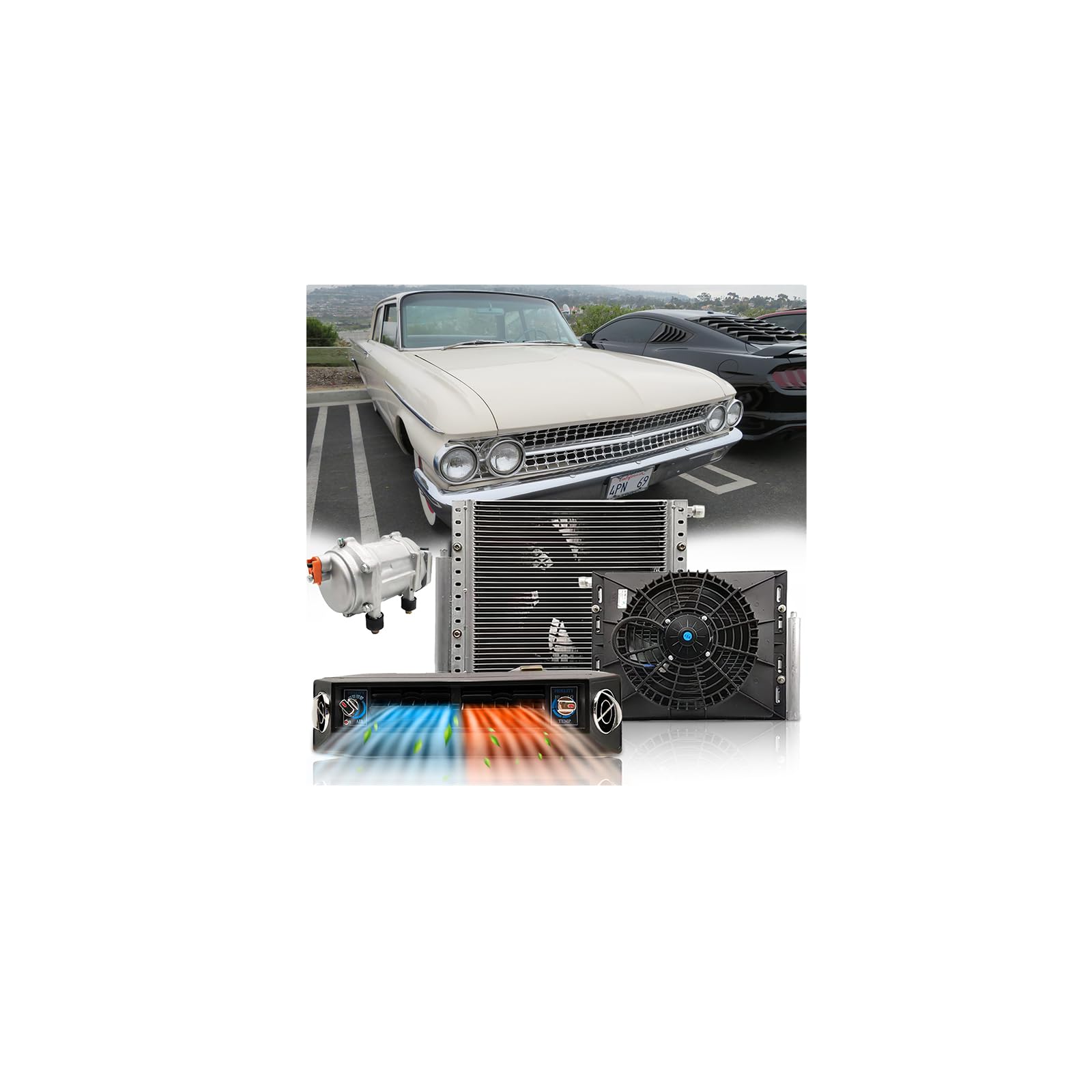
A compact 3-in-1 kit that brings modern cooling to classic cars and tractors.
This is the answer for vehicles with no roof vent and no room for a split system. The 3-in-1 design merges the receiver dryer, condenser fan, and condenser into one unit, which simplifies installation to a single under-dash box measuring 5.5 x 12.6 x 15.7 inches.
Cooling comes from a professional-grade 20cc scroll compressor using R-134A (not included), regulating interior temperature in as little as 8 minutes. It runs below 50dB thanks to the inverter tech, with a household-type ultra-quiet evaporator.
Classic car owners are the happy campers here — one dropped it into a 1956 Chevy Belair with an easy install and all parts included, and said they’d buy two more if it holds up. The honest caveats: there’s no instruction manual, the AC lines run over 8 feet and need cutting and new fittings, and the under-dash box is bigger than some expect.
The trade-off: brilliant fit for classic cars and tractors that have no other cooling option, but plan for a custom install — it’s not a bolt-in job.
Get it if: you’re restoring a classic car or retrofitting a tractor and want 12,000 BTU plus heating in one compact box.
Skip if: you want a factory-style kit with clear instructions — this one expects a confident DIYer.
8. Gidrox 10K BTU Rooftop RV AC with APP Remote
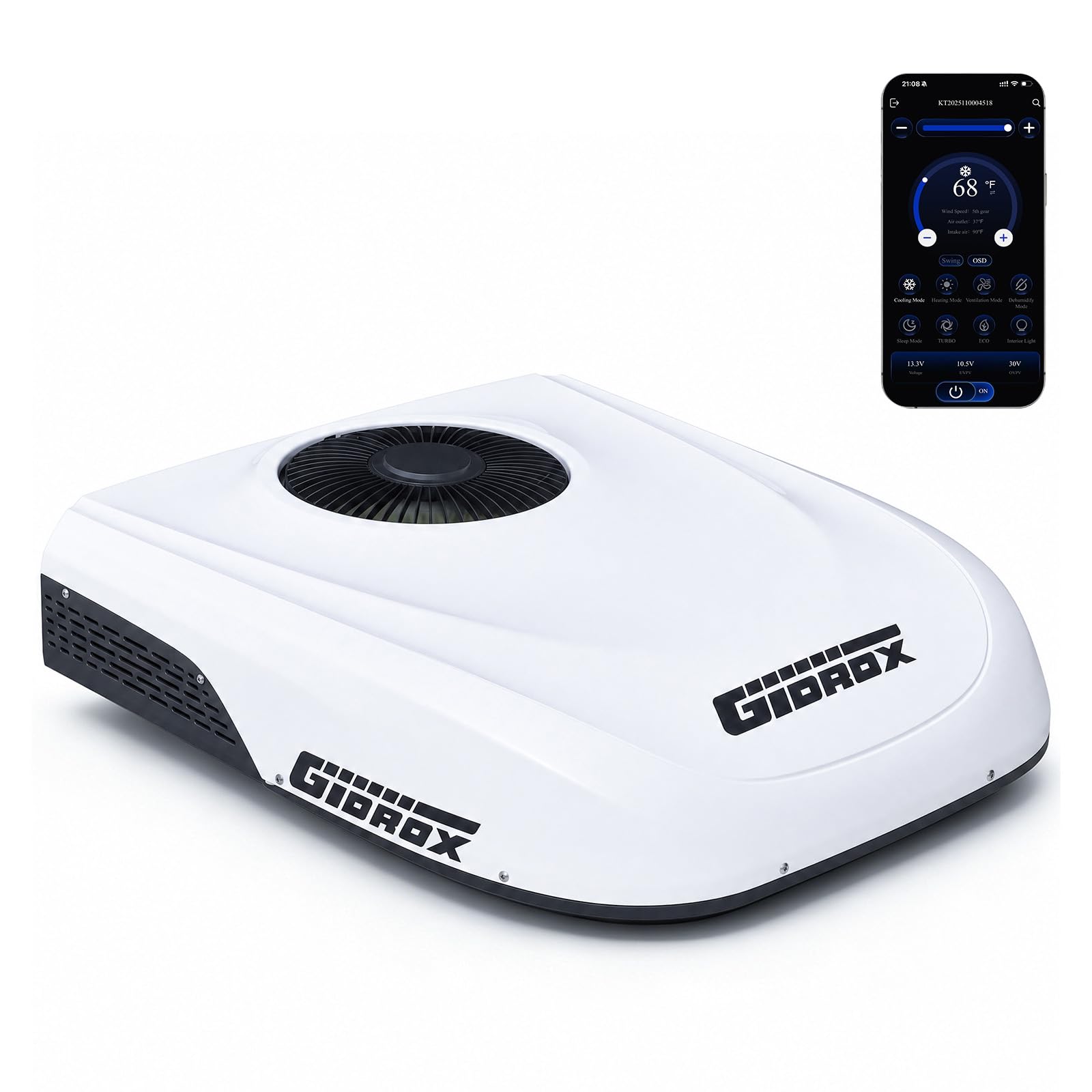
A 40dB sleep-quiet rooftop unit you can run from your phone via Bluetooth.
This 10,000 BTU rooftop unit delivers the triple-control setup: smartphone APP over Bluetooth, an infrared remote, and physical buttons on the unit. Inverter technology gets the cabin cool within 3 minutes, and the tested average draw is only about 350W at night in 30°C ambient — roughly 60% less energy than a traditional AC.
Owners confirm the efficiency story. One ran it all week on 800W of solar and a 600Ah bank, reporting about 30A draw at full power and 15A in eco mode. Another cooled from 98°F to 80°F in 45 minutes on max, using just 0.2 of a 600Ah battery — a shockingly small hit.
The mode behavior is the quirk to know: ECO is fixed at 79°F, so adjusting the temperature kicks you out of eco. There’s also no battery cutoff setting on the unit, and wire routing inside walls is tricky enough that owners recommend an external cable trough.
What wins people over
- Library-quiet 40dB in Sleep mode
- Bluetooth APP control for temp, timers, °C/°F
- Big efficiency — all-night on a 400Ah battery
Know before you buy
- ECO mode is locked at 79°F
- No battery cutoff settings built in
- Wall wire routing is difficult indoors
Reach for this if: you want app control, whisper-quiet sleep mode, and serious battery efficiency from a rooftop unit.
Think twice if: you need a customizable ECO temperature or want unit-level battery protection.
9. Countrymod 12V DC RV Air Conditioner 10K BTU
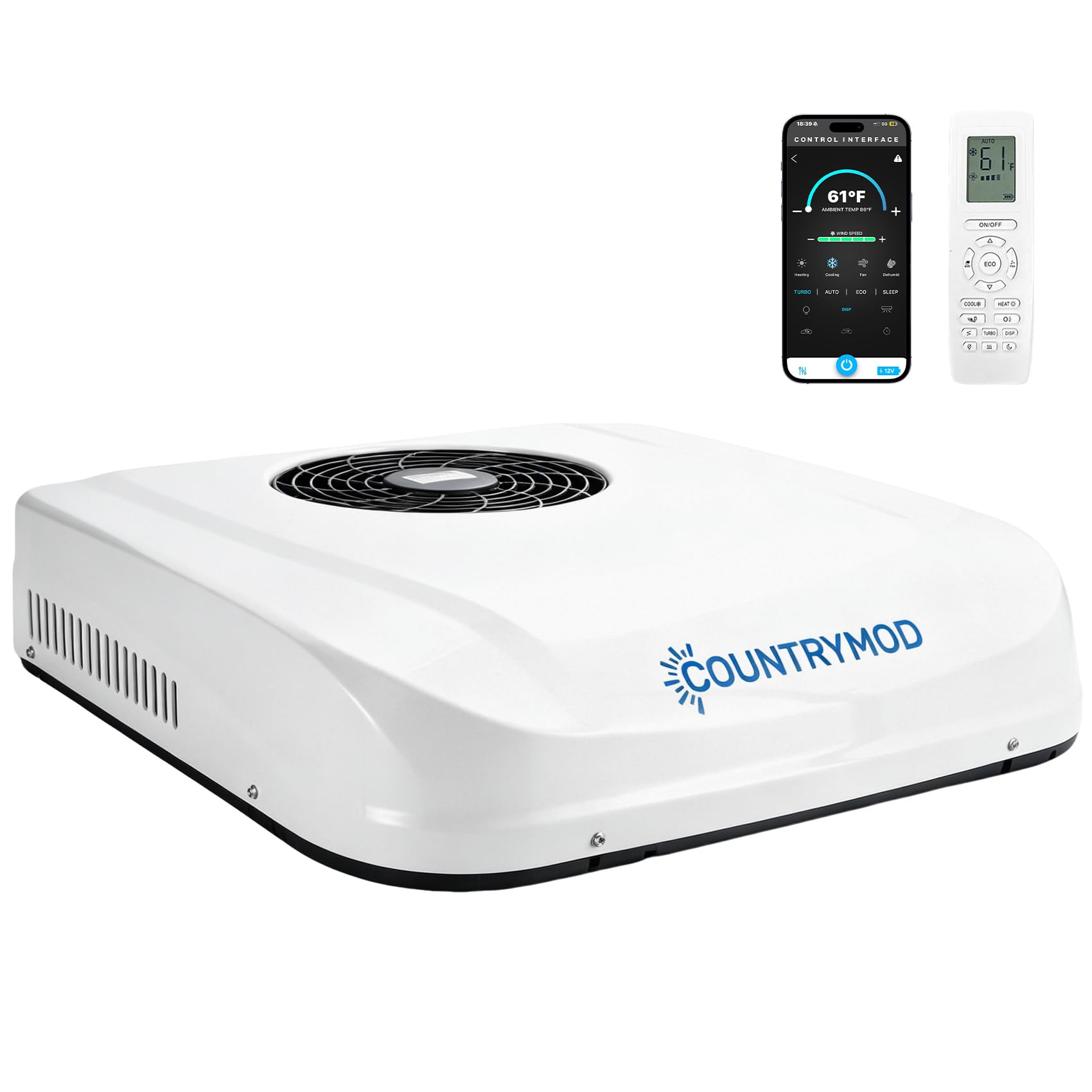
The efficiency standout — 0.3 kWh per hour and a horizontal compressor that adds stability.
This 10,000 BTU rooftop unit is the efficiency pick of the list. The maker claims just 0.3 kWh per hour consumption, which they say is 5 times more efficient than a standard 1.5 kWh/hour air conditioner, with battery life up to 10 hours. Real owners back it up: one with a 300Ah battery reports 12 hours on ECO.
The horizontal compressor is a clever design choice — less vibration and a lower center of gravity than vertical units, which means increased stability, less road shock, and longer service life. Noise sits at 45-55 decibels, described as a slight wind sound that won’t disturb rest.
Install is straightforward: it fits a standard 14″ x 14″ roof vent and is ductless, so no major modifications needed. Owners note it needs 6AWG wire and that arched roofs need 8mm x 160mm bolts, and one measured 44dB in sleep mode. The customer service gets consistent praise, with a team member named Tony mentioned repeatedly.
The standout spec: 0.3 kWh per hour is the best efficiency claim in this lineup, and owners confirm the low draw and quiet operation. The 44dB sleep measurement matches the advertised comfort.
Choose this for: maximum battery life and minimal noise from a rooftop unit — the efficiency numbers are the best in this roundup.
Pass if: your RV has built-in ducting, since this ductless unit isn’t designed for that setup.
10. Outequip 10K BTU Rooftop AC with Heater
The most popular Outequip — same 10K cooling, plus a 4,500 BTU heater for shoulder seasons.
This is the all-year version of the Best Overall pick, adding a 4,500 BTU PTC heater to the same 10,000 BTU cooling core. It cools an RV in about 15 minutes, and the heat provides genuine warmth for mild temperatures and small spaces — though the maker is clear it’s not a primary heat source for extreme cold.
Buyers report the same sturdy build (UV-stabilized ABS, EPDM foam gasket, zinc-coated condenser) and brushless copper motor fans for quiet operation. One details the “Summit 2″ unit as DC 12/24/48V, 43 lbs, 6 inches tall, 40 dB, and a 4-hour install into a 14.1″ x 10.3” opening — ideal for off-grid with 500W solar.
Efficiency is a recurring theme: owners mention roughly 200-300 watts draw in eco or idle mode and a max around 600W. One Transit 250 owner had a fully satisfying experience, praising the clear directions and the user-friendly app. The one caution is that the heater won’t hold 72°F when it’s 20°F outside.
Why it leads: the most-installed Outequip, with the broadest owner consensus on performance, quick cooling, easy install, and quiet operation. The PTC heater is a bonus, not a winter solution.
Grab it if: you want the proven Outequip rooftop with added heating for cool nights and mild winters.
Look elsewhere if: you camp in genuine winter cold — the 4,500 BTU heater is supplementary, not a furnace.
11. Gidrox 12K BTU Rooftop Heat Pump AC
The most powerful Gidrox, pairing 12,000 BTU cooling with a 9,000 BTU heat pump.
This is the top-tier heat pump of the lineup, delivering 12,000 BTU of cooling (with EER up to 12.3) and 9,000 BTU of heating — the maker claims about 65% energy savings versus standard heaters. It’s the same smart-control package as the 10K Gidrox: APP over Bluetooth, infrared remote, and panel buttons.
The efficiency is the selling point. One owner with a 400Ah battery reports 10 hours of run time at 80°F outside holding 70°F inside, versus 6 hours before the upgrade — and says the install took under an hour because it’s pre-wired. A separate owner measured 250-800W draw and called it quiet.
Expect European-style honest critiques on cooling: one says the 12k performs “like a good 8k window unit,” weaker than a 13.5k, while the APP control drew complaints for Bluetooth drops. A few found it “muy ruidoso” (very noisy) and slow to cool for the price.
The verdict in practice: a genuinely efficient heat pump that extends battery run time, but treat the 12,000 BTU claim with a grain of salt — several owners peg real cooling closer to an 8,000 BTU unit.
Best for: off-grid campers who want serious battery endurance plus heating from one rooftop unit.
Not for: anyone expecting 13.5K-class cooling or flawless app behavior — and it needs a solid battery bank and proper wiring.
Understanding the Specs
BTU and cooling power
BTU (British thermal units) measures how much heat the unit can remove per hour. For a van or small RV bedroom, a 10,000 BTU unit is the balance, while 12,000 BTU cools larger cabs faster. Higher BTU means quicker cooling but draws more amps, so your battery bank size is the real limit.
Amp draw and battery run time
Every 12V unit draws a steady current measured in amps (A). To estimate how long you can run off-grid, divide your battery capacity in amp-hours (Ah) by the unit’s draw. A 600Ah bank with a 30A draw gives roughly 20 hours; with a 60A draw, half that. ECO and sleep modes cut the draw substantially, often in half.
Inverter vs. non-inverter
An inverter compressor (also called variable-frequency) adjusts its speed to match the cooling demand instead of cycling on and off. That means steadier temperatures, lower power draw, and a gentler load on your battery bank. Non-inverter units are simpler but draw more power and run in hard on/off cycles.
Low-voltage protection
This is a battery-saving safety feature that cuts power to the compressor when your battery voltage drops too low, often below 11V. It prevents you from draining your bank to the point of damage, which is critical for overnight use. If a unit lacks this feature, your battery is at risk.
FAQ
How long will a 12V air conditioner run on my battery?
Will a 12V AC fit my existing roof vent?
Do I need an inverter to run a 12V air conditioner?
What size battery bank do I need for overnight cooling?
Is a 12V AC more efficient than a 120V rooftop unit?
How much refrigerant does a 12V AC need?
Can I use a 12V air conditioner while driving?
What’s the difference between a mini-split and a rooftop AC?
Final Thoughts: The Verdict
For most buyers, the best 12 volt air conditioner is the Outequip 10K BTU rooftop unit because it pairs fast, quiet cooling with the simplest standard-vent install and a gentle ECO mode amp draw. If you want maximum battery endurance, the Countrymod delivers the best efficiency at 0.3 kWh per hour. And for classic cars or tractors with no roof vent, the Bailigo under-dash kit brings 12,000 BTU of cooling and heating to vehicles that otherwise have no cabin cooling option at all.
How We Picked
We do not accept paid placement. Every pick is matched to a real buyer and a real use-case; we do not hands-on test units.
Sources & Methodology
Specifications: manufacturer listings and product documentation. Review insights: verified customer reviews, as of August 2026. Pricing: not shown on this page (it changes often); check the current price via the retailer link.
As an Amazon Associate, Gadgets Feed earns from qualifying purchases. This does not affect which products we feature.