
Our readers keep the lights on and my morning glass full of iced black tea. As an Amazon Associate, I earn from qualifying purchases.
Specs are compiled from manufacturer listings and verified buyer reviews and can change over time — please confirm the key details on the product page before buying.
You pick a 12-volt battery to avoid the morning it’s drained, the weight you wrestle into a boat, or the charge that fades mid-trip. For a trolling motor, an RV fridge, or solar storage, your choice is between two chemistries: sealed lead-acid (AGM) for proven, budget-friendly duty, and lithium iron phosphate (LiFePO4) for far more usable capacity at a fraction of the weight. Here are the best 12 Volt Batteries across both types, sorted by what you actually need them to do.
I’m Min — the founder and writer behind Gadgets Feed. This guide is built by comparing the manufacturers’ published specifications and the patterns across verified customer reviews, so you get each pick’s real strengths and trade-offs instead of marketing spin.
Capacity, weight, and cycle life decide which 12-volt battery fits your rig, trolling motor, or solar setup. 12 volt batteries range from a 12 amp-hour UPS workhorse to a 150 amp-hour lithium powerhouse, so matching the chemistry to your use case matters more than brand hype.
Our Picks at a Glance


How To Choose The Best 12 Volt Batteries
Picking a 12-volt battery starts with your load—how much power your device draws and how long you need it to run. The two chemistries on the market, AGM and LiFePO4, serve different buyers, and understanding the gap saves you from buying the wrong one.
Capacity: Amp-Hours and Energy
Amp-hours (Ah) is the fuel tank of a battery. A 100Ah battery can theoretically deliver 100 amps for one hour, or 10 amps for 10 hours. For deep-cycle use, a 100Ah LiFePO4 battery gives you roughly double the usable energy of a 100Ah lead-acid because lithium can be discharged to 100% depth of discharge (DOD, the percentage of capacity you safely use) without damage, while most lead-acid batteries should only be drawn down to about 50% to protect their lifespan. So a 100Ah lithium often replaces a 200Ah lead-acid bank in practice.
Chemistry: AGM vs. Lithium LiFePO4
AGM (Absorbent Glass Mat) batteries are sealed lead-acid units that are spill-proof, maintenance-free, and resist shocks and vibration. They are the budget-friendly entry point and a solid choice for backup power and modest setups, but they are heavy—a 100Ah AGM can weigh 60+ pounds—and they deliver fewer charge cycles over their life. Lithium iron phosphate (LiFePO4) packs cost more upfront but weigh a fraction of a comparable lead-acid, last thousands of cycles, and hold their voltage strong until they are nearly empty. For frequent use, boats, and solar storage, lithium usually pays off; for occasional backup power on a tighter budget, AGM is tough to top.
Safety Systems and Monitoring
A Battery Management System (BMS) is the brain inside every lithium battery—it protects against overcharging, over-discharging, short circuits, and overheating. A higher-rated BMS (like a 100A unit) can safely deliver more current to power hungry inverters or high-thrust trolling motors. Some premium lithium packs add Bluetooth connectivity, letting you check voltage, current, and remaining capacity from your phone—a feature that is genuinely useful for solar users and RV owners who want to know their state of charge at a glance.
Quick Comparison
| Model | Best For | Capacity | Chemistry | Weight | Amazon |
|---|---|---|---|---|---|
| Mighty Max ML12-12 2-Pack★ Best Overall | UPS & backup power | 12Ah | AGM Lead-Acid | 18 lbs | Amazon |
| Newport 12V50Ah MarineBest Value | Trolling motors | 50Ah | AGM Lead-Acid | 32 lbs | Amazon |
| dumfume 12V 100Ah LiFePO4Most Versatile | RVs & off-grid | 100Ah | LiFePO4 Lithium | 22.05 lbs | Amazon |
| yeagulch 12V 150Ah LiFePO4 | Solar & marine | 150Ah | LiFePO4 Lithium | 41 lbs | Amazon |
| Mighty Max ML100-12 | Solar & trolling motors | 100Ah | AGM Lead-Acid | 28 lbs | Amazon |
| dumfume 12V 150Ah Max | RV & off-grid systems | 150Ah | LiFePO4 Lithium | 41.03 lbs | Amazon |
| WEIZE 12V 100Ah Group 31 | Wheelchair & commercial | 100Ah | AGM Lead-Acid | 63 lbs | Amazon |
| HumsiENK 12V 100Ah Bluetooth | Tech-savvy RV users | 100Ah | LiFePO4 Lithium | 19.7 lbs | Amazon |
| Litime 12V 100Ah Group 24 | All-around RV upgrade | 100Ah | LiFePO4 Lithium | 21.9 lbs | Amazon |
In‑Depth Reviews
1. Mighty Max Battery ML12-12 2-Pack
Our pick — over 4.5★ from 950+ verified ratings; the strongest balance of quality and price.
The two-pack workhorse that quietly keeps critical gear running for years
If your job is backup power for a sump pump, UPS system, or a mobile scooter, this sealed lead-acid pair is the definition of set-and-forget. Each battery delivers 12Ah of capacity from an 18-pound AGM package that is spill-proof, resists shocks and vibration, and can be mounted in any position—so it fits neatly into tight electronics bays without leaking. One 5-star review described it as “solid workhorse” for a sump pump UPS.
That 5-year example is not unique. Buyers report the ML12-12 lasting five years in a UPS system without issues, and giving new life to mobile scooters. The performance gets the most praise—over 100 buyers single out that it works well right from the start—with value for money the second-most mentioned quality. It easily wins the crowd favorite spot, with 4.6 stars across 900+ ratings, edging out the Litime pick on rating.
The honest trade-off is that 12 amp-hours is a small tank, and battery life gets mixed feedback—some owners mention only about 15 minutes of sustained run time under heavy load. This is a battery for maintaining and bridging outages, not for powering a whole system for hours. The UL-certified build and full one-year warranty back it up if you need a 12 volt battery replacement that just works.
Reliable workhorse: Installs easily, holds charge well, and two batteries cost what many single units do.
Small capacity: Perfect for UPS and scooters, but it won’t run a fridge overnight.
Reach for this if: you need dependable, budget-friendly backup power for a UPS, pump, or scooter.
Look elsewhere if: you need hours of deep-cycle run time rather than a bridge for short outages.
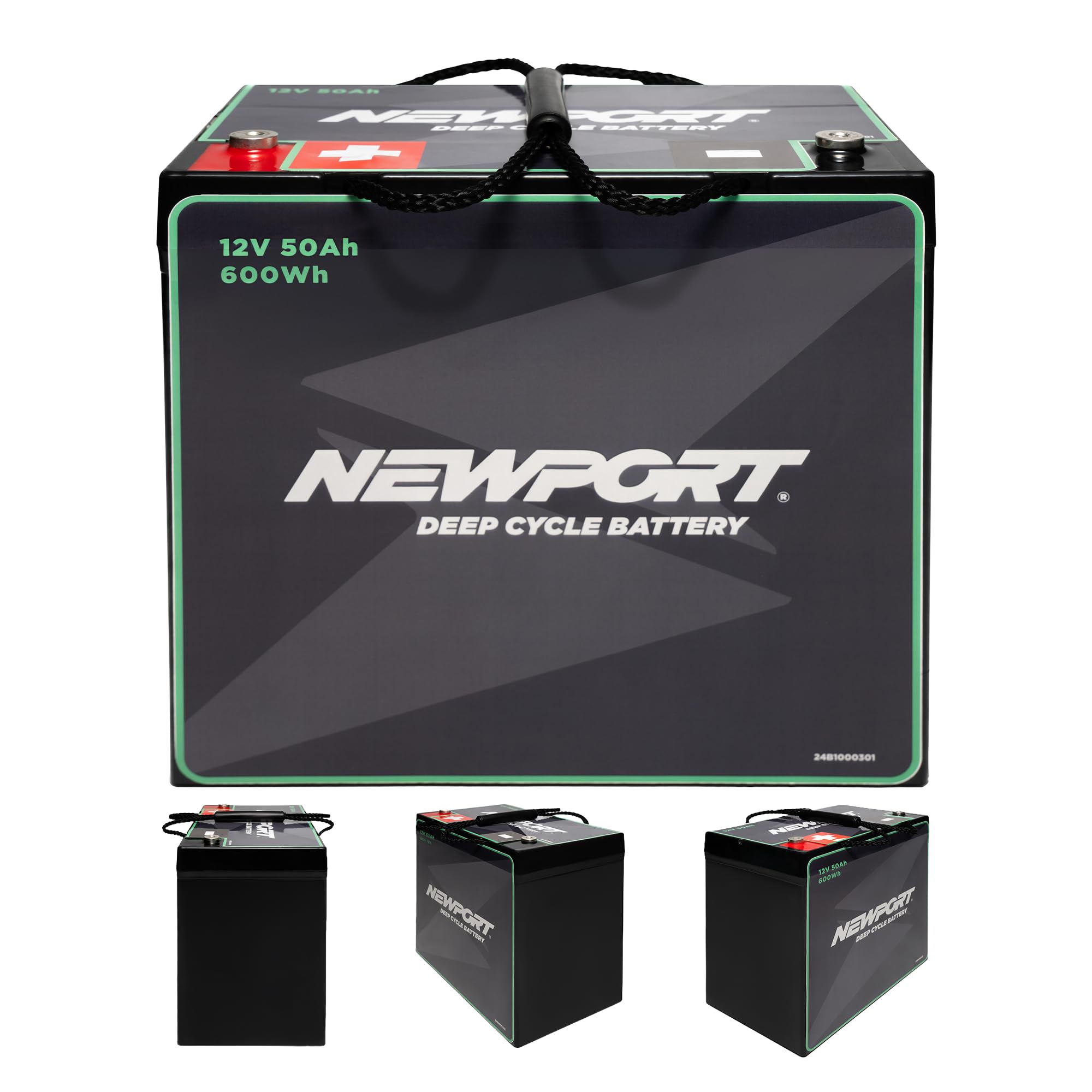
2. Newport 12V50Ah Deep Cycle Marine Battery
A sealed marine battery that keeps a trolling motor running for hours without the usual lead-acid bulk
Anglers and boaters will appreciate what this 50Ah deep-cycle battery brings to the water. At 32 pounds, it’s noticeably lighter than larger marine units, and customers note running a 55lb trolling motor for over 4 hours with stable voltage the whole way. The sealed AGM construction is leak-proof and maintenance-free, so you can install it and forget about checking fluid levels. Its compact size earns consistent praise from owners using it for depth finders and trolling setups.
Battery life is the standout quality—nearly 80 owners call it out, with one noting it’s powerful enough for a 40lb trolling motor. The sizing and weight are also praised, making it ideal for small boats and kayaks where every pound matters. Unlike the dumfume lithium above, this is an affordable entry into marine power, though it won’t match the extreme runtime of a 100Ah pack.
The main critical question is that the battery arrives without terminal bolts, which catches some buyers off guard, and there’s no charge indicator—you’ll want to add an external meter. Value gets mixed feedback, so shop it knowing it’s a capable mid-tier marine battery rather than a premium flagship. For a sealed, portable power source that slips into a small vessel, this delivers exactly what the spec sheet promises.
Marine-ready: 32-pound AGM build holds charge well, and the 50Ah capacity suits trolling motors and fish finders.
Check the terminals: You’ll need to supply your own terminal bolts, so plan for that on install day.
Best for: kayak and small-boat anglers who want a sealed, portable battery for trolling motors.
Who may struggle: anyone expecting a turnkey install without buying extra terminal hardware.
3. dumfume 12V 100Ah LiFePO4 Group 31
A featherweight 100Ah pack that brings lithium’s long life to RVs without the heavy lead-acid toll
For the RV and off-grid crowd, this 100Ah lithium battery is a revelation: it weighs just 22.05 pounds. The maker claims that’s 2/3 lighter than a conventional 100Ah AGM battery, which typically runs around 63.9 pounds. That means you’re saving roughly 40 pounds of weight on your rig while getting 1.28 kWh of usable energy storage. Reviewers point out running a diesel heater and inverter for three days straight, and one buyer powers a 2500-watt inverter with it.
The integrated 100A Battery Management System (BMS) protects against overcharging, over-discharging, short circuits, overheating, and overcurrent—giving you safety coverage for a solar setup or camper. It supports series and parallel connections up to 4S4P, so you can build up to a 51.2V 400Ah system if your power needs grow. Battery quality is the most-praised feature by far, with over 60 buyers calling it out, followed by strong performance marks.
The catch is that lithium batteries like this one require temperatures of 5°C or higher to perform, and return shipping for low-temperature charging issues isn’t covered. There are also a couple of isolated durability complaints, including one unit that failed under a year, so the warranty experience matters if you go this route. As a 12 volt battery for campervans, caravans, or energy storage, the combination of light weight and 4000+ cycles at full discharge makes it a compelling pick.
Why owners switch
- 22.05 lbs replaces a 63.9 lb AGM in the same footprint
- 100A BMS guards against overcharge, over-discharge, and shorts
- Runs a diesel heater and inverter for 3 days per reports
Limits to know
- Needs 5°C or warmer temps to charge properly
- Not for starting engines, golf carts, or jacks
- Warranty support reviews are mixed
Confident verdict: A superb weight-saving upgrade for RV and solar owners who want lithium’s cycle life without the bulk.
Standout spec: 4000+ cycles at 100% depth of discharge versus roughly 500 for lead-acid.
4. yeagulch 12V 150Ah LiFePO4 Battery
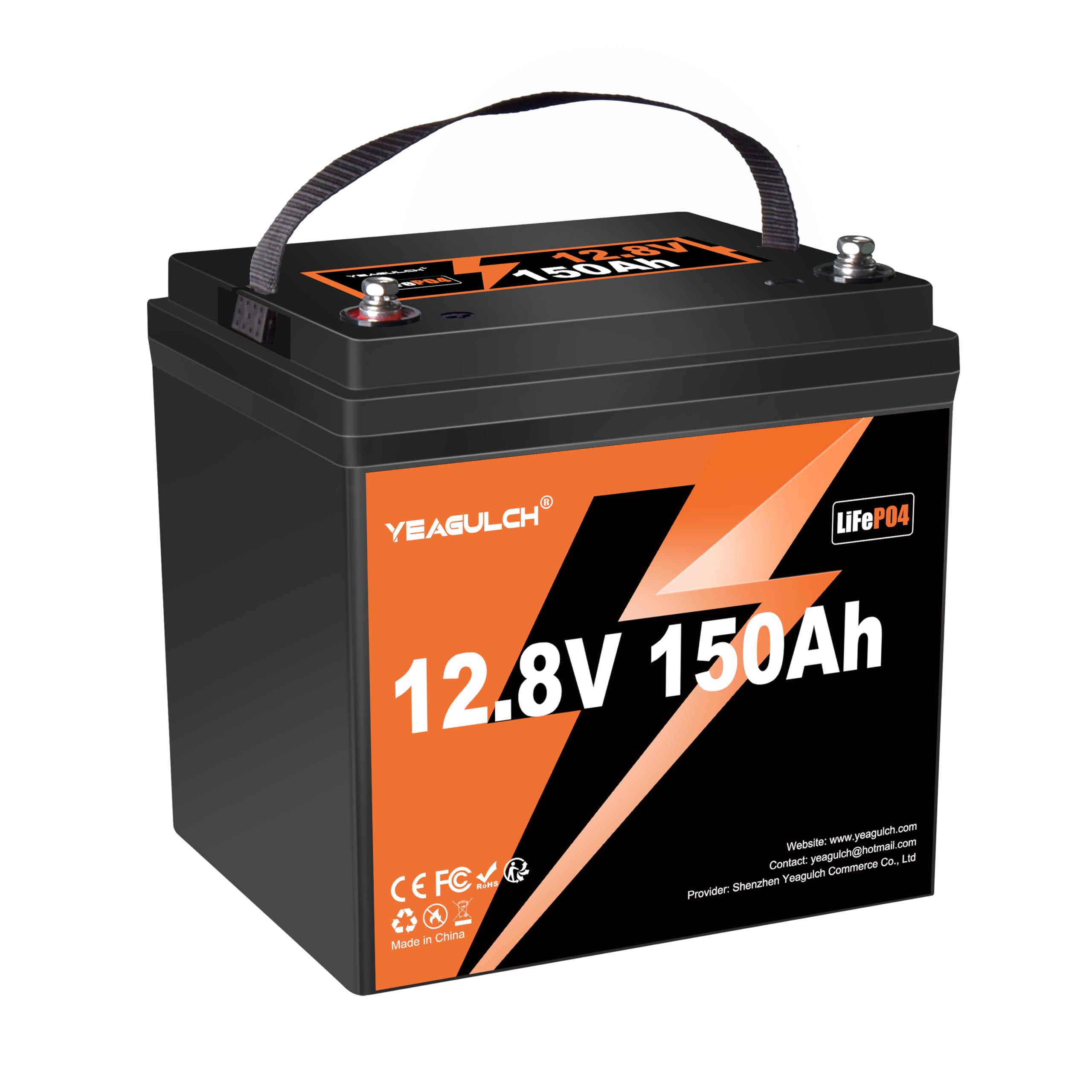
A 150Ah lithium powerhouse that proves its reliability month after month on the water
This upgrade offers serious capacity for pontoon boats, solar setups, and RVs. The 150Ah lithium pack stores 1290 Wh of energy while weighing 41.03 pounds and fitting into a compact 10.01 x 7.68 x 9.84-inch case. Shoppers say running trolling motors to pull a pontoon all week and still landing at half charge. The built-in 100A BMS adds low-temperature cut-off that prevents charging at 32°F and a high-temperature cut-off at 149°F, protecting the cells in extreme conditions.
Reliability leads the praise—nearly 50 buyers call it out, and multiple buyers report running at full power for six months straight. The capacity for expansion is there too: connect up to four batteries in parallel to reach 600Ah, or wire them in series for a 51.2V system. Buyers also praise it as economical for a solar station, charging fully in about half a day.
Unlike the Newport AGM above, this is a heavier investment but one that survives 15,000 cycles at 60% depth of discharge. Some owners note it’s “not the greatest batteries but functional and an amazing value,” and battery life gets mixed feedback—most hold charge well, but a few report units that don’t. It’s a premium-grade 12v battery for serious off-grid use, not a budget option.
High capacity: 1290Wh in a 41-pound package, with low and high-temperature BMS cutoffs.
Worth noting: A few owners mention charging quirks, so pair it with a quality LiFePO4 charger.
Best for: boaters and solar users who need 150Ah of dependable power and want room to expand.
Think twice if: you’re on a tight budget—the AGM options above cost less upfront.
5. Mighty Max Battery 12V 100AH Deep Cycle

A 100Ah AGM that powers whole sheds and fridges for days when tied to solar
When a solar system needs a dependable storage bank, this UL-certified 100Ah AGM from Mighty Max steps up. It’s a sealed lead-acid battery that’s spill-proof, maintenance-free, and mounts in any position, with a Group 27 footprint measuring 12.09 x 6.65 x 8.48 inches. Customers note running a 32″ TV with a 500W inverter for 4 hours and only draining 1%, and another runs a fridge, fan, and lights without issues. There’s even a report of powering a 52″ TV, 10 LEDs, and a fridge for 5 days during a power outage.
Performance earns the most praise, with nearly 70 buyers highlighting it, and solar performance is a named strength—one owner powers all LED lighting in their shed with it. Compared to the WEIZE AGM below, this 28-pound unit is far lighter and more manageable to move. It also holds its value as a no-maintenance option with a 1-year warranty.
Battery life gets mixed reviews: while many say it holds a charge very well, some report it no longer holds a charge after years of heavy cycling. This is the nature of lead-acid chemistry—at roughly 500 cycles, it won’t match lithium’s lifespan. For a 100Ah trolling motor battery on a 12ft Jon boat, reviewers point out 8+ hours of use with 35% charge remaining, which is solid for the price tier.
What wins owners over
- Runs a fridge, fan, and lights off solar without issues
- 28 lbs is manageable for a 100Ah pack
- Fits Group 27 battery boxes and resists vibration
Before you buy
- Battery life is mixed—some units fade after heavy cycling
- Heavy compared to lithium alternatives of the same capacity
Reach for this if: you want proven solar storage or trolling motor power without premium lithium pricing.
skip it if: you need light weight and decade-long lifespan—the lithium picks above win there.
6. dumfume 12V 150Ah Max LiFePO4 Battery
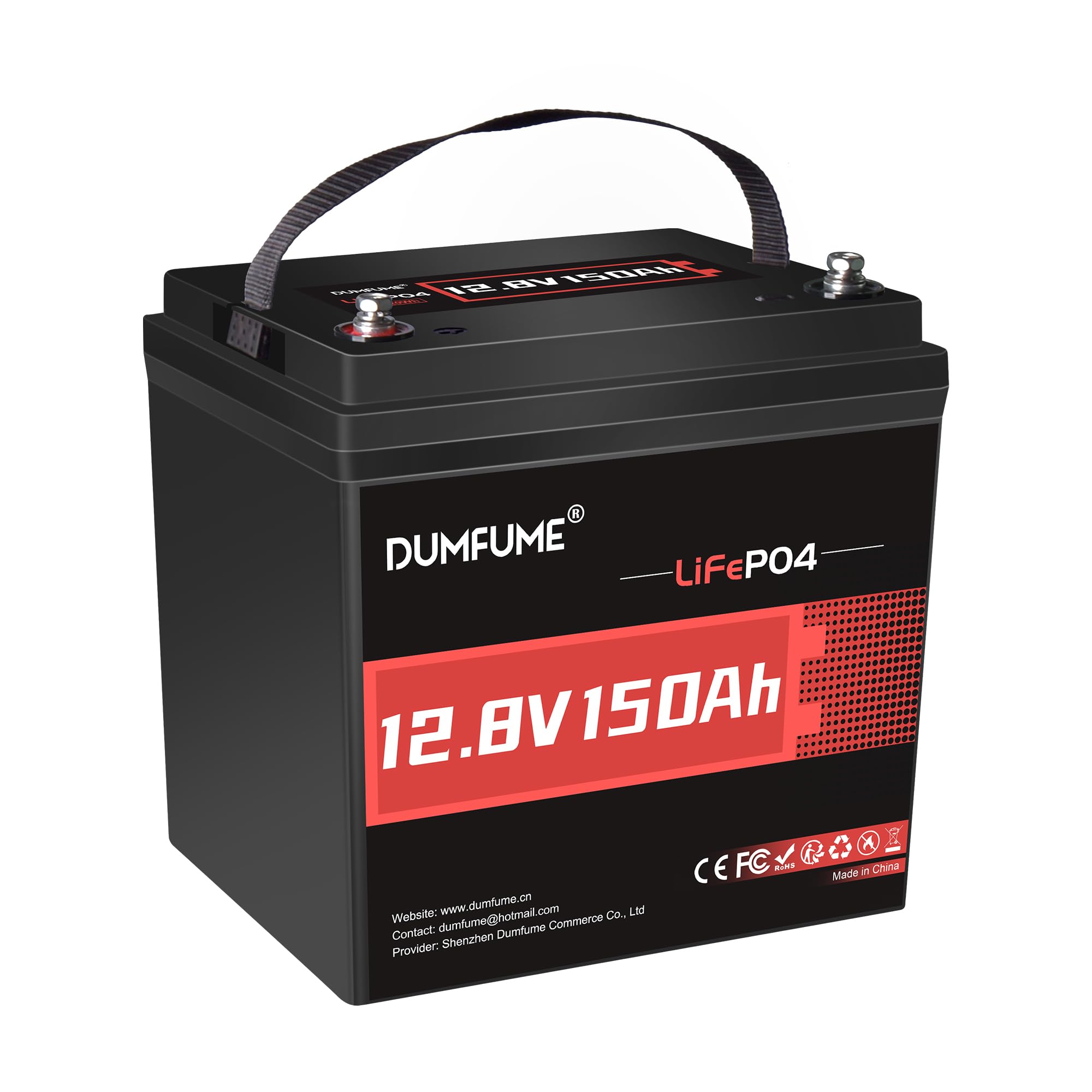
A 1920Wh lithium giant that runs a 100-watt solar camper with ease
This battery is for the serious off-grid RV owner. It packs 1920Wh of reliable energy—among the highest in this lineup—into a 41.03-pound case measuring 10.04 x 7.68 x 9.84 inches. A Scamp camper owner reports it works great with 100 watts of solar on the roof. The built-in 100A BMS provides full protection against overcharge, over-discharge, short circuit, and overheating, and it can be expanded up to 4S4P for larger systems.
Battery quality is the single most-praised feature here, with nearly 120 buyers singling it out, and performance follows. Owners also note it’s lightweight for the capacity, making it a practical upgrade for camper vans and tight cabinet spaces in solar setups. One buyer called it “a good no frills lifepo4 battery,” well-built and dependable for power station storage.
The trade-off appears in charging—it’s the most-discussed mixed aspect, with some owners reporting units that won’t fully charge. There’s also a durability concern, as one owner reports a unit failing after a year. It’s a premium 12 volt battery that rewards careful charging habits; treat it well with a proper LiFePO4 charger and it should serve for years. Just remember it requires temperatures of 5°C or higher for peak performance.
Monster capacity: 1920Wh holds more than the Mighty Max 100Ah at nearly half the weight per unit of energy.
Mixed charging: The biggest recurring gripe is units that don’t fully charge, so use a proper charger.
Standout spec: 4000+ cycles to 80% capacity—over a decade of weekly use for most RV owners.
Look elsewhere if: you want a plug-and-play battery with Bluetooth monitoring; this one is a basic workhorse.
7. WEIZE 12V 100Ah Deep Cycle Group 31

An industrial-grade 100Ah AGM bank that refuses to quit through long off-grid stretches
Commercial buyers and serious off-grid users will find a lot to like in this WEIZE Group 31 battery. Rated for 100Ah with a 1150A max discharge current, it’s built for heavy machinery, wheelchairs, scrubbers, and whole-home backup. One owner ran 18 interior LED lights and 3 vent fans for over 20 hours without recharging. Four of these in parallel can feed a 2000W inverter for around 4.8kWh of emergency backup power, running outlets, fans, and even a garage door opener.
Battery quality leads the praise, with over 60 buyers calling it out, and battery life is a close second. Owners appreciate that it outperforms standard lead-acid at a better price, with a spill-proof, maintenance-free design that needs no fluid checks. One RV owner ran two units off-grid for 2 years with 300W of solar and zero issues. The 3% self-discharge rate means it holds its charge through long storage periods.
The trade-off is weight—63 pounds is heavy, and it’s called out as a mixed point. This is what you get with a sealed lead-acid battery of this size compared to the 22-pound lithium options. It’s also specifically positioned as a replacement for UB121000 and Renogy 100Ah units, making it a reliable swap-in for existing systems. For a stationary, dependable AGM 12v battery that powers the essentials without fuss, this delivers.
Built for endurance
- 1150A max discharge handles high-current inverters
- Ran 18 LED lights and 3 vent fans for 20+ hours
- 3% self-discharge rate holds charge in storage
Heft to plan for
- 63 lbs makes it a two-person lift for most users
- Sealed lead-acid won’t match lithium’s cycle life
Confident verdict: A no-nonsense AGM tank for wheelchairs, commercial gear, and home backup.
Who should pass: anyone installing in a tight boat or RV where the 63-pound weight becomes a chore.
8. HumsiENK 12V 100Ah LiFePO4 with Bluetooth
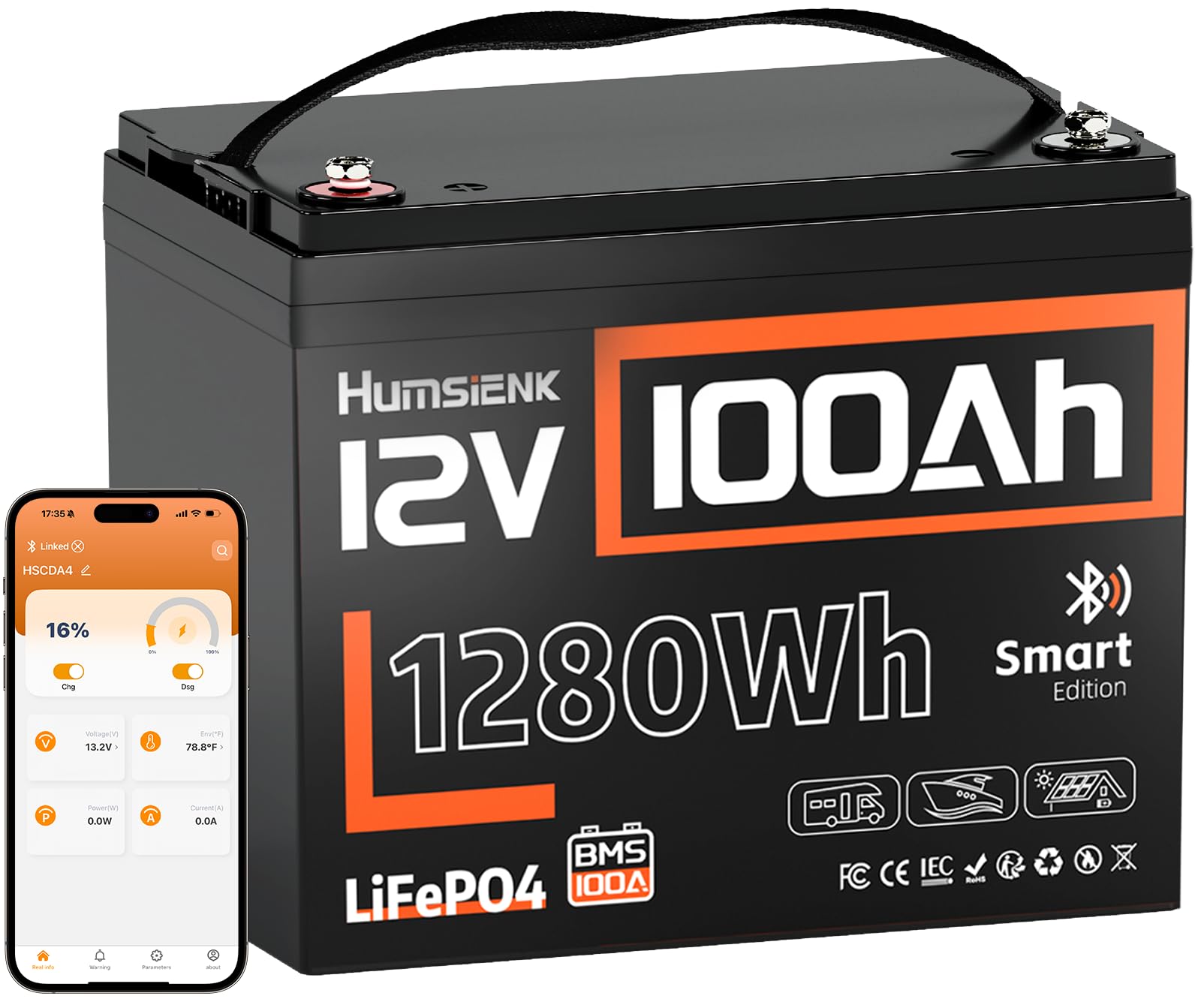
A smart 100Ah lithium that puts live battery data on your phone
Tech-savvy RV owners and solar users will love what HumsiENK brings: a 100Ah LiFePO4 battery with a dedicated Bluetooth app that shows real-time voltage, temperature, and state of charge. It weighs just 19.7 pounds—making it one of the lightest options here—and fits BCI Group 24–31 battery boxes with a compact 8.2″H x 6.6″W x 10.2″L footprint. Owners call the Bluetooth communication “excellent” and the app updates frequently with cell-level details, perfect for monitoring a solar setup at a glance.
The range of uses is broad: it powers 8000 BTU A/C units in eco-mode for 11 hours to 50% drain, runs major kitchen appliances through a 2000W inverter, and holds charge well for marine and RV duty. With an IP65 waterproof rating, it shrugs off splashes, and the 100A smart BMS delivers full protection against overcharge, over-discharge, over-current, and short circuits. Battery quality gets the most praise—over 70 buyers call it out—with light weight following close behind.
It’s important to note that this is designed for deep-cycle energy storage, not engine starting. One buyer had a terminal overheat during a high-draw test, though customer service replaced the unit immediately, and other owners praise the responsive support. The 5-year warranty covers defects, but a few shoppers say units that won’t take a full charge, so verify the first few cycles. Compared to the Litime below, it matches the capacity and Bluetooth features while offering a lower barrier to entry.
App monitoring: Live voltage, temperature, and capacity readouts make it a favorite for solar and camper setups.
Support matters: Customer service is responsive, but occasional charging quirks mean you should verify the first charge.
Ideal for: solar, RV, and marine users who want a lightweight, app-connected battery with a 5-year warranty.
Consider instead: the Litime if you value an even larger owner community and similar smart features.
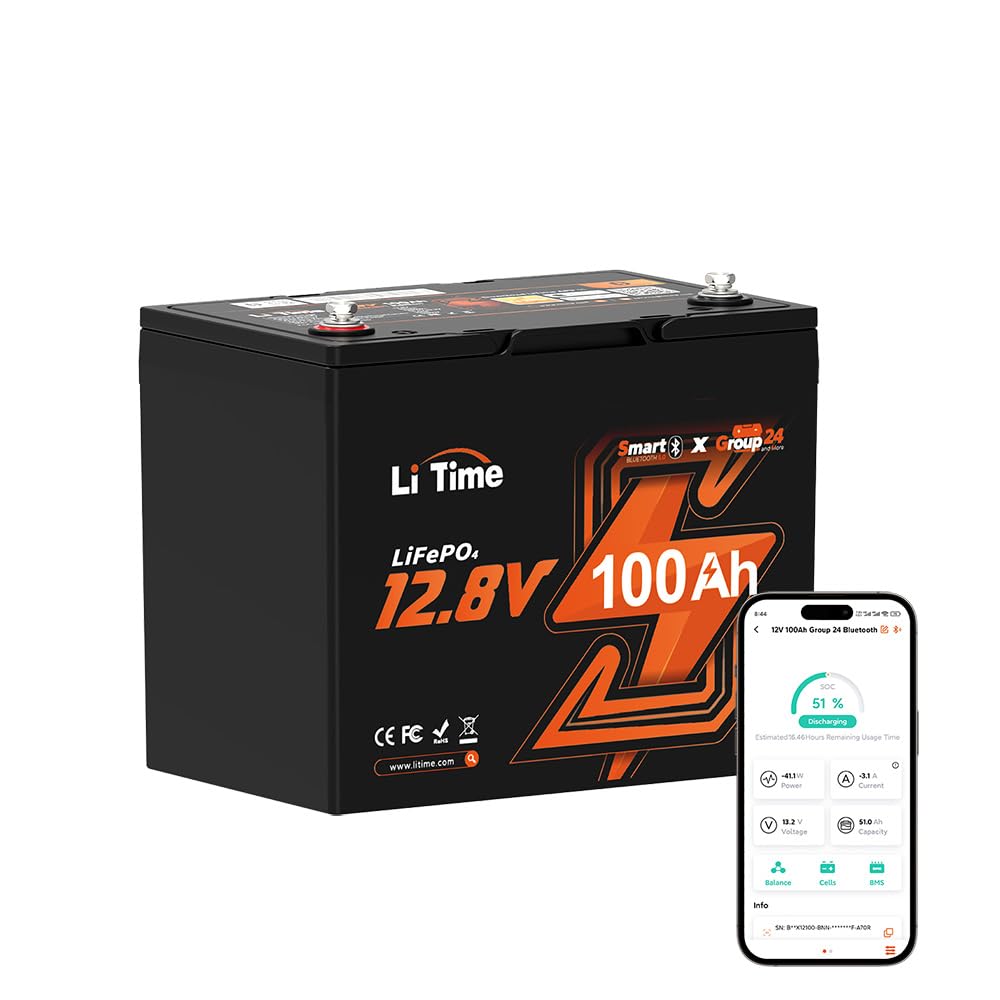
9. Litime 12V 100Ah LiFePO4 Group 24
The premium lithium upgrade RV owners swear by for dependable, monitor-ready power
For the buyer who wants the complete package, this Litime Group 24 lithium battery delivers the strongest owner consensus in the lineup. It weighs just 21.9 pounds and stores a full 100Ah/1280Wh of energy—and unlike a lead-acid battery, the whole 100Ah is usable because lithium discharges fully to 100% DOD. It runs an RV fridge and 30A compressor for two years in a truck bed per one owner, and a tent-trailer owner confirms it charges to 99% with a stock RV charger. The Bluetooth 5.0 app pairs instantly via QR code for monitoring.
The thing everyone raves about is battery quality—over 170 owners call it out, the highest single positive count in this whole guide—with value for money as the second-strongest mention. Buyers describe it as a durable, plug-and-play upgrade that outperforms lead-acid, and it fits perfectly in double battery boxes. Power, weight, and Bluetooth connectivity all score strongly, making it the most well-rounded lithium option here.
The honest caveats: battery life gets mixed feedback, with some owners reporting units that fail to hold charge overnight, and the app can be glitchy during charging—one owner notes annoying disconnect notifications that need a reconnect. The 100A BMS offers 20+ safeguards including a low-temperature cutoff that stops charging at freezing temps to protect the cells. With a 10-year lifespan and 4000+ deep cycles claimed, it’s a premium 12 volt battery that asks you to trust the brand—and most owners say that trust pays off.
Owners’ top compliments
- Battery quality is the most-praised feature of any pick here
- 21.9 lbs and full 100Ah usable capacity beats lead-acid’s 50%
- Bluetooth 5.0 app shows charge and discharge rates live
Fair warnings
- App needs occasional refresh for accurate state of charge
- Battery life feedback is mixed on long-term charge holding
Who it’s for: RV owners and off-grid users who want the most owner-verified lithium quality on the market.
Who should pause: budget-first buyers—the AGM picks above cost far less upfront for basic power.
Understanding the Specs
Amp-Hours (Ah)
Amp-hours measures how much energy a battery can deliver over time. A 100Ah battery gives 100 amps for one hour, or 10 amps for 10 hours. For deep-cycle use, compare how much of that capacity you can actually use: lithium batteries allow a 100% discharge, while lead-acid batteries should stay above 50% to protect their lifespan.
Battery Management System (BMS)
Every modern lithium 12V battery has a BMS—a built-in controller that guards against overcharging, over-discharging, short circuits, and overheating. Look for a high-rated BMS like a 100A unit if you plan to run power-hungry gear like inverters or high-thrust trolling motors that draw significant current.
FAQ
What is the difference between AGM and LiFePO4 batteries?
Can I use a 12V lithium battery as a starting battery for my engine?
How long will a 12V battery last on a single charge?
Why is a 100Ah lithium battery lighter than a 100Ah lead-acid?
What does the Battery Management System (BMS) protect against?
Can I connect multiple 12V batteries together?
What is depth of discharge and why does it matter?
How do I choose between a 50Ah and a 150Ah battery?
Do I need a special charger for LiFePO4 batteries?
Final Thoughts: The Verdict
For most buyers, the 12 volt batteries winner is the Mighty Max ML12-12 2-Pack because it delivers proven, affordable backup power with a stronger owner rating than any other pick here. If you want a smart lithium upgrade with live phone monitoring, grab the Litime 12V 100Ah. And for serious off-grid capacity and trolling motor endurance, the dumfume 150Ah Max is the one to reach for.
How We Picked
We do not accept paid placement. Every pick is matched to a real buyer and a real use-case; we do not hands-on test units.
Sources & Methodology
Specifications: manufacturer listings and product documentation. Review insights: verified customer reviews, as of August 2026. Pricing: not shown on this page (it changes often); check the current price via the retailer link.
As an Amazon Associate, Gadgets Feed earns from qualifying purchases. This does not affect which products we feature.