
Dragging a set of six lead-acid batteries up a hill while your golf cart lags is a familiar frustration. The weight, the maintenance, the acid fumes, and the gradual loss of range all point to a single decision point: switching to a modern, high-energy-density lithium iron phosphate (LiFePO4) setup. The right 12 volt golf cart battery doesn’t just sit under the seat — it transforms how your cart accelerates, climbs, and holds a charge through a full round and then some.
I’m Min — the co-founder and writer behind Gadgets Feed. My analysis here comes from hundreds of hours comparing datasheets, customer load-testing reports, and real-world installation feedback across dozens of voltage and capacity configurations to find the best drop-in and upgrade options for the widest range of carts and budgets.
Whether you are retrofitting an older Club Car or spec’ing a new lithium conversion kit, this guide breaks down every critical spec, BMS capability, and compatibility nuance to help you pick the right 12 volt golf cart battery for your exact driving style and terrain.
How To Choose The Best 12 Volt Golf Cart Battery
Picking the right battery for a golf cart is a decision that balances capacity, physical dimensions, chemistry, and continuous discharge capability. Lead-acid batteries have been the standard for decades, but lithium iron phosphate (LiFePO4) has become the dominant choice for anyone upgrading because it eliminates watering, reduces weight by over 100 pounds in a typical six-battery 36V or 48V pack, and delivers full voltage until depletion instead of the steady voltage sag that plagues lead-acid under load. Here are the core factors that separate a good match from a regretful purchase.
Capacity and Range: Amp-Hours vs Real-World Driving
Capacity, measured in amp-hours (Ah), directly determines how many miles you can drive before recharging. A 100Ah 48V pack delivers roughly 5.12kWh of usable energy. In real-world conditions — flat fairways versus hilly terrain, two passengers versus four, ambient temperature — expect around 20-30 miles per charge from a 100Ah pack and up to 40-50 miles from a 105Ah pack. Lead-acid batteries lose usable capacity as they discharge because their voltage drops continuously. LiFePO4 holds a flat discharge curve above 12.8V (in a 12V nominal cell) for most of the cycle, so the range is more predictable. Always factor in a 20% reserve — running a LiFePO4 pack below 20% state of charge (SOC) can trigger the BMS low-voltage cutoff, leaving you stranded until a charger wakes it up.
Chemistry: AGM, GEL, and LiFePO4 Trade-offs
AGM (Absorbent Glass Mat) batteries are sealed, maintenance-free, and moderately priced, but they offer only 300-500 deep cycles before capacity degrades significantly. GEL batteries use a silica-thickened electrolyte that reduces internal resistance and slows self-discharge compared to AGM — a good fit for solar charging or infrequent use because they hold charge longer when idle. LiFePO4 is the performance winner: 4000 to 6000 deep cycles, half the weight of AGM, no acid leaks, and a built-in Battery Management System (BMS) that handles over-current, over-temperature, short-circuit, and low-voltage cutoff automatically. The trade-off is initial cost — a LiFePO4 pack costs 3-5 times upfront but lasts 10-15 years versus 3-5 years for lead-acid. For any owner who uses their cart weekly, the total cost of ownership is lower with lithium.
BMS Continuous Current and Peak Surge Rating
The BMS is the brain and gatekeeper of any lithium battery. The continuous discharge current rating must exceed your golf cart motor controller’s maximum draw. A typical 3kW golf motor pulls 80-120 amps on flat ground but can spike to 300-400 amps for several seconds during hill starts or when the controller demands full torque. A 100A BMS is suitable only for low-power carts or trolling motors. A 200A BMS handling 400-600 amp peak surges for 3-5 seconds is the safe standard for a full-size golf cart conversion. OGRPHY and Cloudenergy both advertise 200A continuous with 1000A peak for 3 seconds, which provides headroom even with aggressive driving on 15% grade hills. Never undershoot the BMS rating — persistent current draws near the BMS limit cause heat buildup that can lead to thermal shutdown mid-round.
Physical Fitment: BCI Group Size, Terminal Type, and Tray Modifications
A lithium battery may be the perfect spec on paper but pointless if it does not fit in your cart’s battery tray. Most 48V lithium conversion packs aim for a single rectangular footprint that replaces six 8V or four 12V lead-acid batteries. The OGRPHY and TEMGO batteries measure approximately 20.7 x 10.6 x 8.7 inches, which fits the standard Club Car DS and Precedent trays. Yamaha G29 and EZGO TXT trays may require a plywood base or shimming to center the battery. Terminal orientation — M8 studs on the short side versus long side — determines cable routing ease. The Cloudenergy pack includes a retention strap; others require you to drill and bolt angle iron. Measure your tray interior width, length, and height under the seat before buying — an inch too tall means you are raising the seat cushion.
Quick Comparison
On smaller screens, swipe sideways to see the full table.
| Model | Category | Best For | Key Spec | Amazon |
|---|---|---|---|---|
| Cloudenergy GFA48V-105AH | Premium Lithium Kit | Full-range conversion + 6000 cycles | 250A BMS, 105Ah, 20A charger | Amazon |
| VATRER POWER 48V 105Ah | Premium Lithium | Metal-case durability, aggressive driving | 200A BMS, 5.37kWh, 20A charger | Amazon |
| OGRPHY 48V 105AH | Premium Lithium Kit | Smart monitoring + long-range driving | 200A BMS, 105Ah, 50 mi range | Amazon |
| OGRPHY 48V 100AH Kit | Mid-Range Lithium Kit | Full conversion package, Bluetooth monitor | 200A BMS, 5.12kWh, 18A charger | Amazon |
| Wattcycle WT12V100AH100 | Mid-Range 12V Lithium | Multi-pack series for 48V carts | 100A BMS, BCI Group 24, 15000 cycles | Amazon |
| Dumfume 12V 150Ah LiFePO4 | Mid-Range 12V Lithium | High-capacity solar/RV + golf cart | 100A BMS, 1920Wh, 4000+ cycles | Amazon |
| Newport 12V50Ah AGM | Budget Lead-Acid | Light marine/trolling use | 50Ah, 32 lbs, AGM sealed | Amazon |
| Mighty Max ML35-12 GEL | Budget GEL | Gate openers, solar, low-power use | 35Ah, GEL chemistry, Nut & Bolt terminal | Amazon |
| TEMGO S48 100Ah | Mid-Range Lithium Kit | Budget-conscious 48V conversion | 200A BMS, 5.12kWh, 18A charger | Amazon |
In‑Depth Reviews
1. Cloudenergy 48V 105Ah LiFePO4 Golf Cart Battery
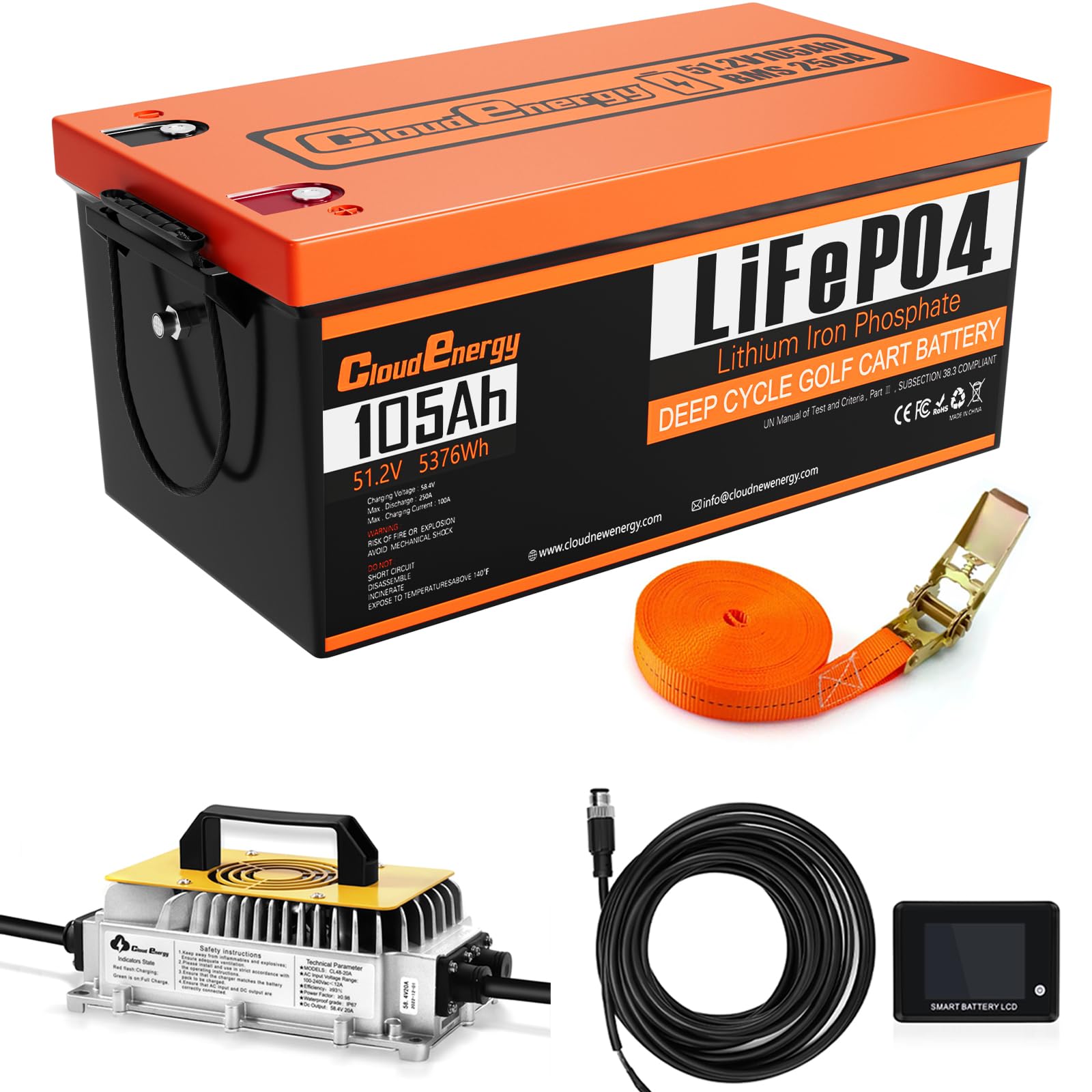
The Cloudenergy GFA48V-105AH stands out with the most generous BMS in this class — a 250A continuous unit that handles 400A surges for 35 seconds and 600A bursts for 3 seconds. That headroom means no BMS-induced power cuts when your motor controller demands peak torque climbing a steep cart path with four passengers. The 105Ah capacity (5.37kWh) translates to 40-45 miles of real-world range in a Yamaha G29, per customer reports, and the included 58.4V 20A quick charger refills from 20% to full in roughly 5 hours. The 2.8-inch LCD touch monitor plus Bluetooth app give you per-cell voltage readings, SOC percentage, and cycle count at a glance, which helps catch early cell imbalance before it becomes a problem.
The 3-in-1 kit includes the battery, charger, LCD display, and a 78.7-inch retention strap — enough hardware to bypass the need for custom drilling in most Club Car DS and Precedent trays. Customers report simple installation in under two hours, including bypassing the OBC (on-board computer) by jumping the white-to-blue wire. The ABS case is fireproof, shockproof, and rated IP67 for water ingress, so a wet washdown or rain exposure won’t shut you down. Multiple verified buyers note a noticeable increase in both acceleration and top speed compared to their old lead-acid packs, and several report no performance degradation after 9 months of weekly use.
The one recurring caveat: the BMS can develop miscalibration if the 12V converter creates a parasitic drain during storage. Cloudenergy’s support team is responsive during business hours, sending firmware updates and replacement chargers via WhatsApp when needed. The 5-year warranty adds peace of mind, but make sure to store the battery above 5°C and perform a full maintenance cycle every six months if leaving it idle. For anyone seeking the highest cycle life warranty and the most robust BMS headroom in a drop-in 48V pack, this is the safest bet in the premium tier.
Why it’s great
- 250A continuous BMS with 600A peak handles the steepest hills without cutoff
- 6000+ cycles at 80% DoD — roughly 15 years of golf-cart use
- Complete kit: battery, 20A charger, LCD monitor, retention strap
- Responsive customer support via WhatsApp with firmware updates
Good to know
- 12V converter parasitic drain can cause BMS miscalibration if not stored correctly
- No printed installation manual; relies on video guides and email support
- Battery is 82.7 lbs — still much lighter than lead-acid but heavy to maneuver alone
2. VATRER POWER 48V 105Ah Lithium Golf Cart Battery

The VATRER POWER 48V 105Ah battery takes a different approach to protection: instead of an ABS plastic case, it uses a high-strength cold-rolled sheet metal enclosure rated IP67 waterproof and fireproof. That metal shell adds about 20 pounds compared to the Cloudenergy but provides vastly superior impact resistance if the battery shifts in the tray during sharp turns. The 200A continuous BMS delivers 400A surges for 35 seconds and 600A for 3 seconds — identical headroom to the OGRPHY pack — and the 5.37kWh capacity powers 50 miles of range per charge with a 3kW motor, per the manufacturer’s controlled test. The included 58.4V 20A charger fills from flat to 100% in about 5.5 hours, and the 2.8-inch LCD touchscreen shows per-cell millivolt readings, which is useful for spotting early cell drift.
Installation in a Club Car DS or Precedent is straightforward, though the M8 mounting screws provided are too short for the DS tray — several customers had to bolt the battery to a 3/4-inch plywood base as a spacer. The battery shipped at 52% SOC out of the box, so a full charge cycle is recommended before first use. The Bluetooth app connects instantly and displays SOC, voltage, current, and individual cell data with the key off. Owners of EZGO RXV and Icon carts report a noticeable improvement in acceleration and hill-climbing torque, and several say the battery easily lasts a full weekend of neighborhood driving without needing a recharge. The 5-year warranty is handled directly by VATRER, with one customer reporting a seamless replacement when his unit failed after an extended unplugged storage period.
The primary concern across reviews is that leaving the battery unplugged for more than five days can trigger BMS low-voltage cutoff if the 12V converter has any parasitic drain — VATRER’s manual explicitly advises turning off the battery switch or leaving the charger connected during storage. A small number of users reported BMS shutdown at 40-50% SOC, which was resolved after a full charge/discharge cycle to recalibrate. The metal case also means that if you need to drill any additional mounting holes, you are working with sheet steel rather than plastic. For buyers who prioritize physical durability — especially in carts subjected to rough terrain, vibration, or frequent rain — the VATRER’s reinforced enclosure and high IP rating make it the most rugged 48V conversion battery available.
Why it’s great
- Cold-rolled steel case provides top-tier impact and puncture resistance
- IP67 waterproof rating handles rain and washdowns without concern
- 50-mile range per charge with a 3kW motor
- 5-year warranty with responsive customer support for replacements
Good to know
- Mounting screws too short for Club Car DS — requires a plywood spacer
- Metal case adds weight (102.5 lbs) and complicates custom drilling
- Parasitic drain can trigger BMS cutoff if left unplugged over 5 days
3. OGRPHY 48V 105Ah Lithium Golf Cart Battery
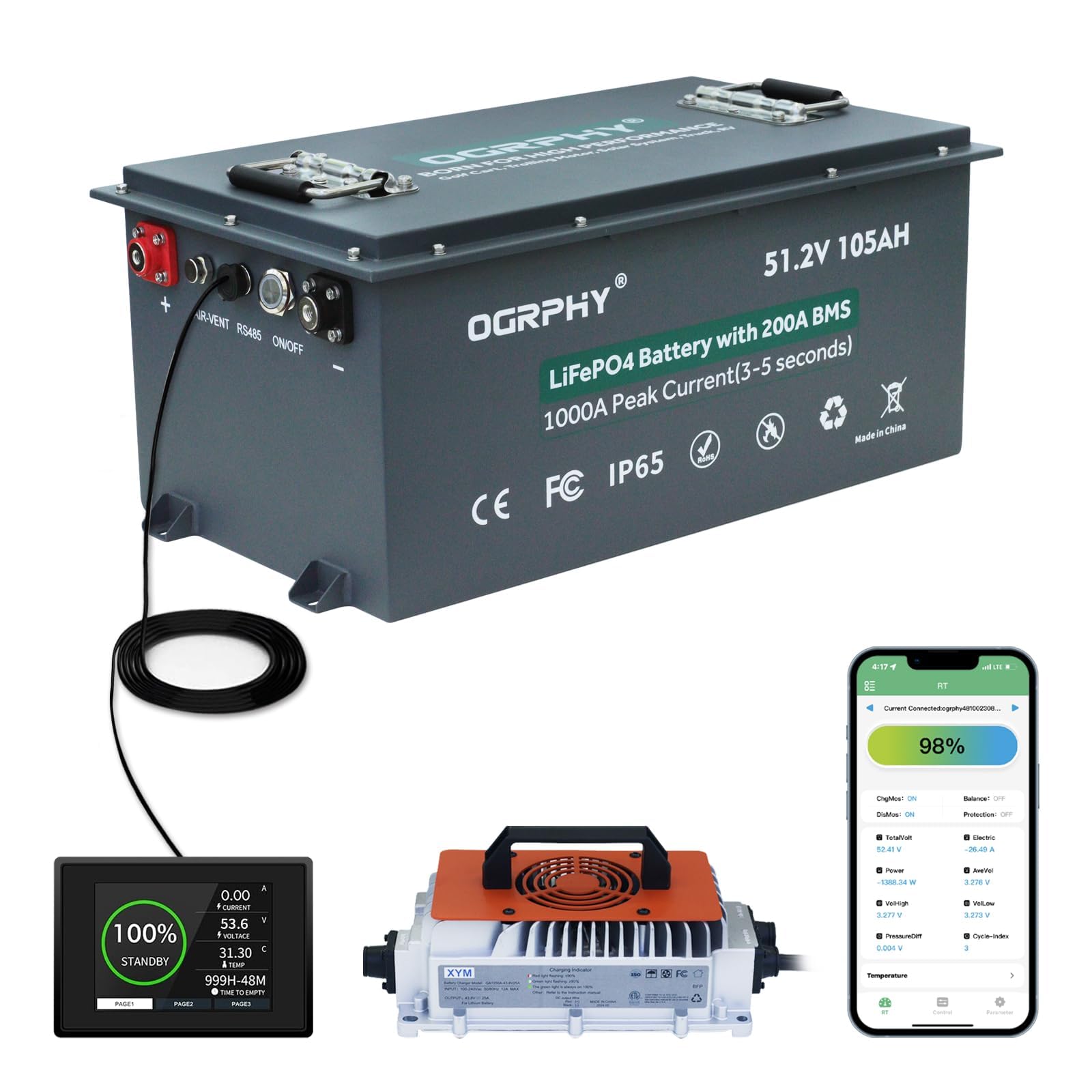
The OGRPHY 48V 105Ah battery hits the sweet spot where capacity, BMS headroom, and smart-monitoring features converge at a price that undercuts the Cloudenergy and VATRER while offering the same 200A continuous / 1000A peak BMS. It uses UL-certified Grade A prismatic LiFePO4 cells and packs 5.37kWh of usable energy — enough for 50 miles per charge with a 3kW motor, per internal testing. The upgraded 200A BMS is one of the most forgiving on the market: 200A continuous indefinitely, 300A for 32 seconds, 600A for 32 seconds, and 1000A peak for 3-5 seconds. That enormous surge handling means that even heavy carts on steep terrain rarely trigger a BMS shutdown. The included 58.4V 18A charger is designed for in-vehicle mounting and charges through the cart’s original port, which simplifies the conversion considerably.
Customer feedback from 2008 Club Car Precedent and 2016 EZGO TXT owners consistently reports speed increases of 2-4 mph after conversion, after-installation range of 30-36 holes of golf on hilly courses with over 70% remaining charge, and straightforward fitment — the compact 19.7 x 11.6 x 8.66-inch footprint fits most standard trays without raising the seat. One user who installed the battery in a 2017 EXGO reported perfect cell balance (3.397-3.409V across 16 cells) after 8 months, with a full recharge from 24% SOC taking about 6 hours. The LCD touch monitor and Bluetooth app both work reliably, and the company offers 7×24 email support with response times under 24 hours. Several reviewers mention that the physical instructions are sparse — relying on YouTube installation videos is the norm.
The main downside is that the 48V 105AH variant is a newer, next-generation release compared to the 100AH kit. A few early buyers noted that the battery’s RS485 screen button requires a firm press to register, and the retention hardware for the existing tray may not match pre-drilled holes exactly — some custom drilling or angle-iron bracketing is still needed. The 5-year warranty covers defects, and OGRPHY provides prepaid return labels for issues. For a single-battery drop-in replacement that delivers class-leading surge capability and a full smart-monitoring suite, the OGRPHY 48V 105Ah is the most balanced premium option on the list.
Why it’s great
- 1000A peak surge capability is unmatched in the sub- tier
- 50-mile real-world range eliminates range anxiety for full-day use
- Compact footprint fits most stock trays without modifications
- Excellent cell balance and battery health after 8 months of use
Good to know
- Installation instructions are minimal — YouTube tutorials are essential
- RS485 screen button is stiff and requires a hard press
- Retention hardware may not align with existing tray bolt holes
4. OGRPHY 48V 100Ah Lithium Golf Cart Battery Conversion Kit
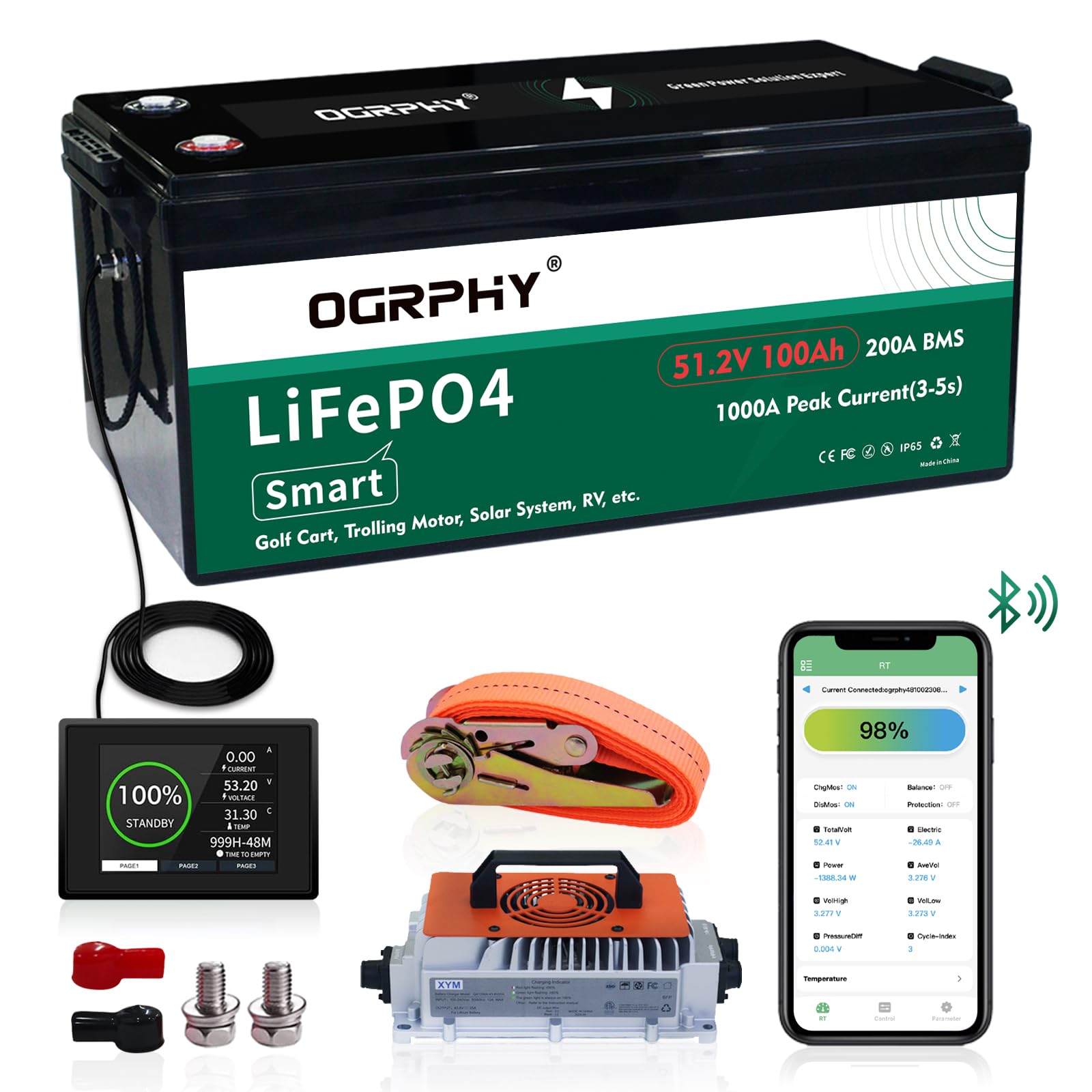
The OGRPHY 48V 100Ah kit is the most complete all-in-one conversion package in the mid-range price tier. It ships with the 100Ah battery (5.12kWh), a 58.4V 18A LiFePO4 charger designed for onboard mounting, a 2.8-inch LCD touch monitor with a stand, and a retention strap — everything except the wrenches. The 200A BMS is the same architecture as the 105Ah version, delivering 200A continuous and 1000A peak for 3-5 seconds, which gives you plenty of headroom for a 3-4kW motor on moderate hills. The 30-mile range claim for a 3kW motor is conservative — real-world user reports on EZGO TXT and Club Car Precedent carts show 28-35 miles depending on terrain and load, which is easily enough for two full rounds of golf plus neighborhood errands.
Installation across different cart models is generally straightforward, but some buyers note that there are no printed instructions for wiring — everything depends on the Bluetooth app’s manual or third-party videos. The battery requires you to bypass the OBC on 2004+ Club Cars by connecting the white wire to the blue wire, which is well-documented in user communities but not always obvious to first-time converters. The physical battery measures 20.4 x 10.6 x 8.6 inches and weighs 88.1 pounds — roughly the weight of a single lead-acid battery from a set of six, but a fraction of the total pack weight. Customers report that the initial charge out of the box takes about 6-7 hours, after which the battery delivers immediate improvement in acceleration and top speed (13 mph to 15-17 mph in one Club Car test).
One edge case: a 2008 Club Car user reported that after 30 minutes of driving, the cart slowed to 9 mph. The cause was a failing speed sensor, not the battery — replacing the sensor and the MCOR resolved it entirely. The 5-year warranty is solid, and the support team is responsive. The one notable difference from the 105Ah version is the charger: the 18A unit is adequate but charges roughly 15% slower than the 20A charger included with the 105Ah kit. For buyers who want a complete, hassle-free conversion kit at the lowest entry point to OGRPHY’s BMS architecture, this 100Ah package is the value king.
Why it’s great
- Complete kit — battery, charger, LCD monitor, retention strap included
- 200A BMS with 1000A peak handle hills and aggressive driving without cutouts
- 30-mile range covers two full rounds with reserve capacity
- 5-year warranty with responsive customer support team
Good to know
- No printed wiring diagram — relies on Bluetooth app manual and YouTube
- 18A charger is slower than the 20A unit found in higher-tier kits
- OBC bypass required for 2004+ Club Car — not immediately obvious to novices
5. Wattcycle 12V 100Ah LiFePO4 Lithium Battery
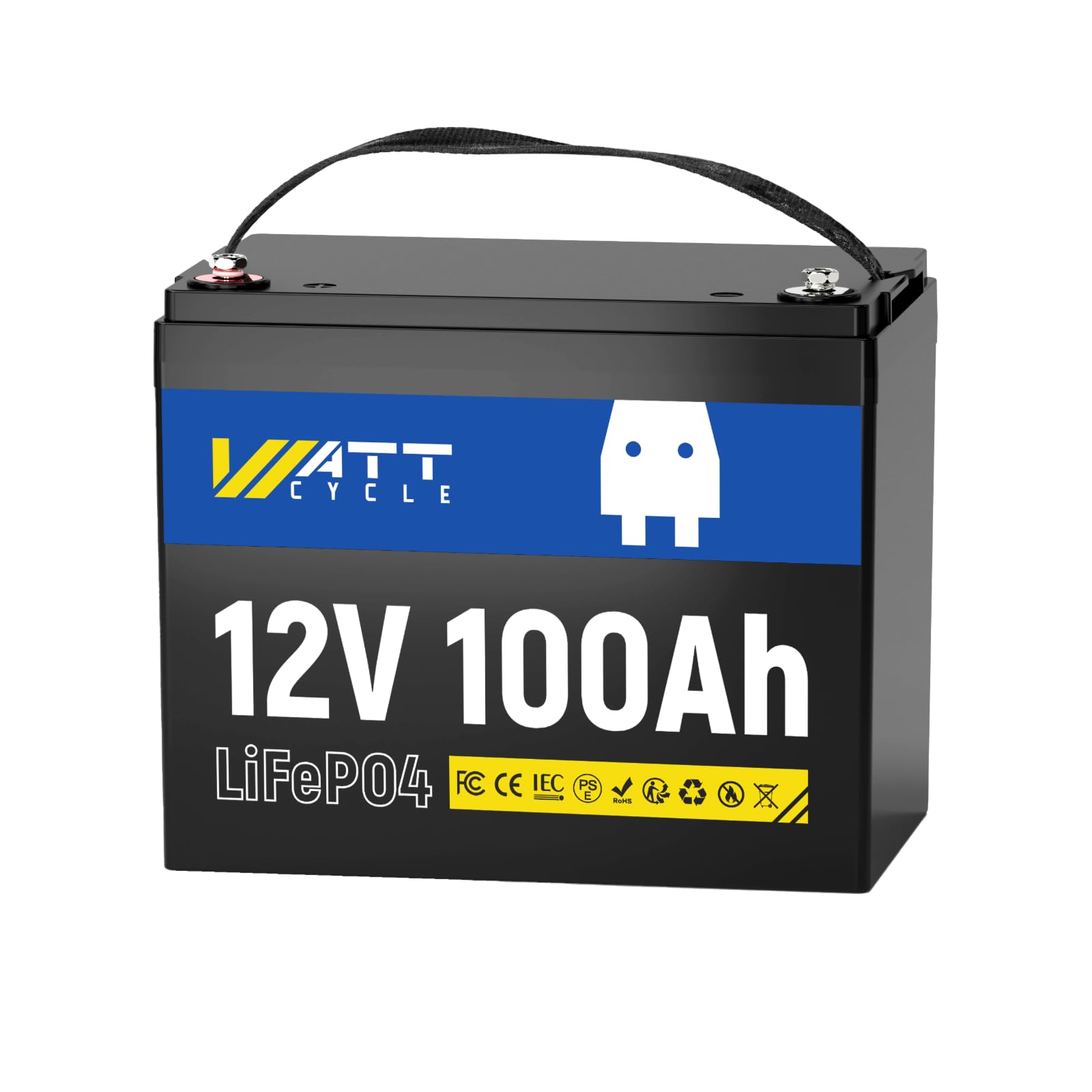
The Wattcycle 12V 100Ah LiFePO4 battery is the ideal building block for anyone constructing a 36V or 48V pack from individual 12V modules rather than buying a single 48V drop-in. Its BCI Group 24 footprint (10.2 x 6.6 x 8.2 inches) fits standard group-size battery boxes, making it a true drop-in replacement for a single 12V lead-acid in trolling motors, RVs, or marine applications — and you can wire up to four in series or four packs in parallel for a massive 20.48kWh energy bank. The headline spec is 15,000 cycles, which is nearly four times the cycle life of the competition at the same price point. That number assumes shallow cycling, but even at 80% depth of discharge, you can expect 5,000-7,000 cycles — still more than double 4,000-cycle-rated batteries. The built-in 100A BMS provides overcharge, over-discharge, short-circuit, and low-temperature cutoff protection, and the BMS automatically disconnects if the discharge current exceeds 300±50A.
Customer reviews highlight the compact size and weight (23.2 lbs) as major advantages — one user runs two in series for a 24V boat trolling setup and reports stable voltage above 25V even after months of use with a 42A max draw at 75% DoD, recharging in 12.5 hours at 6A. Another buyer uses the battery as a house battery on a sailboat to run VHF, lights, a bilge pump, and a 300W inverter, noting that a DC-DC charger is required if your alternator is not LiFePO4-compatible. The main physical annoyance is that the M8 bolt posts are short — 16mm is recommended for parallel connections, but the included bolts are 12mm. A trip to the hardware store for worth of longer hardware solves it, but it is an inconvenience right out of the box.
The battery does not include Bluetooth, which is a trade-off for the lower price — if you want per-cell monitoring, you will need to add a third-party shunt-based monitor (like a Victron BMV or AiLi). Safety certifications include SDS, UN38.3, FCC, CE, and ROHS, so the cell quality is well-documented. For the buyer who is building a custom voltage pack and values the sheer cycle-life longevity above all else, the Wattcycle 12V 100Ah delivers the best per-amp-hour value in the 12V lithium category.
Why it’s great
- 15,000-cycle rating is the highest on this list — far exceeds standard 4000-cycle packs
- BCI Group 24 size fits standard battery boxes for true drop-in replacement
- 20.48kWh max parallel capacity is ideal for large off-grid power banks
- Full safety certification suite (UN38.3, FCC, CE, ROHS)
Good to know
- No Bluetooth monitoring — requires external shunt to track SOC
- Bolt posts are too short for parallel wiring — needs M8 x 16mm hardware
- 100A BMS limits continuous draw — not suitable for high-power golf cart motors alone
6. Dumfume 12V 150Ah LiFePO4 Deep Cycle Battery
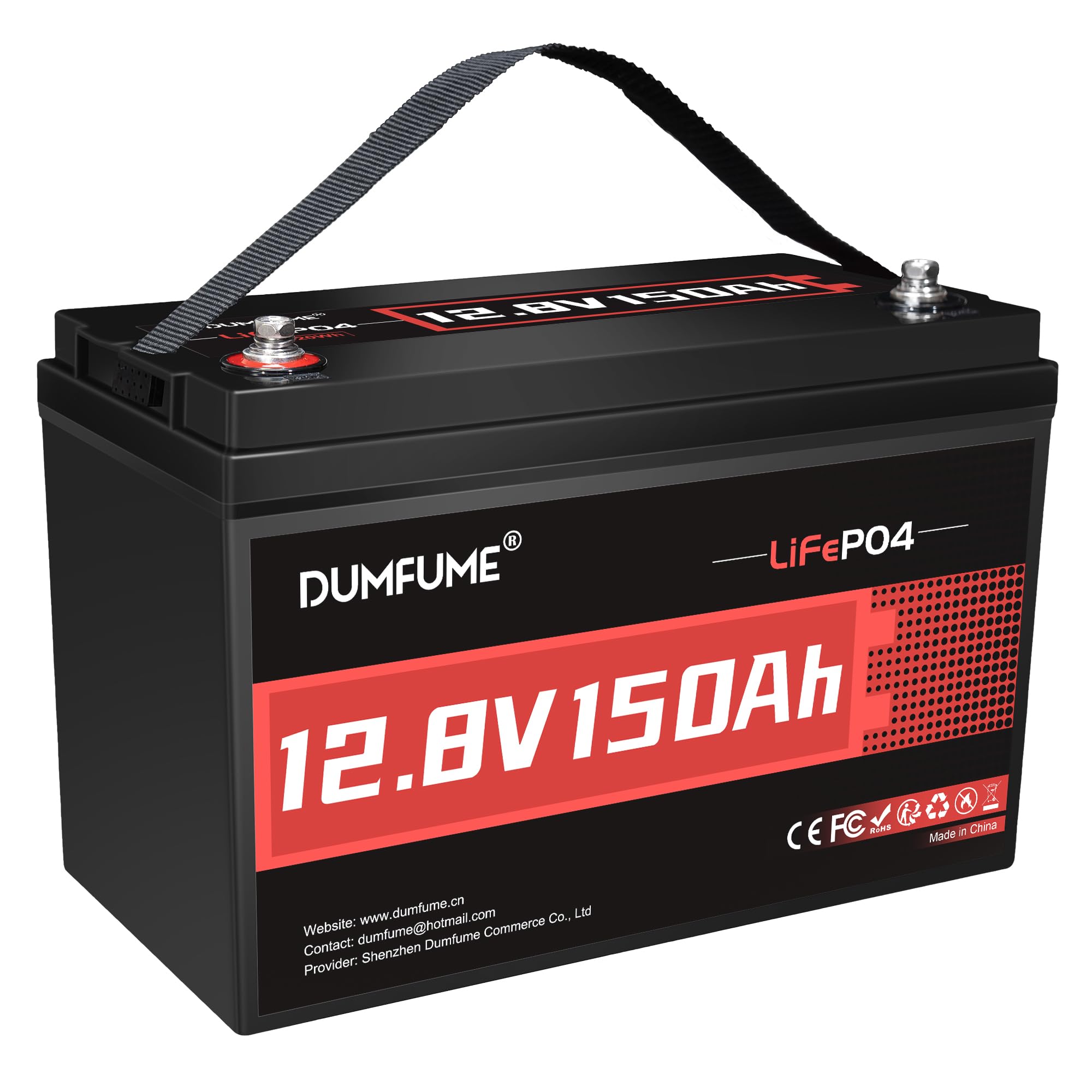
The Dumfume 12V 150Ah LiFePO4 battery is a high-density energy storage cell designed for applications where runtime is more critical than peak discharge current. Its 1920Wh capacity (12.8V x 150Ah) makes it suitable for powering a golf cart’s accessory systems, solar energy storage for a cart-mounted panel, or as a single-battery solution for light-duty electric vehicles that require long runtimes without high surge demands. The 100A BMS limits continuous discharge to 100A (1280W), which is sufficient for a 1.5kW motor but restrictive for a full-size 3-4kW golf cart motor that can draw 200A+ under load. The 4000-cycle rating at 80% DoD is standard for LiFePO4, and the battery supports up to 4S4P expansion (series and parallel) for building a 48V 600Ah bank, though the 100A BMS becomes a bottleneck in series for high-power draws.
Customer feedback is mixed but informative: multiple buyers report that the battery arrived at low voltage (12.2-12.4V) and required a parallel “jump” charge with a known good battery to wake the BMS. This is a common quirk with LiFePO4 batteries that have been sitting on shelves — the BMS enters protection mode if the voltage drops below the cutoff threshold during storage. One user who purchased four batteries for a solar setup found that all four exceeded their rated capacity by roughly 7Ah each, which is a strong sign of Grade A cell quality. However, a critical 1-star review — and the reason this battery sits in the mid-range tier instead of higher — describes a unit that failed after one year in a campervan, unable to hold charge overnight with a 3.5A fridge draw. The user noted that the 5-year warranty only applies to direct purchases from the manufacturer, not Amazon, so the warranty path is ambiguous.
Weighing only 22.05 pounds, the Dumfume is one of the lightest 150Ah batteries available, making it easy to maneuver during installation. The compact footprint (13.05 x 6.78 x 8.66 inches) is narrower than most 100Ah group-size batteries, which helps in tight battery trays. The key specification to verify before purchase is the low-temperature charging cutoff: the manual states that charging below 5°C can damage the cells, and return shipping for such damage is not covered. This battery is best suited for buyers who need a high-capacity 12V cell for stationary solar storage or light-duty cart use, and who are comfortable diagnosing BMS wake-up procedures and verifying warranty terms directly with the seller.
Why it’s great
- 1920Wh capacity delivers the longest single-cell runtime on this list
- 22.05 lbs is extremely light for 150Ah — 50% lighter than AGM equivalents
- Supports 4S4P expansion for building massive 48V 600Ah banks
- A-grade cells — multiple buyers report cells exceeding rated capacity by 7Ah
Good to know
- 100A BMS limits continuous output — not suitable for high-draw golf cart motors
- BMS low-voltage cutoff can leave battery unresponsive without a jump-charge
- 5-year warranty is valid only for direct purchases, not Amazon orders
7. TEMGO 48V 100Ah LiFePO4 Golf Cart Battery Kit
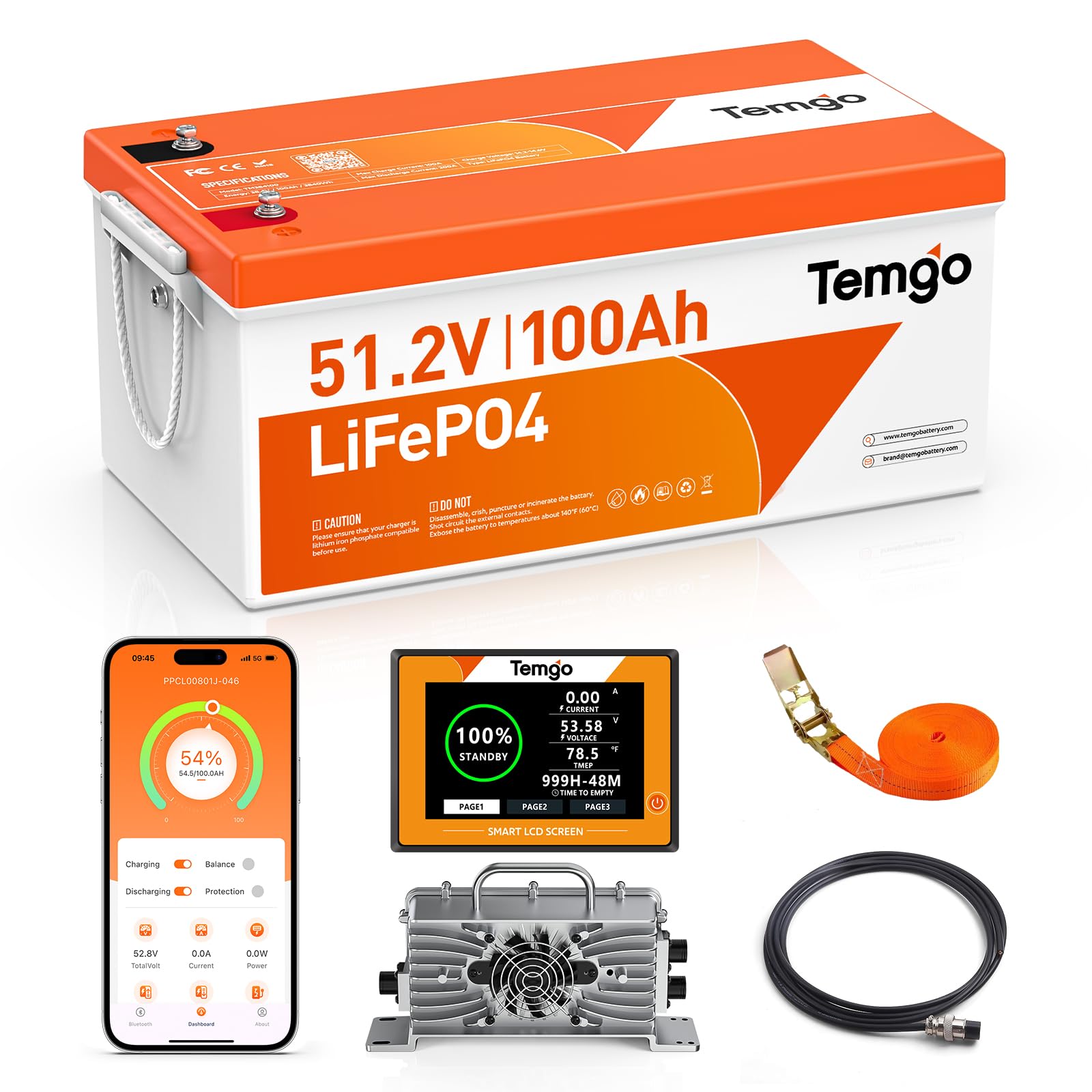
The TEMGO S48 100Ah kit is the most affordable complete 48V lithium conversion package available, undercutting the OGRPHY and Cloudenergy kits by a significant margin while still including a battery, 58.4V 18A charger, 2.8-inch LCD touch display, and a retention strap. The battery uses A-grade LiFePO4 cells and carries a 5000+ deep-cycle rating at 80% DoD, which is competitive with batteries costing 25-30% more. The built-in 200A BMS delivers 200A continuous discharge and 600A for 3 seconds — sufficient for most 3kW to 4kW golf cart motors on moderate terrain. The physical footprint (20.67 x 10.59 x 8.66 inches) is nearly identical to the OGRPHY batteries, so fitment in Club Car DS, Precedent, and EZGO TXT trays is comparable.
Customer reports are largely positive, with particular emphasis on the weight savings — the TEMGO battery weighs 61.7 pounds, which is roughly 25-30 pounds lighter than the Cloudenergy and VATRER packs, and a massive 200+ pound reduction compared to a six-battery lead-acid pack. One user documented a speed increase from 28 mph to 32 mph on flat ground in a 2003 Club Car DS, with a 0.25-mile hill-climb time dropping from 20.4 seconds to 14.8 seconds. The same user reported 18 miles of driving using only 29% of the battery capacity (71% remaining), translating to a theoretical range of over 50 miles. The Bluetooth app and LCD display both work reliably, and the charger is compatible with the cart’s original charging port if wired correctly.
The downsides are centered on fitment details and long-term reliability edge cases. Several buyers in 2003-2004 Club Car DS carts found the battery too tall by about 1.5 inches, requiring them to raise the seat cushion with spacers or cut the seat support frame. The positive cable may also need an extension if the original lead-acid cable routing is too short. One buyer reported a single incident where the battery suddenly fell to zero charge after being parked at 40% SOC overnight — the BMS likely triggered an internal cutoff. The battery recovered fully after a full recharge, but it forced the owner to adopt a new habit of recharging at 50% rather than 20%. For budget-conscious converters willing to handle minor fitment mods and manage BMS behavior cautiously, the TEMGO kit is the best entry point into lithium.
Why it’s great
- Lowest-priced complete 48V conversion kit with charger and LCD display
- 5000+ cycle rating competes with batteries costing 30% more
- Weighs only 61.7 lbs — saves over 200 lbs vs lead-acid
- Notable performance gains: 4 mph speed increase, 5.6 sec better hill climb
Good to know
- 1.5 inches taller than stock lead-acid — may require seat lift in Club Car DS
- Positive cable may need extension for Precedent and DS models
- BMS can drop to zero unexpectedly at 40% SOC — safer to recharge at 50%
8. Newport 12V50Ah Deep Cycle AGM Battery
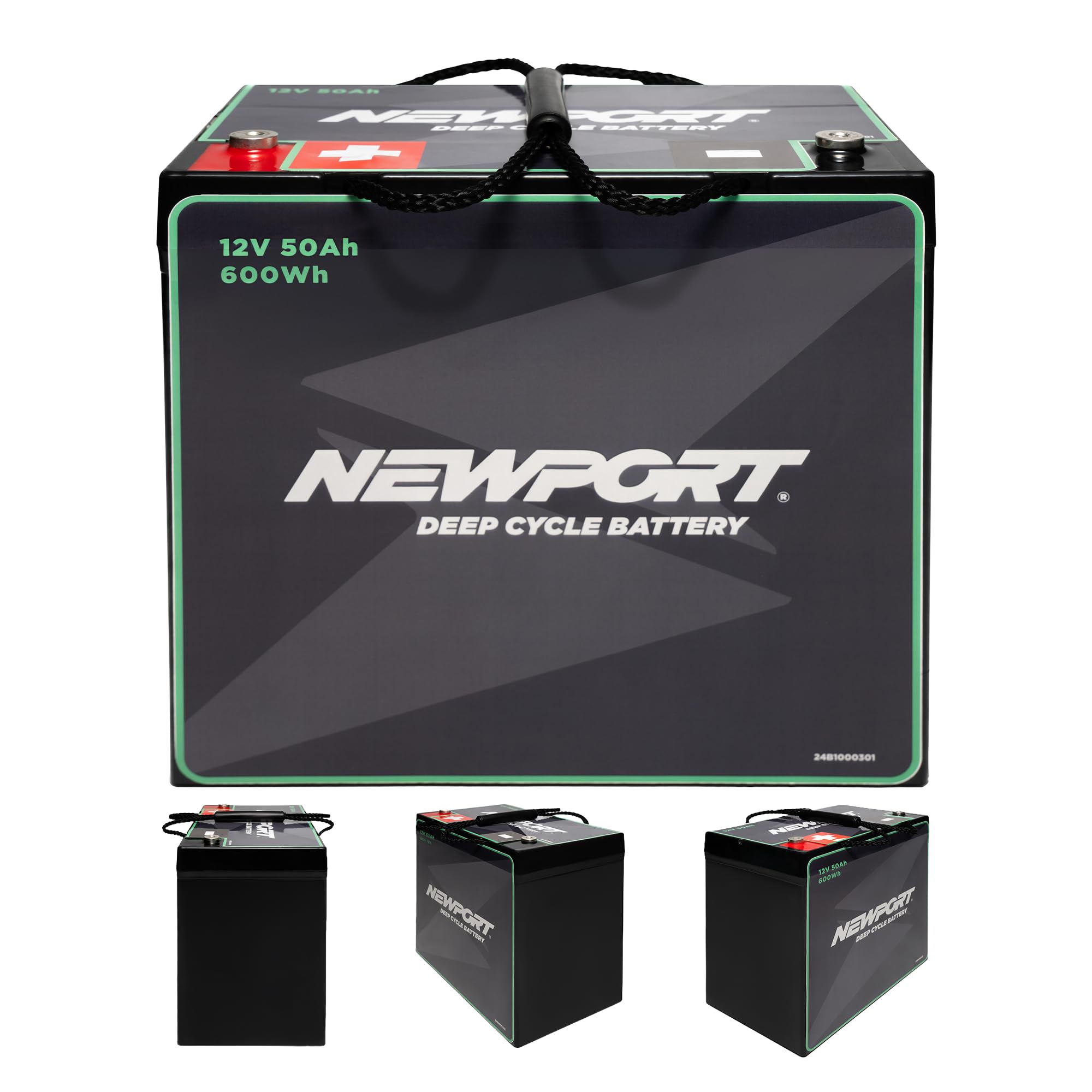
The Newport 12V50Ah Deep Cycle AGM battery is a sealed lead-acid option designed primarily for trolling motors and marine applications, but it works as a low-cost drop-in for small golf carts or utility vehicles with minimal power requirements. At 32 pounds and a 50Ah capacity, it is half the weight and capacity of a typical 12V 100Ah golf cart battery, making it suitable only for lightweight push carts, personal transport vehicles with 0.5-1kW motors, or as an auxiliary battery for accessories. The AGM construction is maintenance-free and leak-proof, so you will never have to add distilled water or deal with acid spills. The sealed design also means it can be mounted in any orientation (except inverted) without risk of electrolyte leakage.
Real-world customer feedback highlights the battery’s toughness in unexpected ways: one buyer reported that the battery survived a 20 mph tumble from a truck bed onto asphalt with only cosmetic damage and no loss of function. Kayak anglers using it with 55 lb thrust trolling motors report 4+ hours of steady power at moderate speeds with stable voltage and no heat buildup. Another buyer is using the battery as a backup sump pump power source, which is a testament to its deep-cycle capability despite the small capacity. The marine terminal design accepts standard ring terminals and holds them securely under high-vibration conditions. The 1-year limited warranty is standard for sealed lead-acid batteries in this price range.
The main limitation is capacity: 50Ah at 12V translates to just 600Wh of usable energy, and with lead-acid you should only discharge to 50% to maximize cycle life, leaving only 300Wh. That is roughly enough to power a small 500W golf motor for 30-40 minutes on flat ground. The lack of a built-in charge indicator means you will need a standalone voltmeter or battery monitor to avoid over-discharge. Its best use case is as a secondary accessory battery for lights, speakers, and USB charging, or as a replacement for a single battery in a multi-battery 36V or 48V lead-acid pack where only one cell has failed.
Why it’s great
- Pound-for-pound one of the toughest batteries — survives 20 mph truck-bed tumbles
- Sealed AGM means zero maintenance and no acid leaks
- Lightweight at 32 lbs — one-hand carry for easy installation
- Versatile terminal design compatible with multiple connection types
Good to know
- 50Ah capacity is too small for primary golf cart traction use
- Lead-acid chemistry limited to 300-500 cycles at 50% DoD
- No built-in charge indicator — requires external voltage monitor
9. Mighty Max Battery ML35-12 GEL 12V 35Ah

The Mighty Max ML35-12 GEL is a niche battery that occupies a specific corner of the 12-volt market: it is a GEL-type lead-acid battery optimized for slow discharge rates, solar trickle charging, and infrequent deep-cycle use. The 35Ah capacity (420Wh) is the smallest on this list, making it entirely unsuitable as a primary golf cart traction battery for any cart larger than a push/pull caddy. However, its GEL chemistry offers two distinct advantages over AGM: a slower self-discharge rate (losing charge at roughly 1-2% per month versus 3-5% for AGM) and better tolerance for temperature extremes from -40°C to +65°C. The thick, non-spillable gel paste inside also makes it extremely resistant to vibration and shock — one owner reported three batteries powering off-grid water pumps for five years with no failures.
The Nut & Bolt terminal design is more robust than the standard SAE posts found on many smaller batteries, allowing for secure ring-terminal connections that will not loosen under vibration. Customer reviews are predominantly positive for the intended use cases: gate openers (one user runs it with a Mighty Mule MM371W and a 50W solar panel, reporting stable voltage with zero drop under surge load), electric wheelchairs, and UTV auxiliary power. One critical review noted that the battery did not stay charged as long as expected when used on a mobility scooter — this is likely due to the 35Ah capacity being insufficient for the scooter’s daily draw, not a defect in the battery. The 1-year manufacturer warranty is standard for sealed lead-acid.
The Nut & Bolt terminal design is more robust than the standard SAE posts found on many smaller batteries, allowing for secure ring-terminal connections that will not loosen under vibration. At 35Ah and 420Wh — and with lead-acid’s 50% DoD rule leaving only 210Wh usable — this battery is realistically limited to powering a golf cart’s 12V accessory system (lights, USB charger, radio) or serving as a backup for a solar-powered gate that opens a cart path. It is not a primary propulsion battery. For a golf cart owner building a hybrid system — a LiFePO4 main pack for traction and this GEL battery for isolated 12V accessories — the ML35-12 GEL’s slow self-discharge and extreme temperature tolerance make it a solid choice for the AUX role.
Why it’s great
- GEL chemistry retains charge longer than AGM when idle — ideal for seasonal use
- Extreme temperature tolerance (-40°C to +65°C) outperforms most sealed batteries
- Nut & Bolt terminals provide vibration-resistant ring-terminal connections
- Proven 5-year lifespan in off-grid solar pump applications
Good to know
- 35Ah capacity is too small for any standard golf cart traction motor
- Lead-acid longevity limited to 300-500 deep cycles at 50% DoD
- GEL chemistry requires a specific GEL-compatible charger — AGM chargers may overcharge
FAQ
Can I replace my 6x8V lead-acid pack with a single 48V lithium battery?
Do I need to bypass the OBC when converting to lithium in my Club Car?
What size battery do I need for a 36V vs 48V golf cart?
Can I use a standard lead-acid charger on a lithium golf cart battery?
How low can I discharge my lithium golf cart battery?
Final Thoughts: The Verdict
For most users, the 12 volt golf cart battery winner is the OGRPHY 48V 105Ah because it delivers a balanced combination of 200A BMS surge capacity, 50-mile real-world range, a full smart-monitoring suite with Bluetooth and LCD display, and a competitive price that undercuts the premium tier while matching its performance. If you prioritize rugged physical protection and IP67 sealing for rough terrain or wet environments, grab the VATRER POWER 48V 105Ah with its cold-rolled steel case. For maximum cycle life and the most headroom from a BMS (250A continuous), the Cloudenergy GFA48V-105AH is the best long-term investment. And for the budget-conscious converter who wants a complete kit without sacrificing essential BMS protection, the TEMGO S48 100Ah kit offers the lowest entry price to a 48V lithium conversion.