
That dead accessory socket, the stereo that won’t power on, the trailer light that’s gone dark — without a reliable circuit tester you’re left swapping fuses blind or chasing wires with a multimeter in one hand and a service manual in the other. A proper 12 volt test light cuts through the guesswork by delivering an instant visual and sometimes audible confirmation of voltage presence, polarity, and ground continuity, saving hours of head-scratching on everything from a simple blown fuse to a complex parasitic drain.
I’m Min — the co-founder and writer behind Gadgets Feed. I’ve spent countless hours analyzing the testing range, impedance load, cord construction, probe tip design, and LED versus incandescent trade-offs across dozens of automotive circuit testers to separate the tools that genuinely speed up diagnostics from the ones that introduce new headaches.
Whether you are a professional technician chasing intermittent faults on modern computer-controlled systems or a home mechanic tracing a dead tail light circuit, choosing the right 12 volt test light determines whether you get a clear answer fast or waste time second-guessing a dim bulb.
How To Choose The Best 12 Volt Test Light
The surface-level difference between test lights is often just the price tag, but the real performance gap lives in the probe tip geometry, the internal circuit design, and the cord construction. Understanding these three factors prevents you from buying a tool that works fine on a 1970s pickup but threatens a modern CAN-bus system or fails to pierce the hard rubber insulation found on today’s engine harnesses.
Incandescent Bulb vs. LED Indicators
An incandescent test light draws approximately 30mA of current when the bulb lights, which means it places a measurable load on the circuit. This load is actually useful — it helps you detect a high-resistance connection that shows 12 volts on a digital multimeter but collapses under real current draw. An LED-based tester draws far less current (often under 5mA), making it inherently safer for computer-controlled circuits but less capable of revealing a weak connection. If you work primarily on late-model vehicles with sensitive ECUs, a high-impedance LED tester is the smarter daily driver. If you troubleshoot classic cars, tractor electrical systems, or heavy equipment where wiring is simpler, the incandescent bulb’s load-testing ability is a genuine asset.
Probe Tip Design and Wire Piercing Ability
The sharpness and geometry of the probe tip dictate how easily you can back-probe a connector without damaging the terminal seal or the wire itself. A stainless-steel needle point is ideal for piercing through thin insulation to reach the conductor, while a hooked tip helps you latch onto a wire and free both hands for operating the test light or turning the ignition key. Some premium test lights include a threaded probe that accepts a screw-on alligator clip, converting the tool into a temporary bridge lead — a feature that pays for itself when you’re trying to hold the probe on a terminal while wiggling a harness to find an intermittent break.
Cord Type: Coiled vs. Straight and Reach
A coiled cord stays tidy when stored and stretches far enough to reach from the battery to the tail lights, but the spring tension can tug on the ground clip and pull it off the terminal if you’re working in a cramped engine bay. A straight cord is easier to route under a dashboard and less likely to snag on protruding fasteners, but it requires deliberate coiling at the end of the job. Look for a cord length of at least 6 feet for normal passenger-car work; 12 feet is better if you regularly test the rear of a truck or trailer. The cord jacket should be oil- and heat-resistant, as engine compartments routinely exceed 200°F near the exhaust manifolds.
Quick Comparison
On smaller screens, swipe sideways to see the full table.
| Model | Category | Best For | Key Spec | Amazon |
|---|---|---|---|---|
| OTC 3633 Mini-Coil | Premium | Professional diagnostics | 12-ft coiled cord, threaded probe tip | Amazon |
| OTC 3634 Straight Cord | Premium | Durability in shop use | 5-ft straight heavy-duty cord | Amazon |
| Innova 3420 Smart Test Light | Premium | Cigarette-lighter convenience | 6-ft leads, 3-color LED indicator | Amazon |
| JASTIND 3-72V Digital | Mid-Range | Wide voltage testing with display | 3-72V range, digital readout to 0.1V | Amazon |
| ALLOSUN Hook Probe | Mid-Range | Hands-free wire hooking | 59-in cord, 3 interchangeable probes | Amazon |
| OEMTOOLS 25886 | Budget | Basic fuse and circuit checks | 12-ft coiled cord, 6-24V range | Amazon |
| Astro Pneumatic 7760 | Budget | Cordless quick checks | Battery-powered, no ground lead | Amazon |
In‑Depth Reviews
1. OTC 3633 Mini-Coil Cord Circuit Tester

The OTC 3633 sits at the top of this category because it nails the fundamentals that professional technicians demand: a needlepoint stainless steel probe that pierces weather-pack seals cleanly, a threaded tip that accepts a screw-on alligator clip for bridging circuits, and a bright high-intensity incandescent bulb that loads the circuit enough to reveal voltage drop issues a digital multimeter would miss. The 12-foot heavy-duty coiled cord provides ample reach from the battery to the tailgate of a full-size pickup without tangling when you stow it in a toolbox drawer.
What sets this tester apart from entry-level options is the ergonomic slim clear handle that fits naturally between your thumb and forefinger, letting you work into tight spots like fuse boxes under the dash or relay panels near the firewall. The replaceable bulb design means you aren’t throwing away the entire tool when the lamp eventually burns out, and the threaded probe gives you the flexibility to switch between piercing mode and clip-on mode without carrying a second tool. At this build quality level, the 3633 genuinely feels like an investment rather than a consumable.
The only compromise to be aware of is the coiled cord itself — while ideal for storage reach, the spring tension can occasionally yank the alligator clip off a battery terminal if the clip isn’t gripping a sharp edge. This is a minor ergonomic preference rather than a functional flaw, and many users find the neat coil worth the occasional clip adjustment. If you work primarily under dashboards where a straight cord would route more cleanly, the OTC 3634 straight-cord version may suit you better, but for outright versatility and proven longevity the 3633 earns its top rank.
Why it’s great
- Threaded stainless needle tip accepts screw-on alligator clip for circuit bridging
- Bright incandescent bulb loads the circuit to reveal high-resistance connections
- Slim ergonomic handle reaches into cramped fuse-box and relay locations
Good to know
- Coiled cord tension can pull the ground clip loose if not clamped onto a sharp edge
- Incandescent bulb draws enough current to risk damaging some sensitive ECU circuits
2. OTC 3634 Heavy-Duty Straight Cord Circuit Tester

The OTC 3634 is the straight-cord workhorse that professional diesel mechanics and collision repair techs reach for when they need a test light that withstands daily shop abuse. Instead of a springy coil, this model uses a 5-foot heavy-duty straight cord with molded strain relief at both ends — one less point of failure and a cable that lies flat across an engine bay without snapping back at your face. The handle is slim and clear, giving you a full view of the bright red incandescent bulb, and the needlepoint probe is sharp enough to pierce through thick heat-shrink tubing and factory wrap.
Where this tester truly distinguishes itself is in the feel of the materials: the clamp is a heavy-duty copper-coated unit that bites hard onto battery terminals or chassis ground points, and the positive-contact bulb holder ensures the light doesn’t flicker when you twist the probe at an angle. The 6- to 12-volt operating range covers the vast majority of automotive, marine, and heavy-equipment electrical systems, and the incandescent bulb’s current draw gives you a reliable load test on every circuit you check. For techs who throw their tools in a gang box and drag them from job to job, the 3634’s build integrity is a noticeable upgrade over lighter consumer-grade testers.
The trade-off for that durability is a shorter cord — 5 feet may not be enough to reach from a front battery to the rear taillight assembly on a long-bed truck without using an extension. Also, the incandescent bulb, while rugged, is not ideal for probing into modern ECU-controlled circuits where a high-impedance LED tester would be the safer choice. If your work is focused on heavy trucks, boats, and older vehicles where the extra load is actually beneficial, the 3634 is arguably the best-constructed non-digital test light in this lineup.
Why it’s great
- Heavy-duty straight cord with molded strain relief eliminates coil-snag frustrations
- Copper-coated alligator clamp provides a secure bite on battery terminals
- Slim profile with bright incandescent bulb for clear circuit-load testing
Good to know
- 5-foot cord is short for reaching rear circuits on full-size trucks
- Incandescent bulb load may not be safe for sensitive modern computer modules
3. Innova 3420 Smart Test Light / Circuit Tester

The Innova 3420 rethinks the test-light concept entirely by eliminating the traditional alligator-clip ground lead in favor of a cigarette-lighter power plug, making it the most convenient option for diagnosing interior circuits — radios, power windows, climate control, and dash lights — where a 12-volt accessory socket is within arm’s reach. The transparent handle houses three bright LEDs: a white light that confirms proper connection and doubles as a work light, a red LED that indicates positive voltage, and a green LED that confirms a good ground path. This three-color system removes the guesswork of watching a single bulb glow dimly and wondering whether the circuit is live but weak or dead entirely.
The kit comes with detachable twin alligator clamps that snap onto the tester body when you need traditional probe-and-clamp operation, and the 6-foot leads offer sufficient reach to stretch from the dash to the engine compartment. Internally, the 3420 is fused and computer-safe, meaning you can probe into ECU power supplies and sensor reference circuits without fear of back-feeding voltage or drawing enough current to damage a module. The ergonomic grip is rubberized and contoured, which makes a real difference when you’re holding the probe steady with one hand while operating a multimeter or a scan tool with the other.
The limitation of the cigarette-lighter approach is that it ties you to a vehicle with a working accessory socket — if the fuse for that socket is blown, the 3420 won’t power on, and you cannot use it to diagnose the very circuit that may be dead. Additionally, the LED indicators are high-impedance by nature, so they won’t load the circuit enough to catch voltage-drop issues the same way an incandescent bulb would. Despite these constraints, the Innova 3420 is the most user-friendly and risk-free test light for modern computer-controlled vehicles, especially if your diagnostic work stays mostly inside the cabin.
Why it’s great
- Three-color LED system (white, red, green) removes ambiguity about voltage and ground
- Cigarette-lighter plug is perfect for quick interior circuit diagnostics
- Computer-safe fused design protects sensitive ECU and sensor circuits
Good to know
- Cannot test the accessory socket itself if its fuse is blown
- High-impedance LED does not load the circuit to detect voltage drop under load
4. JASTIND 3-72V Digital LED Automotive Test Light

The JASTIND 3-72V Digital Test Light bridges the gap between a simple incandescent probe and a full-blown multimeter by embedding an LED digital display that reads voltage with 0.1-volt resolution and ±0.2-volt accuracy. This means you get a precise numerical voltage reading at the probe tip — not just a binary light/no-light verdict — which is essential for diagnosing charging system output, sensor reference voltages, and voltage drop across a connector. The 3- to 72-volt DC range covers not only standard 12V automotive work but also 24V heavy-truck systems, 48V golf carts, and industrial control circuits up to 72 volts.
Two auxiliary white LED beads illuminate the area around the probe tip, a genuine advantage when you’re probing into a dark fuse box under the dashboard or tracing wires in a poorly lit engine bay at night. The tester also functions bidirectionally: attach the clamp to either ground or positive, and the red/green LEDs and audible beeper will indicate polarity without needing to reverse the connections. The circuit board is precision-designed to draw a very small current, making it computer-safe for probing into ECU and BCM circuits where a traditional incandescent test light could cause damage.
The main drawback is bulk — the digital display and auxiliary LEDs add thickness to the handle, making it less ideal for reaching into extremely tight terminal blocks or behind a stereo head unit where a slim analog probe would slip in easily. The clip design also feels adequate rather than premium; it works but lacks the bite of a heavy-duty copper clamp. For users who want numerical readouts, bidirectional polarity detection, and the widest voltage range in this category, the JASTIND delivers impressive functionality at a budget-conscious price point.
Why it’s great
- Digital display reads voltage to 0.1V for precise diagnostics
- 3-72V range covers automotive, heavy truck, and low-voltage industrial circuits
- Dual LED work lights illuminate dark test areas around the probe tip
Good to know
- Bulkier handle than slim analog test lights makes tight-space access harder
- Ground clip feels less robust than premium OTC or Innova clamps
5. ALLOSUN Automotive Wire Piercing DC Voltage Circuit Tester
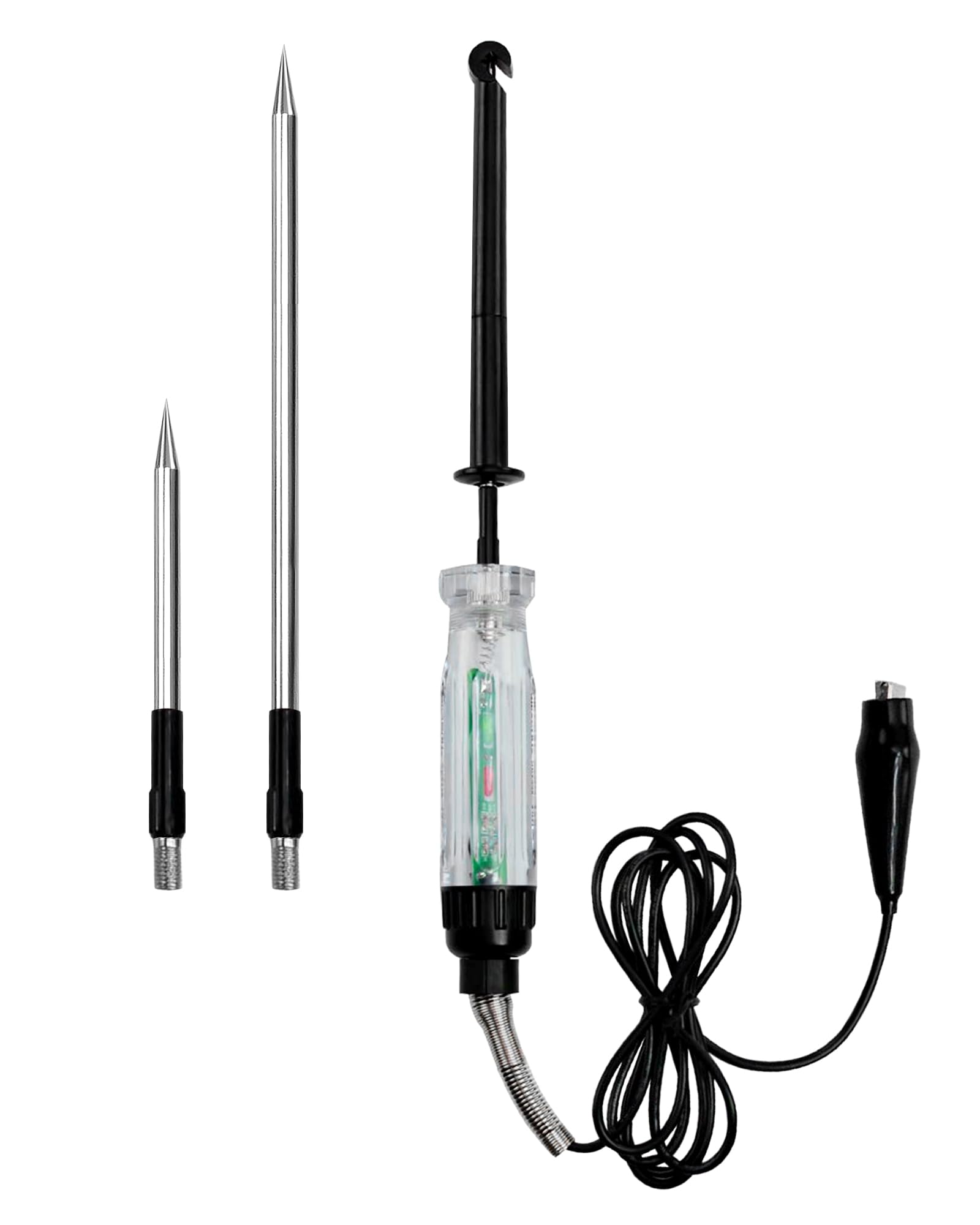
The ALLOSUN wire-piercing tester is built around a clever hook-style probe that lets you latch onto a bare wire or pierce through insulation and then release your grip — the hook holds the connection steady while you turn the ignition key, wiggle the harness, or consult a wiring diagram. This hands-free capability is a genuine productivity booster when you’re diagnosing intermittent faults that only appear when the harness is jostled. The kit includes three interchangeable probe tips: a long probe for general probing, a short probe for tight spaces, and a pierce-type probe with a sharp stainless hook for locking onto individual wires.
The tool uses dual high-visibility LED bulbs and a loud buzzer to indicate voltage presence, making it usable in noisy shop environments or bright sunlight where a single dim bulb could be missed. The 59-inch cord is insulated against heat and oil, and the cord’s length is adequate for working around the engine bay or under the dash of most passenger vehicles. The strain relief and probe body feel reasonably well-built for the price, with a plastic hook cover that protects your fingers from the sharp tip when the tester is stored in a pocket or tool pouch.
The operating range is limited to 6 to 12 volts DC, so this tester cannot be used on 24V heavy-truck systems or higher-voltage industrial equipment. More importantly, the manufacturer explicitly advises against using this tester on sensor or computer wiring — the internal circuit is not high-impedance enough to guarantee safety on modern ECU-controlled systems. For classic cars, trailer wiring, aftermarket accessory installation, and general 12V automotive work where you value a free hand over absolute computer safety, the ALLOSUN hook probe is a smart specialized addition to your electrical tool kit.
Why it’s great
- Hook-style probe latches onto wires for true hands-free testing
- Three interchangeable probe tips adapt to piercing, hooking, or tight-space probing
- Dual LEDs and loud buzzer work well in bright or noisy environments
Good to know
- Limited to 6-12V DC — no support for 24V heavy-truck systems
- Not recommended for sensor or computer wiring due to lower internal impedance
6. OEMTOOLS 25886 Circuit Tester 6-24 Volt

The OEMTOOLS 25886 is the classic DIYer’s test light that proves you don’t need to spend a lot to get a reliable voltage indicator for basic automotive troubleshooting. It tests 6- to 24-volt circuits, covering both standard car electrical systems and light-duty truck applications, and the super sharp stainless steel probe pierces wire insulation effortlessly — including the tough weather-resistant jackets found on modern aftermarket harnesses. The high-intensity incandescent bulb is visible even in direct sunlight, and the clear plastic housing lets you see the filament glow without squinting.
The 12-foot coiled cord is the longest in this lineup, giving you the freedom to clip onto a battery terminal under the hood and walk all the way around to the tailgate with the tester still connected. The ground clamp is heavy-duty with a plastic sleeve to protect your fingers, and the plastic strain relief at the probe end adds durability where most test lights eventually crack. This model includes a spare bulb in the handle, a thoughtful touch for a tool that might see weekend-warrior use in a garage where spare parts aren’t always on hand.
The incandescent bulb’s 30mA draw means this tester will place a load on the circuit, which is fine for typical fuse and relay checks but carries a small risk when probing into computer-controlled systems on late-model vehicles. Build quality is good for the price, but the plastic components and crimped clamp connection are not at the same level as premium OTC or Innova tools. For the budget-minded DIYer who needs a long-reach, bright-bulb test light for classic cars, trucks, trailers, and simple 12V repairs, the OEMTOOLS 25886 delivers dependable performance that punches above its cost.
Why it’s great
- 12-foot coiled cord is the longest reach in this lineup
- Sharp stainless probe pierces modern tough wire insulation cleanly
- Includes a spare incandescent bulb in the handle for quick replacement
Good to know
- Incandescent bulb draws 30mA — not ideal for sensitive ECU sensor circuits
- Plastic components and crimped clamp feel less durable than premium competitors
7. Astro Pneumatic 7760 Cordless Circuit Tester

The Astro Pneumatic 7760 completely eliminates the ground cable and clamp by using your own body as the ground path — you hold the tester in one hand while touching a bare metal chassis ground with your other hand or finger, and the tool lights up and beeps when voltage is present at the probe tip. This cordless approach is liberating when you’re working under a dashboard with limited room to route a test lead, or when you need to quickly check fuses in a crowded fuse box without untangling a coiled cord first. The operating range spans 3 to 28 volts DC, covering everything from low-voltage signal circuits to standard 12V and 24V automotive systems.
Safety is built into the design: the 7760 is rated safe for ECMs, transducers, and airbag circuits, meaning you can probe into computer control modules without worrying about back-feeding current. The V-tip probe provides a centered contact point that grips the terminal or wire securely, reducing the chance of accidental short circuits when working near multiple exposed terminals. At just 1.6 ounces, this tester is light enough to live in your shirt pocket or a small zipper pouch, making it the most portable option for field diagnostics or quick shop-floor checks.
The cordless design has inherent limitations — you cannot use this tester to supply power to a component, check ground quality independently, or test circuits without establishing a body-ground connection, which can be awkward if you’re working in a dry environment with poor skin contact or wearing thick rubber-soled boots. The lack of a dedicated ground clamp also means you cannot use this tool for traditional voltage-drop testing across a suspect wire. For quick go/no-go power checks at fuse terminals, relay sockets, and component connectors, the 7760 is unmatched in speed and portability, but it should complement a traditional test light rather than replace it entirely.
Why it’s great
- Cordless operation with body-ground eliminates lead-management hassles
- Safe for ECM, transducer, and airbag circuits
- Ultra-light and pocket-sized for instant deployment
Good to know
- Cannot independently check ground quality or supply power to components
- Body-ground method is less reliable in dry environments or with insulated footwear
FAQ
What voltage range should I look for in a 12V test light?
Can I use a traditional incandescent test light on modern car computers?
Is a cordless test light without a ground lead accurate?
Why does my test light glow dimly on some circuits?
What is the advantage of a hooked probe tip?
Final Thoughts: The Verdict
For most users, the 12 volt test light winner is the OTC 3633 Mini-Coil Cord Circuit Tester because it combines professional-grade build quality, a threaded needle-point probe with clip-on versatility, and a bright incandescent bulb that reveals voltage-drop issues no digital tool can catch. If you want the convenience of cordless operation for quick fuse checks and do not need to test ground circuits, grab the Astro Pneumatic 7760 Cordless Circuit Tester. And for modern computer-controlled vehicles where ECU safety is the priority and you want a precise digital voltage readout, nothing beats the JASTIND 3-72V Digital LED Automotive Test Light.