
Our readers keep the lights on and my morning glass full of iced black tea. As an Amazon Associate, I earn from qualifying purchases.
Specs are compiled from manufacturer listings and verified buyer reviews and can change over time — please confirm the key details on the product page before buying.
Your car, boat, RV, or workshop’s 12V system can’t directly power 5V devices like phones, dash cams, or Raspberry Pis. A buck converter is a compact module that steps 12V down to clean, regulated 5V for permanent installs. This guide ranks six converters by real-world use cases, from multi-project value to drone micro-modules.
I’m Min — the founder and writer behind Gadgets Feed. This guide is built by comparing the manufacturers’ published specifications and the patterns across verified customer reviews, so you get each pick’s real strengths and trade-offs instead of marketing spin.
The best 12 volt to 5v converter for your setup depends on current draw, port count, and where you plan to mount it, which we explain in plain terms below.
Our Picks at a Glance
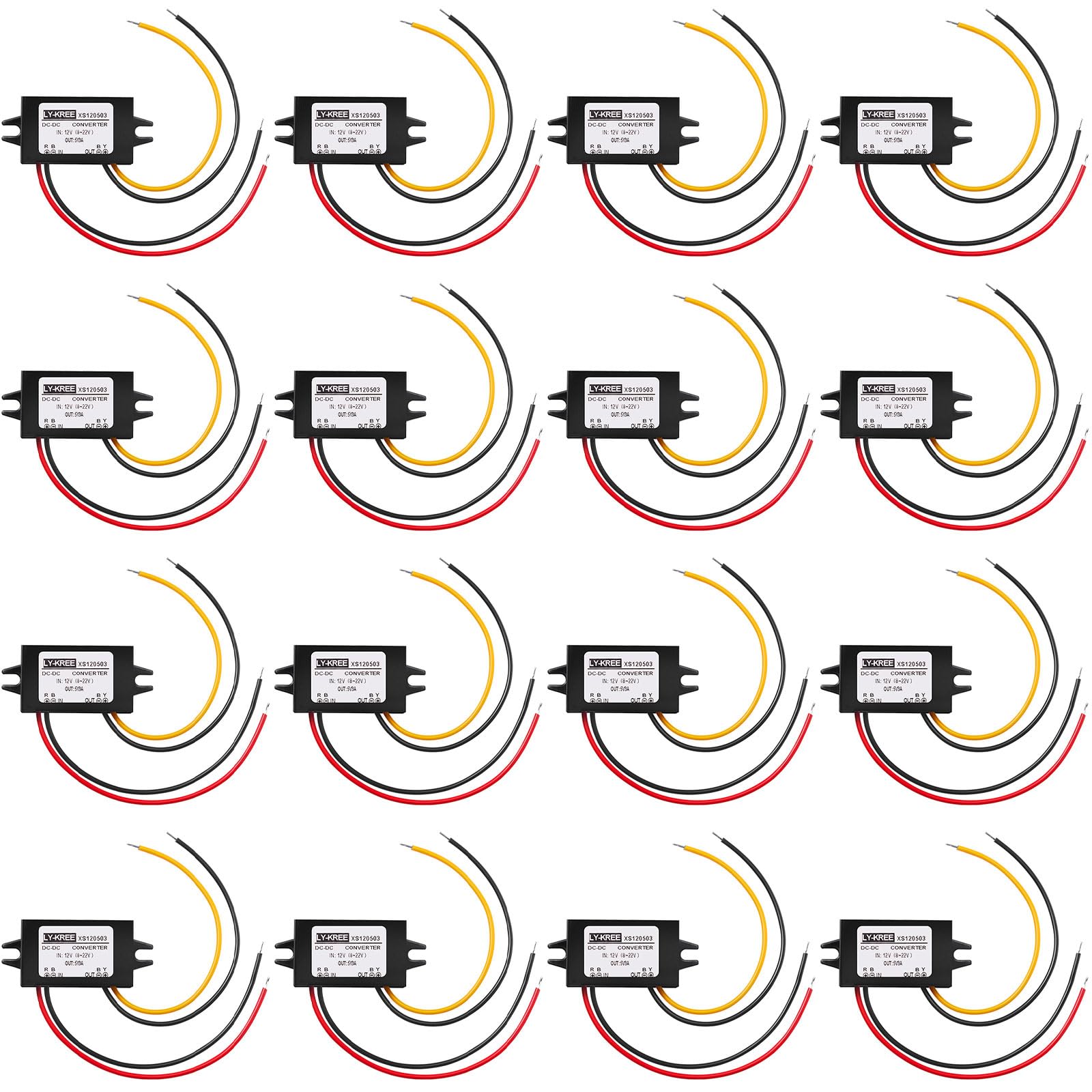

How To Choose The Best 12 Volt To 5V Converter
Before you buy, you need to know three things: your input voltage range, your device’s current draw, and where you’ll mount the unit. A converter that works for a dash cam may be overkill for a single LED strip, and a tiny module can struggle with a power-hungry tablet.
Understand current draw and wattage
Every 5V device lists its current draw in amps (A). Multiply that by 5V to get watts. If your device needs 2A (10W), a converter rated 3A (15W) gives you safe headroom. Oversizing is fine; undersizing leads to voltage drops, slow charging, or shutdowns.
Check the input voltage range
Most car systems sit around 12V, but RVs and boats often run 24V, and solar setups can fluctuate. A converter with a wide input range, like 8-35V or 10-32V, handles all of these safely. Never feed a unit voltage beyond its rated range, or you risk a dead short.
Match protection features to your install
When you hardwire into a vehicle, you need protection against reverse polarity (wiring the positive and negative leads backward), over-current (too much power flowing), and short-circuits (a direct connection that can cause sparks). These safeguards stop a wiring mistake from frying the converter or your expensive phone. A unit with a fuse adds extra safety for permanent installs.
Quick Comparison
| Model | Best For | Output Current | Output Power | USB Ports | Amazon |
|---|---|---|---|---|---|
| Weewooday 3-Pack★ Best Overall | Multi-project value | 3A | 15W | 1 (Type-C) | Amazon |
| YIPIN HEXHA Battery ClipBest Off-Grid | Off-grid 4-device charging | 8A total | 40W | 4 | Amazon |
| DROK Dual USB | Fast-charge compatibility | 2.5A per port | 30W | 2 | Amazon |
| YIPIN HEXHA Dual USB | Full-speed dual charging | 6A total | 30W | 2 | Amazon |
| Wolfwhoop PW-D 4-Pack | Drone and RC gear | 1.5A | 7.5W | 0 (solder pads) | Amazon |
| UCTRONICS 2-Pack | Raspberry Pi power | 5A | 30W | 1 + terminals | Amazon |
In-Depth Reviews
1. Weewooday 3 Pieces Direct Current Converter 12v to 5v 3a 15w Power Adapter
Our pick — over 4.5★ from 450+ verified ratings; the strongest balance of quality and price.
Three 3A converters for the price of one, ideal for multi-project budgets.
This is the converter for anyone juggling multiple gadgets at once. You get three separate units, each delivering 3A max at 15W max (that’s 5V times 3A, the same math behind every USB device). The 96% conversion rate (the percentage of input energy turned into usable output rather than heat) means little power wasted, so it stays cool in tight spaces.
What wins people over is pure performance — the thing buyers talk about most. Model railroad enthusiasts run their 5V electronics off a 12V bus with these, and car owners hardwire them to dash cams that turn on with the ignition. The compact 1.81 x 1.1 x 0.55-inch body tucks behind dashboards and into equipment bays, and the Type-C plug keeps wiring tidy.
Buyers report: “Bought these several times for use in model railroad projects where I need to run 5 VDC electronics off of the layout’s 12 VDC bus.” A handful note the 3A rating feels optimistic — charging is steady but not rapid. The built-in protections (over-voltage, over-current, over-temperature, short-circuit) make it a safe default for most 5V jobs.
Why owners stick with it
- Three units for the price of one single converter
- 96% conversion efficiency keeps heat down
- Intelligent chip guards against shorts and surges
- Compact body fits behind dashboards easily
Where it’s modest
- Charging speed is moderate, not fast-charge
- Not compatible with some phones
- 15W max limits it to lighter loads
Reach for this if: you want a reliable, budget-friendly converter for multiple projects — dash cams, model railroads, GPS units — and you don’t need fast charging.
Look elsewhere if: you’re powering a tablet or a phone that demands quick-charge protocols like QC 3.0.
2. DC Converter with Battery Clip 12V 24V to 5V 8A USB Power Adapter Buck Regulator Charger, 4 Ports
Clips onto any 12V battery to create a four-port, 8A charging hub.
This is the unit that turns a lead-acid or lithium battery into a super power bank. With four USB ports each pushing 2A/10W, you can charge four devices simultaneously — a phone, a tablet, a camera, and a game controller all at once. The total output hits 8A/40W max, which is more current than any other pick here; compare that to the Weewooday’s 15W, and this handles roughly 2.7x the power headroom for multi-device loads.
Reliability is what owners rave about most — 45 buyers single it out. It’s a favorite in off-grid cabins and with solar panel setups, clipping easily onto a car battery. Hunters and campers love the flexibility, with some swapping the clips for Anderson Power Poles (a type of high-current connector) for boat installs. A built-in blue LED shows it’s live, and the 8-35V input range means 12V or 24V batteries both work.
Owners mention: “Slow charge but if you have the time it did last for a couple years and still works in salty environment, just slow.” It does generate some electrical noise (RFI, or radio-frequency interference) when running, which matters if you’re powering sensitive radio gear. The protection suite — reverse polarity, over-current, over-temperature, short-circuit, low voltage, over-charge — covers the usual failure modes.
The crowd favorite
- 4 USB ports charge four devices at once
- Clipping onto a battery takes seconds
- Holds up in salt-air environments for years
- 96% conversion efficiency keeps losses low
Honest trade-offs
- Charging is steady but rarely fast
- Emits electrical noise that can bother radios
- Battery clips may need swapping for permanent mounts
Who it suits: off-grid campers, cabin owners, and boaters who need to charge several 5V devices from a battery without any wiring work.
Think twice if: you need true fast charging or noise-free power for a ham radio setup.
3. DROK DC to 5V USB Buck Converter, Dual USB Port Fast Charger Board

Supports QC 2.0, QC 3.0, and other fast-charge protocols for compatible phones.
Most converters just output a flat 5V, but this one negotiates with your device for faster charging. It supports QC 2.0, QC 3.0, MTK PE 1.1/2.0, AFC, FCP, and SFCP — the fast-charge protocols used by Qualcomm, MediaTek, Samsung, and Huawei phones. When a compatible device connects, the output automatically adjusts from 5V up to 3-12V to speed things up.
Each of the two USB ports is rated 2.5A/30W, and together they run off a 10-32V input. The dual-port design with QC 3.0 earns the second-most praise for compatibility, and it’s a proven workhorse for Wyze security cameras powered through old CCTV wiring. eBike riders wire it into their Bosch and TSDZ2 systems to run USB lights. Customers note: “This converter works great. I’ve been using these for years to power my Wyze cams through old CCTV wiring already run through the attic.”
The catch? It lacks reverse-polarity protection — one owner accidentally reversed the polarity from a solar panel and instantly fried the unit. The included thin wires also draw mixed feedback, with some buyers noting burned wires under sustained load. Input-side fuse and output over-voltage protection help, but wire polarity is on you.
Smart buy for: anyone with a QC-compatible phone who wants fast charging from a 12V or 24V source, plus DIY cam and router projects.
Install note: double-check your polarity before powering up — there’s no protection against a reversed connection.
4. DC Converter 12V 24V to 5V 6A 30W Dual USB Female DC DC Buck Converter

Delivers a full 3A to each of two ports simultaneously, for 6A total.
Here’s a converter that doesn’t split its budget. Each of the two USB ports delivers a full 3A/15W max, meaning you can charge two devices at full speed simultaneously — total 6A/30W max. That’s the same total power as the DROK above, but with a simpler layout that many buyers find easier to wire into a vehicle.
Functionality is the top praise, with owners calling it a nice little unit that works flawlessly. The 10-32V input range covers cars, boats, RVs, and solar panels. One owner wired a wireless charger into their motorcycle by tapping the rear 12V port, hiding the wires completely. Another powers a Garmin dashcam directly. The protective suite is thorough: input reverse connection, over-voltage, under-voltage, output over-current, over-voltage, under-voltage, short-circuit, and overheat.
Owners describe it as easy to install and stable in always-on setups — one wired it straight to a Jeep battery so devices charge even with the ignition off. The USB cable length is 12.2 inches (31cm), which gives you some flexibility on where to mount the unit. With 60g weight and a 1.73 x 1.65 x 0.83-inch footprint, it’s compact enough for most dashboards.
Why it wins: true dual 3A output makes it the pick for charging two power-hungry phones or a phone plus a tablet at real speed.
Who it suits: motorcycle, e-bike, and RV owners who want a permanent, protected 5V source for everyday devices.
5. PW-D Control Buck Converter 6-24V to 5V 1.5A Step-Down Regulator Module (4 Pack)
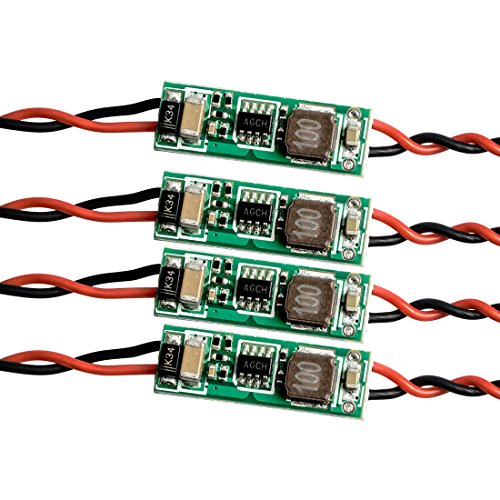
A 17mm module that fits into drones, RC gear, and dash cams.
This is the converter for the maker crowd. At 17mm × 5.5mm, it’s barely bigger than a fingernail, and you get four of them per pack. It’s designed for 2-6S batteries, which in RC terms means anything from a 7.4V to 22.2V pack — the 6-24V input range covers it all. The output is a steady 5V at up to 1.5A.
Buyers use these to power transmitters, receivers, mini cameras, and ESP32 boards (tiny Wi-Fi microcontrollers). One owner fed 12V from a car’s dome light to power a dashcam, hiding the ugly wires entirely. The stable voltage output and the value of getting four units for the price are the most-discussed positives. It’s also CE and UL certified, a rarity at this size.
The small size cuts both ways: the wires are very small, making soldering tedious, and fragility shows up in the feedback as the top negative. Real-world testing shows continuous output is closer to 500mA despite the 1.5A rating, and it runs hot (over 80°C) above 1A without a heatsink. Reviewers point out it’s great for light loads like a dash cam, but pushing it hard invites heat issues.
What makers love
- Four ultra-tiny modules per pack
- CE and UL certified at this price
- Stable 5V output across a wide input range
Know before you buy
- Fragile — delicate solder points and fine wires
- Runs hot above 1A without a heatsink
- Continuous rating closer to 500mA than 1.5A
Built for: drone, RC, and embedded projects where size and weight matter more than raw current.
skip it if: you need to power anything drawing more than about 500mA continuously — pick a sturdier board instead.
6. UCTRONICS DC 9V 12V 24V to DC 5V 5A Buck Converter Module (2 Pack)
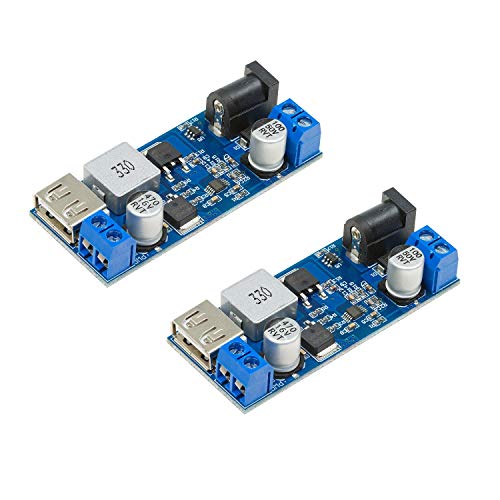
A 5A feed that keeps a power-hungry Raspberry Pi 5 fed without voltage dips.
Raspberry Pi boards are notoriously picky about power — an under-voltage warning appears the moment the supply sags. This converter was built for exactly that problem, delivering 5A of clean 5V power via a 5.5mm×2.1mm DC socket, a USB port, and screw terminals that can output simultaneously. It’s the recommended fix for Pi 4 and Pi 5 installs in cars and projects.
The 9-36V input range is the widest here, so it’s genuinely useful for 12V cars, 24V trucks, and even 36V solar systems. Output adjusts by input: 5.2V/6A at 9-24V in, 5.2V/5A at 24-32V in, and 5.2V/3.5A at 32-36V in. Owners say it powers a Pi 5 plus a 5G M.2 modem without issues, and it’s FCC and UL certified with a 6-month warranty.
Shoppers say it handles varying power well and the screw terminals on both sides make wiring straightforward. The catch: there are no screw holes, so mounting it is a bit awkward, and touching the IC chip can cause a temporary voltage drop. The power output feedback is mixed — some report less than 1 amp in certain setups, so match your load carefully. Use a USB-C PD trigger board for even more versatile power sourcing, as owners suggest.
Best for: Raspberry Pi projects, car PC builds, and any 5V device that needs a stable, high-current feed.
Watch out for: the lack of mounting holes and the heat-sensitive IC chip — give it airflow and it’ll serve you well.
Understanding the Specs
Output Current (Amps)
This is the maximum current the converter can safely deliver to your devices. A 3A converter handles a 2A dash cam with headroom, while a 6A unit can charge two phones at full speed. If your device draws more than the converter’s rating, you’ll see voltage drops, slow charging, or shutdowns.
Conversion Efficiency
Expressed as a percentage (like 96%), this tells you how much input power becomes usable output instead of heat. Higher efficiency means cooler operation, which matters when you tuck a converter behind a dashboard or inside an enclosed project box. Lower efficiency wastes battery power in off-grid setups.
Input Voltage Range
The range of DC voltages the converter accepts safely. A unit rated 10-32V works in a 12V car and a 24V truck, while a 9-36V unit adds solar-system flexibility. Feeding a converter beyond its rated range — like 100V into a 24V-max board — can cause a dead short, as one owner found out.
Protection Features
Reverse-polarity protection stops a wiring mistake from destroying the unit. Over-current, short-circuit, and over-temperature protection shut the converter down before damage occurs. For permanent vehicle installs, look for these plus an inline fuse for extra safety.
FAQ
What is the difference between a buck converter and a linear regulator?
How do I know how many amps my device draws?
Can I use a 12V to 5V converter with a 24V battery?
Will a buck converter drain my car battery when parked?
Why does my phone charge slowly with some converters?
Can I wire a converter directly to my battery?
Which converter should I use for a Raspberry Pi?
What is the difference between QC 3.0 and USB-PD fast charging?
Final Thoughts: The Verdict
For most people, the 12 volt to 5v converter winner is the Weewooday 3-Pack because it blends reliable 3A output, strong 96% efficiency, and three units in one budget-friendly package — the crowd favorite with 4.6 stars across hundreds of owners. If you want fast charging for QC-compatible phones, grab the DROK Dual USB. And for off-grid multi-device charging straight off a battery, the YIPIN HEXHA battery clip is the one to reach for.
How We Picked
We do not accept paid placement. Every pick is matched to a real buyer and a real use-case; we do not hands-on test units.
Sources & Methodology
Specifications: manufacturer listings and product documentation. Review insights: verified customer reviews, as of August 2026. Pricing: not shown on this page (it changes often); check the current price via the retailer link.
As an Amazon Associate, Gadgets Feed earns from qualifying purchases. This does not affect which products we feature.