
Our readers keep the lights on and my morning glass full of iced black tea. As an Amazon Associate, I earn from qualifying purchases.
If you fish from a kayak or small boat, the single biggest headache is a trolling motor that lacks enough thrust to fight a current or a breeze. The wrong pick leaves you drifting, constantly adjusting your heading, or burning through a battery before you’ve had your morning coffee. This guide breaks down six 12-volt trolling motors by the numbers that actually matter — thrust, shaft length, and battery efficiency — so you match the right power to your hull and water conditions without overpaying for features you don’t need.
I’m Min — the founder and writer behind Gadgets Feed. This guide is built by comparing the manufacturers’ published specifications and the patterns across verified customer reviews, so you get each pick’s real strengths and trade-offs instead of marketing spin.
Whether you’re upgrading a jon boat or adding quiet propulsion to a kayak, these picks cover the spectrum of reliable options for any freshwater or saltwater setup. Here is our researched take on the 12 volt trolling motor market today.
Quick Picks
- AQUOS Haswing 12V 65LBS 35.5inch Shaft Transom Electric Trolling Motor — Best Overall
- Newport L-Series 62lb Thrust Transom Mounted Saltwater Electric Trolling Motor — Top Performer
- VEVOR Electric Trolling Motor, Transom Mounted Outboard Boat Motors 12V 55lbs Thrust — Best Value
- Goplus Electric Trolling Motor 8 Speed, Boat Fishing Motor w/Telescoping Handle — Compact Pick
- BODIOO 55lb Thrust Trolling Motor 8 Speed Electric Outboard Motor Kayak Motor — Budget Champion
- PEXMOR 8 Speed Electric Trolling Motor, Electric Outboard Boat Motor w/Adjustable Handle — Entry Level
How To Choose The Best 12 Volt Trolling Motor
Three specs define whether a trolling motor works for your boat: thrust, shaft length, and the type of motor inside. Here is what those numbers mean in real water.
Thrust — the brawn to push your boat
Thrust is measured in pounds (lbs). A 12-volt motor that claims 55 lbs of thrust can push roughly the same load as a 0.83 horsepower outboard. If you run a 12-foot jon boat or a lightweight kayak, 30-40 lbs of thrust is usually enough. Once you move up to a 14- to 16-foot aluminum boat, you’ll want at least 50-55 lbs. For a heavier hull like a 19-foot bayliner or a loaded fishing kayak, you should look at 62 lbs or more. More thrust also means more amp draw — a top-tier 62 lb motor can pull 58 amps at full speed, so your battery must be sized to match.
Shaft length — keeping the prop in clean water
The shaft (the metal or composite tube from the motor head to the propeller) must be long enough to keep the prop below the boat’s wake. In rough water, a shaft that is too short lets the prop break the surface and cavitate — you lose all forward motion. For a typical aluminum boat transom, a 30-inch shaft works. For deeper hulls or tall transoms, or if you fish in heavy chop, a 36-inch or 40-inch shaft prevents that ventilation. The catch: a longer shaft adds weight and can be harder to stow.
Brushed vs. brushless motor — the efficiency fork
Brushed motors have been the standard for decades: they work, they are cheap to replace, but they waste up to 20% of their battery power as heat. A brushless motor uses electronic timing instead of physical brushes. It runs cooler, lasts longer, and buyers report that it doubles run time compared to a similar-thrust brushed unit. The downside is that brushless motors cost more up front. If you fish all day without a shore power outlet, the premium is worth it — you get more hours on the water from the same battery.
Quick Comparison
On smaller screens, swipe sideways to see the full table.
| Model | Best For | Thrust | Shaft Length | Motor Type | Amazon |
|---|---|---|---|---|---|
| AQUOS Haswing 12V 65LBS | All-day fishing & run time | 65 lbs | 35.5 inch | Brushless | $329.00Amazon |
| Newport L-Series 62lb | Saltwater & mid-sized hulls | 62 lbs | 40 inch | Brushed | $324.99Amazon |
| VEVOR 55lbs Thrust | Best-value all-metal build | 55 lbs | 30 inch | Brushed | $163.59Amazon |
| Goplus Electric 46/55/86LBS | High horsepower in a budget package | 4.6 HP (equivalent) | 36 inch | Brushed | $185.99Amazon |
| BODIOO 55lb Thrust | Freshwater quiet cruising | 55 lbs | 30 inch | Brushed | $189.99Amazon |
| PEXMOR 26LB Thrust | Kayaks & small inflatables | 26 lbs | Adjustable | Brushed | $99.99Amazon |
In‑Depth Reviews
1. AQUOS Haswing 12V 65LBS 35.5inch Shaft Transom Electric Trolling Motor

The quiet powerhouse that doubles your day on the water.
This AQUOS Haswing is the only pick with a brushless motor (an electronically timed motor with no physical brushes to wear out), and that makes it the best choice for all-day fishing. The big benefit is run time: owners mention getting 10 hours of slow trolling plus point-to-point travel and still having 40% battery left on a 100Ah LiFePO4 battery. The stepless (infinitely variable) speed control lets you dial in any speed rather than clicking through numbered gears. That is a clear advantage over every other motor on this list, which only offers 5 forward speeds. Customers note the low-speed minimum is around 1 mph, which is too fast if you need to crawl at half a knot for trout trolling — a point several owners mention. It also does not include a circuit breaker, so you will need to buy one separately to protect your battery from voltage surges.
Why it’s great
- Brushless motor delivers roughly twice the run time of a brushed motor on the same battery
- Weighs only 14.6 lbs — far lighter than any brushed motor with comparable thrust
- Stepless speed control for infinite adjustment between crawl and full speed
Good to know
- Lowest speed is about 1 mph, too fast for very slow trolling
- Circuit breaker not included — you must buy one separately
- Slightly louder at lowest setting than some premium brushed motors
Best for: Anglers who want maximum run time and minimal weight without sacrificing thrust
Skip if: You need a true 0.3–0.5 mph crawl for ultra-slow trolling
2. Newport L-Series 62lb Thrust Transom Mounted Saltwater Electric Trolling Motor

The saltwater specialist that lifts a 2,000-pound hull with ease.
With 62 lbs of thrust and a 40-inch shaft (10 inches longer than the 30-inch shaft on the VEVOR 55lb), this Newport L-Series lets you keep the propeller deep in clean water even on choppy days. Owners say it moves a 2,200-pound Bayliner 19-footer with three adults on board at 3–4 knots — real evidence that the 62 lb rating is not exaggerated. The 40-inch shaft is a full 33% longer than the BODIOO 55lb’s 30-inch shaft, which gives you far more margin in waves or on a tall transom.
The motor is built with stainless steel, magnesium, and zinc hardware to shrug off saltwater corrosion — a legit claim that sets it apart from the freshwater-only BODIOO pick. A 60-amp manual reset circuit breaker is included in the box, which is a welcome safety add-on. The trade-off, as buyers point out, is that the LED battery indicator is recessed in the housing and becomes invisible in direct sunlight. Owners also note the handle extension is too short for tall users, and the plastic upper housing feels less substantial than the all-metal VEVOR unit.
Why it’s great
- Truly saltwater-rated construction with stainless steel, magnesium, and zinc hardware
- 40-inch shaft prevents cavitation in rough water and on deep transoms
- Includes a 60-amp manual reset circuit breaker
Good to know
- LED battery indicator is recessed and hard to read in bright sunlight
- Telescoping handle does not extend far enough for some tall users
- Plastic upper housing feels less rugged than the all-metal VEVOR
Best for: Saltwater boaters who need a corrosion-proof motor with a long shaft for rough conditions
Skip if: You need a bright, easy-to-read battery gauge while running
3. VEVOR Electric Trolling Motor, Transom Mounted Outboard Boat Motors 12V 55lbs Thrust
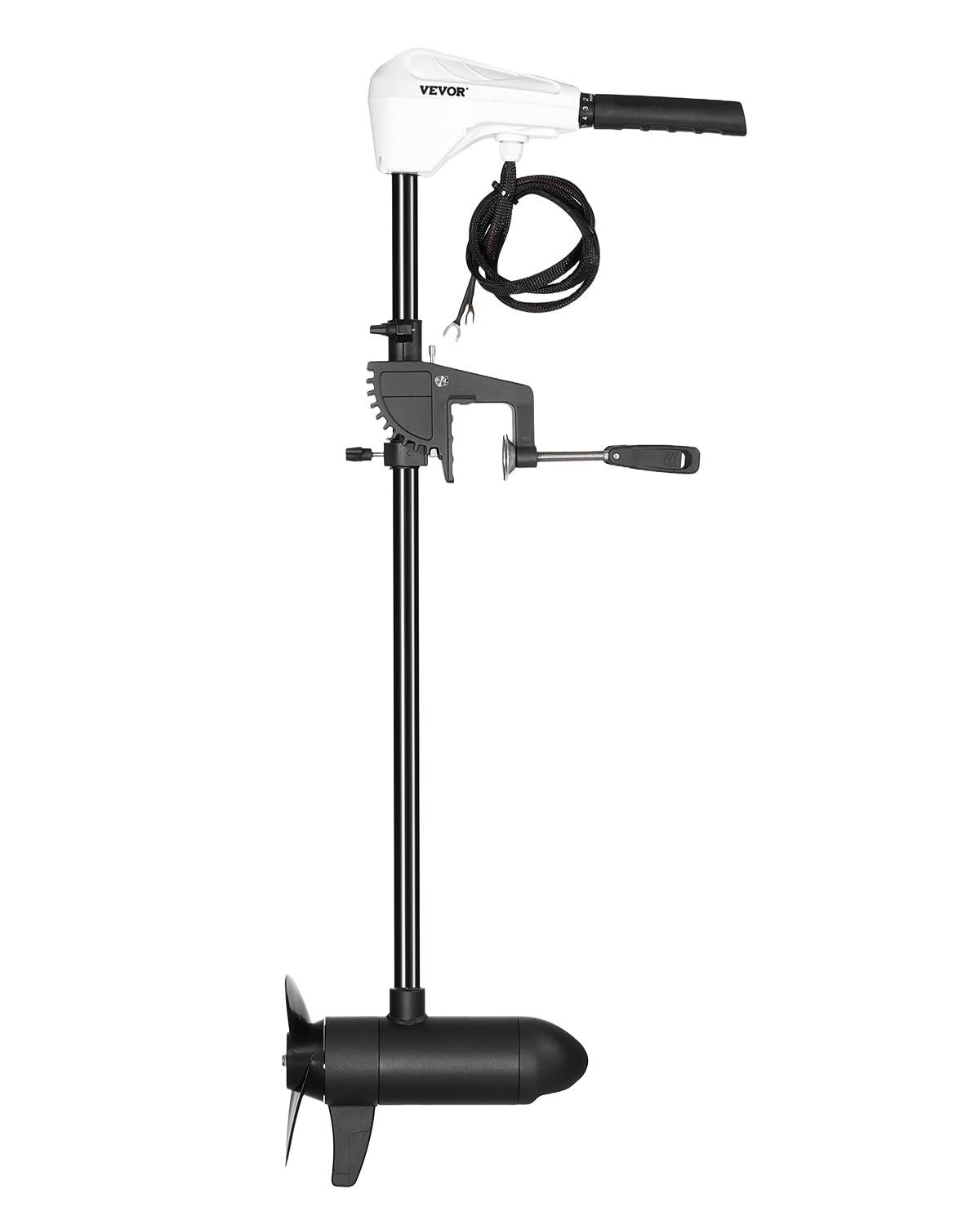
The all-metal brute that creek fishermen swear by.
One of the verified customer reviews on this VEVOR motor reads: “All metal. Nothing cheap about this motor. I am rough on motors because I use them in creeks. Very powerful, backs up good too.” That is the word from a buyer who has owned several motors, and it nails the defining quality of this unit — the VEVOR uses a high-strength aluminum alloy shaft and a sealed aluminum motor head for excellent corrosion resistance, which feels noticeably more durable than the plastic upper housing on the Newport L-Series. At 20.3 pounds, the VEVOR is 2.7 pounds lighter than the Newport, so it is easier to install and remove.
The 55 lb thrust level puts it in the same power class as the BODIOO 55lb motor (both claim 0.83 horsepower equivalent), but reviewers point out the VEVOR has a more robust build overall. The telescoping handle adjusts from 6.3 to 10.6 inches, giving you more range than the 6-inch extension on the BODIOO. A couple of reviews do mention that the tiller handle feels short for taller users, but for most applications on a 12- to 14-foot boat, the reach is fine.
Why it’s great
- Fully metal construction — aluminum alloy shaft and sealed aluminum motor head
- Light enough (20.3 lbs) for one person to mount and remove
- Telescoping handle adjusts from 6.3 to 10.6 inches for sitting or standing operation
Good to know
- Tiller handle still feels short for some taller anglers despite the adjustment range
- A small number of buyers received defective units, per customer reviews
- 30-inch shaft is adequate but not ideal for heavy chop
Best for: Budget-conscious anglers who need a rugged, all-metal motor for freshwater or saltwater creeks
Skip if: You need a 40-inch shaft for tall transoms or rough water
4. Goplus Electric Trolling Motor 8 Speed, Boat Fishing Motor w/Telescoping Handle

The featherweight that punches with 46 pounds of thrust.
The Goplus trolling motor is unique on this list because it is available in multiple thrust levels from 46 to 86 lbs, and the manufacturer publishes a horsepower rating of 4.6 horsepower for the top variant — that is a 5.5x jump over the 0.83 horsepower rating of the BODIOO and VEVOR 55 lb motors. For a 12-volt system, that is an enormous amount of power. A buyer who needs serious push for a larger aluminum boat or a heavy load of gear can get it without stepping up to a 24-volt system.
The shaft is made from glass-fiber composite rods, which resists bending better than raw aluminum in heavy weeds, and the motor includes a fuse that trips before the motor burns out if you get tangled. The 36-inch shaft splits the difference between the 30-inch VEVOR and the 40-inch Newport. One limitation is that Goplus only sells a two-bladed propeller on this model, not the three-bladed prop found on the VEVOR and Newport. A two-bladed prop is slightly more efficient at top speed but has less low-end torque for getting a heavy boat moving from a standstill.
Why it’s great
- Industry-leading 4.6 HP rating for serious pushing power on a 12V system
- 36-inch fiberglass composite shaft resists bending in heavy weeds
- Fuse trips to protect the motor when you get snagged in vegetation
Good to know
- Two-bladed propeller provides less low-end torque than a three-bladed prop
- Available in multiple thrust levels — confirm you get the 46/55/86 lb variant you want
- Glass-fiber composite shaft is durable but slightly less rigid than aluminum
Best for: Anglers who need maximum 12-volt horsepower for a heavy hull without moving to a 24V system
Skip if: You want a three-bladed propeller for better low-speed maneuvering
5. BODIOO 55lb Thrust Trolling Motor 8 Speed Electric Outboard Motor Kayak Motor
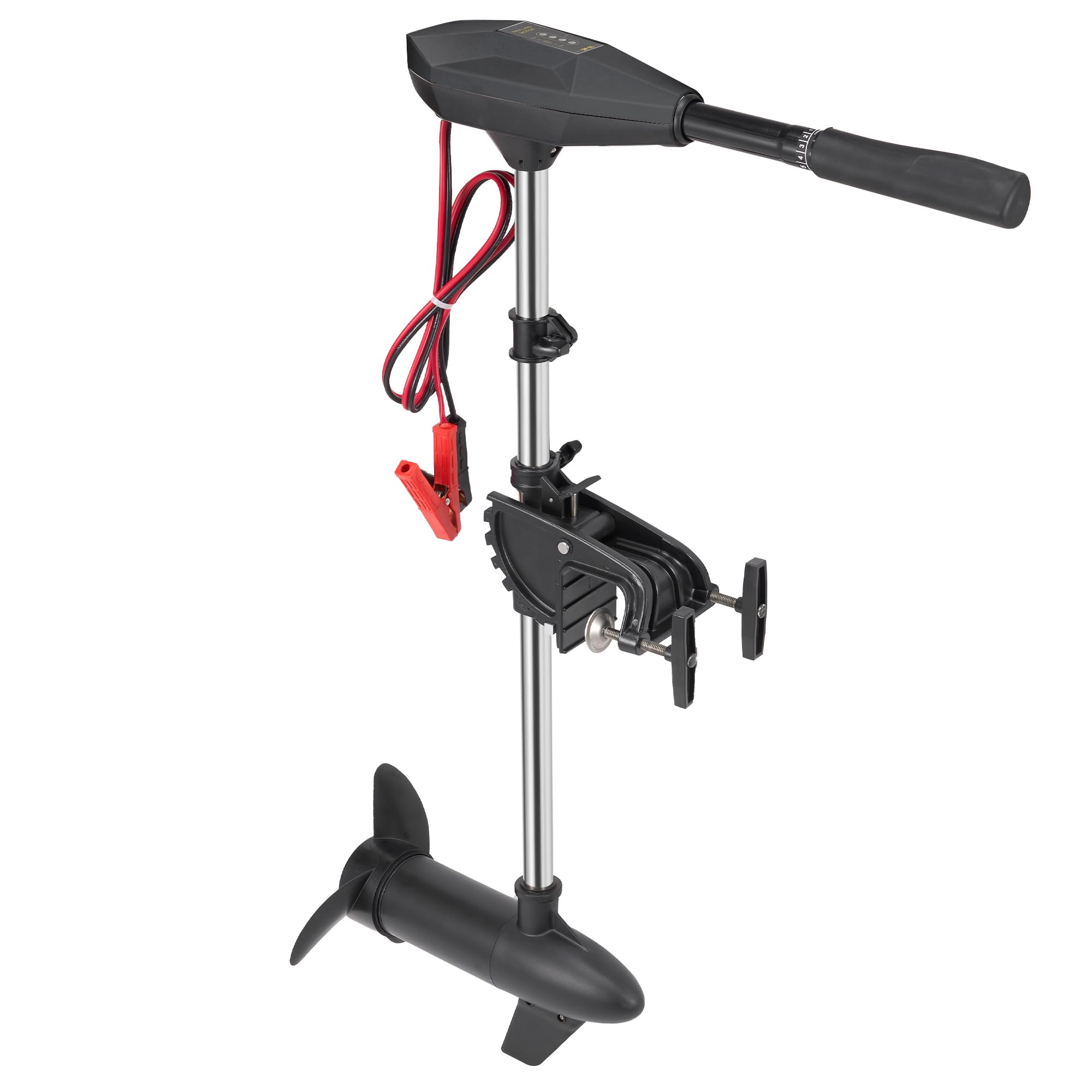
The freshwater runner that buyers compare to a Minnkota.
The BODIOO motor delivers 55 lbs of thrust (equivalent to 0.83 horsepower) through a three-bladed propeller, which provides better low-speed torque than the two-bladed prop on the Goplus. One verified buyer says: “Has good speed. Just as good as a Minnkota.” That is high praise from a segment of the trolling motor world where Minnkota is the gold standard. For a motor that sits in the entry-level price tier, the fiberglass composite shaft and die-cast aluminum head provide a surprisingly solid build.
However, there is a catch you need to know. A detailed buyer report states: “Decent quality, but only pulls 32 amps max, which is under 400 watts. More like 30-40lb thrust.” That means the real-world thrust might be closer to 35-40 lbs than the advertised 55 lbs, since amp draw (the amount of electrical current the motor pulls from the battery) correlates directly with thrust. On still lakes it will perform fine, but in any kind of current you will feel the shortfall. The motor is also rated for freshwater use only — do not take it into saltwater or the corrosion will kill it quickly.
Why it’s great
- Three-bladed propeller provides strong low-end torque for getting a boat moving
- Fiberglass composite shaft and die-cast aluminum head offer decent durability
- Buyers compare performance favorably to premium Minnkota motors at a fraction of the cost
Good to know
- Real-world amp draw of 32A suggests actual thrust is closer to 35-40 lbs than the advertised 55 lbs
- Not rated for saltwater use — freshwater only
- Six-month warranty is shorter than the two-year coverage on the AQUOS and Newport motors
Best for: Kayak and small-boat anglers fishing flat lakes who want a quiet, budget-friendly freshwater motor
Skip if: You fish in saltwater, strong current, or need the full 55 lbs of advertised thrust
6. PEXMOR 8 Speed Electric Trolling Motor, Electric Outboard Boat Motor w/Adjustable Handle
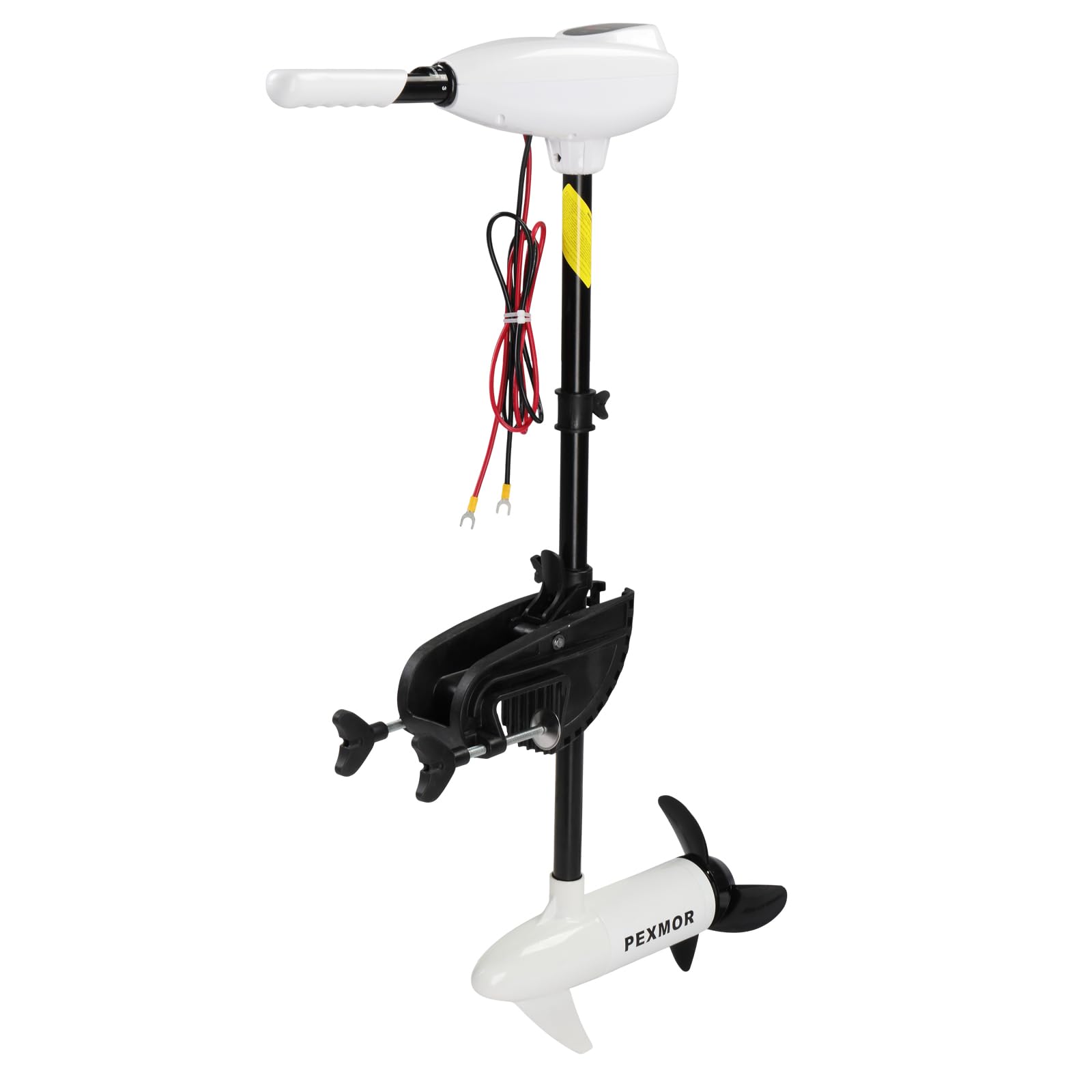
The pocket-sized kicker for inflatables and lightweight kayaks.
The PEXMOR produces only 26 lbs of thrust — that is a 2.4x gap compared to the 62 lbs of the Newport L-Series, and exactly half the advertised thrust of the BODIOO 55lb motor. For its intended use on a small inflatable boat, a lightweight kayak, or a canoe, that is plenty of power. You will not break speed records, but you will move steadily without scaring fish. The motor comes with both a two-bladed and a three-bladed propeller in the box, so you can swap based on whether you prioritize top speed (two-blade) or low-end torque (three-blade).
The standout feature at this tier is the 1-10 LED battery indicator on the handle, which shows you red lights for low power and green lights for adequate charge — a genuine help for avoiding a dead battery a mile from the launch. The telescoping handle extends 6 inches, similar to the BODIOO, and the transom mount adjusts both angle and depth easily. The compromise is obvious: at 26 lbs of thrust, you have almost no reserve power against wind or current. If the breeze picks up, you will be paddling. The one-year warranty is decent for this price point.
Why it’s great
- Comes with both a two-bladed and a three-bladed propeller in the box for on-the-water tuning
- 1-10 LED battery indicator gives clear red/green feedback on remaining charge
- Adjustable handle and transom angle make installation quick and flexible
Good to know
- 26 lbs of thrust is insufficient for anything beyond small inflatables and ultralight kayaks
- No reserve power against wind or current — you will paddle if conditions turn
- LED indicator is helpful but not accurate under load (a common issue on all sub- motors)
Best for: Paddlers adding a first electric motor to a small inflatable or lightweight kayak for calm lakes
Skip if: You fish on rivers with current or need to push a 12-foot aluminum boat
Understanding the Specs
Thrust and Amp Draw
Thrust (measured in pounds) is the forward force the motor produces. More thrust pushes a heavier boat or fights a stronger current. But thrust comes at a cost: amp draw, the electrical current the motor pulls from your battery. A 62 lb motor can pull 58 amps at full speed. You need a deep-cycle marine battery with enough amp-hours (Ah) to match. A rough rule: divide your battery’s Ah rating by the motor’s amp draw to get runtime in hours at full speed. A 100Ah battery on a 58A motor gives you about 1.7 hours — that is why brushless motors (which draw less current per pound of thrust) are such a big deal for all-day fishing.
Shaft Length and Material
The shaft is the tube connecting the motor head to the propeller. Longer shafts (36 to 40 inches) keep the prop submerged in rough water, preventing cavitation (when the prop spins in air instead of water and loses all thrust). Shorter shafts (30 inches) are fine for calm lakes and low transoms. Shafts are made from aluminum alloy, fiberglass composite, or stainless steel. Aluminum is stiff and corrosion-resistant. Fiberglass composite is lighter and bends without taking a permanent set if you hit a rock. Stainless steel is the most durable but adds weight. Match the material to your water: stainless or aluminum for saltwater, fiberglass for freshwater in rocky areas.
FAQ
How much thrust do I need for a 12-foot aluminum boat?
Can I use a 12V trolling motor in saltwater?
What size battery do I need for a 55 lb thrust trolling motor?
What is the difference between a 30-inch and a 40-inch shaft?
Are brushless trolling motors worth the extra money?
Will a 12V trolling motor work on a 19-foot boat?
What does the LED battery indicator actually tell me?
Can I use a 12V trolling motor as a primary motor on a small boat?
How do I choose between a two-bladed and a three-bladed propeller?
Do I need a circuit breaker or fuse for my trolling motor?
Final Thoughts: The Verdict
Across the board, the 12 volt trolling motor winner is the AQUOS Haswing 65LBS because it combines brushless efficiency, the highest thrust on this list, and the lightest weight in one package — giving you all-day run time without the weight penalty. If you need a saltwater-rated motor with a long 40-inch shaft for rough conditions, grab the Newport L-Series 62lb. And for the best balance of all-metal durability and value, the standout is the VEVOR 55lbs Thrust.
How We Picked
We do not accept paid placement, and we did not hands-on test every unit. Instead, we match each pick to a real buyer and use-case by comparing the manufacturers’ published specifications against the patterns in verified customer reviews — so you get each pick’s real strengths and trade-offs instead of marketing copy.
Sources & Methodology
Specifications: manufacturer listings and product documentation. Review insights: verified customer reviews, as of June 2026. Pricing: not shown on this page (it changes often); check the current price via the retailer link.
As an Amazon Associate, Gadgets Feed earns from qualifying purchases. This does not affect which products we feature.
Product prices and availability are accurate as of the date/time indicated and are subject to change. Any price and availability information displayed on Amazon at the time of purchase will apply to the purchase of this product. As an Amazon Associate I earn from qualifying purchases.
CERTAIN CONTENT THAT APPEARS ON THIS SITE COMES FROM AMAZON. THIS CONTENT IS PROVIDED "AS IS" AND IS SUBJECT TO CHANGE OR REMOVAL AT ANY TIME.
Amazon and the Amazon logo are trademarks of Amazon.com, Inc. or its affiliates.