
Our readers keep the lights on and my morning glass full of iced black tea. As an Amazon Associate, I earn from qualifying purchases.
Specs are compiled from manufacturer listings and verified buyer reviews and can change over time — please confirm the key details on the product page before buying.
Here is the short answer: the screen you buy matters as much as the projector you point at it. A 120 inch screen is roughly the width of a small car, so every wrinkle, sag and dull white surface shows up as a blotch on a face, a gray haze in a night scene, or a bright rectangle that looks washed out the moment a lamp is on. The three decisions that actually change your picture are the mounting type (fixed frame, tripod stand, or motorized drop-down), the surface gain, and whether the fabric stays flat once it is stretched. Get those right and a budget projector suddenly looks like a real theater. Get them wrong and even an expensive projector looks soft.
I’m Min — the founder and writer behind Gadgets Feed. This guide is built by comparing the manufacturers’ published specifications and the patterns across verified customer reviews, so you get each pick’s real strengths and trade-offs instead of marketing spin.
You will see which mounts suit a dedicated dark room and which fold into a bag for the backyard. The list below covers every path to a 120 inch projector screen, and it names the one trade-off each design forces you to live with.
Our Picks at a Glance

How To Choose The Best 120 Inch Projector Screen
The first question is not which screen is best — it is whether you are buying a screen that stays on the wall or one that lives in a bag. That single choice decides everything else about how the picture looks and how much effort movie night costs you.
Wall-mounted or portable
A fixed frame bolts to the wall once and never moves, which is why it holds a perfectly flat surface for years. A tripod screen pops up in minutes and packs into a carry bag, but it stands on legs that catch the wind and needs stakes, ropes and a sandbag on grass. Neither is better — they solve different problems.
Gain and room light
Gain is how much light the surface throws back at your seats. A 1.3 gain white surface pushes a brighter picture, which suits a dedicated dark room. A 0.7 gain matte gray surface pulls down stray light instead, so a living room with a lamp on looks less washed out. Match the surface to your room, not to the number.
The frame and the flatness
A tensioned or spring-mounted surface is what keeps edges crisp, because loose fabric shows as waves across the picture. A velvet-wrapped aluminum frame absorbs the stray light that spills past the projected image, which is the difference between a sharp border and a soft, glowing edge.
Quick Comparison
| Model | Best For | Mounting Type | Screen Finish | Viewing Angle | Amazon |
|---|---|---|---|---|---|
| ShowMaven 120″ Fixed Frame★ Best Overall | Permanent home theater wall | Wall Mount | Glossy | 160 degrees | Amazon |
| Wootfairy 120inch Screen and StandBudget Champion | Indoor movie nights on a budget | Tripod Mount | Matte | 160 degrees | Amazon |
| Towond 120 inch with StandBest for Game Day | Soccer nights and backyard parties | Tripod Mount | Glossy | 160 degrees | Amazon |
| ZUVMITG 120inch Screen with Stand | Camping and travel screenings | Floor Mount | — | 160 degrees | Amazon |
| DINAH 120 Inch Electric Screen | Ceiling-mounted push-button use | Ceiling Mount | Matte | — | Amazon |
| Akia Screens AK-FF120WH2 | Bright indoor theater rooms | Wall Mount (kit included) | Matte | — | Amazon |
| Elite Screens Sable Frame B2 | Mixed projector types in one room | Wall Mount | — | — | Amazon |
| AWOL VISION 120″ Matte Gray | Living rooms with ambient light | Wall Mount | Matte | 170 degrees | Amazon |
| Silver Ticket STR-169120-WAB | Speakers hidden behind the screen | Wall Mount | 160 degrees | 160 degrees | Amazon |
In‑Depth Reviews
1. ShowMaven 100in /120in Fixed Frame Projector Screen, Diagonal 16:9 (120″)
Our pick — over 4.5★ from 400+ verified ratings; the strongest balance of quality and price.
The wall screen that stops wobbling, wrinkling and waiting — it just hangs there looking expensive.
If your projector lives in one room and never travels, this is where the money belongs. It is a fixed frame design, which means it bolts to the wall permanently instead of rolling in and out, and that single decision is why the surface stays glass-flat. The 109.1″ W x 63.8″ H viewing area is a true 16:9 shape, so widescreen films fill it edge to edge with no letterbox bars. It carries a 1.1 gain surface and a 160-degree viewing angle, which in plain terms means the picture stays bright and readable for someone sitting off to the side of the couch, not just dead center. It is also 4K Ultra HD and Active 3D ready, so a future projector upgrade will not outrun the surface.
What wins people over is the build — the quality of this screen is the single thing buyers rave about most, and once you see the 2.36″ beveled aluminum frame wrapped in black velvet, you understand why. That velvet border is not decoration: it soaks up the light that spills past the projected image, so the edges of the picture read as crisp and sharply defined instead of glowing soft. The soft PVC surface is completely flat with no wrinkles or waves, and it wipes clean with soap and water on a damp cloth. Assembly runs on a 6-piece split aluminum frame you follow step by step — straightforward, though this is a two-person job once the frame gets long. Contrast that with the tripod screens further down this list, where the whole thing folds into a bag and stands on legs. Here, nothing folds and nothing stands — it is on the wall, done. An honest note: assembly and mounting are the two things that split opinion in the reviews, and the spring assembly in particular has its critics. Budget an afternoon and a helper, and hang it where you intend to keep it, because this is not a take-it-down-every-week design.
Owners keep circling the same point: this screen looks far more expensive than it is, and the value is the second-most praised quality after the build itself. For the price of a mid-range streaming box upgrade, you get a permanent, flat, light-absorbing surface that makes every future projector you buy look better.
What Buyers Keep Praising
- Perfectly flat PVC surface with no wrinkles or waves that show up on screen
- 2.36″ velvet-wrapped aluminum frame absorbs overflow light and sharpens the picture edge
- 109.1″ W x 63.8″ H of true 16:9 viewing area, with a 160-degree angle for off-center seats
- Wipes clean with soap and water on a damp cloth
What To Plan Around
- Permanent wall mount — no packing it away for an outdoor night
- Two people and a free afternoon makes the frame and spring assembly far easier
- 12.7 kg of aluminum means you need solid wall anchors, not drywall plugs alone
Settle in for this one: you have a fixed room, a fixed projector, and you want the flattest, brightest 120 inch surface you can hang without spending premium money.
Keep looking if: you want a screen that folds into a trunk for camping, because this one is designed to stay exactly where you mount it.
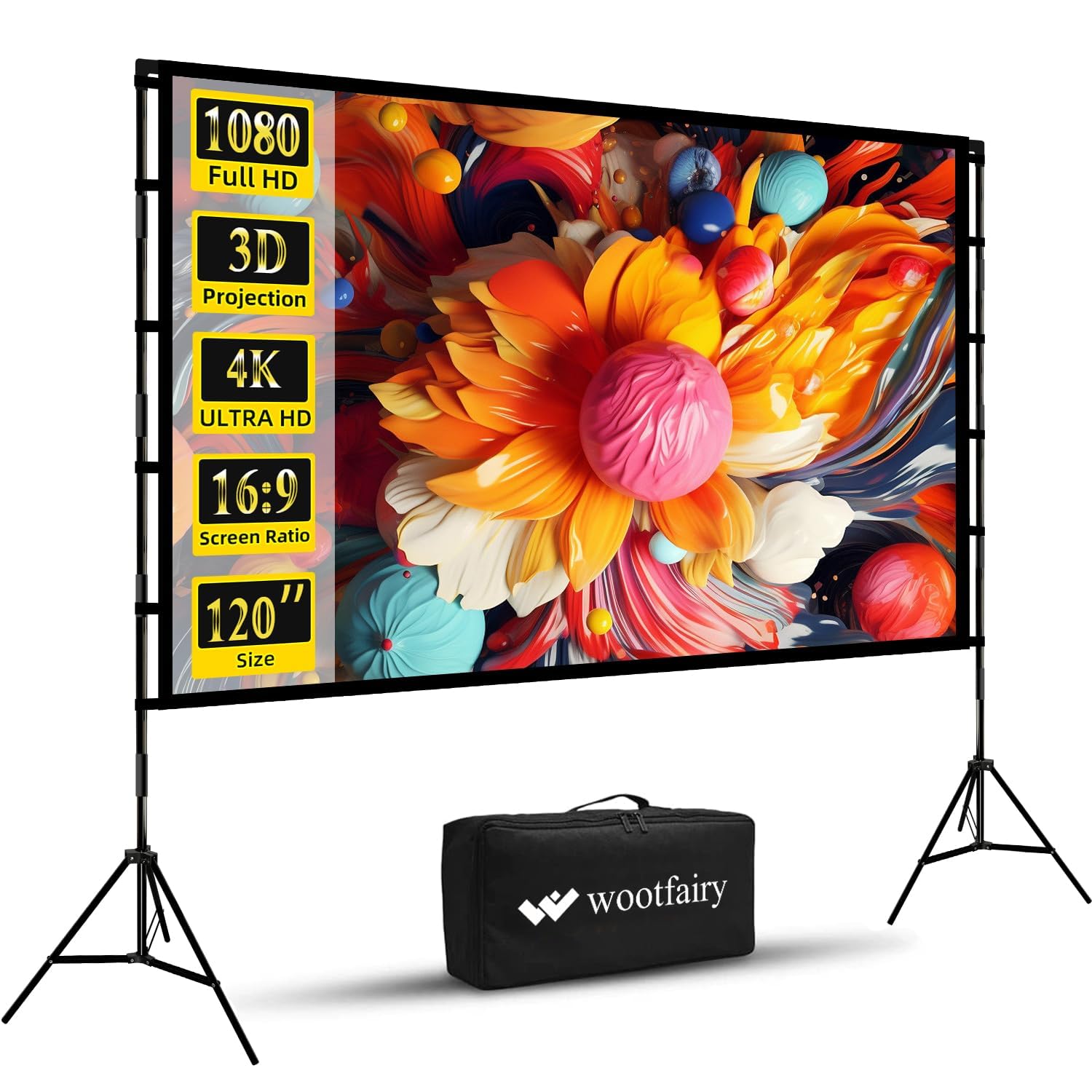
2. Wootfairy 120inch Projector Screen and Stand Indoor Outdoor Movie Screen
A whole cinema that folds into a bag and sets up before the popcorn finishes popping.
Start with the measurement that surprises people: the frame stands 104″ H x 77″ W, which is 42% more vertical footprint than the ShowMaven above at 109″W x 64″H. In a room, that extra height is what makes the scene feel like it wraps around you instead of sitting politely on the wall. It is a 16:9 screen with a 160° viewing angle and double-sided projection, so you can sit behind it as easily as in front. The surface is polyester milk silk, which the maker describes as thicker than ordinary screen fabric.
Setup takes no tools — the crossbar and tripod snap together, and everything packs into the included carry bag at just 8.3 pounds. Buyers report it stores in a small bag they can drop in a trunk, and it has handled presentations, poolside and camping movies, even a hospital watch party. Kids flipping through the parts have labelled bags to thank for the speed. Screen quality and ease of assembly are the two things buyers praise most, and the wrinkle-free claim holds up in practice.
Now the honest part. Stability is the recurring gripe, and it is a real one. On a patio or lawn the tripods will not survive a serious gust — sandbags and the included ropes and stakes are not optional accessories, they are the difference between a movie and a chase scene. One buyer put it plainly: “Not for outdoor use—tripods unstable, blow over in wind. Stable indoors for 3 months.” Keep it indoors, or tie it down properly outdoors, and it behaves. The width also cannot be narrowed — folding the sides in to shrink the image introduces wrinkles.
The clever bit: the 120 inch viewing area is 42% taller in footprint than the fixed ShowMaven screen, yet the entire rig weighs 8.3 pounds and travels in a bag — you trade permanence for portability and get a huge picture in return.
Where it stumbles: anything above a light breeze. Sandbag the legs, stake the ropes, and take it down when the weather turns.
The right call for: renters, campers and anyone who wants a giant screen tonight without drilling a single hole.
Pass it by if: your “outdoor” movie night sits in an open field where the wind has opinions.
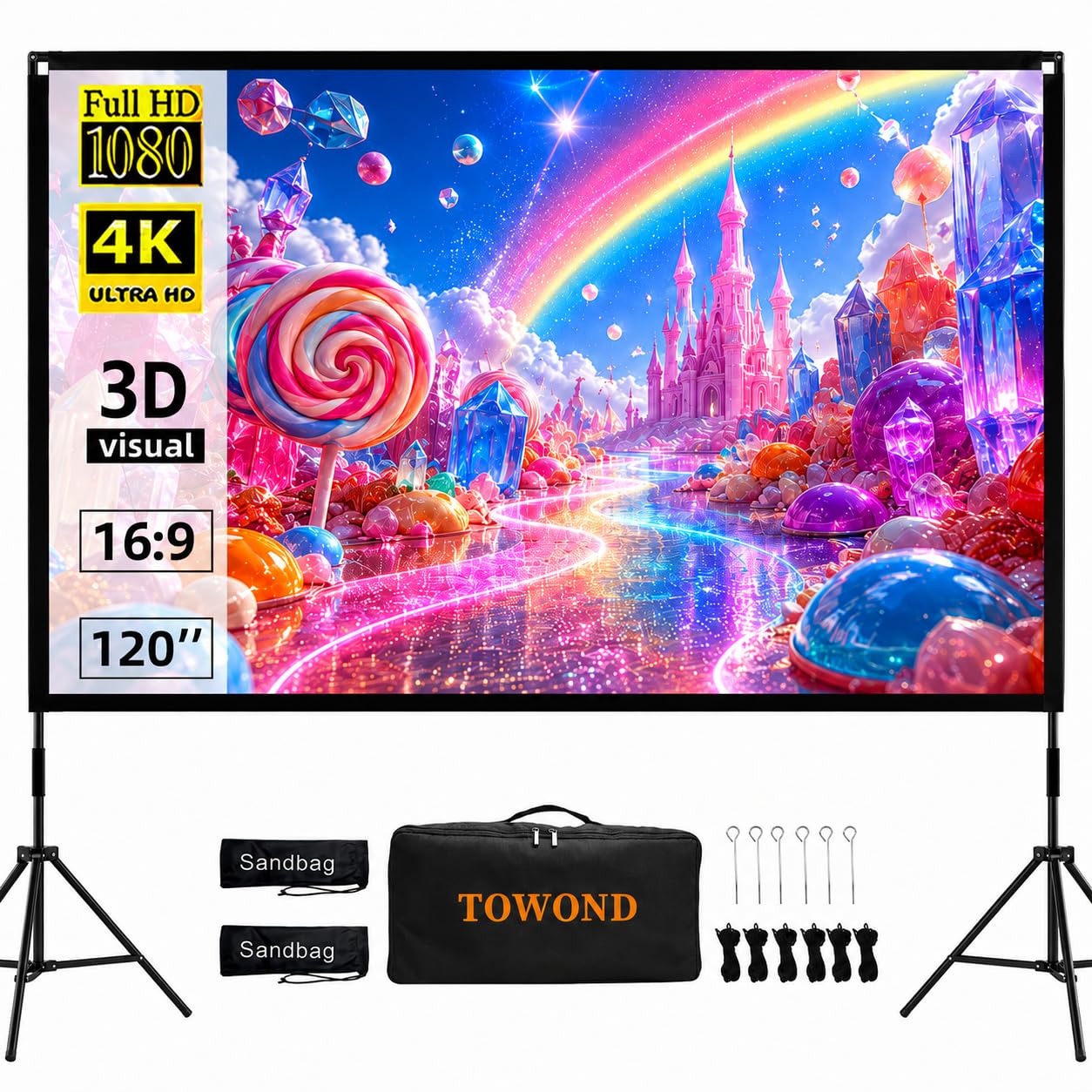
3. Projector Screen with Stand, Towond 120 inch Outdoor Movie Screen 16:9
Built for the crowd that shows up for the match and leaves before the credits.
This one is aimed at group viewing, and the numbers back it: a 160° viewing angle spreads the picture across a patio so nobody has to fight for the middle seat, and the fabric works for front or rear projection. The stand is a 19mm tripod, and the kit includes stakes, ropes and a sandbag to hold it down on grass or soft ground. Setup runs without screws or special tools, and the whole thing weighs about 8.37 lb before folding into its carry bag. The viewing area measures 105″ W x 77″ H.
Most people get it standing in about five minutes, and owners mention the wrinkle-free surface stays smooth, with the individually labelled part bags making teardown quick. A particularly useful field note from owners: you want roughly 15 feet of throw distance between projector and screen, so measure your yard before you commit. The reinforced finished edge is what keeps the viewing rectangle looking clean rather than ragged at the corners.
The trade-off is the fabric itself. It is a thin polyester cloth, and owners describe it as see-through when the projector is running — projecting onto a dark tarp or a black sheet pinned behind fixes it, but it is an extra step nobody mentions in the listing. One buyer compared the surface to “fuzzy soft T-shirt” material, which softens fine detail at 1080p and 4K. A few also found the crossbar fit too tight to seat by hand. It is a party screen, not a reference screen.
Where It Earns Its Place
- Roughly five-minute setup and breakdown, with labelled bags for every part
- 160° viewing angle and front or rear projection for a seated crowd
- Stakes, ropes and a sandbag included for grass and soft ground
- Reinforced finished edge keeps the rectangle clean around the frame
The Catches Worth Knowing
- Thin cloth reads as see-through without a dark backing behind it
- Soft fabric surface dulls fine 4K detail compared with PVC screens
- Crossbar sections can be stiff to seat, and a few units arrived damaged
Buy it when: the point is a crowd on the grass, a soccer kickoff, and a screen up in five minutes flat.
Avoid it if: you are chasing reference-grade 4K sharpness — the woven-fabric screens further down this list are the ones for that job.
4. ZUVMITG 120inch Projector Screen with Stand
The portable screen that answers the wind problem nobody else around this price solves.
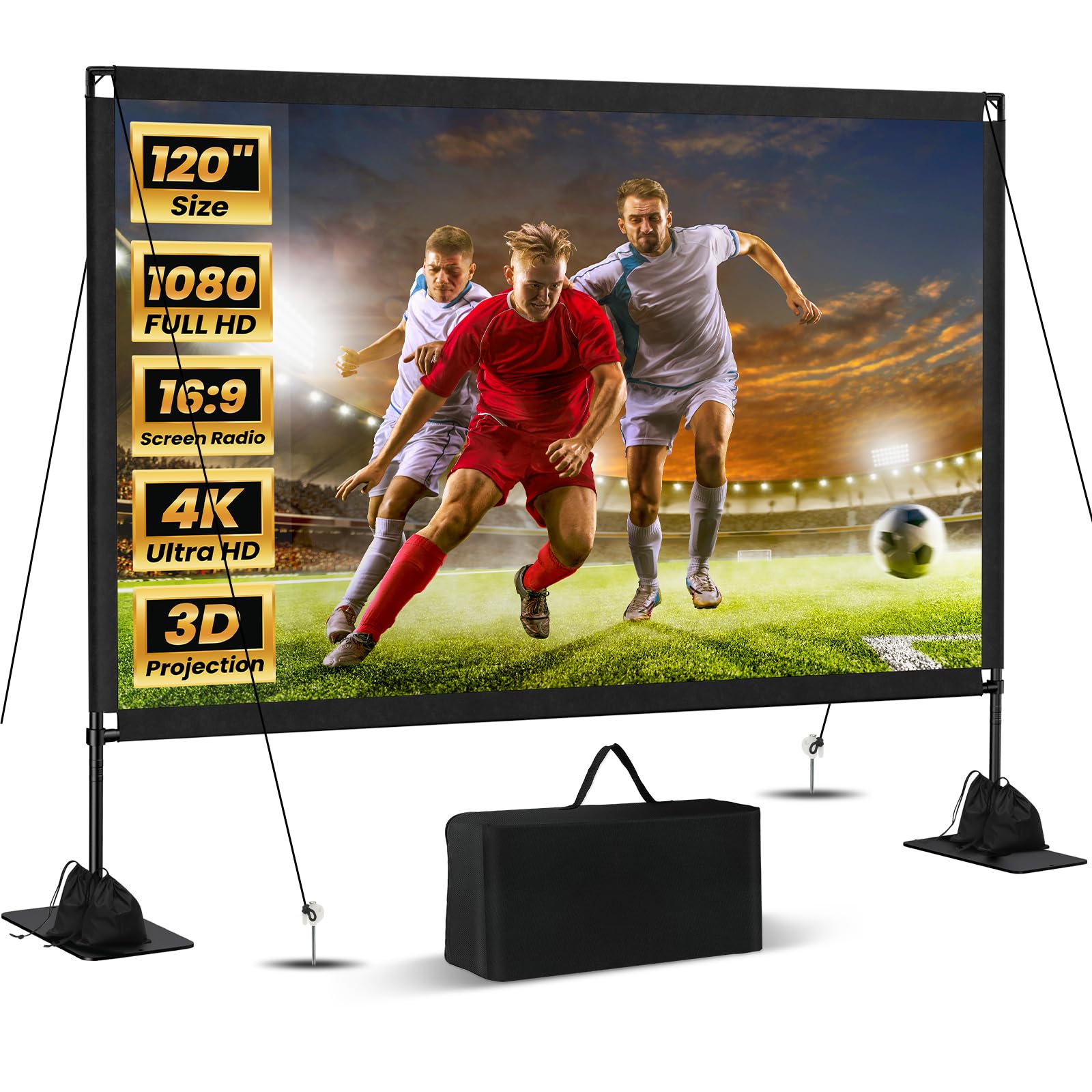
Every tripod screen on this list wobbles. This one attacks that head-on with an extended, reinforced base and support made from premium steel, and that is the whole design argument. The 106″ W x 76″ H 16:9 frame weighs 12.5 pounds and stands on the floor instead of hanging on a wall. It folds flat for storage in a dedicated bag.
The weather kit is where the thought shows: four ground stakes and four ropes, plus four sandbags, all included to stop the screen swaying or collapsing in a breeze. The fabric is washable milk silk with an integrated installation that pulls the surface tight to the frame, so wrinkles are minimised even at the edges. Both sides project, and the 160° angle keeps colors consistent across a wide seating spread. The thing buyers praise most is quality, followed closely by how quickly it goes up — owners describe the component design as a breeze once the labeled parts are laid out.
The practical limit is that this is a stand screen, not a wall screen. It is tall enough that a gust will still test those sandbags, and the instruction sheet only covers the basics, so the first assembly benefits from patience. Set it up once in daylight, learn which bar goes where, and every movie night after that is a ten-minute job. Store it dry — this is fabric, not an outdoor installation.
what separates it: four sandbags, four ground stakes and four ropes are in the box, so the stability problem is addressed before you even open the carrying bag.
Keep in mind: the steel base makes this a 12.5 pound lift rather than a one-hand carry, so it suits car trips more than backpacking.
This is your screen if: you want a portable 120 inch display that holds its footing on a lawn without a rigging project.
Choose differently if: you need to slip a screen into a hiking pack — under nine pounds is where that story lives.
5. DINAH 120 Inch Electric Projector Screen with Remote
Press a button, the screen drops, and your living room stops being a cinema when you are done.
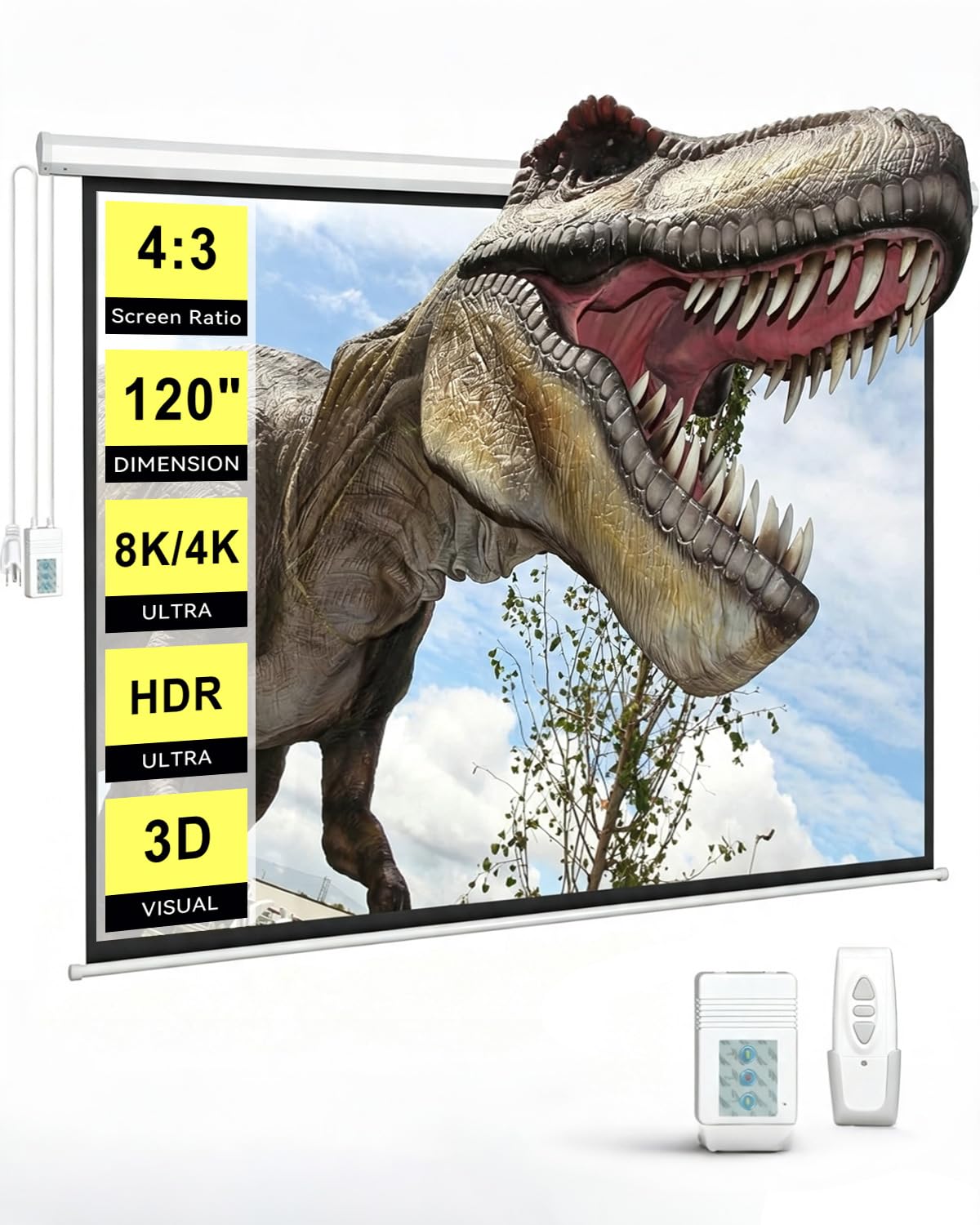
A 120 inch screen is 87″ W x 49″ H of surface, and not everyone wants that hanging on the wall all year. This one retracts. It mounts to the ceiling or wall and rolls down and away on command from the included remote, which is the single feature that separates it from every fixed frame here. The surface is designed for 4K 3D HD projection, and the matte finish keeps reflections off the picture.
Screen quality is what buyers praise most, and the second most-discussed plus is simple functionality — it works the moment you plug it in, no pairing ritual. The picture comes through clear and sharp, and the motor lowers and retracts smoothly and quietly, so it does not announce itself over the opening credits.
Two things to weigh before you buy. The retraction mechanism is where opinions divide — because a motorised screen rolls up on a tube, it cannot match the dead-flat tension of a spring-mounted frame, and over time the surface can develop slight waves. There is also a new-screen smell that owners notice at first; it fades, but it is real on day one. Ventilate the room for the first few days, and mount it where the casing is easy to reach if the motor ever needs attention. That is the cost of push-button convenience, and for most people it is a fair trade.
Why It Earns A Spot
- Remote control lowers and retracts the screen at the touch of a button
- Frees your wall completely when the movie is over
- Designed for 4K 3D HD projection with a matte finish that resists reflections
- Motor runs smoothly and quietly on the way down and up
What To Put On The List
- Roll-up screens cannot match the dead-flat surface of a fixed frame
- A new-screen smell is noticeable for the first few days
- Adds a motor and remote to the setup, which is one more thing to maintain
Made for: a multi-use room where the wall has another job on non-movie nights.
Think again if: you have a dedicated dark theater and want the flattest possible surface permanently — a fixed frame wins there.
6. Akia Screens Fixed Frame Projector Screen 120-Inch, 16:9, AK-FF120WH2
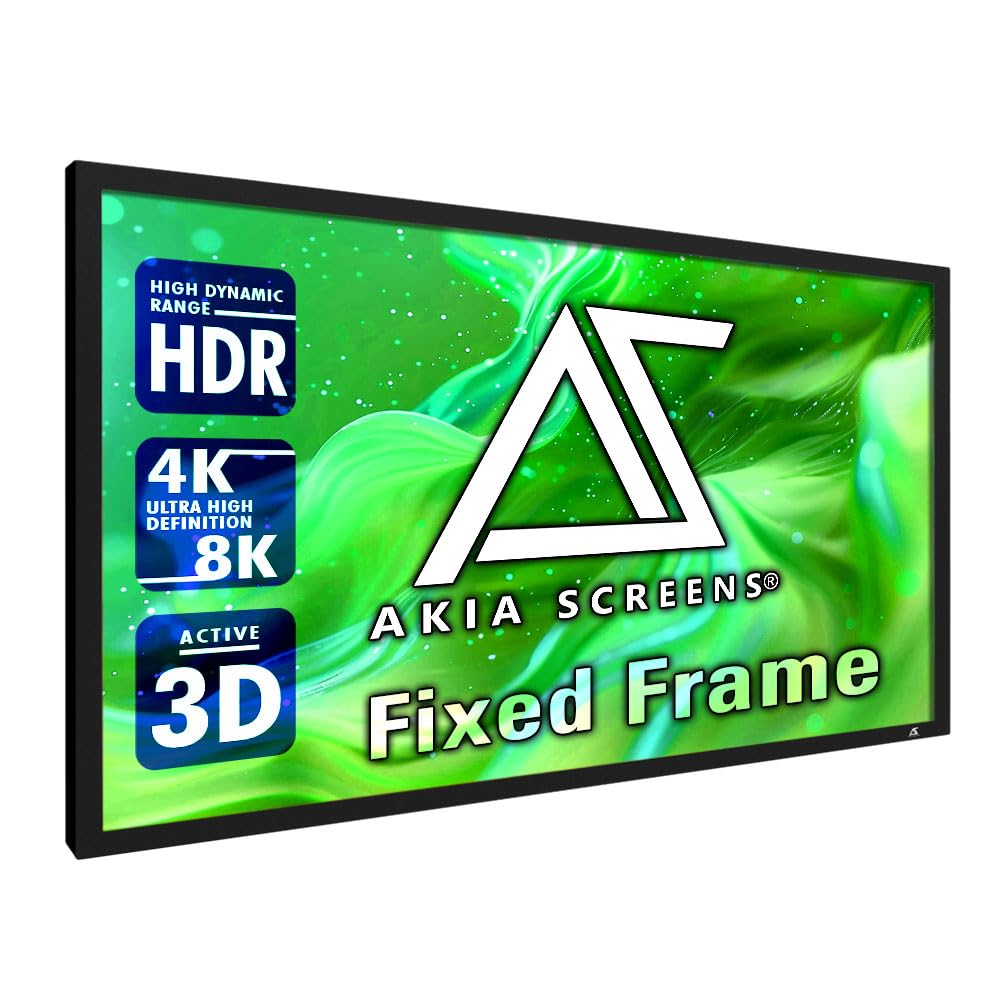
A brighter surface with a velvet frame that swallows light — this is the one that makes a room look built for film.
The number worth understanding here is 1.3 gain. Gain is how much brightness the surface bounces back at your seats, and 1.3 is on the higher side, which is exactly what you want if your projector is running in a room you have darkened but not blacked out. The CineWhite UHD-B material is ISF Certified for accurate color reproduction, backed in black to stop light leaking through, and it holds that brightness across a wide viewing angle. The viewing area is 109.4″ W x 64.3″ H in a true 16:9 frame.
What surprises buyers is how much the frame does. The 2.4-inch lightweight aluminum frame is wrapped in dense black velvet, and that border absorbs projector overshoot — the stray light that spills past the image — which lifts the perceived contrast and makes the black bars around a film look genuinely black. Owners describe the room looking like a movie theater once it is up, and the rigid aluminum structure is what keeps the screen taut instead of rippling. It is a fixed wall mount with the mounting kit included, intended for indoor use only.
Set aside real time for the build. Assembly is the aspect that splits opinion most, and mounting has its own share of grumbles, mostly around getting a long aluminum frame square on the wall. Two people, a tape measure and a free afternoon make the difference between a pleasant job and a frustrating one. Slide the wall brackets into place before you tighten anything. Once it is up, it is up for years with nothing to adjust.
The bright-room advantage: a 1.3 gain ISF Certified surface paired with a velvet frame that eats overshoot light — the combination that keeps a picture punchy when the room is not pitch black.
Plan for it: this is a wall-mounted fixed frame for indoors, so decide where it lives before the box arrives, and bring a helper for the install.
Pick this one for: a dedicated theater or media room where you want maximum brightness and a professional-looking velvet border.
Look elsewhere if: you want a screen that rolls away, because this one stays on the wall.
7. Elite Screens Sable Frame B2 120″ Fixed Frame Projector Screen SB120WH2
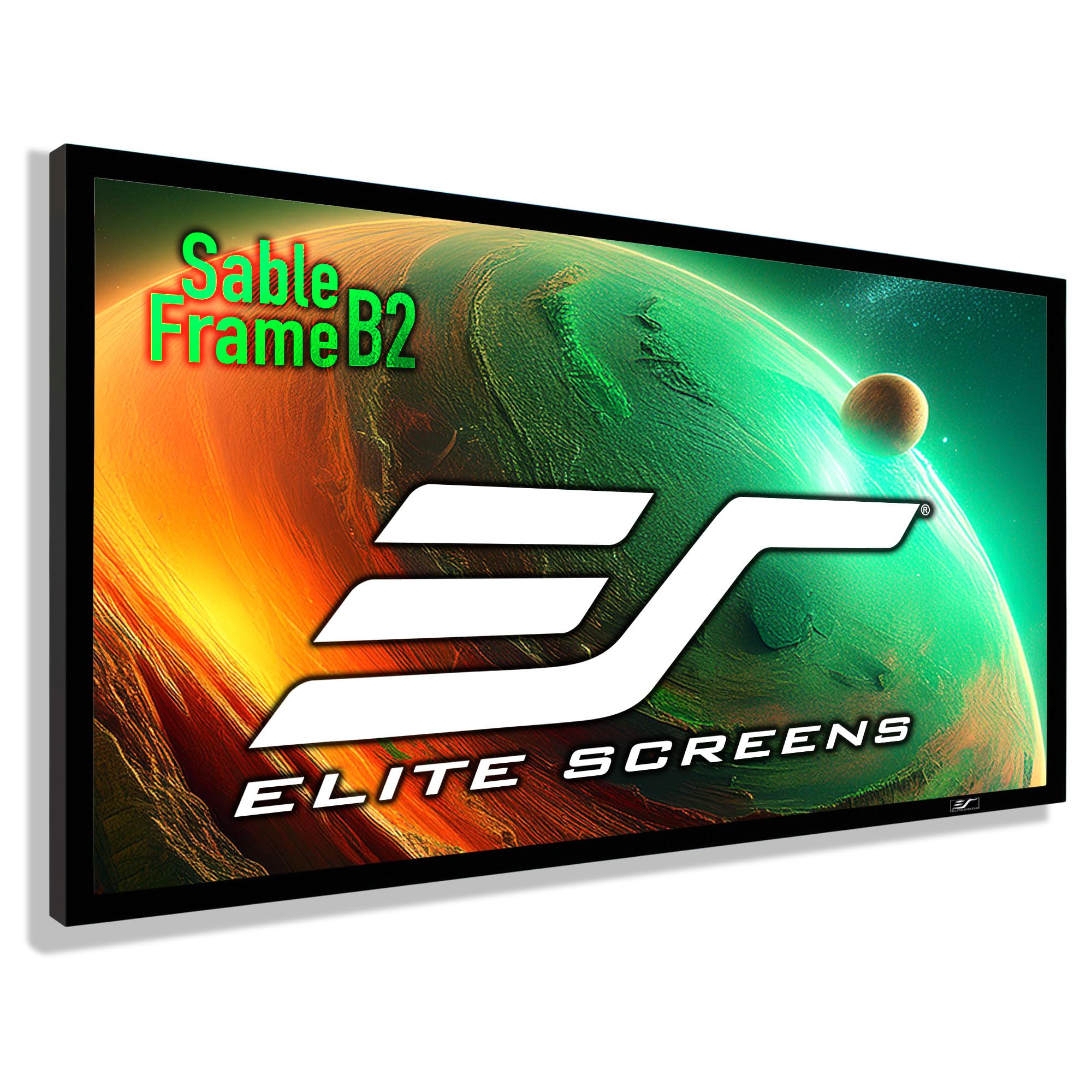
The screen that works whether your projector sits on a shelf or hugs the wall.
Most 120 inch screens pick a lane: they suit a standard throw projector that sits across the room, or an ultra short throw unit that sits inches from the wall. This one handles all three — Ultra Short Throw, Short Throw and Standard Throw — which is why it tops the compatibility column here. The CineWhite UHD-B surface is 1.3 gain, ISF Certified for color accuracy, and HDR and Active 3D ready. The viewing area is 58.7″ H x 104.7″ W within a 16:9 frame.
The tensioned rod and spring system is what keeps the surface ultra-flat, and the frame comes with sliding wall brackets, drywall anchors and screws so you are not hunting for a mounting kit. The 2.75″ aluminum frame wears a dense black velvet finish to absorb overshoot light and lift contrast. Owners are particularly fond of the screen material itself — one comparison that sticks is the “premium rubbery feel” of the fabric, which is a long way from the thin cloth on the portable screens above. Screen quality is the runaway favorite among buyers, and the projector-filling image is what they notice most.
Be ready for the install. Assembly experiences swing between easy and finicky depending on who you ask, and the spring system rewards reading the instructions twice before you touch a spring. The frame is heavy, so a second pair of hands is close to mandatory. The upside is a screen that stays flat from the day you hang it, and a two-year warranty with U.S.-based support behind it.
What Makes It Stand Out
- Works with Ultra Short Throw, Short Throw and Standard Throw projectors
- 1.3 gain ISF Certified CineWhite UHD-B surface, HDR and Active 3D ready
- Tensioned rod and spring system holds the surface ultra-flat
- Sliding wall brackets, drywall anchors and screws all included
Before You Commit
- Spring assembly is finicky and genuinely wants two people
- The 2.75″ frame is heavy to lift into wall position
- You pay a premium over the value fixed frames for that UST compatibility
Worth it when: your projector might change, or you are running an ultra short throw unit that needs a specific surface.
Skip the premium if: you already know your projector is standard throw — the cheaper fixed frames will serve you just as well.
8. AWOL VISION 120″ Fixed Frame Matte Gray Projector Screen
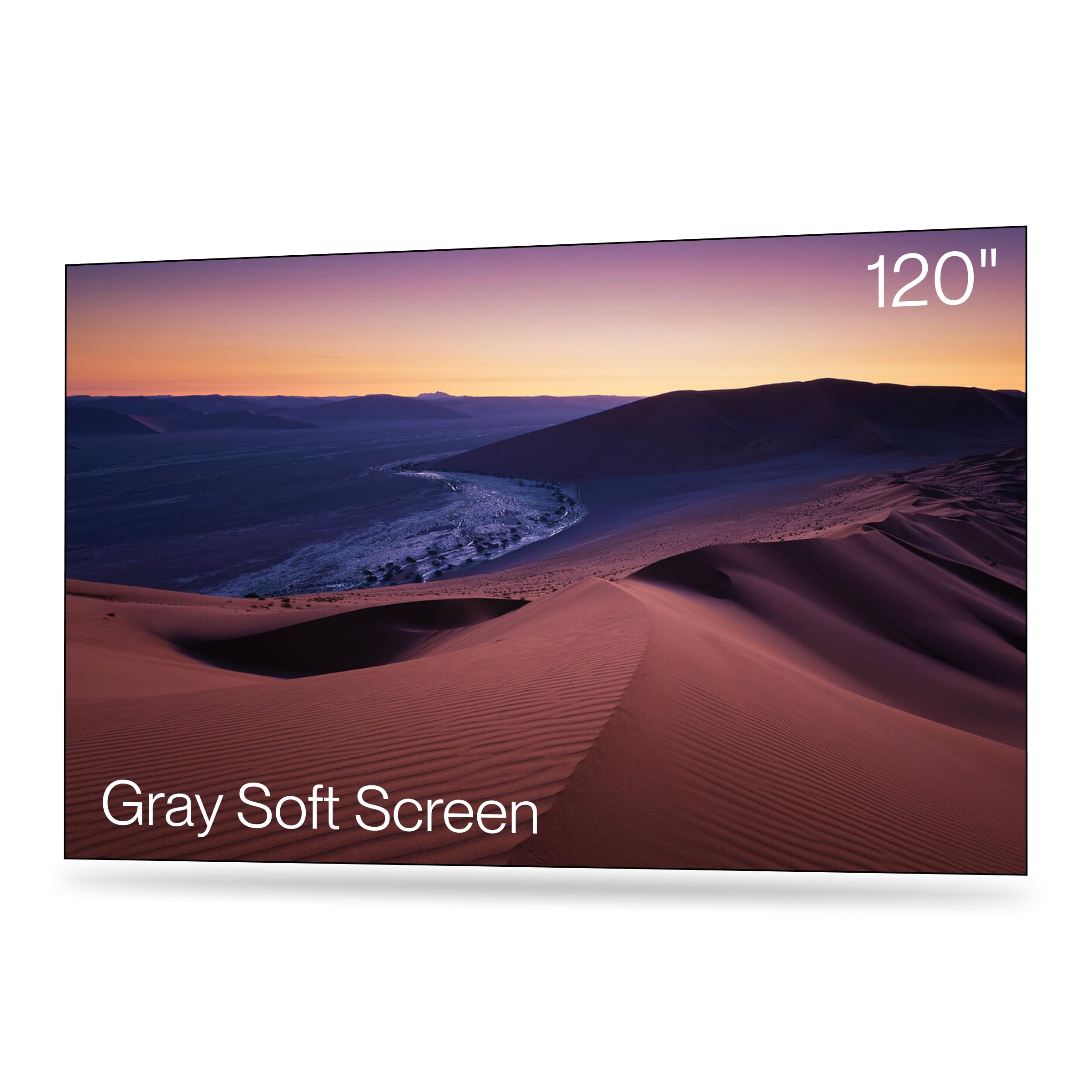
A deliberately dimmer surface, built for the living room you actually live in.
Almost every screen on this list chases brightness. This one walks the other way on purpose, with a 0.7 gain matte gray PVC surface. Gain works like this: a high-gain white screen throws back more light but also bounces stray light from windows and lamps back at your eyes, which is why daytime viewing looks washed out. A low-gain gray surface absorbs part of that stray light instead, so black levels sit lower and dark scenes keep their shadow detail. If your room has curtains drawn or soft lighting rather than total darkness, this is the design that keeps the picture from looking milky.
The 170° viewing angle is the widest here, so color and clarity hold up across a broad seating area rather than only directly in front. The aluminum frame uses multi-point spring tensioning to keep the surface flat and sharp from center to every corner, and the slim 1 in / 2.5 cm bezel looks like it belongs in a living room rather than a commercial rig. There is no motor, no remote, no circuitry and no moving parts — once it is mounted, it is always ready, with zero waiting and no motor noise.
The catch is the assembly and the surface choice itself. Assembly draws mixed feelings, with owners calling it laborious and the written manual and video not always agreeing with each other, and one owner reported a subtle sag at the top middle that affected projection and needed re-tensioning. The gray surface also handles low light far better than daylight. If your room is genuinely dark, the bright 1.3 gain surfaces above will give you more punch for the money.
The room-first logic: 0.7 gain gray is a deliberate trade — less raw brightness, but deeper blacks and less washout when a lamp is on, which is the honest fix for a living room that is never fully dark.
The honest caveat: gray gain only pays off in controlled light. In a blacked-out theater, the white 1.3 gain screens simply look brighter.
Right for you if: your screen shares a room with lamps, windows and normal life, and you want shadow detail to survive.
Not the pick if: your theater is fully blacked out and you want every last lumen on screen — go bright white instead.
9. Silver Ticket Products STR Series 120″ Woven Acoustic Fixed Frame, STR-169120-WAB

The screen you can hear through — your center speaker disappears behind it and the sound comes from the picture.
This is the most specialised screen on the list, and the reason is one phrase: acoustically transparent. The woven fabric is porous, so you can place speakers behind the screen surface — normally your center channel and a subwoofer — and the sound passes straight through. That puts dialogue exactly where the actors are on screen instead of off to the side, and it clears wall space that a traditional setup wastes. The 1.15 gain white surface gives a 160-degree viewing angle with no resolution loss at any angle, and the viewing area is 120″ diagonal, 58.875″ H x 104.5″ W. The frame measures 110.8″ W x 65.18″ H overall and is wall mount only, with no leg or stand option.
Buyers who have owned three or four acoustic screens say the design of this one holds up: a 3 1/8″ heavy-duty beveled aluminum frame wrapped in light-absorbing black velvet, with a tensioning rod system that keeps the surface wrinkle-free. The perforations are fine enough to be invisible from normal seating distance, and customers note the weave disappears entirely past a foot away. Sound quality through the fabric is the standout — owners running a sound meter found minimal loss, and having the center channel behind the screen made the whole front stage sound better balanced.
Two things to know before ordering. First, installation is the most-criticised part: the tensioning springs are genuinely hard to fit, the included spring tools come in different lengths with no clear labelling, and the instructions have been described as poorly written and out of order. Second, this frame is not for every projector — some Ultra Short Throw models are not compatible with the STR frame, and the maker recommends their S7 series for those. If you run a UST unit, check that first. For a standard or short throw setup with real speakers, this is the last screen you will buy.
Why It Is Worth The Premium
- Acoustically transparent weave lets you hide speakers behind the screen
- 1.15 gain white surface with a 160-degree angle and no resolution loss
- 3 1/8″ heavy-duty beveled aluminum frame wrapped in black velvet
- Weave is invisible from normal viewing distance, and sound loss measured minimal
What Demands Patience
- The tensioning springs are hard to seat and the spring lengths are unlabelled
- Instructions are sparse, with steps out of order and duplicate images
- Some Ultra Short Throw projectors are not compatible with this STR frame
Reserve it for: a dedicated theater with real speakers you want hidden behind the picture, and a standard or short throw projector.
Look past it if: you run an Ultra Short Throw projector — the maker points those buyers to a different frame series.
Understanding the Specs
Gain
Gain is how strongly the screen surface reflects your projector’s light back toward the seats. A 1.3 gain surface throws back more light, so a bright, punched-up image suits a fully darkened room. A 0.7 gain surface is the opposite — it gives up some brightness but reduces the stray light that bounces off windows, walls and lamps, which keeps black levels low in a living room that is never fully dark. Neither is better; the right one depends on your room.
Tensioned Frame
A tensioned frame uses springs or tensioning rods to pull the fabric perfectly flat. Flatness matters more than most buyers expect, because even a small wave shows up as a curved distortion across the picture. Fixed frames and the better tripod screens use tensioning to keep edges crisp. A roll-up or motorised screen works differently — it winds onto a tube, which is why it can develop slight waves over time.
Viewing Angle
Viewing angle is how far off-center you can sit before the picture dims or shifts color. A 160-degree angle covers most seating in a home room; a 170-degree angle spreads color and clarity even further across a wide patio. If everyone crowds directly in front of the screen, angle matters less. If people sit along a sofa or spread across a yard, a wider angle keeps the picture consistent for all of them.
Acoustically Transparent Fabric
Acoustically transparent fabric is woven with tiny gaps that let sound pass through, so speakers can sit behind the screen. That puts dialogue exactly where the actors are, and it hides the speakers from view. Perforations are usually invisible from normal seating distance. The trade-off is that the weave needs the right projector — some Ultra Short Throw models are not compatible with acoustic frames.
FAQ
Will a 120 inch screen fit my room?
What is screen gain and do I need a high-gain screen?
Can I use a 120 inch screen outdoors?
What is the difference between a fixed frame and a motorized screen?
What is acoustically transparent fabric good for?
Do 120 inch screens work with ultra short throw projectors?
How do I keep the screen surface flat and wrinkle-free?
How much does a 120 inch screen weigh and how many people does setup take?
Does the projector throw distance change with a 120 inch screen?
Can I hide my speakers behind any 120 inch screen?
Final Thoughts: The Verdict
For most rooms, the 120 inch projector screen winner is the ShowMaven 120″ Fixed Frame, because it combines a completely flat soft PVC surface, a velvet-wrapped aluminum frame that absorbs overflow light, and a 1.1 gain 160-degree picture at the friendliest price of any fixed frame here — the design that gives you the crispest edges without a motor, a tripod or a wobble. If your projector might change or you run an ultra short throw unit, the Elite Screens Sable Frame B2 covers all three throw types on one 1.3 gain ISF Certified surface. Want a screen that vanishes when the movie ends? The DINAH 120 Inch Electric drops on command from the remote. And if you have real speakers to hide, the Silver Ticket STR-169120-WAB puts your center channel behind the picture where it belongs.
How We Picked
We do not accept paid placement. Every pick is matched to a real buyer and a real use-case; we do not hands-on test units.
Sources & Methodology
Specifications: manufacturer listings and product documentation. Review insights: verified customer reviews, as of September 2026. Pricing: not shown on this page (it changes often); check the current price via the retailer link.
As an Amazon Associate, Gadgets Feed earns from qualifying purchases. This does not affect which products we feature.