
Our readers keep the lights on and my morning glass full of iced black tea. As an Amazon Associate, I earn from qualifying purchases.
Specs are compiled from manufacturer listings and verified buyer reviews and can change over time — please confirm the key details on the product page before buying.
You want heat in a room that lacks ductwork. A 120-volt (standard household voltage) baseboard heater is the straightforward fix — it runs on a common wall circuit and does not require a new 240-volt (higher voltage) line pulled through your walls. The real challenge: picking the right length and wattage (power) so the room actually gets warm without tripping the breaker (safety switch) every time the thermostat clicks on.
I’m Min — the founder and writer behind Gadgets Feed. This guide is built by comparing the manufacturers’ published specifications and the patterns across verified customer reviews, so you get each pick’s real strengths and trade-offs instead of marketing spin.
We break down six options from Cadet and King, covering hardwired (permanently connected) and portable (plug-in) models, to help you find the right 120 volt baseboard heater for your space and budget.
Our Picks at a Glance


How To Choose The Best 120 Volt Baseboard Heater
Picking the right baseboard heater depends on three numbers: the size of the room, the wattage (power) of the heater, and the amperage (current draw) of the circuit (electrical wiring path) you plan to plug it into. Get these right, and the heater keeps the room comfortable without nuisance trips or constant cycling.
Match Wattage to Room Size
You need roughly ten watts of heating power for every square foot of floor space in a room with standard eight-foot ceilings. That means a 750-watt heater covers roughly 187.5 square feet (about the size of a 12×15 foot bedroom), a 1000-watt unit works for a 10×10 bedroom, and a 1500-watt heater handles a 12×14 or 13×13 room. If the room has high ceilings, poor insulation, or a lot of drafty windows, bump up to the next size.
Check Your Circuit Capacity
A 120-volt baseboard heater pulls between 6.25 and 12.5 amps (a measure of electrical flow) depending on its wattage. Most standard household circuits (electrical paths) are rated for 15 amps, so a single 1500-watt heater drawing 12.5 amps will eat up most of that capacity with little room for lights or other devices on the same circuit. Some buyers discovered the hard way that a dedicated 20-amp circuit (a specific wiring path with a higher capacity) is required for the highest-wattage models, a detail that was not clearly printed on the box.
Portable vs Hardwired Installation
Portable baseboard heaters plug into a standard wall outlet and can be moved from room to room. Hardwired units (permanently connected) are permanently connected to the electrical system and usually require a separate wall thermostat (temperature controller). Hardwired models tend to look cleaner and are safer for long-term use, but you need basic wiring knowledge or a licensed electrician to install them.
Quick Comparison
| Model | Best For | Wattage | Amperage | Length | Amazon |
|---|---|---|---|---|---|
| Cadet F Series 36″★ Best Overall | Small bedrooms | 750 Watts | 6.25 Amps | 36-Inch | Amazon |
| King 6K1215BWAlso Great | Large living rooms | 1500 Watts | 12.5 Amps | 6-Foot | Amazon |
| Cadet F Series 72″ | Long walls, larger rooms | 1500 Watts | 12.5 Amps | 72-Inch | Amazon |
| King KP1210 Portable | Quiet all-aluminum build | 1000 Watts | 8.3 Amps | 4-Foot | Amazon |
In‑Depth Reviews
1. Cadet F Series 36″ Electric Baseboard Heater (3F750-1W)
Our pick — over 4★ from 550+ verified ratings; the strongest balance of quality and price.
The smallest Cadet — 750 watts — for a modest 11×13 bedroom where you need gentle supplementary heat.
This 36-inch hardwired heater draws only 6.25 amps (a measure of electrical flow), at 6.25 amps versus a full-size 1500-watt unit’s 12.5 amps, making it the easiest pick to add to an existing 15-amp circuit (standard household electrical path) without tripping the breaker. It covers 187.5 square feet according to the specs, and one buyer confirmed it works as supplementary heat in an 11×13-foot bedroom. At 6.45 pounds, it is the lightest unit on this list, which makes wall installation much easier if you are working alone.
The catch is that it uses radiant heat (heat that warms objects directly, not the air), which takes a couple of hours to warm up the objects in the room rather than blowing hot air instantly. One owner reported that the heating element burned the thin flanges (metal edges) inside the unit after a few months, even with a professional installation on a dedicated line. The thermostats are sold separately and can cost extra, so factor that into your total budget.
Advantages
- Low 6.25 amp draw fits most 15-amp circuits
- Light 6.45 pounds for easy wall mounting
- Covers 187.5 square feet per manufacturer coverage spec
Limitations
- Radiant heat is slow to warm the room
- Thermostat not included and costs extra
Best for a small bedroom or office where the heater runs for hours to maintain a consistent temperature rather than quick bursts. pass on it if you want fast, instant heat or do not want to pay extra for a separate thermostat.
2. King 6K1215BW 1500-Watt 120-Volt 6-Foot Baseboard Heater
The heavy-duty six-footer handles a 350-square-foot room without breaking a sweat.
This King heater delivers 1500 watts (a measure of power) of convection heat (heat that circulates air) through a crushproof aluminum ribbon fin element (the part that heats up, designed to resist dents), meaning a dent in the cover does not damage the heating core — a real advantage over thinner-sheet-metal rivals. The full-length safety cutout (an automatic shut-off if it gets too hot) shuts the unit down if it overheats, and the dent-resistant die-form cover (a thick metal casing) keeps the bright white finish looking clean after installation. At 14.8 pounds, it is significantly heavier than the Cadet models, which gives it a solid, premium feel on the wall. Buyers report it weighs more than the Cadet 72-inch model, and not everyone wants that.
Owners mention the heater does the job for a 350-sq-ft room, though it does not come with a thermostat and you will need to buy one separately. According to one reviewer, the thin metal of the cover can bend if the packing takes a hit during shipping, so inspect it closely right from the start.
Why It Leads The Pack
- 1500 watts covers medium-to-large rooms up to 350 sq ft
- Crushproof element survives bumps during installation
- Dent-resistant cover stays looking good
Know Before You Buy
- Heavy at 14.8 pounds — needs solid wall anchors
- Packing could be more protective against shipping damage
Of all the hardwired picks, this King delivers the best build quality for a full-size room. Pass on it if you need a portable plug-in model or are outfitting a very small space under 200 sq ft.
3. Cadet F Series 72 in. Electric Baseboard Heater (6F1500-1W)
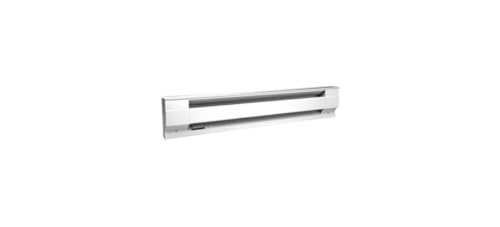
The six-foot Cadet stretches along a long wall but demands a dedicated 20-amp circuit.
At 72 inches and 1500 watts, this heater is built for rooms where a shorter unit would leave cold spots near the ends. It uses a radiant heating element (a part that glows and warms nearby objects) and convection (air circulation) to warm air continuously, and the white powder-coated finish blends into most walls. Reviewers point out it fits and works well once installed, but the 12.5 amp draw is the key limitation — one reviewer pointed out that the product literature does not clearly state that a dedicated 20-amp circuit (a separate electrical path with a higher capacity than a standard 15-amp circuit) is required, so check your breaker panel before buying.
There is a more serious concern: one customer wrote that the center rod overheated and melted the metallic tiles, which then fell onto the carpet and nearly started a fire. Because this review involves a potential safety hazard, it is worth verifying that your specific installation uses a proper thermostat and that no combustible materials sit too close to the heater.
Strengths
- 72-inch length distributes heat evenly along a long wall
- 1500 watts of convection heat for larger spaces
- UL listed for safety certification
Important Warnings
- Requires a dedicated 20-amp circuit, not always stated
- One buyer mentioned an overheating incident with melted tiles
Suits a long narrow room where a 36-inch or 48-inch heater would leave cold ends. Proceed with caution if your wiring is on a 15-amp circuit — you will need an upgrade before this heater runs safely.
4. King KP1210 1000-Watt 120-Volt 4-Foot Portable Baseboard Heater
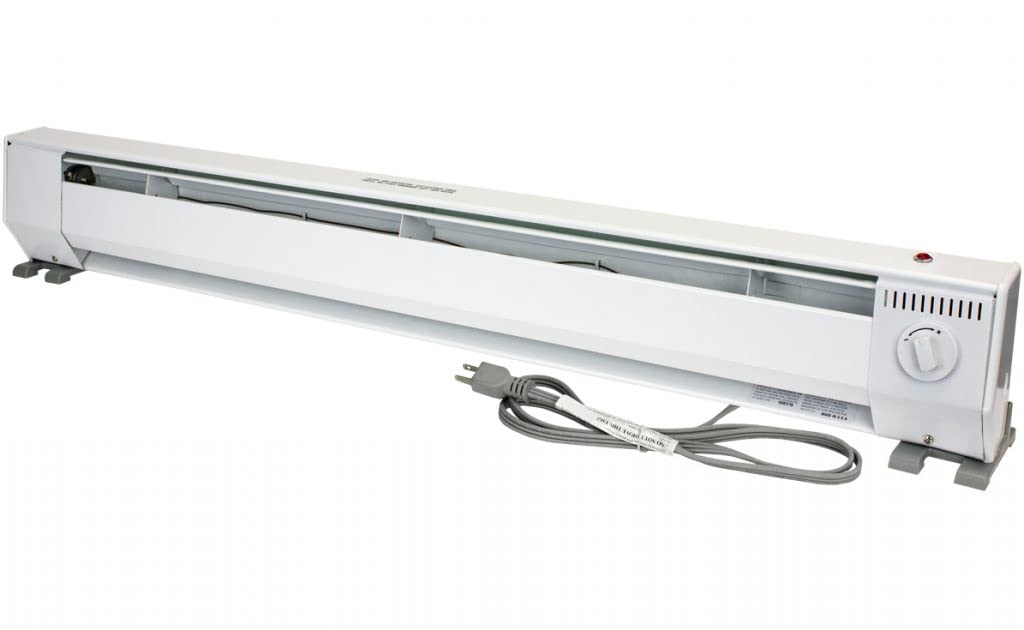
The quiet, all-aluminum running King with a max temperature setting of 194 degrees Fahrenheit — no plastic covers to warp.
This 1000-watt portable heater uses a fully aluminum design with a built-in thermostat and a full-length safety cutout (an automatic shut-off). Unlike the hardwired King models, it plugs into a standard wall outlet and includes a temperature dial, so you do not need to buy any extras. Buyers consistently mention how quiet it runs — one customer observed it works great under a 70-inch bedroom window with no weird smells — and another kept a 14×19 breezeway at 60 degrees Fahrenheit in negative temperatures on the middle setting.
The biggest downside is quality control. Several units arrived damaged: one had a hole in the thermostat regulator (the part that controls temperature), scuffs on the body, and tip-over mechanism parts (parts that shut it off if knocked over) that fell out during shipping. Despite being made in the USA, the packaging is not sturdy enough to protect the heater in transit, so inspect everything the moment it arrives.
Why It Shines
- All-aluminum construction with no plastic parts to degrade
- Built-in thermostat — no separate purchase needed
- Quiet convection heat with a max temp of 194°F
What To Watch For
- Shipping damage is common due to fragile packaging
- At 1000 watts, it is slow for rooms larger than 120 sq ft
A solid portable pick for a small-to-medium room, with a built-in thermostat that saves you an extra purchase. Be ready for a possible return if the unit arrives damaged; order early enough to allow for an exchange.
Understanding the Specs
Wattage and BTU
Wattage (a measure of electrical power) tells you how much energy the heater uses, and it directly determines how much heat the unit produces. Most 120-volt baseboard heaters come in 750-watt, 1000-watt, and 1500-watt versions. The heat output is also expressed in British Thermal Units (BTU) — roughly 3.41 BTU per watt — so a 1500-watt heater puts out about 5120 BTU. Matching the wattage to the room size is the single most important decision you will make.
Amperage and Circuit Requirements
Amperage (a measure of electrical flow) tells you how much current the heater draws when running. A 1500-watt heater at 120 volts draws around 12.5 amps, which leaves almost no room on a standard 15-amp circuit (electrical path) for lights or other devices. A 750-watt model draws only 6.25 amps, giving you a lot more flexibility. Always check the breaker rating (the maximum current your circuit can handle) before buying, and if you plan to run a high-wattage heater, make sure the circuit is dedicated to that heater alone.
FAQ
Can a 120-volt baseboard heater run on a 15-amp circuit?
What size room will a 1500-watt 120-volt baseboard heater heat?
Do baseboard heaters come with a thermostat?
Is it safe to leave a 120-volt baseboard heater on overnight?
How many amps does a 120-volt baseboard heater draw?
Can I install a hardwired baseboard heater myself?
What is the difference between a portable and a hardwired baseboard heater?
Why does my new baseboard heater smell like burning when I first turn it on?
Final Thoughts: The Verdict
For most people, the right 120 volt baseboard heater is the King 6K1215BW because its 1500 watts and crushproof element deliver dependable heat for a full-size room with better build quality than the thinner Cadet models. If you need a portable plug-in unit for a rental or a room without permanent wiring, grab the Cadet F Series 49″ Portable. And for a small bedroom or office where low amperage and quiet operation matter most, the KING 4K1210BW is a solid choice that will not crowd your circuit.
How We Picked
We do not accept paid placement. Every pick is matched to a real buyer and a real use-case; we do not hands-on test units.
Sources & Methodology
Specifications: manufacturer listings and product documentation. Review insights: verified customer reviews, as of July 2026. Pricing: not shown on this page (it changes often); check the current price via the retailer link.
As an Amazon Associate, Gadgets Feed earns from qualifying purchases. This does not affect which products we feature.