
Dropping a heavy cast-iron skillet onto a glass cooktop is a specific kind of kitchen terror, but the bigger anxiety for anyone switching to induction is the electrical panel. You’ve been told you need a dedicated 220-volt circuit, an electrician, and a permit — and that’s simply not true for the portable class built around the humble 120-volt standard outlet that’s already behind your fridge.
I’m Min — the co-founder and writer behind Gadgets Feed. I’ve spent months cross-referencing the control logic, thermal recovery rates, and real-world wattage stability of the current 120-volt induction cooktop lineup to separate the units that genuinely hold a sear from those that cycle on and off like a desk fan.
The challenge is that wattage ceilings vary wildly — some 1800-watt models tax a 15-amp circuit while others throttle mid-boil — which is why I built this guide around actual circuit behavior and not just spec-sheet promises. If you need countertop flexibility without rewiring your kitchen, this is the definitive roundup of the best 120 volt induction cooktop models available right now.
How To Choose The Best 120 Volt Induction Cooktop
Every 120-volt induction cooktop shares the same foundational constraint: you are limited to roughly 1800 watts on a standard 15-amp household circuit. Beyond that ceiling, the breaker trips. The real differentiators come down to how that wattage is managed, how finely you can control temperature, and whether the build quality survives daily use.
Wattage and Circuit Compatibility
Most portable induction cooktops advertise either 1500W or 1800W. The 1800W models boil water significantly faster, but they may cause nuisance tripping on older or shared 15-amp circuits. If your kitchen outlet also powers a refrigerator or microwave, consider a model with a lower default power setting or a wattage-adjustment feature that lets you dial down to 1200W or 900W.
Temperature Control Granularity
Entry-level units offer 10 to 20 temperature levels, often in 20°F to 40°F jumps. That makes it hard to hold a delicate sauce at exactly 190°F or sear a steak just below the smoke point of avocado oil. Premium models such as the Nuwave line provide 5°F increments across 91 or 106 settings, which is the difference between burnt butter and perfect brown butter.
Cookware Compatibility and Detection
Induction requires ferromagnetic cookware — cast iron and most stainless steel works, aluminum and pure copper do not. Some units are more sensitive than others, with non-stick pans often triggering an E1 error code because the magnetic field is too weak. If you own non-stick cookware, verify user reports on detection reliability before buying.
Quick Comparison
On smaller screens, swipe sideways to see the full table.
| Model | Category | Best For | Key Spec | Amazon |
|---|---|---|---|---|
| Nuwave PIC Titanium | Induction | Precision cooking | 106 temps, 5°F increments | Amazon |
| Nuwave PIC Diamond | Induction | Probe-based recipes | 91 temps, digital probe | Amazon |
| Duxtop BT-200T1 | Induction | Built-in or countertop | 15 power + 15 temp levels | Amazon |
| Cusimax C303 | Infrared | Triple-zone cooking | 3 burners, 1800W total | Amazon |
| Empava EC06 | Induction | Budget-friendly | 18 temp levels, 900W default | Amazon |
| OMEO V-G23T | Induction | Compact apartment use | 10 temp levels, 1800W | Amazon |
| ANHANE Radiant | Infrared | Any cookware type | 9 power levels, 9 temp levels | Amazon |
In‑Depth Reviews
1. Nuwave PIC Titanium

The Nuwave Titanium is the most granular temperature-control induction cooktop currently available at 120 volts, offering 106 pre-programmed temperatures from 50°F to 575°F in steady 5°F steps. That range covers everything from holding chocolate at 100°F to searing a steak at the smoke point of ghee. The 8-inch heating coil is visibly larger than the 6.5-inch coil on the Diamond model, which means better heat distribution across a 12-inch skillet.
Users reporting an initial probe defect found the replacement unit held 375°F within a single degree during extended use, and the probe itself is removable for cleaning — a genuine advantage over fixed-probe designs. The cool white digital display is readable from across the kitchen, and the front-mounted on/off switch eliminates the 2-watt phantom draw that plagues some competitors.
Wattage can be dialed down to 700W, which is critical for RVs or outlets sharing a circuit with other appliances. The only real friction is that certain non-stick pans trigger an E1 detection error, so you must stick to cast iron or stainless steel. At this price, the precision justifies every penny for anyone who treats cooking as a metric discipline.
Why it’s great
- Finest temperature resolution (5°F) across 106 settings
- Removable probe enables precision sous-vide and candy work
- Adjustable wattage prevents breaker trips on shared circuits
Good to know
- Does not detect non-stick or aluminum cookware reliably
- User interface is dense and not accessible for visually impaired users
2. Nuwave PIC Diamond

The Nuwave Diamond sits just below the Titanium in the lineup but still delivers 91 precise temperature settings from 100°F to 500°F in 5°F increments — enough granularity for 99% of stovetop tasks. The included digital probe monitors both ambient and internal temperatures up to 212°F, making it a favorite among homebrewers who need to hold a grain bed at exactly 152°F for 90 minutes.
The 6.5-inch heating coil is smaller than the Titanium’s 8-inch coil, which means the outer edges of a 12-inch skillet won’t heat as evenly. In practice, the Diamond handles a 10-inch pan without complaint. The shatter-proof ceramic glass is the same heavy-duty material used across the Nuwave line, tested to withstand thermal shock without cracking.
Users note the fan runs constantly even after the burner is turned off — it continues until the internal electronics cool below a threshold. The unit locks controls for safety, can mute the beep, and toggles between Fahrenheit and Celsius. For probe-based recipes like deep frying or rice cooking, the Diamond’s automated programs are genuinely useful shortcuts.
Why it’s great
- 5°F temperature increments across a wide 100-500°F range
- Probe enables overnight unattended cooking for beer mash or broth
- Shatter-proof ceramic glass tested for thermal shock resistance
Good to know
- 6.5-inch coil may leave 12-inch pan edges underheated
- Fan noise is persistent and does not shut off immediately with the burner
3. Duxtop BT-200T1 / 8600BI

The Duxtop BT-200T1 is the rare portable induction cooktop that doubles as a built-in unit — it includes a trim kit for countertop drop-in installation, which matters if you want a permanent cooktop without hiring an electrician to run 220V. It offers 15 power levels (200-1800W) and 15 temperature settings (140-460°F) with an 83% energy efficiency rating that translates to less waste heat in your kitchen.
Users who bought two units to replace a gas cooktop report that both burners can run at full 1800W simultaneously on two separate 120V outlets without tripping breakers — a configuration that outperforms a standard 4-burner gas stove in boil speed. The sensor panel is sensitive enough that some users found they could operate it through a paper towel, though the glass surface scratches more easily than the Nuwave’s ceramic glass.
The safety lock button prevents accidental changes during cooking, and the 170-minute timer with auto shut-off is generous enough for long braises. The 6.8-pound weight makes it the heaviest single-burner in this roundup, which adds stability but reduces portability. For anyone wanting a single unit that transitions from a dorm room to a built-in kitchen, this is the most versatile option.
Why it’s great
- Built-in capable design with trim kit for permanent installation
- 15 discrete power levels allow fine control over boil rate
- Two units can run simultaneously without overloading standard circuits
Good to know
- Temperature control can overshoot on high-power settings
- Glass surface is prone to visible scratching over time
4. Cusimax C303 Infrared Triple Burner
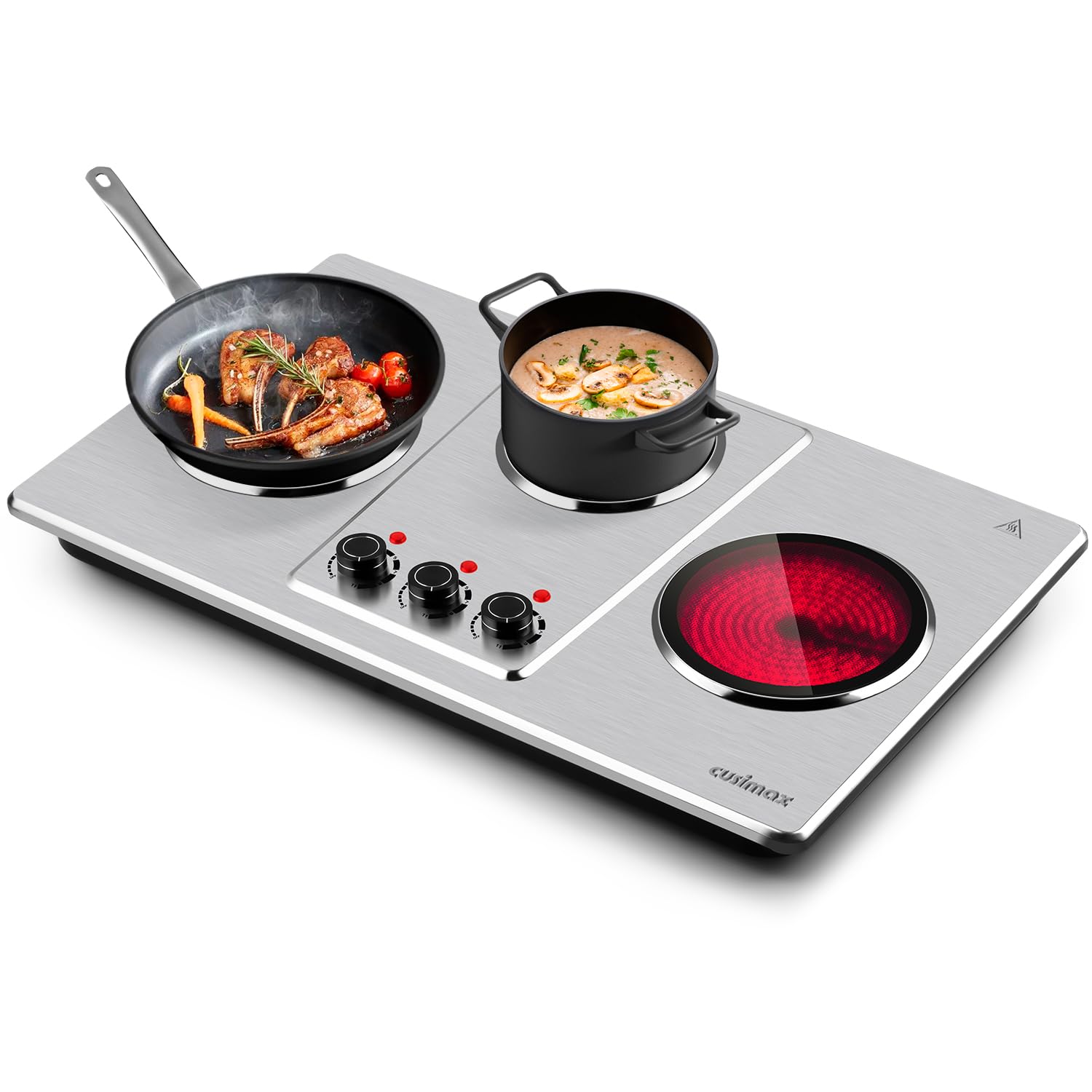
The Cusimax C303 is not induction — it is an infrared radiant cooktop, which means it works with aluminum, copper, and any other cookware that induction rejects. That makes it the only multi-burner option in this guide that does not require magnetic-bottom pots. The three independent heating zones deliver a combined 1800W (650W left + 500W center + 650W right) across a 28.5-inch-wide stainless steel surface.
Knob controls are a deliberate design choice here — unlike touch panels that can be frustrating when wet or greasy, physical knobs offer immediate tactile feedback. Users mention the unit heats quickly and cooks evenly, though the cooking surface itself gets hot during extended use, so ventilation clearance is non-negotiable. The indicator light cycles on and off as the thermostat regulates temperature, which is normal behavior for infrared heaters.
ETL certification covers safety compliance, and the 30-day return policy is standard for the category. The main trade-off is energy efficiency: infrared heating is less efficient than induction, meaning more waste heat radiated into the kitchen. If you need three burners on 120V and own mixed-material cookware, the Cusimax is your only realistic option.
Why it’s great
- Three independent cooking zones enable full meal prep
- Works with all cookware types including aluminum and ceramic
- Physical knob controls are reliable and easy to clean
Good to know
- Infrared heating is less efficient than induction
- Surface gets very hot during extended use — clear ventilation is essential
5. Empava EC06 Portable Induction

The Empava EC06 is the most accessible entry point into induction cooking for anyone on a tight budget. It defaults to 900W to avoid tripping circuits, but the touch interface lets you cycle through 18 temperature levels from 120°F to 460°F with 20°F increments. Three quick-access presets — Melt, Keep Warm, and Simmer — cover the most common low-heat tasks without scrolling through menus.
Users confirm it boils water extremely fast compared to a traditional electric coil burner, and the shatter-proof ceramic glass has held up to daily use in dormitories and RVs without cracking. The 5.5-pound weight and 2.5-inch height make it the most portable unit in this list, easily stowed in a cabinet or camping bin. The auto shut-off activates when the timer expires or when cookware is removed from the surface.
The 20°F temperature jumps mean you cannot hold a precise 190°F for poaching — you land at 180°F or 200°F. The fan stays on briefly after shut-off, and the touch panel can register accidental inputs when wiping the surface clean. For the price, the Empava delivers shockingly good performance as long as you do not need surgical temperature accuracy.
Why it’s great
- Extremely affordable induction option with reliable performance
- Ultra-compact at 2.5-inch height for storage and travel
- Shatter-proof ceramic glass surface resists thermal cracking
Good to know
- 20°F temperature increments limit precision cooking
- Touch panel can trigger accidentally during surface cleaning
6. OMEO V-G23T Induction Cooktop

The OMEO V-G23T packs a full 1800W of induction power into a chassis that is barely 2.36 inches tall, making it one of the slimmest high-wattage burners on the market. The LCD sensor touch interface is responsive, with an LED display that shows real-time temperature and power settings. Ten temperature levels from 140°F to 460°F cover most cooking scenarios, though the jumps are wide — the gap between 240°F and 160°F is a 80°F leap that makes precise simmering tricky.
Users in studio apartments and travel trailers praise its quiet operation and quick heating. One reviewer noted the unit held temperature within 1°F during a long cook, which is impressive for this price tier. The child safety lock is a genuine safety feature for households with small children, preventing accidental setting changes. The auto shut-off function also activates when the pan is removed, which is a standard but important safety feature.
The plastic housing feels less premium than the ceramic-glass bodies of the Duxtop or Nuwave units, and the lack of a dedicated start/stop button means the burner begins heating as soon as you press a menu selection — a minor interface quirk. For a compact, travel-friendly burner that maximizes wattage output, the OMEO delivers reliable performance in a small footprint.
Why it’s great
- Full 1800W output in an ultra-slim 2.36-inch profile
- Child safety lock and auto shut-off provide peace of mind
- Quiet operation suitable for studio apartments and RVs
Good to know
- Only 10 temperature levels with wide gaps between settings
- No dedicated start/stop button — burner activates on menu touch
7. ANHANE Infrared Cooktop
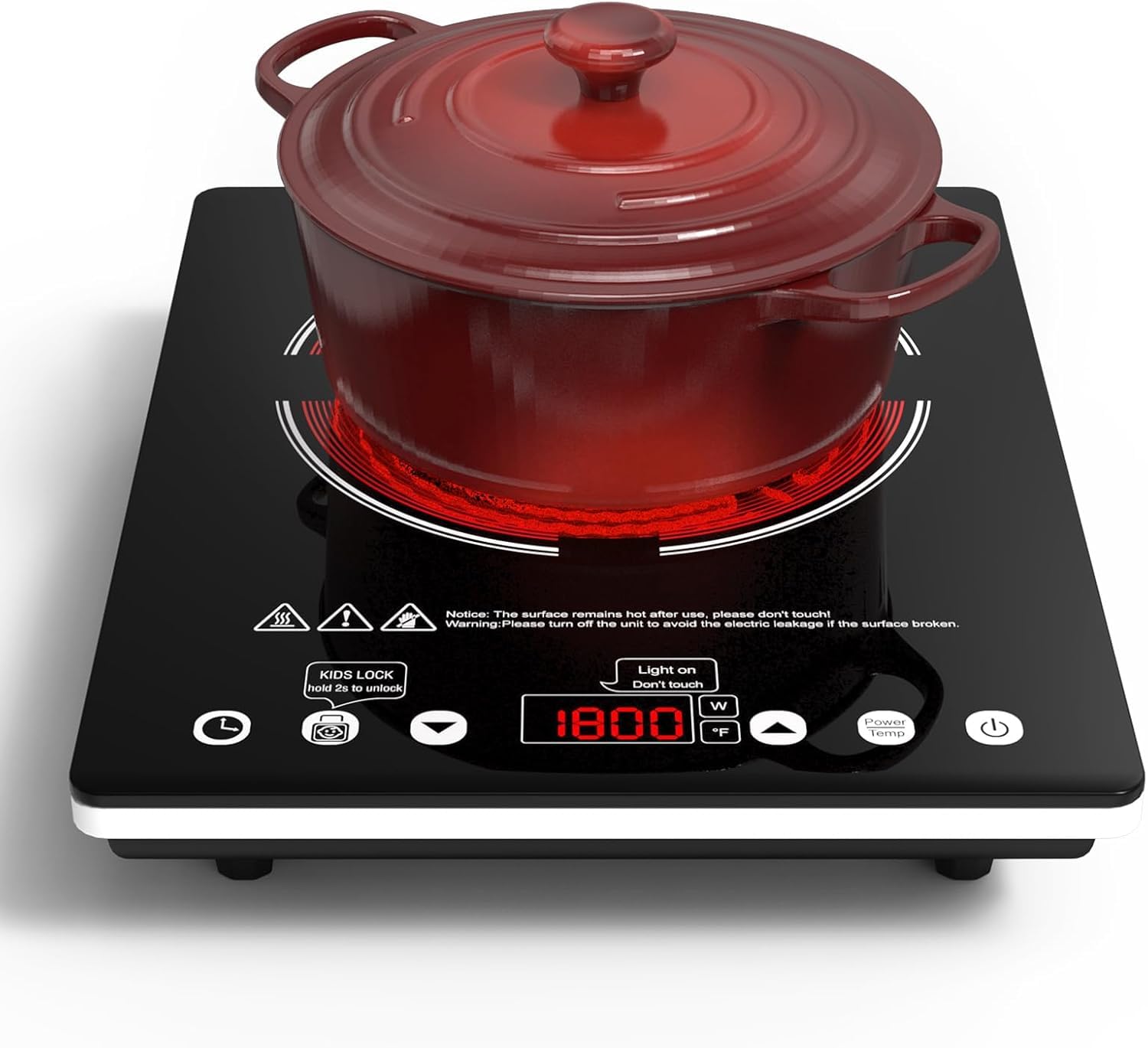
The ANHANE infrared cooktop is the only non-induction unit in this guide, and it earns its place by solving the cookware compatibility problem entirely. It uses radiant infrared heating, meaning aluminum, copper, glass, and ceramic pots all work perfectly — no magnetic-bottom requirement. Nine power levels from 200W to 1800W and nine temperature levels from 176°F to 510°F give you enough adjustment for most cooking tasks without the learning curve of induction pan detection.
Users who own only non-stick or aluminum cookware report this burner works immediately out of the box with no E1 errors. The 14.1-inch by 11-inch surface accommodates larger pans than most single-burner induction units. The child safety lock, automatic shut-off, and non-slip base are standard safety features, though the unit’s ceramic glass surface gets hot during use and stays hot for a while after shutdown — a hot surface indicator light helps remind you.
The 4-hour timer is generous, and the digital touch controls are sensitive and responsive. The main drawback is energy efficiency: infrared heating is significantly less efficient than induction, meaning slower boil times and more ambient heat. If you already own induction-compatible cookware, an induction burner will outperform this unit. But if you need a versatile burner that works with everything you own, the ANHANE is a solid choice.
Why it’s great
- Compatible with all cookware types — no magnetic-bottom requirement
- 9 power levels and 9 temperature settings for broad cooking control
- Large 14.1-inch surface accommodates bigger pots and pans
Good to know
- Infrared heating is less efficient than induction — slower boil times
- Surface remains hot after power-off, requiring a cool-down period
FAQ
Can a 120-volt induction cooktop run on a standard 15-amp circuit?
Will my existing cookware work with a 120-volt induction cooktop?
Why does my induction cooktop make a humming or buzzing noise?
Final Thoughts: The Verdict
For most users, the best 120 volt induction cooktop winner is the Nuwave Titanium because its 106 temperature settings and removable probe give you the precision needed for both delicate sauces and high-heat searing, all within the limits of a standard outlet. If you want built-in flexibility, grab the Duxtop BT-200T1. And for multi-zone cooking without cookware restrictions, nothing beats the Cusimax C303 Triple Burner.