
Our readers keep the lights on and my morning glass full of iced black tea. As an Amazon Associate, I earn from qualifying purchases.
Specs are compiled from manufacturer listings and verified buyer reviews and can change over time — please confirm the key details on the product page before buying.
You want hot water at a sink that sits far from your main tank, and the only power nearby is a standard 120-volt outlet. The honest truth is that these compact units are built for one sink at a time, not a whole house — and the biggest mistake shoppers make is expecting instant, unlimited heat from a plug-in. This guide sorts six of the most popular point-of-use heaters by what they can actually deliver: warm water in seconds for a kitchen, bathroom vanity, wet bar, or laundry room.
I’m Min — the founder and writer behind Gadgets Feed. This guide is built by comparing the manufacturers’ published specifications and the patterns across verified customer reviews, so you get each pick’s real strengths and trade-offs instead of marketing spin.
Expect a clear breakdown of heating power, flow rates, wiring demands, and the honesty to say when a unit is undersized for your winter water. Here is my roundup of the best 120 volt tankless water heater options for single-sink duty.
Our Picks at a Glance

How To Choose The Best 120 Volt Tankless Water Heater
Before you buy, understand that a 120-volt tankless heater delivers a fraction of the power of its 240-volt cousins. That means it shines at a single sink with a modest flow, not a running shower or a busy dishwasher. Match your expectations to the physics and you’ll be thrilled; ignore them and you’ll be disappointed.
Flow Rate Is the Real Spec
The gallons per minute (GPM) a unit can warm is the number that decides if you get hot water or lukewarm water. A 3.5kW unit typically manages around 0.5 GPM at a meaningful temperature rise — fine for washing hands or rinsing dishes, but a full faucet blast will cool it down fast. Keep the flow at a trickle to maintain the heat.
Hardwired vs. Plug-In
Most 120V units pull 29 to 32 amps, which is too much for a standard wall outlet — they must be hardwired to a dedicated double-pole circuit breaker with thick 10 AWG wire. A true plug-in model like the 3kW LECLOC is the exception, trading a bit of power for easy installation. Check your panel capacity before committing to a hardwired unit.
Quick Comparison
| Model | Best For | Heat Output | Max Temp | Weight | Amazon |
|---|---|---|---|---|---|
| ThermoMate 3500W★ Best Overall | First-time buyers wanting a digital display | 3500 watts | 131 °F | 3.1 lb | Amazon |
| CAMPLUX 3.5kWSmart Saver | Buyers wanting self-modulating energy savings | 3.5 kW | 131 °F | 3 lb | Amazon |
| Stiebel Eltron Mini 3 | Compact, reliable installs with a long warranty | — | — | 3.4 lb | Amazon |
| LECLOC 3kW | DIY-friendly plug-in installs | 3000 watts | 55 °C | — | Amazon |
| Ecosmart POU 3.5 | Warm climates with a single low-flow sink | 3.5 kW | — | 4 lb | Amazon |
| Rheem RTEX-04 | Camper and tight-spot installs with digital control | 3.5 KW | 140 °F | 4.5 lb | Amazon |
In‑Depth Reviews
1. ThermoMate 3500W Tankless Water Heater
Our pick — over 4★ from 750+ verified ratings; the strongest balance of quality and price.
A digital display and 1-degree temperature control make this the easiest sink-side heater to dial in exactly.
This 3500-watt unit is the crowd favorite for good reason: it delivers instant hot water at a sink and gives you a precise readout. You can set the temperature anywhere between 86°F and 131°F in single-degree steps, so you’re not guessing at a knob position. The touch panel is a genuine upgrade over basic models that just run hot or warm.
It draws 29.2 amps, which means it must be hardwired to a 32A double-pole breaker with 10 AWG wire — no plugging into a wall outlet. The compact 7.9″ x 6.4″ x 2.5″ body tucks neatly under a cabinet or behind a bar counter, and the cast aluminum heating element stays separate from the water line to reduce scale and corrosion. The SUS 304 stainless steel water tube adds long-term durability confidence.
Owners consistently report it heats water in about 5 minutes and works well for light sink use. The recurring honesty in reviews: this is a one-sink device, and running a lot of water at once will drop the temperature. A steady trickle keeps the heat — that’s the secret to happy use. Buyers report: “This small tankless water heater works great for a sink or small space.”
What wins people over
- Precise digital temp control in 1° steps up to 131°F
- ETL certified with a smooth touch panel
- Compact build that mounts in tight spots
Know before you buy
- Must be hardwired — no standard plug here
- Best at a single sink, not heavy simultaneous use
- Reheat takes about 5 minutes after heavy draw
Reach for this if: you want the clearest temperature readout and easiest daily control at a single sink.
Look elsewhere if: you expect to wash many dishes at once — you’ll need to pause for reheat.
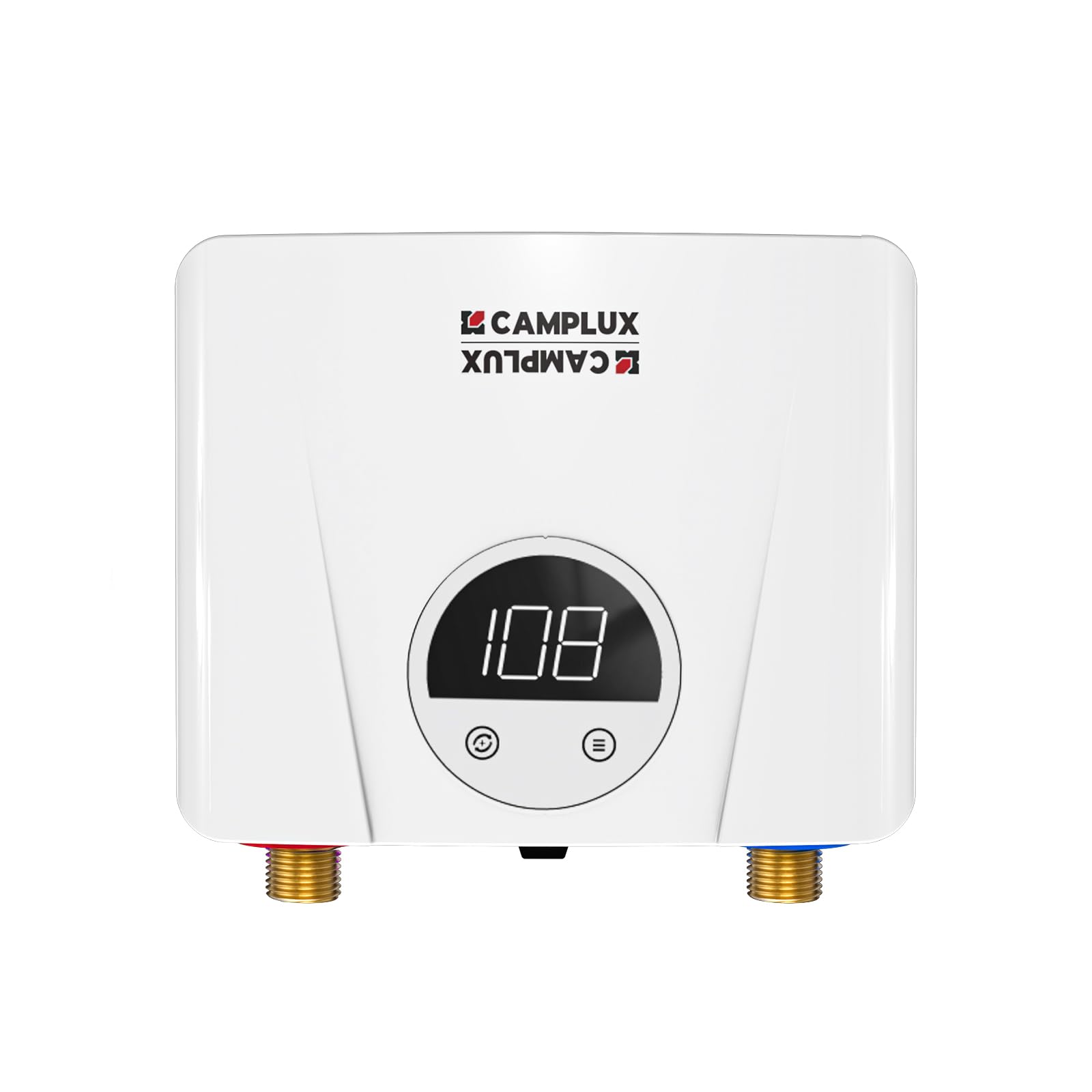
2. CAMPLUX 3.5kW Tankless Water Heater
A self-modulating design that trims power in real time, saving energy without you touching a dial.
For a vacation cabin or a workshop sink you use only now and then, the CAMPLUX cuts wasted energy. Its self-modulating technology (a system that adjusts power input in real time based on water flow and your temperature setting) means it heats only when you run water. The maker claims up to 98% energy savings versus a tank that keeps water hot 24/7. That is a big difference for occasional use.
The build quality gets consistent praise — the heating design keeps elements away from direct water contact, which owners say avoids the temperature fluctuations they saw in older units. At just 3 pounds, it’s lighter than the Stiebel Eltron by 13% (3 lb vs 3.4 lb), and its footprint of 7″W x 6″H is notably more compact than the 11″ wide Ecosmart. It activates at a low 0.4GPM-0.66GPM flow, so even a gentle stream triggers the heat.
Buyers who replaced a failed brand were pleasantly surprised at how consistent the output feels, calling it logical and easy to install. The honest caveat surfaced by a returning owner: at 3.5kW, it can’t keep up with a washing machine fill — water runs lukewarm before the washer is full. That confirms the single-point-of-use balance. As one buyer put it: “I wish I had chosen it first.”
Energy angle: self-modulating power and up to 98% claimed energy savings make this the efficiency pick.
The line to draw: superb for one sink or a wet bar, underpowered for appliances that pull a lot of water at once.
3. Stiebel Eltron Mini 3 Tankless Water Heater

A 7-year leakage warranty and a track record of decade-plus service make this the reliability play.
Stiebel Eltron is a German name with engineering credibility, and the Mini 3 backs that up with confidence: a 7-year leakage warranty and 3-year parts coverage. Owners mention 10-year runs on outdoor sinks, with one replacing it after a freeze — a durability record that beats any spec sheet. At 3.4 pounds, it’s the heaviest of the compact trio but still small enough to mount in plain sight.
The sleek white body is designed to be mounted visibly, not just hidden under a cabinet. Buyers praise the wall-plate install with flexible lines that snap on and off for easy service. Flow rates here are low at 0.08 liters per second, so this is strictly for a single basin — think a powder room or a utility sink where space and reliability beat raw power.
Heat output draws the most mixed feedback in the reviews. Some owners get water hot enough that they add cold to the stream, while others in colder climates find it only lukewarm. One buyer who ran it 12 months in a powder room called the temp “lukewarm” and wouldn’t repurchase. The pattern is clear: in warm climates it’s a hero, in cold winters it’s modest. This is a fit question, not a quality flaw.
Long-haul pick: the only unit here promising 7 years of leakage protection — built for buyers who keep things for a decade.
Who it isn’t for: anyone in a cold-water region wanting genuinely hot output; expect “warm” most of the year.
4. LECLOC 3kW Plug-In Tankless Water Heater
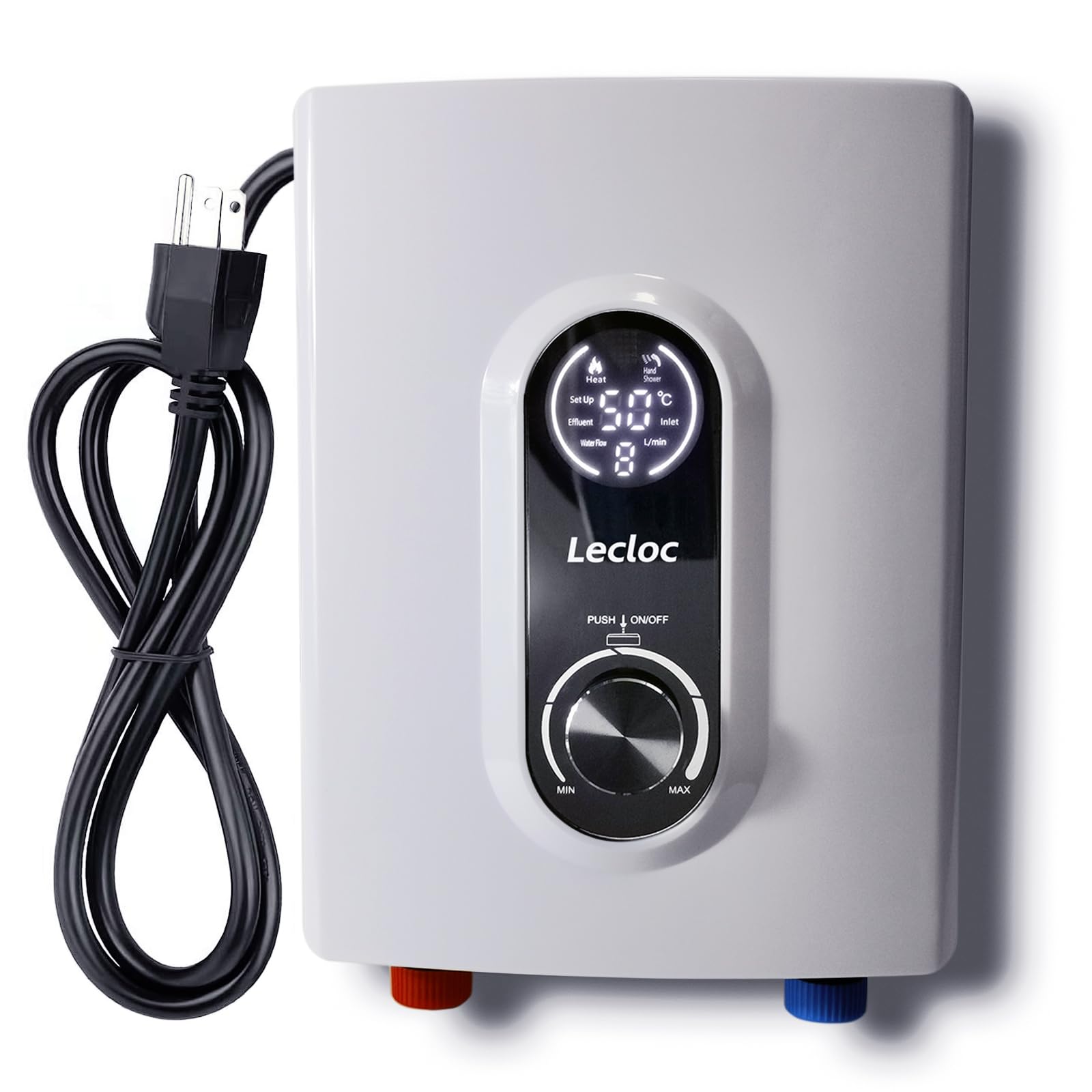
The rare 120V tankless that actually plugs in, skipping the electrician and the hardwired headache.
If you want to skip the electrician, the LECLOC is your pick. At 3000 watts and 120 volts, it plugs straight into a wall outlet — no 32A breaker, no 10 AWG wire, no electrician required. That alone separates it from every other unit in this roundup, which all demand hardwiring. The trade-off is a lower 3kW heat output, so it’s strictly for low-flow single taps.
The big knob is a deliberate design choice over fiddly touchscreen buttons. One dial handles power and temperature from 30°C to 55°C, with an LED display showing your setting. Safety is a priority here: overheat, leakage, dry-heating, and over-pressure protection, plus IPX4 waterproofing (protection against splashing water) and drop-test certification for confidence in a damp under-sink cabinet.
Owners like how it fits tight spaces and one swapped it in to replace a 50-gallon tank at a clubhouse with just three sinks, noting a lower energy bill. The catch: at 3kW, it “only warms” water rather than delivering piping hot, and the English manual is rough. It’s the convenience-first choice when wiring access is a problem.
Pick it for: a dorm, garage, or rental where you can’t rewire and just want warm water from an outlet.
Think twice if: you need genuinely hot output — 3kW caps the ambition here.
5. Ecosmart POU 3.5 Tankless Water Heater

A big-brand 3.5kW with transparent temperature-rise math — great for warm climates, honest about cold ones.
Ecosmart publishes the exact temperature math, which is refreshingly honest. At 0.5 GPM the max rise is 47.8°F, at 1 GPM it drops to 23.9°F, and at 1.5 GPM just 15.9°F. That means in warmer climates it delivers comfortable hot water to one sink at a low flow; in cold winters those numbers shrink dramatically. The brand itself recommends the POU 6 for colder regions.
Setup needs a 30-amp breaker and 10 AWG wire, with 1/2″ NPT connections and a 29-amp draw. The wider 11″W x 6″H footprint is the biggest in this list, so measure your cabinet space first. A Florida RV owner used it daily for two years, finding it adequate but noting the real-world rise ran slightly under the rated 47.8°F.
Reviews split on heat output — it struggles to push past 100°F for some owners in cold feed water. The smart approach: pair it with a sink you use gently, and you’ll be happy. It’s the right call for southern climates or seasonal cabins where the incoming water rarely dips below 60°F.
Transparent fit: the published rise-at-each-flow table lets you size it honestly before buying.
Honest limit: cold-climate owners find it lukewarm; this is a warm-weather tool by design.
6. Rheem RTEX-04 Tankless Water Heater

A name-brand 3.5kW with digital control up to 140°F, sized for campers and tight condo spots.
Rheem is a trusted name in water heating, and the RTEX-04 brings a digital temperature display with 1°F increments from 80°F to 140°F — the highest max temp in this lineup. At 99.8% efficiency, it wastes almost no power converting electricity to heat. It’s a natural fit for an RV, camper, or small condo where a full tank heater doesn’t fit.
Weighing 4.5 pounds with a 10.88″W x 5.88″H footprint, it’s compact enough to slot into the tightest spots — one owner replaced a camper heater and said it fit perfectly in the small space, heating fast and staying hot. The 3.5 KW output at 120V keeps it in the single-sink class, though its higher max temperature gives more headroom for dialing in genuinely hot water.
The honest read from reviews is more mixed. Reliability comes up as the most-discussed concern, with some units failing to turn on and one stopped after a year with a blank screen. A shower install disappointed one owner who waited 3-4 minutes to reach 98°F. This is the pick for buyers who prioritize the Rheem brand and digital range — ideally on a kitchen sink with a steady, low flow.
Choose it for: the widest temperature range (up to 140°F) and a name you recognize in a camper or tiny wall.
Be cautious if: you want zero headaches — the review mix includes some reliability complaints.
Understanding the Specs
Why 3.5kW and 120V Limits You
The physics is simple: 120 volts carries roughly a third of the power of 240 volts. At 3.5kW, a heater can raise water temperature about 22-24°F at a 1 GPM flow. That’s a comfortable warm for a sink trickle, but a full faucet blast will outrun the heater. Match your flow to the wattage and you’ll get consistent warmth.
Hardwired Means an Electrician (Usually)
Most 120V point-of-use units draw 29-32 amps — far above a standard 15-amp outlet. They require a dedicated double-pole breaker and thick 10 AWG wire. The LECLOC is the lone plug-in exception at 3kW. Always check your breaker panel capacity before buying a hardwired unit, and budget for professional install if you’re not comfortable with electrical work.
FAQ
Will a 120-volt tankless heater run a shower?
Which is better for cold climates, 120V or 240V?
What does hardwired mean for installation?
Can I plug a 3.5kW tankless heater into a regular outlet?
How long does it take to get hot water?
What is a point-of-use water heater?
How many gallons per minute can these heat?
Is a tankless heater more efficient than a tank model?
Final Thoughts: The Verdict
For most people, the winner is the ThermoMate 3500W because it combines a precise digital display with the strongest owner satisfaction for a single-sink setup. If you want CAMPLUX’s self-modulating energy savings, it’s a smart buy. And for a true plug-in install without an electrician, the LECLOC 3kW is the one to reach for.
How We Picked
We do not accept paid placement. Every pick is matched to a real buyer and a real use-case; we do not hands-on test units.
Sources & Methodology
Specifications: manufacturer listings and product documentation. Review insights: verified customer reviews, as of August 2026. Pricing: not shown on this page (it changes often); check the current price via the retailer link.
As an Amazon Associate, Gadgets Feed earns from qualifying purchases. This does not affect which products we feature.