
A 120-volt thermostat handles a fundamentally different electrical load than the low-voltage unit controlling your central furnace. Getting the voltage wrong—or picking a mechanical switch with a 6-degree hysteresis gap—can turn a simple baseboard heater into a room that never feels right. The right choice depends on matching the thermostat’s internal switch, amperage rating, and temperature swing to the specific heater type you’re running.
I’m Min — the co-founder and writer behind Gadgets Feed. I’ve spent hundreds of hours analyzing line-voltage thermostat specifications, comparing hysteresis differentials, and digging into which mechanical and smart units actually hold their calibration across seasonal temperature swings.
This guide breaks down the seven best models on the market right now, from rugged industrial units for workshops to smart Wi-Fi options for whole-home scheduling. Read on to find the right 120 volt thermostat for your baseboard, fan-forced, or in-wall electric heater.
How To Choose The Best 120 Volt Thermostat
Selecting a line-voltage thermostat is less about brand loyalty and more about matching electrical specs to your heater. The three most important variables are single-pole versus double-pole configuration, maximum amperage rating, and the thermostat’s switching differential. Ignoring any of these three can lead to short-cycling, overheating, or a room that never reaches your desired temperature.
Single-Pole vs. Double-Pole Wiring
A single-pole thermostat breaks only one side of the 120V line when “off,” meaning current still flows through the heater. This is acceptable in mild climates where you want a simple low-cost control, but it creates a standby energy draw and a slight shock risk during maintenance. A double-pole thermostat breaks both legs, fully disconnecting power. If you live in a cold region or need a true shutoff for safety, double-pole is the correct choice. Check your heater’s wiring diagram: if you see four wires (two hot, two load), you need a double-pole unit. Most smart thermostats also require four wires to power their electronics.
Amperage and Wattage Limits
Every thermostat has a maximum current rating—typically 15A, 16A, or 22A for residential 120V models. Multiply the amperage by your voltage (120V) to get the maximum wattage the thermostat can handle. A 15A thermostat on a 120V circuit can control up to 1800W. If your baseboard heater draws 2000W, you’ll either need a 20A-rated thermostat or you must split the load across two units. Always check the heater’s nameplate wattage before buying.
Quick Comparison
On smaller screens, swipe sideways to see the full table.
| Model | Category | Best For | Key Spec | Amazon |
|---|---|---|---|---|
| Meross Smart Thermostat | Smart Wi-Fi | Home automation & scheduling | 16A max, HomeKit/Alexa/Google | Amazon |
| Mysa Smart Thermostat LITE | Smart Wi-Fi | Energy monitoring & remote control | 5-year warranty, 4-wire required | Amazon |
| KING K902-B Hoot | Smart Wi-Fi | Touchscreen & programmable zones | Double pole, 120-240V | Amazon |
| Peco TF115-001 | Industrial Mechanical | Outdoor, garage, damp environments | NEMA 4X weatherproof enclosure | Amazon |
| Dayton 6EDY5 | Mechanical Heavy-Duty | Greenhouse, well house, freeze protection | SPDT, snap-acting contacts, 20A | Amazon |
| Stelpro SWT2F | Mechanical Double-Pole | Affordable double-pole replacement | 22A capacity, 120-277V | Amazon |
| Legacy TH5 | Plug-in Mechanical | Portable heaters, barns, temporary setups | 120V/15A, 3-prong cord plug | Amazon |
In‑Depth Reviews
1. Meross Smart Thermostat
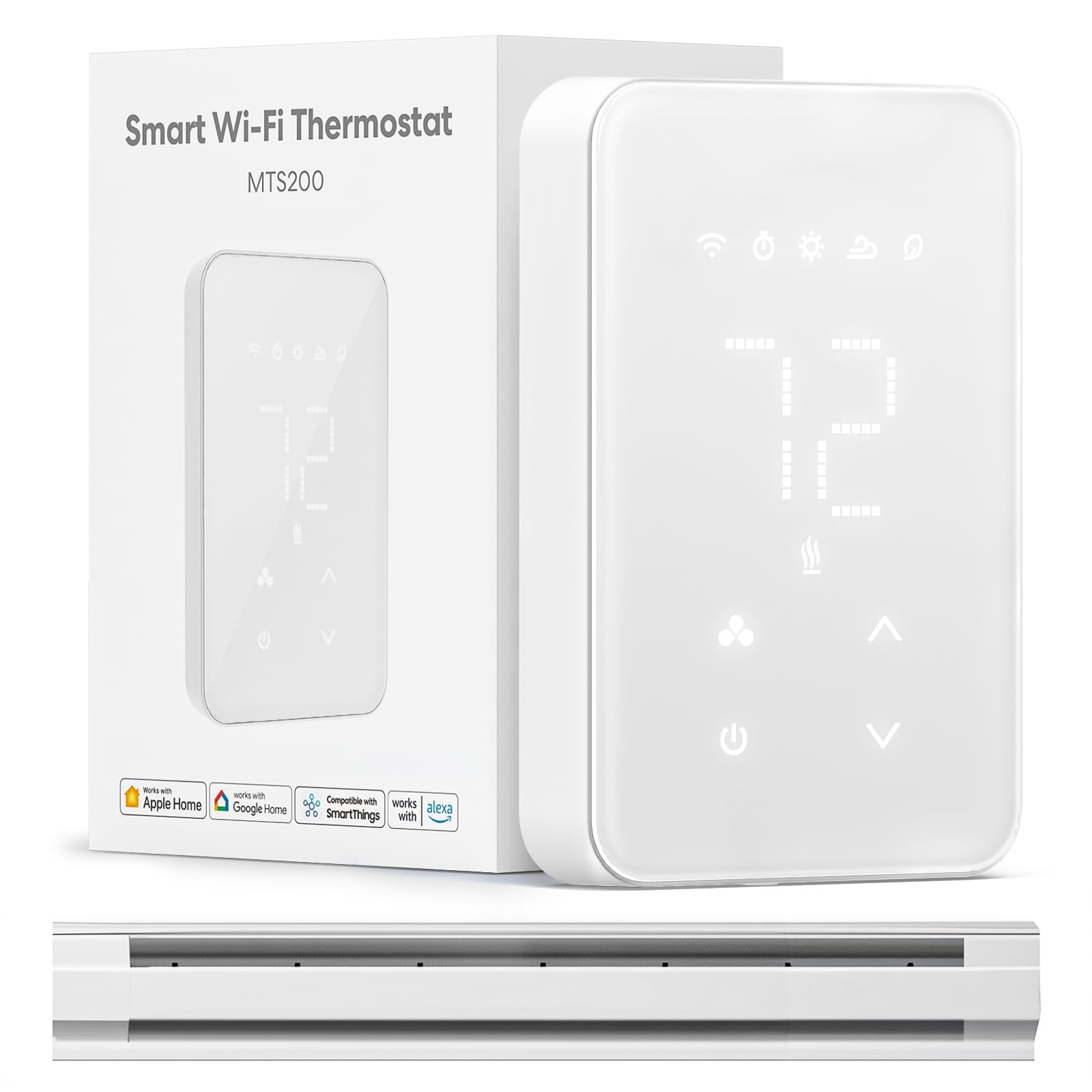
The Meross Smart Thermostat sits at the sweet spot of feature density and cost, offering HomeKit, Alexa, and Google integration at a price well below most competitors. Its 16A max output (1920W at 120V) covers most residential baseboard heaters and fan-forced units, and the 1°F accuracy thermostat ensures the room temperature doesn’t drift noticeably during a cycle. The pure white LCD display is polished and sits flush against the wall, looking nothing like a clunky mechanical dial.
Installation requires a 4-wire box (line, load, neutral, ground), which is the same requirement as the Mysa and the KING Hoot, so check your existing wiring before buying. The Meross app offers an open-window detection feature that automatically pauses heating when it senses a sudden temperature drop, saving you from heating the outdoors. The energy monitoring graph in the app shows real-time power consumption and historical data, giving budget-conscious users actionable data to adjust their schedule.
The thermostat handles both single-pole and double-pole systems, but note that you must have four physical wires in the junction box—if you only have two wires, you’ll need to run a new cable or stick with a mechanical model. Customer reviews consistently mention the straightforward installation process, especially when following the in-app video guide, and the reliability has held up well after months of daily cycling.
Why it’s great
- Excellent ecosystem support (HomeKit, Alexa, Google, SmartThings)
- High 1°F accuracy with adjustable switching differential
- Energy monitoring and open-window detection built into the app
Good to know
- Requires four wires (neutral) in the box—not compatible with two-wire installations
- 5GHz Wi-Fi must be disabled during initial pairing; unit only works on 2.4GHz
2. Mysa Smart Thermostat LITE
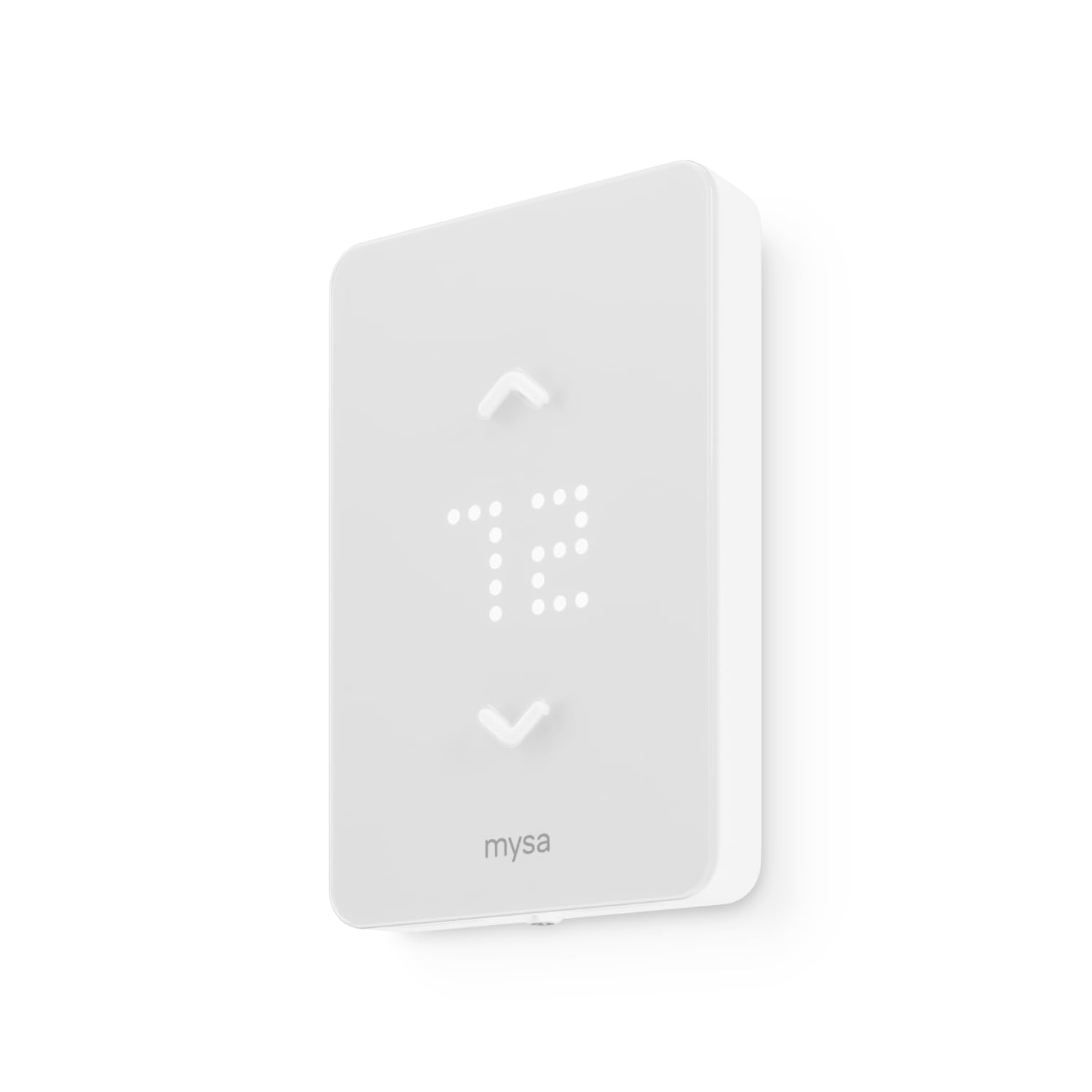
Mysa’s Smart Thermostat LITE targets the same 120V-240V baseboard market as the Meross but adds a 5-year manufacturer warranty and a more refined hardware design. The LITE variant is a simplified version of Mysa’s flagship model—it lacks humidity sensing and adaptive display brightness, but it retains the core features that matter: 7-day scheduling, geofencing, vacation mode, and monthly runtime reports emailed directly to you. The physical buttons on the LITE are more responsive than the touch-sensitive panel on the V2, which is a welcome improvement for users who tap the wall unit rather than reaching for their phone.
Installation follows the same 4-wire pattern as the Meross, and the Mysa app provides an excellent wiring guide that even includes tips for homes with 40-year-old electrical systems. The LITE supports single-pole and double-pole configurations and works with fan-forced heaters, wall heaters, and convector units in addition to standard baseboards. The geofencing feature uses your phone’s location to automatically lower the temperature when you leave and raise it when you’re minutes away, which is a practical way to save on heating costs without manual scheduling.
Where the Mysa LITE pulls ahead is its build quality and long-term support. The plastic housing feels dense and well-molded, the faceplate sits cleanly on the wall with no gaps, and the 5-year warranty covers manufacturing defects that cheaper units might not survive. Customer reviews highlight the simple app setup, the reliability after two months of daily use, and the ease of wiring even for older homes. If you want a smart thermostat that feels built for the long haul, this is the one.
Why it’s great
- 5-year manufacturer warranty—best in class for smart line-voltage thermostats
- Geofencing and vacation mode automate savings without daily scheduling
- Monthly runtime report emails help track and reduce energy consumption
Good to know
- No humidity sensor or ambient light adaptive display (premium V2 has those)
- Cannot group multiple thermostats in the app for zone-wide control
3. KING K902-B Hoot WiFi Thermostat

The KING K902-B Hoot offers the most prominent display of any thermostat in this roundup—a large LCD touchscreen that shows the current temperature, set point, and menu options in a format readable from across the room. It is a double-pole, 4-wire unit rated for 120V, 208V, and 240V, making it flexible for different electrical configurations. The Hoot app allows you to program 4 or 6 time periods per day, giving you the granularity to lower heat during work hours and raise it before you wake up.
The thermostat uses a thermistor for electronic sensing, which delivers ±1°F accuracy compared to the 5°F–6°F hysteresis of mechanical bi-metal strips. This thermistor-based sensing means the room temperature stays much closer to your set point without the long overshoot and undershoot cycles that make mechanical units feel imprecise. The unit also supports over-the-air (OTA) firmware updates, so future software improvements can be installed without pulling the thermostat off the wall.
A few caveats: the touchscreen requires a deliberate press—some users describe it as “stiff” or needing more force than expected. The Hoot app is functional but lacks polish compared to Meross or Mysa; there is no energy usage graph or runtime tracking, which feels like a missed opportunity for a smart thermostat at this price tier. A small number of customer reports mention the thermostat failing to shut off after a few weeks, though King Electric’s warranty covers replacement. Overall, the K902-B is a strong option if you prioritize the on-unit touchscreen display over app sophistication.
Why it’s great
- Large LCD touchscreen with clear, readable numbers from across the room
- Thermistor-based sensing provides ±1°F accuracy versus 5°F+ mechanical hysteresis
- OTA firmware updates keep the device current without rewiring
Good to know
- App lacks energy tracking and runtime reports found on competing smart thermostats
- Some units have reported failure (heat stuck on) within weeks of installation
4. Peco TF115-001 NEMA 4X Thermostat

The Peco TF115-001 is built for environments where a standard plastic thermostat would fail: greenhouses, barns, garages, attics, and exterior installations. Its NEMA 4X-rated enclosure is weatherproof, dust-tight, and resists corrosion from moisture and airborne contaminants. The unit measures 7.13 inches deep, which is larger than typical residential thermostats, but that extra depth houses a robust snap-action switch that handles the load without the contact wear that plagues smaller bi-metal units.
This thermostat works for both heating and cooling applications by swapping a single internal wire connection, and the multi-positional mounting bracket allows it to be installed on a flat wall, a junction box, or even a piece of equipment. The mechanical knob has a positive detent feel—you can feel it click through the temperature range—and the enclosure includes a gasket seal that keeps out hose-directed water, which is common in greenhouse and barn wash-down scenarios.
Customer reviews overwhelmingly praise its reliability in tough conditions, with one reviewer using it for an attic fan and another for an exhaust fan in a condo garage. The only trade-off is the lack of a digital display or programmable scheduling—this is a pure on/off mechanical control with a set-point dial. If your use case demands a thermostat that can survive rain, dust, and temperature extremes without failing, the Peco TF115-001 is the most rugged option in this lineup.
Why it’s great
- NEMA 4X weatherproof enclosure—built for outdoor, damp, and dusty environments
- Multi-positional mounting for flexible installation on walls, boxes, or equipment
- Heating/cooling switchable with a simple internal wire change
Good to know
- Larger physical footprint (7.13″ deep) than typical wall thermostats
- No digital display, no scheduling, no remote control—purely mechanical operation
5. Dayton 6EDY5 Line Voltage Thermostat

The Dayton 6EDY5 is a workhorse mechanical SPDT thermostat designed for applications that demand reliable switching under sustained loads. It handles 120V to 240V and uses snap-acting contacts rather than slow-make/break contacts, which reduces arcing and extends the contact life significantly. The unit includes a 1/2-inch threaded conduit opening and four mounting tabs, making it suitable for installing through a knockout on an electrical box or directly onto a panel.
One of its strongest features is the narrow on/off temperature differential—customers report it maintains a tighter deadband than most mechanical thermostats, meaning the temperature doesn’t swing as widely before the switch engages. This makes it an excellent choice for freeze-protection applications in well houses and pump houses, where a wide hysteresis could allow temperatures to drop dangerously low before the heater kicks on. The plastic enclosure feels thick and durable, and the unit can be wired for either heat or cool operation by moving a jumper.
The main drawback is that a power cord is not included—you must supply your own wiring and connector, which adds a minor hassle factor if you’re expecting a plug-and-play solution. Some customers also note that the price on Amazon is higher than other retailers, so it pays to comparison shop. For heavy-duty use in a greenhouse, workshop, or any location that needs a narrow deadband and robust construction, the Dayton 6EDY5 delivers exactly what it promises.
Why it’s great
- Snap-acting contacts reduce electrical arcing and extend switching life
- Narrow temperature differential for tighter room temperature control
- Thick, durable plastic enclosure with conduit opening and mounting tabs
Good to know
- No power cord included—separate wiring and connector required
- Amazon price may be higher than other distributors; check around
6. Stelpro SWT2F Double-Pole Thermostat
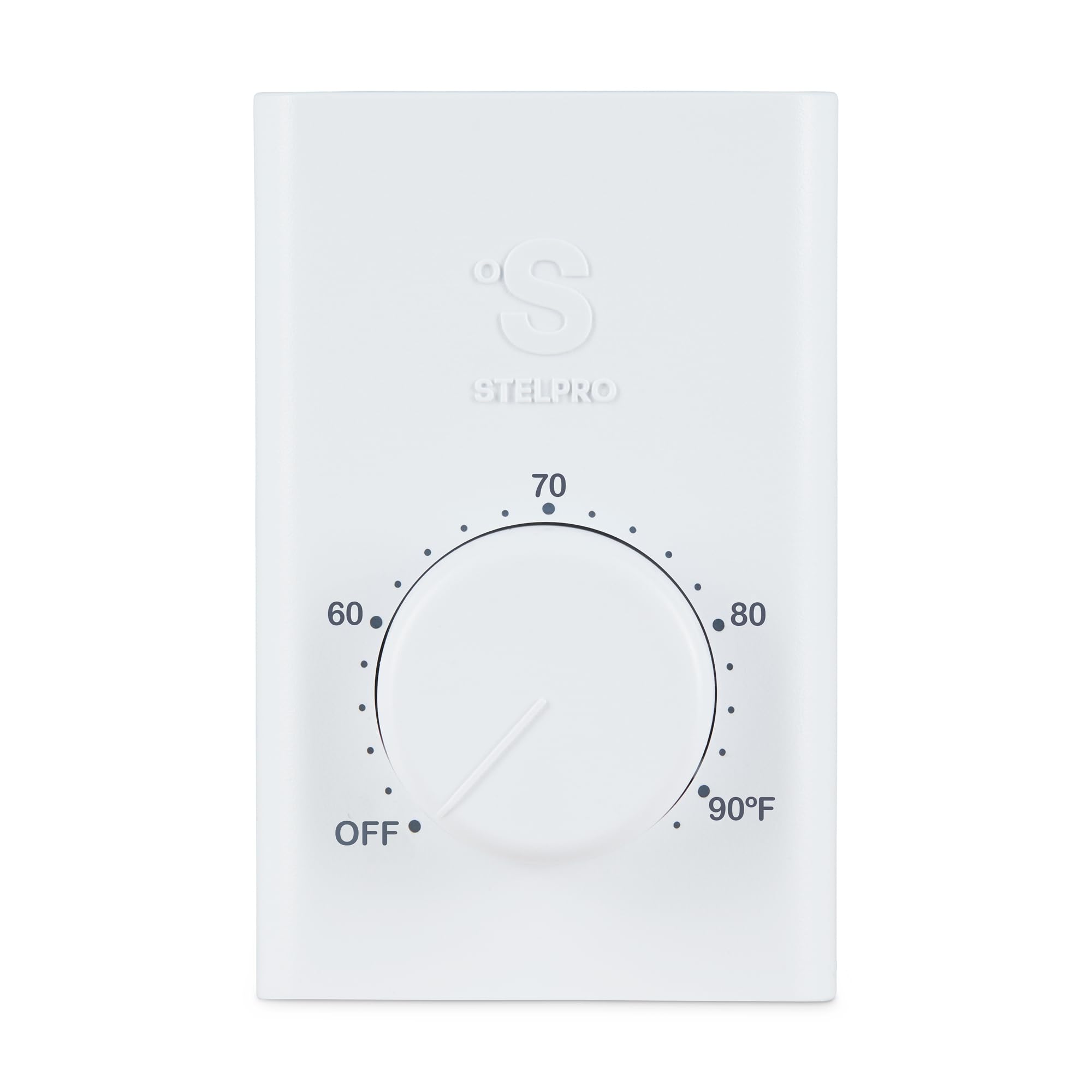
The Stelpro SWT2F is the most affordable double-pole mechanical thermostat on this list, but it doesn’t cut corners on the critical spec: its 22A rating at 120-277V makes it one of the highest-capacity units available in a residential form factor. If you need to control a large 120V baseboard heater or a fan-forced heater pulling close to 2500W, the Stelpro can handle it without the risk of contact welding that a 15A unit might suffer over time. The mechanical dial offers a smooth 50-90°F adjustment with a positive “off” stop that fully disconnects both poles—no current flows through the heater when the dial is turned to off.
The low-profile rectangular housing in white blends into any wall décor, and the unit is CSA/UL-approved for line-voltage use, which is a requirement in most North American jurisdictions. Installation is straightforward: the two line wires connect to one side, the two load wires to the other, and the double-pole action ensures complete electrical isolation during maintenance. Customers report using it as a direct replacement for Marley and Hallowell models, and the three-screw terminal design accepts both solid and stranded copper wire without issue.
The trade-off is accuracy: like most mechanical thermostats, the Stelpro has a hysteresis of roughly 5-6°F, meaning the room temperature will swing several degrees above and below the set point before the switch re-engages. This is normal for the technology, but if you want tighter control, you’ll need to step up to an electronic or smart thermostat. For its price, the Stelpro SWT2F offers the highest amperage capacity of any mechanical unit here, making it the right choice for large heaters on a tight budget.
Why it’s great
- 22A rating—highest capacity in the lineup, handles large 2500W+ heaters
- Double-pole design fully disconnects power for safety during maintenance
- CSA/UL-approved and affordable—best value for high-load mechanical control
Good to know
- Mechanical hysteresis of 5-6°F means noticeable temperature swings
- Some units shipped with calibration off by as much as 20°F (quality control variance)
7. Legacy TH5 Plug-In Thermostat

The Legacy TH5 is the only thermostat in this roundup that comes with a built-in 120V 3-prong US plug, meaning you don’t need to open a junction box or touch any wiring. This makes it ideal for portable heaters, torpedo heaters, space heaters, and temporary setups in barns, workshops, or garages where hardwiring a thermostat isn’t practical. The temperature range spans 40°F to 104°F with a 2.5°F differential, and the unit can be switched between heating and cooling modes by changing an internal wire connection.
The gray metal enclosure is more industrial in appearance than the white plastic of residential models, but the build quality is robust for a plug-in device. The dial control is simple and intuitive—you turn it to your desired temperature and the thermostat switches the heater on or off as needed. Customers have used it successfully to control fans for rabbit hutches, mister pumps in summer, and torpedo heaters in cold workshops, demonstrating its versatility beyond just heating applications.
One consideration: the TH5 ships configured for heating, so if you need cooling mode, you must open the enclosure and swap a wire connection, which requires basic electrical comfort. The unit’s 15A rating limits it to 1800W at 120V, so it won’t work for large 240V heaters or multi-heater zones. Some users also noted that the temperature scale is approximate—there are no degree markings below 40°F, so you’ll need to dial it in by feel if you’re working in very cold conditions. For plug-and-play convenience with a torpedo or space heater, the Legacy TH5 is uniquely suited among the options here.
Why it’s great
- Plug-and-play with built-in 3-prong cord—no hardwiring or junction box needed
- Switchable between heating and cooling via internal wire change
- Durable metal enclosure suitable for barns, garages, and industrial settings
Good to know
- 15A/1800W limit—not suitable for high-wattage or 240V heaters
- No marked degree increments below 40°F; approximate dial calibration
FAQ
Can I replace a 240V thermostat with a 120V thermostat?
What does 4-wire installation mean for a smart thermostat?
How do I know if my thermostat is single-pole or double-pole?
Final Thoughts: The Verdict
For most users, the best 120 volt thermostat winner is the Meross Smart Thermostat because it balances smart-home connectivity, 1°F accuracy, and energy monitoring at a price that undercuts the premium competition. If you need the longest warranty and the cleanest build quality, grab the Mysa Smart Thermostat LITE. And for rugged outdoor or damp-environment use where digital features don’t matter, nothing beats the Peco TF115-001.