
Welding at home often comes down to a single constraint: you only have access to a standard 120-volt wall outlet. A dedicated 240-volt circuit is a luxury many garage workshops and DIY spaces simply don’t have. The disconnect between the welder you want and the power you actually have can be frustrating, leading to either undersized tools or expensive electrical upgrades. The generation of compact inverter-based welders has changed that reality, delivering real welding power from a common household plug without triggering a breaker on every long bead.
I’m Min — the co-founder and writer behind Gadgets Feed. I’ve spent countless hours sifting through technical datasheets, duty cycle curves, amperage charts, and real-world user feedback to separate the machines that genuinely deliver a stable arc and deep penetration on a 120V circuit from those that merely claim to. Every amp and terminal listed here has been weighed against what a home fabricator actually needs.
Whether you need to patch a trailer frame, repair farm equipment, or build a custom gate from your garage, the best 120 volt welder is the one that matches your process, material thickness, and skill level without demanding a costly electrical panel upgrade.
How To Choose The Best 120 Volt Welder
Choosing a welder that runs on a standard household outlet is a balancing act between available power and the welding process you intend to use. Not all 120V welders are created equal — some excel at thin sheet metal while others can penetrate 1/4-inch steel with multiple passes. Understanding a few core specs will prevent you from buying a machine that either pops breakers constantly or simply lacks the heat to fuse metal properly.
Process Type: MIG, Stick, TIG, or Multi-Process
A dedicated MIG welder with flux-core capability is the easiest path for a beginner because it handles dirty or rusty metal without needing a shielding gas tank. Stick welders (SMAW) offer deeper penetration on thicker materials but require more skill to run a clean bead and produce slag that needs chipping. TIG welding at 120V is possible with thin gauge metals like stainless steel or aluminum, but it demands the most practice and a machine with AC balance control for non-ferrous materials. Multi-process machines combine two or three of these methods in one chassis, giving you flexibility to switch from sheet metal to structural steel without buying a second unit, though you often sacrifice duty cycle in each individual process.
Duty Cycle and Thermal Management
A duty cycle tells you how long the welder can operate continuously before it needs to cool down, measured as a percentage of a ten-minute period. For example, a 60% duty cycle at 140A means you can weld for six minutes straight before the machine forces a four-minute cooldown. Inverter-based welders with IGBT technology run cooler than older transformer units, but the machine’s internal fan design and heatsink surface area ultimately determine whether you can lay a long 10-inch bead on a hot summer day without hitting thermal shutdown. Dual-fan or intelligent fan systems that run only when needed can extend usable run time and reduce noise.
Synergic Control vs. Manual Adjustment
Synergic control automates the relationship between wire feed speed and voltage — you set the amperage, and the machine picks the appropriate wire speed for that setting. This dramatically reduces the learning curve for MIG beginners and speeds up setup for experienced welders switching between material thicknesses. Manual welders require you to adjust voltage and wire speed independently, which offers more fine-tuning capability once you understand how changes affect arc characteristics. If you are learning, a synergic machine removes the frustration of bird-nesting wire or poor arc starts. If you are an experienced fabricator, manual control gives you the ability to dial in a specific arc for exotic materials or out-of-position welds.
Quick Comparison
On smaller screens, swipe sideways to see the full table.
| Model | Category | Best For | Key Spec | Amazon |
|---|---|---|---|---|
| Weldpro TIG 200AC/DC | Premium | Aluminum TIG & Precision Work | 200A AC/DC TIG, 110/220V | Amazon |
| ARCCAPTAIN MIG200 | Premium | Multi-Process Home Fabrication | 200A 6-in-1, Synergic MIG | Amazon |
| Lincoln Electric Weld-Pak 90i | Mid-Range | Portable Flux-Core MIG | 90A, 15 lbs, 120V only | Amazon |
| FEMEROL MIG 250PRO | Premium | High-Amp Multi-Process & Aluminum | 250A, 6-in-1, Spool Gun Ready | Amazon |
| VEVOR MIG-270 | Mid-Range | Heavy Plate on 220V, 3-in-1 | 270A, 3-in-1, IGBT | Amazon |
| Forney 298 Easy Weld 100ST | Mid-Range | Stick & TIG for Light Repair | 90A Stick/TIG, All-Metal Case | Amazon |
| Bestarc MIG165 | Mid-Range | Synergic MIG for Beginners | 165A, 4-in-1, Dual Voltage | Amazon |
| HITBOX 140A 3-in-1 | Budget | Entry-Level Multi-Process Value | 140A, 3-in-1, 6.6 lbs | Amazon |
| ARCCAPTAIN CUT55 Pro | Premium | Plasma Cutting (not welding) | 55A Pilot Arc, Cuts 3/4″ | Amazon |
In‑Depth Reviews
1. Weldpro 200A AC/DC TIG Welder with Pulse
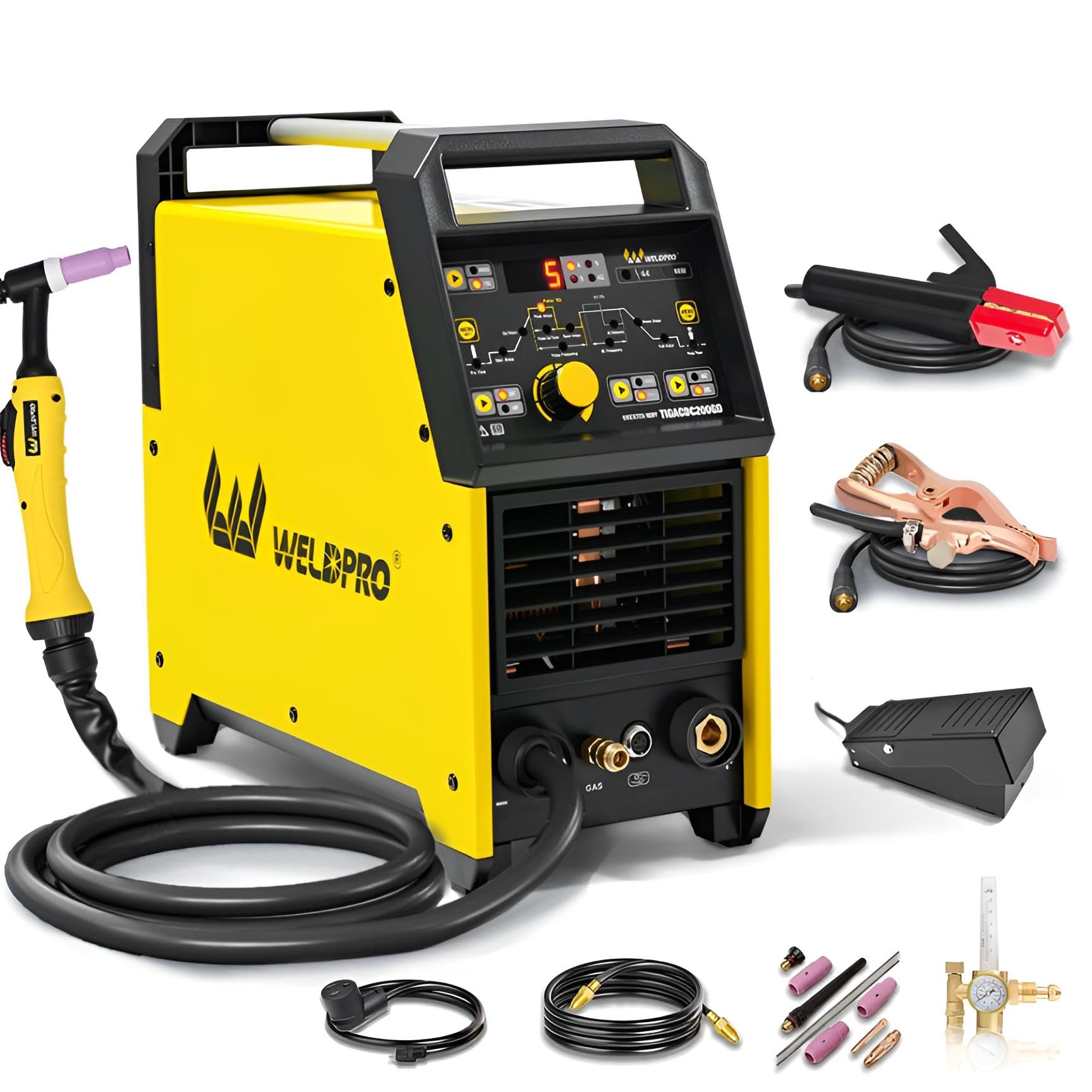
The Weldpro TIG200 is a 5-in-1 machine that covers AC TIG, DC TIG, AC Pulse TIG, DC Pulse TIG, and Stick welding, all while running on 110V or 220V with automatic voltage detection. For aluminum, the adjustable AC balance, frequency, and pulse controls let you clean the oxide layer and manage heat input precisely — critical for preventing burn-through on thin sheet. The included heavy-duty foot pedal provides hands-free amperage control, giving you real-time current adjustment as you move across a joint.
On 110V, the unit delivers enough heat for light stainless fabrication, exhaust work, and thin gauge aluminum up to about 1/8-inch. The high-frequency, non-contact arc start eliminates tungsten contamination, and the CK17 flex torch that ships with the kit is a premium touch often found only on machines costing double. The 40% duty cycle at 200A on 220V drops on 110V, but stays workable for short-run hobbyist and repair projects.
Some users reported that the supplied pressure gauge was inaccurate out of the box, costing them gas before they swapped it. However, the overall build quality and welded performance match machines priced well above this tier, making it a legitimate option for the serious TIG hobbyist.
Why it’s great
- Full AC/DC control with pulse lets you weld aluminum, stainless, and steel from one machine
- Premium CK17 flex torch and foot pedal included — no separate purchases needed for pro-level work
- 110V/220V auto-sensing lets you take it from home garage to shop without rewiring
Good to know
- Regulator pressure gauge may be inaccurate; plan to replace it before first gas use
- Ground clamp spring is extremely tight, making it difficult to attach to some workpieces
- Gas-cooled torch gets hot quickly on long, continuous beads above 150A
2. ARCCAPTAIN MIG200 6-in-1 Multi-Process Welder
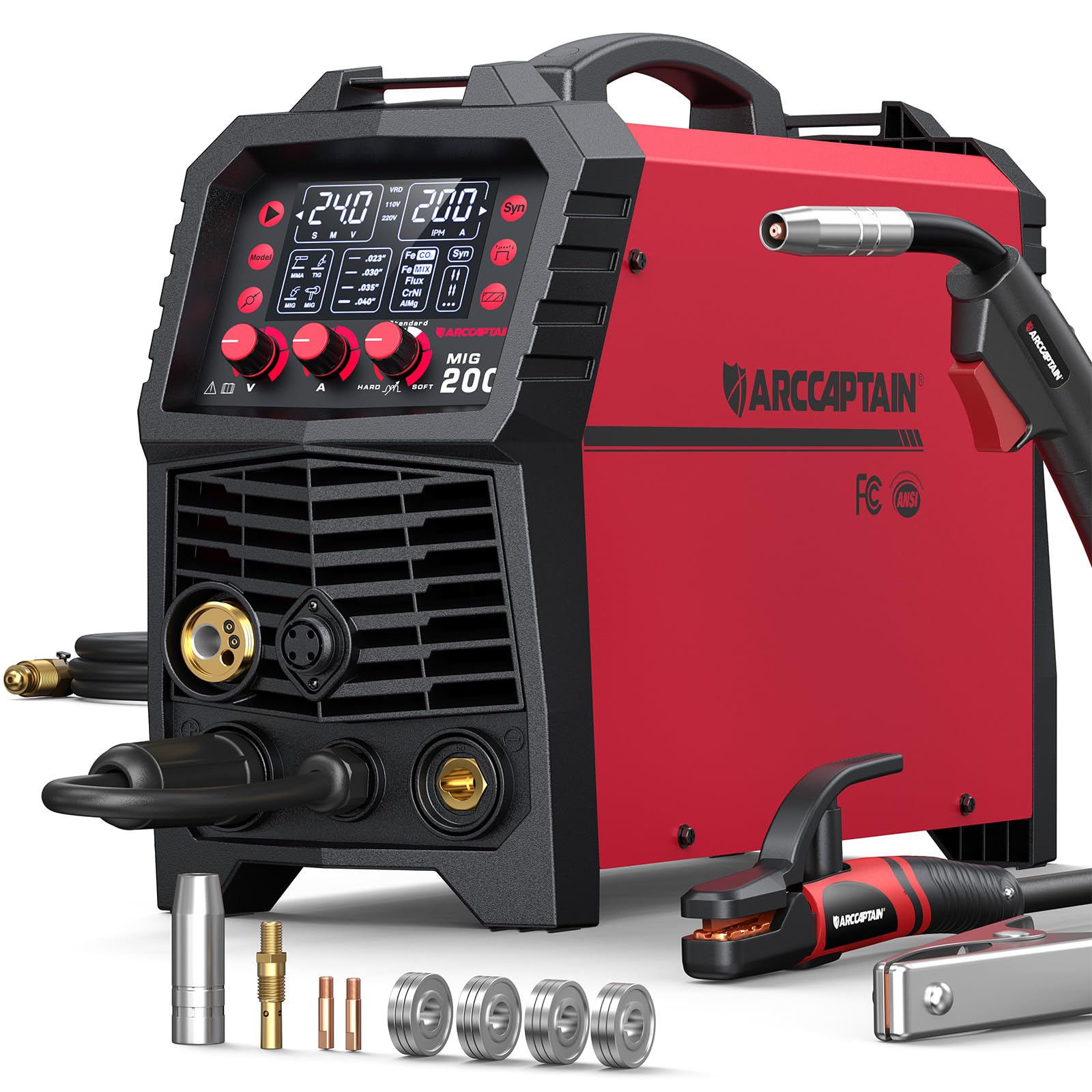
The ARCCAPTAIN MIG200 packs gas MIG, gasless flux-core MIG, stick, lift TIG, spot welding, and spool gun compatibility into a single red chassis weighing just over 14 pounds. The synergic control automatically matches wire feed speed to the current you select, which makes first-time MIG welders productive immediately — no two-dial guessing game. The large LED display shows voltage, current, and wire speed clearly, and you can save up to 10 preset parameter sets for repeat jobs, cutting down setup time significantly.
On 110V, the MIG200 runs .030-inch flux-core wire easily through 1/8-inch steel, and it includes a shoulder strap for maneuvering around a farm or repair trailer. The intelligent cooling fan only runs when needed, which keeps noise down and prevents dust from being pulled into the electronics during idle. Burn-back adjustment, pre-flow/post-flow timing, and 2T/4T trigger modes give it a level of control usually reserved for machines double its price.
Reviewers note that the included accessories are generous, but the .035-inch drive rolls were missing from some early kits. The manual lacks a detailed setup chart for different wire diameters and gas combos, so you will rely on the synergic presets or your own experience. The 110V-to-220V adapter also poses a potential safety hazard if switched while the screen is still lit, so the power-down sequence matters. Despite those quirks, the weld quality is clean and the machine punches above its weight on thicker stock with 220V.
Why it’s great
- Synergic MIG automates wire speed matching, drastically reducing beginner frustration
- 10 preset memory slots let you dial in parameters once and recall them instantly
- Intelligent fan runs only on demand — quieter and less dust ingestion
Good to know
- Some kits shipped without the .035-inch drive rolls; check your box immediately
- Manual lacks a comprehensive setup chart for gas/wire combinations
- Do not switch between 110V and 220V while the display is still lit — wait for full shutdown
3. Lincoln Electric Weld-Pak 90i

The Lincoln Electric Weld-Pak 90i is a pure 120V machine — no dual-voltage gimmicks, no multi-process complexity — just a compact, proof-tested MIG and flux-core welder from a brand professional shops trust. At only 15 pounds with a built-in shoulder strap and a protective metal case, it is the definition of a grab-and-go unit for mobile maintenance, fence repair, and light hobby work. The inverter power source runs cooler and more efficiently than the old transformer-based Lincoln machines, providing a smoother arc at 90 amps output.
Using E71T-11 flux-core wire, the 90i can weld 1/4-inch steel with multiple passes, and the infinitely variable voltage control lets you fine-tune the arc length and heat input for thin sheet metal without blowing holes. The included accessories cover gasless and gas operation with a dual-track drive roll system, a Harris gas regulator, and a full set of contact tips. The metal case protects the unit from bumps in the truck bed, making it a durable companion for professional welders who need a quick repair backup.
The Weld-Pak is not designed for heavy industrial use — its 90-amp output on 120V limits penetration on material thicker than 3/16-inch with solid wire. The 15-amp household circuit can trip if you run long, continuous beads at full power, especially with an extension cord. The premium price over lower-amp competitors is the cost of Lincoln’s build quality, parts availability, and customer support network. For the home user who values dependability over raw specs, this is a trustworthy choice.
Why it’s great
- Inverter design delivers a smooth, efficient arc with less spatter than traditional 120V welders
- Metal case and shoulder strap make it truly portable for off-site repairs
- Infinite voltage control allows fine-tuning for thin sheet metal without burn-through
Good to know
- 90-amp output limits single-pass penetration on material over 3/16-inch thick
- Long beads at full power on a 15-amp circuit can trip breakers with an extension cord
- Premium price compared to similar-spec competitors from newer brands
4. FEMEROL 250A MIG Welder 6-in-1

The FEMEROL MIG 250PRO is a 6-in-1 heavy hitter that includes gas MIG, gasless flux-core MIG, stick, lift TIG, spot welding, and spool gun compatibility for aluminum. With a claimed peak of 250 amps and a 60% duty cycle, it is one of the most powerful units in this price tier, capable of welding mild steel up to 14mm with multiple passes. The synergic control automatically selects the correct starting parameters when you input wire diameter and gas type, significantly lowering the learning curve for multi-process switching.
The large LED display is easy to read through a welding helmet, and the metal wire feeder is sturdier than the all-plastic units found on many budget machines. The ability to support a spool gun means you can run .035-inch or .045-inch aluminum wire without bird-nesting, making aluminum repairs on boat trailers or RV components feasible without a TIG rig. The induction control and burn-back adjustment let you fine-tune the arc for position welding and overhead beads.
Several users note the continuous fan noise — it runs constantly rather than cycling on demand, which is a minor annoyance in a home shop. The 120V input cord and plug are undersized for the machine’s full potential, so you will need to run it on 220V to access the top of the amperage range. The gas inlet is a barbed fitting rather than a standard CGA connection, requiring a hose clamp modification to prevent leaks. Nonetheless, the weld quality and feature set for the price are exceptional.
Why it’s great
- 250-amp output and 60% duty cycle provide headroom for thicker materials and longer weld runs
- Spool gun compatibility enables aluminum MIG without the headache of push-pull feed issues
- Induction control and burn-back adjustment allow precise tuning for position welding
Good to know
- Cooling fan runs continuously, producing constant noise during operation
- 120V power cord and plug are undersized for full amperage use
- Gas inlet uses a barbed fitting that may leak without a hose clamp modification
5. VEVOR MIG-270 3-in-1 Welder

The VEVOR MIG-270 is a 3-in-1 machine that combines MIG, lift TIG, and stick welding with a peak output of 270 amps, making it one of the highest-amp single-phase units available for under . The IGBT inverter technology provides a stable arc and efficient power conversion, allowing it to weld carbon steel, stainless steel, and iron. The LCD digital display clearly shows current and voltage settings, and the independent knobs for wire speed and voltage give you full manual control without relying on automated presets.
On 110V, the MIG-270 runs flux-core wire with enough heat for 1/8-inch to 3/16-inch steel in a single pass. On 220V, it handles 3/8-inch plate with multiple passes, leaving a deep, consistent puddle. The unit accepts both 2.2-pound and 11-pound wire spools, which is a welcome flexibility for users who want to avoid frequently swapping rolls on larger projects. The built-in overheat protection and IP21 splash resistance add a layer of security for outdoor use in covered areas.
The included accessories are basic: the welding torch, ground clamp, and electrode holder function adequately, but the gas regulator included with some kits is reported to be unreliable, often requiring replacement before the first job. The duty cycle on 110V is not explicitly stated, but real-world users report that long beads over 8 inches trigger thermal shutdown faster than on more expensive units. Despite these cost-saving choices, the raw power and penetration on 220V make it a strong contender for farm and shop repair work where ultimate duty cycle is less critical than sheer heat.
Why it’s great
- 270-amp peak output provides serious penetration on 220V for structural repairs
- Accepts both 2.2 lb and 11 lb wire spools, reducing changeover time on large jobs
- Overheat and overcurrent protection with IP21 rating adds safety for covered outdoor use
Good to know
- Included gas regulator is often unreliable; plan to replace it before first use
- Duty cycle on 110V is lower than advertised — thermal shutdown can occur on long beads
- Accessories are functional but feel budget grade compared to the machine’s power potential
6. Forney 298 Easy Weld 100ST

The Forney 298 is a dedicated 90-amp stick and TIG-capable inverter welder built into a rugged all-metal case. There are no MIG or flux-core functions — this is a machine designed for users who prefer the simplicity and deep penetration of stick welding on a 120V circuit. With 5/64-inch E6013 rods, it starts easily at 45 amps and runs smooth beads on 1/16-inch to 3/16-inch steel without excessive spatter. The inverter technology provides a stable arc that older transformer-based 120V welders simply cannot match at this weight.
For TIG welding, the 100ST supports lift-start DC TIG with an optional torch, making it capable of clean welds on stainless steel and thin carbon steel. The unit weighs only 13.74 pounds and measures compact enough to fit in a tool bag, which makes it a convenient option for mobile repairs. The all-metal housing protects the electronics from bumps and drops on the job site, and the 8-foot electrode holder and ground clamp offer decent reach for small to medium work areas.
The 90-amp ceiling limits the Forney to light-duty work — 3/8-inch steel requires multiple passes with preheating, and 1/4-inch is the practical maximum for a single pass. The on-off rocker switch is difficult to operate with welding gloves on, and the included stinger is adequate but not premium. Professional welders returning to the hobby after years away have praised its ease of use for small repairs, but anyone planning regular work on structural steel should look at higher-amperage options.
Why it’s great
- Inverter technology provides a stable arc at low amperage for thin sheet metal work
- All-metal case is rugged enough for job site conditions and tool bag transport
- Lightweight design at 13.74 lbs makes it one of the most portable stick welders available
Good to know
- 90-amp output limits single-pass penetration to 1/4-inch steel or less
- On-off switch is hard to operate while wearing heavy welding gloves
- No MIG or flux-core capability — this is strictly a stick and TIG machine
7. Bestarc 165A MIG Welder 4-in-1
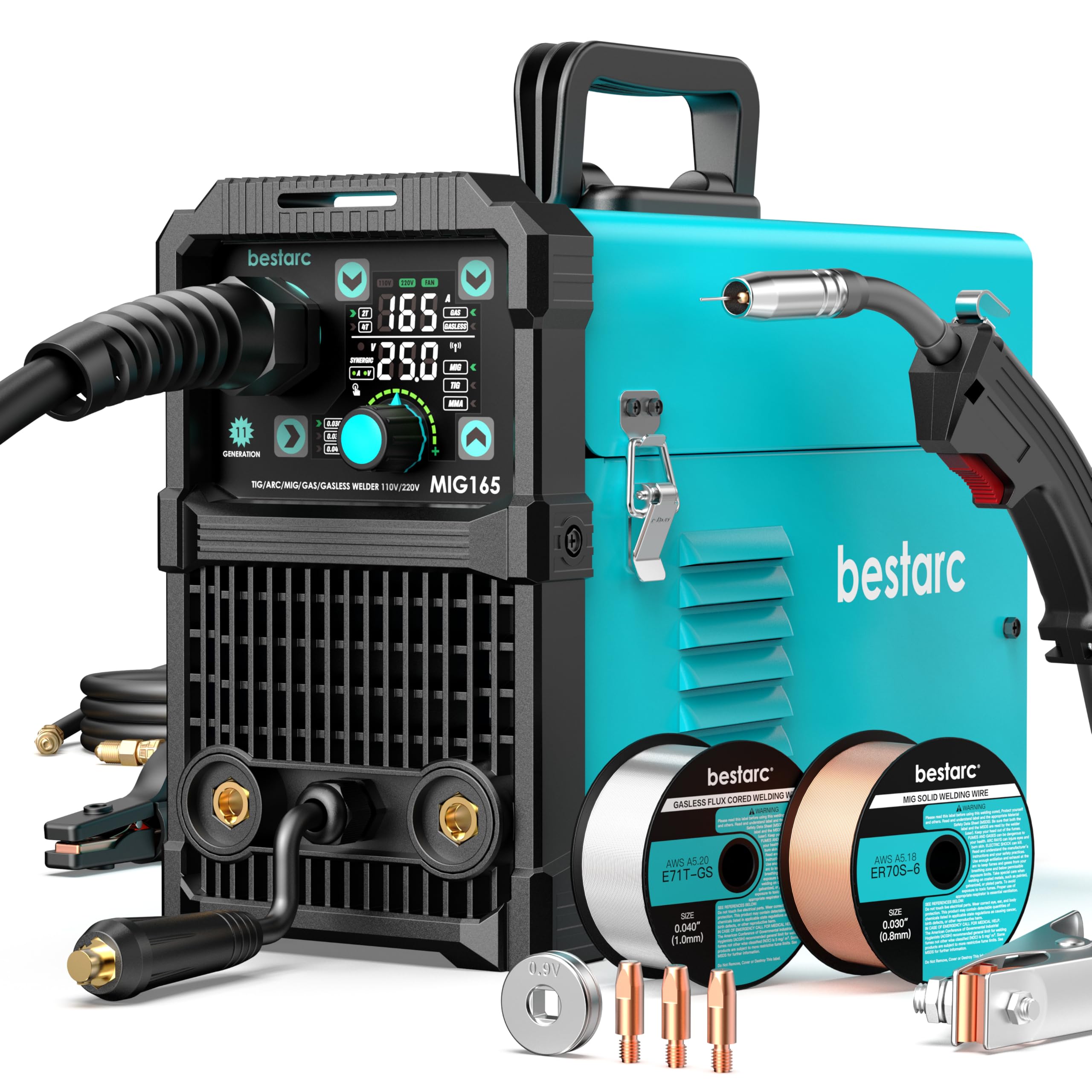
The Bestarc MIG165 is a 165-amp 4-in-1 welder that covers gas MIG, gasless flux-core MIG, lift TIG, and stick welding, all running on automatic-sensing 110V/220V. The synergic control is designed to take the guesswork out of setting wire speed — you adjust the amperage and the machine sets the feed rate automatically. This is particularly beneficial for beginners who are learning to read a puddle without also juggling two knobs. The large LED display shows voltage, current, and wire speed clearly through a lens.
The unit weighs 23.1 pounds and comes with a shoulder strap, making it reasonably portable for its capability. It runs .030-inch and .035-inch flux-core wire effectively on 110V for 1/8-inch steel repairs, and switching to 220V allows it to handle 1/4-inch plate with solid MIG wire and gas shielding. The built-in safety protection automatically compensates for voltage fluctuation and includes over-current, over-load, and over-heating shutdown to protect the IGBT inverter.
Early versions of the Bestarc 145 had a short 5.5-foot gun lead and lacked a knurled drive roll for flux-core wire, but the newer MIG165 addresses these issues with a longer lead, two knurled drive rolls, and an improved manual. The stick welding mode maxes out around 130 amps, which is adequate for 1/8-inch rods but not for heavy 3/16-inch electrodes. The spool tension spring is also quite stiff, causing occasional wire feeding hesitation with softer aluminum wire in the spool gun mode.
Why it’s great
- Synergic control matches wire speed to amperage, simplifying setup for beginners
- 110V/220V auto-sensing enables seamless switching between home and shop power
- Improved gun lead length and dual knurled drive rolls fix earlier generation complaints
Good to know
- Stick welding top end is limited to roughly 130A, insufficient for large diameter rods
- Spool tension spring is stiff, which can cause wire feed hesitation on some setups
- Aluminum spool gun not included; requires separate purchase for aluminum MIG
8. HITBOX 140A 3-in-1 MIG Welder
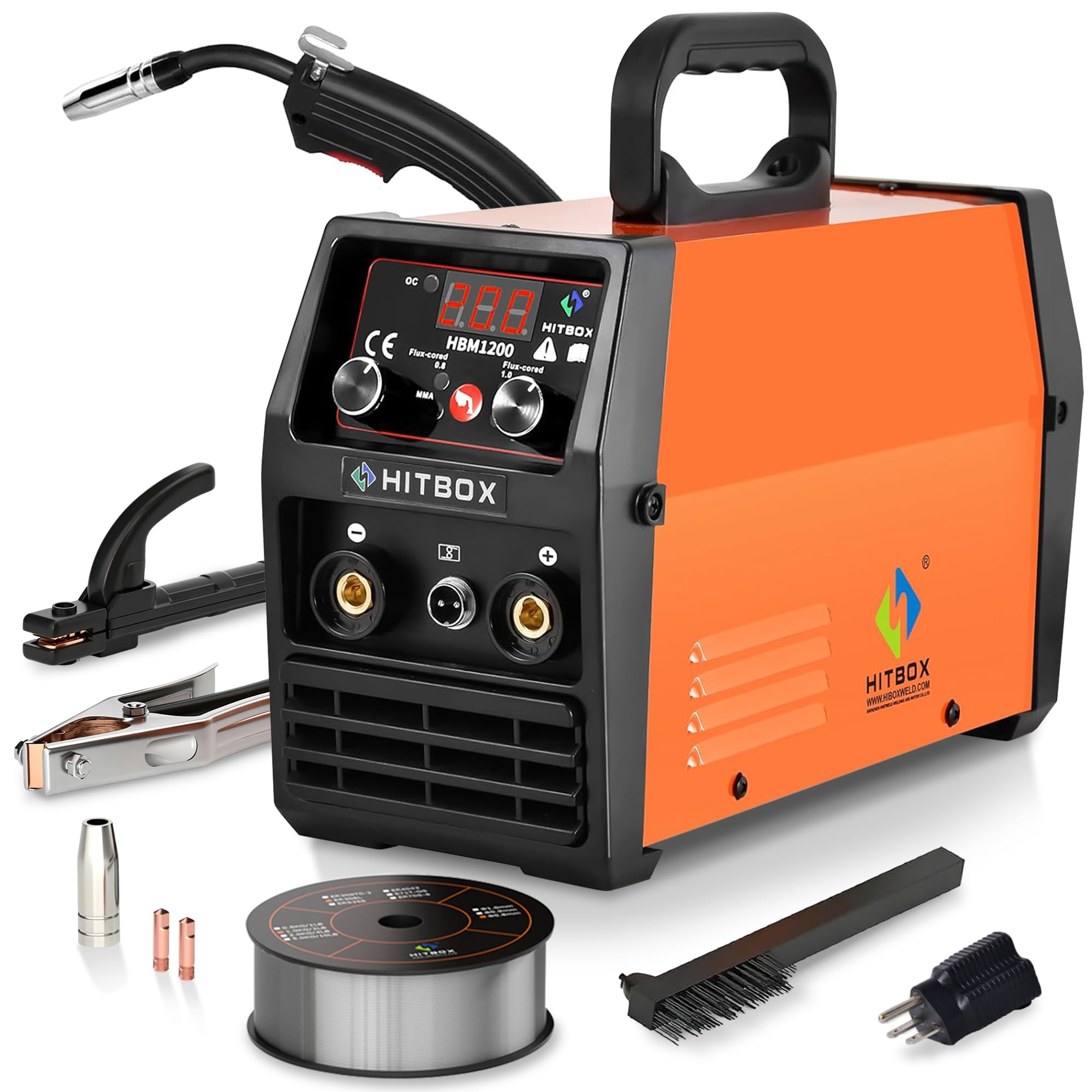
The HITBOX 140A is a 3-in-1 multi-process welder (flux-core MIG, stick, and lift TIG) that weighs just 6.6 pounds, making it the lightest full-function welder in this list by a wide margin. The IGBT inverter and copper windings allow it to run efficiently on 110V without the weight penalty of a traditional transformer. The synergic control automatically matches wire feed speed to the amperage you dial in, reducing the chance of bird-nesting and making first-time welds possible for an absolute beginner.
On 110V, the HITBOX uses flux-core wire to achieve full penetration on 1/8-inch steel in a single pass, and the arc remains stable without spatter jumping or cutting out. The dual 7-fin aluminum heatsinks and a 5,000 RPM fan pull 46 CFM of air through the chassis, keeping the inverter cool enough to avoid thermal shutdown during light production work. ETL certification and Class F insulation add a layer of safety verification that is rare at this price point. The 2-year replacement warranty and US-based support are also standout features for a unit under .
The MIG wire spool capacity is limited — the unit cannot accept standard 8-inch or 12-inch spools without modification, so you are restricted to small 2.2-pound rolls. The ground clamp is made from a soft metal that can warp after repeated clamping, requiring replacement sooner than expected. The 220V adapter that ships with the unit uses an uncommon plug configuration, not the standard NEMA 6-50 found on most shop outlets. For home garage use on 110V, however, the value-to-weight ratio is unmatched.
Why it’s great
- 6.6-pound weight makes it the most portable welder in this guide — truly one-handed transport
- Synergic control automates wire feed speed, lowering the barrier for first-time welders
- ETL certified with a 2-year replacement warranty, rare for a machine at this entry-level price
Good to know
- Wire spool capacity is limited to small 2.2 lb rolls — standard spools will not fit
- Ground clamp uses soft metal that deforms after repeated use; plan for early replacement
- 220V adapter uses an uncommon plug type, not the NEMA 6-50 found in most shops
9. ARCCAPTAIN CUT55 Pro Plasma Cutter

The ARCCAPTAIN CUT55 Pro is a 55-amp non-touch pilot arc plasma cutter that runs on both 120V and 240V, delivering a quality cut thickness of 1/2-inch and a maximum sever cut of 3/4-inch. The high-frequency pilot arc starts without contacting the workpiece, which means you can cut through painted, rusty, or coated steel without stopping to grind a clean starting point. This is a game-changer for salvaging parts from old vehicles or cutting structural steel on a farm where material cleanliness is never guaranteed.
The APP control feature allows you to adjust cutting parameters and monitor machine status from up to 10 meters away, which is genuinely useful when you are positioned awkwardly under a vehicle. The 2T/4T trigger modes, combined with intelligent post-blow timing that adjusts automatically based on current draw, extend consumable life by clearing molten metal from the nozzle after each cut. The smart fan reduces noise by roughly 50% and doubles cooling efficiency compared to constant-run designs.
The included 10-foot cutting torch and air hose limit your range without dragging the machine closer, which can be an issue in large shops. The CUT55 Pro is a plasma cutter, not a welder — it cannot fuse metal. It is included here because many serious fabricators pair a 120V-friendly plasma cutter with a small MIG welder for a complete portable fabrication kit. If you already own a welder and need clean, fast cuts without grinding, this machine earns its place in your gear.
Why it’s great
- Non-touch pilot arc cuts through rust, paint, and coatings without pre-cleaning — huge time saver
- APP control lets you adjust settings and monitor from distance, useful under a vehicle or on a lift
- Smart fan runs quieter and doubles cooling efficiency, extending machine life
Good to know
- 10-foot torch lead limits range — you may need to reposition the machine for large workpieces
- This is a plasma cutter, not a welder; it cannot be used to join metal
- Sepium cut thickness requires 240V — 120V limits you to thinner material
FAQ
Can a 120 volt welder weld 1/4-inch steel in a single pass?
Is flux-core wire better than solid wire with gas for a beginner on 120V?
What size extension cord do I need for a 120V welder?
Final Thoughts: The Verdict
For most users, the best 120 volt welder winner is the ARCCAPTAIN MIG200 because it combines synergic ease-of-use, genuine multi-process capability, and enough power on 110V for 1/4-inch repairs, all in a portable package that grows with your skill level. If you want dedicated aluminum TIG performance with pulse control and a foot pedal, grab the Weldpro TIG 200AC/DC. And for pure portability and brand-backed reliability at the lowest weight in the field, the HITBOX 140A 3-in-1 is the budget-friendly champion for grab-and-go jobs.