
Our readers keep the lights on and my morning glass full of iced black tea. As an Amazon Associate, I earn from qualifying purchases.
Specs are compiled from manufacturer listings and verified buyer reviews and can change over time — please confirm the key details on the product page before buying.
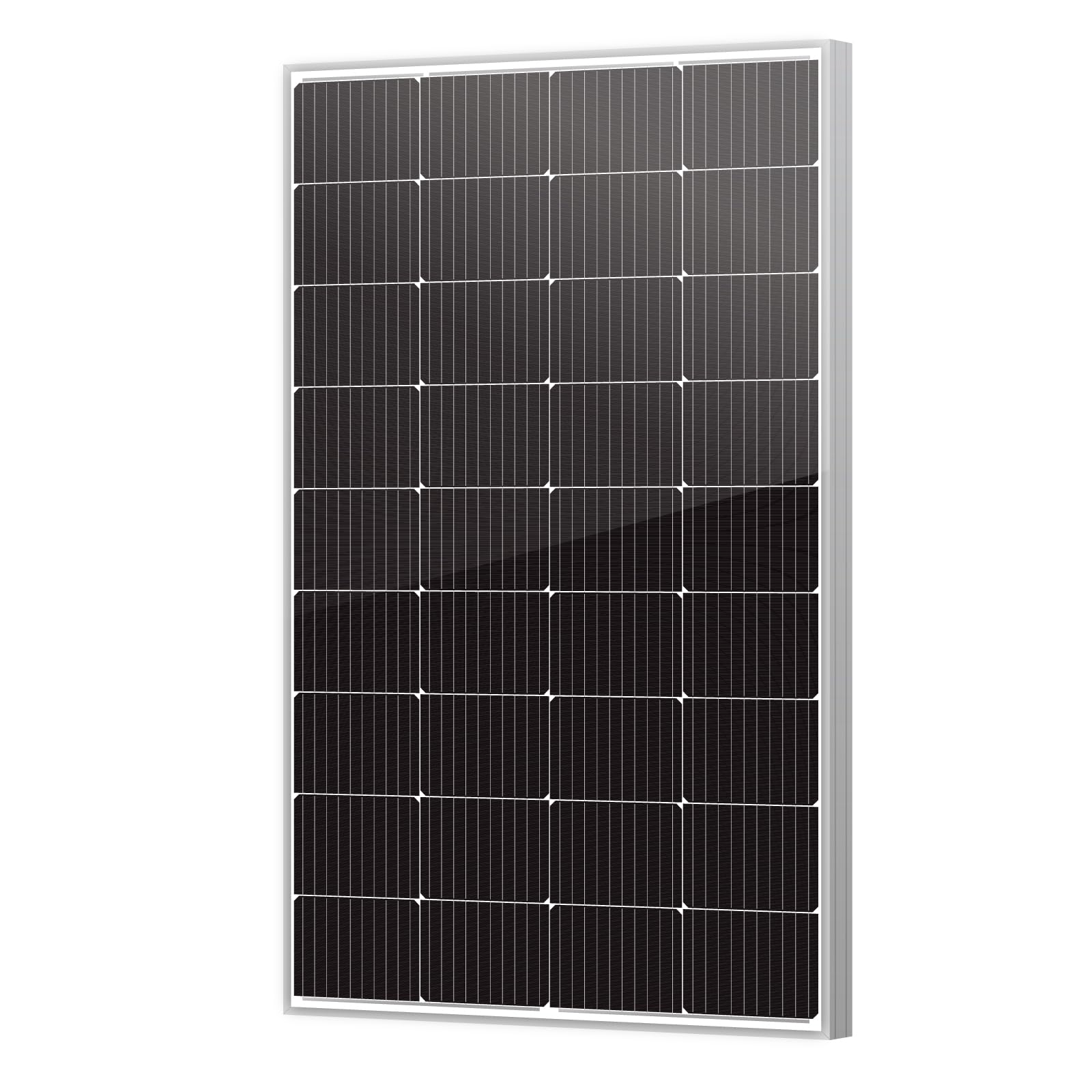
You need a 12V 200W solar panel that actually fits your roof or campsite, and this list separates the rigid rooftop workhorses from the foldable campers’ companions using real owner experience and hard specs. One honest note before the picks: this list uses human-like matching for the search term, so not every panel is the EXACT model printed on the box — the nearest same-size and same-wattage serves the same purpose, and the numbers below come straight from each verified listing.
I’m Min — the founder and writer behind Gadgets Feed. This guide is built by comparing the manufacturers’ published specifications and the patterns across verified customer reviews, so you get each pick’s real strengths and trade-offs instead of marketing spin.
If you need a 12v 200w solar panel that survives storms, shrugs off shade, and keeps charging even on overcast days, these nine picks cover every mounting style and budget tier.
Our Picks at a Glance

How To Choose The Best 12V 200W Solar Panel
Before you buy, you need to decide where the panel lives. A rigid framed panel bolts to a roof for the next decade; a foldable one follows you to a campsite and packs into the trunk. That single decision shapes every other spec that matters.
Efficiency and Cell Technology
The conversion efficiency tells you how much sunlight becomes electricity. Top panels here reach 25%, while older polycrystalline types sit near 17%. The best performers use N-Type cells with 16 busbars — those thin metal lines on the cell surface — which collect current more evenly and hold up better as they age than 5 or 9 busbar designs.
Bifacial Design and Shade Tolerance
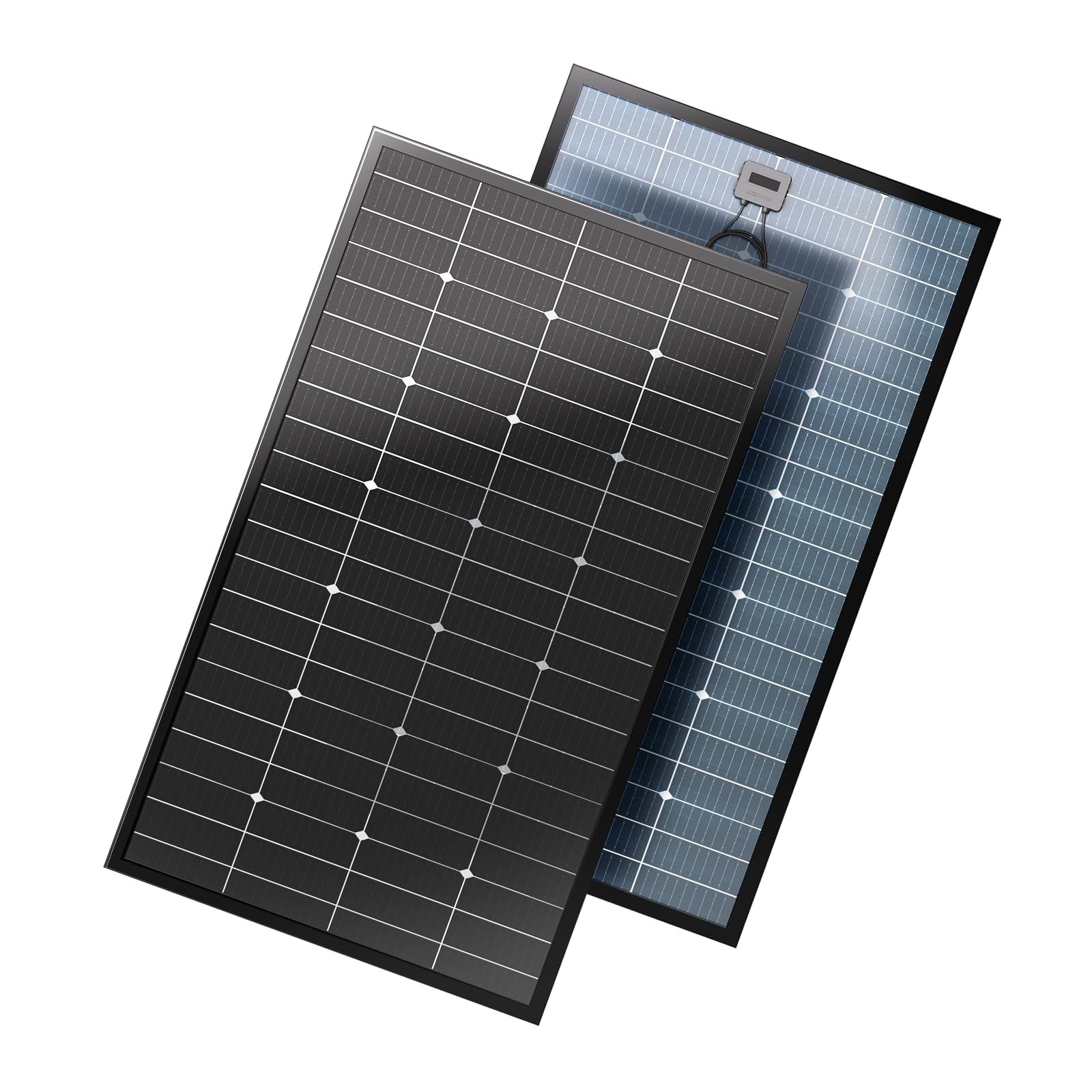
A bifacial panel has a transparent back instead of an opaque one, so it captures reflected light from underneath as well as direct sun overhead. Some makers claim this adds up to 30% more output. If trees or antennas will cross your roof, look for panels split into two independent halves, so shade on one side does not kill the other side’s power.
Durability Ratings
Check the wind and snow load figures. Strong panels shrug off 2400Pa of wind and 5400Pa of snow. The junction box and connectors carry IP ratings — a quick waterproofing scale — with IP67 meaning full protection against dust and low-pressure water jets, which matters for a panel living outdoors for years.
Quick Comparison
| Model | Best For | Efficiency | Weight | Amperage | Amazon |
|---|---|---|---|---|---|
| Newpowa 200W★ Best Overall | Overland vans on a budget | High Efficiency | 24.4 lb | 10.75 A | Amazon |
| JJN Bifacial 16BBPremium Pick | Premium power from both faces | 25% | 23.2 lb | 9.12 A | Amazon |
| JJN Bifacial 10BBBest Value | Best raw output per dollar | 23% | 25 lb | 9.12 A | Amazon |
| Callsun N-Type 16BB | Tight Class B van roofs | 25% | 23.8 lb | 8.43 A | Amazon |
| EBL Foldable 200W | Charging power stations on the go | 23.5% | 18 lb | — | Amazon |
| BougeRV N-Type 16BB | Compact premium RV rooftops | 25% | 22.8 lb | — | Amazon |
| Renogy E.Flex 200W | Ultralight campers and hikers | 25% | 13.9 lb | 11.3 A | Amazon |
| RICH SOLAR 200W | Permanent off-grid arrays | High Efficiency | 24 lb | 10.9 A | Amazon |
| Renogy ShadowFlux | Shaded roofs and cloudy climates | 25% | 23.8 lb | — | Amazon |
In-Depth Reviews
1. Newpowa 10BB Cell 200W Monocrystalline
Our pick — over 4.5★ from 700+ verified ratings; the strongest balance of quality and price.
The six-year rooftop veteran that keeps proving time outlasts flashy specs.
The defining trait here is longevity. Buyers report zero issues and no visible degradation after six years on a van roof — a trust level that no lab sheet can match. The 10 busbar design on a 182mm cell improves current collection and extends lifespan versus older 5BB cells, which matters when this panel lives outdoors through every season.
You get a true rooftop fixture rather than a portable toy, weighing 24.4 pounds and measuring 52.36 x 30.12 x 1.38 inches. The build quality earns the most praise by far — over 70 owners single out the construction — and installation is genuinely simple because the junction box comes with pre-installed diodes and a pair of 3ft extension cables, so you are not hunting for parts at mounting time. It shrugs off 2400Pa of wind and 5400Pa of snow loads, figures that translate to surviving real storms on a Ford Transit roof without complaint.
The honest caveat is the power-output debate. Some owners mention it exceeding 200 watts in good sun, while others find it falls short of the advertised number, so treat 200W as the optimistic ceiling rather than a guarantee. It generates 10.75 amps on paper, which is the highest amperage figure on this list — useful if you are charging banks quickly. The warranty math is reassuring: 2 years on materials and workmanship, with 10-year and 25-year power-output guarantees of 90% and 80% respectively. For the van-dwelling crowd it is the smart money pick, backed by a crowd that has already spent years proving it.
Why Owners Return to It
- Proven six-year track record with no degradation reported
- 10BB technology extends cell lifespan over older designs
- Highest amperage here at 10.75 A for faster bank charging
The Realistic Trade-Offs
- Power output varies — some units fall short of 200W
- Heavy 24.4 lb frame suits permanent mounts, not portability
Reach for this if: you are outfitting a van or RV roof and want a proven performer that has survived years of real road use.
Look elsewhere if: you need a panel to carry by hand to a campsite — this is a fixed rooftop workhorse, not a portable companion.
2. JJN Bifacial 200W 16BB N-Type
A transparent back lets this one harvest light from below as well as above.
The bifacial design with 16BB N-Type cells at 25% efficiency captures reflected light from below. Unlike conventional panels with an opaque back, the transparent backsheet captures reflected light from underneath, and the advanced N-Type cells stay less affected by shadows than common 9BB or 10BB cells. Customers note the output is genuinely impressive — reviewers point out 880W total from a set of four 200W panels, which works out to 220W per panel at 110% of the rated output.
At 23.2 pounds, it is lighter than the standard JJN bifacial model, and the black corrosion-resistant aluminum frame carries the same storm credentials: 2400Pa wind and 5400Pa snow loads. The IP67 solar connectors and IP65 junction box give complete protection against particles and low-pressure water jets. Pre-drilled holes on the back make mounting straightforward, and the 10-year workmanship warranty plus an 88.9% output guarantee at 30 years shows the manufacturer trusts its own longevity claim.
What wins people over is the quality — over 120 owners praise it, with power output the second-most-discussed strength. The recurring notes are mixed on durability and weight: some find the frame sturdy and solid, others wish it were lighter or found the panel less sturdy than expected. A few panels arrived with cosmetic micro-cell dots that did not affect output. For anchored power production from both faces, this is the premium choice on the list.
Brightest Bifacial: The transparent back and 16BB N-Type cells deliver that rare panel that outproduces its own label — 220W per panel is the number shoppers say.
Fair Warning: Cosmetic cell dots and shipping dings appear occasionally, so inspect on arrival even though output is unaffected.
3. JJN Bifacial 200W 10BB Rigid
The performance leader of this whole list, and it refuses to stop at 200W.
This is the output heavyweight. The performance category is the most-discussed by far — nearly 200 owners single it out — and the stories back it up: four panels on an RV roof pushed 848W or more on good days, with one owner reporting 1110W from five panels. The 10BB monocrystalline cells at 23% efficiency plus the bifacial backsheet keep it charging hard even when clouds roll in, which is the real-world reason it earns the “Best Value” label.
The build is solid: black corrosion-resistant aluminum frame, IP65 junction box, IP67 connectors, and the same 2400Pa wind and 5400Pa snow ratings. One owner drove 50,000 miles with it strapped to a car roof in Southern California for three years and it is still producing cleanly.
The catch is packaging. One panel arrived shattered because the corners were poorly protected in transit, even though the panels themselves are well-made and perform brilliantly. Durability gets mixed reviews for this reason, so unbox carefully and check for corner damage immediately. The 30-year transferable power-output warranty provides genuine long-term confidence, charging 80-90% of a battery bank in just a couple of hours per owner reports.
Raw Output King: The most-discussed performance on this list — 848W from four panels on good days and strong cloudy output.
Inspect the Box: Transit corner damage happens occasionally, so check packaging before you mount.
4. Callsun N-Type 16BB 200W Bifacial

The shade-tolerant twin-cell design built for tight Class B van roofs.
The TwinCell anti-shade design splits the panel into two independent 100W halves. If a tree or antenna shadows one half, the other keeps generating — a huge advantage over single-cell panels that collapse entirely under shade. With 16BB N-Type cells at 25% efficiency, this is among the most shade-resilient rigid panels on this list, boosting shading tolerance by up to 50% compared to conventional panels.
At 51.3 x 30.3 x 1.4 inches and just 23.8 pounds, it is sized specifically for Class B vans and other tight rooftop spaces, with pre-drilled holes on the back for quick rail mounting. The build quality is a point of pride — over 30 owners praise it — and the IP68-rated junction box is a step above the IP65 boxes on most rivals. It also carries a low temperature coefficient of -0.3%/K, meaning it holds onto more power in scorching summer heat than panels that sag as they heat up.
Performance stories are strong: buyers report over 200W in full sun, with one hitting a peak of 245 watts, and another running 16 panels on a cloudy day that still produced meaningful power. Owners praise the output beyond the rating — one runs a refrigerator and charges a solar generator, regularly seeing 250+ watts in good sun. Backed by 10 years of technical support and a 25-year performance commitment keeping at least 84.5% output, this is the premium choice for vans where every inch and every watt counts.
Built for Compact Rooftops
- TwinCell split design keeps half the panel working in shade
- IP68 junction box outranks the IP65 boxes on most rivals
- Compact 51.3″ length fits Class B vans
The Small Print
- Fewer total reviews than the big-volume picks, so long-term data is thinner
- Premium positioning means budget-minded buyers may prefer JJN
Who It Beats: Any van owner tired of one shaded corner killing the whole array — the TwinCell halves keep the unshaded side pulling.
Who It Does Not: Budget buyers who want the cheapest watt — the premium N-Type cells cost more.
5. EBL 200W Portable Foldable
The trunk-sized charger that keeps a power station fed wherever you park.
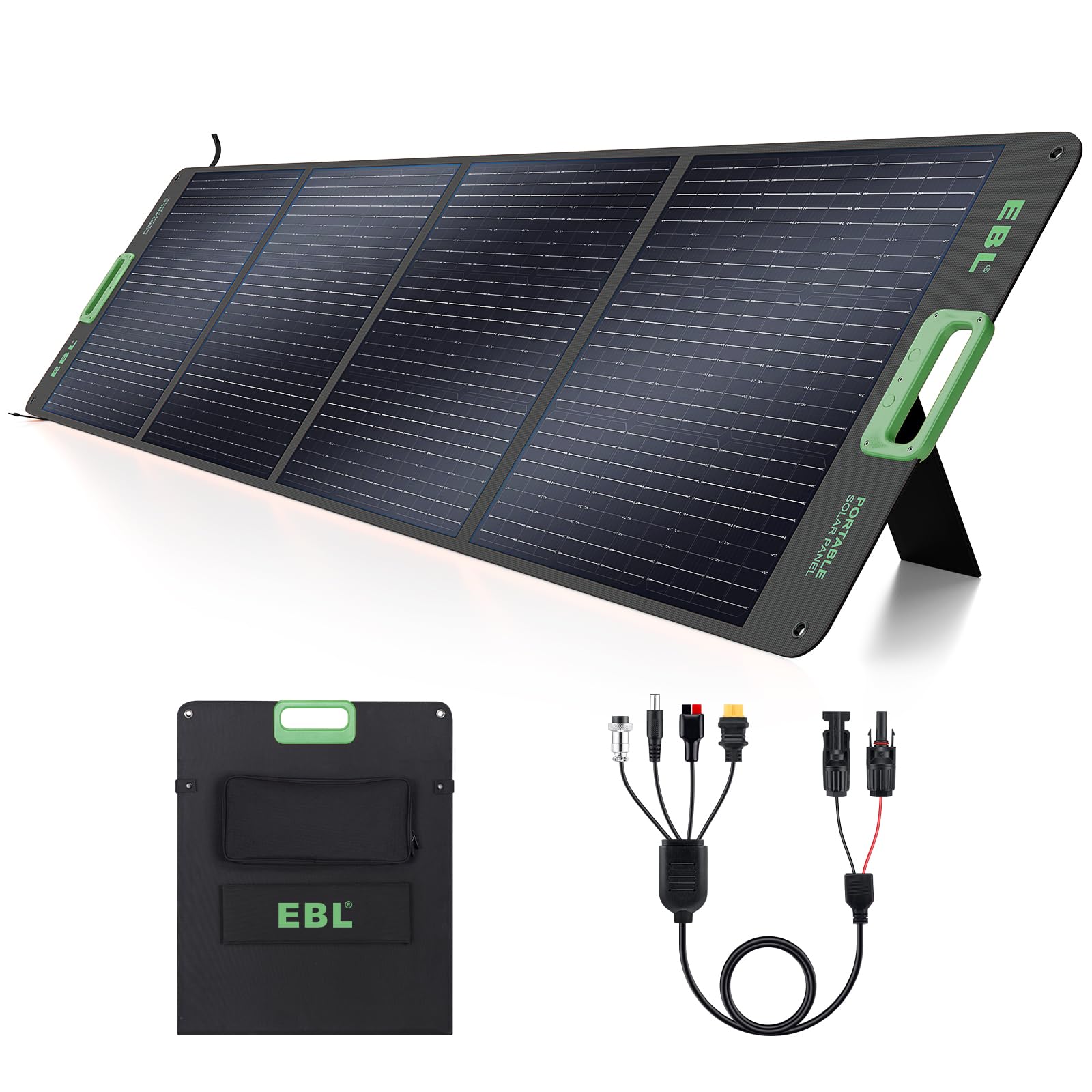
This is the panel you grab when there is no roof to bolt things to. It folds down to 25.31 x 20.87 x 2.17 inches and weighs just 18 pounds, so it slides into a trunk or camper’s storage pocket without fuss. The upgraded PET lamination over an 840D Oxford cloth outer gives you waterproof protection and wear resistance, making it a legit IP65-rated outdoor companion for sudden rain.
Compatibility is the hidden strength. It ships with an MC4-to-4-in-1 solar charge cable — covering XT60, Anderson, DC79*09mm, and Aviation connectors — so it plugs into nearly every power station from Grecell and BLUTTI to Anker and EF ECOFLOW. The monocrystalline cells hit up to 23.5% efficiency, well above the 17% typical polycrystalline rate, and the panel carries FCC, RoHS, and EMC certifications plus short-circuit and surge protection.
Real-world output is a mixed bag. One owner pulled 148 watts on a summer afternoon in Ohio and came back to buy a second unit, a solid 74% of the rating. Owners praise portability and build quality — one notes the cables and connectors store neatly in the back pocket — and the recurring gripe is that actual wattage trails the label. It is not the most efficient foldable here, but for station-and-camp flexibility, it is the best value portable.
Grab-and-Go Charging: The 4-in-1 cable kit means it works with almost any power station, and the 18 lb foldable build travels cleanly.
Match the Angle: Output varies wildly with sun angle — 148W in one test, 77W in another — so tilt it properly and expect less than the label.
6. BougeRV 200W N-Type 16BB Bifacial

The compact superstar that pulls near-rated watts even when the sky is grey.
The 16BB cell layout cuts covered area by 26% versus standard panels while keeping 25% efficiency. The 16BB cell design shrinks the covered area by 26% versus standard panels while maintaining 25% efficiency, which is a huge win for RV roofs where every square inch is fought over. The N-Type cells deliver an 80% bifacial gain — versus 70% for P-Type — and the transparent backside absorbs direct, refracted, and diffuse sunlight from both directions.
At 51.6 x 30.2 x 1.4 inches and 10.36 kg (about 22.8 pounds), it mounts easily with pre-drilled holes on the back, pairing with on-grid and off-grid inverters alike. The corrosion-resistant aluminum frame shrugs off the outdoor environment, and owners mention seriously real-world output: “Getting almost 200 watts on a cloudy day!” is a direct quote, with one owner pulling over 400 watts from a pair mounted due south.
The longevity story is strong. N-Type panels carry a 30-year service life per the manufacturer’s lab data, five years longer than P-Type panels, and BougeRV backs it with 10 years of product tech support. With a 4.6-star rating across a smaller pool of under 100 owners, the praise is concentrated on performance and power output — the two most-discussed aspects, both positive. It is the compact premium pick for anyone who wants maximum power from minimal roof real estate.
Small Footprint, Big Output: 26% less covered area than standard panels, yet customers note nearly 200W on cloudy days.
Thinner Track Record: With fewer owners on record, long-term performance data is lighter than the high-volume brands.
7. Renogy E.Flex 200W Portable
The featherweight that climbs into a backpack and still charges three devices at once.
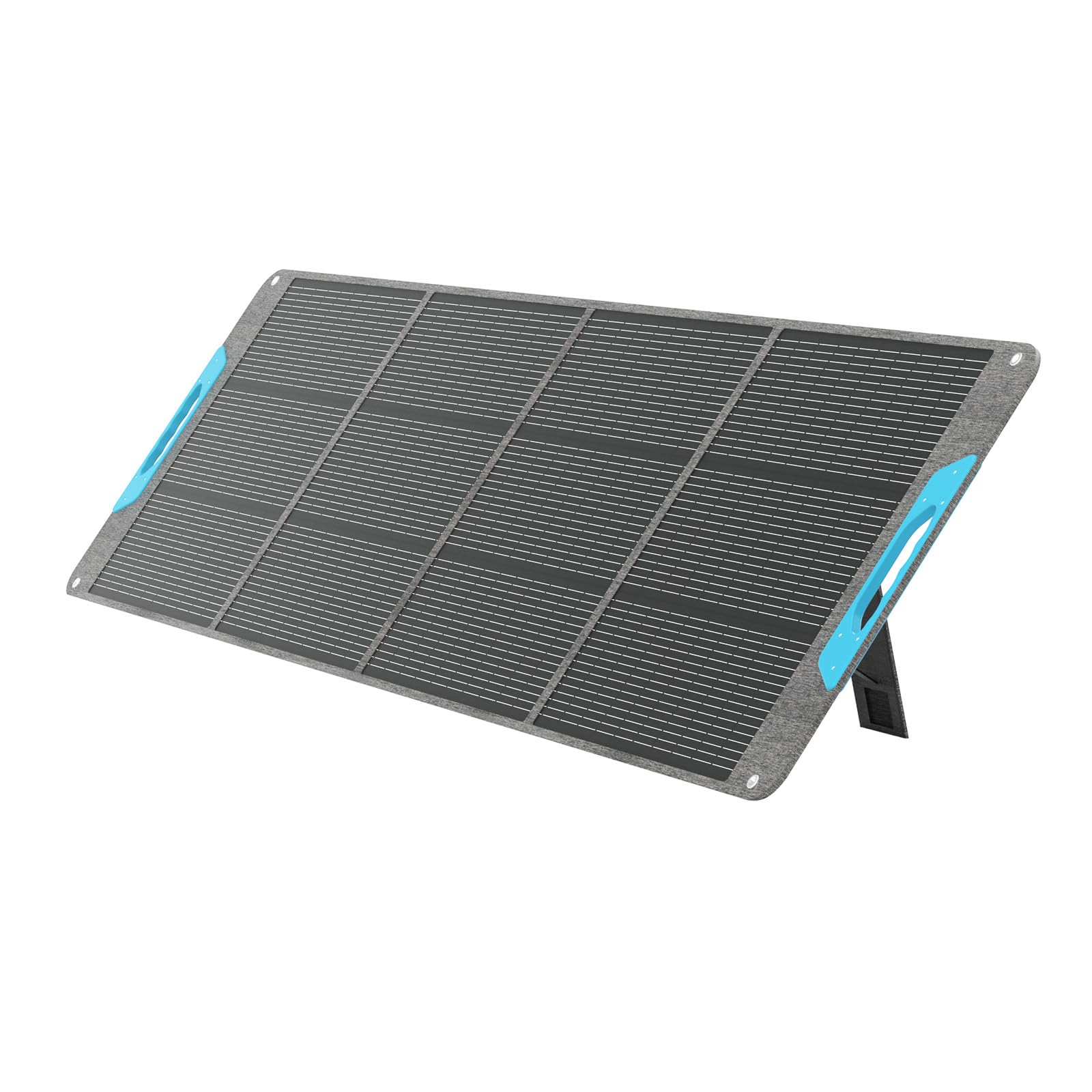
The standout number is 13.9 pounds — the lightest panel on this list by a wide margin, undercutting even the foldable EBL by over 4 pounds. It packs down to 23.72 x 22.99 x 1.97 inches with a unique magnetic closure instead of the usual snaps or Velcro, making setup and storage genuinely quick. This is the panel built for SUV campers, pickup bed campers, and 4×4 overlanders who count every ounce.
The 16BB N-Type cells hit 25% efficiency, outperforming standard 9BB panels at 22.5%. what separates it from rigid rivals is the USB flexibility: a USB-C PD port at 45W max and two USB-A ports at 18W and 15W let you charge a phone, tablet, and laptop directly off the panel without a power station in between. The MC4 output still connects to any portable power station or 12V battery system, including AGM, LiFePO4, and deep-cycle batteries.
Reviewers point out roughly 180-185W on good days, though the range stretches from 60W to 130W in less ideal conditions. One runs a 60W laptop and charges an Anker SOLIX C1000 simultaneously at 154W flat, and another reports 90% efficiency on hot days and near 100% in cold. The four adjustable kickstands with three angles (40°/50°/60°) keep it stable in wind, and the IP65 rating shrugs off dust and splashes. It is UL 61730 certified, along with CE, RoHS, FCC, CA65, and PSE compliance — the most safety-certified panel on this list. Quality is the most-praised aspect here, with over 120 owners citing it.
Why It Earns the Pack Space
- Lightest in class at 13.9 lb, packs to 1.97″ thick
- Built-in USB-C PD and dual USB-A for direct device charging
- UL 61730 certified plus full CE/RoHS/FCC compliance
The Honest Limits
- Output varies widely — 60W to 185W depending on conditions
- Some owners find the carry case less durable than the panel
Grab it for: Campers who want one panel that charges both a power station and their devices directly, without the weight penalty.
Give it a miss for: Permanent roof installs where a rigid 24 lb panel offers more rugged, storm-proof mounting.
8. RICH SOLAR 200W N-Type 18BB

The storm-tested array panel that survived 95 mph winds without a scratch.
The 1.3mm anodized aluminum frame and tempered glass survived a 95+ mph storm with hail. One owner’s roof-mounted panels survived a 95+ mph storm with hail — the windshield was smashed but the panels emerged unscathed. That track record comes from a heavy-duty 1.3mm anodized aluminum frame and tempered glass with anti-reflective coating, built to handle wind, snow, and harsh weather for decades. It generates 10.9 amps, the second-highest amperage on this list behind the Newpowa, charging 12V batteries fast.
At 58.7 x 26.8 x 1.2 inches and 24 pounds, this is the longest panel here, tune for permanent arrays rather than tight van roofs. The 14 pre-drilled holes work with standard Z-brackets, ground mounts, side pole mounts, and tilt mounts, so it adapts to almost any mounting scenario. The advanced N-Type cells deliver low LID — light-induced degradation — and stable output in heat, clouds, and early mornings.
Owners run full 1000W-plus arrays on their RVs, powering electronics, TV, lights, a fridge, and even Starlink reliably. This is the panel that keeps off-grid lawn equipment charged through outages. Quality is the most-praised aspect with over 50 owners citing it, and the charging speed is a highlight — most shoppers say a full charge in 2-3 hours. Power output is mixed: some report total array output exceeding 920W, while one owner saw just 70W in full sun, a variance note for expectation-setting. The 25-year power-output warranty and 5-year material warranty back the long-term claim.
Storm-Proof Workhorse: The 1.3mm anodized aluminum frame and anti-reflective glass survived a 95+ mph storm that broke a windshield.
Play the Angles: Output varies between owners — over 920W arrays from some, just 70W from others — so tilt and position matter here more than most.
9. Renogy ShadowFlux 200W N-Type
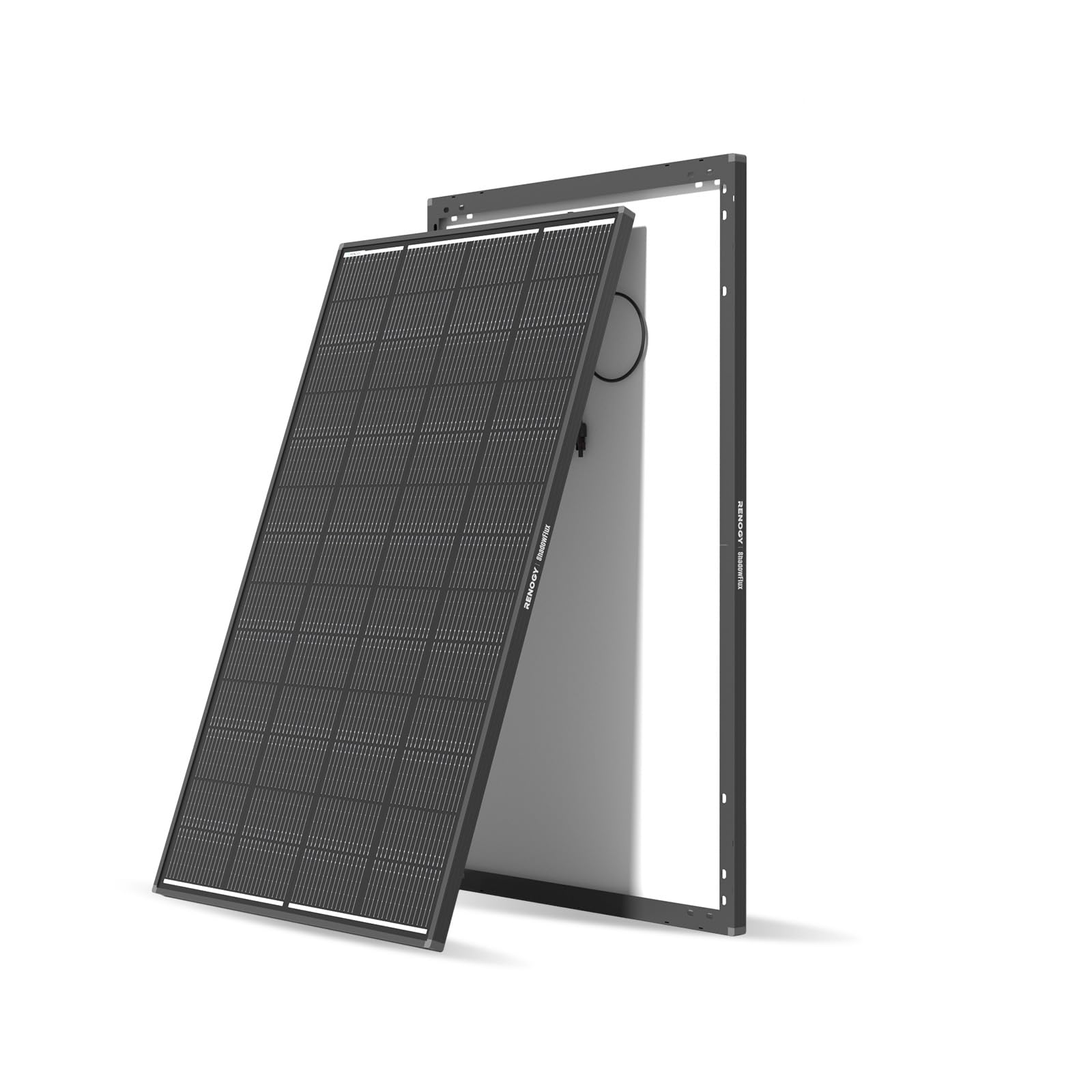
The shadow-busting panel that keeps pulling 600W on completely overcast days.
The ShadowFlux anti-shading tech keeps power flowing when buildings, plants, or stains cast shade. It is built specifically for shaded areas caused by buildings, plants, or stains, keeping power flowing when a tree branch crosses the panel. A direct owner quote sums it up: “even on cloudy days, and I mean completely overcast, I’ve seen them draw upwards of 600W.” The 16BB N-Type cells at 25% efficiency reduce hot spots and micro-cracks, and the built-in bypass diodes prevent shade on one section from killing the whole panel.
At 49.69 x 30.08 x 1.18 inches and 23.8 pounds, it is 7% smaller and 10% more compact than PERC panels — a meaningful space saving for RV roofs. The IP67 rating handles snow, rain, and small hail, with advanced encapsulation boosting water vapor resistance. Owners on boats report 800Wh on overcast days and up to 1200Wh in full sun paired with a Victron MPPT controller, and there is one standout story of 28 bypass diodes and a 36.5V open circuit voltage for exceptional shade resilience.
The most-praised aspect is quality, with over 65 owners citing it, and functionality is the second-most-discussed strength — one owner runs six panels across a 1300W peak, cutting through shade with ease. Value for money gets mixed reviews, and some owners find compatibility with certain controllers less straightforward. The 5-year output and workmanship warranty plus a 25-year output guarantee at 80% makes the longevity claim concrete. For shaded roofs, cloudy climates, or boats with masts casting shadows, this is the panel that refuses to quit.
Overcast Specialist: Anti-shading tech and bypass diodes deliver 600W on fully overcast days — the best low-light story on this list.
Setup Sensitivity: Compatibility with controllers needs attention, and value perceptions vary between owners.
Understanding the Specs
Efficiency and Cell Type
Efficiency measures how much sunlight becomes electricity. A 25% panel produces more power per square foot than a 17% polycrystalline panel, so you need less roof space. N-Type cells with 16 or 18 busbars — the fine metal lines collecting current — resist degradation and handle partial shade better than older 5 or 9 busbar P-Type designs.
Bifacial Gain and Shade Tolerance
A bifacial panel has a transparent back, capturing reflected light from below to add up to 30% more output. Panels split into two independent halves — like the Callsun TwinCell — keep one side working when the other is shaded. Bypass diodes prevent a single shadow from collapsing the entire panel’s output.
Durability and Waterproofing
Wind and snow loads measure structural strength: 2400Pa of wind and 5400Pa of snow are the gold standard for rigid panels. The IP rating on the junction box and connectors tells you waterproofing — IP65 resists water jets, IP67 adds full dust protection and submersion resistance, and IP68 handles continuous immersion.
Output and Amperage
Real-world output trails the label, often landing at 80-90% of rated watts. Amperage — measured in amps — determines how fast you charge a battery bank. Higher amperage like 10.9A charges 12V batteries faster than 8.43A, but voltage and sun angle matter just as much for total daily energy.
FAQ
Will a 200W panel actually deliver 200 watts in real use?
What is the difference between bifacial and monofacial panels?
How many busbars should a good 200W panel have?
Can I mount two panels in series or parallel?
How long does a 200W solar panel last?
What does the IP rating on a solar panel mean?
How well do these panels handle cloudy or overcast days?
Can I plug a portable 200W panel directly into a power station?
How much weight does a 200W panel add to my roof?
Does panel angle really change output that much?
Final Thoughts: The Verdict
Across the board, the 12v 200w solar panel winner is the Newpowa 200W because it pairs a proven six-year track record with the highest amperage on the list and the strongest owner loyalty — a crowd of 700+ with decades of combined rooftop miles behind the brand. If you want a portable panel that charges both a station and your laptop directly, grab the Renogy E.Flex, the lightest in class at 13.9 pounds. And for a shady roof or cloudy climate where every photon counts, the Renogy ShadowFlux is the one to reach for — its anti-shading tech keeps 600W flowing even on completely overcast days, making it the single most shade-resilient panel on this list.
How We Picked
We do not accept paid placement. Every pick is matched to a real buyer and a real use-case; we do not hands-on test units.
Sources & Methodology
Specifications: manufacturer listings and product documentation. Review insights: verified customer reviews, as of August 2026. Pricing: not shown on this page (it changes often); check the current price via the retailer link.
As an Amazon Associate, Gadgets Feed earns from qualifying purchases. This does not affect which products we feature.