
Our readers keep the lights on and my morning glass full of iced black tea. As an Amazon Associate, I earn from qualifying purchases.
Specs are compiled from manufacturer listings and verified buyer reviews and can change over time — please confirm the key details on the product page before buying.
Keeping your motorhome cool on a summer night without a noisy generator or shore power is a real challenge. A standard 110-volt household air conditioner drains your battery fast and needs an inverter. A 12-volt rooftop unit solves that because it runs directly off your house battery bank. You get cool, quiet sleep at a remote campsite or truck stop without plugging anything in. The trick is picking a unit whose power draw and cooling capacity match your rig’s size and battery system — get it wrong, and you face a sweaty night or a dead battery by dawn.
I am Min, founder and writer at Gadgets Feed. This guide compares the manufacturers’ published specifications and patterns from verified customer reviews. You will see each pick’s real strengths and trade-offs, not marketing claims.
Below are three solid options for a 12v air conditioner for motorhome. They are ranked from the versatile all-rounder with a built-in heater to the lightweight specialist for tight installs, with every key spec laid out side by side.
Quick Picks
- 10000 BTU 12V DC RV Air Conditioner with Heater — Best Overall
- Outequip RV Air Conditioner, 12V — Compact Pick
- Outequip RV Air Conditioner, 12V 10000 — Premium Pick
How To Choose The Best 12V Air Conditioner For Motorhome
The motorhome AC market splits between heavy 110V rooftop units that need shore power or a loud inverter generator, and newer 12V DC models that draw power from your house battery. Choosing the right one means matching three things: your roof cutout size, your battery capacity, and how you use the rig — boondocking full-time or occasional weekend trips.
Battery Bank and Power Draw — The Real Runtime Equation
These 12V units advertise a broad runtime range, but the real number depends on your battery’s usable amp-hours (Ah). A 10,000 BTU (British Thermal Units — the amount of heat the AC removes per hour) unit draws roughly 350W to 960W depending on the fan speed and outside temperature. At the average test condition of 350W at night, a 360Ah lithium battery delivers about six to seven hours on max cooling. If you plan to run the AC all night without a generator, aim for at least 400Ah of lithium capacity on your battery bank.
Roof Thickness and Cutout Compatibility
Most motorhomes use a standard 14-inch by 14-inch roof cutout, but roof thickness varies widely — from thin van roofs at 1.5 inches to thick motorhome roofs up to 6 inches. Before buying, measure your roof thickness and confirm the unit’s included mounting bolts are long enough. Some units ship with bolts that only reach 3.5 inches, so a thicker roof means you will need to buy longer 8mm all-thread rod yourself.
Heater vs. Cool-Only — Do You Need the Heat Pump?
Several 12V AC units include a built-in heater element (often PTC — a Positive Temperature Coefficient ceramic heater that warms up fast). The 4,500 BTU PTC heater is useful for taking the chill off a mild night (around 40-50°F), but it is NOT a primary heat source for freezing weather. If you camp in cold climates, you need a separate propane or diesel heater anyway. For three-season campers who just want to knock the edge off a cool evening, the heater version is worth the small price difference.
Noise Level — Sleep Mode vs. Turbo Fan
An AC that sounds like a jet engine at 2 AM defeats the point of a quiet campsite. Look for a rated noise level around 40 dB in sleep mode — that is roughly the sound of a quiet library or a refrigerator’s hum. The brushless fan motors in these units are inherently quieter than traditional shaded-pole motors, but the fan speed setting still makes a big difference. Turbo mode cools fast but is noticeably louder, so use it to knock the heat down before bed, then switch to sleep mode for the night.
Quick Comparison
| Model | Best For | BTU | Avg Wattage | Weight | Amazon |
|---|---|---|---|---|---|
| 10000 BTU 12V DC RV AC (Gidrox) | All-season comfort with heater | 10000 BTU | ~350W (night) | 54 lbs | Amazon |
| Outequip RV Air Conditioner (cool-only) | Lightweight install on thin roofs | 10000 BTU | 960W | 43 lbs | Amazon |
| Outequip RV AC with Heater | Off-grid with hybrid heat pump | 10000 BTU | 960W | ~47 lbs | Amazon |
In-Depth Reviews
1. 10000 BTU 12V DC RV Air Conditioner with Heater (Gidrox)
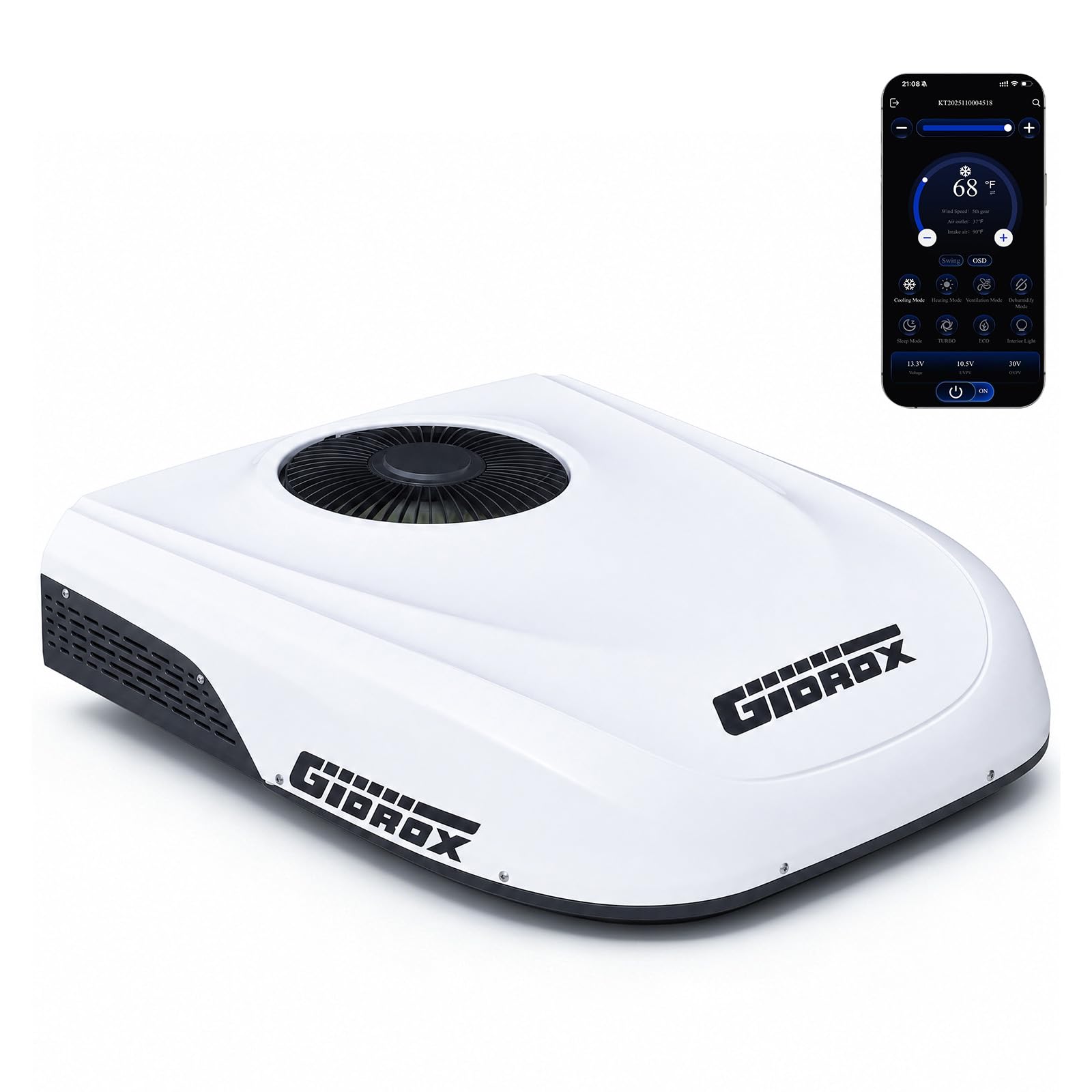
The one AC that heats, cools, and sips power quietly enough for an all-night boondock session.
This is the most versatile pick because it includes a PTC heater (a ceramic heating element that warms up fast) alongside the 10,000 BTU cooling system. Buyers report the tested average power consumption is only about 350W during nighttime operation in 30°C ambient, which . That low draw means you can run it overnight on a 400Ah lithium battery without waking up to a dead bank.
At 54 lbs, this unit is the heaviest of the three, but still light enough for a single person to wrestle onto the roof with a helper. It fits the standard 14 by 14-inch roof cutout and includes a 19.7-foot power cable and a fuse on the battery end, which one reviewer praised as a clear safety touch. The noise level drops to 40 dB in Sleep mode — quieter than many RV roof fans — and you get three control options: the touch panel on the unit, an infrared remote, and a smartphone app that works over Bluetooth even without internet.
The main catch, as some buyers discovered, is the included 8mm threaded rods are too short for thicker roofs beyond 3.5 inches. Several owners with 5th wheels or thick motorhome roofs had to buy longer 8mm all-thread rod and cut it themselves. One reviewer with a 6-inch thick roof built a plenum to bridge the gap. If your roof is less than 3.5 inches, this is the most complete package from the start — cooling, heating, quiet operation, and app control in one unit.
Why It Leads the Pack
- PTC heater handles mild cold nights (4,500 BTU) so you do not need a separate unit for shoulder-season camping
- Lowest measured night-time draw at ~350W, giving you 6-7+ hours on a 400Ah bank
- Bluetooth app control works without cellular signal — ideal for remote boondocking
Install Hiccup
- Supplied bolts max out at 3.5-inch roof thickness — thicker roofs need longer hardware
- Owners mention the remote control can be finicky; the phone app is a more reliable fallback
The all-season choice: Go for this pick if you want cooling, heating, and low power draw in one rooftop package and your roof is no thicker than 3.5 inches.
Check your roof first: If your motorhome has a roof over 3.5 inches thick, budget extra time and a trip to the hardware store for longer mounting bolts before you start the install.
2. Outequip RV Air Conditioner, 12V 10000 BTU (Cool-Only)
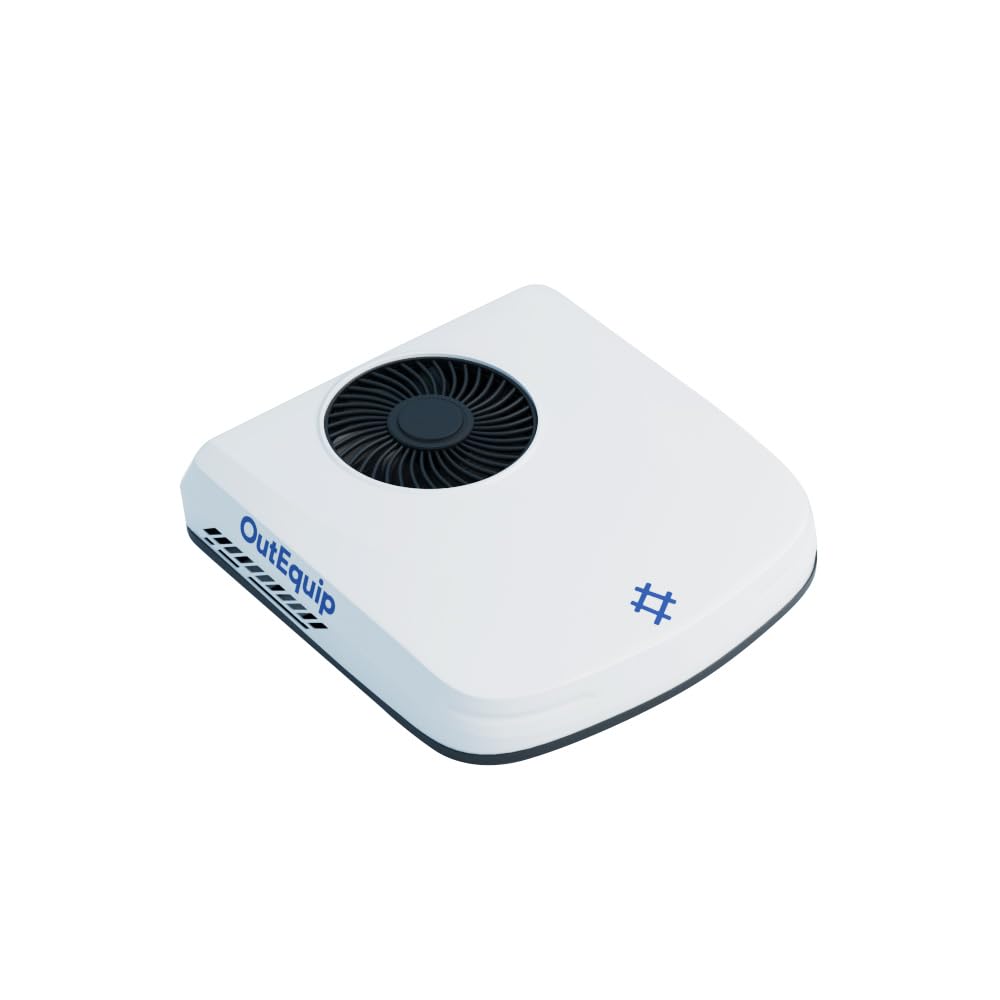
The featherweight that a single person can install without breaking a sweat.
At only 43 lbs, this is the lightest unit here , which itself is lighter than a typical 90-lb Coleman Mach 110V unit. That weight difference is a real factor if you are installing solo on a van or small motorhome. One reviewer with a VW Westfalia bus installed it alone and reported the unit draws surprisingly low power on eco mode while getting very cold.
The cooling performance is rated at 10,000 BTU (British Thermal Units — the heat removed per hour), which means it chills a motorhome interior in about 15 minutes, according to the manufacturer. Buyers confirm this: a user with a 360Ah lithium battery reports getting around 6 to 7 hours on max cooling. The unit runs directly off 12V DC with no inverter needed, and it comes with 15 feet of 6 AWG (American Wire Gauge — a thick wire for low voltage) cable and a 100-amp fuse included. The noise level is notably low — reviewers who swapped out old Coleman Mach 10Q units say this is “crazy quiet,” even on high fan speed.
The trade-off is that this version has no built-in heater at all. If you camp in mild climates where you only need cooling, the weight savings and simpler install make this a smart choice. But unlike the Gidrox that handles both seasons, you will need a separate heat source for any chilly night. The unit also has a 1-ton capacity spec, so it is best suited to smaller to mid-size rigs, not 40-foot diesel pushers.
Where It Wins
- Weighs just 43 lbs — easiest solo rooftop install of the three picks
- Buyers praise the quiet operation: one called it “crazy quiet, even on high”
- Comes with 15 ft of 6 AWG cable and a 100-amp fuse for a clean install
The Cold Truth
- No heater at all — useless for any night below about 50°F
- Rated at 960 watts annual energy consumption, which is higher than the Gidrox’s tested 350W night-time average
Best for warm-weather boondockers: Choose this if you only need cooling, have a thin roof, and want the lightest unit to install yourself without help.
Look elsewhere if: You ever camp in cold weather or your motorhome has a thick roof over 3.5 inches where bolt length could be tight.
3. Outequip RV Air Conditioner, 12V 10000 BTU (with Heater)
A low-profile unit that uses an inverter-driven compressor to keep power draw efficient for a 500-watt solar array.
This is the same compact 12V platform as the cool-only Outequip above, but with a 4,500 BTU PTC heater added for mild cold nights. Customers note this keeps power draw efficient so they can run it straight off their battery system. One reviewer paired it with a 500-watt solar array and called the heat pump clutch for mild cold nights.
The cooling system delivers 10,000 BTU (British Thermal Units — the heat removed per hour), matching the cool-only version’s 15-minute cool-down claim, according to the manufacturer. It also has a Seasonal Energy Efficiency Ratio (SEER — a measure of cooling efficiency over a season) rating of 15, which is respectable for a rooftop RV unit. At 6.3 inches tall, it is a low-profile design that leaves room for solar panels on the roof. The noise level is rated at 40 decibels, the same as the Gidrox in sleep mode, using brushless copper motor fans and spring-supported mounts to dampen vibration.
However, the manufacturer is clear that the 4,500 BTU heater is supplementary — it is not suitable as a primary heat source in extreme cold or very large spaces. So if you camp in freezing conditions, you still need a separate furnace. This makes the cool-only Outequip slightly simpler for pure summer use. The customer service gets high marks: one buyer who ordered the wrong voltage received a free replacement and free return shipping.
Smart Heat Pump Addition
- Heat pump extends your shoulder-season camping without a separate heater
- Low 6.3-inch profile leaves roof space for solar panels
- Rated noise at 40 dB — brushless fans and spring mounts keep it quiet
Heater Limits
- 4,500 BTU PTC heater is not enough for below-freezing temps
- No inverter on the cooling side, so compressor is fixed-speed
Best for solar-equipped off-grid rigs: Go with this if you already have a solid battery bank and solar array and want the extra warmth of a heat pump for cool nights without relying on propane.
skip it if: You camp in genuine winter weather (below 30°F) where you need a proper furnace — the PTC heater is just a supplement, not a primary heat source.
Understanding the Specs
BTU (British Thermal Units) — Cooling Capacity
This number tells you how much heat the AC can remove from the air in one hour. For motorhomes, 10,000 BTU is the balance for rigs up to about 25 feet — enough to cool down a space in roughly 15 minutes without overloading your battery. A higher BTU number cools faster but also draws more power, so matching BTU to your rig’s size is more important than chasing the biggest number.
Wattage and Amp-Hour Draw — How Much Battery You Need
Wattage (W) is the rate of power consumption at any moment, while amp-hours (Ah) is the total energy stored in your battery. A 12V unit drawing 350W is pulling about 29 amps from a 12V battery. To run it for 6 hours, you need 174 Ah of usable capacity — meaning a 200Ah lithium battery (which can be safely discharged to 80-90%) is the minimum. The good news is the inverter and heat pump models adjust their draw based on the temperature, so actual runtime varies with the weather.
FAQ
Will a 12V AC unit fit my existing motorhome roof cutout?
How many amp-hours of battery do I need to run one of these overnight?
Can I install a 12V rooftop AC myself, or should I hire someone?
Does the built-in PTC heater replace my propane furnace?
Will I need longer bolts for a thick motorhome roof?
How loud is a 12V RV air conditioner in sleep mode?
Do these units work with solar panels on the roof?
What does “no inverter needed” mean for a 12V AC?
Can I control these AC units with my phone?
How long does the cooling take to feel cold?
Final Thoughts: The Verdict
For most motorhome owners, the best 12v air conditioner for motorhome is the Gidrox 10000 BTU unit with heater because it combines the lowest real-world night-time power draw, a PTC heater for mild cold nights, and three ways to control it (panel, remote, phone). If your roof is thin and you only need summer cooling, the lighter Outequip cool-only unit is the easiest solo install. And if you run a solar-charged battery bank and want a heat pump for the shoulder seasons, the Outequip with heater gives you the most efficient off-grid setup.
How We Picked
We do not accept paid placement. Every pick is matched to a real buyer and a real use-case; we do not hands-on test units.
Sources & Methodology
Specifications: manufacturer listings and product documentation. Review insights: verified customer reviews, as of July 2026. Pricing: not shown on this page (it changes often); check the current price via the retailer link.
As an Amazon Associate, Gadgets Feed earns from qualifying purchases. This does not affect which products we feature.