
Our readers keep the lights on and my morning glass full of iced black tea. As an Amazon Associate, I earn from qualifying purchases.
Specs are compiled from manufacturer listings and verified buyer reviews and can change over time — please confirm the key details on the product page before buying.
The biggest mistake is grabbing the cheapest 12V charger and expecting it to rescue a dead battery quickly. A 1-amp maintainer needs about 10 hours to top off a battery, while a 20-amp unit finishes in a fraction of that time. This guide matches your setup — daily driver, seasonal motorcycle, or RV lithium bank — to the right amperage and technology.
I’m Min — the founder and writer behind Gadgets Feed. This guide is built by comparing the manufacturers’ published specifications and the patterns across verified customer reviews, so you get each pick’s real strengths and trade-offs instead of marketing spin.
The chargers here range from a budget-friendly trickle unit to a premium shop-grade workhorse that handles multiple battery types and sizes. Sp
12v battery charger showdown hinges on amperage and chemistry—so here’s how they compare.
Our Picks at a Glance


How To Choose The Best 12V Battery Charger
You need a charger that matches your battery’s size and your schedule. A small maintainer that barely sips power won’t rescue a deeply drained car battery, and a heavy multi-amp unit is overkill for keeping a lawn mower battery topped off all season.
Match the Amperage to the Battery
A 20-amp output means faster top-ups but demands the battery can take that abuse. Larger deep-cycle units like 100Ah batteries are built for it and can pull a hefty 20A feed without complaint. Small 12V batteries — like those in motorcycles or lawn equipment — prefer a gentler 1-amp trickle so thin internal plates don’t overheat, and that low current is also what keeps them healthy through months of storage.
Check the Battery Chemistry First
Lead-acid and lithium (LiFePO4) batteries need different charge voltages. Lead-acid typically peaks near 14.7V, while LiFePO4 floats around a more delicate 14.6V; using the wrong one risks an incomplete charge or a shorter life. If you run both types across your garage, buy a charger that features a dedicated lithium mode instead of juggling two separate units.
Look for the Safety and Smart Features that Actually Matter
Spark-proof clamps and reverse-polarity protection catch the most common user mistakes before they cause sparks or damage. A smart maintainer with multi-stage logic will automatically stop once your battery hits full, then hover in a float mode to prevent overcharging — so you can leave it plugged in all winter without checking on it daily.
Quick Comparison
| Model | Best For | Amperage | Chemistry Support | Charge Time | Amazon |
|---|---|---|---|---|---|
| LiTime 12V 20A★ Best Overall | Fast RV & solar lithium banks | 20 A | LiFePO4 | 5 hours | Amazon |
| NOCO GENIUS1Best Value | Long-term winter maintenance | 1 A | Lead-acid & Lithium | 10 hours | Amazon |
| ECO-WORTHY 12V 5ASmart 5A | RVs and generators on a budget | 5 A | Lead-acid & LiFePO4 | 2 hours | Amazon |
| CTEK US 0.8 | Motorcycles & classic car care | 0.8 A | Lead-acid | — | Amazon |
| HTRC 0-20A | Versatile 12V/24V garage workhorse | 20 A | Multi-chemistry | — | Amazon |
| CRAFTSMAN 12A | Bringing dead car batteries back | 12 A | Multi-chemistry | — | Amazon |
| NEXPEAK 4-Pack | Maintaining a whole fleet winter | 1.75 A | Lead-acid | — | Amazon |
| NOCO GENIUS5 | Reviving neglected batteries | 5 A | Lead-acid & Lithium | 8 hours | Amazon |
| Battery Tender 15A | Heavy-duty dual-battery rigs | 15 A | Multi-chemistry | — | Amazon |
In‑Depth Reviews
1. LiTime 12V 20A Lithium Battery Charger
Our pick — over 4.5★ from 950+ verified ratings; the strongest balance of quality and price.
The fastest lithium lifeline for off-grid solar and RV power banks.
If you run a serious lithium bank in an RV, off-grid cabin, or solar rig, this is the charger that gets you back online in under an hour from a partial drain. It feeds up to 20A into 12.8V LiFePO4 batteries — the chemistry behind most modern deep-cycle setups. Buyers report a 100Ah LiFePO4 bank refilling from empty in about 5 hours, while 135Ah units take roughly 7.
Crucially, it handles the failure mode that kills other lithium chargers: a battery whose internal protection circuit (the BMS, or battery management system — the board that guards against damage) has shut down. The 14.6V output and 0V activation mode wake up such deeply discharged batteries safely, so a bank that seems permanently dead can be brought back to life. The aluminum housing with a cooling fan keeps the internals from overheating during those long high-amp sessions.
In terms of physical footprint, the 8.13″D x 3.56″W x 2.5″H unit is roughly double the size of a wall-plug maintainer, and the Anderson 50A-style connectors give you a solid, heavy-duty link to your battery bank.
The crowd favorite: sheer durability and quality lead the owner chatter, with reviewers emphasizing the heavy-duty connections and the “click” of a secure hookup.
The honest caveat: that cooling fan is audible — not annoying, but present — during high-output charging. And it is not waterproof, so it doesn’t belong on a boat deck.
Reach for it if: you manage lithium batteries over 100Ah and want fast charge times plus protection upgrades to keep them alive for years.
Look elsewhere if: you only need to maintain a small lead-acid car battery — the 20A output is more power than it needs.
2. NOCO GENIUS1 1A Smart Charger
The always-on guardian that keeps your battery alive through brutal winters.
This is the classic leave-it-plugged-in-everything solution. A 1-amp output trickle is slow — it takes about 10 hours to charge a battery from empty, versus the LiTime’s 5 hours on a 100Ah bank — but speed is not the point. The GENIUS1 is a maintainer first, a charger second. It constantly monitors your battery, and its smart logic keeps a top-up voltage flowing without ever pushing into overcharge territory.
The defining feature is its cold-weather resilience. Owners say it held a generator battery at full charge through -25°F outages and daily storms, with the engine starting instantly. It can even recover a battery drained as low as 1 volt, using a Force Mode for completely dead units.
Weighing just 15.2 ounces and measuring 4.02″D x 3.43″W x 6.73″H, it stows easily anywhere, and the battery clamps plus integrated eyelet terminals cover most hookup scenarios. It handles both 6V and 12V lead-acid (AGM, Gel, SLA) and lithium (LiFePO4).
Why Owners Rely On It
- Constantly monitors battery, preventing overcharge damage on long connects.
- A thermal sensor adjusts charging in hot and cold weather.
- Recovers batteries drained to 1 volt, with a Force Mode for totally dead.
The Paybacks
- At 1 amp it is painfully slow for a truly dead car battery.
- Not weatherproof — keep it out of the rain.
Pick this for: seasonal vehicles, generators, and lawn equipment that need a charge held from fall to spring.
Think twice if: you are trying to revive a dead daily driver within the hour.
3. ECO-WORTHY 12V 5A Charger
The feature-packed pulse maintainer that handles both lead-acid and LiFePO4.
The mid-range 5A output is the jack-of-all-trades. This smart unit runs its own bulk, absorption, and float stages to prevent overcharging — a no-brainer for RV owners who need a maintenance top-up between trips. Its 2-hour charge time is a healthy mid-point for a drained 20Ah battery and honestly decent for its class.
You can use it on both 12V lead-acid and 12V lithium (LiFePO4) batteries. If it detects low voltage, it prompts you to repair a sulfated battery (a crusty lead-sulfate buildup that forms when a battery sits unused too long and robs it of capacity) or tells you the battery’s beyond help.
A 10A fuse protects the included SAE connector and battery clips, and the 0.45 kg weight keeps it light enough to mount near your battery bank.
What wins people over: reliability is the standout here — owners appreciate that it recharges an RV battery correctly and the smart LCD display showing voltage and charging rate.
The one caution: the unit runs warm during the bulk charging phase, so give it clearance and airflow.
Best suited to: RV, generator, and boat owners who want a genuine smart maintainer without premium pricing.
Who might skip it: anyone looking for a high-amp rapid charge on a large 100Ah+ battery.
4. CTEK US 0.8 Charger

The ultra-gentle 6-step specialist that treats small motorcycle batteries like precious cargo.
CTEK’s reputation runs deep among serious owners — the recurring owner line is that these units are so reliable they end up owning multiple. The US 0.8 steps in with 0.8A of current designed for powering 1.2Ah to 32Ah lead-acid batteries, which squarely covers motorcycles, jet skis, ATVs, and lawnmowers. It can also maintain a much larger classic car battery — up to 100Ah — on float.
Its 6-step program doesn’t just dump juice; it runs a patented desulphation function to recover weak batteries, then transitions to a slow float stage at 13.2V to hold charge without cooking the battery. A splash and dustproof case with reverse-polarity protection and short-circuit proofing rounds out the safety story.
The one thing to know about the 0.8A rating is it is not designed for jump-starting a dead SUV. It is for precision maintenance on smaller machines, not rescue charges.
The CTEK Difference
- Patented desulphation recovers lost battery life.
- Splash and dustproof design with non-sparking clamps.
- Protects sensitive vehicle electronics from surges on the clean DC output.
Know The Limits
- Won’t charge a truly dead battery below about 2.25V — keep it on maintenance duty.
- A 32Ah limit means large batteries need a different unit.
For the garage: this is the one to wire into a motorcycle or classic car and leave connected all winter.
Not for: big diesel trucks or deep-cycle banks that need real amperage.
5. HTRC Car Battery Charger 20A
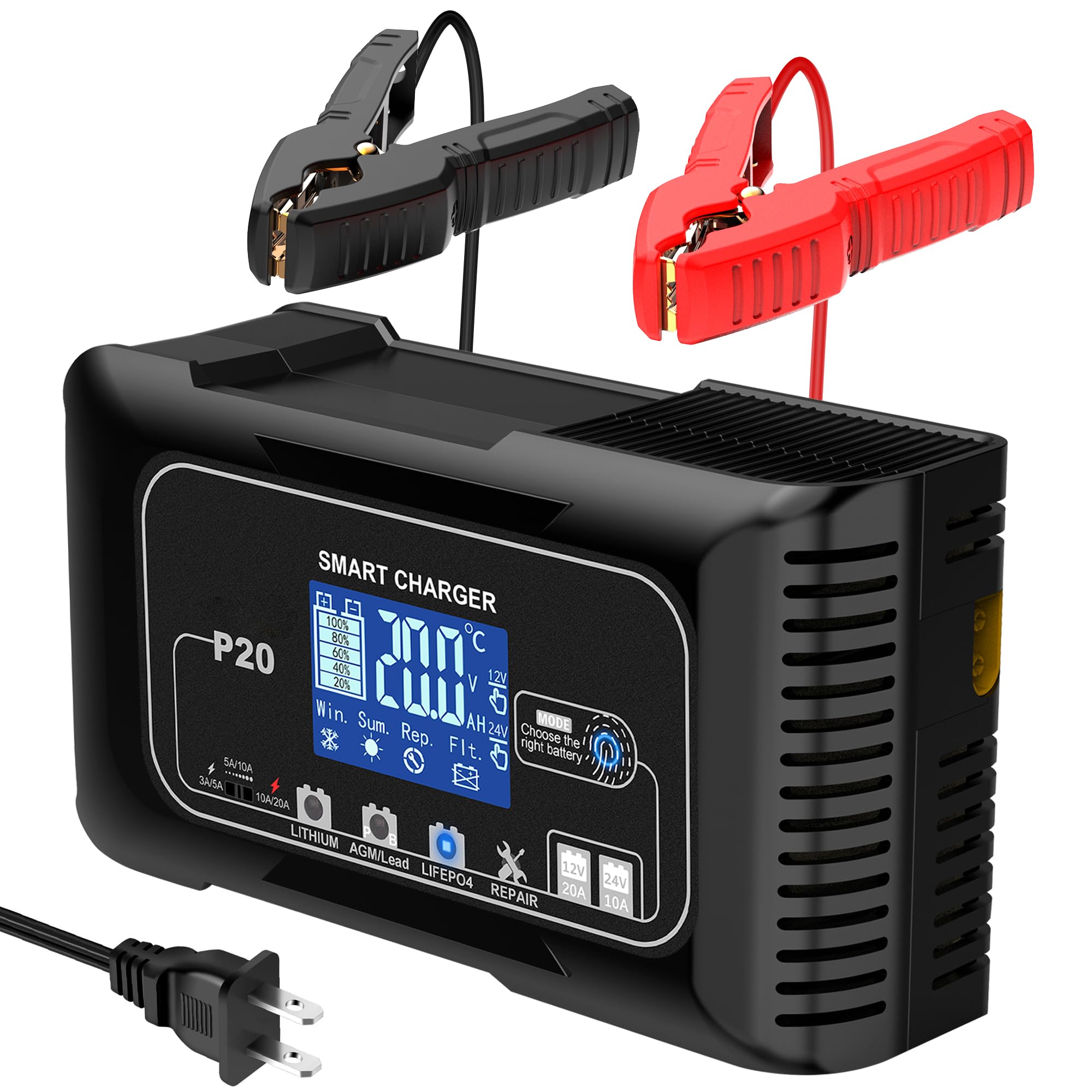
The one-button garage workhorse that auto-detects 12V or 24V systems.
This unit brings genuine versatility to a multi-vehicle household. The smart 9-stage charging logic runs battery detection, desulfurization, and trickle modes automatically, plus a dedicated repair mode for reviving old, weak batteries. It is not just a 12V-only box — it can also handle 24V systems, making it a fit if you have a truck or boat running a 24V setup. Owners mention it works on kids’ 12V LiFePO4 power wheel batteries, further broadening its reach.
The adjustable current output lets you switch between mild maintenance and rapid charging: 12V offers 5A, 10A, or 20A outputs, and 24V steps down to 3A, 5A, or 10A. An LCD screen shows voltage, current, and temperature. Auto summer and winter modes adapt the charge to ambient conditions to keep a battery healthy year-round.
After 10 seconds of charging, the mode locks to prevent accidental touches, and seven layers of protection (including spark and reverse polarity safeguards) back it up.
The standout: true dual-voltage capability and up to 20A of adjustable current in a compact 3.5″D x 6.1″W x 1.9″H frame.
The fair trade-off: it won’t activate a completely zero-voltage battery — a repair function for old batteries isn’t a resurrection miracle worker.
Who it fits: a multi-battery garage where one charger covering cars, motorcycles, and 24V rigs saves money and shelf space.
Who it does not fit: those wanting a set-and-forget unit with zero menu reading; it has modes to select.
6. CRAFTSMAN 12A Charger & Maintainer
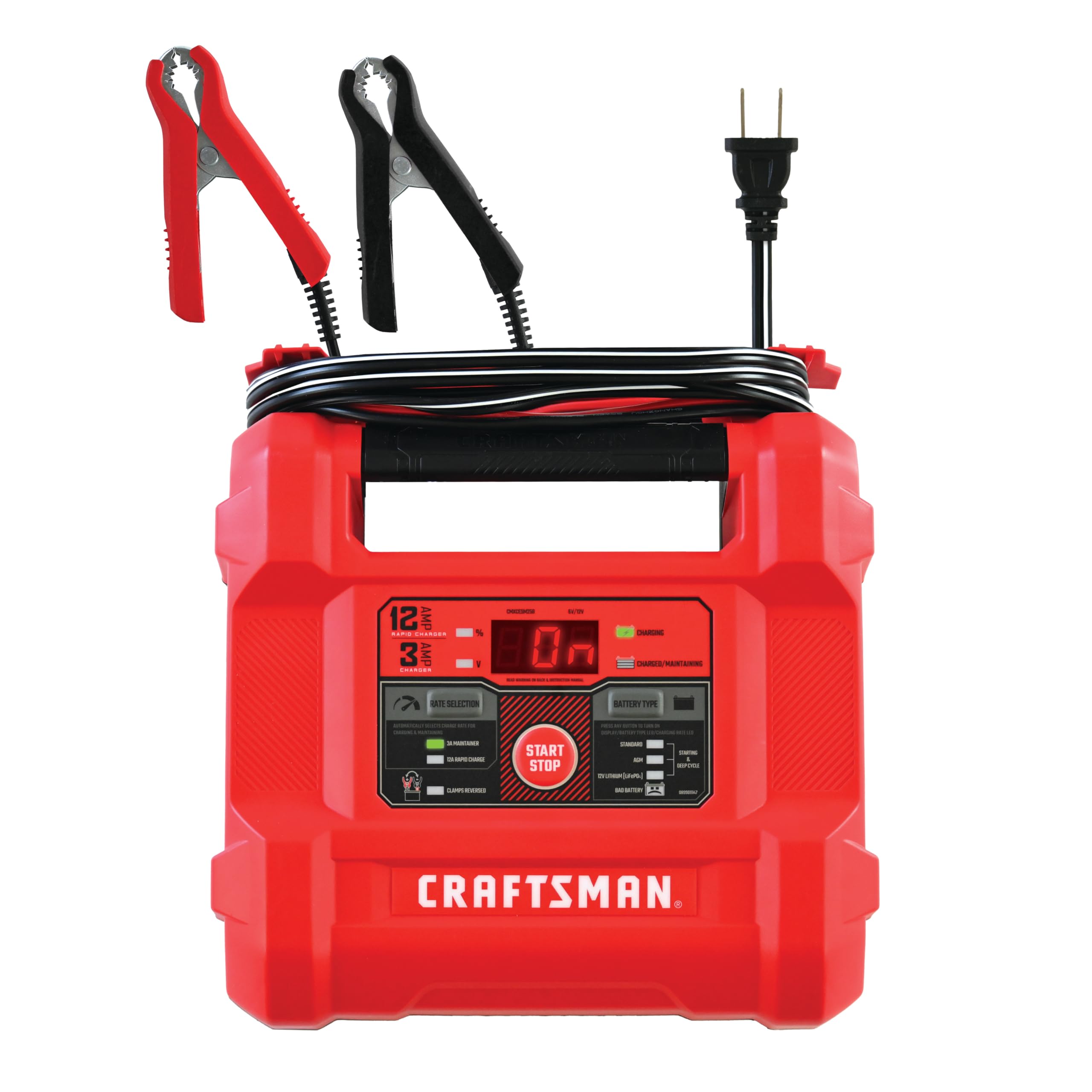
The 4-in-1 garage workhorse that revives a stone-dead car battery in hours.
When your car won’t turn over, the 12A output on this CRAFTSMAN model is the kind of help that gets you moving again. Customers note reviving a fully dead battery to a startable state in about 3.5 hours at 12A. It is a 4-in-1 device that charges, maintains, tests, and restores batteries for cars, motorcycles, ATVs, trucks, SUVs, and boats.
Smart safety features are central to its design. Microprocessor controls provide auto voltage detection for 6V and 12V systems, and a reverse hook-up protection guards against damage if you clamp backwards. The 12-foot total reach from a 6-foot AC cord plus 6-foot battery cables gives plenty of range to hook up under a hood without hunting for an extension cord.
Its advanced desulfation mode is a genuine longevity feature, helping clear that lead-sulfate buildup from batteries in seasonal vehicles so they hold charge better during storage.
Why Owners Trust It
- Rapid 12A brings a dead car battery to full in hours, not days.
- Desulfation mode extends the life of underused batteries.
- Lightweight 3.4-pound design that is still tough enough for a garage.
Occasional Gripes
- Battery condition upon delivery is inconsistent — occasionally a unit doesn’t turn on right from the start.
- No charge-time spec published for a full top-up from empty on larger banks.
Reach for this if: you need a dependable everyday charger for a modern family car with AGM, standard, or lithium batteries.
skip it if: your whole fleet is small motorcycles — the 12A is heavier than necessary.
7. NEXPEAK 4-Pack 1.75A Charger

Four compact maintainers that keep an entire stable of vehicles ready for spring.
If you have a growing collection — a car, a golf cart, a motorcycle, and a lawn mower — this 4-pack is the efficient answer. Each 1.75A unit acts as a battery charger, maintainer, trickle charger, and desulfator, enough to keep a battery topped up through long stretches of inactivity. An extra-long 6.6ft SAE cord with detachable alligator and ring connectors means a secure fit works for most setups without extra adapters.
Each unit features an intelligent digital LCD screen showing charging status, percentage, voltage, and current — so you can check battery health at a glance. A 7-stage charging program runs desulfurization, trickle, constant current, and float phases to recondition an old battery and keep it healthy.
A trickle mode maintains your battery at 12.5V and automatically cuts off power once fully charged, which is exactly what you want for a season of storage.
The owner consensus: these are excellent little winter battery maintainers, with buyers spotlighting the display that shows voltage even when the unit isn’t charging.
The one catch: charging performance is mixed for deeply discharged batteries, and auto-detection can occasionally misread voltage — it won’t damage your battery, but you may need to override the mode.
Best value for: households juggling three or more seasonal vehicles who want one box to handle them all.
Not ideal for: a single-car owner who needs serious amperage for a dead daily driver.
8. NOCO GENIUS5 5A Smart Charger

The smart 5A charger that resurrects batteries other chargers declare dead.
The GENIUS5 sits between too-slow and too-harsh. Its 5A output can deliver a startable charge in about 15 minutes — enough to get you moving, not a full top-up. It handles 6V and 12V lead-acid (AGM, Gel, SLA) and lithium (LiFePO4) batteries.
Its stand-out feature is the ability to recover batteries other chargers give up on. Owners have revived sulfated gel batteries that analyzers declared dead, and restored a 0V lawn tractor battery over multiple repair cycles. Its Force Mode lets you manually charge a completely dead battery down to zero volts.
Like the GENIUS1, it auto-adjusts based on ambient temperature and can be left connected indefinitely for maintenance. At 1.6 pounds with a mounting bracket included, it fixes neatly to a garage wall near your battery.
The Resuscitation Power
- Force Mode recovers batteries drained all the way to zero volts.
- Precision pulse charging reverses sulfation to extend battery lifespan.
- 5A output restores a startable charge in roughly 15 minutes.
Real-world Notes
- Gets warm to the touch during repair and charge cycles — set it on a flat, heat-safe surface.
- Skimpy on instructions; the manual doesn’t always match actual button behavior.
Choose it for: neglect-prone garages where batteries regularly sit months idle and need more than a gentle trickle.
pass on it if: you shop purely on price — the GENIUS1 covers basic maintenance for less.
9. Battery Tender 15 Amp Charger

The switchable 15A heavy-hitter for diesel trucks and dual-battery rigs.
The 15-amp Battery Tender is the closest thing here to a shop-grade charger in a portable frame. Its defining feature is switchable amperage — you choose 15A for a big-battery fast charge, 8A for a standard daily driver, or 2A for a delicate trickle — all in the same unit. That flexibility means this one unit can properly charge a dual diesel truck battery setup and then, with a twist, safely maintain the small battery on a motorcycle.
It runs selectable chemistry profiles for standard flooded, AGM, gel-cell, and even LiFePO4 lithium batteries, so you match the charge precisely to the battery you own. An interactive LCD display shows charge rate, battery type, percentage charged, and any error codes. If your battery voltage drops under load, an ISM adaptive charging mode resumes full charger output automatically.
Its 3.5-pound frame packs the punch of a rolling cart charger that usually needs wheels, which impressed owners. Spark-proof lead connection and automatic reverse-polarity detection ensure a safe connection before power flows.
What stands out: the screen and status readouts, with buyers calling it a “proper” charger and tender that revived batteries other tenders couldn’t.
The honest caveat: after a power loss, it defaults back to standard 2A mode rather than remembering your chemistry selection, so check settings after an outage.
Bring this home if: you have trucks, SUVs, and a mix of chemistry types that need one versatile device.
Pass it by if: you want a premium pick at a mid-tier spend — this is worth its price, but it’s not the budget champion.
Understanding the Specs
Amps (A)
Amperage is the speed of your charge — the higher the rating, the faster your battery refills. A 20A unit like the LiTime can refresh a large 100Ah deep-cycle battery in hours, while a 1A maintainer like the NOCO GENIUS1 needs far longer but is perfect for holding a charge safely. The danger of too much amperage is overheating small batteries, so match the output to your battery’s capacity.
Voltage Output and Chemistry
Not all 12V batteries charge the same way. Lead-acid batteries need a higher peak voltage (around 14.7V) than lithium LiFePO4 cells (around 14.6V) and handle charging differently. If your charger lacks the right profile, it can undercharge your lithium bank or leave a lead-acid cell short of full. Always check that your unit supports the chemistry you own home in on.
Smart Modes — Desulfation and Float
Sulfation is a chemical buildup that steals capacity from a lead-acid battery left sitting too long. A desulfation mode sends targeted pulses to break down that buildup and restore lost performance. Float mode keeps a battery topped off at a safe voltage around 13-14V without overcharging, which means you can leave a smart maintainer connected all winter and walk away without worry.
Safety Features
Most quality chargers now carry protections that cover the top rookie mistakes. Reverse polarity protection means the unit won’t spark if you accidentally swap the clamp connections. Spark-proof and short-circuit protection add layers of insurance against blown fuses or damaged electronics. These are worth confirming before you buy rather than discovering their absence the hard way.
FAQ
What is the difference between a “charge” and a “maintain” mode on a smart charger?
Can a 12V battery charger also work on a 24V system?
Will a lithium charger work on a regular lead-acid car battery?
Can I jump-start my car with a battery charger?
What does “0V activation” mean on the LiTime charger?
How long does a 1-amp trickle charger take to charge a car battery?
Is it safe to leave my battery charger connected all winter?
What is the “desulfation” or “repair” mode for?
What is the difference between AGM, Gel, and standard wet cell battery types?
Which amperage do I actually need for my battery?
Final Thoughts: The Verdict
For most buyers with a lithium deep-cycle bank in an RV or solar setup, the clear winner is the LiTime 12V 20A charger — its fast charge times and 0V activation solve real problems that cheaper units can’t touch. If your needs are simple winter storage for a car or motorcycle, the NOCO GENIUS1 does that job flawlessly without the premium spend. And if you need one versatile unit for everything from a dead daily driver to a 24V boat, the HTRC 20A brings the most flexibility to a single garage 12v battery charger slot.
How We Picked
We do not accept paid placement. Every pick is matched to a real buyer and a real use-case; we do not hands-on test units.
Sources & Methodology
Specifications: manufacturer listings and product documentation. Review insights: verified customer reviews, as of September 2026. Pricing: not shown on this page (it changes often); check the current price via the retailer link.
As an Amazon Associate, Gadgets Feed earns from qualifying purchases. This does not affect which products we feature.