
Our readers keep the lights on and my morning glass full of iced black tea. As an Amazon Associate, I earn from qualifying purchases.
Specs are compiled from manufacturer listings and verified buyer reviews and can change over time — please confirm the key details on the product page before buying.
If your car, boat, or garage rig still runs on an old radio with no wireless input, you do not need a new stereo — you need a small box that feeds Bluetooth audio straight into what you already own. It taps into your vehicle’s 12-volt power, grabs the music from your phone, and hands it to your amplifier or head unit through standard RCA cables (the red and white plugs that carry left and right audio). The catch is that it must power on with your ignition, and many cheap units fail that test. This guide covers six 12V Bluetooth receivers and matches each to a specific install.
I’m Min — the founder and writer behind Gadgets Feed. This guide is built by comparing the manufacturers’ published specifications and the patterns across verified customer reviews, so you get each pick’s real strengths and trade-offs instead of marketing spin.
Your pick depends on three things: whether you have an ACC wire, if you need RCA line-level or speaker-level output, and how much mounting space you have. If you are restoring a classic dash or upgrading a jet boat, this breakdown of the 12v bluetooth receiver market will help you match the hardware to your install before you buy.
Our Picks at a Glance

How To Choose The Best 12V Bluetooth Receiver
Before you compare models, understand the three wiring facts that decide whether your install works on the first try or frustrates you for a weekend. Get these three right and any unit on this list will power on and play.
The ACC wire is not optional
An ACC wire (short for accessory, the circuit that goes live when you turn your key or flip your ignition switch) is what tells the receiver to wake up. If your vehicle has no ACC signal to tap, you tie the red ACC wire and the yellow positive wire to the same 12V source. Leave it dangling and the unit simply never lights up — no beep, no LED, nothing.
Do you need an amplifier or just a signal?
Some units on this list are amplifiers that push speakers directly, and some are receivers that only output a line-level signal for a separate amp. A hideaway receiver sends audio through RCA jacks and expects your existing amplifier to do the heavy lifting. Buy a line-level receiver without an amp and you get no sound at the speakers.
Heat, moisture, and mounting space
Any amplifier needs open air around it, because the circuitry gets warm under load. Marine decks and enclosed dash cavities are the hardest environments here — look for coated circuit boards and water-resistance ratings if the unit lives in a boat, a bike, or an engine bay.
Quick Comparison
| Model | Best For | Type | Power Input | Output | Amazon |
|---|---|---|---|---|---|
| AK-380 2.0 CH HiFi Amp★ Best Overall | Garage and home stereo power | Amplifier | 12V DC (12V 5A supply included) | Speaker terminals | Amazon |
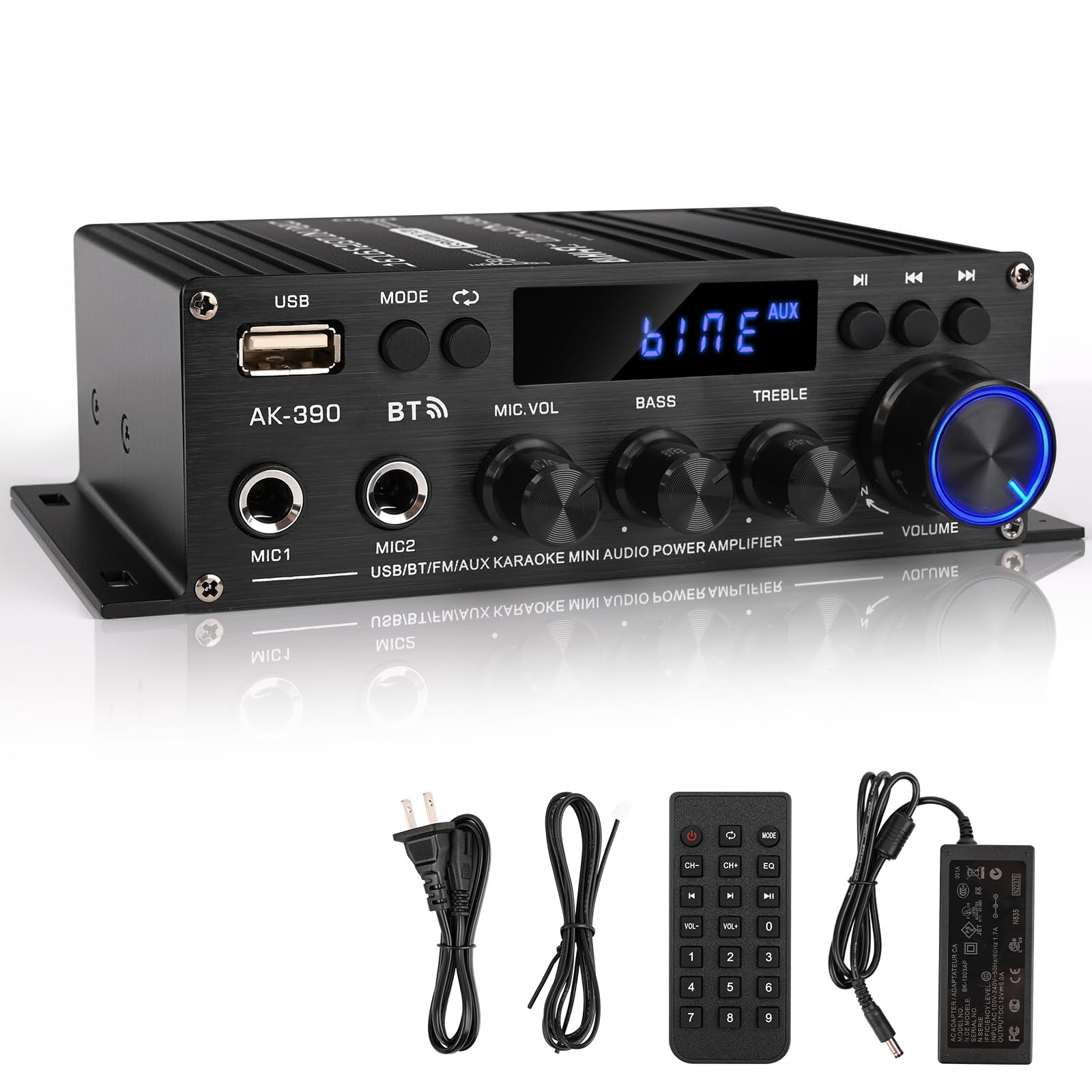
| Romicta AK-390 Stereo AmpParty Pick | Karaoke and party setups | Amplifier | 12V DC (12V 5A supply included) | Speaker terminals | Amazon |
| blafili CAR Hideaway Receiver | Classic cars and motorcycles | Hideaway receiver | 12V/24V with ACC trigger | Stereo RCA | Amazon |
| Pyle PLRMR23BTW Marine Receiver | Replacing a single DIN boat deck | In-dash head unit | 12V DC | RCA line out | Amazon |
| Metra IBR64 Universal Receiver | Adding wireless to an existing radio | Hideaway receiver | 12V remote turn-on | RCA | Amazon |
| Pyle PLRMR27BTB Marine Receiver | Budget in-dash replacement | In-dash head unit | 12V DC | RCA line out | Amazon |
In‑Depth Reviews
1. AK-380 USB SD BT.C FM AUX Audio Power Amplifier 2.0 CH 40W+40W HiFi AMP
Our pick — over 4★ from 750+ verified ratings; the strongest balance of quality and price.
A 40W-per-channel amp that turns any pair of passive speakers into a wireless stereo system.
The AK-380 is the desktop workhorse of this group. It delivers 40W+40W of rated power — meaning real, continuous output per channel rather than a peak-power marketing number — and it drives speakers rated between 4 and 16 ohms. In plain terms, that covers almost any bookshelf, garage, or outdoor speaker you already own. It comes with its own 12V 5A power supply, so you plug it into a wall or a vehicle circuit and it runs. Amazon’s reviews back this up: buyers praised the sound quality most, with functionality and overall quality drawing steady praise across the 783-strong review pool.
What surprises owners is how quiet it stays. The built-in Bluetooth 5.0 core (the wireless chip that pairs with your phone) and YD7377 chip (the audio processor) are designed so there is no pop and no audible hum when your phone connects, and buyers echo that — a common report is that the amp sounds clean with no ground loops (a wiring issue that causes buzzing), and Bluetooth range lands around 30 to 40 feet. The LCD backlit display and separate treble and bass knobs let you shape the high and low end by hand, and it reads both U-disk (a USB flash drive) and memory card. There is a remote for adjusting volume from across the room. The one honest catch: the box is labelled 400W+400W peak (the maximum burst power), and a wave of buyers report that the real continuous figure is the 40W+40W rating, not the headline number. Not fatal — plenty of owners power outdoor speakers through it and report it survives being left in the elements for weeks.
What buyers keep repeating
- Clean, hum-free sound with no pop when Bluetooth connects
- 40W+40W rated power drives speakers from 4 to 16 ohms
- Own 12V 5A power supply included in the box
What buyers flag as the catch
- Real output is the 40W+40W rating, not the 400W peak label
- Must use the included 12V 5A adapter — no substitutes
Grab it if: you want one box that turns passive speakers into a Bluetooth stereo for a garage, home, or outdoor setup.
Think twice if: you need a hideaway receiver that lives behind a dash — this one is a full amplifier and needs open airflow.
2. Romicta Stereo Audio Amplifier, 2.0 CH Mini Home Audio Bluetooth 5.0 Stereo Receivers with 400W, FM, AUX, USB, Microphone Input, 12V 5A Power Supply, Power Amplifier for Car Home Bar Party
This is the amp for people who want a microphone in the mix, not just music.
The Romicta AK-390 adds something none of the other amps here carry: dual microphone inputs (two mic jacks for singing or speaking). That single feature reframes the whole product — it is built for karaoke nights, event announcing, and public speaking, not just background music. It runs the same Bluetooth 5.0 core and YD7377 chip as the AK-380 and posts the same 400W+400W peak and 40W+40W rated figures, but it weighs 0.71 kg against the AK-380’s 0.78 kg — a small edge in the hand, though not something you will notice under a table. Owners describe it as simple to set up for either Bluetooth or a wired audio-in, and several report it “really blasts the music.”
Support for 4 to 16 ohm passive speakers up to 40W each means the same speaker flexibility you get across this category, and there is USB flash drive and SD card playback on top of Bluetooth. The LCD backlit display pairs with separate treble, bass, and volume knobs, plus a dedicated mic volume control. It ships with a remote, a 12V 5A adapter, and a quick start guide. One buyer wired it to a set of Bose 901 speakers in a garage and reported no issues at all. The honest math worth knowing: with a shallower review pool than the AK-380, the feedback is thinner, so treat the early praise as promising rather than proven.
Where it earns its place: dual mic inputs plus a mic volume knob make this the only amp on the list built to mix a voice over your music — genuinely useful for parties and announcements.
The honest trade-off: same 400W peak label versus 40W+40W rated reality as its sibling, and a smaller body of buyer feedback to lean on.
Reach for this if: karaoke, MC work, or any setup where someone talks over the music is part of the plan.
Look elsewhere if: you want a long track record of owner feedback — the AK-380 has the deeper review history.
3. CAR Bluetooth Receiver with RCA Output for Auto, Truck & Marine
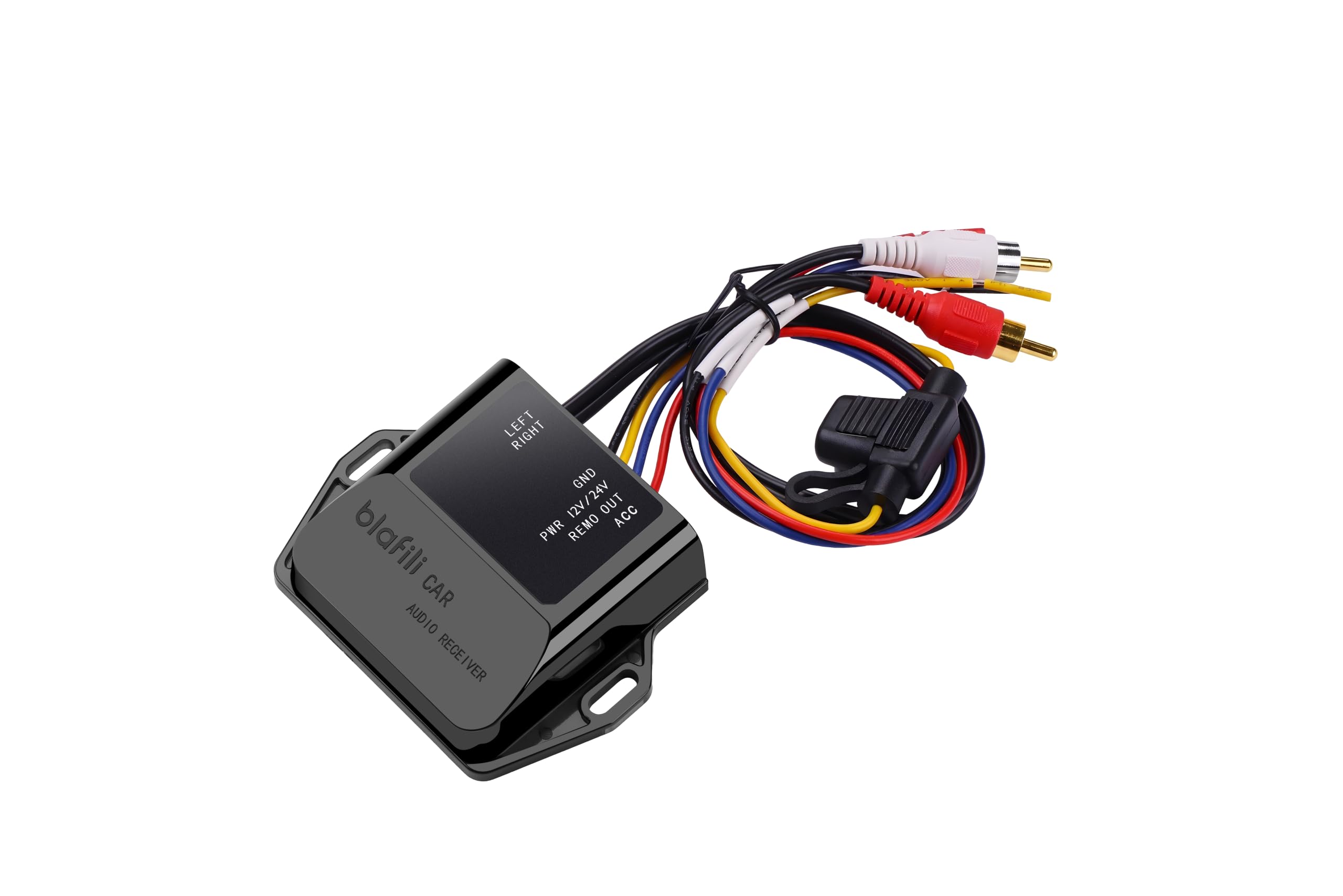
A genuine hideaway receiver — tuck it under the dash and keep your original interior untouched.
Not every buyer wants a new head unit staring back at them. The blafili CAR is a compact hideaway box that mounts under the dash, behind a panel, under a seat, or in a trunk, and it sends stereo RCA line-level audio to whatever amplifier you already run. It is not an amplifier and it does not drive speakers directly. Inside sits a Qualcomm QCC3040 chipset with Bluetooth 5.2, which together deliver the low latency and efficient connection that keep audio in sync with video and steady at range. The spec sheet claims up to 30m of range — and owners back the reach, describing it as farther than they actually need.
Codec support (the audio formats the receiver can decode) is where this one pulls ahead of the cheaper hideaways. It handles aptX Adaptive, aptX HD, aptX, AAC, and SBC, so Android and iOS phones both get a high-quality audio path rather than a forced downgrade to the basic SBC codec. An IP65 rating (dust-tight and protected against water jets) suits marine and motorcycle duty, and the 85 × 65 × 20 mm body means it disappears wherever you mount it. The audio-activated blue remote wire is the smart part: it powers your amp only while Bluetooth audio is actually playing, which saves your battery during silence. The catch owners hit is that same wire — it drops the remote signal after roughly two seconds without an audio signal and re-wakes on new sound, which can be noticeable when you pause a track or change songs. Because there is no microphone, there is no hands-free calling; this is a music-streaming-only device.
Why it holds the top hideaway spot
- Qualcomm QCC3040 chipset with Bluetooth 5.2 for stable, low-latency audio
- aptX Adaptive, aptX HD, aptX, AAC and SBC codec support
- IP65 rating handles boat and motorcycle environments
- Audio-activated remote wire saves battery during silence
Before you wire it in
- Won’t power on at all unless the ACC wire is connected
- Remote output cuts after about two seconds of silence
- No microphone and no hands-free calling
Best fit: classic cars, motorcycles, and boats where you want wireless audio without cutting up the dash.
Skip if: your build relies on a constant amp trigger rather than an audio-activated one.
4. Pyle Bluetooth Marine Receiver Stereo – 12v Single DIN Style Boat In dash Radio Receiver System with Digital LCD, RCA, MP3, USB, SD, AM FM Radio – Remote Control, Wiring Harness – PLRMR23BTW (White)

The single-DIN deck that swaps straight into a dead boat radio and brings Bluetooth with it.
If your boat already has a single-DIN radio cutout, this is the direct replacement. The PLRMR23BTW drops into a 1.97″D x 4.26″W x 7.01″H slot and ships with a power and wiring harness, a metal chassis frame bracket, a trim frame cover, and a remote. That is a full kit for someone starting from a bare hole in the dash. Output is 300W peak across four channels at 75W each, with EQ controls for bass, treble, balance, and fader so you can tune the sound to the space. Owners describe the install as quick, with one reporting the DIN cage fitting a car or boat in about ten minutes, and the value for money here is the thing buyers mention most and praise most.
The feature set is deep for the tier. There is a built-in microphone for hands-free calls, with the number shown on the LCD panel, plus a call answer and end button and a redial function. Front-panel Aux-in, USB, and SD slots sit next to AM/FM radio, and rear RCA line-out jacks let you feed a separate amplifier. Pairing is easy from an iPhone, and owners mention the Bluetooth connects reliably to a phone. What holds it back is the display: sunlight washes it out and it reads too dark to see in daylight, a frustration echoed by enough owners that it belongs in your decision. A few owners also report the screen failing after a handful of uses. With over 1,800 ratings behind it, the vast majority of buyers come away pleased — just know going in that this is a bright-daylight-weak display.
The value read: a complete single-DIN kit — harness, bracket, trim, remote, and built-in mic — that slots into an existing boat or car opening, and owners single out the value above all else.
The display caveat: the LCD is hard to read in direct sun and too dark for daylight viewing, so mount it where shadow falls across the face.
For you if: you are replacing a dead single-DIN deck and want Bluetooth, radio, USB, and calling in one install.
Not your pick if: you need a screen you can read in full sun — this face struggles there.
5. Metra IBR64 Universal Bluetooth Receiver with auto-Remote, Waterproof for Boat
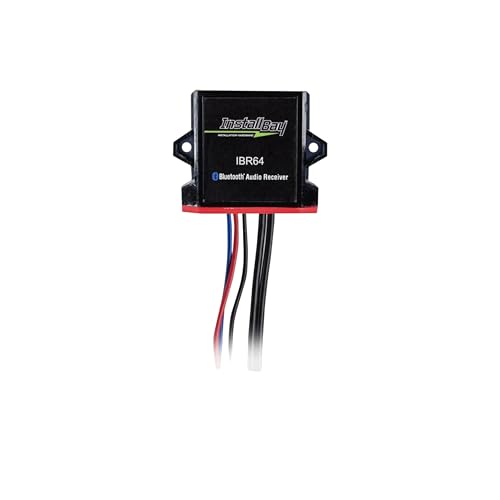
Weighing just 0.08 kg, this is the lightest way to add wireless audio to an old radio.
It is a water-resistant universal receiver that upgrades an existing non-Bluetooth radio by feeding A2DP stereo audio through RCA outputs and a 12V remote turn-on wire for your amplifier. The headline behavior is automatic reconnection: pair your phone once, and the unit finds it again on its own every time after, stopping the connection when the car powers down. Owners confirm exactly that — pair once, and it connects by itself on later trips. With a connection range of up to 30 ft and support for WAV and WMA formats, it covers the essentials without extra buttons or knobs.
The draw here is weight and complication. At 0.08 kg it adds almost nothing to your install, and the wiring is a two-wire job for the power side plus the RCA run to your amp. That simplicity is why it appeals to anyone upgrading an old head unit that already has an Aux input or RCA-in. The honest downside is reliability over the long haul. The pattern across longer-term owner reports is that some units eventually fail to reconnect cleanly or drop out entirely, and a couple of owners describe the unit quitting after working well for a stretch. Buy it for a cheap, simple wireless upgrade, but keep the receipt in case it stops reconnecting.
What it delivers
- Automatic reconnection to your last paired phone
- RCA output plus 12V remote turn-on for an amplifier
- Water-resistant construction for boat duty
- Feather-light 0.08 kg body hides almost anywhere
What to weigh
- Long-term reliability is the recurring owner concern
- No amp inside — you need existing amplification to drive speakers
Choose it when: you want the least-complicated wireless upgrade for a radio that already has RCA or Aux inputs.
Weigh the risk if: you need a unit to run for years without attention — the failure reports cluster in long-term use.
6. Pyle Bluetooth Marine Receiver Stereo – 12v Single DIN Style Boat In dash Radio Receiver System with Digital LCD, RCA, MP3, USB, SD, AM FM Radio – Remote Control, Wiring Harness – PLRMR27BTB (Black)

The black-face twin of Pyle’s marine deck — same kit, same power, different panel color.
This is the black version of the PLRMR23BTW above, and the hardware story is nearly identical. It puts out 300W peak across four channels at 75W each with EQ control over bass, treble, balance, and fader. The front panel carries an Aux-in, USB and SD slots, and AM/FM radio, while the rear offers RCA line-out jacks to feed a separate amp. It ships with a wiring harness, DIN chassis bracket, trim cover, and remote, and the single-DIN universal size replaces a standard car or boat deck. Owners repeatedly praise its value and its sound — the “loud” button that boosts the bass gets singled out as the feature that pumps up low end nicely.
Where buyers pull it apart is the mounting hardware and long-term Bluetooth behavior. The connector locking tabs are stiff to engage and may not stay seated, and the head unit’s locking brackets leave it able to slide rearward without the key in use, so some owners reinforce the trim with aluminum strapping. Bluetooth generally connects without trouble at first, though the feedback on whether it keeps working after a while is genuinely mixed rather than clean either way. Reliability after months of use is the aspect owners question most, and a few report the unit failing to power on despite correct wiring. For a budget boat deck replacement, this covers sound, radio, USB, calling, and Bluetooth in one install — just plan to reinforce the mount.
What owners like: the value and the bass-boost “loud” button come up again and again, and the hands-free calling and USB charging round out a full-feature dash unit.
What needs attention: the connector tabs and head-unit brackets are the weak points — plan on reinforcing the mount, and note that Bluetooth reliability is a mixed picture over time.
Right for: budget-conscious boat or car owners who want a complete single-DIN deck with radio, USB, calling, and Bluetooth in one box.
Pass if: you want a mount-and-forget install — the brackets here ask for extra shoring up.
Understanding the Specs
Peak power vs rated power
A peak power figure (like 400W) is the momentary maximum a chip can flash for an instant. Rated power (like 40W) is the continuous output you actually hear. When a listing shows both, trust the rated number for matching speakers — peak is a burst, not a steady output. Match your speakers to the rated figure for clean, distortion-free sound.
ACC wire and power-on logic
An ACC wire is the accessory circuit that goes live when you switch the ignition. Many 12V receivers will not power on at all until it sees voltage there. If your vehicle has no accessory signal, tie the red ACC and yellow positive leads to the same 12V source so the unit wakes with the system.
Bluetooth codecs explained
SBC is the basic Bluetooth audio codec every phone supports. AAC is Apple’s higher-quality path, and aptX and aptX HD are higher-resolution options on many Android phones. More codec support means more chances your specific phone gets a clean audio path instead of a forced downgrade.
RCA vs speaker outputs
RCA output sends a low-level audio signal that needs an external amplifier to power speakers — it is the quiet signal, not the power. Speaker terminals push amplified power straight to the drivers. Buy a receiver with RCA out if you already have an amp, and a full amplifier if you do not.
FAQ
Why won’t my 12V Bluetooth receiver turn on?
Does a hideaway receiver need an amplifier to work?
Can I add Bluetooth to a classic car without cutting the dash?
What does the blue remote wire on a Bluetooth receiver do?
Is a 300W marine deck enough power for a boat?
Do I need RCA cables or a wiring harness to install one of these?
Will a 12V Bluetooth receiver work with both iPhone and Android?
Can I run a marine receiver off a 24V system?
What is the Bluetooth range on these receivers in real use?
Do these receivers support hands-free phone calls?
Final Thoughts: The Verdict
For the widest range of setups, the 12v bluetooth receiver winner is the AK-380 — 40W+40W of clean, hum-free rated power that turns any passive speakers into a wireless system, backed by the deepest and most consistent owner feedback of any amp on this list. If you want a microphone in the mix for karaoke or announcements, the Romicta AK-390 adds dual mic inputs on the same core. And if your goal is a hideaway box that keeps a classic dash or motorcycle handlebar untouched, the blafili CAR is the one to wire in — just connect that ACC wire (the ignition-switched power line) and it will wake with the ignition every time.
How We Picked
We do not accept paid placement. Every pick is matched to a real buyer and a real use-case; we do not hands-on test units.
Sources & Methodology
Specifications: manufacturer listings and product documentation. Review insights: verified customer reviews, as of September 2026. Pricing: not shown on this page (it changes often); check the current price via the retailer link.
As an Amazon Associate, Gadgets Feed earns from qualifying purchases. This does not affect which products we feature.