
Our readers keep the lights on and my morning glass full of iced black tea. As an Amazon Associate, I earn from qualifying purchases.
Specs are compiled from manufacturer listings and verified buyer reviews and can change over time — please confirm the key details on the product page before buying.
Choosing a camper battery by size alone often leads to a unit that can’t power a fridge overnight or adds excessive tongue weight. The real question is how much usable energy you get for the weight you carry, and how deep you can drain it without damage. This distinction separates a reliable workhorse from one that leaves you in the dark.
I’m Min — the founder and writer behind Gadgets Feed. This guide is built by comparing the manufacturers’ published specifications and the patterns across verified customer reviews, so you get each pick’s real strengths and trade-offs instead of marketing spin.
You need a battery that delivers reliable power without turning your campsite into a dead-weight problem, and this 12v camper battery roundup answers which chemistry, capacity, and weight actually fit your RV.
Our Picks at a Glance

How To Choose The Best 12V Camper Battery
You pick a camper battery by balancing three things: your daily power needs, your rig’s weight limit, and whether you prefer the simple, heavy lead-acid type or the lighter, longer-lasting lithium. Start with how much energy you use each day, then match that to the right capacity and chemistry.
Lithium vs. Lead-Acid Chemistry
Lithium iron phosphate (LiFePO4) batteries let you use nearly all of their rated capacity, while a lead-acid battery can only be safely drained to about half before it suffers damage. That means a 100Ah lithium battery delivers roughly double the usable power of a 100Ah lead-acid of the same size. The trade-off is cost — lithium is more expensive upfront, but it lasts for thousands of cycles instead of a few hundred, and it weighs a fraction of the lead-acid equivalent.
Understanding Amp-Hours and Usable Capacity
The amp-hour (Ah) rating tells you how much current the battery can supply over one hour. A 100Ah battery can theoretically deliver 100 amps for one hour, but in practice you are usually drawing much less — say 5 amps for a fridge. The real deciding factor is how deep you can drain it, because a lead-acid battery gives you only about 50Ah of usable energy from a 100Ah rating, while a LiFePO4 gives you the full 100Ah.
Physical Fit and Weight
Battery group sizes (like Group 24 or Group 31) are standard box shapes that your camper is designed to hold. Before you fall in love with a spec sheet, measure your battery compartment and check the terminal layout — some batteries have top posts, others have side terminals. Weight matters too, because a 60-pound lead-acid unit on the tongue of a small trailer can hurt your tow capacity, whereas a 21-pound lithium of the same capacity is far easier to manage.
Quick Comparison
| Model | Best For | Capacity | Voltage | Weight | Amazon |
|---|---|---|---|---|---|
| Litime 12V 100Ah★ Best Overall | Smart connected campers | 100 Ah | 12.8 V | 21 lb | Amazon |
| WEIZE 12V 100AhBest Value | Budget lead-acid swaps | 100 Ah | 12 V | 63 lb | Amazon |
| Renogy Core Mini 100AhCompact Pick | Tight spaces | 100 Ah | 12.8 V | 22.7 lb | Amazon |
| Redodo 12V 100Ah | High-cycle solar users | 100 Ah | 12.8 V | 22 lb | Amazon |
| Power Queen 12V 100Ah | Portable handling | 100 Ah | 12.8 V | 21 lb | Amazon |
| Interstate Group 31M AGM | Marine dual-purpose | 100 Ah | 12 V | 64.5 lb | Amazon |
| SUPER EMPOWER 300Ah | Maximum off-grid runtime | 300 Ah | 12.8 V | 58.4 lb | Amazon |
| ECO-WORTHY EnergyRock 280Ah | Metal-case durability | 280 Ah | 12.8 V | ~60 lb | Amazon |
In‑Depth Reviews
1. Litime 12V 100Ah LiFePO4 Battery, Group 24
Our pick — over 4.5★ from 700+ verified ratings; the strongest balance of quality and price.
The smartest 100Ah camper battery — check your charge from your phone
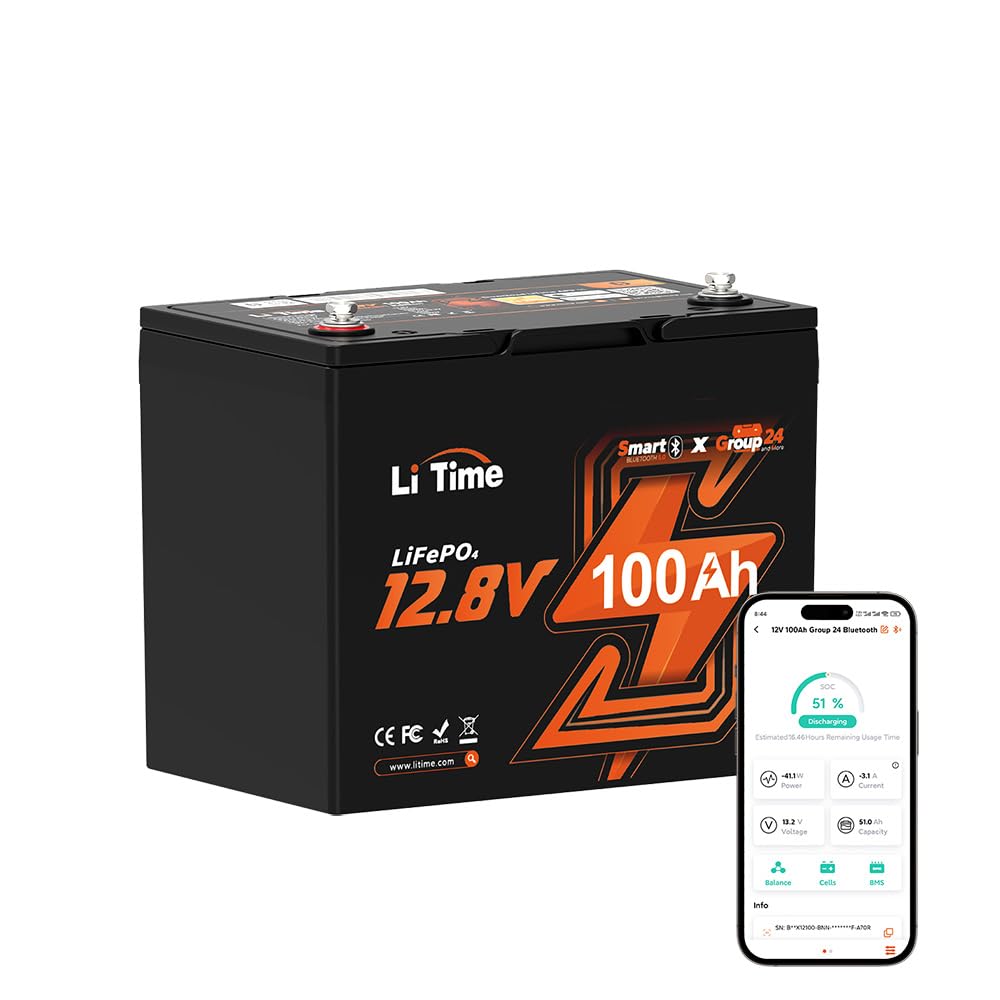
The Litime Group 24 is the battery that ends the guessing game about whether you have enough power left for the night. A built-in Bluetooth 5.0 module pairs with the LiTime app via a QR code, letting you watch voltage, state of charge, and charge or discharge rates in real time from 50 feet away. Owners running a fridge and a 30A compressor off it report two years of dependable service, and the app is the reason most pick it over cheaper rivals.
At 21 pounds, this battery is dramatically lighter than the 63-pound WEIZE lead-acid of the same 100Ah rating — a 3.0x weight gap you will feel every time you lift it into the battery box. That lighter weight comes with full usable capacity, so you get 100Ah of draw-down versus roughly half that on a lead-acid. The 12.8-volt rating is also note against the WEIZE’s 12 volts, a small voltage edge that helps keep a steady electrical bus.
Protection is a genuine priority here. The built-in 100A BMS (battery management system — the circuit that guards against overcharge, over-discharge, and overheating) offers 20+ safeguards, and a low-temperature cutoff stops charging at freezing temps to protect the cells. The flip side is that this version is not heated — owners in freezing climates note you should buy the heated variant instead, and they warn against mixing heated and non-heated units in one bank. It also carries a 10-year lifespan and a 5-year warranty, and it expands up to 4P4S for a 20.48kWh bank if you later want a bigger off-grid system.
Smart power control: What wins people over is battery quality — over 170 owners highlight it — and the Bluetooth app is the standout daily feature. This battery minimizes worry and boost trip enjoyment.
Honest trade-off: The companion app can be glitchy during charging, sometimes needing a reconnect, and it demands location access for warranty registration. A small trade-off for complete monitoring visibility.
Grab it if: you want live battery monitoring, a featherweight lift at 21 pounds, and the freedom to drain the full 100Ah.
Look elsewhere if: you camp in deep-freeze conditions and need a self-heated pack — this one relies on the BMS cutoff instead.
2. WEIZE 12V 100Ah Deep Cycle Battery, Group Size 31
The budget AGM workhorse with the heavy-lift flaw you must plan for
The WEIZE is the answer for campers who want dependable lead-acid power without the premium cost of lithium. It is a sealed AGM (absorbent glass mat — a type of lead-acid battery where the acid is held in fiberglass mats, so it never spills and needs no water top-ups), and it is completely maintenance-free. One owner swapped it in as the replacement house battery for a motor home, calling it better than the original factory install — the kind of endorsement that speaks to straight-up reliability.
You have to accept the obvious drawback: this battery weighs 63 pounds. Compare that with the 21-pound Litime lithium above, and you are lifting three times the weight for the same 100Ah rating. The payoff is a lower entry price and a design that has no BMS to fail, which some owners actually prefer for simplicity. It also self-discharges at just a 3% rate, so it holds its charge well during winter storage.
Real-world endurance is strong — one verified owner reports it ran 18 interior LED lights and 3 vent fans for over 20 hours without a recharge. It is built to replace units like the UB121000 and Renogy 100Ah, fitting a Group 31 box at 12.99 x 6.73 x 8.34 inches. The main limitation is heavy loads: a single unit feeds a 2000W inverter comfortably in parallel banks, but it will not run a stove, dryer, or HVAC. For a camper or cabin running lights, a fridge, and a fan through the night, that is rarely a problem.
Braced for duty: Battery quality and battery life are the most-discussed strengths, and value for money earns consistent praise. Owners call it an excellent value that outperforms standard flooded lead-acid at a better price.
Real-world catch: Weight is the most-mentioned downside — several buyers report it is very heavy, so budget for the lift or install it on a permanent tray.
Reach for it if: you want the lowest-cost dependable 100Ah and do not need to move it often.
Skip the lift if: you have a slide-in truck camper where every pound hurts payload — go lithium instead.
3. Renogy 12V 100Ah LiFePO4 Battery Mini Size, Core Series
The space-saving lithium that slips into nooks bigger batteries cannot
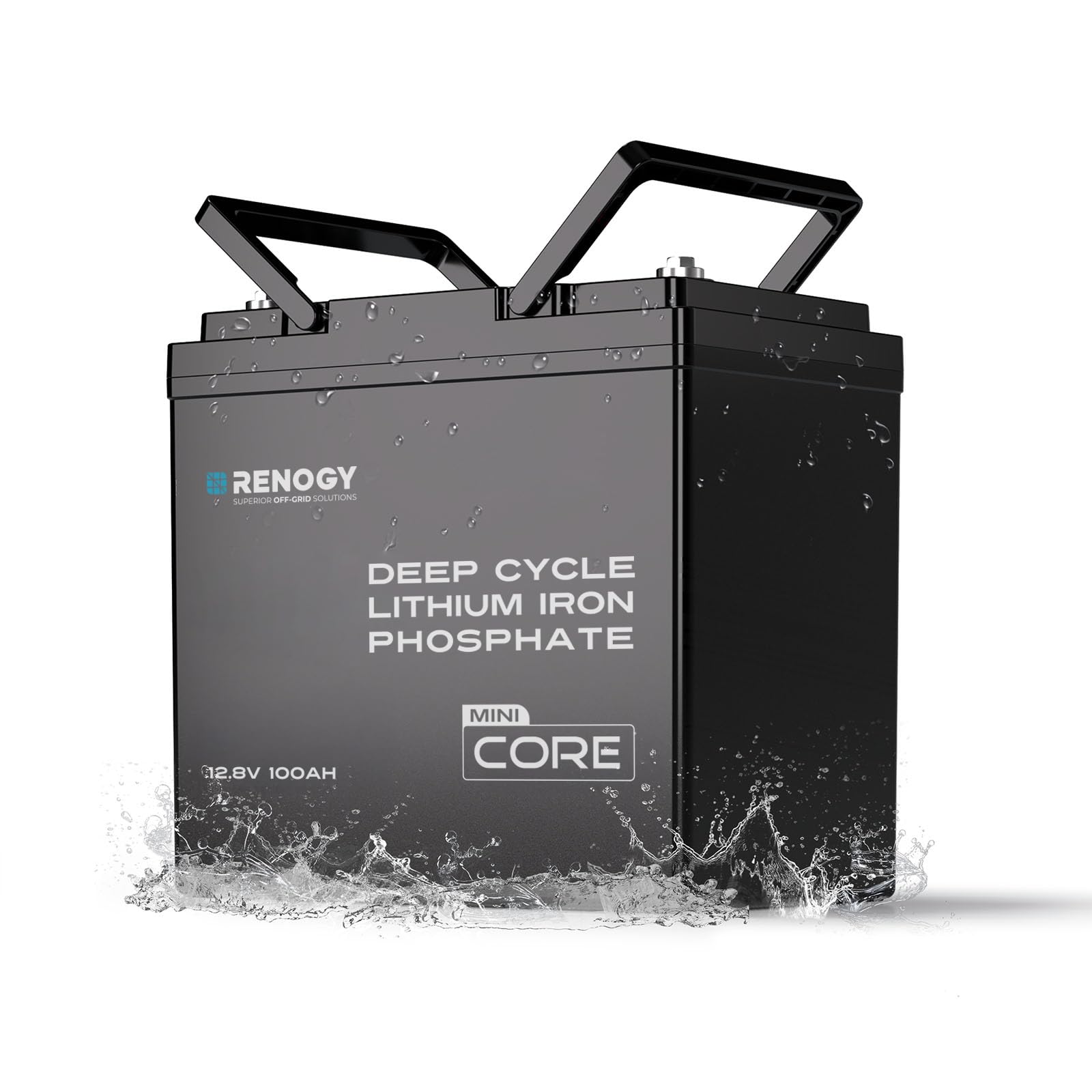
If your battery compartment is the size of a shoebox, the Renogy Core Mini fits where full-size units won’t. At 9.02 x 5.43 x 8.39 inches, it is up to 50% smaller than a Group 31 battery and 13% smaller than other equivalent 12.8V 100Ah mini batteries — a 44% size gap versus the longer WEIZE you saw above. You can slide it under a teardrop trailer bunk or inside a kayak hatch.
You can mount it in any orientation, which is a huge flexibility win when you are trying to wedge it into an awkward corner. The integrated metallic cell spacers keep the UL-listed, EV-grade prismatic cells locked in position even on unpaved roads, and the IP65-rated casing resists splashes, water, and dust — so you do not have to baby it around camp. Owners who pair it with Renogy solar gear describe it as a plug-and-play improvement, and one called it a “10x improvement” over their old AGM on discharge and capacity.
The 100A BMS (battery management system — the safety circuit that guards the cells) protects against low-temperature charging, high heat, overvoltage, undervoltage, overcurrent, and short circuits. It runs 22.7 pounds, and for monitoring, you add the Renogy 300A Battery Shunt (sold separately) to see status through the DC Home app or Renogy ONE monitor. It is the lightest full-featured option here at just 22.7 pounds, and the 5-year warranty backs the build.
Why the tight-space fan picks it
- Up to 50% smaller than a Group 31 battery
- Mount in any orientation for awkward spots
- IP65-rated against dust and splashes
Where it gives ground
- No built-in Bluetooth — you need the sold-separately shunt
- Upside-down mounting is not recommended
Choose it when: the mounting spot is the problem, not the power — this is the volume-saver of the list.
Plan around: the missing built-in monitoring, so budget for the auxiliary shunt if live status matters to you.
4. Redodo 12V 100Ah LiFePO4 Battery, Group 31
The solar-ready Group 31 that swallows a weekend of drawing power
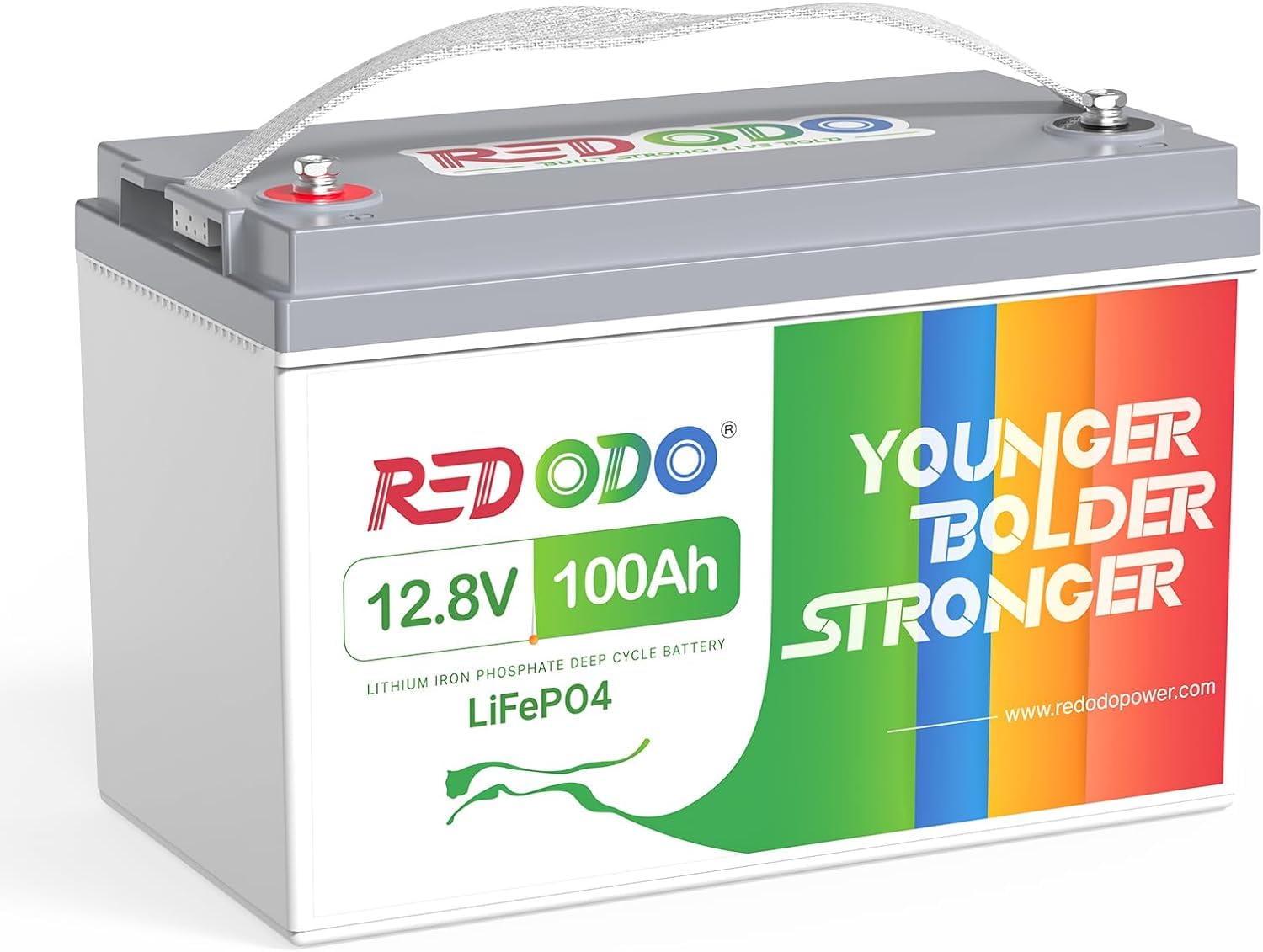
The Redodo is built for campers who run solar and want a battery that recharges hard and holds its own under heavy draw. One full-time van owner reports using 40-60Ah overnight across a fridge, TV, and laptop, then topping back to 100% in about 5 hours of full sun. That kind of cycling is exactly what the automotive-grade LiFePO4 cells are made for — up to 4,000 cycles at 100% depth of discharge, and it tests out at 105Ah, a touch above its 100Ah rating.
It is a Group 31 battery at 12.99 x 6.82 x 8.46 inches, and at 22 pounds it is 60% lighter than the typical lead-acid of the same capacity (which usually hits around 63.89 pounds). The 100A BMS (battery management system — the built-in safety circuit) guards against overcharge, over-discharge, overcurrent, short circuit, and high temperature, so you can push it without much worry. Owners like that it charges four ways — a LiFePO4 charger, solar with controller, alternator, or generator.
Customer support is a standout feature. One buyer whose battery failed after 3 years got a return label and a replacement within days, and another praised the team for explaining MPPT (maximum power point tracking — a smart solar controller that squeezes more charge from panels) settings that other brands wouldn’t touch. But this is a specialty battery: it is built for a 30-70 lbs thrust trolling motor, not for starting engines or powering golf carts.
Built for the long cycle: Battery quality leads the praise at over 160 mentions, with value for money and charging speed close behind. The 60% weight saving versus lead-acid is the figure owners repeat most.
The honest caveat: Battery life draws mixed feedback, and one long-term owner wished it lasted longer before warranty — but the replacement service redeemed the experience.
Best suited for: off-grid campers with solar who want a 100Ah battery that cycles hard and recharges fast.
Not for: engine-starting duty — that is what the Interstate pick below handles.
5. Power Queen 12V 100Ah LiFePO4 Battery, Group 24
The carry-handle lithium that one-hand trips into place
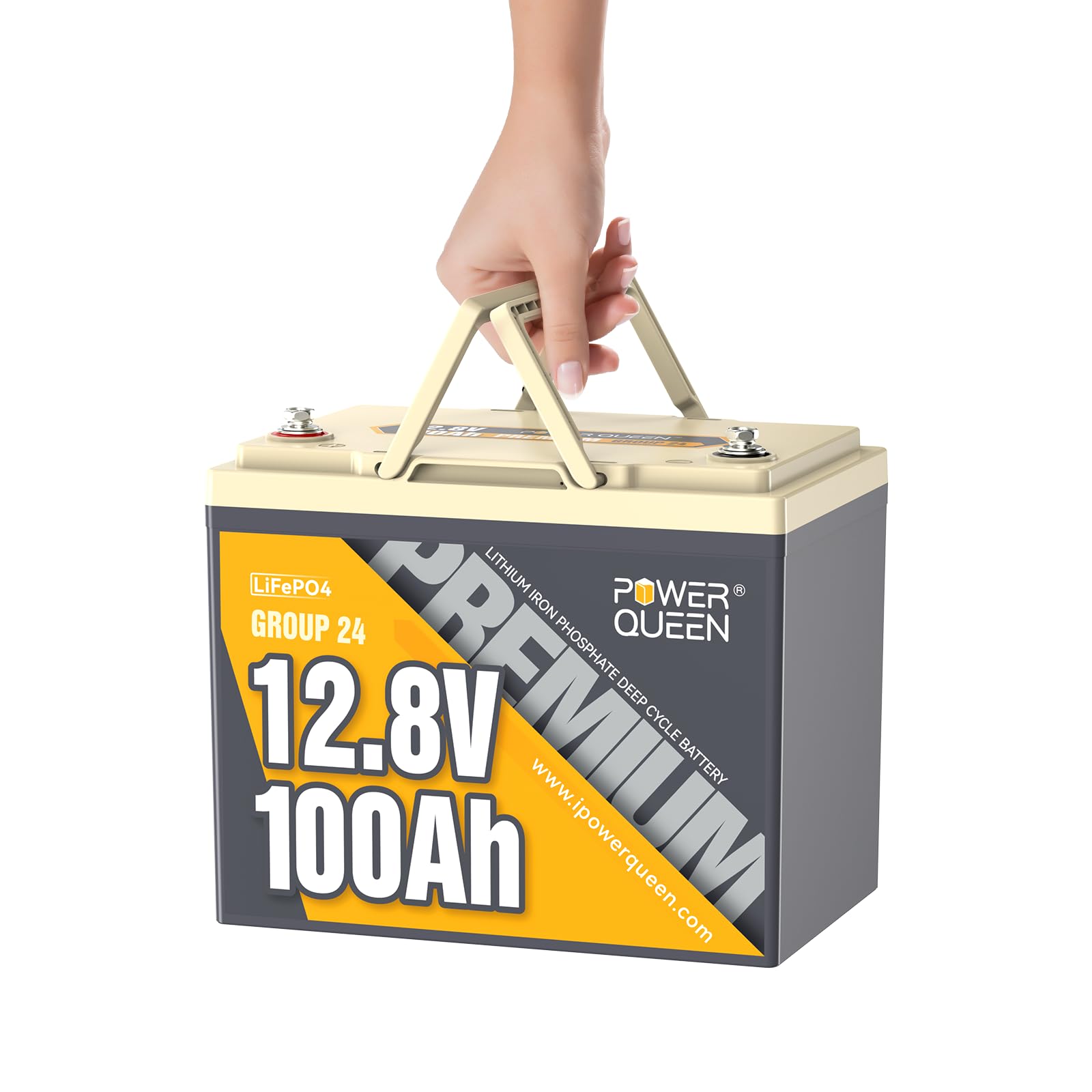
The Power Queen earns its spot on portability — it has actual carry handles, which sounds minor until you are moving a battery with one hand while holding a hatch open with the other. At 21 pounds and a true drop-in Group 24 fit, it swaps into a standard box with no wiring changes. Owners use it as a field battery for HAM radio and as a CPAP power source during hurricane outages, both of which demand easy handling and steady output.
It delivers 1280Wh of 100% usable energy, versus about 500Wh from a 70Ah AGM at 50% depth of discharge — so you get more runtime from a battery that is one-third the weight of an equivalent AGM. The EV-grade LiFePO4 cells are rated for 4,000 cycles at full depth of discharge, with a 10-year lifespan and a 5-year warranty. The BMS (battery management system — the safety circuit) provides 20+ protections against overcharge, over-discharge, overheat, and short circuits.
What makes it flexible is the expansion path: connect up to 16 units in a 4P4S arrangement to build a 51.2V 400Ah bank (max 20.48kWh). That suits an RV solar setup that you plan to grow over time. Just note the warm tips — it is an energy storage battery, not for engines or golf carts, and you should use gaskets with screws under 2mm to prevent loosening or overheating. It consistently delivers a steady 100-120 watts of output in field use, and owners mention about 20% more energy than expected.
Easy-moving power: Battery life leads the praise, followed by charging performance, and the carry handles earn repeated callouts for day-to-day convenience.
Watch this: The BMS counts on proper torque and gaskets — a loose connection can cause heat, so follow the install note.
Pick it for: campers who move the battery between setups — the handles and 21-pound weight make it the easiest to relocate.
Take care: with terminal screws and gaskets, since heat at a loose joint is the one real failure mode here.
6. Interstate Batteries Marine/RV Battery 12V 100Ah 825CCA Group 31M AGM

The 825-CCA dual-purpose battery for boaters who also camp
Choose the Interstate when your battery must start a motor sometimes and run house loads other times. It is a dual-purpose AGM (absorbent glass mat — a spill-proof lead-acid design), rated at 825 CCA (cold cranking amps — the measure of starting power in cold weather), so it can crank a boat motor or power a trolling motor whether the engine is on or off. That split personality makes it the strongest pick here for the boating camper who refuses to carry two batteries.
It uses pure, non-alloy lead, which the maker says delivers about 2x the service life of a conventional alloy AGM and 3x that of a flooded battery. For the camper side, customers note running four of these in a Class A RV flawlessly, and a pair wired in parallel kept a sump pump and modem going through outages with stable voltage. It tested at over 950 CCA against its 825 rating, so there is real headroom on the starting side.
There is no BMS (battery management system) to fail here, which fans of simple, rugged lead-acid appreciate, and the marine terminal fits standard boat wiring. It is heavy — 64.5 pounds — so it is a set-and-forget unit rather than a portable one. The support experience is generally strong, and the battery ships with a 2-year manufacturer warranty. The one wrinkle owners flag is sizing: check your box carefully, because a Group 31M with marine terminals is wider than some camper trays expect.
Strongest for dual duty
- 825 CCA with real tested headroom over 950
- Pure lead for 2x-3x the life of alloy or flooded
- Spill-proof, no maintenance, no BMS to fail
Weight and fit friction
- 64.5 pounds — the heaviest pick here
- Group 31M marine terminals can mismatch some camper trays
Buy it for: a boat or RV that needs both starting power and deep-cycle draw from a single unit.
Double-check: the terminal type and box size before ordering — fit is the one recurring headache for buyers.
7. SUPER EMPOWER 12V 300Ah LiFePO4 Lithium Battery
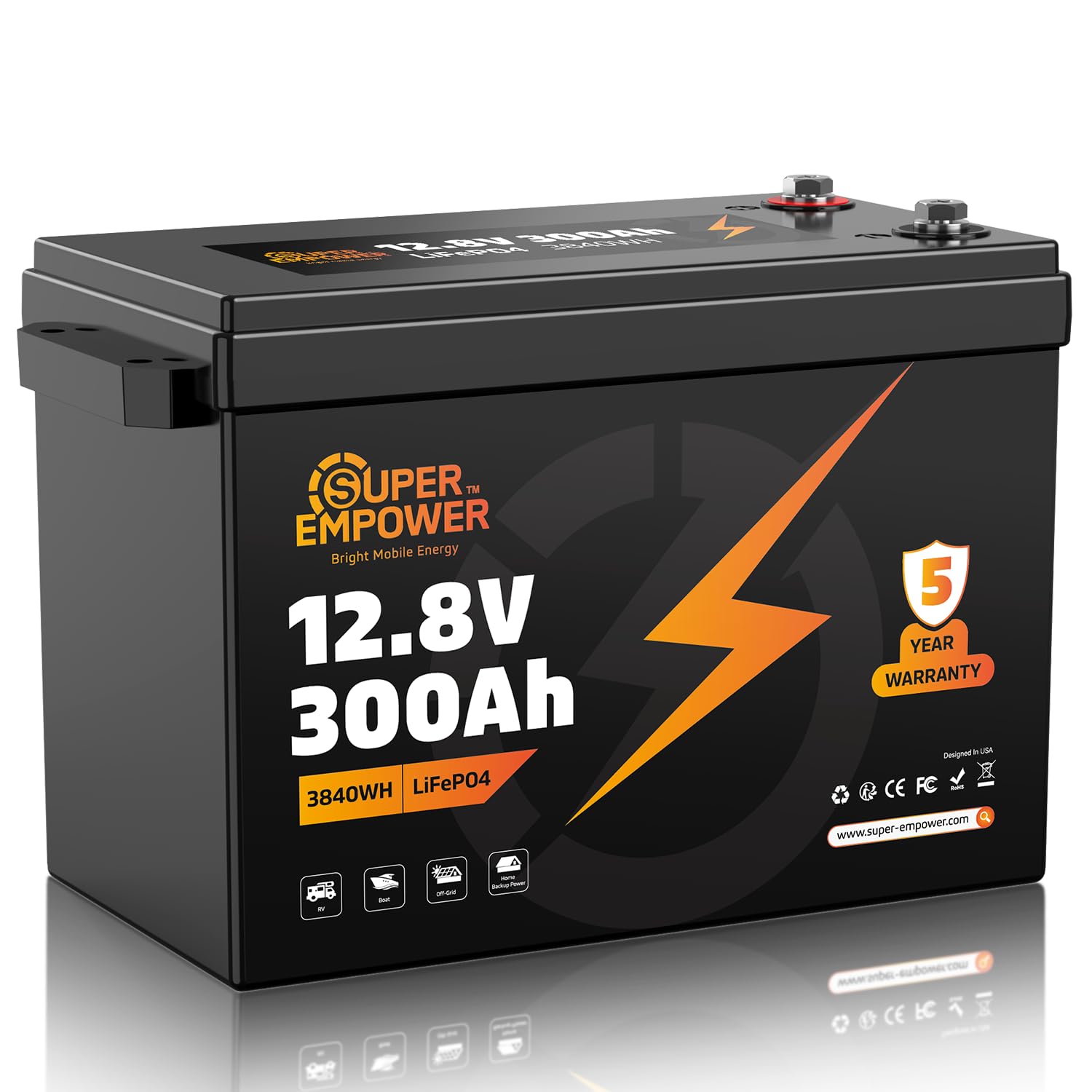
The 3840Wh brute that replaces four lead-acid batteries in one box
The SUPER EMPOWER 300Ah is the answer for campers who want one battery to replace a whole bank. It packs 3840Wh of energy into a single unit, and one owner used it to replace four Trojan T105s in a van while saving over 200 pounds of weight. At 58.4 pounds, it is roughly equal to the weight of one lead-acid battery but carries three times the usable energy — that is the math that makes a single big lithium worth it.
Real-world numbers back the size. Reviewers point out holding a constant 14.8 volts under load, running a van for 3 days of camping and still having 270Ah left, and getting about 6 hours of steady run time on demanding gear. The 200A BMS (battery management system — the safety circuit) manages charging, discharging, and temperature, and the low-temperature function pauses charging below 0°C (32°F) and stops discharge at –20°C (–4°F) before resuming above 5°C (41°F). That cold-weather behavior makes it a genuine choice for winter camping.
The catch is physical. At 15.35 x 7.59 x 9.84 inches, it will not fit a standard Group 31 box — owners note you need a commercial or custom metal box, which can cost extra and demands planning. The M8 terminals are substantial, and the rope handles make moving the 58.4-pound unit manageable. A sailboat owner who runs two of them notes a “sleepy BMS” that needed a day-long jump start, though the support team resolved it — so treat the first connection with patience.
Wh per pound winner: Battery performance leads owner praise, with steady 14.8V output and the 200+ pound weight savings versus a lead-acid bank earning the loudest cheers.
Size reality: The oversized footprint is the recurring note — this is not a drop-in; it is a build-around.
Grab it if: you are building or rebuilding a van or camper and want one battery to handle days of off-grid living.
Plan ahead if: your compartment is a standard Group 31 tray — this needs a bigger or custom enclosure.
8. ECO-WORTHY EnergyRock 12V 280Ah Metal Case LiFePO4
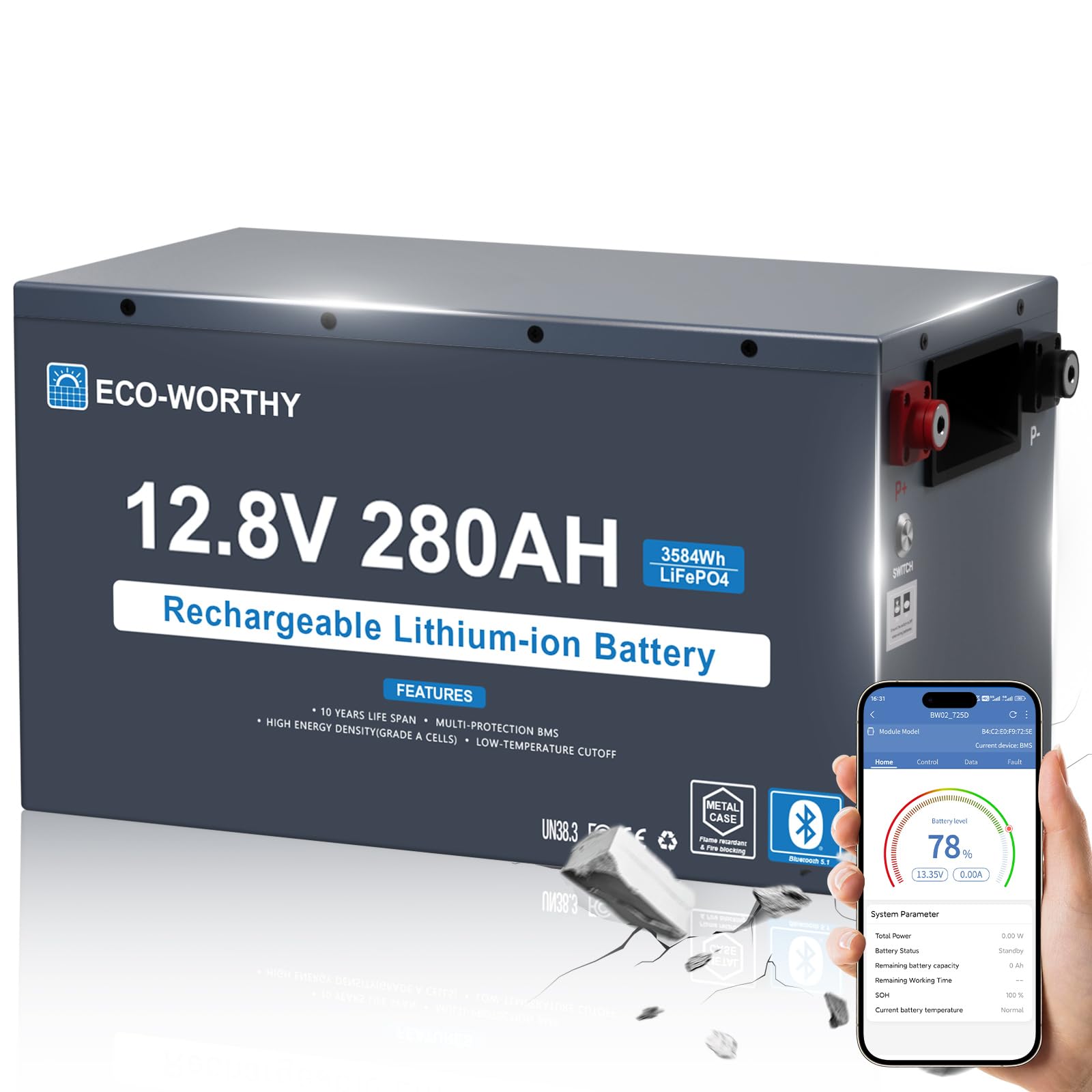
The metal-armored 280Ah that skips the battery box entirely
The EnergyRock is the toughest battery in this lineup, wrapped in a heavy-duty metal enclosure instead of the usual plastic shell. That metal case gives it enhanced heat resistance and fire protection, and it means you can bolt it straight into your RV with the 4 included mounting feet — no extra battery box required. The side posts, on/off switch, and flat stackable top make it a clean install, and the reinforced case plus internal cell holders shrug off road vibration on rough trails.
Capacity is the headline: at 280Ah, it outruns every other pick here except the 300Ah SUPER EMPOWER above, and shoppers say it exceeds its rated capacity. One RV owner powered a 12V 10 cu ft fridge for two days straight, with the fridge starting from a warm state. The built-in Bluetooth app delivers real-time voltage, capacity, and charge/discharge status, and the low-temperature cutoff stops charging at 20°F to protect the cells — it ran fine at that same temperature in testing.
The 200A BMS (battery management system — the safety circuit) handles protection, and the one-touch safety switch cuts the discharge circuit for safer installs or maintenance. A campervan owner ran a shop vac, table saw, and a 12K BTU AC for 2 hours down to 30% charge, which tells you the surge capability is real. It weighs around 60 pounds, so it is not light — but you get roughly 2.5x the capacity of a 110Ah AGM at comparable weight. Durability is the one aspect with mixed feedback, so treat the metal case gently against sharp impact, though the build quality otherwise earns strong praise.
Why the boondocker chooses it
- 280Ah with Bluetooth monitoring built in
- Metal case needs no extra battery box
- 200A BMS with a one-touch safety switch
Know before you buy
- Around 60 pounds — a two-hand lift
- Durability draws mixed notes; the metal shell still deserves care
Speaks to: off-grid boondockers who want big capacity, Bluetooth insight, and a case that survives the trail.
Weigh the cost: in pounds and dollars — this is a premium, heavy commitment, not a casual swap.
Understanding the Specs
Amp-Hours (Ah) and Usable Power
The amp-hour rating tells you how much current the battery can supply over an hour. A 100Ah battery can theoretically deliver 100 amps for one hour, or more realistically 5 amps for 20 hours. The number that matters more is usable capacity: a lead-acid battery can only be drained to about 50% without damage, so a 100Ah lead-acid gives you roughly 50Ah of usable energy. A LiFePO4 lithium battery gives you the full 100Ah because it tolerates deep discharge.
The BMS (Battery Management System)
The BMS is the battery’s onboard safety computer. It monitors voltage, current, and temperature, and it cuts power to protect the cells if something goes wrong — like overcharge, over-discharge, overcurrent, or extreme heat or cold. A 100A BMS can handle 100 amps of continuous draw, which is plenty for a fridge and lights. Some batteries add low-temperature cutoff, which stops charging in freezing conditions to save the cells, and a few even include Bluetooth so you can watch status from your phone.
FAQ
How many amp-hours do I need for a weekend in a camper?
Can I use a lithium battery in my existing camper that came with lead-acid?
What is the difference between a deep cycle battery and a starting battery?
How much weight will a lithium battery save me?
Will a 100Ah battery run a 12V fridge overnight?
What does Bluetooth monitoring actually do for me?
Can I connect multiple camper batteries together for more capacity?
Is lead-acid or lithium better for a camper battery?
How do I read the group size and know it will fit my camper?
Final Thoughts: The Verdict
For most buyers, the 12v camper battery winner is the Litime 12V 100Ah because it pairs the lightest lift in its class — 21 pounds — with built-in Bluetooth monitoring and the full 100Ah of usable capacity that campers actually need. If you want the budget route with zero electronics to think about, the WEIZE AGM delivers dependable lead-acid power at 63 pounds. And for maximum off-grid runtime in one box, the ECO-WORTHY EnergyRock 280Ah gives you metal-case toughness plus big capacity that outlasts a weekend.
How We Picked
We do not accept paid placement. Every pick is matched to a real buyer and a real use-case; we do not hands-on test units.
Sources & Methodology
Specifications: manufacturer listings and product documentation. Review insights: verified customer reviews, as of August 2026. Pricing: not shown on this page (it changes often); check the current price via the retailer link.
As an Amazon Associate, Gadgets Feed earns from qualifying purchases. This does not affect which products we feature.