
There is nothing worse than climbing into a frozen cab on a bitter winter morning, only to realize your vehicle’s stock heater barely takes the edge off. A dedicated 12V car heater changes that equation entirely, delivering focused warmth directly to you or your windshield without idling the engine for fifteen minutes. Whether you drive a truck with a long cold soak, an older car with a weak HVAC system, or an off-road rig without cabin insulation, this is the upgrade that transforms a frigid commute into a tolerable one.
I’m Min — the co-founder and writer behind Gadgets Feed. I spend hundreds of hours researching automotive accessories, cross-referencing heat output claims against real-world amperage draws and user installations, so I can separate the few heaters that genuinely warm a cabin from the many that merely blow lukewarm air at your knees.
After analyzing dozens of models across multiple design types — electric ceramic, coolant-based auxiliary, and compact blowing units — I’ve built this guide around the specific tradeoffs that matter most. Keep reading to find the best 12v car heater for your winter setup.
How To Choose The Best 12V Car Heater
Not every heater that plugs into a cigarette socket is worth your time. The key is matching the heater’s power draw and heat delivery method to your vehicle’s electrical system and your specific need — cabin warmth, windshield defrost, or both.
Amperage and Battery Safety
Every 12V outlet has a fuse rating — usually 10A to 15A in passenger cars, sometimes 20A in trucks. A ceramic heater pulling 8A to 10A is safe for most lighter ports, but a 300W unit drawing over 25A demands a direct battery connection with heavy-gauge wire. Drawing more than the circuit can handle will blow the fuse or, worse, overheat the wiring. Always check your vehicle’s accessory socket fuse before plugging in a high-power model.
Electric PTC vs. Coolant-Based Heat
Electric PTC (Positive Temperature Coefficient) heaters are the simplest plug-and-play option — they use ceramic elements that self-regulate temperature, drawing power directly from your battery. They warm up in seconds but are limited to roughly 200W–300W on a typical circuit. Coolant-based auxiliary heaters tap into your engine’s existing hot coolant loop, delivering 8,000 BTU or more using the heat your engine already produces. They require hose connections and a water pump but generate far more heat without draining your alternator.
Mounting and Airflow Direction
Dash-mounted electric heaters need a stable, non-slip surface and a clear path to blow warm air toward the driver or windshield. Underdash coolant heaters typically mount with brackets or bolts beneath the glove box or center console, then connect ducting to direct airflow. If you need defrosting, look for a unit with a 360° rotatable head or adjustable louvers so you can aim heat exactly at the windshield base. Static, non-adjustable heaters are far less useful in practice.
Quick Comparison
On smaller screens, swipe sideways to see the full table.
| Model | Category | Best For | Key Spec | Amazon |
|---|---|---|---|---|
| Roadpro RPSL-681 | Electric Ceramic | Direct battery hardwire | 300W, 15-ft 12-gauge wire | Amazon |
| Therwen Auxiliary Heater | Coolant Loop | Full underdash defrost | 4-port, 6.9 lbs | Amazon |
| Saihisday Auxiliary Heater | Coolant Loop | Budget coolant upgrade | 4-port, 8A draw | Amazon |
| XuSha 8000 BTU | Coolant Loop | High heat output in compact space | 8,000 BTU, 7 lbs | Amazon |
| KINOWJI 200W Defroster | PTC Electric | Windshield defog & dash heating | 200W, 360° base | Amazon |
| Haofy PTC Ceramic | PTC Bare Element | Small enclosure / 3D printer heat | 100W, 8.33A cold draw | Amazon |
| Yerloa Dual Fan | Electric Fan (Cooling) | Cab ventilation in hot weather | Dual head, 360° rotation | Amazon |
In‑Depth Reviews
1. Roadpro RPSL-681 12-Volt Ceramic Heater/Fan

The Roadpro RPSL-681 stands apart because it ships with a 15-foot, 12-gauge wire set designed for a permanent battery connection — not a flimsy cigarette lighter plug that limits current. At 300 watts of ceramic PTC heat, this unit delivers roughly double the warmth of typical 150W dash-top heaters, but those watts come with a catch: you must hardwire it directly to the battery. The supplied wire is properly sized for the 25A draw, and the included switch lets you toggle between heat-only and fan-only modes.
Owners report that the fan’s airflow is modest — the heat only travels about 6 inches from the grill on the high setting. That short throw makes the Roadpro best suited for direct impingement heating: aim it at your legs, your feet, or a small space like a tractor cab rather than trying to heat the entire cabin. The burn-guard material over the heating element is a genuine safety detail that cheaper units lack, and the low/high fan speed adjustment gives some flexibility.
The main drawback is the lack of a mounting bracket — the box sits on a flat surface, which can slide around on a bumpy road. It also draws enough current that you should never run it with the engine off unless you have a deep-cycle auxiliary battery. For a permanent install where wiring effort is acceptable and focused heat is the goal, this is the most capable electric 12V ceramic model available.
Why it’s great
- True 300W ceramic heat with proper 12-gauge wire included
- Burn-guard over element adds real safety for enclosed use
- Separate fan-only mode for summer ventilation
Good to know
- Fan has short throw — heat only reaches a few inches
- No built-in mount; slides on smooth surfaces
- Requires permanent battery wiring, not plug-and-play
2. Therwen 12V Universal Car Auxiliary Heater

The Therwen auxiliary heater uses your engine’s coolant loop rather than battery power, so it can produce far more heat than any electric plug-in unit. With four circular vent ports and a compact metal-core body weighing in at 6.93 pounds, this unit connects to 5/8-inch heater hose and mounts under the dashboard to blow hot coolant-circulated air directly at the windshield or into the cabin. It does not require additional wiring for power — just the coolant hoses and a 12V signal to the fan switch — making it a cleaner install for someone comfortable splicing into a cooling system.
User feedback consistently highlights excellent heat output once the engine reaches operating temperature, with the blower moving enough air to clear a fogged windshield in short order. The noise level varies: some owners call it quiet, others describe the fan as loud. The unit does not include mounting bolts, so you will need to source your own fasteners. The switch quality also draws mixed reviews, with a few reports of switches failing after short use.
For anyone driving an older truck, a classic car, or a van that lacks adequate factory defrosting, the Therwen delivers genuine warmth rather than the tepid breeze of a lighter-plug heater. It won’t work at all until the coolant warms up, so it is useless for a cold start, but once the engine is warm, it outperforms every electric heater on this list in raw BTUs.
Why it’s great
- Uses engine coolant for high BTU output, not battery power
- Four adjustable vent ports for targeted defrosting
- Compact enough to fit under most dashboards
Good to know
- No mounting hardware or bolts included
- Fan can be noticeably loud at higher speeds
- Switch quality inconsistent across units
3. Saihisday 12V Car Auxiliary Heater

The Saihisday heater shares the same basic engineering as the Therwen — a four-port coolant loop design that mounts under the dash — but at a more accessible price point that makes it a solid entry-level pick. The blower motor draws around 8 amps, and the metal housing feels reasonably stout for the price. Users report installing this unit in single-cab trucks like the 1998 Chevy S10 where every inch of space counts, and they consistently say it delivers noticeable warmth.
The instruction sheet is minimal, which can be frustrating for first-time installers — the wiring color codes are described in text only, with no diagram. The included hose clamps and plastic air tubes are the weakest components; several buyers note that the clamps strip easily and the tubes feel brittle. The fan motor itself is described by some as a bit weak compared to premium coolant heaters, but it still moves enough air to defrost a windshield in moderate cold.
If you are on a tight budget and need a coolant-based heater rather than an electric plug-in, the Saihisday provides a path to real heat without the premium price tag. Plan to replace the included clamp hardware and possibly the switch, but the core heater unit itself performs reliably when properly installed. It is the most affordable way to get into an auxiliary coolant heating system.
Why it’s great
- Functional coolant heater at a budget-friendly price
- Four ports give good coverage for single-cab vehicles
- Metal body offers decent durability for the money
Good to know
- Included hose clamps and tubes are low quality
- Weak blower compared to more expensive units
- No wiring diagram — tricky for first-time installers
4. XuSha 8000 BTU 12V Universal Car Heater

The XuSha 8000 BTU heater is explicitly rated for high heat output, placing it in the same coolant-loop category as the Therwen and Saihisday but with a smaller and lighter body — 10.6 x 8.4 x 4 inches and 7 pounds. It connects to your vehicle’s heater hose circuit using 5/8-inch inner diameter tubing, and its four vents provide focused airflow to the windshield or footwell. The smaller footprint makes it easier to wedge into tight underdash spaces on UTVs, classic trucks, or vehicles with minimal cabin room.
Customer experiences reveal a split: many users see dramatic improvement in cab warmth, with one owner reporting comfortable driving at 16°F in a Polaris RZR with soft doors. Others report vibration that causes acoustic noise, and at least one had the switch burn out after the second use. The mounting screws may be missing from some boxes, and the instruction manual is cryptic. However, once properly installed and secured, the core heater produces genuine engine-heated air that no 12V electric unit can match.
The big tradeoff is that the XuSha, like all coolant heaters, provides no heat until the engine is warm. That makes it a complement to an electric dash heater, not a replacement. For a cold-weather UTV, a rescue vehicle, or a farm truck that idles for long periods, the high BTU rating from a compact form factor is a strong argument in its favor.
Why it’s great
- True 8,000 BTU output from a compact coolant loop design
- Fits in tight underdash spaces where larger units won’t go
- Four-port vents allow decent coverage for a small cabin
Good to know
- Some units vibrate and produce annoying acoustic noise
- Switch quality is inconsistent — may fail early
- Hardware (mounting screws) sometimes missing from package
5. KINOWJI 200W 12V Fast Heating Defroster
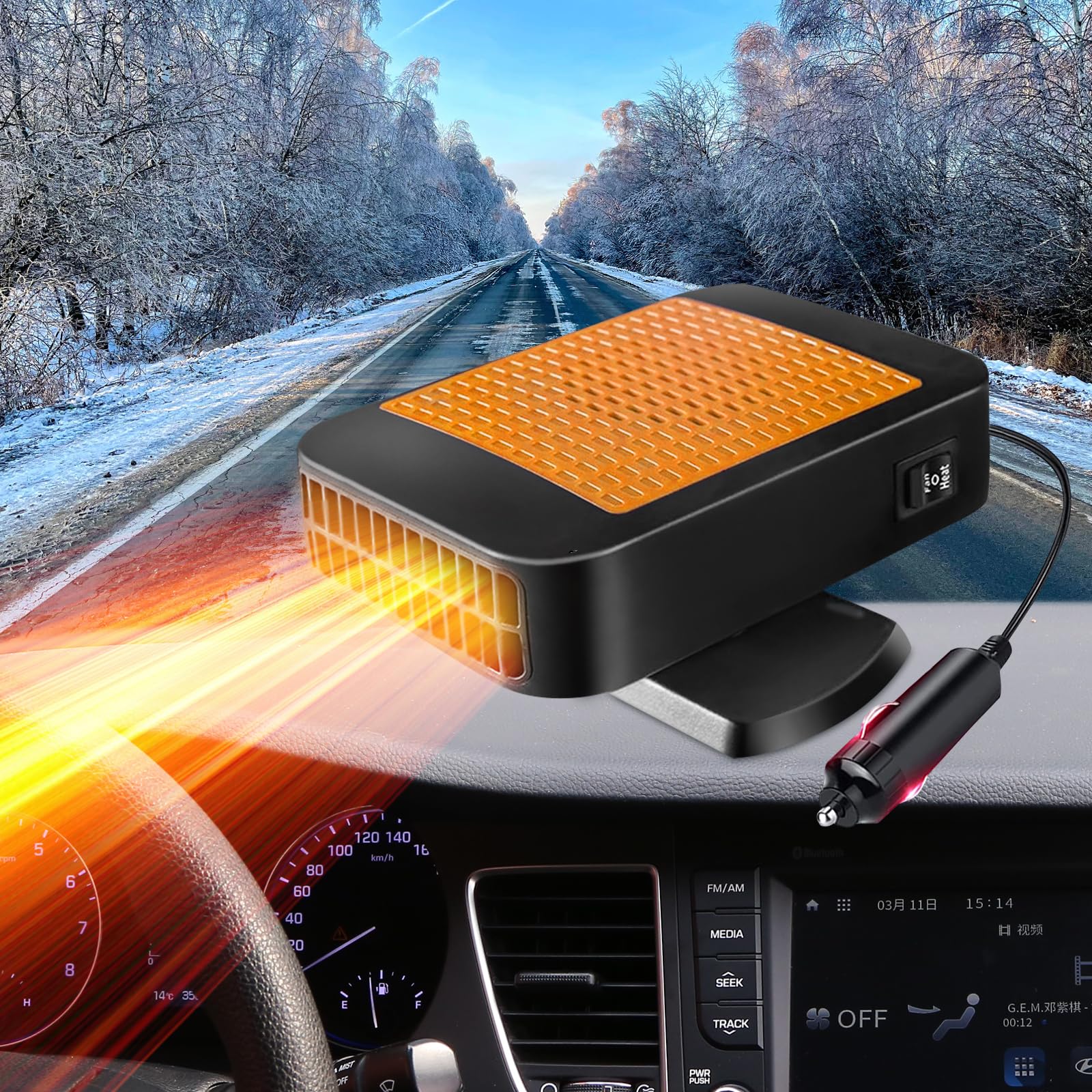
At 200 watts and weighing only 12.6 ounces, the KINOWJI defroster is a lightweight, plug-and-play electric heater designed primarily for windshield clearing. The 360° rotatable bracket lets you aim the heat directly at the glass, and the compact body fits on any dashboard or center console without blocking visibility. It plugs into a standard 12V cigarette lighter socket, making it the fastest install on this list — you pull it out of the box, plug it in, and rotate the head toward the windshield.
User feedback is mixed, which is typical for this sub- price tier. Enthusiastic buyers describe strong airflow and huge improvement for rear passengers in SUVs, while detractors report the unit stops working after the return window closes — possibly due to a poor internal connection or switch failure. The three-speed fan is genuinely quiet on all settings, but the heater core’s warmth is best described as supplementary rather than transformative. It will defog a windshield faster than the factory defroster alone, but it will not heat a cold cabin to shirt-sleeve comfort.
For its intended role as a spot defogger and auxiliary warm-air blower, the KINOWJI hits a sweet spot of convenience and price. Just be aware that longevity may be a gamble — treat it as a seasonal accessory and test it thoroughly during the return period. If it survives its first winter, it is a bargain.
Why it’s great
- Truly plug-and-play with a standard 12V lighter socket
- Rotating head lets you aim heat exactly at the windshield
- Very quiet operation across all three fan speeds
Good to know
- Reliability is inconsistent — some units fail after a few uses
- 200W output is only supplemental, not full cabin heat
- Short power cord may limit placement options
6. Haofy PTC 100W 12V Ceramic Air Heater

The Haofy PTC heater is a bare-element unit — no housing, no switch, no fan speed control — making it a specialist tool rather than a general cabin heater. It measures just 2.4 inches on each side and weighs 155 grams, so it is designed to be wired into custom enclosures like 3D printer filament dryers, small incubators, or battery compartments in RVs. The ceramic element self-regulates its temperature, drawing around 8.33 amps when cold and dropping as it warms, which is a genuine safety advantage over nichrome wire heaters.
Users rave about its performance in small spaces. Several owners installed it to keep LiFePO4 batteries from freezing in custom campers, and 3D printer enthusiasts use it to preheat enclosures for ABS prints. The lack of a wiring diagram frustrates some buyers, but the wiring is straightforward: two thin wires for the fan motor, two thicker wires for the ceramic heater element. You must provide your own fan, enclosure, and thermostatic control.
This product is absolutely not for someone looking to plug a heater into their car’s dash. It is for the DIY builder who needs a compact, self-regulating heat source in a 12V system. If that describes your project, the Haofy is an excellent, cheap building block. If you just want warm air in your cab, look at the plug-in options above.
Why it’s great
- Self-regulating PTC ceramic element is safe and efficient
- Extremely small footprint fits into custom enclosures easily
- Very low power consumption once it reaches target temp
Good to know
- No fan, housing, wiring diagram, or thermostat included
- Requires DIY wiring knowledge to install safely
- Only suitable for small enclosures, not cabin heating
7. Yerloa Dual Head 12V Car Fan
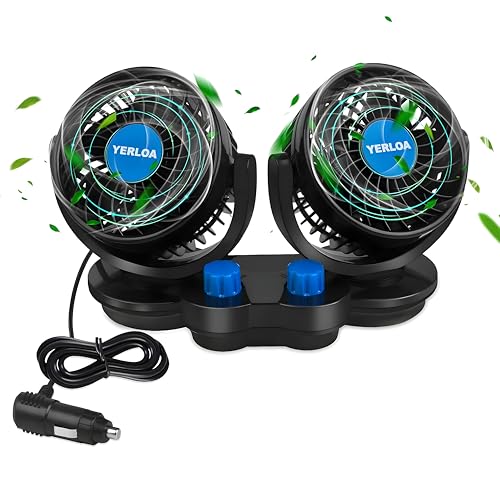
The Yerloa dual-head fan is not a heater — it is a 12V cooling and ventilation fan — but it earns a place in this guide because many buyers search for 12V heaters and benefit from a solution that handles both hot and cold weather. The two fan heads rotate independently 360 degrees, and each fan has its own separate on/off switch. It plugs into a standard cigarette lighter socket, draws minimal power, and produces a strong breeze that can make a broken AC or no-AC vehicle bearable during summer.
Owners of UTVs, golf carts, and older cars without working air conditioning find this fan invaluable. One user mounted it in a Polaris RZR and reported the brushless motor resists dust well. The included 3M adhesive pads are genuine and hold securely. The noise level blends with road noise at speed, and the two-speed switch gives basic airflow control. The build quality is adequate for the price, though the plastic housing and mounting clip feel light.
For true year-round cabin management, pair the Yerloa with one of the electric or coolant heaters above. It won’t generate any heat, but it will circulate air and provide a lifesaving breeze when the mercury climbs. If you only need winter heat, skip this one and focus on the ceramic or coolant models earlier in this guide.
Why it’s great
- Dual independently rotating heads cover multiple seating positions
- Low amp draw is safe for standard 12V accessory sockets
- Brushless motor handles dusty environments well
Good to know
- This is a cooling fan, not a heater — no heat function
- Plastic components feel less durable than metal alternatives
- One fan may be installed backwards from the factory
FAQ
Can I run a 12V car heater off the cigarette lighter without draining the battery?
What is the difference between a PTC heater and a coolant-based auxiliary heater?
How do I know if my vehicle’s electrical system can handle a 200W heater?
Can a 12V car heater be left unattended while driving?
Final Thoughts: The Verdict
For most users, the best 12v car heater winner is the Therwen Auxiliary Heater because it delivers real, engine-generated heat without taxing your electrical system, and its multi-port design clears a windshield faster than any plug-in ceramic unit. If you want instant plug-and-play warmth for defogging or spot heating, grab the KINOWJI 200W Defroster. And for a permanent high-heat solution in a small vehicle or UTV, nothing beats the XuSha 8000 BTU for its compact footprint and genuine BTU output.