
Our readers keep the lights on and my morning glass full of iced black tea. As an Amazon Associate, I earn from qualifying purchases.
Specs are compiled from manufacturer listings and verified buyer reviews and can change over time — please confirm the key details on the product page before buying.
Choosing a 12V DC fan is rarely about picking the biggest brand. It is about matching airflow, noise, and size to the exact job you have in front of you — cooling a fridge, ventilating a grow tent, or replacing a whining computer case fan. This guide ranks eight 12V DC fans by airflow, noise, and fit for specific cooling jobs.
I’m Min — the founder and writer behind Gadgets Feed. This guide is built by comparing the manufacturers’ published specifications and the patterns across verified customer reviews, so you get each pick’s real strengths and trade-offs instead of marketing spin.
It is time to find a reliable 12v dc fan that balances quiet operation with powerful airflow for your specific electronics and DIY cooling needs.
Our Picks at a Glance


How To Choose The Best 12V DC Fan
Measure your mounting space first—a 120mm fan won’t fit a 60mm slot. A 120mm fan moves a lot of air but will not fit in a tight DVR or a compact network switch. Match the fan’s amp draw to your power supply’s capacity, especially in RVs or solar setups.
Size and Mounting Holes
Standard sizes (60mm, 80mm, 120mm) make matching your old fan’s dimensions the fastest path to a perfect fit. Pay attention to the thickness too, since a 25mm-thick fan pulls more air but might not fit a slim laptop dock. Check the hole-to-hole distance if you are replacing a fan in a custom enclosure, because mounting points vary even within the same “standard” size.
Airflow vs. Static Pressure
Airflow, measured in CFM (cubic feet per minute), tells you how much air the fan moves in free space. For pushing air through a dense heatsink, a radiator, or a filter, you need static pressure, which is measured in inches of water column (In H2O). A high-CFM fan with low static pressure will struggle in a restricted space, so think about whether you are moving air through open space or against resistance.
Noise and Bearing Technology
Noise is measured in dBA; a 10 dBA increase sounds twice as loud. Sleeve bearings are cheap but short-lived; dual ball bearings last longer and handle heat but are louder. Hydraulic bearings balance quiet operation with a long service life.
Quick Comparison
| Model | Best For | Airflow (CFM) | Speed (RPM) | Noise (dBA) | Amazon |
|---|---|---|---|---|---|
| Wathai 120mm 2-Pack★ Best Overall | High-volume DIY cooling | 66.7 | 2000 | 28 | Amazon |
| KEYFANCLUB 120mm 2-PackQuiet Performer | Quiet case ventilation | 58 | 1500 | 23 | Amazon |
| GDSTIME 60mm 2-PackSpace-Saving Specialist | Slim tight builds | 18.2 | 3500 | 25.8 | Amazon |
| PANO-MOUNTS 80mm 2-Pack | Moisture-prone areas | 46.5 | 3500 | 38.5 | Amazon |
| ANVISION 40mm 2-Pack | Tiny DVR & server spots | 7.56 | 6200 | 27.5 | Amazon |
| PANO-MOUNTS 120mm 2-Pack | Maximum airflow output | 88 | 3000 | 47 | Amazon |
| Wathai 60mm Waterproof | Outdoor & splash zones | 26 | 4500 | 36 | Amazon |
| GDSTIME 80mm 2-Pack | Heavy-duty enclosure cooling | 59 | 4500 | 43.2 | Amazon |
In‑Depth Reviews
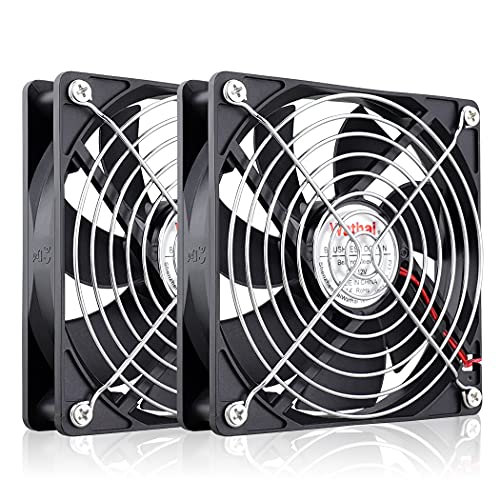
1. Wathai 120mm x 25mm 12V Computer Case Cooling Fan 2-Pack
Our pick — over 4.5★ from 550+ verified ratings; the strongest balance of quality and price.
The big dual-pack that quietly powers serious DIY cooling projects while staying affordable.
If you need to move a serious volume of air, this 120mm pair tops the list because it pushes 66.7 CFM at just 28 dBA — a strong airflow-to-noise balance that few fans in this tier match. The packing includes a fan grill and mounting screws, so you can get it mounted and running the moment it arrives. Buyers report it proved effective in a chicken coop, lowering the temperature several degrees over weeks of constant use.
You can mount this fan almost anywhere—from a space heater to a grow tent—because it weighs just 4 ounces and runs on a standard 12V 0.15A feed that most power supplies handle easily. Owners praise the build quality most, calling it consistent and sturdy, which matters for a fan that might run 24/7. The 28cm (11-inch) cable gives you plenty of reach inside a larger enclosure.
The sleeve bearing is rated for 35,000 hours, limiting lifespan in hot environments. It is fine for a few years of heavy use, but a dual ball bearing would last longer in a very hot environment. Noise feedback is a little split, with a few owners noting a slight high-pitched tone, though most report it as quiet. This is the best all-rounder for anyone who wants maximum airflow from a 120mm frame without constant whine.
Why It Wins
- Excellent 66.7 CFM airflow for the size
- Grill, screws, and nuts included for easy setup
- Proven in humid environments like coops and greenhouses
Watch Out For
- Sleeve bearing caps lifespan at 35,000 hours
- Noise is mixed, with a few noting a high-pitched tone
Reach for it when: you need a high-volume airflow workhorse for a grow tent, workshop exhaust, or a large electronics cabinet.
Look elsewhere if: you are building a silent media PC, because the 28 dBA rating is quiet but not invisible.
2. KEYFANCLUB 2-Pack 120mm DC 12V Computer Fan
The standby workhorse that has quietly spun 24/7 for years in countless builds.
This is the fan for anyone whose top priority is a whisper-quiet environment. At 1500 RPM and just 23 dBA, it is markedly quieter than the Wathai above, though it gives up some airflow at 58 CFM. That makes it a great pairing for a bedroom PC or a DIY fume extractor used while filming, where the low noise is the whole point.
The 2-pin XH2.54 connector is simple — red is positive, black is negative — and the 11.8-inch wires give you room to route cleanly. Owners love that it is reliable and inexpensive, with one reporting two of these running 24/7 since 2021 without issue. It sips just 1.2 watts, so it is also a smart pick for a solar-powered or battery-run ventilation project where every watt matters.
The honest catch is airflow. A few owners note it does not move as much air as they hoped from a 120mm frame, so it is not the best choice for pulling heat off a high-wattage amplifier. But for circulating air in a quiet office, a fridge, or a console cabinet, the silence is worth the trade. The included metal grill and hardware make mounting a real five-minute job.
Best-case scenario: a near-silent, low-power fan for a bedroom setup or film-friendly DIY extractor where background hum is unacceptable.
The trade-off: if you need maximum air movement, the quieter 1500 RPM speed leaves the high-CFM work to a faster fan.
3. GDSTIME 60mm x 15mm Fan 3 Pin 12V DC Brushless Quiet Slim PC Cooling 2-Pack
A paper-thin 60mm fan that fits impossibly tight spots while reporting its own speed.
When space is the enemy, this slim 60mm fan is the answer. At just 0.59 inches thick and 1.32 ounces, it is tiny enough for a compact mini-ITX build, a DVR, or a network switch, yet it still spins at 3500 RPM and moves 18.2 CFM. The 3-pin connector is the standout feature here: the yellow tachometer wire feeds your RPM signal back to the motherboard, so you can monitor exactly what the fan is doing.
Owners in tight ITX builds report the temps dropped dramatically — one saw a 55-65°C range settle to 35°C after mounting these. The hydraulic bearing keeps things quiet at 25.8 dBA, and it starts at just 7V, so it is forgiving if your power rail dips. The included 8 screws and nuts make installation easy, and at just 2.36 inches square, it will not crowd your other components.
A recurring note is that delivering all three fans from one header can cause a shutdown, so plan your splitters carefully. Also, this is a modest 18.2 CFM, which is expected at this size, but too little for a large case. If you need to cool a tiny enclosure with speed feedback and care about fit, this is the best small-format pick.
Its specialty: precise, slim 60mm cooling with motherboard RPM feedback for cameras, DVRs, and tight PC builds.
Plan ahead: give each fan its own header or a powered hub to avoid one shutting down under load.
4. PANO-MOUNTS 80mm Moisture-Proof 12V High Airflow Cooling Fan 2-Wire 3-Pin 2-Pack

An 80mm fan built to shrug off humidity in greenhouses, garages, and RV fridges.
If your fan will live anywhere damp, this 80mm model is engineered for exactly that. It carries an IP44 rating, meaning it resists splashing water and solid particles, which makes it a natural fit for an underground garage, a humid greenhouse, or a marine electrical box. It pushes a strong 46.5 CFM at 3500 RPM, so you are not sacrificing airflow to get the moisture protection.
The 2-wire 3-pin connector (0.33A, 3.96W) is easy to wire, and owners have used it to build a circulating fan for an RV fridge, running it off the light switch wires. One used it to cool a welding unit without hassles, and it holds up in a boat amp application. At 7.36 ounces for the pair, it has a bit of heft that suggests a solid build.
The honest warning is that noise at 38.5 dBA is firmly in the audible camp, and durability reports are split — some units have failed within days. If you need silence, choose a slower fan; if you need to move air in a humid space, this is the focused pick, just buy with the expectation of some noise.
The right setting: a humid environment like a greenhouse or boat compartment where an ordinary fan would not last.
Know the cost: the 38.5 dBA noise and mixed durability make it a fit for function-first spots, not quiet bedrooms.
5. ANVISION 2-Pack 40mm x 10mm DC 12V Brushless Cooling Fan, Dual Ball Bearing

A tiny 40mm fan that spins at 6200 RPM to rescue DVRs and Ham radios from heat.
Do not let the 1.57-inch size fool you. This little 40mm fan spins at 6200 RPM and moves 7.56 CFM, which is remarkable for such a small frame and exactly what a cramped DVR or surveillance recorder needs. The dual ball bearing is a huge plus here, giving it a much longer service life than a sleeve bearing in a hot, always-on device.
Owners mention using it to revive old DVR fans—one whining, one dead—and the replacements worked perfectly, keeping Ham Radio power supplies cool. The 2-pin connector is reversible, so you can flip the airflow direction if needed, which is handy in a tight install. The two-year warranty adds confidence for a fan that often runs 24/7.
The catch is that 40mm is genuinely tiny, and some buyers misjudge the size. Also, at 27.5 dBA, it is not silent; owners note it is fine in a closet or remote area but noticeable in a quiet room. If you have a small, hot device, this is the focused fix — just do not expect it to cool a room.
Its role: targeted spot-cooling for tiny electronics like DVRs and radio gear, with a durable dual ball bearing.
Remember: double-check the 40mm dimensions before ordering, and expect audible high-RPM whine.
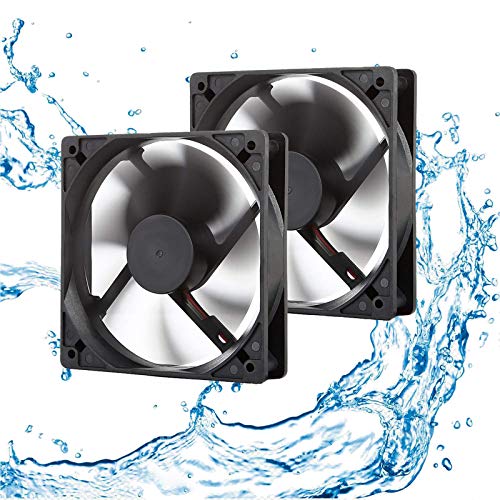
6. PANO-MOUNTS 120mm 12V 2-Wire 3-Pin 3000RPM Moisture-Proof RV Cooling & Exhaust Fan 2-Pack
The high-speed 120mm powerhouse that drops RV fridge temps by several degrees.
When you need to move the most air possible from a 120mm frame, this is the fan that delivers. It hits a huge 88 CFM at 3000 RPM — a full third more airflow than the Wathai pick — while still keeping noise in check thanks to a hydraulic bearing. The IP44 moisture-proof rating means it is right at home in a humid greenhouse or an RV fridge compartment.
Customers note it fit Norcold refrigerators perfectly and cooled their RV fridge noticeably in desert heat. One used it to replace the fans on a wine cooler and found it much more affordable than buying a new unit. The 2-wire 3-pin setup runs on 7V-13.2V, so it is tolerant of voltage dips. At 14.08 ounces for the pair, it feels substantial and well-made.
The realistic trade-off is volume. At 47 dBA, this is the loudest fan on this list, so it belongs in a garage, a workshop, or a fridge compartment, not in a bedroom. There is also a note about durability that is a bit mixed, so it is not the pick if you need a silent 24/7 whisper. For raw cooling power in a vented space, nothing else here comes close.
Why Push Air Here
- Massive 88 CFM airflow beats most 120mm peers
- IP44 moisture protection for damp locations
- Proven fit for RV and wine cooler replacement
Where It Falls Short
- 47 dBA is noticeably loud for indoor use
- Durability feedback is not uniformly glowing
Choose this for: RV fridge exhaust, solar inverter cooling, or greenhouse ventilation where max airflow beats silence.
Pass on it if: a quiet home office or living room is the destination — the noise will dominate the space.
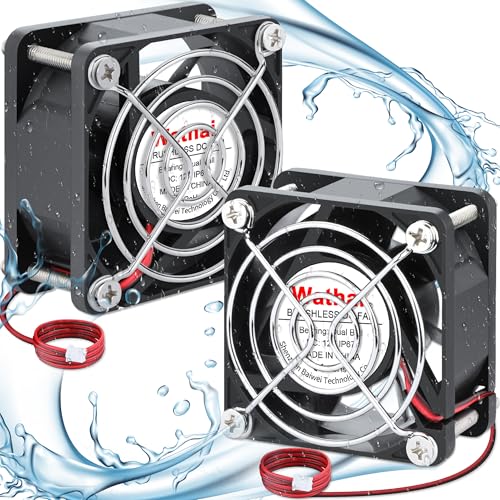
7. Wathai 60mm 12V Fan Waterproof High Speed Small 12V DC Computer Cooling Fan
A rugged 60mm fan sealed against rain and splashes for outdoor and marine projects.
This is the fan you want when the weather is part of the challenge. With an IP67 rating (fully dust-tight and safe against temporary water immersion), it stands out for a greenhouse, pet house, shed, or marine environment where splashes are a fact of life. It also spins at 4500 RPM and pushes a solid 26 CFM.
The dual ball bearing is rated for 50,000 hours, giving it a long, reliable service life. Owners have run these continuously for over six weeks in a marine environment and reported they stayed efficient and quiet. Another used them in a fish house and noted the waterproofing meant a spilled beer did not kill them. It runs on just 0.2A, so it is easy on the power budget.
The trade-off is that at 36 dBA, it is audible — not silent, but acceptable for most outdoor or mechanical uses. A few owners noted the water resistance is not as bulletproof as advertised over time, so it is best for splash zones rather than constant submersion. If you need a small, tough fan that survives the elements, this is the one.
Best location: a damp shed, a chicken coop, a marine console, or any place a standard fan would corrode.
Keep expectations honest: the IP67 seal handles rain and splashes, not permanent underwater operation.
8. GDSTIME 2-Pack 80mm x 25mm Dual Ball Bearings High Speed 12V Cooling Fan

A compact 80mm fan that roars with 59 CFM for serious enclosure and inverter cooling.
For a fan of its size, this 80mm unit is a genuine brute. It spins at 4500 RPM and pushes 59 CFM — a level of airflow that rivals many 120mm fans, making it ideal for a CNC controller box, a car audio amplifier, an inverter, or a battery box. The dual-ball bearing motor is rated for 50,000 hours, so it is built to run hard for years in a workshop or truck.
Owners consistently highlight the high airflow, with one calling it the best 12V fan output for its size after using it to cool solar controllers and inverters. The XH2.54 2-pin connector with 11.8-inch wires is easy to wire, and the kit includes metal fan grills and mounting screws. It runs on 7V to 13.5V, so it is flexible with different power sources.
The price of all that power is noise. At 43.2 dBA, it is genuinely loud — one owner measured 63dB at 3 feet, describing the office as sounding like a server room. There is also a documented case of a unit failing after months of use, though the seller replaced it quickly. If your priority is raw airflow in a noise-tolerant environment, this is the specialist pick.
Built For Power
- Outstanding 59 CFM from a compact 80mm frame
- Dual ball bearings rated for 50,000 hours
- Grills, screws, and long 11.8-inch wires included
Built To Be Heard
- 43.2 dBA is heavy — office spaces will notice
- Occasional unit failures reported, though replaced fast
Use it for: workshops, outdoor electrical cabinets, trucks, or any vented spot where moving air outweights the noise.
skip it if: a quiet living space is the destination — this fan is a workhorse, not a whisper.
Understanding the Specs
CFM: The Airflow Number That Matters
CFM, or cubic feet per minute, is the core measure of how much air a fan moves. It is the single best way to compare fans of the same size, and it tells you if a fan can actually cool a space. A large grow tent or engine bay needs high CFM, while a small DVR or network switch only needs a little to pull heat off a chip. A 40mm fan at 7.56 CFM is fine for a tiny device, but a 120mm fan at 88 CFM is built for serious ventilation.
dBA: The Noise Rating Explained
Noise is measured in dBA, a scale that matches how the human ear perceives loudness. Every 10 dBA increase sounds about twice as loud. A 23 dBA fan is near-silent in a bedroom, a 38 dBA fan is clearly audible in a quiet room, and a 47 dBA fan belongs in a workshop or garage. Remember that the number on the box is measured at a set distance in an open space — mounting it against a vent or in a metal box can amplify the sound.
FAQ
What is the difference between a 2-pin and a 3-pin fan connector?
Will a 12V DC fan work with a USB power source?
What does the IP rating mean on a waterproof fan?
What is the difference between a sleeve bearing and a ball bearing?
Is a higher CFM always better?
How do I know if a fan will fit my device?
Can I run a 12V fan on a lower voltage?
How long will a 12V DC fan last?
Why is my new fan louder than I expected?
What does static pressure mean for a fan?
Final Thoughts: The Verdict
For the majority of shoppers, the 12v dc fan winner is the Wathai 120mm 2-Pack because it strikes the best balance of powerful 66.7 CFM airflow and a reasonable 28 dBA noise level for a wide range of projects. If you want maximum airflow for an RV fridge or greenhouse, grab the PANO-MOUNTS 120mm, which pushes a class-leading 88 CFM. And for tight spaces like DVRs and compact PCs, the GDSTIME 60mm delivers slim, monitored cooling that simply fits where others cannot. The crowd favorite among these picks — the ANVISION 40mm pack with its 4.5 stars across 900+ owners — is the go-to for reviving dead micro-device fans, proving that a tiny, well-built fan can be the perfect specialized fix.
How We Picked
We do not accept paid placement. Every pick is matched to a real buyer and a real use-case; we do not hands-on test units.
Sources & Methodology
Specifications: manufacturer listings and product documentation. Review insights: verified customer reviews, as of August 2026. Pricing: not shown on this page (it changes often); check the current price via the retailer link.
As an Amazon Associate, Gadgets Feed earns from qualifying purchases. This does not affect which products we feature.