
Our readers keep the lights on and my morning glass full of iced black tea. As an Amazon Associate, I earn from qualifying purchases.
Specs are compiled from manufacturer listings and verified buyer reviews and can change over time — please confirm the key details on the product page before buying.
Choosing the right 12V deep cycle battery determines whether your trolling motor, RV fridge, or solar setup runs reliably all weekend. The real question isn’t just about capacity—it’s about how many times you can drain and recharge it before it gives up. This guide focuses on the two main chemistries you’ll actually choose between: the budget-friendly AGM lead-acid and the longer-lasting, lighter lithium iron phosphate (LiFePO4).
I’m Min — the founder and writer behind Gadgets Feed. This guide is built by comparing the manufacturers’ published specifications and the patterns across verified customer reviews, so you get each pick’s real strengths and trade-offs instead of marketing spin.
The best 12V deep cycle battery for your trolling motor, RV fridge, or solar setup depends on your budget and how often you drain it.
Our Picks at a Glance

How To Choose The Best 12V Deep Cycle Battery
Before you pick a battery, you need to know what “deep cycle” actually means. Unlike a car starter battery that gives a quick burst of power, a deep cycle battery is designed to be drained down and recharged over and over again. You need to match the battery’s chemistry to your usage pattern, weight tolerance, and climate.
Amp Hours (Ah) are your runtime
This is the single most important number. A 50Ah battery delivers 50 amps for one hour, or 5 amps for ten hours. For a trolling motor or an RV fridge, a higher amp-hour rating means longer time between charges. Match the Ah to your daily power use, not just the physical size you want.
Weight and chemistry: AGM vs. Lithium
AGM (Absorbent Glass Mat) batteries are cheaper and simpler, but they are heavy—a 100Ah AGM weighs over 60 lbs. Lithium (LiFePO4) batteries typically weigh less than half that, and they let you use more of their capacity (80% vs 50% for lead-acid). You pay more upfront for lithium, but get more usable energy and far more charge cycles.
Quick Comparison
| Model | Best For | Chemistry | Capacity | Weight | Amazon |
|---|---|---|---|---|---|
| Power Queen 100Ah★ Best Overall | All-around Performance | LiFePO4 | 100Ah | 24.25 lb | Amazon |
| Newport 50AhBudget Champion | Entry-level Marine | AGM | 50Ah | 32 lb | Amazon |
| Dumfume 100AhSpace Saver | Compact Value | LiFePO4 | 100Ah | 22.05 lb | Amazon |
| Mighty Max 100Ah | Budget Solar | SLA/AGM | 100Ah | Heavy | Amazon |
| WEIZE 100Ah | Versatile SLA | Lead Acid | 100Ah | 63 lb | Amazon |
| Dumfume 150Ah Max | Big RV Draws | LiFePO4 | 150Ah | 41.03 lb | Amazon |
| Wattcycle 100Ah | Compact Group 24 | LiFePO4 | 100Ah | 23.2 lb | Amazon |
| ECO-WORTHY 100Ah | Bluetooth Monitoring | LiFePO4 | 100Ah | 23.2 lb | Amazon |
| Redodo 100Ah | Crowd Favorite | LiFePO4 | 100Ah | 22.04 lb | Amazon |
| Power Queen 100Ah LTP | Cold Weather Marine | LiFePO4 | 100Ah | 22.16 lb | Amazon |
| Litime 230Ah | Maximum Capacity | LiFePO4 | 230Ah | 45.98 lb | Amazon |
In‑Depth Reviews
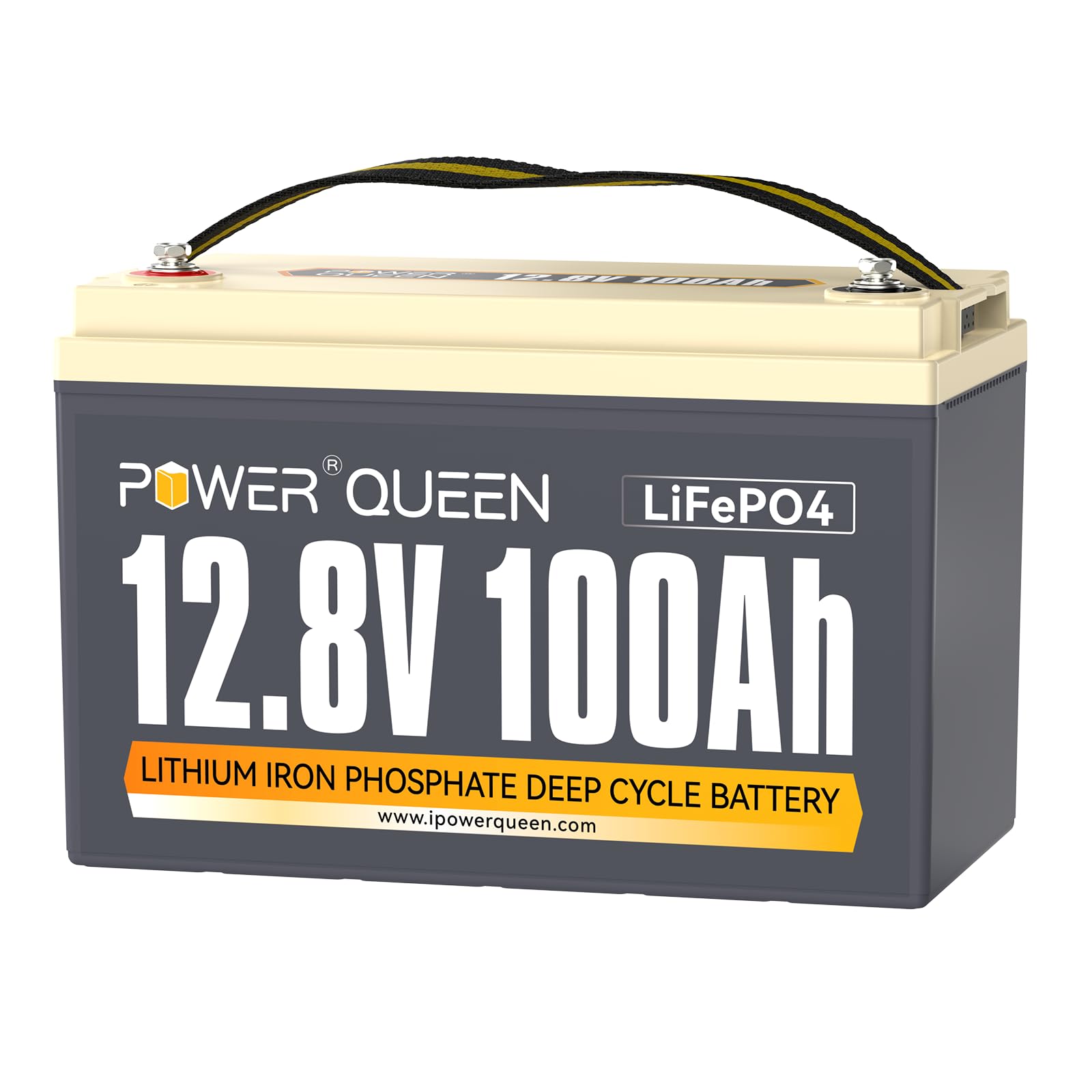
1. Power Queen 12V 100Ah LiFePO4
Our pick — over 4.5★ from 200+ verified ratings; the strongest balance of quality and price.
The all-rounder that brings lithium’s power and weight savings to a drop-in Group 31 size.
This lithium battery drops into your boat, RV, or solar setup with no maintenance, no acid checks, and at 24.25 lb it’s easy to carry. The defining specs are its 1280Wh of energy and 12.8V output, which let you run a trolling motor or fridge for long stretches. It weighs only 24.25 lb, so buyers report it’s about 1/3 the weight of a comparable lead-acid unit—a huge relief when you’re hauling it to a trailer or boat.
The brain of this pack is the smart BMS (a Battery Management System that protects the cells) with 20+ protections against overcharge, over-discharge, and short circuits. That’s what lets it hit 4,000 cycles at 100% depth of discharge, meaning you can drain it fully and recharge it thousands of times before it wears out. If you ever outgrow it, you can chain up to a 4P4S setup for a massive 51.2V 400Ah system.
Buyer reviews confirm the battery’s real-world performance matches the marketing claims. The most common scene from the review pages: an 18-hour day of fishing in choppy water on a 17.5 ft boat, and the battery “hardly lost any juice” after all that time. One owner called it “better than any lead acid I’ve ever used,” which sums up why this pick earns the top spot. The single recurring technical gripe is that a 14.4v or 14.6v charger may not reach its full CV mode because the BMS cuts off around 14.2V, so it may not hit a 100% charge with every charger.
budget-friendly performer
- Weighs just 24.25 lb—roughly 1/3 the weight of lead-acid for easier carrying.
- Rated for 4,000 cycles at 100% depth of discharge, so it outlasts lead-acid.
- Standard Group 31 footprint drops into existing RV and marine trays.
heftier than rivals
- BMS cuts charging around 14.2V, so some chargers won’t push it to full capacity.
- Expensive upfront compared to an AGM battery.
value pick: you want one reliable power source for trolling, camping, or solar that won’t need replacing for years.
size matters: you’re on a strict budget and can’t justify the higher lithium price for occasional weekend use.
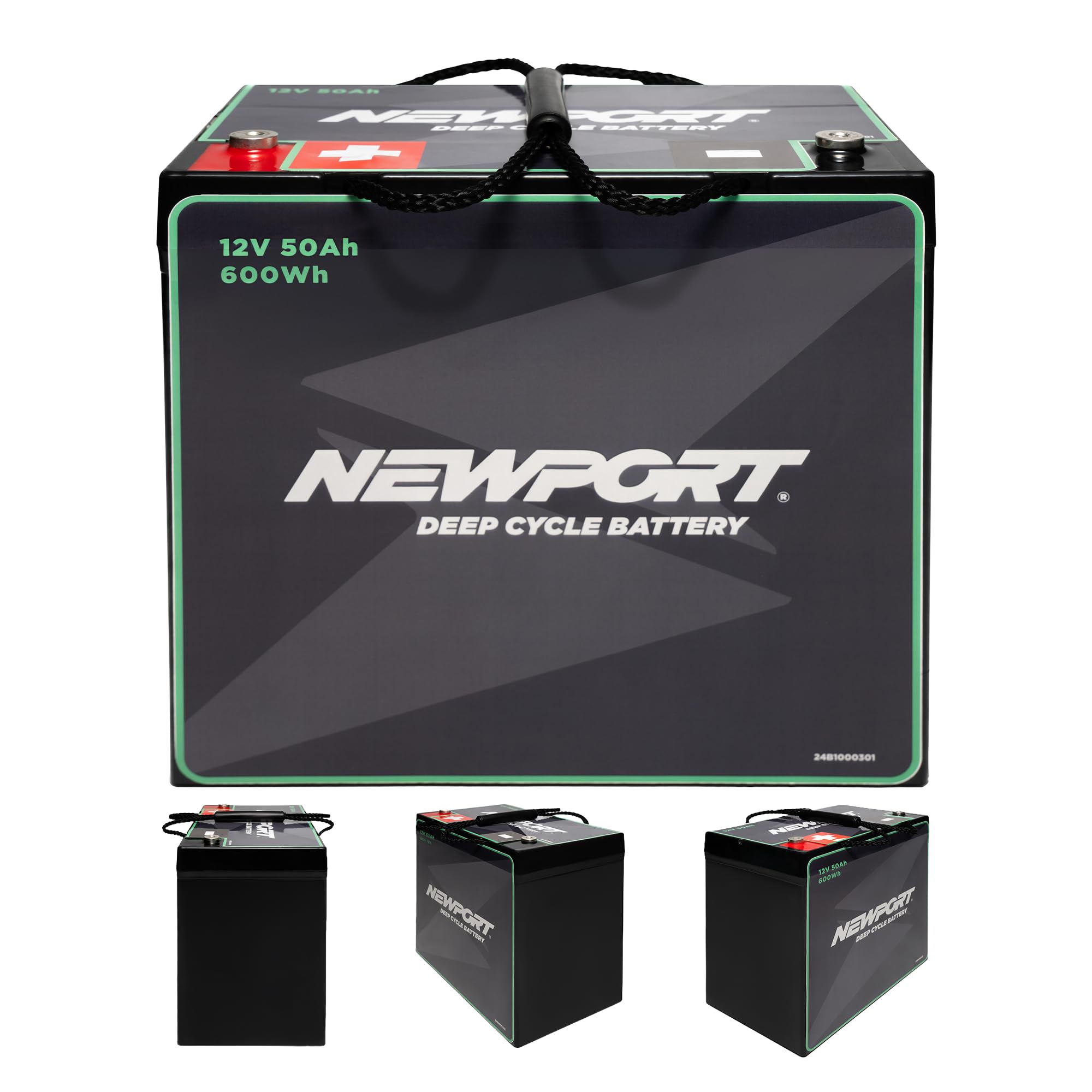
2. Newport 12V 50Ah Deep Cycle Marine Battery
A lightweight AGM that offers the cheapest entry point into reliable marine power.
If you’re new to boating and don’t want to gamble a big sum, this Newport battery is the classic starter move. It delivers a 12V output with a 50Ah capacity, which is a good match for smaller trolling motors and fish finders. Its 32 lb weight is genuinely easy to handle—owners mention carrying it one-handed to and from the boat, which is a huge convenience on a busy day on the water.
It’s built as a sealed AGM (Absorbent Glass Mat) battery, which means no water to check and a leak-proof, maintenance-free design. It’s an ideal partner for a Newport 36-pound thrust motor, and the reviews back that pairing. The trade-off is capacity: at 50Ah, it’s exactly half the rated capacity of the 100Ah Power Queen above, so it will run for less time on the same load.
Customers note a solid 4+ hours on a 55 lb trolling motor with stable voltage, and the build quality is described as heavy-duty. The recurring gripe is the lack of a charge indicator, so you won’t know exactly how much juice is left until the motor slows. This unit comes with a 1-year limited warranty, and its battery-lightening is best summed by owners who call it “surprisingly lightweight yet powerful.”
compact marine starter: It’s the right call if you want a dependable, no-fuss AGM for a kayak, small jon boat, or casual fishing without spending lithium money.
3. Dumfume 12V 100Ah LiFePO4 Battery
Shrinks down to a 22.05 lb package with the same 100Ah punch as heavier rivals.
This is the battery for tight spaces. Dumfume claims a 25% size reduction over conventional 100Ah units, and it weighs in at just 22.05 lbs—that’s about 2/3 lighter than a standard 100Ah AGM battery that tips the scales at 63.9 lbs. If you’re squeezing battery storage into a caravan compartment or an off-grid cabinet, the space savings are immediately obvious.
You get a 100A BMS (a battery management system that automatically cuts power to prevent overcharging, over-discharging, short circuits, overheating, and overcurrent), so your battery stays safe even if you forget to unplug it. The ABS casing resists impact, heat, weather, and fire, and it’s rated IP65 (meaning it keeps out dust and light rain, though the maker is clear it is not waterproof). You can also connect up to 4S4P (four in series, four in parallel) to build a larger 51.2V 400Ah bank later, so you can expand your power without buying a new battery.
Reviewers point out it packs “a lot of energy in a small package,” with one owner using it with a 2500W inverter successfully. There is some mixed feedback on lifespan, so treat the advertised 10-year lifespan as a best-case goal rather than a promise. Battery performance requires temperatures of 5°C or higher, so this isn’t the pick if you’re parking your rig in deep winter without a heated compartment.
daily driver: caravans and small off-grid cabinets where every inch of space matters more than brand familiarity.
off-grid heavy: you regularly camp in sub-5°C weather, since low-temperature charging issues are not covered.
4. Mighty Max Battery 12V 100AH Deep Cycle

The lead-acid workhorse that powers solar rigs and radios without the lithium sticker shock.
For anyone building a budget solar setup, this Mighty Max is a proven, UL-certified sealed lead-acid (SLA) battery that won’t break the bank. It’s a 12V 100Ah Group 27 unit that’s spill-proof and maintenance-free, and you can mount it in any position. It’s designed for the deep discharges that solar wind systems and emergency lighting demand.
Shoppers say impressive real-world results for a lead-acid battery. Buyers report running a 32″ TV and Roku on a 500W inverter for 4 hours with only 1% drain, and one owner used it to power a radio room effectively. It pairs naturally with 100-watt solar panels, and several owners note it works better than expected for the price.
The honest downside is the weight—buyers describe it as heavy, which is expected for sealed lead-acid. And the battery life gets mixed feedback: some owners say it holds a charge very well, others report it stops holding a charge after a couple of years. It comes with a full 1-year warranty, and if you need to return it, expect hazardous-material shipping costs. It’s a solid value pick, not a lifelong one.
budget deep-cycle: Choose this if you want the lowest cost per amp-hour for a stationary solar array or radio room where you don’t haul the battery around.
5. WEIZE 12V 100Ah Deep Cycle Battery

A high-discharge, heavy-duty AGM that powers serious inverters without the lithium price.
This WEIZE is the battery for people who need to push serious current, like running a 2000-watt inverter. It’s a 100 amp-hour sealed lead acid battery with a 1150A max discharge current, meaning it can handle sudden heavy loads without voltage sag. If you’re running power tools, electric vehicles, or emergency lighting, this is a fit.
The 63 lb weight signals its lead-acid heritage, and buyers are upfront that it’s heavy—but they’re also quick to note it doesn’t need to move once installed. It holds a charge remarkably well, and its 3% self-discharge rate means it sits longer between uses without draining. The design is spill-proof and maintenance-free, perfect for users who don’t want to top up water ever.
Reviews consistently describe it as a dependable performer. One owner runs a 700W inverter with a crock pot and TV off a pair of these with 150W solar panels, going two years off-grid with zero issues. Buyers consistently call it excellent value versus lithium. The honest trade-off is the 60 lb handling and a mixed reputation on long-term battery life—this is a “get what you pay for” lead-acid that serves hard for a few seasons.
steady use: you need a powerful, stationary backup for a cabin, garage, or off-grid inverter system on a budget.
cold climates: you want to save your back—the 63 lb weight makes this a firm no for portable or frequent-moving setups.
6. Dumfume 12V 150Ah Max LiFePO4 Battery
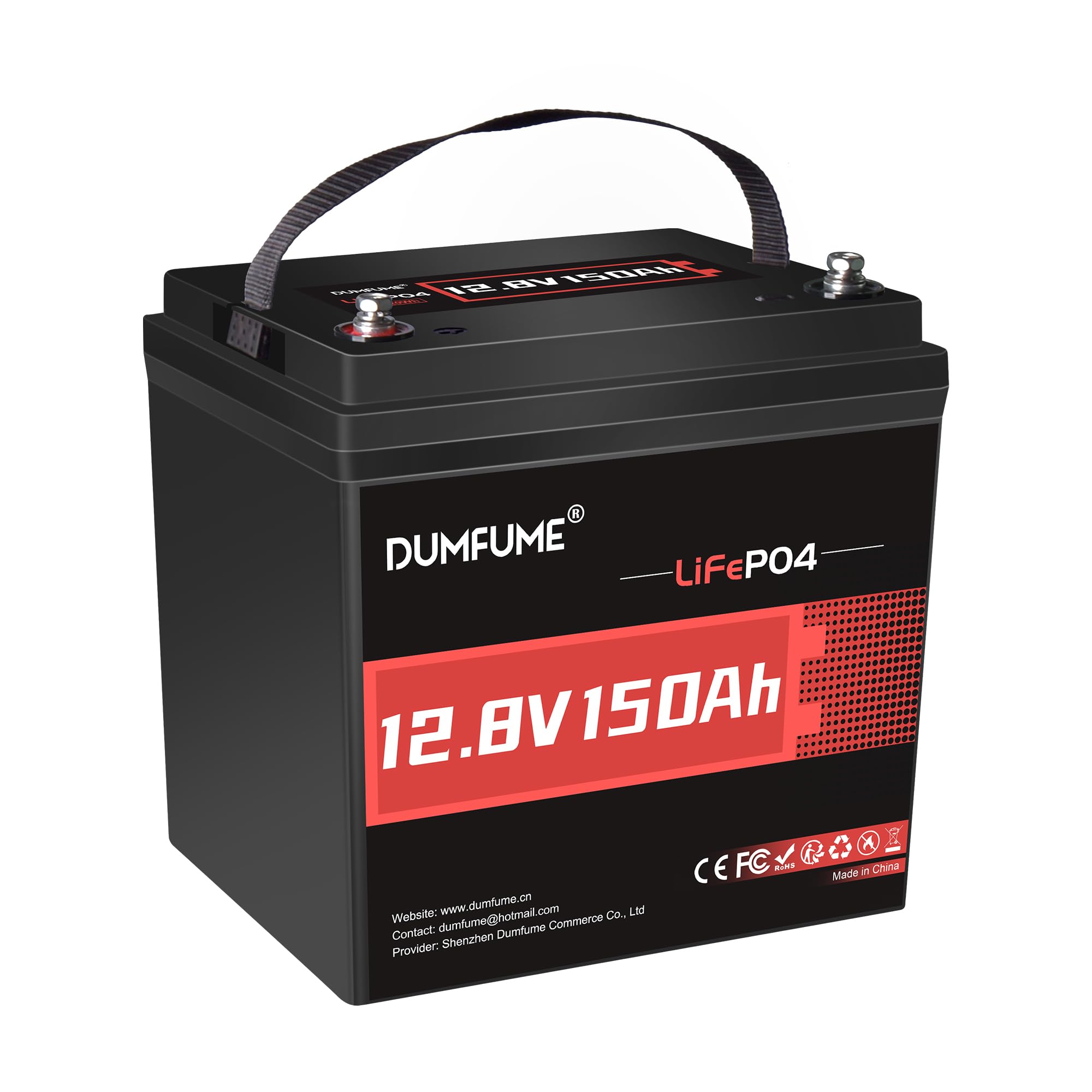
A big 150Ah capacity that keeps energy-hungry RVs and solar rigs fed for days.
When 100Ah isn’t enough, this Dumfume steps up with a substantial 1920Wh of stored energy. That’s the headline spec for RV owners who run a fridge, lights, and electronics without wanting to recharge daily. It’s rated for 4,000+ cycles to 80% capacity, so it’s built for the long haul.
Weighing 41.03 lbs, it’s still significantly lighter than a comparable lead-acid unit, and it measures a compact 10.04″×7.68″×9.84″ to fit in tight cabinet spaces. A built-in 100A BMS protects against overcharge, over-discharge, short circuit, and overheating, keeping your solar panels and home backup gear safe. It also supports series and parallel connections up to 4S4P for future expansion.
Owners mention it works great for small home solar projects, and the installation is straightforward with easy-to-connect terminals. A very satisfied owner using two of these in a 300Ah RV setup said they run the fridge easily with an 800W solar array. The caveats: some units arrive needing a parallel jump start if they’ve sat too long, and there are scattered reports of capacity fade over time. Also, it requires temperatures of 5°C or higher for best performance.
high-capacity champ: This is the pick if your daily amp-hour draw is high and you’d rather buy one bigger battery than link two smaller ones together.
7. Wattcycle 12V 100Ah LiFePO4 Battery
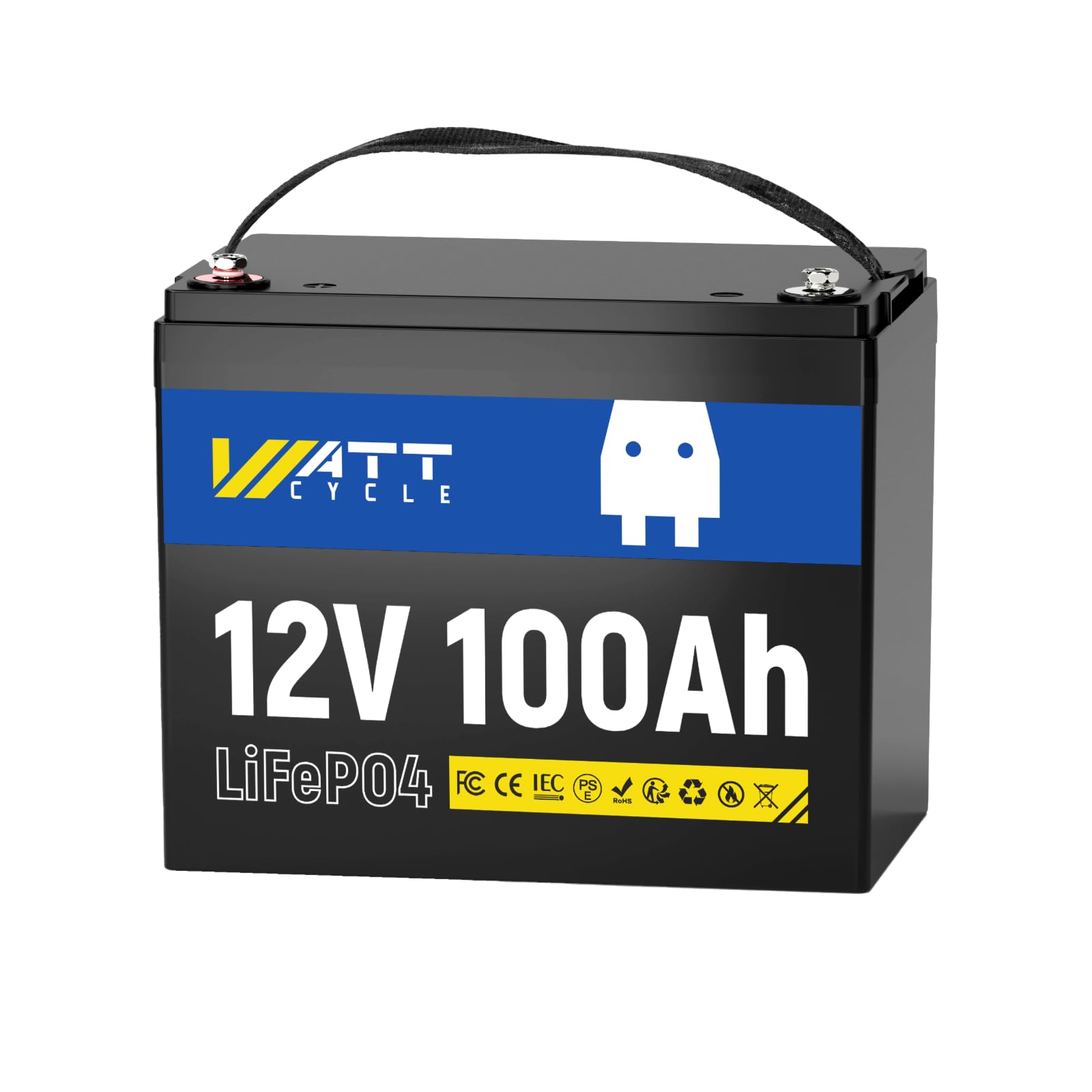
A Group 24 lithium that slips into tighter battery boxes than its Group 31 peers.
If your boat or RV has a Group 24 battery box, most of the 100Ah lithiums on this list won’t fit. This Wattcycle is designed exactly for that smaller footprint, measuring just 10.2×6.6×8.2 inches and weighing a manageable 23.2 lbs. It boost energy density so you don’t lose capacity by downsizing the case.
The battery uses A+ grade cells and is certified SDS, UN38.3, FCC, CE, and ROHS—meaning it meets international safety and quality standards. It can handle up to 15,000 cycles, and its built-in 100A BMS automatically disconnects if discharge current spikes over 300±50A. Just as importantly, it’s built to operate in temperatures from as low as -4°F (-20°C) up to 158°F (70°C), so harsh climates won’t stop it.
Owner feedback consistently highlights it as a “perfect drop-in replacement” and praises its light weight and build quality, especially in campers and for trolling motors. One user linked two in series for heavy trolling duty and saw voltage stay above 25V after a full day. There’s a recurring note about the terminal bolts being short—plan on grabbing M8x16mm bolts—and battery life gets mixed reviews, so treat the cycle claims with some caution.
tech lovers: kayaks, small boats, and RVs with Group 24 boxes where a Group 31 unit won’t physically fit.
simple needs: buyers who hate fiddling with bits—the short terminal bolts may require a quick hardware store run.
8. ECO-WORTHY 12V 100AH LiFePO4 Battery

The battery that talks to your phone, so you always know exactly how much power is left.
This ECO-WORTHY adds one thing most others don’t: Bluetooth 5.1 so you can monitor voltage, current, and remaining capacity right from your phone. For anglers who want to know if they’ll make it through the fishing trip, that real-time data removes all guesswork. It’s wired for a Group 24 size, measuring 10.23″L x 6.6″W x 8.43″H and weighing just 23.15 lbs.
Underneath, the battery uses automotive grade LiFePO4 cells that are UL and IEC tested, and CE and RoHS certified. The built-in 100A BMS guards the battery against overcharge, over-temperature, over-discharge, overcurrent, low temperature, and short circuits. It also features low-temperature cutoff protection below -7°C (19.4°F) to keep winter charging from damaging the cells.
Buyers are full of praise for the app’s insight—one said it “tells me the state of charge and an estimated working time,” which is a killer feature. Users have run portable AC units for 10+ hours off it in series and powered diesel heaters for days. The Bluetooth feature is loved but also draws neutral comments from purists who say it should be optional. It carries a 3-year warranty, which is solid for the category.
solar-ready option: If you want to check your battery’s exact charge from your phone while you’re out on the water, this battery is the one to choose—it shows a live percentage so you never guess when to head back.
9. Redodo 12V 100Ah LiFePO4 Battery
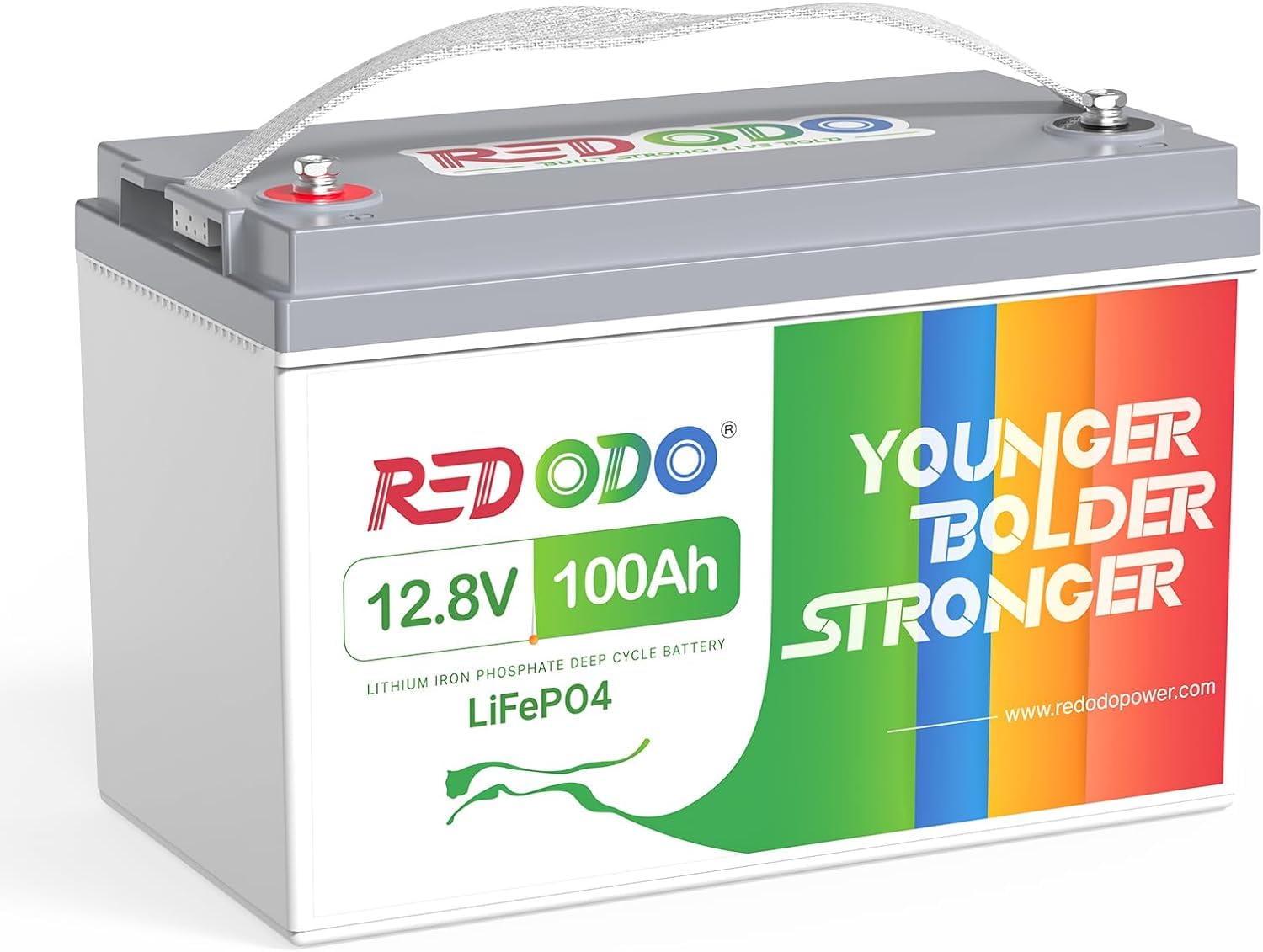
The most-trusted lithium pack on the list, with thousands of owners singing its praises.
This Redodo is the battery you see in every forum thread as the default recommendation, and for good reason. It delivers 1280Wh from a Group 31-sized case, weighing only 22.04 lbs. That’s a huge savings over the 63.89 lbs a lead-acid of the same capacity typically weighs, making it a 60% lighter drop-in replacement. It also claims a 3% self-discharge rate, so it holds its charge while sitting through the off-season.
It’s built with automotive grade LiFePO4 cells and a 100A BMS for protection against overcharge, over-discharge, over-current, short circuit, and high temperature. It’s rated IP65 for water resistance, and it can be expanded up to 4S or 4P configurations (51.2V or 400Ah max). You can charge it via a dedicated LiFePO4 charger, solar panel, alternator, or generator—four different ways.
Owner reviews confirm the battery’s real-world performance. A pool company switched its fleet of vacuums to this battery, and reported they’re lighter, last all day, and show no voltage sag—products that were failing every 3-4 months as lead-acid. Another owner saved his electric mower by swapping in four of these to get a full lawn mowed at 90% charge remaining. Charging speed is a frequent praise point, with one buyer noting a full charge in about eight hours. This reputation earns it a spot on our list.
owner-approved pick
- Ultra-light 22.04 lb frame with a 60% weight reduction vs lead-acid.
- Fast charging—one owner tops it off in about eight hours.
- IP65 waterproofing adds confidence for marine installs.
warranty quirks
- Not meant for starting engines or golf carts—keep it for deep-cycle loads.
safe choice: If you want the lithium experience with overwhelming owner validation, this is the one to buy.
10. Power Queen 12.8V 100Ah LiFePO4
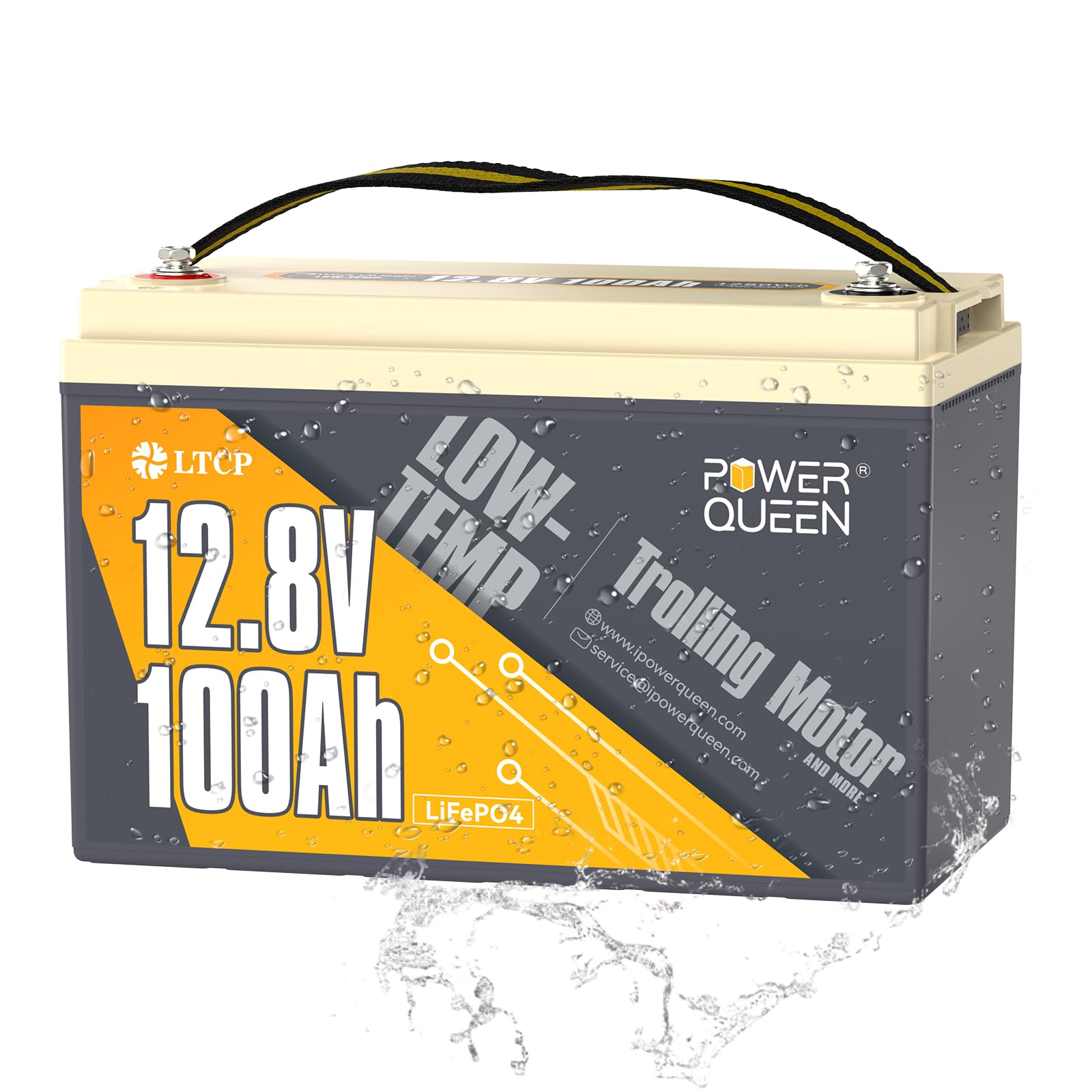
A marine-grade lithium built for big trolling motors and cold northern waters.
This Power Queen is engineered specifically for serious anglers and boaters. Its standout feature is smart low-temperature protection: it stops charging below 32°F and stops discharging below -4°F, shielding the cells from cold-weather damage. That makes it a far safer choice for boats moored in northern climates than a battery without these safeguards.
The marine focus continues with TVS surge protection built for trolling motors up to 120 lb thrust, which blocks voltage spikes for 12V-36V motors in rough water. It’s also ABYC E-13 compliant, meaning it meets marine electrical standards with a triple-protected BMS that handles dust, water, and salt-spray. At just 22.16 lbs, it’s up to 64% lighter than a 12V 100Ah lead-acid battery.
Customers note flawless performance even after heavy use. One angler ran a Minn Kota 50lb trolling motor for 10+ trips averaging 4 hours each and still found the battery full at the end of the day. Another ran three in series flawlessly since October 2023. The full-depth cycles are rated at 4000+ at 100% DOD, and it carries a 5-year warranty. The caveat: a couple of units needed BMS replacements after 2 years—but the owner praised the fast, professional warranty process.
marine-grade build: This is your battery if you fish in cold weather, run a big trolling motor, or want marine electrical certification behind you.
11. Litime 12V 230Ah LiFePO4 Battery
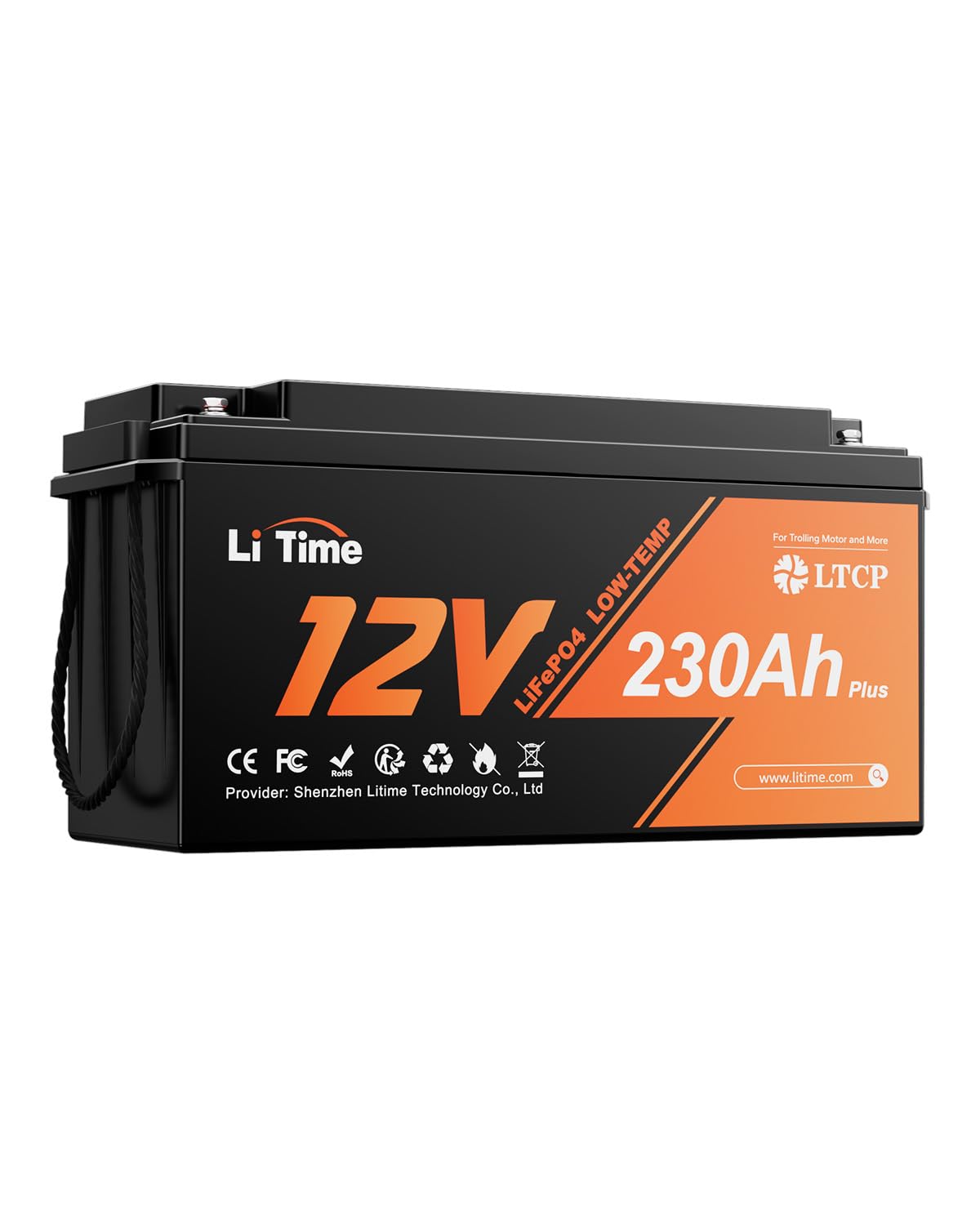
A true powerhouse with 230Ah capacity for full-time RV living and serious backup.
This is the battery for people who live in their RVs or need real home backup power. The Litime 230Ah packs 2944Wh of energy, which is why reviewers point out it powers a fridge for 6-7 months out of the year. It fits into a Group 4D box, and despite the huge capacity, it weighs only 45.98 lbs—about 1/3 the weight of a comparable lead-acid unit.
Safety is a major pillar here. The built-in 200A BMS offers 20+ safeguards, including advanced low-temp protection that pauses charging below 0°C (32°F). It’s rated for 4,000+ cycles at 100% depth of discharge, which the maker claims is a 10-year lifetime. You can also expand it dramatically—up to 16 batteries in a 4P4S setup for a massive 48V 920Ah system.
Owners love the app functionality (though some report it’s glitchy) and the compact size for the capacity. One buyer’s trailer was overwhelmed by the charge current, noting it surged at 50+ amps and required a charger upgrade—worth planning for if you’re converting an older RV from lead-acid. A 5-year service warranty with 24/7 support backs the whole thing up.
RV living: Choose this when daily power demands are high and you want to minimize the number of batteries in your bank.
portable needs: Older RVs may need a charger upgrade to handle the high current draw this lithium can accept.
Understanding the Specs
Amp Hours (Ah) and Watt Hours (Wh)
Amp hours tell you how much current a battery can supply over time. A 100Ah battery can give you 100 amps for one hour, or 10 amps for 10 hours. Watt-hours multiply that by voltage to show total energy—a 12.8V 100Ah battery holds roughly 1280Wh. The higher the number, the longer your devices run before a recharge. Match this to your daily usage, not the physical size you want.
BMS Protection and Low-Temp Cutoff
A Battery Management System (BMS) is the safety brain that monitors voltage, current, and temperature. It cuts power to prevent overcharging, over-discharging, and short circuits. Low-temperature cutoff is a specific BMS feature that stops charging in freezing conditions to protect the lithium cells. Both are essential for lithium batteries, especially for winter RV or marine use.
FAQ
What is the difference between a deep cycle battery and a starting battery?
How long will a 12V 100Ah battery run a trolling motor?
Is it worth paying more for a LiFePO4 battery over a lead-acid AGM?
Can I charge a lithium LiFePO4 battery with my existing lead-acid charger?
What is a BMS and why do I need it in a lithium battery?
Will a Group 31 battery fit in my RV or boat?
Can I connect multiple 12V lithium batteries together?
How should I store my deep cycle battery in the winter?
Does cold weather affect deep cycle battery performance?
What is the actual usable capacity of a 100Ah battery?
Final Thoughts: The Verdict
For most buyers, the 12v deep cycle battery winner is the Power Queen 100Ah because it nails the balance of price, weight, and long lifespan while staying affordable. If you want a proven crowd favorite with a massive owner base, grab the Redodo 100Ah. And for budget-focused solar or small boat use, the Mighty Max 100Ah is the one to reach for.
How We Picked
We do not accept paid placement. Every pick is matched to a real buyer and a real use-case; we do not hands-on test units.
Sources & Methodology
Specifications: manufacturer listings and product documentation. Review insights: verified customer reviews, as of August 2026. Pricing: not shown on this page (it changes often); check the current price via the retailer link.
As an Amazon Associate, Gadgets Feed earns from qualifying purchases. This does not affect which products we feature.