
A 12V electric motor that stalls under the first sign of resistance is not a motor—it’s an anchor. Whether you’re retrofitting a power wheel, building a custom CNC spindle, or replacing a tired bathroom vent fan, the difference between a frustrating project and a flawless build comes down to one thing: torque, measured not in marketing hype but in newton-meters and amp draw under load. The wrong spec here kills momentum literally.
I’m Min — the co-founder and writer behind Gadgets Feed. I’ve spent countless hours cross-referencing datasheets, tearing apart customer reviews for actual load-testing data, and mapping real-world stall currents to match the right motor architecture against the job it needs to do.
This guide breaks down the seven most searched 12V electric motors by their measurable strengths, so you stop wasting time on motors that can’t deliver. After hours of analysis, I’ve ranked the strongest contenders to help you find the best 12v electric motor for your specific build, repair, or upgrade project.
How To Choose The Best 12V Electric Motor
A 12V motor looks simple—two wires, a shaft, spin it up. But the internal architecture determines whether your project succeeds or sits unfinished in a box. The three specs that matter most are operating speed under load, torque delivery, and shaft interface.
Match Speed to the Mechanical Load
High-speed motors (20,000 RPM) suit direct-drive spindles and blowers where you can gear down externally. Low-speed worm gear motors (10–60 RPM) deliver high torque at the shaft without external reduction. A 10 RPM motor produces roughly 200X the torque of a 20,000 RPM motor at the same wattage—so choose based on whether you need pushing power or spinning speed.
Self-Locking vs. Free-Spinning
Worm gear motors (like the JGY-370 and Greartisan models) self-lock when power is removed—the output shaft won’t back-drive. This is critical for lifting mechanisms, solar panel tilts, and safe actuators where gravity could cause a crash. Spur gear motors and direct-drive 775 motors free-spin, making them better for fans, wheels, and pumps but dangerous in vertical loads without a separate brake.
Check the Amp Draw Against Your Power Supply
A motor’s stall current (the amps it pulls when starting or overloaded) can be 4–7A for a 775 DC motor and 2.5A for a 30W permanent magnet motor. Your 12V battery or power brick must deliver that starting surge or the motor will never spool up. Always overspec your supply by at least 30% above the motor’s listed starting current.
Quick Comparison
On smaller screens, swipe sideways to see the full table.
| Model | Category | Best For | Key Spec | Amazon |
|---|---|---|---|---|
| Greartisan 12V 60RPM | Worm Gear | Self-locking high torque | 7 kg.cm at 60 RPM | Amazon |
| HUSETOO 775 2-Pack | High-Speed DC | Power wheel upgrade | 20,000 RPM / 80W | Amazon |
| Makermotor PN01007-38 | Gear Motor | Auger / heavy linear drive | 6 N-m torque at 50 RPM | Amazon |
| BRINGSMART JGY-370 | Worm Gear | DIY curtain / small actuator | 10 RPM / all-metal gears | Amazon |
| HUSETOO 775 Single | High-Speed DC | CNC spindle / small buffing | 20,000 RPM / cooling fan | Amazon |
| WMYCONGCONG 30W | Permanent Magnet | Cotton candy / small grinder | 3,500 RPM / 30W | Amazon |
| PANDEELS SM550 | Bathroom Fan | Exhaust fan replacement | 3,000 RPM / 120V plug | Amazon |
In-Depth Reviews
1. Greartisan 12V 60RPM Worm Gear Motor
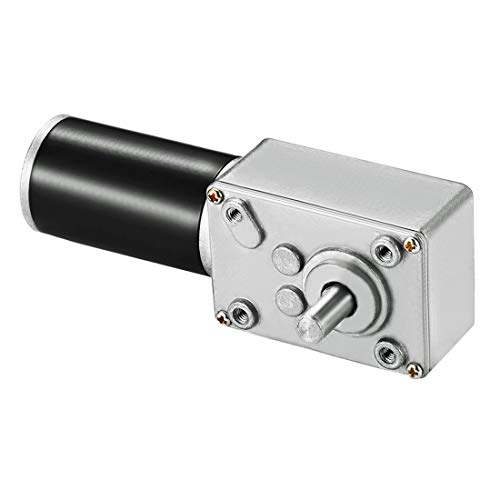
The Greartisan worm gear motor delivers an impressive 7 kg.cm of torque from a package that fits in the palm of your hand. The self-locking worm gear design means the output shaft stays fixed when power is cut—critical for any application where gravity is the enemy. Users report reliably running 12V record cleaning platters and small robotic actuators without stalling.
At 60 RPM, this motor hits the sweet spot between usable speed and brute force. The 8mm single shaft comes with a detent hole for set-screw coupling, though some builders note the short shaft length can be limiting if you need a D-profile coupler. Forward and reverse speeds are not identical—reverse is slightly slower due to worm gear geometry—so plan your wiring direction carefully.
Noise is notably low for a geared motor of this torque class. A standard 12V 5A brick powers it easily, and the all-metal gearbox inspires confidence for sustained duty cycles. For any project requiring self-locking reliability and real pulling power, this is the motor to beat.
Why it’s great
- Self-locking output prevents back-driving under load
- 7 kg.cm torque in a compact metal-housing package
- Noticeably quieter than typical worm gear motors
Good to know
- Shaft is short—D-profile coupling parts are hard to source
- Reverse speed is slower than forward direction
- Torque drops off significantly above 60 RPM in this series
2. HUSETOO 775 2-Pack (20,000 RPM)

The 775 platform is the undisputed workhorse of the DIY power-wheels upgrade world, and this HUSETOO twin-pack delivers two fully assembled motors with brackets, spacers, and spring inserts. Each motor spins up to 20,000 RPM on 12V with a starting current of 4–7A, making them ideal for high-speed applications like small drill spindles, lawn mower retrofits, and belt sanders.
Both motors include built-in cooling fans—a critical design detail that prevents heat soak during extended high-current runs. The round 5mm shaft accepts standard chucks and conversion sleeves, and the all-metal gear housing holds up to sustained abuse. Users have swapped these into snowblowers and converted AC heaters to DC with reported success.
Be aware: these are noisy. The high RPM and brushed architecture produce audible whine under load. You’ll also need a PWM speed controller to dial back from full-speed, as 20,000 RPM is too fast for most direct-drive wheels without a gear reduction.
Why it’s great
- Twin-pack saves money for dual-motor builds like power wheels
- Built-in cooling fan extends duty cycle at high RPM
- 5mm round shaft accepts standard collets and chucks
Good to know
- Very noisy under load without a muffler or enclosure
- Needs a PWM controller for adjustable speed operation
- Starting surge of 4–7A may trip small power supplies
3. Makermotor PN01007-38 (50 RPM)

The Makermotor PN01007-38 is in a different league of torque density. Rated at 6 N-m (4.4 ft-lb) from a 50 RPM gearbox, this motor pushes enough rotational force to drive an auger system or a 10-inch wheel directly. The 3/8-inch D-shaft provides immediate coupling grip—no set-screw slippage common with smaller round shafts.
At 60W and 13.5V rated voltage, this motor runs cool even under heavy loads. Users confirm reliable operation on drum carders, conveyor feeder augers, and heavy gate actuators. The bull gear is steel-meshed with a plastic worm, a deliberate design that sacrifices the gear first to protect the motor in a jam. Mounting uses M6 threaded holes spaced at 120 degrees, which is standard for industrial gearbox flanges but requires metric bolts not included.
The downsides are few but real: one user reported a defective bearing out of four units, and the lack of a mounting alignment template means you’ll need to measure and drill your own attachment holes. For serious multi-unit builds where torque consistency is non-negotiable, this motor justifies its premium positioning.
Why it’s great
- 6 N-m rated torque for heavy auger and drive applications
- 3/8″ D-shaft provides positive locking without set-screw creep
- Runs cool at rated voltage for extended duty cycles
Good to know
- M6 mounting bolts not included; metric hardware can be hard to find locally
- No alignment template included for repeatable mounting
- Occasional bearing defect reported in multi-unit orders
4. BRINGSMART JGY-370 (10 RPM)

The JGY-370 is the smallest worm-gear motor on this list, but its all-metal gearbox punches well above its 169-gram weight. At 10 RPM, this motor is built for applications that require precise, slow, high-torque actuation—ham radio antenna tuners, label machine feeds, automated curtain drawers, and small safe locks. The worm gear self-locking feature means the output shaft stays put when powered off, which is essential for position-holding tasks.
The D-shaped output shaft is made from high-hardness steel and resists deformation under side load. Users running 3D-printed bullet feeders report over 10,000 cycles without performance degradation. The micro-turbine worm design keeps noise impressively low for a metal-geared reducer—a common complaint with budget worm motors is eliminated here.
One caveat: the motor is physically smaller than product photos suggest (0.98″ square), so verify your mounting space before ordering. It also draws modest current, meaning it can run from a standard 12V 1A wall wart, but don’t expect it to drive heavy gates or power wheels.
Why it’s great
- All-metal gears for abrasion resistance and long life
- Self-locking worm gear for position-holding applications
- Extremely low noise for a metal gearbox motor
Good to know
- Physically very small—0.98″ square; verify fit before ordering
- Only 10 RPM; not suitable for high-speed applications
- Limited torque for heavy gate or auger loads
5. HUSETOO 775 Single (20,000 RPM)
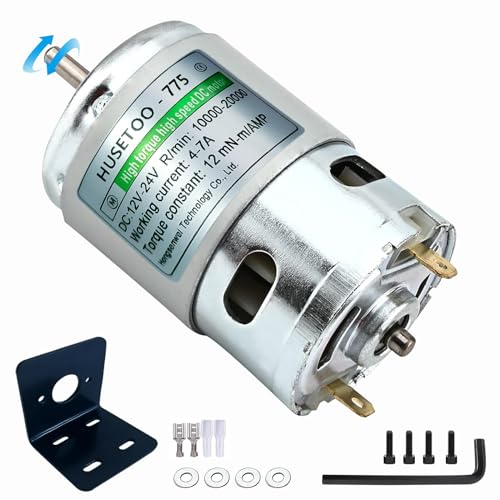
If you only need one high-speed motor, the single-pack HUSETOO 775 offers the same 20,000 RPM capability and 80W rating as its twin-pack sibling without the extra cost. The built-in cooling fan is identical—critical for avoiding thermal throttling during extended use as a CNC spindle or buffing head. Starting current sits between 4–7A, and the motor accepts a standard PWM controller for variable speed.
Users have successfully adapted this motor for snowblower replacements, AC-to-DC heater conversions, and small lathes. The 5mm round shaft with bracket mount makes installation straightforward for most DIY frames. Metal gears provide good wear resistance, and the pure copper winding keeps resistive losses low even at high RPM.
Noise is the same limitation as the twin-pack—this is a loud brushed motor. The included bracket and spacer kit is a nice touch but the fixing screws are small and easy to lose. For hobbyists needing a single high-RPM driver without paying for a second unit, this is the smart buy.
Why it’s great
- Same cooling fan and winding as the 2-pack at half the cost
- Pure copper windings for efficient power transfer
- Accepts standard PWM controllers for speed tuning
Good to know
- Loud under load; needs enclosure for quiet operation
- Small fixings included are easy to misplace
- High starting surge may require a dedicated power supply
6. WMYCONGCONG 30W Permanent Magnet Motor

The WMYCONGCONG 30W motor is the quietest option here—users consistently describe it as virtually silent, which makes it the top choice for noise-sensitive environments like indoor grinders, cotton candy machines, and small medical devices. The permanent magnet design delivers smooth, responsive torque with almost no cogging at low RPM, and it includes spare brushes for long-term maintenance.
Rated at 3,500 RPM on 12V, this motor draws approximately 2.5A at full load, making it easy to run from a standard bench supply. The kit comes with two mounting brackets, two 6mm hex couplings, and a hex wrench—everything needed to install out of the box. Users report successful use in DIY rock tumblers running for two weeks straight at 3.3V with no overheating.
The shaft is 8mm, and the included hex coupler works well for 6mm shafts but may need replacement if your load uses a different size. The bracket mounting holes use 4-40 screws, which are not included. For its price point, this is the best low-noise, medium-speed motor for benchtop tools.
Why it’s great
- Extremely quiet operation for indoor or noise-sensitive builds
- Includes spare brushes and full mounting kit with brackets
- Low 2.5A full-load draw works with standard power supplies
Good to know
- Hex coupler fits 6mm shafts only—may not match your load
- Bracket mounting screws (4-40) not included
- Only 30W; not suitable for heavy torque applications
7. PANDEELS SM550 Bathroom Fan Motor

The PANDEELS SM550 is a specialty replacement motor designed specifically for 120V bathroom exhaust fans, not a general-purpose 12V motor. It operates at 3,000 RPM and delivers 50 CFM of airflow, making it the right fix for old NuTone and Broan units that have failed. The kit includes a plastic blower wheel matched to the motor shaft—no guesswork on fan blade sizing.
Installation is straightforward: remove the old bracket, swap the motor, and reconnect the plug. The 6-inch wire leads make wiring accessible, and the mounting studs at 1-7/8″ on center fit standard fan housings. Users report saving the cost of a full fan unit replacement and completing the swap in under 15 minutes. Noise output is significantly quieter than the original motors in 1970s-era fans.
The limitation is clear: this is a 120V fan motor, not a 12V project motor. If you’re looking for a 12V motor for DIY builds, this won’t work. But if your bathroom fan is dead and you want the cheapest, fastest fix that runs silently, the SM550 is the correct solution.
Why it’s great
- Complete replacement kit with blower wheel included
- Much quieter than original 1970s fan motors
- Simple 15-minute swap with no modifications needed
Good to know
- Runs on 120V AC—not a 12V DC motor for general projects
- Only 50 CFM; not for large rooms needing high airflow
- Does not fit every brand’s bracket pattern—measure first
FAQ
What size power supply do I need for a 12V 775 motor?
Can I use a worm gear motor for continuous rotation?
What does self-locking mean and why does it matter?
How do I reverse the direction of a DC motor?
Final Thoughts: The Verdict
For most users, the best 12v electric motor winner is the Greartisan 12V 60RPM Worm Gear Motor because it balances high torque, self-locking safety, and compact dimensions for the widest range of DIY and repair applications. If you need high-speed power for a wheel upgrade or spindle, grab the HUSETOO 775 2-Pack. And for heavy-duty industrial-torque projects like augers and conveyors, nothing beats the Makermotor PN01007-38.