
Our readers keep the lights on and my morning glass full of iced black tea. As an Amazon Associate, I earn from qualifying purchases.
Specs are compiled from manufacturer listings and verified buyer reviews and can change over time — please confirm the key details on the product page before buying.
If you are tired of cranking a dry carburetor on a mower that sat all winter, a 12V fuel pump solves it in minutes — and the right one moves fluid quietly, primes itself, and holds steady pressure. The nine picks below run from a 4-7 PSI inline pump for carbureted cars to a 3.7-gallon-per-minute transfer unit for draining boat tanks.
I’m Min — the founder and writer behind Gadgets Feed. This guide is built by comparing the manufacturers’ published specifications and the patterns across verified customer reviews, so you get each pick’s real strengths and trade-offs instead of marketing spin.
Pressure, flow rate, and self-priming are the three numbers that decide whether a pump will feed your engine or just hum at you — and this best 12v fuel pump breakdown covers all three, plus the wiring quirks owners actually flag.
Our Picks at a Glance


How To Choose The Best 12V Fuel Pump
Every pump here runs on a 12-volt DC power source — the same voltage your car battery or cigarette lighter socket delivers. What separates them is how much pressure they push (measured in PSI, or pounds per square inch), how much fluid they move per hour, and whether they can pull fuel up from a tank on their own instead of needing gravity to help.
Match the pressure rating to your engine
A carbureted engine typically wants low pressure — 4 to 7 PSI is the common range for a mechanical pump replacement. Push more than that without a regulator and you risk flooding the bowl. Fuel-injected engines need higher pressure and usually a different pump entirely, so check what your engine was built for before you buy.
Flow rate tells you how fast the tank empties
Flow is measured in gallons per hour (GPH) or in some listings as GPM (gallons per minute) or L/H (liters per hour). A 32 GPH pump is sized for feeding an engine; an 85 GPH transfer pump is built to move bulk fluid from a can into a tank fast. Match the number to the job — a small lawn mower does not need three gallons a minute.
Self-priming and dry lift decide your mounting spot
Self-priming means the pump can pull fuel up from the tank without you pouring fluid into the inlet first. Dry lift is how high it can pull from a dry tank. If your pump is not self-priming, it has to be mounted low, below the fuel level, or it will run dry and burn out.
Quick Comparison
| Model | Best For | Fuel Type | Flow / Style | Power Source | Amazon |
|---|---|---|---|---|---|
| 12V Fuel Transfer Pump 85GPH Set★ Best Overall | Draining tanks on equipment | Gasoline or Diesel | 85 GPH Transfer Kit | 12V DC | Amazon |
| MILADO 12V Fuel Transfer Pump SetAlso Great | Portable draining and refuelling | Gasoline or Diesel | 30 GPH Transfer Kit | 12V DC | Amazon |
| TOPWAY 12V DC Gasoline Fuel PumpTop Performer | Reversible draining jobs | Gasoline, Diesel, Kerosene | 3.7 GPM Transfer Pump | 12V DC | Amazon |
| Holley 12-427 Mighty Mite | Feeding a carbureted V8 | Gas, Diesel, Ethanol Blends | 32 GPH Inline Pump | 12V DC | Amazon |
| Portable DC 12V Electric Gasoline Transfer Pump | High-volume bulk fuel transfer | Gasoline or Diesel | 110 GPH Transfer Pump | 12V DC | Amazon |
| TREXFLOW TF P4594 Rotary Vane | Fuel delivery at 6-8 PSI | Gasoline | 72 GPH Inline Pump | 12V DC | Amazon |
| TREXFLOW TF P4070 Rotary Vane | Quiet carburetor priming | Gasoline | 72 GPH Inline Pump | 12V DC | Amazon |
| Universal Electric Fuel Pump Kit 12v 3-6 PSI | Budget lawn mower fix | Gasoline or Diesel | 70 L/H Inline Pump | 12V DC | Amazon |
| Electric Fuel Pump 12v 4.5-7psi Universal | Low-cost mechanical pump swap | Gasoline or Diesel | 90 L/H Inline Pump | 12V DC | Amazon |
In‑Depth Reviews
1. 12V Fuel Transfer Pump 85GPH Electric Gasoline Transfer Pump Set
Our pick — over 4★ from 200+ verified ratings; the strongest balance of quality and price.
An 85 GPH kit with a pulley lead pipe that bends into curved tank interiors.
This Steauty pump delivers 80-85 gallons per hour through a 70W motor, using a patented pulley lead pipe that leans on a steel wire to guide it through curved tank structure and down to the bottom. The yellow hose has an 8mm inner and 12mm outer diameter, sized to slip into most fuel tank openings. What sets the kit apart is its two power cables — an 11.5-foot cigarette lighter cord and an 11.8-inch alligator clip conversion — plus an enlarged storage case that keeps it all organized.
Owners describe it as basically plug and play, with the carrying case getting steady praise for keeping hoses and clamps together. It handles fuel transfers for boats, farm equipment, and RVs alike, and the pre-assembled setup means far less fumbling with loose parts than a bare pump. Speed gets mixed reviews — some call it very fast, while a few report about 8 to 10 minutes for 5 gallons.
Two practical limits to keep in mind. It runs on 12V power only and will not work through a 110V AC-to-DC converter, so a bench outlet is out. And that pulley lead pipe, clever as it is, benefits from careful handling — do not force it through a tight filler neck.
High 85GPH output
- Uses two power sources — a 11.5-foot lighter cord or alligator clips onto a battery.
- The enlarged storage case keeps the kit contained and travel-ready.
- Pulley lead pipe reaches awkward tank interiors where a straight hose will not.
- Sold mostly pre-assembled, so setup is quick and swapping between vehicles is painless.
Thin plastic housing
- Pumping speed is inconsistent across users — some fast, some slower than expected.
- Only 12V DC will do; a 110V converter will not run it.
- The flexible pulley pipe rewards gentle handling around tight filler openings.
Large tank fills: you deal with several vehicles and equipment and want one kit with dual power options and case storage.
Rough handling: you were planning to run it from a wall outlet — it needs a true 12V source.
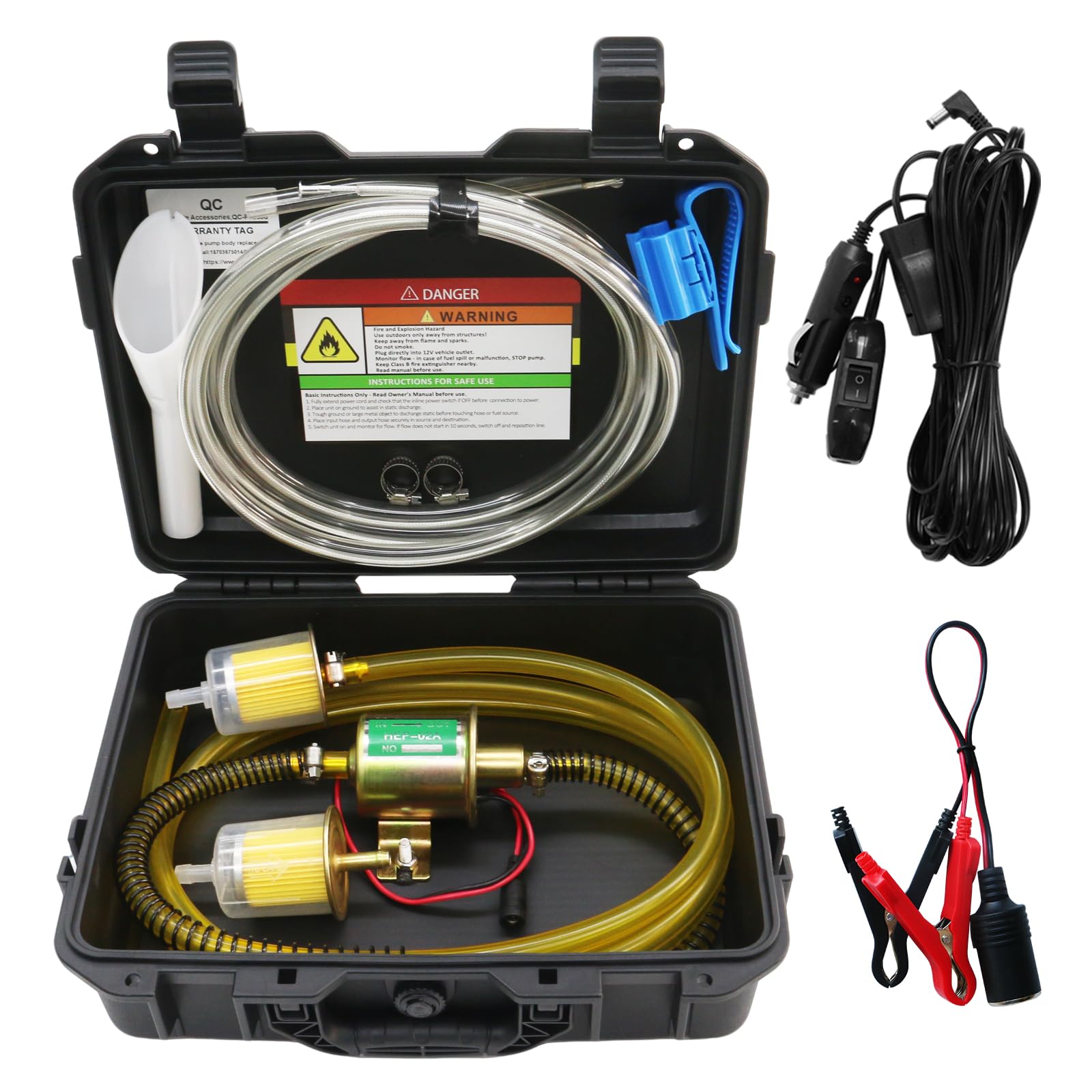
2. MILADO 12V Fuel Transfer Pump Set, Gasoline Transfer Pump Kit, Electric Fuel Pump with Case, 30 Gallons of Gas or Diesel Per Hour Inline Fuel Pump
A cased 30 GPH transfer kit that drains 11 gallons of old gas in about 20 minutes.
The MILADO set moves 30 gallons per hour (GPH — a gallon-per-hour measure of how much fluid the pump shifts) through a hose with an anti-kink spring, a stainless steel lead pipe, and two filters that pull grit out before it reaches your equipment. It runs off 12V DC — either your car’s cigarette lighter socket or a battery — so you can drain a mower, a truck, or a boat tank without wiring anything permanent. The motor is copper and the shell is steel, and the whole thing packs back into a carrying case when the job is done.
What owners keep coming back to is how the kit simply works as a system — it drains 11 gallons of gas in roughly 20 minutes, and the steel-cable-reinforced suction tube holds whatever position you bend it to. A few note the pace is deliberately gentle rather than fast, which the same owners frame as a safety feature when you are moving gasoline, not a fault. One buyer put it clearly: “It drained 11 gallons in about 20 minutes without a hiccup.”
The one wiring note worth knowing: some units ship with a battery pigtail that arrives dead on arrival, while the cigarette-lighter cord runs fine. That is a minor connection issue on a kit that otherwise does exactly what it says — and it is easy to swap the pigtail or just use the socket.
Complete gas can setup
- Functionality is the standout — it drains 11 gallons in about 20 minutes without fuss.
- Quality finish on the copper motor and steel housing, with a case that keeps filters and hose tidy.
- Self-primes on its own, so you are not hand-filling the inlet before you start.
- Reinforced suction tube with a roller tip reaches the bottom of awkward tanks.
Hose clamp grip
- The pace is steady rather than quick — plan on a slow, controlled drain.
- A handful of units ship with a faulty battery pigtail; the lighter cord is the reliable path.
- It is a transfer kit, not a permanent inline pump for a running engine.
Fill your tank: you want one kit that drains old fuel from cars, boats, or mowers and stores away cleanly afterward.
Buy separate hose: you need a pump plumbed permanently into a fuel line for a running engine — this is a portable transfer tool.
3. TOPWAY 12V DC Gasoline Fuel Pump 3.7GPM Self-priming Oil Transfer Pump With Handle, Reversible Pumping, Overheat Protection, Explosion-Proof, Built-in Bypass
A 3.7-gallon-per-minute workhorse that can push fuel and then pull it back the other way.
This one is built for speed and versatility. It moves up to 3.7 GPM (gallons per minute — roughly 222 gallons every hour) of gasoline, fuel, or light oils, and can lift suction from up to 4.9 feet below the pump. The cast iron and stainless steel body handles gasoline, diesel, and kerosene, and the reversible two-way switch lets you flip the pumping direction with a button instead of re-plumbing your hoses. A built-in bypass and overheat protection add a layer of safety on longer jobs.
Owners use it for exactly the jobs where reversing saves a headache — siphoning gas out of a vehicle into cans for a generator, then pushing that same fuel into another tank. One described it working beautifully on a boat tank, and another stuck it down a jet ski fill tube and cleared it out too. In practice it has handled about 20 gallons without a hitch.
The main caution comes from a small number of units that failed early — one reviewer noted the motor dying after two uses. With an 83-rating track record and most owners reporting repeat trouble-free use, that reads as an outlier rather than the norm, but it is worth running your first few transfers with an eye on the motor.
Quick refueling: anyone who needs to move fuel in both directions without swapping hoses around.
Loose hose risk: test it early on a short transfer so any motor issue shows up before you depend on it.
4. Holley 12-427 32 GPH Mighty Mite Electric Fuel Pump, 4-7 PSI

A 4-7 PSI inline pump that feeds a carbureted V8 up to 400HP.
Holley’s Mighty Mite holds 4-7 PSI (pounds per square inch — the pressure that pushes fuel to the carburetor) and flows 32 gallons per hour. It is rated for naturally aspirated engines up to 400HP, self-priming with a 12-inch dry lift, and compatible with everything from straight gas and diesel to blended alcohol, ethanol, and e-85. The solid-state design runs on a simple two-wire hookup, and it ships with a fuel filter, fittings, and mounting hardware.
Where this pump shines is feeding, not pulling. Owners who mounted it on the frame rail right at the tank, pushing fuel forward, report it firing an engine up on the first try — one ran it on a truck for two years behind a 500 CFM carburetor with fuel to spare. Mount it on the fender beside the motor, though, and it struggles, because it is designed to push from the tank, not siphon from above.
Two honest notes appear more than once. First, it is loud — one owner likened it to a woodpecker in the trunk, and a rubber-washer mount helps quiet that down. Second, a small share of units have dropped fuel pressure after running, so if you are wiring this as your only fuel source, add a pressure gauge so you can see what it is actually delivering.
Holley carburetor match
- The 4-7 PSI range matches most carbureted engines without needing a regulator.
- 32 GPH is enough fuel for a naturally aspirated V8 up to 400HP.
- Works with gas, diesel, ethanol, and e-85 blends — no fuel-type guessing.
- Two-wire hookup and supplied filter and fittings keep install simple.
Loud operating noise
- It is loud, and frame-mounting without rubber washers makes it louder.
- Must be mounted low, at the tank, because it pushes fuel and does not pull it well.
- Occasional pressure loss under load, so a gauge is worth fitting.
Carbureted engines: you are swapping a mechanical pump on a carbureted car, truck, or boat and want a known brand with simple wiring.
Quiet ride needed: your only mounting spot is high on the fender beside the motor — it wants to sit low at the tank.
5. Portable DC 12V Electric Gasoline Transfer Pump, with 75W DC Motor, Moves Up to 110 Gallons of Gas or Diesel Per Hour

A 110 GPH transfer pump with 39 inches of suction reach for emptying full tanks.
When you have a full tank to empty, this 75W (watt — a measure of the motor’s power draw) pump is the one that clears it fast. It shifts up to 110 gallons of gas or diesel per hour with 39 inches of suction reach, and it runs off either a cigarette lighter cord or alligator clips onto a 12V battery. The kit includes a filter, pipe joints, power cord, rubber pad, and three stainless steel throat hoops, and the whole unit weighs just 1.3 pounds.
Owners repeatedly point to the same scenario — draining a bad tank before a fuel pump change. One emptied 24 gallons out of a truck tank that way, and another cleared 40 gallons of bad gas out of a boat. They also note the speed surprised them for a pump this small, and that it primes and runs cleanly once you feed fluid into the raised inlet first.
Here is the thing that trips people up, and it is worth repeating: this pump must be primed. Running it dry can damage it, which explains why one buyer mentioned a crawl of 30 minutes for a single gallon. Feed a cup of gas or fluid into the inlet tube, run the pump a few seconds until liquid flows, and it behaves. It is also louder than a small pump suggests, and a hardwired connection makes it more reliable than the plug for permanent setups.
Portable transfers: bulk transfer speed matters and you want a compact pump that empties a full tank in one sitting.
Dry run damage: run this dry and you risk damaging the motor — always fill the inlet tube first.
6. TREXFLOW TF P4594 Replacement Electric Fuel Pump 12V 6-8 Psi Rotary Vane
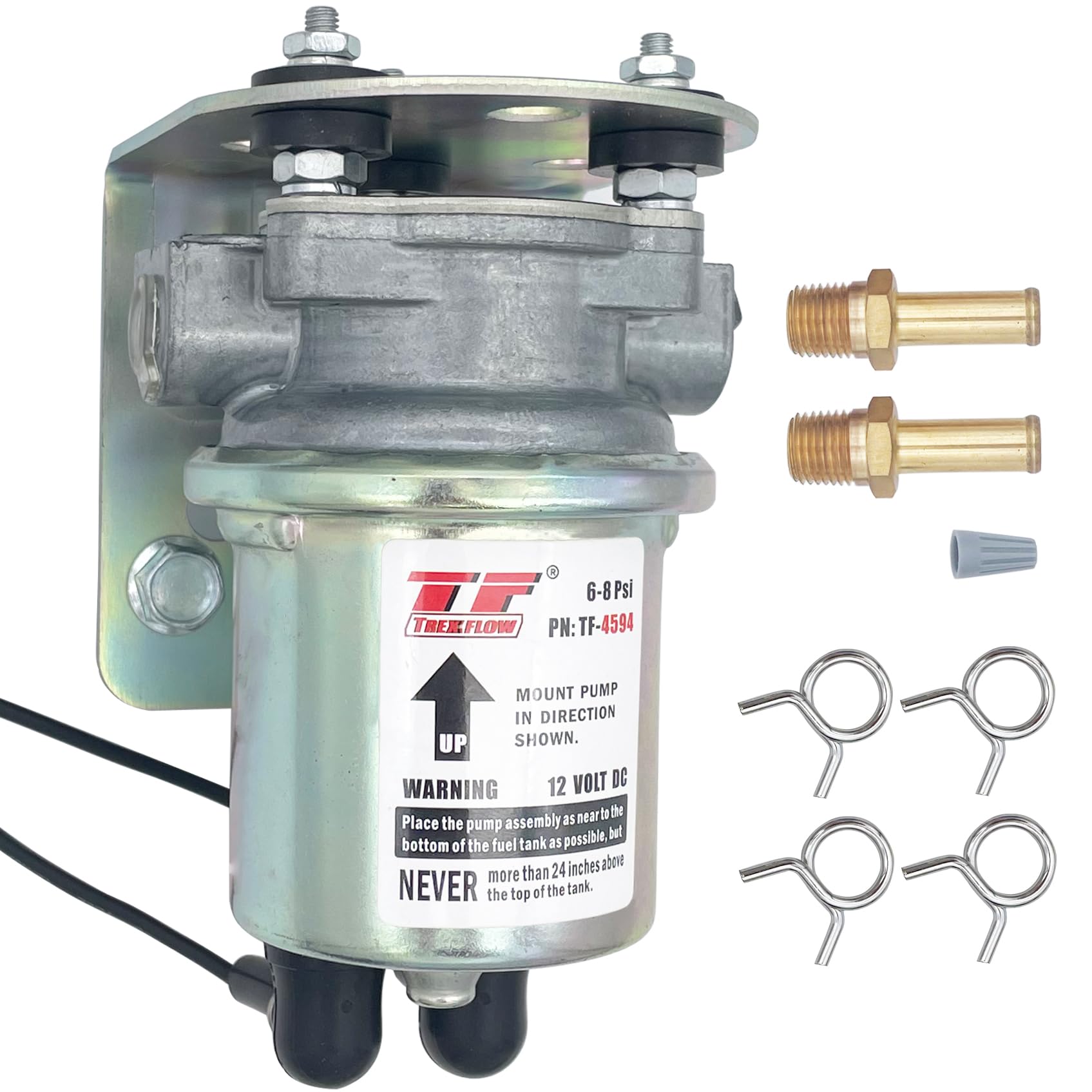
A rotary vane pump that holds 6-8 PSI steady, with threaded posts so the wiring cannot pop loose.
The P4594 runs on 12 VDC, pushes 6-8 PSI, and flows 72 gallons per hour through 1/4-inch NPS inlet and outlet threads. The rotary vane design pumps continuously without the on-off pulsing you get from some mechanical pumps, and the electrical posts are threaded so your connections stay put over time. It ships pre-assembled onto its metal mounting bracket with a full install kit, and it carries a one-year warranty.
Owners run these on older carbureted vehicles where the factory pump has given up. One fitted it to an El Camino and reported it quieter than the pump it replaced, with no cavitation problem. Another used it to replace a failing boat fuel pump — noting that a cheaper low-volume pump could not keep up, and this one re-plumbed with factory connectors ran beautifully. The kit arrives with everything you need for mounting.
The one recurring note is that some engines need a pressure regulator downstream depending on the carburetor, so if you are pushing 6-8 PSI into a carb that wants less, add a regulator to the line. Durability complaints exist but they are rare against a solid track record; treat this as a sound replacement pump rather than an unknown.
Stock fuel systems: carbureted engines and boats that need steady mid-range fuel pressure with quiet running.
Adjustable pressure: if your carburetor wants less than 6-8 PSI, add one downstream to keep the bowl from flooding.
7. TREXFLOW TF P4070 Replacement Electric Fuel Pump 12V 4-6 Psi Rotary Vane

The lower-pressure sibling of the P4594 — 4-6 PSI with quieter, pulse-free flow.
Where the P4594 runs 6-8 PSI, this P4070 runs 4-6 PSI on 12 VDC and also flows 72 GPH through 1/4-inch NPS threads. The rotary vane design flows continuously without the interval pulse of a mechanical pump, and the terminal posts use worm clamps and a metal clip so wiring stays anchored. It comes pre-assembled on its bracket with the install kit included, saves you from sorting through a box of parts, and is backed by a one-year warranty.
Owners use it to wake up older carbureted engines that have lost their fuel delivery. One fitted it to a 1940 Buick running a small block Chevy with a 600 CFM carburetor and regained good power; another used it as the lift pump on a 1979 Mercedes diesel and cured running issues with a noticeable power increase. It holds pressure at the carburetor as advertised.
The honest caveat here is noise. Rotary vane pumps are quieter than many mechanical ones, but not silent — one buyer wanted it quieter for in-cab use. Mounting it on rubber isolators tames that. A couple of buyers also mention durability is unconfirmed on low-hours installations, so for a daily driver, keep an eye on it during the first weeks.
Low 4-6 PSI range: It is the gentler-pressure option in this pair. Choose the P4070 when your carburetor wants 4-6 PSI and you value continuous, pulse-free delivery over the higher pressure of the P4594 above.
Carbureted imports: you are priming an older carbureted engine that wants a lighter 4-6 PSI feed.
High pressure builds: it still makes noise — mount it on rubber isolators if it sits anywhere near the cabin.
8. Universal Electric Fuel Pump Kit 12v 3-6 PSI Low Pressure with Fuel Filters, Hose Clamps and Fuel Line

A complete low-pressure kit that gives you the pump, the filter, the line, and ten clamps in one box.
This JDMSPEED kit is the low-cost way to replace a failed mechanical pump on a lawn mower, small engine, or older carbureted car. It runs at 3-6 PSI and flows 70 L/H (liters per hour) through an 8mm / 5/16-inch hose. The kit is genuinely complete — the pump, a socket wire, a fuel filter, 2 meters / 6.56 feet of 5/16-inch ID fuel line, and ten hose clamps. The line itself is a 3-layer build rated to 2MPa / 300 PSI working pressure and 8MPa / 1200 PSI bursting, with a -30° to 120° temperature range.
The upgrades here are what set it apart from a bare pump. The check valve is upgraded to reduce pump noise and allow quiet operation, and the filter paper is densely pleated and seated firmly to catch impurities before they reach the carburetor. It weighs 0.73 kg — noticeably heavier than the 0.5 kg YONEDA below, because the kit includes more. Owners installing it on everything from a 1930 hot rod to a car that sat for years report it fitting right in and working as expected.
Two honest realities. It is not fast — several buyers report it is slow to move fuel, so it is meant for feeding an engine, not emptying a tank. And durability is the aspect owners flag most; a few report failures, so treat this as a budget replacement with a shorter working life than the premium picks above.
DIY installs: you are replacing a mechanical pump on a mower or small engine and want every part in one box.
Vibration loosens: you need to move bulk fuel quickly — this is a feeder pump, and owners note it moves slowly.
9. Electric Fuel Pump 12v 4.5-7psi Universal Standard Self Priming Heavy Duty In-Line In-Tank Fuel Pump with Installation Kit

The budget inline pump that has quietly become a go-to for carbureted cars and tractors.
This YONEDA pump runs at 4.5-7 PSI, which is 50% more pressure than the JDMSPEED kit above at 3-6 PSI, and flows 90 L/H through a 5/16-inch threaded port. It draws 1.5A (amps — a measure of current draw), uses full copper winding and strong suction for stable fuel feeding, and fits all 12V cars, trucks, boats, carburetors, lawn mowers, and generators. It comes with a 1-year manufacturer warranty.
What has kept this pump in so many toolboxes is how it performs in the field — one owner had it pulling fuel 12-18 inches from tank to engine with no problems. It replaces a mechanical pump on engines like a Suzuki Samurai easily, and its compact body fits tight engine bays. Owners mention it is easy to install and delivers fuel reliably, with the sound level described as typical for a tractor.
The trade-off here is longevity. Customers note mixed experiences with quality and durability — some run it for years as a budget alternative to a factory part, while a few report early failure. It is very much a low-cost replacement meant to get you running, and for a daily driver you should plan to check it periodically rather than treat it as permanent.
Standard self priming: You get more pressure (4.5-7 PSI) and flow (90 L/H) than the budget kit above at a similar low entry level, which is why it holds a place as a first-swap fix for a dead mechanical pump.
Daily drivers: a quick mechanical-pump replacement on a tractor, older car, or generator where cost matters.
Turbo applications: durability is the weak spot owners name — it is a get-running fix, not a permanent upgrade.
Understanding the Specs
Pressure and Flow Rate
PSI (pounds per square inch) is the pressure pushing fuel to your engine — a carbureted engine typically wants 4 to 7 PSI, built for a steady feed. Flow rate is how much fluid the pump moves, measured in GPH (gallons per hour), GPM (gallons per minute), or L/H (liters per hour). A feeder pump like the Holley at 32 GPH is sized to keep an engine running; a transfer pump like the 110 GPH portable unit is built to empty a tank fast. Match the number to the job — buying more flow than you need just means a pump working below its design point.
Self-Priming and Dry Lift
Self-priming means the pump can pull fuel up from the tank without you pouring fluid in first, and dry lift is how high it can pull from empty. A 12-inch dry lift, like the Holley Mighty Mite, means the pump can raise fuel from a foot below. Pumps without enough dry lift must sit low, below the fuel level, or they run dry and risk motor damage. That is why the portable transfer pumps here require priming — feed fluid into the raised inlet before you start, or the pump will struggle and possibly fail.
FAQ
What PSI do I need for a carbureted engine?
Can I run a 12V fuel pump off a wall outlet?
Why does my transfer pump need priming before it works?
What is the difference between a transfer pump and an inline fuel pump?
Will these pumps handle diesel and gasoline both?
Do I need a pressure regulator with these pumps?
Why is my fuel pump so loud?
How long does a 12V fuel pump last?
Final Thoughts: The Verdict
For most people needing the best 12V fuel pump, the MILADO 12V Fuel Transfer Pump Set wins because it turns draining old fuel into a clean, cased, one-person job — self-priming, filter-protected, and ready to store. If your real need is cranking a stalled carburetor back to life, the Holley 12-427 Mighty Mite pushes steady 4-7 PSI and handles everything from gas to e-85. And for moving serious volume — emptying a full tank before a repair — the Portable 110 GPH transfer pump at 110 gallons an hour is the one to grab, as long as you prime it properly before the first pull.
How We Picked
We do not accept paid placement. Every pick is matched to a real buyer and a real use-case; we do not hands-on test units.
Sources & Methodology
Specifications: manufacturer listings and product documentation. Review insights: verified customer reviews, as of September 2026. Pricing: not shown on this page (it changes often); check the current price via the retailer link.
As an Amazon Associate, Gadgets Feed earns from qualifying purchases. This does not affect which products we feature.