
Our readers keep the lights on and my morning glass full of iced black tea. As an Amazon Associate, I earn from qualifying purchases.
Specs are compiled from manufacturer listings and verified buyer reviews and can change over time — please confirm the key details on the product page before buying.
If your golf cart feels sluggish on hills and you are tired of checking water levels, the single biggest upgrade you can make is swapping your heavy lead-acid batteries for a modern deep-cycle set. This guide cuts through the noise to help you pick the right 12-volt batteries for your cart, your budget, and the way you actually drive.
I’m Min — the founder and writer behind Gadgets Feed. This guide is built by comparing the manufacturers’ published specifications and the patterns across verified customer reviews, so you get each pick’s real strengths and trade-offs instead of marketing spin.
You will find the best 12v golf cart batteries ranked by real owner feedback and hard specs, from budget AGM upgrades to premium lithium that saves hundreds of pounds.
Our Picks at a Glance
How To Choose The Best 12V Golf Cart Batteries
Before you click buy, you need to know three things: the voltage your cart needs, the physical space you have, and if you want to babysit your batteries or ignore them for years. This guide uses flexible matching for 12-volt nominal voltage, so not every pick is the exact number searched; the nearest same-type size serves the same purpose.
Capacity and Range: Amp Hours
Capacity is measured in amp-hours (Ah). Think of it as the size of the fuel tank. A 100Ah battery will run a cart longer than a 50Ah battery on a single charge. If you drive a full 18 holes with hills and a heavy load, look for at least 100Ah per battery.
Chemistry: AGM versus Lithium
AGM (Absorbent Glass Mat) batteries are sealed lead-acid batteries. They are cheaper upfront, maintenance-free, and completely spill-proof. Lithium (LiFePO4) batteries cost more but weigh a fraction of the lead-acid equivalent, hold their voltage better under load, and can last thousands of charge cycles. Your choice depends on budget versus long-term performance.
Quick Comparison
| Model | Best For | Capacity | Weight | Discharge Current | Amazon |
|---|---|---|---|---|---|
| Weize AGM 100Ah★ Best Overall | Budget-friendly drop-in | 100Ah | 57 lbs | 1150A | Amazon |
| DJLBERMPW 100Ah LiFePO4Best Weight-Cut | Massive weight savings | 100Ah | 23 lbs | 100A | Amazon |
| Wattcycle 100AhBest Cycle Life | Proven cycle life | 100Ah | 23.2 lbs | 100A | Amazon |
| ECO-WORTHY 100Ah | Bluetooth monitoring | 100Ah | 23.2 lbs | 100A | Amazon |
| CHINS 100Ah | Trolling & marine use | 100Ah | 23.4 lbs | 100A | Amazon |
| Renogy AGM 200Ah | Maximum capacity AGM | 200Ah | 127.9 lbs | 2000A | Amazon |
| E-LekTech 330Ah | Long-range lithium | 330Ah | 56 lbs | 200A | Amazon |
| DJLBERMPW 48V 4-Pack | Complete 48V conversion | 100Ah (48V) | 23 lbs (each) | 100A | Amazon |
| Trojan T-1275 4-Pack | Traditional flooded setup | 150Ah | 85 lbs | — | Amazon |
In‑Depth Reviews
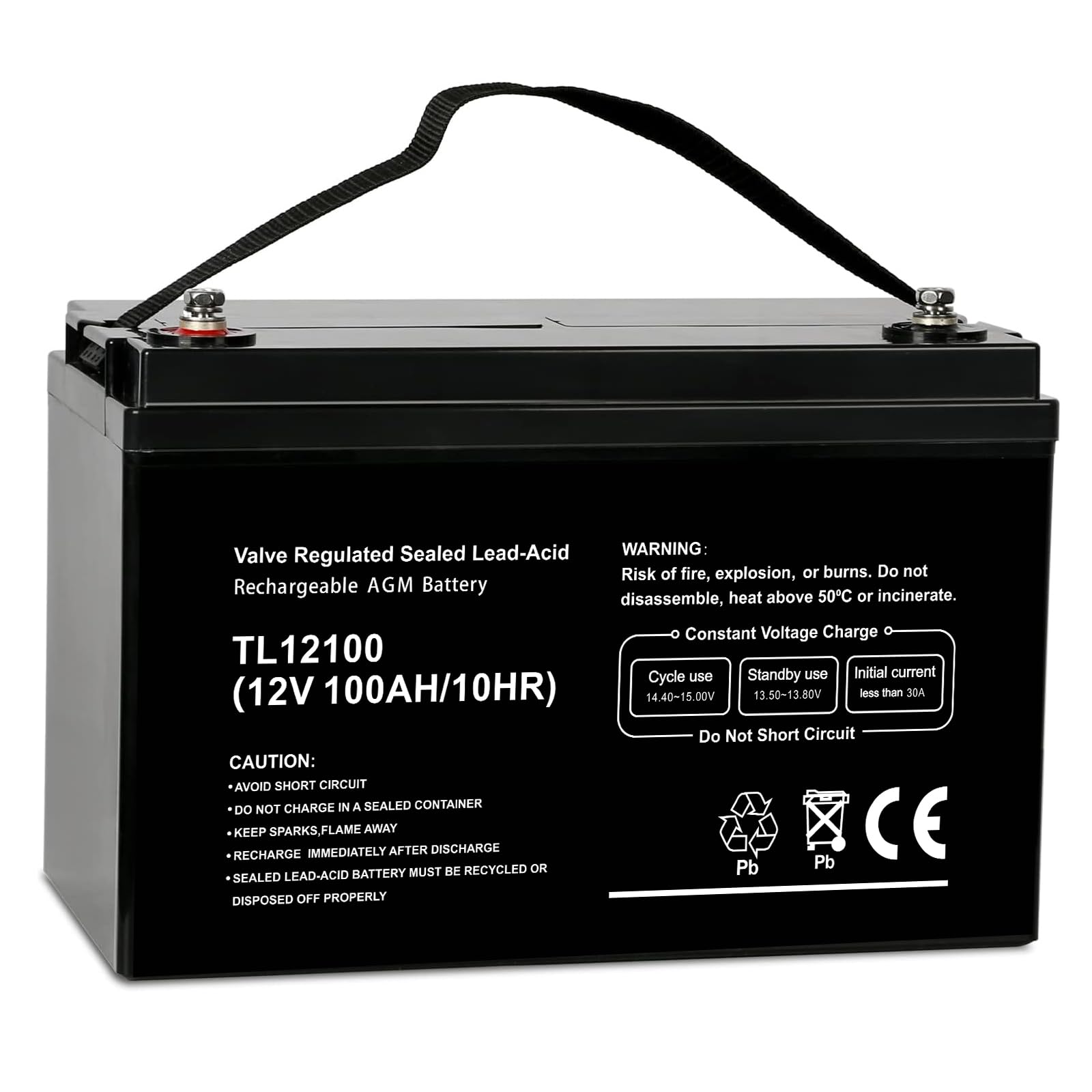
1. Weize Deep Cycle AGM 12V 100Ah Battery
Our pick — 4.5★ from 20,514 verified ratings; the strongest balance of quality and price.
The go-to AGM that makes upgrading from old flooded batteries painless.
If your cart has lead-acid batteries and you want a sealed, maintenance-free upgrade without the lithium price tag, this Weize is the crowd favorite. It delivers a massive 1150A of max discharge current, versus the 100A rating of comparable 100Ah lithium batteries — the instant burst you need for hill starts and quick acceleration.
The real weight trade-off is obvious: this battery weighs 57 pounds, while a 100Ah lithium battery weighs just 23 pounds, and that difference matters if you lift batteries in and out of a cart tray. Buyers report the battery holds up through years of hard use — one kept a pair running in a kids’ rideable jeep for two full years without issue, and another buyer’s first set lasted five years, including two years of daily deep discharges.
What wins people over is performance — it is the most-praised aspect in the review data, followed closely by build quality. It is a perfect replacement for everything from wheelchairs to UPS systems and golf carts, and the sealed AGM construction means no acid leaks and no watering. The fit is a common positive too, dropping neatly into standard battery boxes. Battery life does get mixed feedback, mostly around how long it holds under heavy continuous load, so it is best for carts with moderate daily use.
Why owners stick with it
- 1150A max discharge delivers strong starting bursts
- Sealed AGM means zero maintenance and no leaks
- Proven multi-year lifespan in real carts
The honest trade-offs
- 57-pound weight makes hauling it a workout
- Battery life gets mixed reviews under heavy loads
- Charging behavior varies with the charger used
Best if: you want a reliable, budget-friendly AGM upgrade that slots into your existing setup with no wiring changes.
Not for: drivers who want maximum range and minimum weight — lithium beats it there.
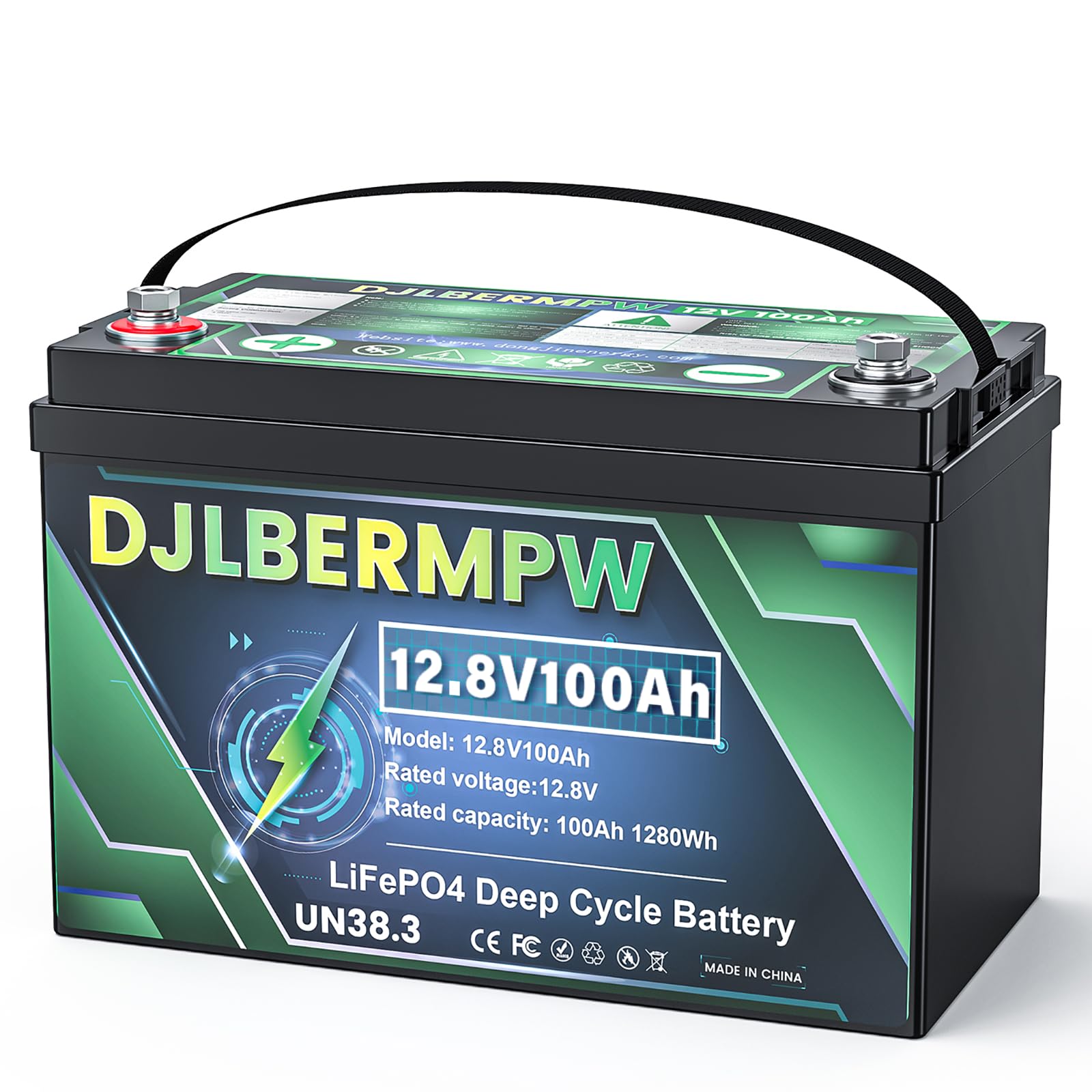
2. DJLBERMPW 12V 100Ah LiFePO4 Battery
Shed 264 pounds of dead weight and gain real speed on the course.
This is the battery for the golf cart owner who wants the dramatic lithium advantage at an entry-level lithium price. The spec that changes everything is weight: at 23 pounds, this battery is lighter than a 57-pound AGM of the same 100Ah capacity. A real-world cart swap tells the story — owners replaced 6 lead-acid batteries weighing 55 pounds each with 3 of these at 22 pounds each, cutting a stunning 264 pounds from the cart. The result was noticeably better hill climbing and an instant speed increase.
The built-in 100A BMS (Battery Management System — the protective brain that guards against overcharging, over-discharging, and short circuits) is upgraded with a low-temperature cut-off, so it stops charging in freezing conditions to protect the cells. It is rated for 15,000 deep cycles at 60% depth of discharge, with a 10-year lifespan claim and a 5-year after-sales warranty.
Owners specifically praise the quality and the lightweight design — those are the two most common positives. One solar user has run a fridge off it continuously for a year, even through six days of storms and cloud, and recovered fully in two to three sunny days. The main caveat: the battery life aspect is the most frequently mentioned topic overall and it gets mixed marks, which tracks with the reality that lithium performance depends on using the right lithium-compatible charger — a standard lead-acid charger will not cut it.
Why the swap pays off
- 23 pounds each — a 264-pound weight cut in a full cart swap
- 100A BMS with low-temperature cut-off for safety
- 5-year after-sales warranty and fast support
What to know first
- Needs a lithium-compatible charger, not a lead-acid one
- Battery life feedback is mixed across owners
- Fewer long-term reviews than the AGM crowd
Reach for this if: you want the biggest possible weight reduction and are ready for the lithium charger upgrade.
Look elsewhere if: you want a plug-and-play drop-in with zero charger changes — stick with AGM.
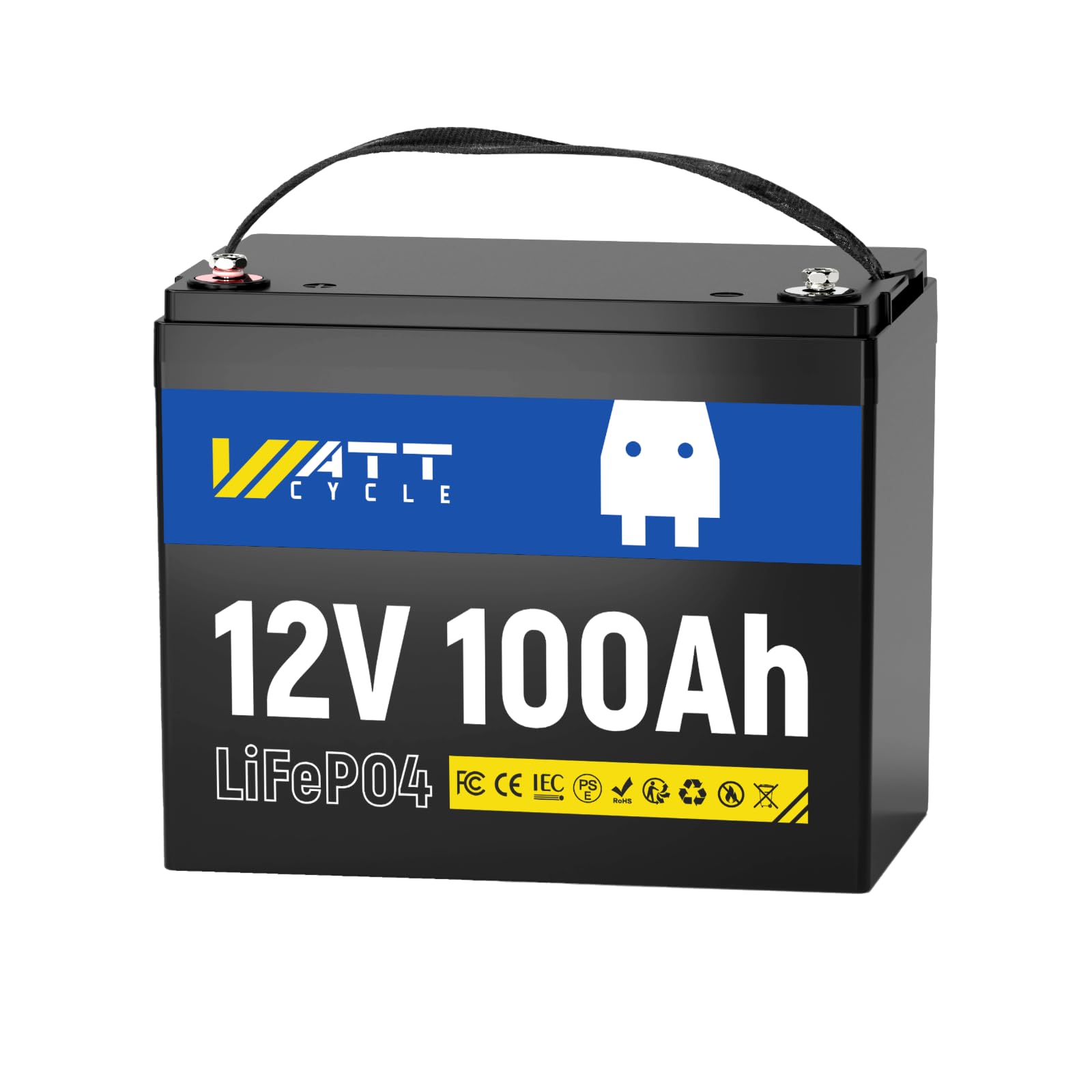
3. Wattcycle 12V 100Ah LiFePO4 Battery
A compact Group 24 lithium with a claimed 15,000-cycle lifespan.
If you plan to keep your cart for a decade, the Wattcycle is built to outlast it. It is a BCI Group 24 size, meaning it matches the standard battery-box footprint, and it weighs just 23.2 pounds. The 15,000-cycle rating means the manufacturer claims you can recharge and drain it 15,000 times before it wears out, versus 300 to 500 cycles for lead-acid.
Safety is a strong suit here. It uses A+ grade cells and carries SDS, UN38.3, FCC, CE, and ROHS certifications. The built-in 100A BMS automatically disconnects the battery if the discharge current exceeds 300±50A, which is a solid safety net for the surge demands of a trolling motor or a cart climbing a steep fairway. Owners mention it holds a steady 12.8V output and works well in series for 24V trolling setups, with voltage staying above 25V even after hard use.
What owners rave about is quality first, then performance — those two are the top positive aspects. It gets described as a perfect drop-in replacement for campers and marine applications. The one recurring complaint is mechanical: the supplied bolts for the terminals are short, so parallel connections may require buying M8x16mm bolts separately. It is an easy fix, but worth knowing before you install.
The long-game strengths
- 15,000-cycle rating for multi-year service
- 100A BMS trips over 300A for protection
- Compact Group 24 size fits standard boxes
The small hitches
- Terminal bolts run short for parallel wiring
- No Bluetooth monitoring built in
- Charging speed feedback is mixed
Pick it if: you want a certified, long-cycle lithium that fits standard Group 24 trays and you do not mind a quick bolt swap.
skip it if: you want phone-app battery monitoring — the ECO-WORTHY below has that.
4. ECO-WORTHY 12V 100Ah LiFePO4 Battery with Bluetooth

The only battery here that talks to your phone about its own health.
This is the battery for the data-driven owner who wants to know exactly what is happening under the seat. It is the rare pick with Bluetooth 5.1 monitoring built in, letting you check voltage, current, and remaining capacity from your phone, along with an estimate of the battery’s remaining working life. You can spot a problem before it strands you on the back nine.
Under the smart shell, it is a BCI Group 24 lithium battery measuring 10.23 x 6.6 x 8.43 inches and weighing 23.15 pounds. The cells inside are automotive-grade lithium iron phosphate, UL and IEC tested, with CE and RoHS certification. The built-in 100A BMS protects against overcharge, over-temperature, over-discharge, over-current, low temperature, and short circuits — and it has a low-temperature cut-off that stops charging below -7°C (19.4°F) to protect the cells in winter.
Owners single out battery quality and reliability as the twin top positives — each gets equal billing in the reviews. One owner runs three of these in a 36V golf cart and reports they work great together. The Bluetooth drain is negligible, and the battery holds a 100% charge for weeks when idle. The one honest gripe: some owners feel the Bluetooth should be optional, noting the price runs higher than non-smart competitors. If you do not need the app, you are paying for a feature you will not use.
Why the app matters
- Bluetooth 5.1 shows voltage, current, and capacity live
- UL and IEC tested cells with full BMS protection
- Low-temperature cut-off protects winter charging
Consider before buying
- Bluetooth adds cost over dumb batteries
- Battery life feedback is mixed overall
- Delivery may take longer than expected
Go for it if: you want to monitor battery health from your phone and you run a multi-battery setup where diagnosing a weak unit matters.
Think twice if: you are price-sensitive and simply want raw capacity — the DJLBERMPW gives you that for less.
5. CHINS 100Ah LiFePO4 Battery

A dependable 12.8-volt lithium that shines on the water as much as the fairway.
This CHINS battery brings a serious performance record for a mid-range price, and it is particularly beloved by the trolling-motor crowd. The key spec is the 12.8V standard voltage and 100Ah capacity, which owners have verified by testing — one measured a real 110Ah capacity across eight units, and another confirmed 104Ah through an inverter. It is also 30% lighter than lead-acid at the same capacity, so it is genuinely easy to move around.
The built-in 100A BMS includes a high-temperature cut-off that stops charging above 122°F (50°C) and a low-temperature cut-off that protects against charging below 32°F (0°C). The peak current of the BMS can reach 370 to 400A for 3 to 5 seconds, which makes it strong enough for most golf carts and trolling motors. You can connect up to four in series for 48V, or four in parallel for up to 800Ah total.
Performance is the number-one positive in the owner feedback, with battery life and value for money close behind. The recurring story is a day on the lake: one owner runs it with a 30lb trolling motor on an inflatable raft and has never come close to draining it. The honest caveat is that battery quality gets mixed feedback — a small number of owners had units fail early. That is the risk variance of a mid-tier brand, so check the warranty terms before you commit.
What it does well
- Tested capacity comes in at or above rated 100Ah
- High and low temperature cut-offs for safety
- Supports up to 48V series or 800Ah parallel banks
The honest picture
- Quality control gets mixed marks from owners
- Lighter warranty support than premium brands
Best suited to: trolling motor and marine use where you need dependable capacity at a fair price.
Less ideal for: buyers who want the highest consistency and longest warranty — step up to a premium brand.
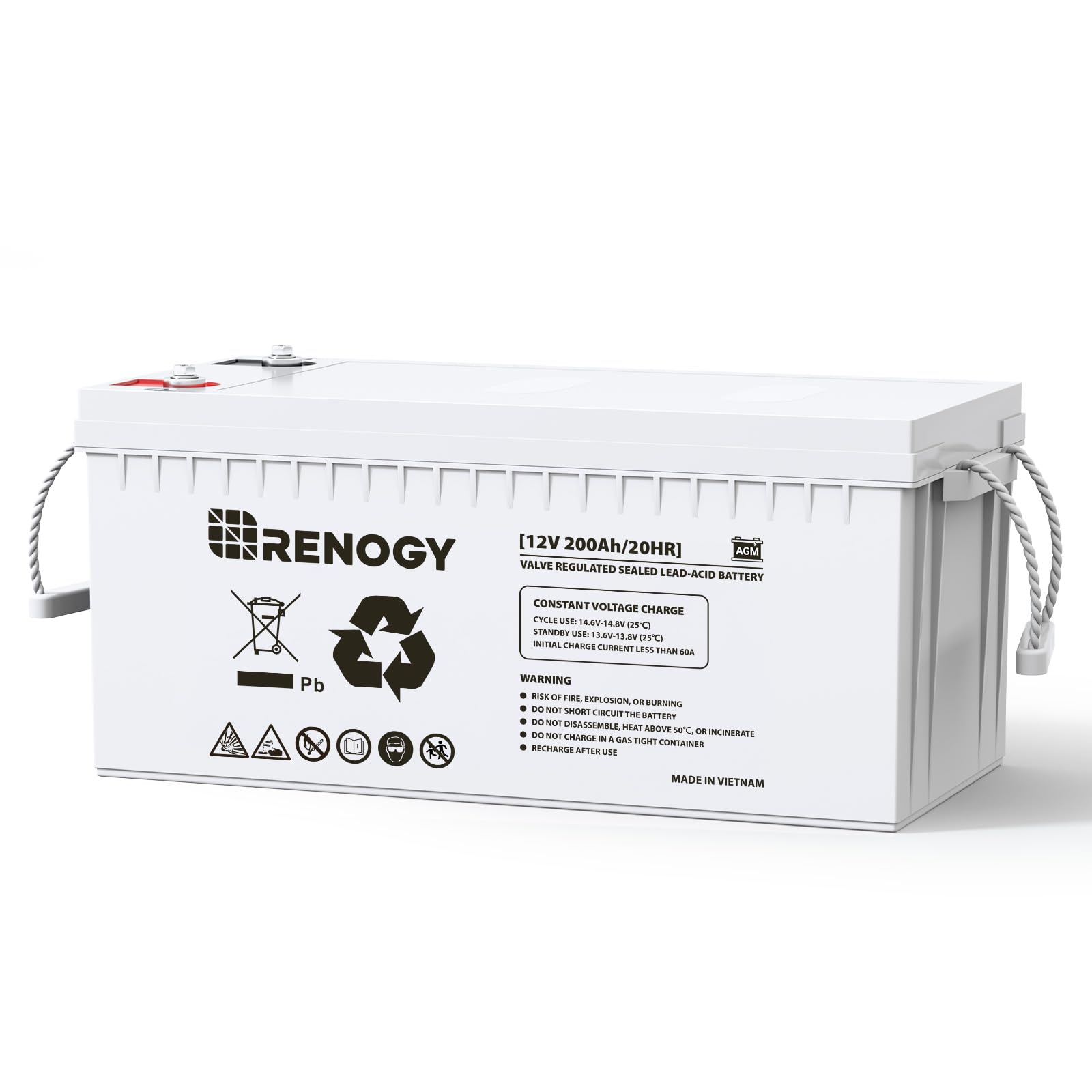
6. Renogy Deep Cycle AGM Battery 12V 200Ah
Double the capacity of a standard AGM, for carts that run all day without a charge.
When 100Ah is not enough, Renogy steps in with a 200Ah deep-cycle AGM that doubles your range. The spec sheet is impressive: a 2000A max discharge current, and a low internal resistance that allows high discharge currents of up to 10 times the rated capacity — the headroom you need for heavy appliances and steep hills. It is the battery for an RV or a golf cart that also powers accessories.
The trade-off for all that capacity is physical. At 127.9 pounds, this is the heaviest battery on this list, and owners confirm it — one describes it as “very heavy 123 lbs” but notes the strong handles make it manageable. It measures 20.5 x 9.4 x 8.8 inches, so be sure you have the physical space before committing. It is made from high-purity materials and keeps self-discharge below 3% per month at 77°F.
Build quality and value for money are the two most-praised aspects in the review data, and owners use it widely across RVs, solar systems, and off-grid cabins. The reference capacity numbers tell you how it behaves under load: C20 is 200Ah, C10 is 190.5Ah, C5 is 172.3Ah, and C3 is 152.9Ah — meaning the faster you drain it, the less usable capacity you get. Battery life is the most-discussed aspect overall and it is mixed, so this is best matched with a smart shunt to track real state of charge.
The power player
- 200Ah capacity for extended runtimes
- 2000A max discharge for heavy loads
- Low 3% monthly self-discharge rate
The physical cost
- 127.9 pounds is a serious lift
- Large footprint needs generous tray space
- Battery life tracking is mixed without a shunt
Choose this if: you need maximum AGM capacity and a battery that powers both the cart and your accessories.
Pass if: weight matters on your cart — a lithium option cuts this down to a fraction.
7. E-LekTech 12V 330Ah LiFePO4 Battery
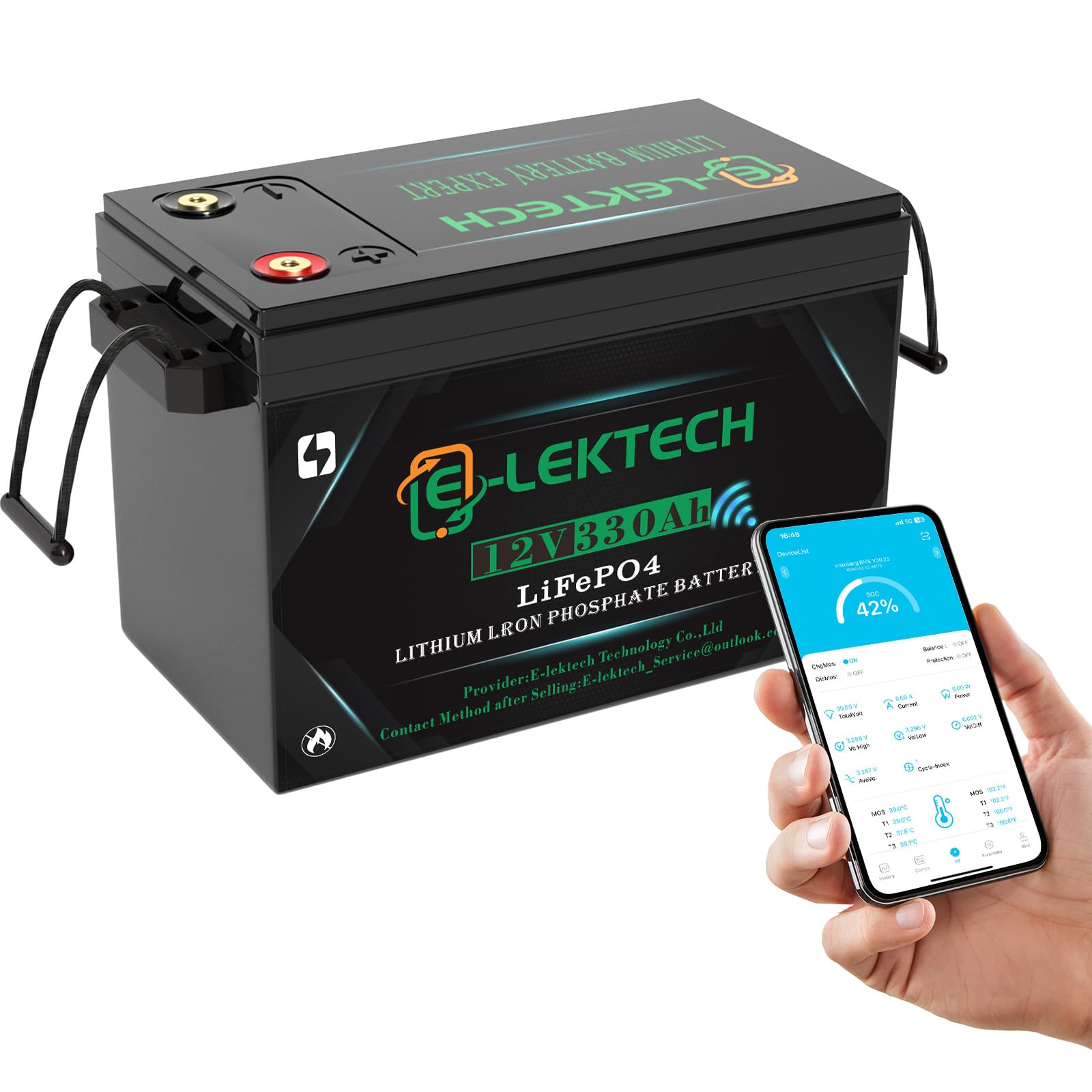
A 330Ah powerhouse that packs 4.22kWh into a 56-pound frame.
This is the battery for the cart owner who wants to charge once and forget about it. The E-LekTech 330Ah lithium battery holds 4.22kWh of energy — enough to run ordinary appliances for several days, according to the manufacturer. At 56 pounds, the maker claims it carries up to a 10-year warranty.
The core is a Grade A cell paired with a 200A intelligent BMS — a stronger management system than the 100A units on other picks, reflecting the higher capacity and 2560W maximum load power. It has over-charge, over-discharge, over-current, and over-temperature protection. The form factor is compact for the capacity: 13.4 x 7.6 x 9.8 inches, which owners confirm fits Class C RV under-step boxes and Sprinter chassis compartments.
Owners who made the swap from lead-acid report increased usable capacity: one went from a 50% state of charge floor down to 10% to 15%, meaning far more real range per charge. Another tested it at 305Ah over a 71-hour load, confirming the rating is honest. The recurring negative is the BMS’s built-in voltage meter, which gives inaccurate readings under load and below 50% state of charge; the fix is adding an external battery shunt for accurate tracking.
The capacity king
- 330Ah / 4.22kWh for multi-day runtimes
- 200A BMS handles heavy continuous loads
- 10-year manufacturer warranty
Know the limits
- Built-in voltage meter is inaccurate under load
- Hard to reach a true 100% charge on solar
- Premium price reflects premium capacity
Pick this for: maximum range and the smallest number of charges per season — it is the closest thing to set-and-forget.
Reconsider if: you want accurate onboard monitoring without adding an external shunt.
8. DJLBERMPW 48V 100Ah LiFePO4 4-Pack

The complete 48-volt conversion kit, pre-matched and ready to wire in series.
If your cart runs on a 48V system, this four-pack removes the guesswork of matching individual batteries. It is four 12V 100Ah LiFePO4 batteries designed to be wired in series to create a 48V 100Ah system with 5120Wh of energy — the battery bank your 48V golf cart was built for. It is IP66 waterproof, so it shrugs off rain and washdowns.
Each battery carries a 100A BMS with full protection against overcharging, over-discharging, over-current, overheating, and short circuits, plus a low-temperature cut-off for cold-weather charging. The recommended setup is charging each battery with a 20A charger to full, then placing them in parallel for 1 to 2 hours to balance voltage, or pairing them with a battery balancer — a proper drop-in replacement for a 48V golf cart battery.
The story from a Club Car owner is compelling: a cart used for 10 hours daily on hilly terrain only needed charging every four days, a clear step up from the old deep-cycle batteries. Another owner doing the swap describes it as the best upgrade for a cart with old heavy lead batteries, noting an instant speed increase of about 8 mph, and charge that lasts much longer. The one caution from the review data is a single unit arriving upside down in the box — pack carefully, and check the orientation on delivery.
The full-kit advantage
- Pre-matched 4-pack wired in series for 48V
- 5120Wh total energy capacity
- IP66 waterproof for outdoor use
Set expectations
- Needs a lithium-compatible 48V charger setup
- One report of a unit arriving upside down
Get this if: you want a turnkey 48V lithium conversion with matched cells and instant weight and speed gains.
Weigh it if: you already own individual 12V lithiums — you may only need a balancer, not a full kit.
9. Trojan T-1275 12V 150Ah Flooded Battery (4-Pack)

The traditionalist’s choice: a proven flooded lead-acid 150Ah workhorse in a four-pack.
For owners who want the classic, know-the-brand golf cart battery, Trojan’s T-1275 is the gold standard of flooded lead-acid. This listing is a four-pack of 150Ah, 12-volt deep-cycle batteries in BCI Group GC12 size, measuring 12.96 x 7.13 x 11.13 inches and weighing 85 pounds each. It is recommended for golf cars, RVs, marine use, solar and wind energy, floor machines, and man lifts.
The honest trade-off with flooded batteries is maintenance: unlike the sealed AGM and lithium picks above, these require regular water level checks and can spill if tipped. That is the price you pay for the lower upfront cost per amp-hour and the class-leading Trojan brand heritage. Customers note it arrives as an exact replacement for old cart batteries, with easy delivery and even a battery carrier included to help with installation.
The review data is thin but positive: buyers describe a perfect fit for a 48V golf cart setup and a smooth purchase-to-delivery experience. The main complaints are about the high price and occasionally tricky delivery logistics for very heavy items.
The classic appeal
- 150Ah per battery — more than standard 100Ah options
- Exact replacement fit for GC12 trays
- Proven Trojan brand heritage
The old-school costs
- Flooded design needs water checks and ventilation
- 85-pound each weight is heavy to handle
- Premium price for the brand name
Buy this if: you want the traditional flooded setup with proven brand reliability and you are comfortable with regular maintenance.
Avoid if: you want zero maintenance — the AGM and lithium picks above are sealed and care-free.
Understanding the Specs
Amp Hours (Ah)
Amp hours tell you how much energy the battery stores, like the size of a fuel tank. A 200Ah AGM stores 200Ah versus 100Ah for a 100Ah battery, so it runs your cart longer between charges. Lithium batteries deliver a higher percentage of their rated capacity than lead-acid, which is why a 100Ah lithium often feels like it lasts longer than a 100Ah AGM.
Max Discharge Current (A)
This is the peak burst of power the battery can deliver, measured in amps. A higher number means the battery can handle sudden heavy demand, like climbing a steep hill or pulling a heavy load, without voltage sagging. AGM batteries like the Renogy 200Ah with 2000A handle massive surges, while a 100A rating on a lithium battery is plenty for most golf carts and trolling motors.
FAQ
How many 12V batteries does my golf cart need?
What is the difference between AGM and flooded lead-acid batteries?
Can I replace my lead-acid golf cart batteries with lithium?
How long do 12V golf cart batteries last?
What does the BMS on a lithium battery do?
Will a 12V battery fit my golf cart’s existing tray?
Is a higher discharge current rating better for a golf cart?
Why are lithium golf cart batteries so much lighter?
Can I connect multiple 12V batteries for more power?
Final Thoughts: The Verdict
Across the board, the 12v golf cart batteries winner is the Weize Deep Cycle AGM 100Ah because it delivers proven reliability, a massive 1150A discharge burst, and a maintenance-free sealed design at a budget-friendly price. If you want the dramatic weight savings and long-term cycle life of lithium, grab the DJLBERMPW 100Ah. And for a complete 48V conversion with the least effort, the DJLBERMPW 4-Pack is the one to reach for.
How We Picked
We do not accept paid placement. Every pick is matched to a real buyer and a real use-case; we do not hands-on test units.
Sources & Methodology
Specifications: manufacturer listings and product documentation. Review insights: verified customer reviews, as of August 2026. Pricing: not shown on this page (it changes often); check the current price via the retailer link.
As an Amazon Associate, Gadgets Feed earns from qualifying purchases. This does not affect which products we feature.