
Our readers keep the lights on and my morning glass full of iced black tea. As an Amazon Associate, I earn from qualifying purchases.
Specs are compiled from manufacturer listings and verified buyer reviews and can change over time — please confirm the key details on the product page before buying.
Before you buy a 12V inverter for your RV, ask yourself what you will actually run while parked. A 1000W unit powers your TV, laptop, and a small fridge, but a 2000W or 3000W model is needed for a microwave or hair dryer. This guide ranks the top options by real-world strengths, so you match wattage and features to your camping style without overspending.
I’m Min — the founder and writer behind Gadgets Feed. This guide is built by comparing the manufacturers’ published specifications and the patterns across verified customer reviews, so you get each pick’s real strengths and trade-offs instead of marketing spin.
The best 12v inverter for rv depends on your power needs, which is why this guide breaks down the top models across different wattages and price points.
Our Picks at a Glance
How To Choose The Best 12V Inverter For RV
Before you buy, you need to know your battery bank’s capacity and the total wattage of the appliances you plan to run. Every inverter converts your 12V battery power into 120V AC electricity, but they differ in how much they can deliver continuously and in short bursts.
Match Continuous Wattage to Your Heaviest Load
The continuous wattage rating is the real workhorse number. A 1000W inverter can comfortably run a laptop, TV, and small appliances all at once. If you want to power a microwave (usually 1000W-1200W) or a hair dryer, step up to a 2000W or 3000W model so you have headroom for startup spikes.
Understand Peak Surge Power
Motors in refrigerators, air conditioners, and power tools draw a big burst of power for a split second when they start. That is what the peak surge rating covers. An inverter rated for 2000W continuous with a 4000W surge can briefly deliver that extra kick to get a motor spinning without tripping its protection.
Check the Included Battery Cables
The cables that connect the inverter to your battery matter as much as the inverter itself. Thicker cables handle more current without heating up. If you are planning a long wire run to a remote battery, you may need to buy heavier-gauge cable than what ships in the box.
Quick Comparison
| Model | Best For | Continuous Power | Peak Surge | Weight | Amazon |
|---|---|---|---|---|---|
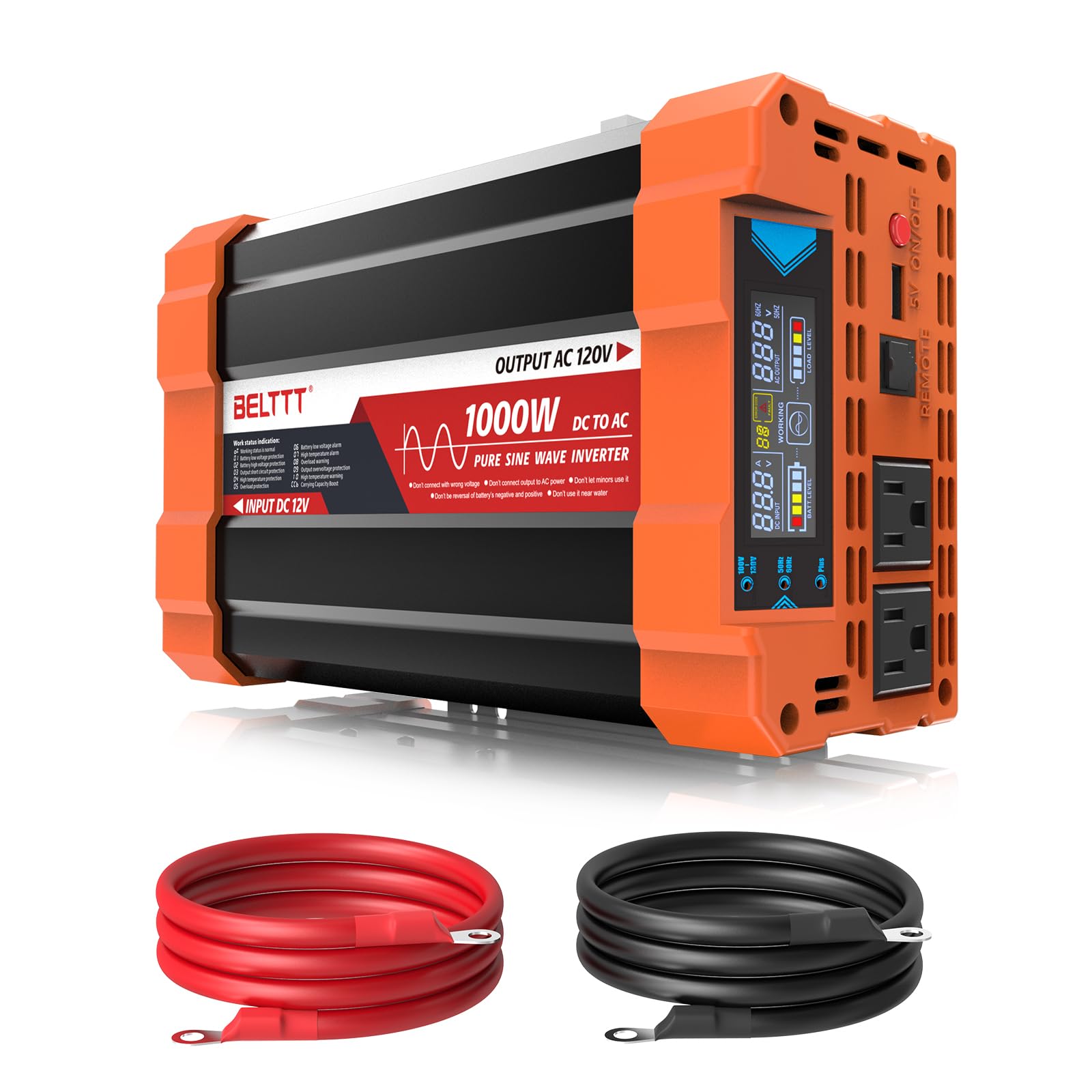
| BELTTT 1000W Pure Sine Wave★ Best Overall | Light off-grid loads with a smart display | 1000W | 2000W | 4.4 lbs | Amazon |
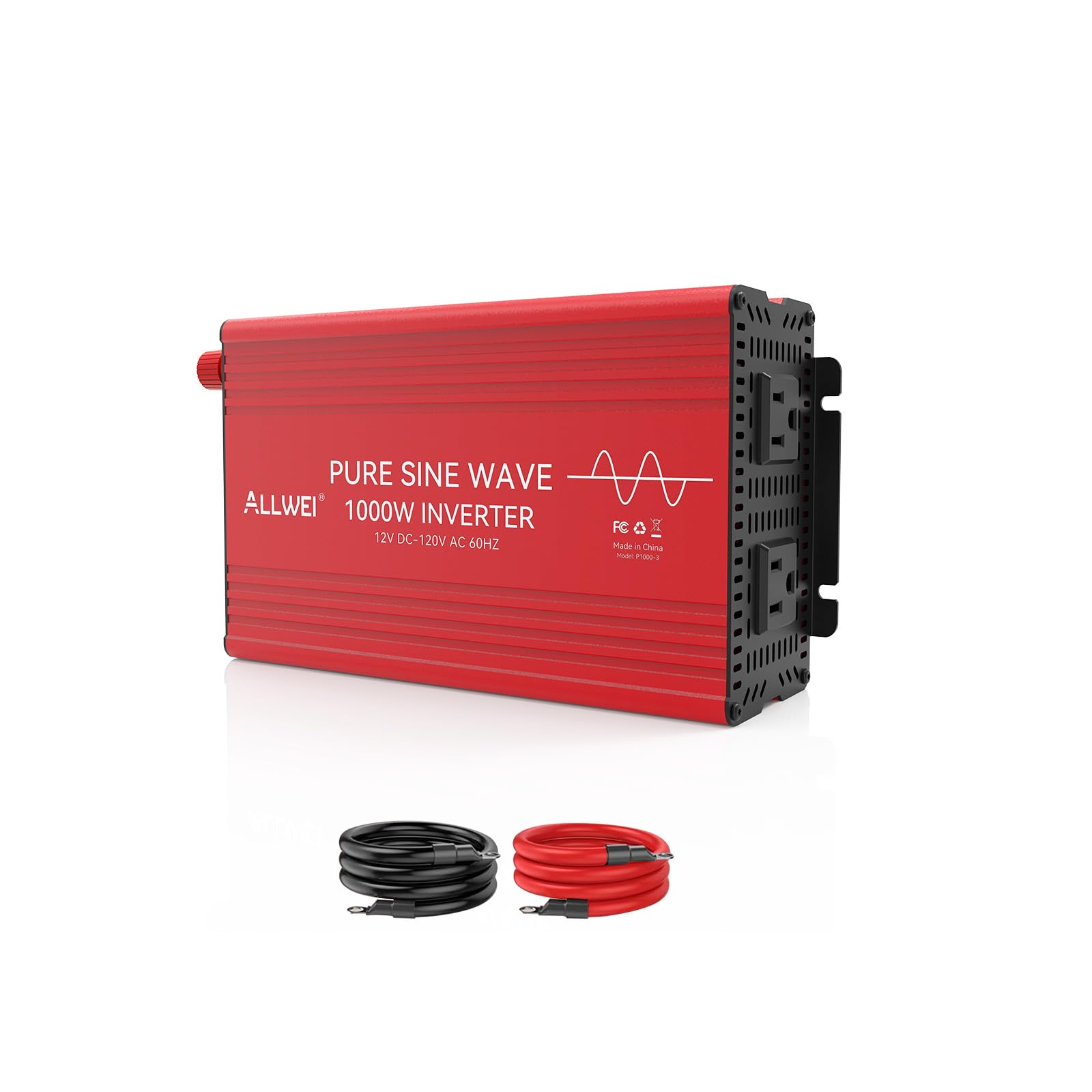
| ALLWEI 1000W Pure Sine WaveBest Value | Budget-friendly basic 1000W needs | 1000W | 2000W | 3.3 lbs | Amazon |
| ALLWEI 1000W ETL Listed | Safety-certified 1000W with LCD | 1000W | 2000W | 3.5 lbs | Amazon |
| LANDERPOW 2000W Inverter | High-power needs with USB-C fast charging | 2000W | 4000W | 6.3 lbs | Amazon |
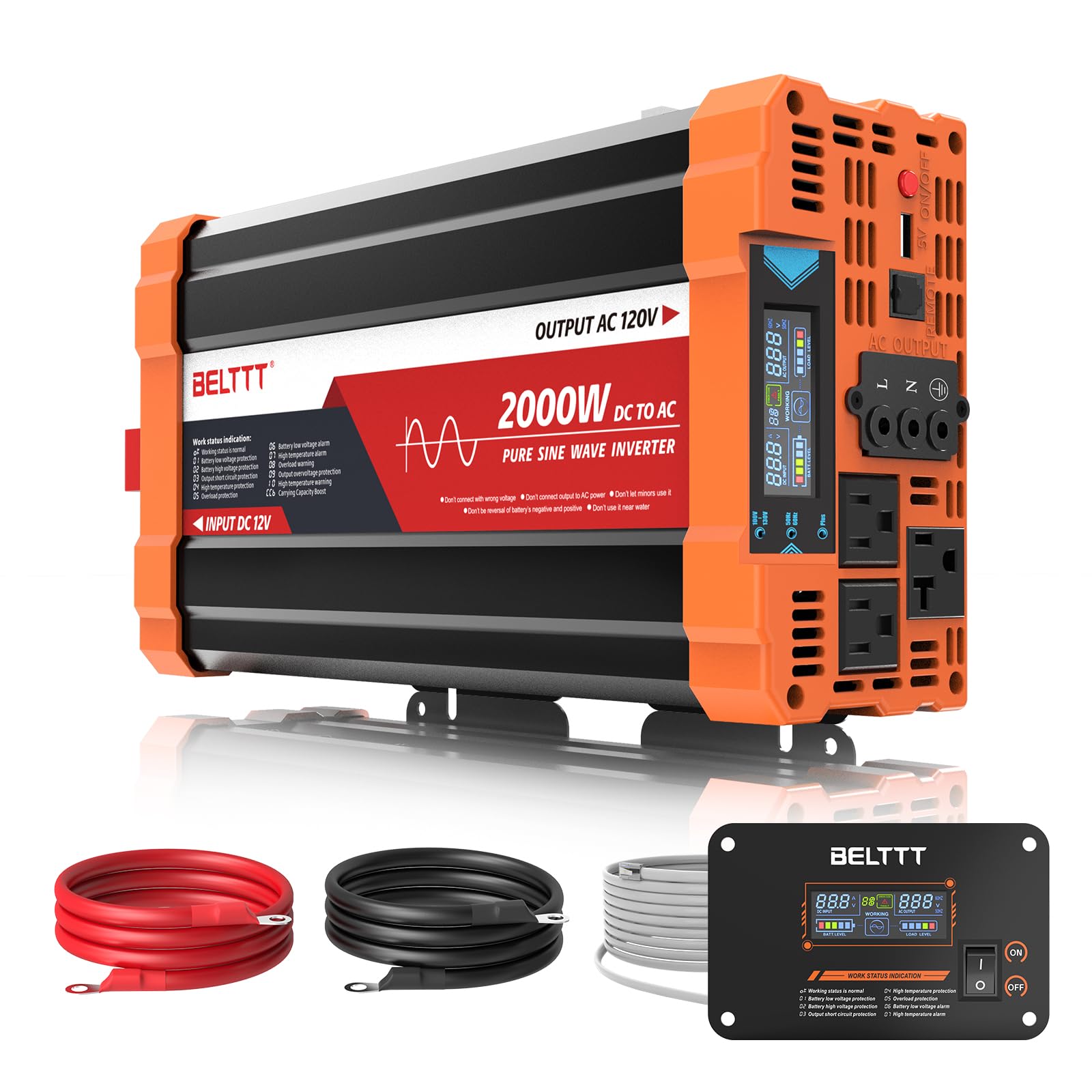
| BELTTT 2000W Pure Sine Wave | Balanced power with a 23ft remote | 2000W | 4000W | 7.7 lbs | Amazon |
| BELTTT 3000W Pure Sine Wave | Running AC units and heavy appliances | 3000W | 6000W | 9.9 lbs | Amazon |
| VOLTWORKS 3000W Pure Sine Wave | Quiet 3000W with a 30ft remote | 3000W | — | 12.6 lbs | Amazon |
In‑Depth Reviews
1. BELTTT 1000W Pure Sine Wave Inverter
Our pick — over 4.5★ from 200+ verified ratings; the strongest balance of quality and price.
The 1000W camp companion with a high-brightness display that finally runs finicky ice makers.
This little workhorse converts your 12V battery into 120V AC power at 1000W continuous, with a 2000W surge for starting up motors. What wins people over is the performance — it handles inductive loads like an ice maker that two other inverters failed on, which is a common frustration with cheaper units. The smart LCD screen shows input and output voltages, battery status, and load levels all at once, so you can spot a problem before it becomes a dead battery.
At 4.4 pounds, it is noticeably heavier than the ALLWEI 1000W model’s 3.3 pounds, and its 11-inch length takes up a bit more space under your counter. But that extra bulk comes with heavier-duty DC power terminals and a build quality that owners rave about. The dual AC outlets plus a 5V 2.1A USB port give you room for a TV and a phone charger simultaneously, and the included 3-foot cables and fuses mean you can install it right from the start.
Its conversion efficiency tops 90%, so minimal battery charge is lost as heat. Buyers report it runs an air purifier, laptop, and TV without breaking a sweat, and the fan only spins up when needed, keeping things quiet at night. The recurring advice is simple: for loads under 800W continuous, the included wiring is plenty — push toward that 1000W max and you will want to upgrade the cables.
Why owners stick with it
- LCD display shows voltage and load in real time
- Handles inductive loads like ice makers and shop vacs
- Bolt-type terminals feel safer than cheap knobs
- Quiet, on-demand cooling fan
The honest limits
- Included wires run thin above 800W continuous
- Heavier and longer than the ALLWEI 1000W
- Display shows a load bar graph, not an exact wattage number
Reach for this if: you want a dependable 1000W unit with a screen that tells you what is happening and enough guts to start a small appliance motor.
Think twice if: you plan to run near the full 1000W continuously — you will want to swap in thicker battery cable first.
2. ALLWEI 1000W Pure Sine Wave Inverter
A featherlight 3.3-pound 1000W unit that squeezes into tight van builds and glove boxes.
The ALLWEI 1000W delivers the same continuous 1000W and 2000W surge as the BELTTT, but packs it into a smaller frame at 10.24 inches long and just 3.3 pounds. For anyone squeezing an inverter into a compact camper or under a truck seat, that size difference is the whole ballgame. The pure sine wave output means your laptop, TV, and CPAP machine run clean with no buzzing or flickering, exactly like plugging into a wall outlet.
What stands out here is the circuit protection. Owners mention plugging in two USB devices and a higher-amp 110V appliance at the same time without blowing the 12V automotive fuse — the inverter’s built-in safeguards step in before your vehicle’s fuse does. The 8-fold protection covers low and high voltage, over and under temperature, overload, over-current, reverse polarity, and short circuits, with a buzzer that alerts you the moment something goes wrong.
Weighing 3.3 pounds versus the BELTTT’s 4.4 pounds, it is also the easier unit to mount on a vertical surface. The intelligent cooling fans auto-adjust speed based on load and temperature, and the aluminum alloy housing is built to shrug off the heat of a Texas summer. Keep in mind that some owners find the fan noticeable on startup, though it settles down as the load drops.
The smart-buy read: you get genuine pure sine wave power, rugged protection, and a compact footprint for less than the feature-packed BELTTT.
Who it suits: van-lifers and light-duty campers who prioritize a small, light install over a built-in display and heavy-duty terminals.
3. ALLWEI 1000W ETL Listed Inverter

The certified 1000W with an ETL UL458 stamp that insurance-minded RV owners look for.
This ALLWEI model earns its spot with an ETL UL458 certification — a safety standard for power conversion gear in RVs — so you get an independently tested unit for your trailer. It delivers 1000W continuous with a 2000W surge and a conversion efficiency above 91%, so less battery energy is wasted as heat.
The LCD display is a real upgrade over the standard ALLWEI, letting you keep an eye on input and output status at a glance. Owners note the unit is quieter than expected for its class, and the aluminum alloy housing keeps it cool across a 14°F to 104°F operating range. The dual AC sockets plus the same 8-fold protection and auto-cool fans make it a versatile choice for home backup, marine use, or your RV.
At 3.5 pounds and 10.24 inches long, it matches the footprint of the standard ALLWEI while adding the display and certification. The fan does get loud during startup and heavy use, which is a trade-off for staying cool under load. It is a strong middle option for buyers who want the ALLWEI price point but refuse to skip the safety certification.
The certified angle: you pay a little more than the plain ALLWEI but get an LCD screen and an ETL UL458 safety listing that matters when it lives in your RV.
The plain-English catch: expect fan noise when you first power it on and while running big loads — it is working to keep itself cool.
4. LANDERPOW 2000W Pure Sine Wave Inverter

A 2000W powerhouse with a 15ft remote and 30W USB-C for serious RV living.
When your RV needs to run a microwave or power tool without tripping, this LANDERPOW steps up with 2000W continuous and a 4000W surge. The standout feature is the smart LED remote with a 15ft cable — mount the display near your driver’s seat and watch battery level, output, and error codes in real time without walking to the battery compartment. The one-touch shutdown switch prevents a dead battery more often than you would expect.
The 30W USB-C port fast-charges modern phones and tablets without an AC adapter, a feature no other pick offers. Beyond that, you get three AC outlets plus a hardwired terminal for high-current tools, and two 2AWG battery cables that stay cool under heavy load. The full metal shell handles drops and RV vibrations, and the 3-year total coverage (1-year replacement plus 2-year support) backs it up.
Customers note loving the remote readout that shows battery level and demand, and installation is genuinely plug-and-play. The honest caveat is mixed noise feedback — some call it super quiet while others hear normal fan hum under load — and a few early units needed replacement after an error code, though the seller swapped them quickly. For a mid-range 2000W with modern charging, this is the most complete package.
What makes it a daily driver
- 30W USB-C fast charging built in
- 15ft remote shows battery level and output
- 3 AC outlets plus a hardwire terminal
- 3-year total coverage from the seller
What to watch
- Fan noise is a matter of opinion — some find it loud
- Included cables feel thin for the full 2000W draw
- An occasional unit arrives needing an exchange
Best for: RVers who want 2000W of headroom, fast USB-C device charging, and the convenience of a remote you can read from the cab.
Not for: anyone who insists on whisper-quiet operation during heavy loads — plan for some fan noise.
5. BELTTT 2000W Pure Sine Wave Inverter
A 2000W bruiser with a 23ft remote and quiet cooling that runs a 10,000 BTU AC.
This BELTTT 2000W delivers 2000W continuous with a 4000W surge and a conversion efficiency past 93%, among the highest here. That combination of power and thermal control is the reason it wins over heavy users.
The graphical LCD display shows input and output voltages, battery status, and fault codes, and the 23ft wired remote lets you mount the controls anywhere in the rig. You also get a dual AC outlet, a separate 20A outlet for heavier gear, a 5V 2.1A USB port, and a hardwire port for permanent connections. The package includes two 2AWG battery cables and six 45A fuses, so the install kit is genuinely complete.
There are two honest caveats. First, the included 3ft cables are fine for a short run, but if you need a 10-15ft reach to your battery, plan on buying 2/0 AWG cable and a 250A fuse separately. Second, the outlets sit flush to the case, so L-shaped plugs will not fit — grab a straight-plug power strip. Owners also note the idle draw is a touch higher than older inverters, so turn it off when you are not using it to protect your battery.
The decisive edge: it runs a window AC unit longer and cooler than most 2000W units, with remote control and fault-code displays to match.
The planning note: factor in a heavier cable kit if your battery is more than a few feet from the mounting spot.
6. BELTTT 3000W Pure Sine Wave Inverter

The 3000W beast whose 6000W surge starts microwaves and coffee makers in a semi cab.
If your RV or truck doubles as a rolling kitchen, this BELTTT 3000W is the one that keeps the microwave, crock pot, and blow dryer all within reach. It delivers 3000W continuous and a 6000W surge, with the same >93% efficiency and smart LCD display as its 2000W sibling. Owners running it daily in semi trucks report clean power that runs a microwave, coffee maker, and laptop without a hiccup, and the 23ft remote makes switching it off from the cab easy.
The bigger story is the startup surge. A 1200W microwave can draw up to 140A from the battery for a split second, and this unit absorbs that without shedding the load. You do need a serious battery bank to feed it — owners recommend 200Ah or more of lithium or marine batteries, with one running a 400Ah setup. The included 1/0AWG battery cables are heavier than what ships with most units, which is a good sign for sustained high draw.
It is a substantial 9.9 pounds and 17 inches long, so plan your mounting space. Owners note the fans are audible above 1000W loads (that is normal at this power level) and that the AC outlets sit close together — a power strip solves that. Standby draw sits around 1A, so killing it when idle is smart for battery health. For a full-scale off-grid setup, this is the most reliable big-wattage value here.
The heavy-lifter strengths
- 6000W surge starts big motors without tripping
- 23ft remote with full display for cab mounting
- 1/0AWG cables included for high current
- Runs a 1200W microwave on a 400Ah bank
Size and setup realities
- 9.9 pounds needs solid mounting space
- Fan noise is noticeable above 1000W
- Demands a 200Ah+ battery bank to feed it
Choose it if: you are building a serious off-grid setup and want one inverter that starts a microwave and coffee maker without drama.
skip it if: your battery bank is under 200Ah — this unit will drain it fast and leave you without power.
7. VOLTWORKS 3000W Pure Sine Wave Inverter

The 3000W quiet giant whose fan only wakes up at 104°F or 1400W of load.
The VOLTWORKS 3000W takes a different approach to cooling: instead of spinning fans constantly, it keeps them silent until the case hits 104°F or the load passes 1400W. That makes it the quietest big-wattage option here, which matters if the inverter lives near your sleeping area. It delivers a true 3000W continuous at 120V AC, with clean pure sine wave power that runs circular saws and electric kettles alike, per owner reports.
The 30ft remote controller is the longest in this lineup, easily routing from a rear compartment to your dashboard. The remote uses an RJ10 4P4C connector, so you can extend the cable with standard phone cable. It includes battery monitoring to check your bank’s status and avoid draining it flat, plus four battery cables (black and red) in the box. The hardwire terminal is rated for 30A, offering a permanent connection for a proper RV install.
At 12.6 pounds, it is the heaviest unit here, and owners note the battery meter is not useful with LiFePO4 batteries (it always shows good). The idle draw is around 0.7A, so you will want to switch it off when parked for long stretches. It comes with an 18-month warranty and liability coverage, which speaks to the manufacturer’s confidence.
The quiet achiever: you get full 3000W capability with fans that barely run, ideal for night-time use in a small camper or boat.
The honest note: the battery meter is aimed at lead-acid batteries — LiFePO4 users should watch voltage elsewhere.
Understanding the Specs
Pure Sine Wave vs. Modified Sine Wave
The output waveform describes the shape of the electricity. Pure sine wave (what you get from a wall outlet) is what sensitive electronics like laptops, TVs, and CPAP machines need to run cleanly without humming or flickering. All seven picks here are pure sine wave, which is the right call for RV use.
Continuous vs. Peak Surge Power
Continuous wattage is what the inverter can deliver steadily. Peak surge is the brief burst it can handle when a motor starts. A fridge might run at 200W but need 600W for a second to start — that is what the surge rating covers. Always size your continuous wattage to your heaviest simultaneous load.
FAQ
What size inverter do I need to run a microwave in my RV?
Can a 1000W inverter run a small refrigerator?
Why does my inverter need a remote control?
What battery capacity do I need for a 3000W inverter?
Are the included battery cables good enough?
What does ETL UL458 certification mean for an RV inverter?
Will a pure sine wave inverter stop my lights from flickering?
How do I know if my inverter is draining my battery when idle?
Final Thoughts: The Verdict
For the majority of shoppers, the best 12v inverter for rv is the BELTTT 1000W because it combines dependable pure sine wave performance with a smart LCD display and the muscle to start finicky inductive loads. If you need more wattage and modern charging, the LANDERPOW 2000W with its 30W USB-C and 15ft remote is the mid-range standout. And for full-size off-grid living, the BELTTT 3000W delivers the surge power that starts a microwave and an air conditioner without breaking a sweat.
How We Picked
We do not accept paid placement. Every pick is matched to a real buyer and a real use-case; we do not hands-on test units.
Sources & Methodology
Specifications: manufacturer listings and product documentation. Review insights: verified customer reviews, as of August 2026. Pricing: not shown on this page (it changes often); check the current price via the retailer link.
As an Amazon Associate, Gadgets Feed earns from qualifying purchases. This does not affect which products we feature.