
Our readers keep the lights on and my morning glass full of iced black tea. As an Amazon Associate, I earn from qualifying purchases.
Specs are compiled from manufacturer listings and verified buyer reviews and can change over time — please confirm the key details on the product page before buying.
If you pick the wrong transformer for your landscape lights, you get dim, flickering yard lights or a tripped breaker every night. The transformer steps down (converts) your home’s 120V power to a safe 12V (low voltage that won’t hurt you if you touch a wire). If you guess wrong on wattage, nothing works right. This guide looks at seven popular transformers to help you find one that matches your yard, your light count, and how much control you want over the schedule.
I’m Min — the founder and writer behind Gadgets Feed. This guide is built by comparing the manufacturers’ published specifications and the patterns across verified customer reviews, so you get each pick’s real strengths and trade-offs instead of marketing spin.
The right 12v landscape lighting transformer balances wattage headroom (how much extra power you have for future lights), timer flexibility, and weather resistance without forcing you to pay for features your setup doesn’t need.
Quick Picks
- DEWENWILS 300W Low Voltage Landscape Transformer — Three‑Zone Commander
- SURAIELEC 300W Wi-Fi Low Voltage Landscape — Smart & Sleek
- Lightkiwi 300W Landscape Lighting Transformer — Voltage‑Drop Master
- VOLT 300W Slim Line Low Voltage Transformer — Premium Lifetime Build
- WILAWELS 300W Low Voltage Landscape Transformer — Six‑Mode Power
- GOODSMANN Low Voltage Transformer 120W — Compact 120W Power
- SUNVIE 60W Low Voltage Landscape Transformer — Budget Entry Point
How To Choose The Best 12V Landscape Lighting Transformer
Before you pick a transformer, you need to know the total wattage of every light you plan to hook up. Add the wattage of each fixture, then multiply that number by 1.25 — that gives you the 80% headroom most manufacturers recommend to avoid overheating (so your transformer works cool and lasts). A 300W transformer should run no more than 240W of lights.
Timer and Sensor Types
Most transformers include a photocell sensor (a light detector that measures sunlight) so lights turn on automatically at dusk and off at dawn. Some add a countdown timer (2, 4, 6, 8, or 10 hours) so you do not waste power all night — your lights stay on for a set time and then turn off. A few models offer programmable timers where you set exact on/off times, and the smartest ones let you control everything from a phone app.
Multi-Tap vs Single Voltage Output
If your wire runs are long (over 100 feet), voltage drop (electricity loss in the wire) becomes a real problem — lights at the end of the line will be dimmer. Multi-tap transformers let you choose 12V, 13V, 14V, or 15V output to push enough power all the way to the last fixture. Standard units give you only 12V or maybe a 12V/14V switch.
Weatherproofing and Build
Even though you might install the transformer inside a garage or basement, some people mount it outside. Look for a NEMA type 3R rating (it handles rain, snow, and direct sun), a metal housing instead of cheap plastic, and a door or lid that covers the controls from rain and direct sun. A heavy unit usually means a beefier core that runs cooler and quieter.
Quick Comparison
| Model | Best For | Wattage | Output Voltage | Weight | Amazon |
|---|---|---|---|---|---|
| DEWENWILS 300W | Multi-zone yards | 300W | 12/14V AC | 12.4 lbs | $98.99Amazon |
| SURAIELEC 300W Wi-Fi | Smart home users | 300W | 12/15V AC | — | $99.98Amazon |
| Lightkiwi 300W | Voltage-drop compensation | 300W | 12-15V AC multi-tap | 17.5 lbs | $154.99Amazon |
| VOLT 300W Slim Line | Premium long-term build | 300W | 12/15V AC | 13 lbs | $299.97Amazon |
| WILAWELS 300W | Simple power with six modes | 300W | 12/14V AC | 5.1 kg | $71.60$89.99Limited time dealAmazon |
| GOODSMANN 120W | Small to medium light setups | 120W | 12V AC | — | $62.99Amazon |
| SUNVIE 60W | Budget-friendly small yards | 60W | 12V DC | — | $37.99Amazon |
In‑Depth Reviews
1. DEWENWILS 300W Low Voltage Landscape Transformer
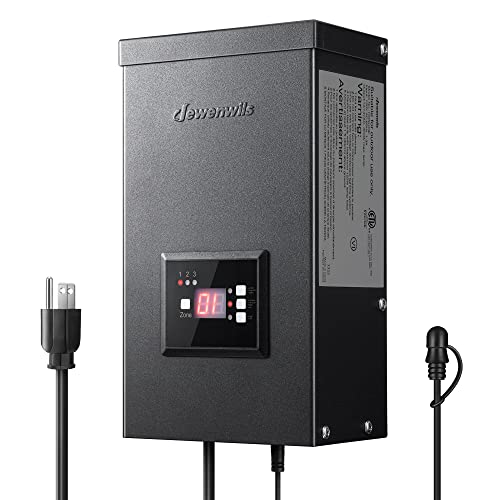
Lets you run your front yard, backyard, and garden path on separate schedules — all from one metal box.
This is the transformer for anyone who wants the front yard, backyard, and garden path on different schedules. You get three separate output zones you can turn on or off individually by pressing the “Zone” button — your front path lights can stay on until dawn while the backyard lights shut off at midnight. At 300W (the same max as the 300W WILAWELS below, versus the 60W SUNVIE), it steps down 120V to 12V or 14V AC to keep the risk low. The sturdy metal housing (3″D x 6″W x 11″H, 12.4 lbs) feels solid and handles rain, snow, and direct sun.
It has a detachable photocell sensor (a sunlight detector) with a 6-foot sensor cable so you can mount the transformer indoors while the sensor looks outside. The built-in countdown timer ranges from 1 to 12 hours, and the memory function remembers your settings after a power outage, so you do not have to reprogram it every time the weather knocks things out. Buyers report it powers nine 10-volt lights easily and runs two 100-foot lines with 15-20 lights each without issue. Unlike the SURAIELEC Wi-Fi model, this unit has no app or voice control — it is purely a strong, simple multi-zone unit.
Why It Earns Its Spot
- Three independent zones let you separate front/back/garden paths
- Memory restores settings automatically after a power outage
- Detachable photocell with long 6-foot sensor cable
One Limitation
- No Wi-Fi or smart-home integration — you set everything from the front panel
Best for the multi-area yard: If you have separate lighting circuits for the front path, the deck, and the garden, this saves you from buying two separate transformers.
Not for app lovers: There is no smartphone control — you set everything from the front panel.
2. SURAIELEC 300W Wi-Fi Low Voltage Landscape Transformer

A 300W transformer you can turn on with your voice or from anywhere in the world using your phone.
If you want to say “Alexa, turn on the yard lights” or set your lights to follow sunrise and sunset times from the Smart Life app, this is the pick. It has two independent channels for front and back, gives you 12V or 15V AC output, and uses a weatherproof NEMA type 3R enclosure (rated for outdoor use in rain and snow) with a lockable lid to keep the elements out. The unit is compact at 3.3″D x 6.1″W x 11.6″H and fits neatly on a wall. The internal circuit breaker (a safety switch that trips on overload) protects against overloads, and the maker says you should not exceed 240W connected load to keep it efficient.
The Wi-Fi connects to your 2.4GHz network — no extra hub needed. Owners mention the setup is easy and the integration with Alexa works immediately, though a few owners note the app is not the most intuitive. Some reviews mention units failing after several months, but the company support team (Murphy) has been responsive, promptly sending replacements. If you prefer a purely mechanical transformer with no app or connectivity, the DEWENWILS above gives you multi-zone control without the smart features.
Smart Features That Stand Out
- Voice control with Amazon Alexa and Google Assistant — speak to your lights
- Two independent channels for front and backyard
- Lockable weatherproof NEMA 3R enclosure
Where It Stumbles
- Wi-Fi connects only to 2.4GHz, not 5GHz (the faster band)
- Some users report reliability issues within the first months
Reach for this if you love voice control: It plays nice with Alexa and Google Assistant for hands-free lighting.
Look elsewhere if you want a simple plug-and-play unit: The app adds complexity, and some owners found the connection finicky.
3. Lightkiwi 300W Landscape Lighting Transformer
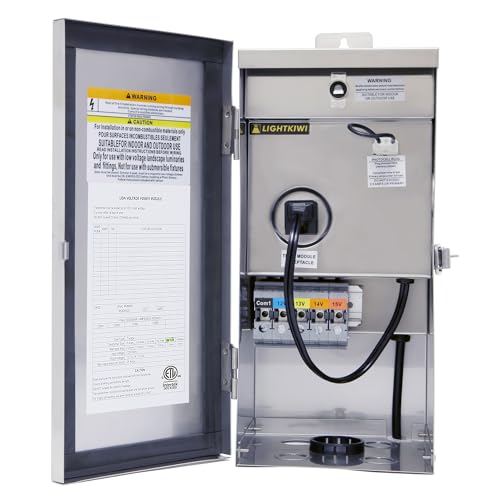
A heavy, near-silent transformer with four output voltage taps to fight voltage drop on long wire runs.
If your longest wire run stretches 150 feet to the last fixture, standard 12V output may leave that light looking weak. This 300W unit from Lightkiwi gives you taps at 12V, 13V, 14V, and 15V AC so you can dial up the voltage just enough to keep all fixtures bright — your far-path lights stay as bright as the ones near the transformer. The core is a high-performance toroidal design (a donut-shaped component) — customers note it runs near-silent (just a faint hum) and stays cool even under load. At 17.5 lbs (6.4″D x 6.2″W x 13″H), it is noticeably heavier than the DEWENWILS and gives you dual circuit breakers (a primary auto-reset thermal breaker that protects from overheating, and a secondary 25A magnetic breaker) so you have two layers of protection against shorts.
It is compatible with all low-voltage landscape lighting, including halogen and LED. It does not come with a built-in timer or photocell, so you need to buy a separate timer like an Intermatic DT620, as one reviewer did, to automate dusk-to-midnight control. One owner reported powering 23 fixtures on three separate runs with a 150-foot longest run and still seeing 11.5-12.5V at the fixtures. The stainless steel housing and DIN-rail-style terminals are built for durability, but the terminals accept only one wire each — if you need to daisy-chain multiple wires, you will want bus bars (separate connector blocks).
Why You Would Pick This One
- Four voltage taps (12-15V) to correct voltage drop on long runs — more fine-tuning than the VOLT’s 12V/15V
- Quiet toroidal core runs cool and efficient
- Dual circuit breaker system for extra safety
A Small Catch
- No built-in timer or photocell — you must add your own (budget for an external timer)
Perfect for complex wiring layouts: The multi-tap output lets you fine-tune voltage drop on long runs, a feature the simpler WILAWELS and SUNVIE lack.
Not if you want an all-in-one package: You need to budget for a separate timer and photocell to get full automation.
4. VOLT 300W Slim Line Low Voltage Transformer
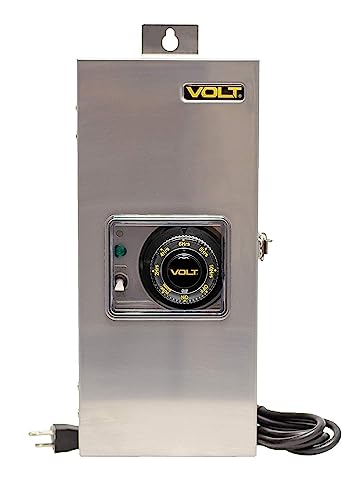
A slim, stainless-steel transformer backed by a lifetime warranty — designed to outlast any other pick here.
If you want a transformer that might outlast your house, the VOLT is it. The 3.7″D x 5.5″W x 15.33″H unit weighs 13 lbs and uses a toroidal core that runs quieter and cooler than standard laminated transformers. It gives you only two voltage taps (12V and 15V) — the maker deliberately skipped extra taps to keep the profile slim and installation simple. The clamp-type terminal blocks (wire connectors you squeeze shut by hand) are a standout convenience: you just insert the stripped wire and close the clamp, skipping the frustration of tiny screws. It accepts up to 10-gauge wire (thicker than most competitors). The modular timer includes a built-in photocell and is visible through the housing window. Set it for dusk-to-dawn or dusk-to-timed-off.
A professional electrician with 15 years of experience called this the best transformer he had ever used. Reviewers praise the stainless steel case that reflects its surroundings and stands up to weather. The biggest differentiator is the lifetime warranty covering the core, enclosure, and all electrical components — the SURAIELEC above offers a 1-year warranty by comparison. The trade-off is the price — you pay a premium, and the transformer only has two taps (no 13V or 14V option for fine-tuning drop like the Lightkiwi multi-tap provides).
Built to Last
- Lifetime warranty on every component — class-leading coverage
- Clamp-type terminals make wire connection fast and simple — no tiny screws
- Stainless steel case resists rust and weather
The Trade-Off
- Only two voltage taps (12V and 15V), missing finer gradations for tricky long runs
- Premium price that reflects the warranty and materials
Reach for this if you want one transformer forever: The lifetime warranty and stainless build are class-leading in this list.
Consider the Lightkiwi if you need exact voltage correction: The multi-tap gives you more voltage options for tricky wire layouts.
5. WILAWELS 300W Low Voltage Landscape Transformer
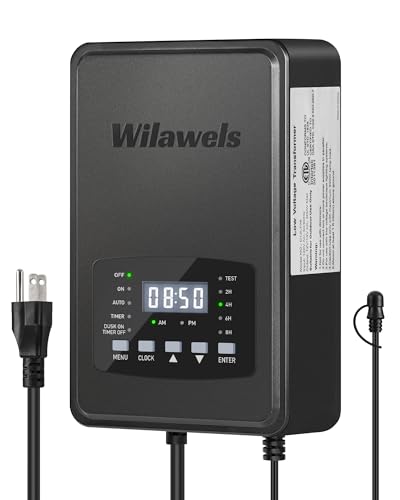
A heavy, ETL-certified (safety-tested) workhorse with six timer modes packed into a compact enclosure.
This 300W unit from WILAWELS (the 300W WILAWELS, not to be confused with the DEWENWILS) safely converts 120V AC to 12V or 14V AC and supports both LED and halogen lights. It measures 3.2″D x 5.7″W x 8.9″H — compared to the SUNVIE 3.94-inch cube — making it easier to mount in tight spaces. The detachable photocell sensor has a 6-foot cord and triggers auto-on at dusk and off at dawn. But the real draw is the six setting modes: manual on/off, auto dusk-to-dawn, countdown from 2 to 8 hours, programmable timer, a combined dusk-on timer-off mode, and a test mode. That range covers every schedule you could want, from all-night security to a few hours of evening ambiance — and it does this without a smartphone.
The internal circuit breaker disconnects the power if a short or overload occurs; you reset it manually after fixing the issue. The memory function keeps your last settings even through a power outage. One buyer reports this transformer handled a load much larger than it recommends, calling it “simple and effective.” The 5.1 kg weight feels sturdy, and the built-in corrosion and heat resistance mean it holds up in rain, snow, and dust. Compared to the 60W SUNVIE, this gives you 300W vs 60W with a slightly larger footprint.
Why It Works
- Six distinct modes cover every lighting schedule — no smart hub needed
- Memory function retains settings after a power outage
- Detachable photocell sensor with 6-foot cord
A Minor Annoyance
- Only outdoor installation allowed — the sensor cord is not designed for indoor mounting
Best for buyers who want every timer option: Six modes give you total control without needing a smartphone or smart hub.
Not ideal if you need multi-zone control: Unlike the DEWENWILS, this is a single-zone unit with no separate outputs.
6. GOODSMANN Low Voltage Transformer 120W
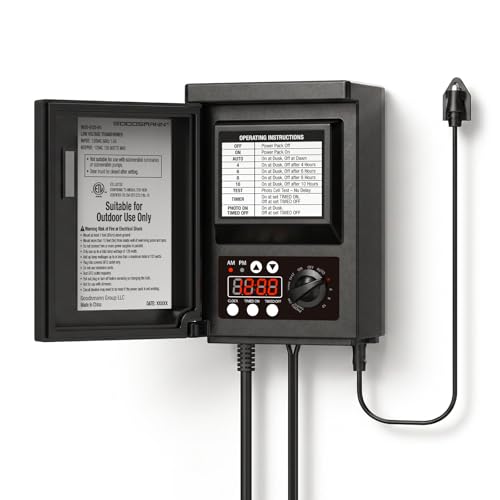
A 120W mid-range unit with a replaceable photo sensor and flexible timer modes for moderate yards.
If your lighting setup is moderate — maybe a dozen path lights or a small deck — this GOODSMANN transformer gives you 120W, which converts 120V AC household voltage to safe 12V AC. It offers three timer modes: a built-in clock for custom on/off times, a dusk-to-scheduled-off mode, and a dusk-to-dawn automatic mode. The photocell sensor is replaceable, which is a nice touch since sensors are often the first component to fail. The unit has overheating and overload protection, plus a front door that shields the control panel from sun, rain, and dust.
Reviewers point out that 110W LED lights work perfectly with it, and some run it at 10% over wattage with no blinking or issues. One owner installed it indoors for longevity and poked the sensor through the wall. It is UL-, CSA-, and ANSI-certified (third-party safety tested). The magnetic door stays shut securely, and the terminals have room for two heavy-gauge wires per connection. The trade-off is wattage: at 120W, it cannot handle a large yard like the 300W units from DEWENWILS, SURAIELEC, or WILAWELS. Plan your total light wattage carefully before picking this one.
What Makes It Practical
- Replaceable photo sensor extends the unit’s lifespan
- Three flexible timer modes, including clock-based scheduling
- Overheating and overload protection built in
The Limitation
- 120W capacity limits you to smaller lighting setups — you will hit the cap fast
Solid choice for a small-to-medium landscape: The replaceable sensor and flexible timers make it a reliable mid-range pick.
Look at a 300W unit if you plan to expand: You will outgrow 120W quickly if you add more lights later.
7. SUNVIE 60W Low Voltage Landscape Transformer

A tiny, budget-friendly 60W transformer ideal for a few path lights — just make sure your lights are LED.
If you only have a handful of low-voltage LED lights — say, five or six small path fixtures — this SUNVIE is the most affordable way to get them powered. It converts 120V AC to 12V DC (direct current, not AC, so it only works with LED lights and is not compatible with halogen bulbs). The 3.94-inch cube shape is compact enough to tuck into a corner of the garage. The external photocell sensor mounts separately with a 6.8-foot cord so you can install the transformer indoors and only run the sensor outside, protecting the electronics from weather corrosion.
The controls are simple: press a button to cycle through auto mode (dusk-to-dawn), or select a 2/4/6/8/10-hour countdown. The built-in circuit breaker cuts power on a short or overload, and the memory function keeps your last setting after a power outage. Shoppers say it is easy to install and has performed perfectly over the last three months, and one reviewer calls it the easiest transformer/timer to set up. The limitation is just 60W — the maker says not to exceed 80% (48W). If you ever plan to add more lights, a 120W GOODSMANN or a 300W WILAWELS gives you room to grow.
What It Gets Right
- Compact cube shape fits tight spaces
- External photocell sensor with 6.8-foot cord
- Simple one-button mode cycling
The Hard Cap
- 60W (48W usable at 80% rule) limits you to a very small lighting setup — you will outgrow it fast
- Not compatible with halogen lights — DC output only works with LEDs
Perfect for a small LED-only yard: It gets a handful of path lights running reliably for very little money.
Outgrow it fast if you plan more lights: The 60W ceiling is the lowest here; pick the 120W GOODSMANN or a 300W model if you anticipate expansion.
Understanding the Specs
Wattage and the 80% Rule
The wattage rating on a transformer (60W, 120W, 300W) tells you the maximum total load it can handle. But most manufacturers, including SUNVIE and VOLT, explicitly say never exceed 80% of that rating. A 300W transformer should only power up to 240W of lights. Running it at 100% all night generates heat that shortens the transformer’s life, so you keep a 20% safety margin.
Photocell vs Timer
A photocell sensor (a light detector) detects ambient light and triggers the transformer to turn on at dusk and off at dawn automatically. A timer lets you set a specific duration (2, 4, 6, 8, or 10 hours) after dusk. Many transformers combine both: the photocell turns the lights on, then the timer turns them off after your chosen delay. The WILAWELS offers six modes, while the Lightkiwi leaves those decisions to a separate timer you supply.
AC vs DC Output
Most landscape transformers output 12V or 14V AC (alternating current, like a standard wall outlet), which is what traditional halogen and many LED landscape lights expect. The SUNVIE 60W is the exception here — it outputs 12V DC (direct current, like a battery), so it only works with DC-compatible LED lights. If you have older halogen fixtures, pick an AC-output unit like the GOODSMANN or the DEWENWILS.
Multi-Tap Voltage Output
Multi-tap transformers let you choose between several output voltages (12V, 13V, 14V, 15V). The higher taps compensate for voltage drop — electricity loss in the wire — on long runs. The Lightkiwi gives you four taps, the VOLT gives you two (12V and 15V), while standard models like the DEWENWILS offer just 12V and 14V. If your longest run exceeds 100 feet, a multi-tap model helps keep far lights as bright as near ones.
FAQ
Can I install a 12V landscape lighting transformer outdoors?
What happens if I exceed the transformer’s wattage rating?
Will a 12V DC transformer work with my existing halogen lights?
What is the difference between a photocell and a countdown timer?
How do I know what wattage transformer I need?
What wire gauge should I use with a low-voltage transformer?
Why are my lights at the end of the run dimmer than the first ones?
Do I need a smart transformer with Wi-Fi and Alexa?
What does the memory function do on a landscape transformer?
How long should a landscape lighting transformer last?
Final Thoughts: The Verdict
For the majority of shoppers, the 12v landscape lighting transformer winner is the DEWENWILS 300W because its three independent zones let you run different schedules for the front, back, and sides of the yard from one metal housing. If you want voice control and smart scheduling, grab the SURAIELEC 300W Wi-Fi. And for a premium build that will outlast everything else, the standout is the VOLT 300W Slim Line with its lifetime warranty and stainless steel case.
How We Picked
We do not accept paid placement. Every pick is matched to a real buyer and a real use-case; we do not hands-on test units.
Sources & Methodology
Specifications: manufacturer listings and product documentation. Review insights: verified customer reviews, as of July 2026. Pricing: not shown on this page (it changes often); check the current price via the retailer link.
As an Amazon Associate, Gadgets Feed earns from qualifying purchases. This does not affect which products we feature.
Related Guides
Product prices and availability are accurate as of the date/time indicated and are subject to change. Any price and availability information displayed on Amazon at the time of purchase will apply to the purchase of this product. As an Amazon Associate I earn from qualifying purchases.
CERTAIN CONTENT THAT APPEARS ON THIS SITE COMES FROM AMAZON. THIS CONTENT IS PROVIDED "AS IS" AND IS SUBJECT TO CHANGE OR REMOVAL AT ANY TIME.
Amazon and the Amazon logo are trademarks of Amazon.com, Inc. or its affiliates.